Tag: rakuten

  • Rakuten and Gmarket announce trading partnership

    Rakuten and Gmarket announce trading partnership

    When Japanese e-commerce platform Rakuten shut offices in Singapore, Malaysia and Indonesia two weeks ago, the company stressed a renewed corporate focus on cross-border trading in East Asia.

    In a concrete result of the mandate, Rakuten announced today a partnership with South Korea’s largest e-commerce shopping mall Gmarket to boost cross-border trading amongst merchants in both countries.

    “Rakuten is delighted to announce this collaboration between the leading internet shopping mall retailers of both Japan and Korea, as another step on the path toward more active and profitable cross-border trading for merchants, small and large, of both countries,” said Masato Takahashi, Managing Executive Officer at Rakuten.

    As part of the deal, Gmarket will launch mini-stores on Rakuten Ichiba (its Japanese platform) to offer Korean fashion and beauty products in the country. At initial launch, the deal will include 200 items of women’s fashion and 100 Korean SME beauty products.

    Henry Chun, Head of Gmarket, explained his perspective as to why the deal would be beneficial for his company.

    “The deal will pave the way for Korean small fashion and cosmetic brands who have been struggling to introduce their unique, high-quality products to consumers worldwide, to increase their exports to Japan,” he said.

    In Korea, Rakuten will launch a flagship e-commerce store on Gmarket and offer products on the Korean company’s curated commerce service G9.

    The next few months will be focussed on increasing the product line on both platforms.

    During its fiscal year 2015 review, Rakuten revealed its Vision 2020 plan. The strategy was an inwards move which resulted in the Southeast Asia shutdowns. The desire to promote cross-border agreements in East Asia was part of the Vision 2020 plan.

    This is not the first deal of this nature in recent months for Rakuten. In December, the Japanese company inked a similar deal with Chinese e-commerce giant JD.com. In that instance, Rakuten opened a store on the JD.com network.

    Gmarket is owned by eBay, the American online auction company bought it for a whopping US$1.2 billion in 2009.
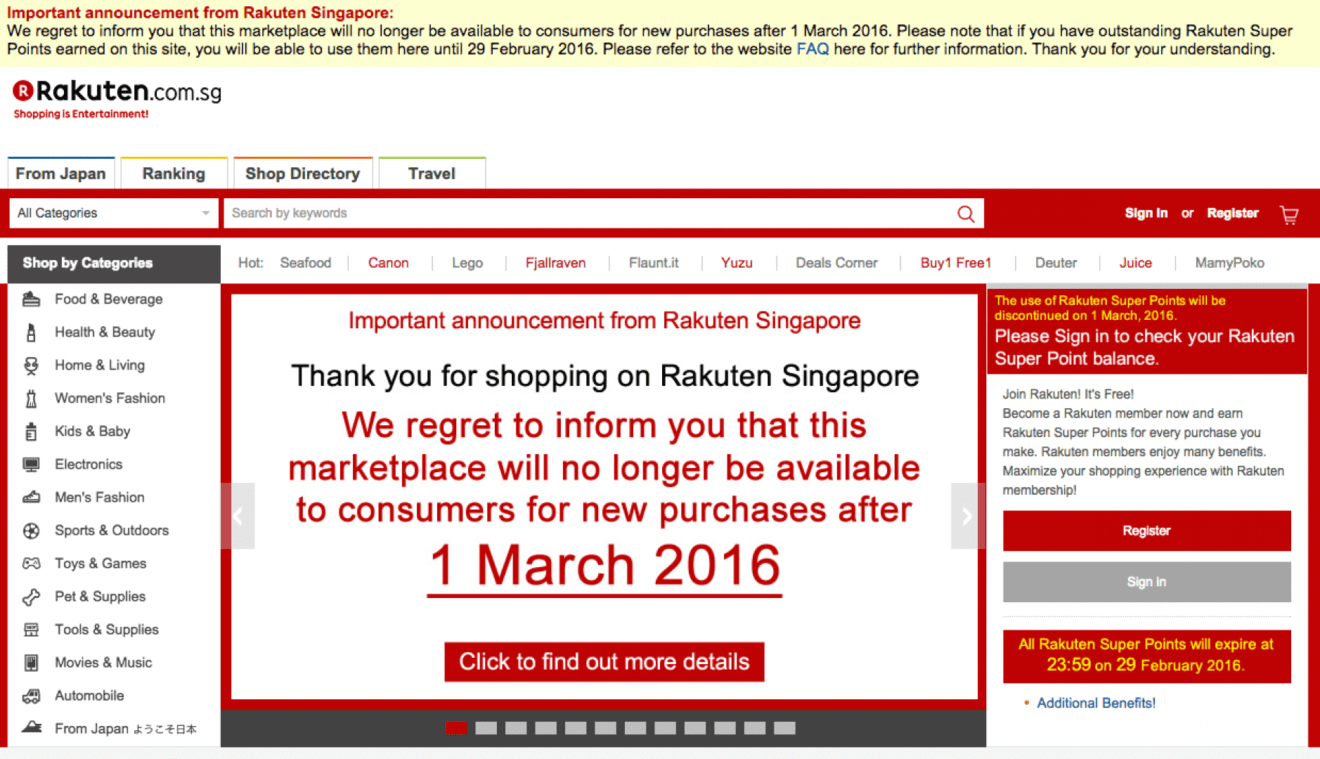

  • Rakuten Singapore axes eCommerce site

    Rakuten Singapore axes eCommerce site

    Japan’s online retailing giant Rakuten is to close its eCommerce websites in Singapore, Indonesia andMalaysia on March 1.

    And it is reportedly seeking a buyer for its Thailand business Tarad.com which it bought in 2010.

    The decisions follow a disappointing trading result which has prompted the business to refocus on its domestic operations and scale back unprofitable overseas activities. The company reported net profit for the year fell 38 per cent year-on-year to 44.3 billion JPY (US$393 million) on revenue of 714 billion JPY ($6.3 billion) – up 19 per cent, largely due to writedowns of its Kobo, Southeast Asian and other struggling divisions.

    Some 30 staff in Singapore had their employment terminated on Friday, just five days into the Lunar New Year. By the time the sites are wound down, about 150 staff will have been axed in the three markets, but the company will retain a regional headquarters in the city state.

    Rakuten’s apparently profitable Taiwan business will continue to operate.

    Tech website Techcrunch reported the three eCommerce sites to be shuttered will be replaced by a new product in Southeast Asia, “a consumer-to-consumer app called Rakuma” which, Rakuten said, has grown 20 per cent month-on-month in Japan.

    “That concept sounds a lot like (indeed, the same as) Carousell, the app that Rakuten Ventures is an investor in. Singapore-based Carousell is currently in three countries in Southeast Asia but, as we reported late last year, it is trying to raise a $50 million round to expand its service significantly across Asia.”

    No further details of the Rakuma concept, which is mobile-based, have been released, with the project still under development.

    In a statement to Reuters, Rakuten said the new concept was a consumer-to-consumer business model, rather than the aggregation-based business-to-business-to-consumer format of the closing Rakuten sites.

    “In Southeast Asia, as the market itself changes and adapts, we are looking toward C2C (customer to customer) and mobile business models for eCommerce and other businesses,” Rakuten said.

  • Rakuten Closes Marketplaces in South-East Asia

    Rakuten Closes Marketplaces in South-East Asia

    Japanese e-commerce platform Rakuten has announced plans to close a number of global operations as part of a new strategic focus.

    As of March 2016, the company will shutter its marketplaces in Singapore, Malaysia and Indonesia. It is also looking to sell off its Thailand-based platform Tarad.com, which it acquired in 2010.

    The closures will mean the loss of about 150 jobs, although the company said it will provide redundancy compensation above the legal requirements and will help to find new jobs for those affected.

    Rakuten’s regional Asian headquarters in Singapore will remain operational, as will its e-commerce business in Thailand, which is reportedly performing well.

    According to Rakuten’s Vision 2020 statement, the closures are part of a strategy that will see the company focusing more on its stronger markets in Japan and Taiwan.

    In place of the South-East Asia marketplaces, Rakuten is looking to focus on a consumer-to-consumer app called Rakuma — a marketplace app that enables transactions between individuals (similar to Carousell).

    Rakuten is also an investor in Singapore-based C2C marketplace Carousell. It’s unclear at this stage how the company will integrate the competing Rakuma into the region. Rakuten has not yet commented on this rollout.

    As part of its strategy realignment, Rakuten’s operations in Brazil will shift from a marketplace model to a SaaS model.

    Rakuten’s Vision 2020 is focused on three core principles: strong, smart and speed. The decision to refocus the company’s strategy in the emerging markets of Brazil and South-East Asia may represent the still-evolving nature of e-commerce in these markets. By focusing on mobile apps and SaaS in emerging markets, the company looks to be shoring up its future in these uncertain markets.

  • Rakuten to shut Singapore website, cuts 30 local staff

    Rakuten to shut Singapore website, cuts 30 local staff

    Japan’s largest online retailer Rakuten is closing its Singapore website after two years, and trimming its staff.

    On Friday, the fifth day of Chinese New Year, about 30 local employees were given the pink slip .

    While the company will continue to keep its regional HQ here, a notice on the website posted on Friday evening said no new purchases can be made from its online portal from next month.

    Earlier that afternoon, around 30 staff at its Market Street office at Raffles Place were told that they would be laid off. They included sales, marketing and customer service staff who were directly involved in running the website.

    They were among the 150 employees who were laid off in Singapore, Malaysia and Indonesia. The company is closing its websites in the other two countries as well.

    Most of the Singapore staff were told to immediately return their staff passes, and their e-mail accounts were deactivated on the spot. They were escorted out of the office and told that they did not need to turn up for work any more, said a source.

    “All were in shock,” the source said. “They were told that Friday was their last day (of work).”

    A handful can continue to work until the end of the month, when the website finally goes offline.

    The Sunday Times understands that the individual severance packages are tied to how long the staff have worked there. The company will make the payouts only next month.

    When contacted yesterday, a Rakuten spokesman in Japan declined to give details of the Singapore retrenchments, but he said that the firm will compensate workers “above and beyond legal requirements” and help them find jobs.

    Rakuten Group, which is listed on the Tokyo Stock Exchange, announced in Japan on Friday a five-year business plan that includes overhauling its business model in South-east Asia by closing down its online retail websites and starting a customer-to-customer trading application.

    Experts were surprised that the retrenchments were carried out over the Chinese New Year celebrations that span 15 days.

    “We usually tell unionised companies to avoid retrenchments during festive seasons. This is good industrial relations practice,” said labour MP Patrick Tay, who chairs the Government Parliamentary Committee for Manpower.

    The firm is not unionised but the affected professionals, managers and executives can turn to the National Trades Union Congress (NTUC) for job placement help, said Mr Tay, who is NTUC’s assistant secretary-general.

    “The timing is a little brutal,” said Singapore Human Resources Institute president Erman Tan, adding that the speed at which retrenched staff were shown the door within hours was “very fast”.

    “This reflects the culture of the e-commerce sector. Things move very fast online and perhaps retrenchments too,” said Mr Tan.

    Association of Small and Medium Enterprises president Kurt Wee said the retrenchments signal the start of a phase of consolidation by companies as they respond to the global slowdown and local economic conditions.

    “When companies consolidate, some staff retrenchments are inevitable,” said Mr Wee.

  • Rakuten to open on JD.com

    Rakuten to open on JD.com

    Rakuten, Japan’s largest eCommerce company, is to open an online flagship on Chinese cross-border eCommerce platform JD.com.

    The Japanese company says it aims to take “the best Japanese products to Chinese consumers”. It launched a beta version of the new marketplace on JD Worldwide earlier this month. Plans are under way to expand the merchandise range over coming months, with an initial focus on categories such as cosmetics, snacks and health food products.

    Masato Takahashi, managing executive officer of Rakuten, said the partnership between Rakuten and JD.com will promote cross-border trade by connecting Chinese consumers with authentic and popular Japanese products from a top selection of Rakuten’s merchants from around Japan, both small and large.

    “Rakuten will continue to work to expand our offering to Chinese consumers.”

    Haoyu Shen, CEO of JD Mall, said imported Japanese products have proven popular in China to date.

    “Our focus remains on partnering with the most trusted retailers in key overseas markets to meet the growing demand for premium imported products.”

    Expansion of the product line-up will continue over the coming months.

  • Japanese e-retail leader Rakuten doubles its online sales in China

    Japanese e-retail leader Rakuten doubles its online sales in China

    Rakuten’s Q3 growth from China jumps 101%. The Tokyo-based company plans to open a store soon on Chinese marketplace JD.com. The falling value of the Japanese yen and China’s relaxed cross-border e-commerce policies have helped Rakuten Inc., Japan’s dominant online marketplace operator, double its web sales in China in the third quarter.

    Founded in 2007, Rakuten says it now sells about 150 million products from over 41,000 merchants on its Japanese online marketplace, Rakuten.jp.

    Rakuten operates localized sites in 13 countries, including Japan, the United States, the United Kingdom, Spain, Brazil, Germany, France, Austria, Singapore, Thailand, Malaysia, Indonesia and Taiwan. CEO Hiroshi Mikitani has pursued a global strategy that has included several e-retail acquisitions, such as of Buy.com in the U.S. and PriceMinister in France.

    Rakuten also operates the Rakuten Global Market, an online marketplace offering 1.2 million Japanese products from 10,000 merchants to consumers outside of Japan. China represents the fastest-growing country in terms of purchases on the Rakuten Global Market, the Rakuten spokesman says. “Our Q3 total cross-border trading showed 50% growth year on year,” he says. “Our Q3 growth from China showed a significant increase of 101%.”

    Japanese products have become much cheaper to Chinese consumers as the Japanese yen has depreciate about 30% over the last few year.

    In addition, China has relaxed its policies on online imports, making it easier for Chinese consumers to buy from foreign e-commerce sites. For example, the duty charged on small online purchases from abroad is lower than the tax charged on domestic purchases in China, and China has created free-trade zones in nine cities where parcels from overseas move through customs faster than before.

    Rakuten says Chinese consumers are particularly interested in unique and high-quality Japanese-made goods. “We will also continue to explore new avenues to empower Rakuten merchants in expanding their businesses in China.” the spokesman says.

    This week, Rakuten announced it will open an online store to sell Japanese products on the e-commerce site of Chinese e-retailer and marketplace operator JD.com, No. 1 in the Internet Retailer 2015 China 500.

    This is not the first time Rakuten has entered China. In 2010, Rakuten and Chinese search engine company Baidu created a joint venture to operate Rakuten.cn, aiming to sell products in China to Chinese consumers. After only 18 months, the site was closed by Rakuten in 2012, reflecting the fierce e-commerce competition in China.

    In April 2015, Rakuten also announced it had invested in a Chinese cash-back shopping site, Fanli.com, but did not disclose the investment amount.

    Rakuten is No. 20 in the Internet Retailer Asia 500. JD.com is No.1 in the Internet Retailer 2015 China 500. Rakuten is the leading online retail site in Japan, accounting for about 20% of web sales in 2014, according to Euromonitor International.

  • 7-Eleven Taiwan in MyDay eCommerce partnership

    7-Eleven Taiwan in MyDay eCommerce partnership

    Taiwan’s largest convenience store chain, 7-Eleven, says it will work with local shopping website MyDay to have online purchases from overseas delivered to its 5000-plus stores around Taiwan.

    The convenience store introduced the delivery service on Wednesday (November 25), allowing shoppers on the MyDay website to have their purchases delivered from Japan, the US and South Korea in as little as five days.

    Myday has over 10 years’ experience in cross-border eCommerce services and also partners with other sites such as Amazon in the US, Rakuten in Japan, and Gmarket in South Korea, said 7-Eleven.

    7-Eleven is the second convenience store chain in Taiwan to offer such a service, following FamilyMart, which established a similar partnership with the Japanese shopping site Tenso in September.

    Registered members of Tenso can have their purchases delivered to FamilyMart stores in Taiwan in about six days.

    Over 43 per cent of online shoppers in Taiwan buy products on overseas sites six times per year on average, according to a 2013 survey by the Market Intelligence & Consulting Institute under the Institute for Information Industry.

  • Poll finds Asian prefer Christmas shopping online

    Poll finds Asian prefer Christmas shopping online

    Nearly half of Asia’s shoppers said they prefer to do their Christmas shopping online this year, according to a new survey conducted by internet services company Rakuten.

    Of 2500 shoppers polled in Singapore, Malaysia, Indonesia, Thailand and Taiwan, 47 per cent said they preferred to complete their Christmas shopping online – due to convenience (83 per cent), the ease of browsing and comparing of products (55 per cent) and cost effectiveness from attractive rebates and loyalty programs (41 per cent).

    The same shoppers reported an average increase of 20 per cent, in terms of the amount spent online on Christmas shopping in 2014, versus the year before.

    The Rakuten Shopping Secrets Survey 2015 found that 75 per cent of shoppers expect to buy more, or at least, the same number of Christmas gifts online this year compared to the previous year.

    “Our survey found that in general, when shopping for a gift, shoppers look at price (33 per cent) as the single biggest factor influencing their decision of what to buy, followed by the likeability of a gift by the recipient (26 per cent) and practicality of the gift (25 per cent),” said Masaya Ueno, director of Rakuten Asia

    Rakuten has launched a five per cent rebate on everything listed on its shopping sites, every day, with no limit on the amount of rebates, through the Rakuten Super Point program, across all its online shopping sites in Asia.

    This means that if shoppers buy anything on Rakuten sites in Singapore, Malaysia, Indonesia, Thailandor Taiwan, they are given Rakuten Super Points that are the equivalent of five per cent of their purchase value. These points can be used like cash, to offset their next purchase.

    Asians spend on average US$30 on a Christmas gift, and Rakuten says its new cashback scheme would reward shoppers with a $15 voucher if they bought gifts for 10 people.

    Meanwhile, the survey found that while three in five people remembered what they received for Christmas last year, a quarter of them received gifts they disliked. Those gifts ended up being re-gifted (38 per cent), kept somewhere and forgotten about (33 per cent), donated to charity (24 per cent), or being sold off (13 per cent).

    That could be one reason why 27 per cent of Asians find Christmas a stressful occasion, with Singapore shoppers the most stressed (40 per cent), well ahead of shoppers from Taiwan (32 per cent), Malaysia (30 per cent), Indonesia (18 per cent) and Thailand (17 per cent).

    “The year-end season is usually the busiest time of the year for online retailers like us, with shoppers wanting to splurge due to great discounts (62 per cent), liking to start a new year with new things (40 per cent), or rewarding themselves after a year of hard work (33 per cent),” said Ueno.

  • Korea more active than Japan in Southeast Asian tech

    Korea more active than Japan in Southeast Asian tech

    In a region where masses of users are newly armed with smartphones and more spending power, Southeast Asia is a new gold mine for tech enterprises.

    China’s quickly saturating market for all things tech has pushed Asia-bound start-ups to seek new territory, and global companies like Rakuten, eBay and Rocket Internet are vying over Southeast Asia with no clear winner ― meaning plenty of opportunities still abound for new players.

    Those conditions drew Korean-Japanese entrepreneur Tesong Kim, who led e-commerce at Japanese investor Rakuten’s offices in Tokyo and Jakarta, to launch his own discount retail start-up VIP Plaza for fashion goods in Indonesia, Southeast Asia’s biggest market, in 2014, and recently expand to Malaysia.

    And Korea’s start-ups are joining the rush, he says.

    They seem to be making bigger waves there than in Japan. He cannot list any Korean start-ups with a big presence in the country, a closed, conservative market that is a nut nearly impossible for foreign companies to crack. But in expanding to Southeast Asian markets like Singapore, Indonesia and Malaysia, he says they are far more active than their Japanese rivals.

    “Korea is quite aggressive in Southeast Asia, I think more aggressive than Japan in terms of e-commerce start-ups,” he told The Korea Herald in an interview on the sidelines of tech start-up conference Tech in Asia Tokyo 2015 last week.

    “Korea is very crowded. The population is very small, geographically the landscape is very small, and there’s a lot of start-ups. So it’s quite packed, but I think Japanese investors think Korean start-ups can go global more than Japanese start-ups.”

    Indeed, SK Planet’s e-commerce retailer 11st is seen harnessing the region’s demand for Korean fashion and beauty products, while couples messenger Between and crowdsourcing translation app Flitto are also gaining traction in markets like Indonesia, Taiwan and Thailand.

    Meanwhile, Kim says Japanese start-ups are trapped at home, falling hard when they try to copy and paste their successful domestic strategies into new markets.

    But competition in Southeast Asia is heating up fast. Kim believes Korea’s KakaoTalk lost the messenger app war in the region to rivals like BlackBerry, WhatsApp, LINE ― one successful Japanese exception in the region ― and WeChat because it entered too late.

    That’s why it has pivoted to commercial services such as e-commerce when targeting markets like Indonesia, he said.

    Not that e-commerce is any easier, as Kim knows from his experience with Rakuten’s Indonesian e-commerce venture and starting his own online discount retailer. Handling logistics, acquiring products and dealing with fragmented, cash-based payment systems takes immense effort.

    But due to the region’s overall cheaper costs, he believes Korean and Japanese start-ups underestimate the investments they need to gain ground ― a mistake that will get them steamrolled in the market. “They think that with $1 million-$2 million, they can go to Indonesia, try to develop ― with that kind of mindset, they will never succeed,” he says. “All the very aggressive companies are investing into Southeast Asia with a very big amount of money.”

    Even for Korea’s prized e-retailer Coupang, which received a $1 billion boost from Japan’s SoftBank Ventures this year, it might already be too late to test the region’s waters, he said.

    “What they have is a know-how of how to sell things, of impulse buying. They have a system and good talents, but they are not localizing the region,” he said. “If they tackle some new country now, they need to invest in everything ― the products, warehouse, marketing and user acquisition.”

    But the market is already crowded by Lazada, Elivenia and Rakuten, not to mention 11st and Kim’s own start-up VIP Plaza. “I think it’s already too late in terms of social commerce,” he said. “The better strategy is buying out some local players. It’s not only easier, but much cheaper.”

    Still, Japan’s massive opportunities can’t be ignored, he says. Its app market is the biggest in the world, and gaming companies are seizing opportunities. “So in that sense, I think the market is still very big.”


  • Rakuten launches express delivery

    Rakuten launches express delivery

    Japan’s leading eCommerce portal Rakuten has launched Rakubin – a new rapid delivery service which promises goods in as little as 20 minutes – 2 hours a day.

    The new service has made its debut in the Tokyo suburbs of Shibuya, Setagaya, Minato and Meguro. It applies to a limited range of 450 items – largely convenience or drug-store core lines, such as noodles, cafe products, confectionery and coffee; detergent, toilet paper and diapers.

    In the Rakubin app, users can check the estimated time of delivery before placing their order.

    After the order has been completed, a delivery interval of 15 minutes will be displayed, allowing users to effectively make use of the time before the arrival of the order. The delivery cost for one order is 390 yen (including tax) when users receive the goods beside the delivery vehicle at the specified location, and 770 yen (including tax) when the goods are delivered directly to users by a member of the delivery staff.

    Fulfilment is undertaken by a fleet of delivery vans which carry stock of the items and circle the areas, awaiting despatch to delivery addresses.

    Rakuten says it will expand the service to include a longer list of products, and a broader geographical area once the concept is bedded down and refined.

  • Rakuten, Gentosha launch online magazine linked to e-commerce

    Rakuten, Gentosha launch online magazine linked to e-commerce

    apan’s Rakuten and Gentosha Inc. recently launched GINGER mirror, a free online fashion magazine for women linked with e-commerce.

    GINGER mirror is a free online fashion magazine optimized for smartphones aimed at busy women in their late 20s and 30s who wish to enjoy the latest fashions despite having limited time and budget. The magazine showcases reasonably priced fashion items that can be bought on Rakuten Ichiba.

    Rakuten said the ratio of purchases made on mobile devices on Rakuten Ichiba has been increasing in recent years, especially in the fashion genre. By presenting Rakuten Ichiba fashion items to readers through a smartphone-optimized online magazine and providing a simple system for users to purchase the featured items, the number of purchases of fashion products made through mobile devices is expected to increase.

    The first edition of GINGER mirror, released on April 15, features model and actress Nanao on the cover and introduces around 400 hot fashion items and accessories across 100 pages under the theme “Spring Fashion Cost Performance Buying Guide.”

    Rakuten will continue to strive to create new added value for the wide array of reasonably-priced products offered on Rakuten Ichiba, harnessing the know-how of Gentosha in producing women’s magazines to bring even more gloss and appeal to its products.

  • Rakuten invests in China online discounter

    Rakuten invests in China online discounter

    Japanese eCommerce titan Rakuten has taken a stake in Chinese online shopping discounts site Fanli.

    The stake, less than 10 per cent, comes in the form of an undisclosed amount of series C funding into the start-up. The announcement states that Fanli is now valued at approximately US$1 billion, making it China’s newest start-up unicorn.

    Fanli is a very minor player among the dozens of well-established eCommerce stores in China, but it claims to be the largest that focuses on rebate-based loyalty shopping. It connects shoppers with discounts on an array of third-party stores, such as Alibaba’s Taobao, JD.com, Ctrip, and the Apple online store.

    Rakuten said in a press release that the stake in Fanli is essentially a strategic way to tie the Chinese start-up to Rakuten’s duo of US-based discount stores, Ebates.cn and Extrabux. Rakuten acquired Ebates – which allows Chinese shoppers to buy things from US ecommerce sites with discounts – last September for US$1 billion.

    Kevin Johnson, CEO of Ebates, will join Fanli’s board of directors.

    “This investment in Fanli reflects Rakuten and Ebates’ ongoing interest in the rapidly evolving Chinese market,” said Johnson.

    “As the market continues to mature we believe consumers will demand world-class shopping experiences. Rakuten and Ebates hope to support Fanli’s vision of fulfilling this role and exploring potential collaborations in China and abroad.”

    Rakuten has long struggled to find a foothold in China up against homegrown rivals like Alibaba and JD. Rakuten’s own China joint-venture store with Baidu was shuttered in 2012.


  • Bitcoin breakthrough

    Bitcoin breakthrough

    Japanese eCommerce giant Rakuten will start to accept bitcoin, the ‘cryptocurrency’ on its global marketplaces.

    TechinAsia.com reports the payment format will begin its roll out in America and then spread to Rakuten Germany and Rakuten Austria.

    Bitnet, an enterprise-focused developer that creates bitcoin platforms, is Rakuten’s partner in the rollout. Bitnet is a young company, founded in January 2014, but it is not your average startup. The team behind the firm also created CyberSource, a payment gateway sold to Visa for US$2 billion.

    “Rakuten’s mission is to empower the world through the Internet,” commented Yaz Iida, president of Rakuten US in a statement. “Not only can Bitcoin support this vision by helping our merchants better compete globally, but it also has the potential to benefit society by enhancing the security, privacy, and convenience of financial transactions. This is one of the reasons why we invested in Bitnet last year and we look forward to working with them on our US marketplace.”

    Rakuten’s move indicates that it is moving closer and closer to accepting Bitcoin. Already, its American logistics subsidiary accepts the currency. With its core ecommerce operations now getting integrated, it could just be a matter of time before the Japan office follows suit, writes David Corbin of TechinAsia.com

    It would not be the first Japanese tech titan to accept Bitcoin. GMO Internet set that precedent last September. However, Rakuten’s integration of bitcoin domestically could be the sort of move that pushes the currency into the mainstream. Rakuten is used by almost every adult in Japan. It has over 97 million registered users while Japan itself has a population of 127 million. Those users drove US$16.5 billion worth of sales last year.

    For Japanese bitcoin enthusiasts, the march towards widespread acceptance in their country is a long slog. With Rakuten’s latest signal of support, the goal becomes less of a mirage and more of an steadily approaching reality.

  • Rakuten buys eBook business

    Rakuten buys eBook business

    Japanese eCommerce giant Rakuten is to pay US$410 million in cash to buy OverDrive, a leading eBook and audiobook content marketplace and sharing economy pioneer.

    Cleveland, US-based OverDrive was founded in 1986 and supplies the world’s largest catalog of eBooks, audiobooks, music and streaming video to 30,000 libraries, schools and retailers around the globe.

    “OverDrive’s deep content library and relationships with publishers, libraries, schools, and retailers will allow Rakuten to extend our mission of empowerment to new market segments and accelerate the growth of our digital contents businesses,” said Takahito Aiki, head of Rakuten’s global eBook business.

    “OverDrive is a widely-respected pioneer in digital content and the sharing economy. Long before even Kobo emerged onto the global stage, OverDrive had already seen the future and was working with publishers to digitise their content to share with the world, building one of the most comprehensive online digital marketplaces in the process,” he said.

    “OverDrive’s deep content library and relationships with publishers, libraries, schools, and retailers will allow Rakuten to extend our mission of empowerment to new market segments and accelerate the growth of our digital contents businesses.”

    With the top rated eBook & audiobook app for libraries and schools and OverDrive Read, the ePub and HTML5 browser-based reading experience, OverDrive supports all major computers and devices, including iOS, Android and Kindle (in the US only). OverDrive delivers all digital media on a single platform, and offers APIs to streamline a seamless user experience. Recent innovations include in-library touchscreen stations for browsing and instant sampling, multi-lingual user interface, and eReading Rooms for kids and teens..

    OverDrive Founder and CEO, Steve Potash, said Rakuten’s vision of empowerment is perfectly aligned with OverDrive.

    “Since 1986, our vision has been to advance digital publishing and content to connect readers with books and information. We’re passionate about working with publishers, libraries, schools and retailers… and we are very excited to join an innovative company that shares and supports our vision.”

    As Rakuten expands its global Internet services ecosystem, digital content represents one of Rakuten’s three key strategic pillars, alongside eCommerce and finance. Since first acquiring eReading company Kobo in 2012, Rakuten has continued to grow its digital contents businesses, adding video streaming service Wuaki.tv in 2012 and global TV and video site Viki in 2013. The acquisition of OverDrive adds a digital distribution platform, more than 2.5 million titles, and relationships with 5000 publishers and 30,000 libraries that will strengthen Rakuten’s eBook and digital contents businesses globally.

    OverDrive returned a pre-tax profit of US$25 million in 2014. With the addition of OverDrive, Rakuten expects its global eBook business will come close to breaking even in 2015.

    The deal will close in April.

  • E-Commerce giant Rakuten trains SMEs in Indonesia

    E-Commerce giant Rakuten trains SMEs in Indonesia

    Rakuten Belanja Online, the local affiliate of Japanese e-commerce giant Rakuten, seeks to woo Indonesia’s small- and medium-sized enterprises by providing e-commerce courses as part of its growth strategy in Southeast Asia’s largest economy.

    Global e-commerce players such as Rakuten are eying Indonesia as a potential market, largely due to the rapid growth the country’s young and affluent middle class.

    The online shopping platform earlier this week officiated Southeast Asia’s first Rakuten University program, consisting of a series of courses the company offers to its merchants.