Tag: report

  • F J Benjamin narrows FY15 loss

    F J Benjamin narrows FY15 loss

    Retail group F J Benjamin’s net loss for the financial year ended 30 June narrowed from S$22.1 million to S$16.99 million.

    Revenue slid 20 per cent year on year to S$293.41 million amid a challenging year on the back of reduced business in North Asia, currency volatility as well as lower tourist arrivals. The group rationalised its store portfolio, which caused it to incur impairment charges for store closures, early termination of leases, stock provisions and redundancies.

    “While this has impacted turnover, it has yielded significant improvements in the productivity of its stores across the region,” the group said.

    Loss per share came to 2.99 Singapore cents, versus a loss per share of 3.89 cents a year ago.

     No dividend was declared for the current year. In the corresponding period a year ago, a first and final dividend of 0.25 cents per share was announced.

    It said: “The group will complete its rationalisation and planned closure of two remaining stores by end December 2015. To address the shift in consumer trend and structural change in retail environment, it has also undertaken a restructuring of its in-house brand, Raoul, to improve performance on a reduced cost base.”

    It expects consumer sentiment to remain muted given global economic and political uncertainty. Meanwhile, it is striving to further improve inventory management and cost efficiencies.

  • Singapore economy grows by 1.8% in Q2

    Singapore economy grows by 1.8% in Q2

    Singapore’s Ministry of Trade and Industry (MTI) announced on Tuesday that the Singapore economy grew by 1.8 per cent on a year-on-year basis in the second quarter, slower than the 2.8 per cent growth in the previous quarter.

    On a quarter-on-quarter seasonally-adjusted annualised basis, the economy contracted by 4.0 per cent, a reversal from the 4.1 per cent growth in the preceding quarter.

    The manufacturing sector contracted by 4.9 per cent year-on-year, extending the 2.4 per cent decline in the previous quarter. The sector was primarily weighed down by declines in the output of the biomedical manufacturing and transport engineering clusters.

    The construction sector expanded at a faster pace of 2.5 per cent year-on-year, supported by a pick-up in public sector construction works, compared to the 1.1 per cent in the previous quarter.

    The wholesale & retail trade sector grew by 5.0 per cent year-on-year, slightly slower than the 5.3 per cent expansion in the previous quarter. Growth was driven by both the wholesale trade and retail trade segments, with the latter being supported in turn by robust motor vehicle sales.

    The accommodation & food services sector contracted at a faster pace of 0.6 per cent year-on-year compared to the 0.1 per cent decline in the previous quarter. The slowdown in the sector was largely due to sluggish performance in the food & beverage segment.

    The finance & insurance sector posted growth of 7.1 per cent year-on-year, extending the 7.8 per cent growth in the previous quarter. Growth was largely underpinned by the fund management segment.

    The information & communications sector grew by 4.5 per cent year-on-year, moderating from the 4.9 per cent growth in the previous quarter. Growth was mainly driven by the IT & information services segment.

  • Indonesia retail sales surge in June

    Indonesia retail sales surge in June

    Indonesia’s retailers appear to be among Asia’s most pessimistic.

    One month ago after government data showed a 19.8 per cent rise in May retail sales, the 700 retailers polled to create the index said they expected sales growth would slow in June.

    This week, the government has released revised figures showing a 20.6 per cent increase in May – and a massive 22.9 per cent rise in June, only just behind April’s 23.1 per cent.

    In this month’s poll, they said they expected sales growth to slow in September as demand returned to normal after the Ramadan festivities.

    The Bank of Indonesia said June’s Indonesia retail sales  increase was largely attributable to greater demand for food, beverages and tobacco, in line with increased consumption during the Muslim fasting month of Ramadan.

  • Hong Kong retail sales stable

    Hong Kong retail sales stable

    Hong Kong retail sales are not as depressing as many luxury retailers would have us believe.

    Figures for June released unusually late in the day on Friday show a year on year decrease of just 0.4 per cent, a figure low enough to adjust the first half year’s sales slippage to just 1.6 per cent – from the 2.3 per cent for the first four months.

    But take the effect of inflation out of the equation, and the territory’s retail sales increased by 4.4 per cent in June 2015. In volume terms, sales rose 4.7 per cent in the month, and for the first half of the calendar year are up by 4.7 per cent.

    Basically, it is the luxury sector – high end fashion, watches and jewellery – which is suffering the most. For most other retailers, there’s nowhere near the same level of decline.

    A Census and Statistics Department (C&SD) spokesman indicated that retail sales volume grew moderately further in June over a year earlier.

    “The fall in the sales of jewellery, watches and clocks, and valuable gifts narrowed, while retail outlets selling certain consumer durable goods registered visible growth in sales.”

    But the C&SD spokesman maintained a conservative outlook for the remainder of the year.

    “Looking ahead, the near-term performance of retail sales is still subject to uncertainties, depending on inbound tourism growth and any spillover to consumption sentiment from the recent stock market volatility.

    “Nevertheless, the stable job and income conditions should provide some support. The Government will monitor closely how these factors, as well as the various uncertainties in the external environment, would affect the retail business going forward,” he said.

    By broad retail category, and in descending order of value of sales, the value of sales of jewellery, watches and clocks, and valuable gifts decreased by 10.4 per cent in June 2015 compared with a year earlier.

    This was followed by sales of commodities in supermarkets (down 0.5 per cent), wearing apparel (down 3.8 per cent), commodities in department stores (down 3.3 per cent), medicines and cosmetics (down 4.2 per cent), footwear, allied products and other clothing accessories (down 8.4 per cent), furniture and fixtures (down 3.7 per cent), books, newspapers, stationery and gifts (down 9.5 per cent) and Chinese drugs and herbs (down 4.2 per cent).

    On the other hand, the value of sales of electrical goods and photographic equipment increased by 21.4 per cent in June 2015 compared with a year earlier. This was followed by sales of food, alcoholic drinks and tobacco (up 3.6 per cent) and optical shops (up 0.4 per cent).

    Based on the seasonally adjusted series, the value of total retail sales decreased by 4.4 per cent in the second quarter of 2015 compared with the preceding quarter, while the volume of total retail sales decreased by three per cent.

  • Strong Vietnam retail sales growth

    Strong Vietnam retail sales growth

    Vietnam retail sales growth reach 8.3 per cent in the first half of this year, according to government data.

    In the first seven months of this year, the private sector accounted for 85.6 per cent of total retail sales, earning $73.4 billion or a year-on-year increase of 9.5 per cent, according to the Vietnam News Service..

    Vu Manh Ha of the General Statistics Office, says the nation’s retail sales stabilised during the first quarter. Sales rose eight per cent in the first four months, 8.2 per cent in the first five months and 8.3 in the first six.

    He attributed the stabilisation in the growth rate to a low increase in the Consumer Price Index.

    Total retail sales reached US$85.8 billion.

  • Japan retail sales growth slows

    Japan retail sales growth slows

    Japan retail sales grew 0.9 per cent in June – ahead of expectations but much slower than May’s three per cent.

    Analysts had been tipping a rise of just 0.5 per cent after the relatively strong May growth.

    Government data showed rising fuel prices could have unduly affected the figures in the first half of the year – fuel accounts for about eight per cent of total retail sales, and fuel prices have risen by about six per cent since January.

    Capital Economics, in a research note, warned not to pay too much attention to retail sales data as a measure of consumer sentiment.

    “We would instead pay more attention to core household spending, due on Friday. This measure of consumer expenditure has done a good job lately in explaining moves in the Cabinet Office’s synthetic consumption expenditure, the monthly equivalent of private consumption as measured in the national accounts.”

    A Reuters survey of economists projects a 1.7 per cent growth in household spending year on year in June – far lower than the 4.8 per cent of May.

    Nevertheless, May’s retail spending increase marks the third month in a row of growth after mixed results for a year.

    In March, retail sales fell nine per cent, although that was largely due to an irregular March 2014 when consumers brought forward spending prior to a sales tax increase on April 1.

  • Rents down, vacancy rate up for retail space in Q2

    Rents down, vacancy rate up for retail space in Q2

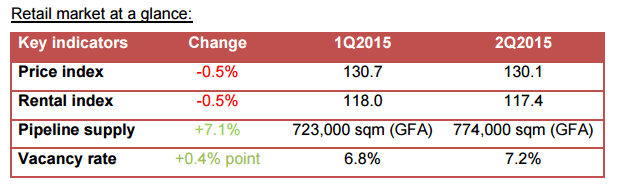
    Prices and rentals of retail space both dipped by 0.5 per cent in the second quarter of this year, according to data from the Urban Redevelopment Authority on Friday.

    It was the second straight quarter of rental decline and comparable to the level seen early last year. Prices had stayed stable in the first quarter.

    Vacancy rate of retail space rose 0.4 percentage points to 7.2 per cent for the second quarter, the highest in over four years.


    SOURCE: URA

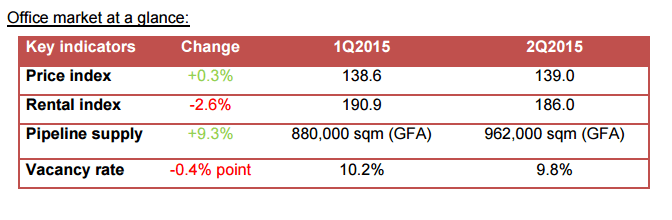
    Office rents also weakened by 2.6 per cent in the second quarter, after rising 0.6 per cent in the first quarter.


    SOURCE: URA

    Office prices rose 0.3 per cent in the quarter, after falling 0.1 per cent in the first quarter.

    Vacancy rate of office space dipped by 0.4 percentage points to 9.8 per cent for the second quarter.

  • China retail sales stabilise

    China retail sales stabilise

    China retail sales growth is stabilising.

    Figures from the National Bureau of Statistics show a 10.4 per cent year on year growth rate in the first half of 2015, to US$2.32 trillion.

    That rate is a negligible 0.2 percentage points lower than the rate seen in the first quarter.

    In the latest month, June, retail sales rose by 10.6 per cent, half a percentage point ahead of May.

    The biggest mover was the catering sector, which recorded an 11.5 per cent year on year rise in the first six months of 2015. ‘Other consumer products’ was the next best performing category with growth of 10.3 per cent.

    Online retail sales soared 39.1 per cent.

  • HKIA retail growth halves to 10.8% but still flies high

    HKIA retail growth halves to 10.8% but still flies high

    The retail licences and advertising revenue segment at Hong Kong International Airport (HKIA) rose by a respectable +10.8% to HK$6,820m/$880m in 2014/15, with an upswing that was lower than the year before when it shot up by +23%, largely reflecting a full year of contributions from DFS Group as its anchor tenant.

    The segment now represents 41.7% of turnover – a marginal share increase on the previous year. Retail was a key component that allowed operator Airport Authority Hong Kong (AAHK) to generate record revenue of HK$16,367m/$2,111m (+10.5%) and rocketing profit of HK$7,254/$936m – a rise of +12.4% (see chart below and click to enlarge).

    Retail licences and advertising contributed nearly half of the rise in AAHK’s turnover for the year and the authority specifically highlights higher retail concession revenue as a major contributor to the above figures.

    AAHK does not split out its retail and advertising income, but from its comments it seems that the shopping units – in particular its well-trodden high-end boutiques – have delivered good gains. They have also been more of a focus in FY2014/15.

    STILL SEEING GOOD LUXURY DEMAND
    AAHK says: “This increase (of +10.8%) was a result of the commencement of new luxury retail licences; better sales performance for luxury brands, liquor and tobacco, perfumes and cosmetics, commercial catering and financial services categories; higher advertising revenue from new clients and categories; and joint promotional initiatives with major brands and China UnionPay.”

    Other terminal commercial revenue grew +5.2%, to HK$1,160m/$150m and mainly represents income from leasing offices and airport lounges to airlines and other tenants.

    HKIA enhanced its shopping experience in 2014/15 with the opening of 33 new luxury boutiques, with 10 new brands making an entry at T1.This latest luxury cluster includes the first Harrods store in Hong Kong, plus Balenciaga, Blancpain, Bulgari, Christian Dior, Givenchy, Jaeger Le Coultre, Miu Miu, Moncler and Tory Burch.

    HKIA is still attracting Chinese passengers in big numbers

    With a strong Chinese PRC mix at the airport and numbers in the last fiscal year up +22% (bettered only by passengers from southeast Asia) HKIA has, so far, managed to leverage high-end sales to this group. Whether the authority can maintain that successfully this year, in the light of the luxury downturn being seen in the local Hong Kong market, remains to be seen.

    Looking ahead, AAHK believes that traffic demand will continue to grow, but at a slower pace. “As a result, some of HKIA’s facilities, such as aircraft parking stands and other terminal facilities will soon reach capacity in the existing two-runway system,” it warns.

    MIDFIELD TO THE RESCUE

    To meet immediate needs, the expanded west apron is now fully operational with 28 aircraft parking stands. The Midfield development, which includes a five-level concourse and 20 aircraft parking stands, will provide added capacity when it enters service later this year for up to 10m passengers.

    AAHK expect profits to grow at a slower pace this year largely due to its current capacity constraints. Nevertheless, it has its eye firmly fixed on increasing non-aeronautical revenue “by optimising HKIA’s retail space, revamping the overall retail experience for our passengers, introducing innovative marketing, and supporting our business partners while they expand their operations”.

    HKIA is the world’s third busiest international hub after Dubai International and London Heathrow – and in FY 2014/15 it handled 64.7m passengers, up +6.6%.

  • Vietnam tablet market soars

    Vietnam tablet market soars

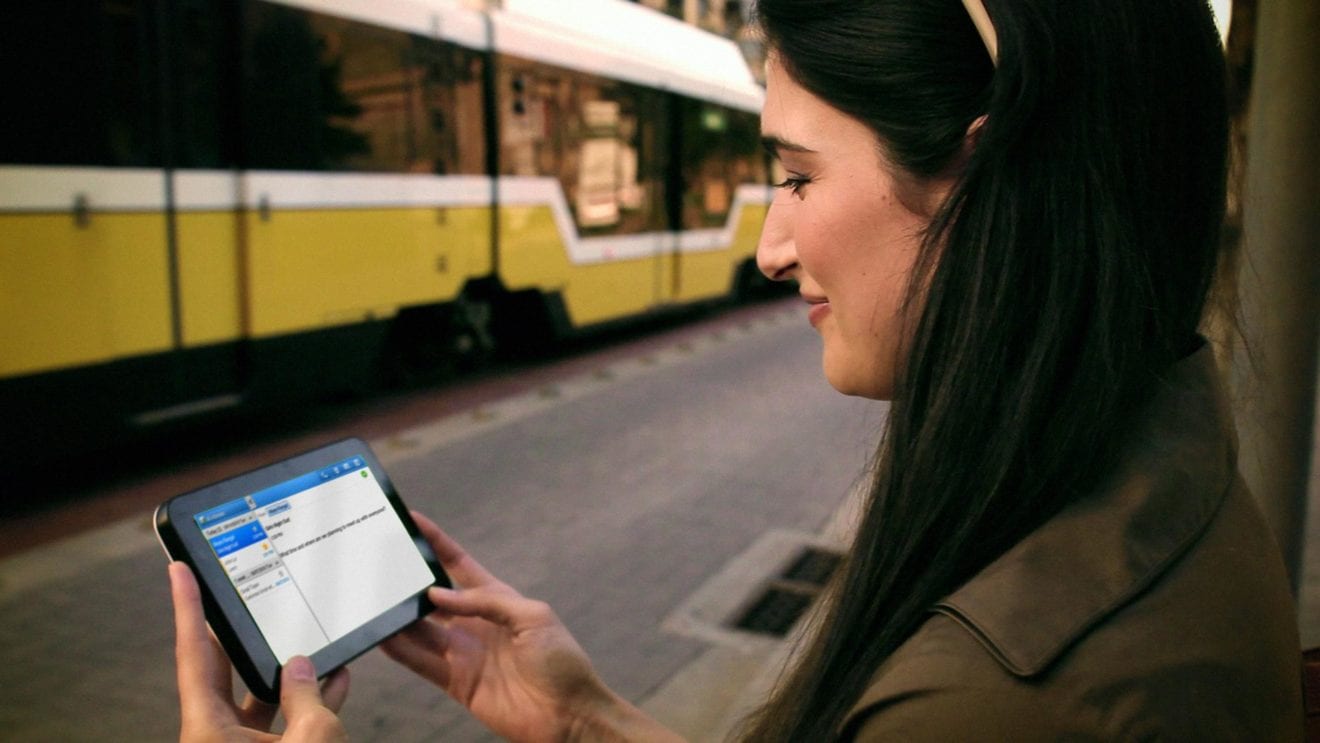
    The rapid growth of the Vietnam tablet market is boosting the potential of eCommerce in the fast-maturing Southeast Asian nation.

    New figures from GfK this week show the growing number of lower priced entry level tablets has seen a double digit growth in sales in first five months of this year – or 149,000 extra units – to reach 582,000.

    GfK projects the media tablet market will achieve even higher sales in the third quarter of the year with the anticipated back to school promotions, with annual sales estimated to hit 1.9 million for the year.

    Yet the total amount spent on tablets has fallen by about five per cent, due to the greater contribution of those lower value media tablet models.

    “Over three in every four (76 per cent) media tablets sold so far in 2015 cost less than US$300, as compared to just one in two (50 per cent) in 2014; signifying a strong shift in market trends towards the low-end segment,” observed Tran Khoa Van, MD of GfK in Vietnam.

    “The result of more media tablets being sold at lower prices brought about a shrinkage in the total market value in spite of strong consumer demand for the gadget.”

    On the other hand, high-end media tablets priced above US$500 which accounted for 29 per cent of the total market’s sales volume had reduced by half to make up only 14 per cent share in the first five months of this year. A similar trend is seen in the US$300-500 segment, where its 22 per cent share last year was reduced to 11 per cent in 2015.

    According to GfK findings, the average price of media tablets declined by 30 per cent from US$367 last year to US$259 this year. Although the number of brands catering to the Vietnamese market reduced from 56 to 49, the remaining players have introduced 20 more new models – from 278 to 298.

    Another emerging trend is the rising popularity of smaller screen sized media tablets, specifically the 7.9” and below segment. Over seven in 10 (71 per cent) of media tablets purchased this year were of this size, up from its 62 per cent market share last year.

    On the other hand, it was the 9-10” segment which reported a dwindled market share by half – from 26 to 13 per cent.

    “Price erosion is a natural progression of a tech product’s lifecycle and the average price of media tablets will definitely be drifting down further from the low of US$250 reported in the latest tracked month of May,” said Van.

  • Ford’s Retail Sales in China Increase 4% in May

    Ford’s Retail Sales in China Increase 4% in May

    Ford Motor Co. F sold 91,013 vehicles in China in May 2015. This reflects a 4% year-over-year increase from 87,887 units sold in May 2014. Sales of Ford in the world’s largest automobile market totaled 459,982 units in the first five months of 2015, up 1% from 456,594 vehicles sold in the same period of 2014. It is worth noting that Ford has started reporting only retail sales from May as opposed to wholesale figures reported earlier.

    Meanwhile, Ford’s passenger car joint venture, Changan Ford Automobile (“CAF”) witnessed a 3% year-over-year rise in vehicle sales to 67,357 units in May 2015. Sales of CAF inched up 1% to 332,999 vehicles in the first five months of 2015.

    Further, Ford’s commercial vehicle investment in China, Jiangling Motors Corporation (“JMC”), sold 20,910 vehicles in May. Sales improved 7% from 19,569 vehicles sold in May 2014. Moreover, JMC’s sales in the first five months of 2015 grew 4% year over year to 114,638 vehicles.

    In order to support the demand in China, Ford inaugurated an assembly plant – Changan Ford Hangzhou Plant – in Hangzhou in March. Changan Ford Hangzhou, Ford’s sixth assembly plant in China, required an investment of $760 million. It has a production capacity of 250,000 vehicles.

    Ford currently carries a Zacks Rank #3 (Hold). Better-ranked automobile stocks include The Goodyear Tire & Rubber Company GT , PACCAR Inc. PCAR and U.S. Auto Parts Network, Inc. PRTS , all carrying a Zacks Rank #2 (Buy).


  • Hong Kong retail gross sales stabilise

    Hong Kong retail gross sales stabilise

    Authorities figures for Hong Kong retail gross sales in Might recommend the worst of the tumult seems to be over.

    The whole worth of retail gross sales in Might 2015, provisionally estimated at HK$39 billion, edged down by zero.1 per cent in contrast with the identical month in 2014. The revised estimate of the worth of complete retail gross sales in April 2015 decreased by 2.1 per cent in contrast with a yr earlier.

    For the primary 5 months of 2015, the worth of complete retail gross sales decreased by 1.eight per cent in contrast with the identical interval in 2014. As earlier reported, complete gross sales for the primary three months fell 2.three per cent.

    Higher but: After netting out the impact of worth modifications over the identical interval, the quantity of complete retail gross sales in Might 2015 elevated by four.6 per cent over a yr earlier. And for the primary 5 months of 2015, complete retail gross sales elevated by 1.three per cent.

    As anticipated, gross sales of jewelry, watches and clocks fell – by 14.9 per cent. Attire gross sales have been down simply 1.9 per cent.

    Division retailer gross sales rose 7.6 per cent and electrical items and photographic gear by 14.6 per cent.

    A authorities spokesman stated the figures confirmed relative enchancment in Might.

    “However, the drag from the slowdown in vacationer spending remained notable, because the gross sales of jewelry, watches and clocks, and helpful presents continued to register a double-digit yr on yr decline.

    “The near-term outlook for retail gross sales will nonetheless rely a lot on the efficiency of inbound tourism. But, the secure job and revenue circumstances ought to render some help to native shopper sentiment.”

  • Japan retail gross sales proceed to strengthen

    Japan retail gross sales proceed to strengthen

    Japan retail gross sales rose a wholesome three per cent in Might – marking the second consecutive month-to-month achieve after a yr of stagnancy or decline.

    Knowledge from the Ministry of Financial system, Commerce and Business, exhibits shoppers are enjoyable their purse strings with gross sales at giant retailers rising 5.three per cent yr on yr ona  similar shops foundation.

    Retail gross sales have been depressed following the implementation of a gross sales tax improve on April 1 final yr.

    Meals, clothes and residential electronics have been the main performers in Might.

    In March, retail gross sales fell 9 per cent, though that was largely as a result of an irregular March 2014 when shoppers introduced ahead spending previous to a gross sales tax improve on April 1.

    The Financial institution of Japan says the retail figures present shoppers are extra assured, easing the strain on the financial institution to extend a stimulus program.

  • Oriental Watch profit plummets

    Oriental Watch profit plummets

    Listed retailer Oriental Watch Holdings says its net profit fell 78 per cent in the year to March.

    The company, which had issued a profit warning earlier in the year, has been hit by the slump in demand for luxury watches from mainland Chinese, in turn a result of the mainland government’s clampdown on gift giving.

    OWH says its net profit fell to HK$5 million, (US$641,000) on turnover down 11 per cent to around HK$3.11 billion.

    The company said luxury brand shoppers had changed preferences and attitudes and blamed slimmer margins on intense competition from watch retailers competing for a shrinking customer base.

    Oriental Watch has 68 stores in mainland China, 13 in Hong Kong, three in Macau and three in Taiwan.

  • Huawei hails SE Asia success

    Huawei hails SE Asia success

    Smartphone maker Huawei says its determination to concentrate on Southeast Asia is already bearing fruit.

    With the profitable Southeast Asia regional launch of the Huawei P8 and wearable units in Bangkok Thailand in late Might, Huawei is retaining the momentum going by introducing the P8, P8Max, P8Lite, Talkband B2 and AP007 energy financial institution to Myanmar, Laos, and Cambodia, Hong Kong, Taiwan and different Southeast Asia nations and areas.

    The corporate says it set a brand new gross sales document in Myanmar when it launched the P8 handset there on June 6.

    After two weeks of pre-orders of Huawei’s newest flagship merchandise, the primary batch of P8s turned obtainable in 28 outlets throughout Myanmar – all of them bought out by 10am.

    “The regional gross sales supervisor from one among telephone store famous that the P8 has set a brand new gross sales document and has turn into the best-selling handset of their store’s historical past and that they have been amazed by the variety of preorders,” stated Richard Yu, CEO of Huawei Shopper BG.

    says Southeast Asia is now one of many key markets for Huawei, and the corporate is optimistic concerning the potential within the area.

    “Southeast Asia is likely one of the most promising and high-potential financial entities on the earth, each now and sooner or later. It’s considered a strategic market and an engine driving the quick progress of Huawei’s Shopper Enterprise,” Yu stated.

    “In 2014, Huawei noticed over 10 million complete shipments on this area. With the launch of the P8, P8Max and P8Lite this yr, we anticipate complete shipments to succeed in eight million models, a 167 per cent improve.”

    The corporate has seen substantial progress in regional shipments within the area. Thomas Liu, president of Huawei Shopper Enterprise Group Southeast Asia, stated within the first quarter of 2015, smartphone shipments in Southeast Asia rose 120 per cent over final yr.