Tag: samsung electronics

  • Samsung and SK Hynix Slump Drags Seoul Benchmark Down 3.12 per Cent

    Samsung and SK Hynix Slump Drags Seoul Benchmark Down 3.12 per Cent

    South Korea’s benchmark KOSPI index dropped 3.12 per cent on Monday as sharp declines in Samsung Electronics and SK hynix dragged down Seoul equities. The semiconductor sell-off erased gains from the previous two sessions, leaving Samsung tumbling 8.70 per cent and SK hynix down 3.41 per cent by the close.

    The benchmark index settled at 6,696.96 points, down 215.99 points from Friday after opening 0.46 per cent lower. Foreign institutional funds drove the retreat, offloading a net 3.69 trillion won ($2.67 billion) in shares, while domestic institutions sold 1.29 trillion won. Local retail buyers absorbed 3.32 trillion won of the selling pressure.

    Divergent Shareholder Return Strategies

    Investor disappointment centered on the stark contrast between the capital return programs announced by the two semiconductor giants. SK hynix revealed a plan last Wednesday to repurchase and cancel 40 trillion won of its own stock, alongside a pledge to return at least 50 per cent of its free cash flow over the next three years. The chipmaker immediately started buying roughly 650,000 shares a day, accounting for up to 15 per cent of its daily trading volume.

    Samsung took a different approach, winning board approval on Friday for a capital allocation package worth between 90 trillion and 110 trillion won this year. That total includes about 30 trillion won in cash payouts and regular third-quarter dividends. Traders reacted negatively to the lack of immediate share cancellations, dumping the stock after management deferred specific allocation mechanics.

    Retail Buyers Cushion Foreign Outflows

    Across regional tech capital, institutional funds increasingly reward immediate share retirements over cash dividends because equity cancellations permanently reduce share count. Samsung’s reliance on cash payouts left investors exposed to timing uncertainty while SK hynix locked in direct daily buying demand.

    Capital that fled Samsung found a temporary home in smaller technology names. The secondary Kosdaq index gained 1.42 per cent to close at 813.33 points as money rotated into secondary battery suppliers and electronic materials manufacturers. In foreign exchange trading, the Korean won ended onshore trade at 1,382.4 per US dollar, strengthening by 4.1 won.

    Samsung’s board of directors is scheduled to meet in late October to determine the final dividend allocation and exact cash distribution timetable for the remaining portion of its 110 trillion won plan.
  • Samsung Eyes over $72 Billion Shareholder Return Amid AI Chip Surge

    Samsung Eyes over $72 Billion Shareholder Return Amid AI Chip Surge

    Seoul, South Korea based Samsung Electronics is expected to announce a substantial new shareholder return policy later this month, reportedly exceeding 100 trillion won (approximately $71.75 billion). This initiative comes as the technology giant seeks to share record profits with investors, largely fueled by the ongoing AI-driven chip supercycle.

    According to media reports, the South Korean memory-chip maker’s board is scheduled to convene at the end of August to approve the new shareholder return plan. Industry sources suggest the program will include a special dividend and allocate 50 percent of the company’s free cash flow to this new scheme.

    Rival Actions and Market Impact

    This anticipated announcement from Samsung follows closely on the heels of a significant move by its local competitor, SK Hynix. On Wednesday, SK Hynix, the world’s second-largest memory-chip producer after Samsung, revealed its own 40 trillion won share buyback and cancellation program. This represents the largest shareholder return initiative ever declared by a publicly listed South Korean company. SK Hynix also committed to dedicating over 50 percent of its free cash flow generated between 2025 and 2027 to shareholder returns.

    Such large-scale financial commitments from key players like Samsung and SK Hynix highlight the robust profitability within the global semiconductor industry, particularly in the memory chip segment. The surge in demand for chips due to advancements in artificial intelligence has created a lucrative environment for these technology powerhouses, allowing them to reward investors handsomely. These moves are likely to influence investor sentiment and financial strategies across Asia’s tech sector, setting a precedent for how major corporations manage their excess capital in times of high growth.

    Rewarding Investors Amid Strong Performance

    The reported shareholder return program from Samsung underscores a period of strong financial performance for the company. The AI-driven surge in demand for high-performance memory chips, essential for AI applications, has significantly boosted revenues and profits for chip manufacturers. By distributing a substantial portion of its free cash flow, Samsung aims to enhance shareholder value and maintain investor confidence. The company has not yet commented on the media reports.

  • Samsung ‘shock’ as profits start to droop

    Samsung ‘shock’ as profits start to droop

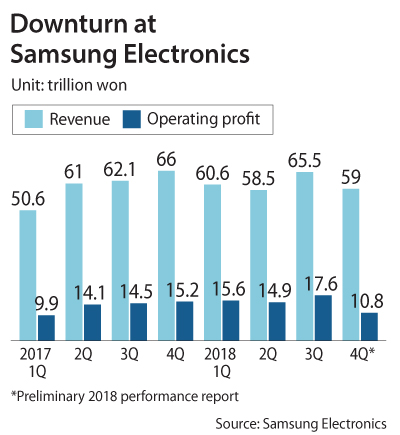
    Samsung Electronics announced sharply lower earnings for the fourth quarter, an earnings “shock” that suggested that the “supercycle” in the global semiconductor market is nearing an end. Preliminary 2018 performance numbers released Tuesday predicted the local IT giant’s operating profit between October and December of last year would be 10.8 trillion won ($9.6 billion), down 28.71 percent year on year.

    This is the lowest figure since the first quarter of 2017’s 9.9 trillion won. Between those two quarters, operating profit had consistently stayed in the 14 to 17 trillion won range.

    Revenue for last year’s fourth quarter slumped 10.58 percent year on year to 59 trillion won. Last year’s third quarter saw record quarterly highs of 65.5 trillion won in revenue and 17.6 trillion won in operating profit.

    Local analysts had expected 13.4 trillion won in operating profit for the fourth quarter and 63.2 trillion won in revenue, according to the stock information provider FnGuide.

    Samsung did not reveal performance figures for different business divisions, but the company cited “slow demand” in semiconductors as a major factor in a public announcement the same day. The IT giant has three major business divisions: chips, smartphones and home electronics.

    The results for all of 2018 showed that the company had a record high operating profit of 58.89 trillion won, a 9.77 percent jump from last year, and 243.5 trillion won in revenue, up 1.64 percent year on year.

    Before starting to slow, semiconductors were the main contributors to Samsung’s high performance over the last two years.

    In the announcement, the company added that demand from data center clients in the fourth quarter had fallen short of expectations.

    “Shipping of memory chips retreated from the third quarter, and the price decline turned out to be bigger than what we expected earlier this year,” it said.

    One reason is because companies with data centers such as Amazon, Facebook and Microsoft bought large amounts of dynamic random-access memory (DRAM) chips during the last two years, which are now piling up.

    DRAM prices started to fall after more than a year of increases – another factor that is affecting demand as companies anticipate more price cuts.

    Slow growth in smartphone sales and one-off expenses including the company’s offering of incentives to staff at the year’s end also affected the profit level.

    Worries that the semiconductor supercycle was ending have surfaced for years, but Samsung and other chipmakers have reported strong earnings – until the fourth quarter.

    December’s chip exports from Korea retreated for the first time in 27 months. The general consensus among local analysts is that Samsung’s revenue will continue to shrink in the first half of this year.

    But they have a more positive outlook for the second half.

    “Memory chip prices will bounce back in the second half of 2019,” said analyst Lee Jae-yun of Yuanta Securities. “Because the supply growth rate of major chipmakers in 2019 will be 19 percent [year on year], whereas demand growth is expected to reach 20 percent.”

  • Samsung to invest more in education programs

    Samsung to invest more in education programs

    Samsung Electronics will expand investments to develop youth education programs, it said Monday. The company’s three division heads sent an in-house broadcast to employees that day to share a newly set mission: “Enabling people,” which means to help people discover and develop their innate potential. A particular target will be put on developing programs for teens. The theme that will lay out the direction for this corporate social responsibility campaign is “Education for future generations.”

    Samsung has conducted corporate social responsibility (CSR) activities in the past, but this is the first time the company has publicly announced its mission. It comes a month after Samsung de facto leader and Vice Chairman Lee Jae-yong pledged to fully commit in taking on social responsibility as Korea’s leading conglomerate in a meeting with President Moon Jae-in at the Blue House.

    The No. 1 local company by market cap, Samsung Electronics already has a vast lineup of ongoing CSR programs, including educational ones. The designation and public announcement of the new mission, however, signals that the company will be expanding investment in the sector.

    Although there are no concrete plans at the moment, a spokesman explained there will be an increase in programs for teens. Now that there is a fixed mission, the programs will also be organized in a more “structured” way instead of the company and affiliates independently devising programs on their own.

    “We should realize a new model for future education that is based on our know-how in technology and innovation,” said Samsung President Kim Hyun-suk, who leads the consumer electronics division.

    In Monday’s message, there was a repeated emphasis on Samsung’s increased role in society. President Koh Dong-jin, who heads the mobile device business, for example, stressed that no company can communicate with customers if they do not consider social values.

    The word social responsibility has become increasingly common at Samsung recently, including in statements for the launch of a research center for fine dust and an official apology to former workers in November who got sick working at chip factories. The drive is particularly evident since Vice Chairman Lee returned to the company’s helm after his release from prison last year, which some industry watchers say is a move to improve the conglomerate’s public image.

  • Samsung to pay its biggest tax bill ever as profits rise

    Samsung to pay its biggest tax bill ever as profits rise

    Samsung Electronics is expected to pay 16.8 trillion won ($15 billion) in corporate taxes this year, up 20.1 percent from a year earlier, due to its record earnings, its regulatory briefing showed Monday. It is expected to cough up 28.6 percent of its operating profits, which reached an all-time high of 58.9 trillion won in 2018, according to its consolidated financial statement.

    The estimated tax amount is the highest amount ever for the company, 2.4 times the number from 2015 and over 14 times from 2009, its past reports showed.

  • Samsung spent $3.12M lobbying in U.S. last year

    Samsung spent $3.12M lobbying in U.S. last year

    The American subsidiary of Korean tech giant Samsung Electronics spent $3.12 million on lobbying U.S. politicians and officials last year, the second-largest amount following 2017, data from a Washington-based research group showed Monday. Samsung Electronics’ lobbying expense was the ninth largest among electronics companies operating in the United States, moving up two notches from a year earlier, according to the Center for Responsive Politics (CRP).

    Microsoft spent the most with $7.18 million, followed by Qualcomm with $6 million, Oracle with $5.47 million and Apple with $5.09 million, said the nonprofit research group, which tracks the effects of money and lobbying on elections and public policy.

    Among foreign companies, Samsung Electronics was the second-biggest lobbying spender after German engineering group Siemens.

    The Korean tech conglomerate has been intensifying its lobbying efforts in its key market since U.S. President Donald Trump took office in 2017 and advocated more protectionist trade policies.

    Samsung’s lobbying expenses over the past two years amounted to $6.62 million, far surpassing $6.04 million spent during former President Barack Obama’s second term from 2013-16, data showed.

    Trade-related issues were Samsung’s main lobbying target in the United States last year, with 13 cases out of 81 total in this area.

    The company also made extensive lobbying efforts for the telecommunication sector as it has been exploring ways to expand its foothold in the 5G network equipment market.

    Last month, Samsung and American telecommunication company Verizon announced their plan to launch 5G-compatible smartphones in the U.S. market in the first half of 2019.

  • Korean start-ups also shine at CES in Las Vegas

    Korean start-ups also shine at CES in Las Vegas

    Industry big boys aren’t the only companies exhibiting at this year’s Consumer Electronics Show (CES). Over 1,200 start-ups have set up at the event’s Eureka Park, reserved for smaller companies, to capture the attention of consumers and possibly become the next unicorn (a start-up valued at over $1 billion).

    Of the start-up companies from Korea, those that developed through the “Israeli start-up” model have grabbed the most attention from the media. The model refers to companies with a weak capital base that grows with investment from other IT companies or venture capital firms. Many Korean start-ups that took part in CES this year got investments from IT giants such as Naver or Kakao.

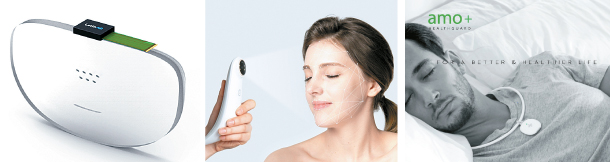
    Augmented reality (AR) and virtual reality (VR) company LetinAR is one of the hottest start-ups. LetinAR produces smart glass lenses that makes use of “Pin Mirror” technology. The company incorporates the pinhole effect, which makes vision clearer by looking through a small hole, and applies it for use in VR and AR.

    LetinAR also created a lens that provides vision of up to 80 degrees. While humans can see up to 150 degrees, existing products are typically limited to 50 degrees.

    “The 80-degree vision is like looking at a 120-inch TV from a meter away [3.28 feet],” said Choi Kyung-on, a director at the company. “If our product becomes commercialized … we will be able to release smart glasses the size of large conventional glasses within three years.”

    While smart glasses got a lot of headline in 2013 with the introduction of Google Glass, the product failed due to the difficulty of developing a lens with a wide-viewing angle.

    Meanwhile, beauty artificial intelligence (AI) start-up lululab won the CES Innovation Award in the biotech sector for its AI skin care assistant Lumini.

    The device analyzes skin conditions such as its wrinkles and pores and provides product information and recommendations personalized for a user.

    “[Users] can use personalized AI skin analysis service without the help of a store employee,” explained Choe Yong-joon, CEO of lululab.

    The company was born in Samsung Electronics’ start-up incubator, C-Lab.

    AMO Lab is another promising start-up from Korea. The company, which got investment from Naver last September, specializes in products that improve users’ quality of sleep.

    The company recently developed AMO+, a device worn like a necklace, which sends out minute electrical signals to the body to improve sleep.

    According to recent test results, users’ parasympathetic nervous systems became active when wearing the device.

    “We are currently discussing collaboration with U.S. and European companies after prototype development,” said Kim Min-kyu, CEO of AMO Lab.

    WELT, another alumnus of Samsung’s C-Lab, gained attention for releasing a smart belt in collaboration with French luxury brand S.T. Dupont. WELT’s smart belt can be used for two months with a single charge and provides basic health information.

  • Samsung ranks second in 2018 U.S. patent grants

    Samsung ranks second in 2018 U.S. patent grants

    Samsung Electronics grabbed the No. 2 spot in U.S. patent grants among global corporate giants in 2018, industry data showed Thursday. Samsung Electronics, the world’s top smartphone and memory chip maker, received 5,850 U.S. patent grants last year, up 13 from the previous year, according to the data from IFI Claims Patent Services, provider of a top global patent data platform.

    IBM topped the list with 9,100 grants, up 1 percent from a year earlier, maintaining the U.S. company’s position as top patent leader for a 26th consecutive year.

    Canon followed Samsung with 3,056. Intel came next with 2,735 then LG Electronics with 2,474. All registered declines from a year earlier.

    Other Korean firms included Samsung Display, which ranked 14th with 1,948 grants. Hyundai Motor placed 19th with 1,369.

    Last year, U.S. patent grants totaled 308,853, down 3.5 percent from the previous year.

    By country, the United States took up the largest share, at 46 percent, followed by Japan with 16 percent, Korea with 6.5 percent, Germany with 5 percent and China 4 percent.

    China was the only major patenting country to report an on-year increase in the 2018 patent grants.

  • Samsung signals big 5G equipment push, again, at factory

    Samsung signals big 5G equipment push, again, at factory

    Samsung Electronics Vice Chairman Lee Jae-yong’s first appearance in the field this year was to celebrate the start of production at a 5G network equipment factory Thursday. His field visit comes as the company puts more weight this year on the 5G network-equipment business, which involves components used in 5G networks. These components are supplied to telecommunications companies.

    Lee and several other top executives, including Koh Dong-jin, CEO and president of the IT & mobile division, were present at the celebration ceremony held at the company’s factory and office complex in Suwon, Gyeonggi.

    “The 5G market is a new field, and we have to build competence with the mindset of a challenger,” Lee told employees during the event.

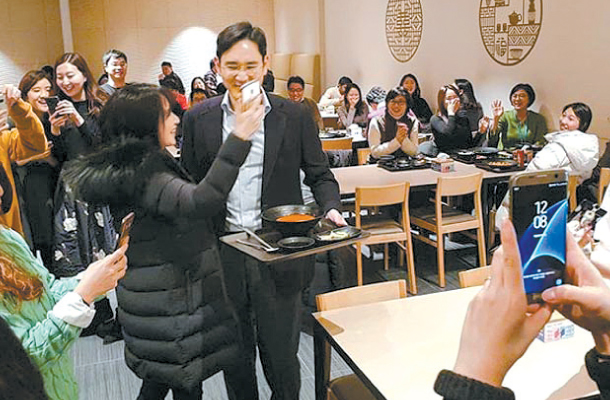
    Lee and the team of executives stopped by the cafeteria of the complex for lunch, resulting in posts on Instagram featuring Lee and employees.

    The manufacturing line for 5G equipment in Suwon is the first in the industry to be designed using “smart factory” principles. It utilizes 5G connections to enhance productivity and reduce the rate of defects.

    The company originally manufactured 5G network equipment in Gumi, North Gyeongsang, but had the production line relocated to Suwon, the site of its R&D center. This was done to help create synergies between the manufacturing and R&D facilities, said a spokesman.

    Samsung signaled last August that 5G connectivity is one of its four growth engines for the future when it announced a plan to invest $161 billion by 2021.

    The business area is receiving considerable attention from global technology companies. 5G connectivity is vital not only to telecommunications in the future, but will also be an essential component of other, related state-of-the-art technologies, such as autonomous cars, AI-powered robots and virtual reality.

    Samsung’s presence in the global telecommunications equipment market is relatively low, with a share of around 11 percent for fourth-generation LTE equipment, according to market research firm Dell’Oro. The larger players include Huawei, Ericsson and Nokia, all with shares of more than 25 percent.

    The company’s current goal is to hit a 20 percent market share in the 5G equipment market next year.

    Samsung has been expanding its client base for 5G equipment mainly in Korea and the United States. Names on the list include SK Telecom, KT, AT&T and Verizon. Samsung hopes to leverage those client relationships to attract other customers.

    The company plans to release the Galaxy S10 in March. It will be its first smartphone to support 5G connections.

    Kim Young-ki, Samsung’s president of network business, said at an event last November that the company will invest a total of $22 billion to develop 5G-network technology.

  • Samsung Electronics gives stability a try

    Samsung Electronics gives stability a try

    The CEOs of Samsung Electronics semiconductors, smartphones and consumer electronics divisions all kept their jobs in the company’s annual corporate reshuffle announced Thursday. Kim Ki-nam, head of Samsung’s device solutions division, which includes semiconductors, retained his position but has been promoted from president to vice chairman. Samsung’s semiconductor business has seen operating profit grow for the past 11 quarters as of September.

    The other two division heads – Koh Dong-jin of IT and mobile communications and Kim Hyun-suk of consumer electronics – were reappointed as CEOs and will retain their current president job titles.

    Roh Tae-moon of the IT & mobile communications division was promoted from vice president to president and will continue to head the smartphone development team. Roh has been at the core of technology development for Samsung’s Galaxy smartphone brand since the range was first introduced.

    For a company well known for rapidly exchanging executives based on performance, the minor superficial changes at the top made this year suggest that Samsung is shifting instead to put more weight on stability rather than expansion next year.

    The company already went through a major generation change last year when it laid off older executives to replace them with younger ones. A total of 14 top executives were reshuffled at the time. Samsung said in a statement on Thursday that it “re-appointed business executives from last year to realize ‘innovation within stability.’”

    The drive for stability also comes at a time when Samsung faces several uncertain factors that analysts say will halt this year’s rally of record profits. The global chip market, which has been on an unusually long supercycle over the last few years, is anticipated to slow down in 2019.

    Outlooks on the global economy are also grim due to the remaining risk of the United States and China continuing their trade war.

    Samsung also stuck to its performance-based HR strategy by heavily compensating executives and managers in the device solutions division, including CEO Kim Ki-nam.

    Kim has been heading the semiconductor business at Samsung since December 2014. Under his lead, the company celebrated the last two years as the No. 1 chip manufacturer in the world. Chips were also a major contributor to Samsung’s record-high quarterly profits this year.

    Kim wasn’t the only one to be rewarded. Among a total of 158 senior executives promoted at Samsung, including those below president, 80 were from his division.

    Samsung employees in the device solutions division will receive bonuses between 300 to 500 percent of annual wages. Even external partners and suppliers for the division will reap incentives this year of up to 89.7 billion won ($79.8 million) in total.

    Meanwhile, this was the first time in three years that Samsung Electronics has released annual reshuffle results at the year’s end – a sign that Samsung is getting back on its feet after Vice President Lee Jae-yong’s return from prison in February.

    There were no annual reshuffles at all in 2016 when Lee was investigated for bribery charges regarding former President Park Geun-hye. It was only in October last year that the company announced a reshuffle plan among top executives.

    Other Samsung affiliates announced annual reshuffle results on Thursday. Samsung C&T Vice President Kim Myeong-soo was promoted to president. He was in charge of the task force in charge of improving competitiveness in engineering, procurement and construction.

    Vice Chairman Lee’s sister Lee Seo-hyun was appointed as chairman of the Samsung Foundation, which conducts social welfare projects. She was formerly president of the fashion division at Samsung C&T.

  • Samsung to support the Olympics through 2028

    Samsung to support the Olympics through 2028

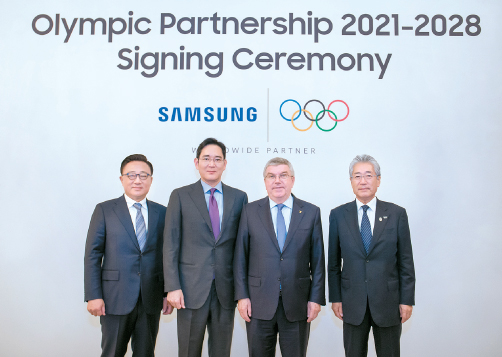
    Samsung Electronics announced on Tuesday it will extend its partnership with the International Olympic Committee (IOC) through 2028, from the original 2020 end date of the collaboration. The two parties signed an agreement at a ceremony at the Hotel Shilla in central Seoul in the presence of IOC President Thomas Bach and Samsung Electronics Vice Chairman Lee Jae-yong, as well as other executives from the company and officials from the committee.

    Samsung said it will continue as a Worldwide Olympic Partner in the wireless communications equipment and computing equipment category and promote the artificial intelligence (AI), virtual reality (VR), augmented reality (AR) and 5G features of the supplied equipment. Samsung will continue the support beyond the Olympic Games in Tokyo in 2020 through to the Los Angeles 2028 Olympics. The agreement also covers the Youth Olympic Games through 2028.

    Samsung will continue to support the IOC, the national Olympic Committee and the teams, the technology company added. The company will remain a Worldwide Partner of the International Paralympic Committee, extending a relationship that began in 2006.

    In collaboration with the IOC and the Organizing Committees, Samsung plans to continue its Athlete Phone Program. Under this program, it provides Olympic Edition Galaxy phones to all participating Olympic and Paralympic athletes.

    “As part of the agreement, the IOC and Samsung will further develop their strategic digital collaboration to engage young generations around the world in order to promote the power of sport and the values of Olympism,” Samsung said in a statement.

    “As a Worldwide Olympic Partner for the last 22 years, Samsung has been inspired by the spirit of hope, friendship and unity,” said Koh Dong-jin, president and CEO of the IT and mobile communications division at Samsung Electronics. “Through our innovative wireless and computing equipment, which supports AI, VR, AR and 5G technology, we hope to spread the excitement of the games so that fans and athletes around the world can stay connected and share in the journey to achieve greatness at the highest level of sportsmanship.”

  • Korea’s KT skips Huawei for 5G

    Korea’s KT skips Huawei for 5G

    KT has chosen Samsung Electronics, Ericsson and Nokia as suppliers of 5G network equipment. As expected, Huawei was excluded from the list.  “In choosing 5G equipment providers, the company considered a wide range of factors: the level of technology, investment costs and management stability based on the compatibility with the existing LTE network,” KT said in a statement.

    The bid results, announced by the company Thursday, come a month after SK Telecom named Samsung Electronics, Ericsson and Nokia as its 5G equipment providers.

    This is the second time Huawei was left out despite having participated in internal tests along with the three selected.

    SKT and KT’s choices were anticipated because both had used equipment from Samsung, Ericsson and Nokia for their 4G LTE networks.

    Compatibility of equipment is an advantage for mobile carriers in terms of cost and maintenance, especially in the early stages when 5G equipment is not fully installed nationwide.

    LG U+ is the only one among Korea’s three mobile carriers that has not yet announced 5G equipment suppliers. The smallest mobile carrier is likely to include Huawei on its list. It partnered with the Chinese company for its 4G LTE network, along with Samsung, Ericsson and Nokia.

    An LG spokesman said Thursday that the company “does not have plans to openly disclose selected bidders for 5G network equipment at the moment,” as it is not mandatory.

    However, LG U+ Vice Chairman Ha Hyun-hwoi gave a strong hint at the parliamentary audit late last month when he gave a positive answer to a lawmaker’s question on whether it was “unavoidable” to use Huawei’s 5G equipment as its 4G equipment was from the same company.

    The biggest advantage of Huawei’s 5G equipment is cost efficiency. The Chinese company is known to charge prices that are 20 to 30 percent lower than other global competitors for high-quality 5G equipment. A factor that argues against Huawei is security concerns.

    Due to its ties to the Chinese government, there have been worries that the company’s equipment is being used for spying. In August, the U.S. and Australian governments banned Huawei from supplying equipment for their 5G wireless infrastructure citing security reasons. Britain said in July it “is less confident” about the integrity of Huawei products.

    The concern is shared by some local customers as well. Online petitions at the Blue House’s official website have been posted since June requesting a stop to LG’s adoption of Huawei’s 5G equipment. Huawei has been denying such allegations.

    In a press release last month, the Chinese tech company highlighted that, despite ongoing security concerns, there has been zero cases of actual information leakage in the past.

    “We have supplied LTE equipment for LG U+ since 2013, and until now, there were no cases of security accidents,” said the statement. “After multiple verifications by the government, it has been proved that there have been no problems.”

  • Samsung offers laptop with millennial style

    Samsung offers laptop with millennial style

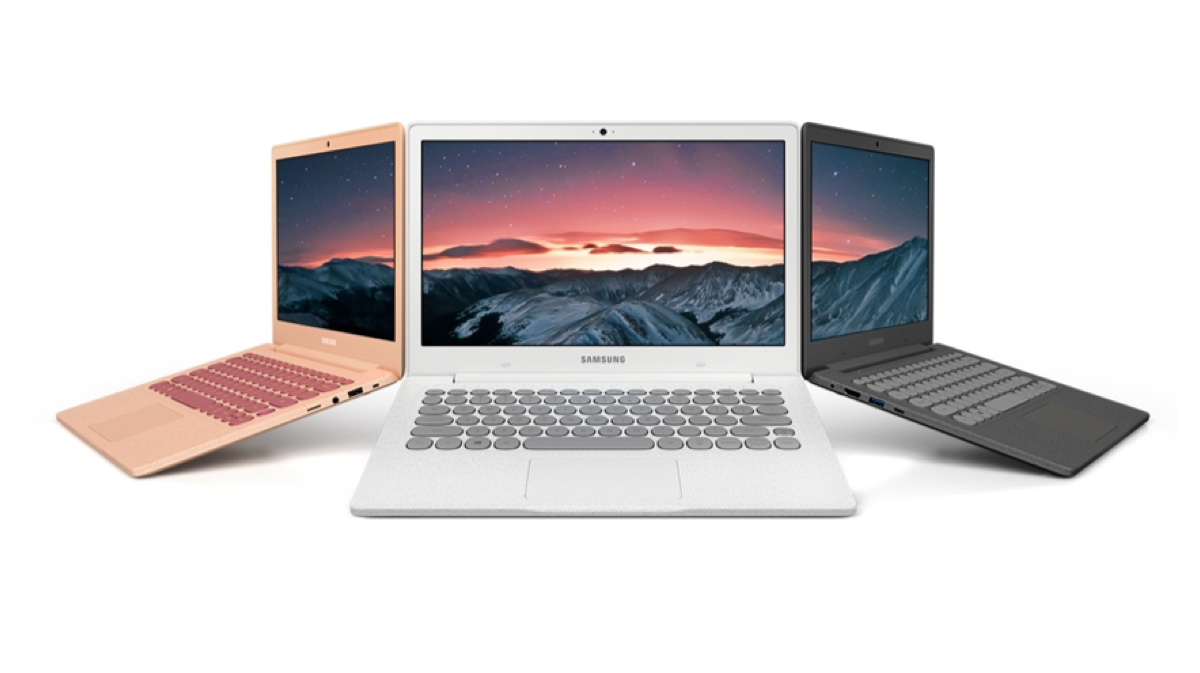
    Samsung Electronics introduced on Monday a laptop it believes will appeal to millennials.  The 13.3-inch computer, the Samsung Notebook Flash, has rounded key caps reminiscent of old typewriters. Its palm rest has a coarse fabric, not conventional metal, which feels comparatively warm, Samsung explained.  The new device is based on the Windows 10 operating system.

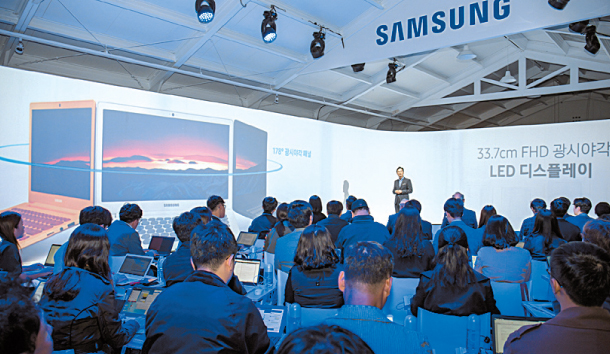
    “We worked with Samsung Design Europe to come up with a refined European model that millennials would want,” said Lee Min-chul, managing director of the company’s PC business unit at a launch event in northern Seoul on Monday.

    The laptop comes in three cover designs: linen white, twill charcoal and soft coral. It is powered by Intel’s latest gigabit WiFi chip, rated for download speeds of up to 1.7 gigabytes per second – a speed that Lee says is currently the fastest.

    The laptop supports universal flash storage, a flash storage that achieves five times the reading speeds of MicroSD technology.

    Fingerprint login capabilities and a secret folder, in which the user can save important files, contribute to a high level of security.

    But at 1.37 kilograms (three pounds), the new device is relatively heavy, weighing much more than typical one kilogram ultra-light laptops.

    For Samsung, a top global vendor of smartphones, semiconductors and TVs, laptops are a weak spot.

    The tech giant ranks behind the six largest players – HP, Lenovo, Dell, Apple, Asus and Acer. Those six have about 89 percent of the global market, according to TrendForce in a February report.

    Samsung, LG and others make up the remaining 11 percent.

    Samsung currently retails laptops only in Korea, the United States, China and Brazil. A full 45 percent of all laptops sold globally are sold in these markets.

    Samsung’s annual shipment of laptops totals about 3.2 million units, according to the company.

    The target for Flash laptop sales in the four target markets is one million units.

    Despite its minimal global presence, Samsung is committed to the laptop business, said Lee, citing the device’s “connectivity” with other devices.

    “PCs are central when it comes to IT devices they support – such as monitors, printers and even mobile phones,” Lee said.

    Laptops have been evolving in different ways in recent years, and Samsung wants to develop hybrid products, including laptops with foldable displays.

    “But it’s not only about hardware. It’s important to provide new usability,” he added.

    Coming in two storage sizes – 64 gigabytes and 128 gigabytes – the Flash laptop carries a price tag of 810,000 won ($717).

    But a model specifically designed for wireless operator KT can be purchased for 8,000 won per month on a 36-month subscription with KT’s internet service and the Olleh internet protocol TV.

  • Samsung opens its incubation

    Samsung opens its incubation

    Samsung Electronics is opening up its internal incubating program, C-Lab, to young entrepreneurs from outside the company, and it plans to help 300 of them over the next five years. It will incubate 200 internal start-up projects during the same period, bringing the total to 500 by 2023. Expanding support to start-ups is part of Samsung’s massive 180-trillion-won ($158-billion) investment plan announced in August.

    “There were lessons learnt during our last six years running C-Lab inside the company, so we suggested sharing our experience and know-how externally as a way to contribute to solving the problem of youth unemployment,” said Lee Jai-il, vice president of the company’s Creativity & Innovation Center, at a press event held Thursday at Samsung’s R&D center inside Seoul National University.

    Started as an internal program to encourage young staff to freely suggest new ideas, C-Lab has produced substantial results.

    Of a total 230 ideas suggested to C-Lab, 78 eventually became a Samsung product or service while 36 people who had those ideas quit their jobs to establish start-ups of their own.

    Some went as far as to set up offices in Silicon Valley or show their products at the Consumer Electronics Show.

    “Another thing I noticed working with 200 C-Lab teams is that there is a type of person more suited than others to do innovative work,” said Lee. “When it comes to realizing their own idea, these people have a tendency to completely immerse themselves in that task and I believe these are the type of people that will lead this country’s future.”

    Opening the one-year program up to outsiders, Samsung will select 20 external teams every year, mainly in their early stages.

    It already has chosen 15 teams this year and they are working inside the R&D center, which the company built in partnership with Seoul National University last November.

    The center looks more a co-working space, not the typical feel for an office at Samsung, which has a reputation for a hierarchical and inflexible corporate culture.

    Several groups were having discussions inside meeting rooms while smaller groups of three to four worked on laptops on random tables in open spaces.

    The building also has a space equipped with 3-D printers and laser cutters to create prototypes.

    There’s a cafeteria that serves three meals a day on the fourth floor, and across from that is a meeting space that offers a wide view of trees in the campus.

    A Samsung staffer said they tried to create “a soft and cozy space fit for young start-ups.”

    All the facilities in the building are offered for free for a year to C-Lab teams. Other advantages include financial support of up to 100 million won and mentoring from various experts from Samsung.

    “What I’m looking forward to, even more than the infrastructure and financial support, is the possibility to find collaboration points with existing Samsung services or businesses and possibly find new service ideas we couldn’t think of before,” said Jinu Kim, CEO of the mobile app Liner, which is one of the 15 external C-Lab teams.

  • Samsung tip has government investigating KIP

    Samsung tip has government investigating KIP

    The Ministry of Trade, Industry and Energy has been investigating a Korean company over technology leakage overseas at the request of Samsung Electronics, sources said on Monday.

    The probe into KIP, a private company belonging to the Korea Advanced Institute of Science and Technology, started in April after Samsung Electronics reported the issue to the government. But the issue is complicated by an ongoing lawsuit between KIP and Samsung in the United States.

    KIP sued Samsung over mobile transistor intellectual property, and critics have suggested that Samsung’s recent allegations are an attempt to cloud the issue.

    Back in late 2016, the company run by a group of researchers at Kaist filed a suit at a federal court in Texas against Samsung for using its patented technology for mobile 3D transistors, known as fin field effect transistors (FinFET), since 2015. The technology is used to increase the processing speed of smartphones and tablet PCs.

    Unlike Samsung, Intel has been paying around 10 billion won ($9.3 million) to use the technology since 2012. KIP demanded that Samsung pay for its use of the technology as well, and a jury is set to hand down the first verdict on the case on June 16.

    Samsung, however, has refused to pay for the technology, claiming it was initially developed as part of a state-supported research project. The electronics giant fought back, claiming that KIP leaked the core technologies overseas.

    The world’s No. 1 chipmaker asked the ministry to look into whether KIP’s intellectual property fits into one of seven categories that either have technological and economic value in markets at home and abroad or have great growth potential that are stipulated in the Act on Prevention of Divulgence and Protection of Industrial Technology.

    The seven designated technologies need state approval before being exported overseas.

    While reviewing documents preparing for a trial, Samsung claims it found evidence of a national core technology being leaked abroad without approval from the Commerce Ministry.

    FinFET was originally a joint project between Wonkwang University, where Lee Jong-ho, now professor at the department of electrical and computer engineering at Seoul National University, was serving as professor, and Kaist in 2001. Lee patented the technology under his name in Korea and handed it over to KIP later. KIP then transferred the patent to its U.S. branch, which was established in 2016.

    “It is hard to conclude whether [the KIP-owned technology] is a core national technology and it is not clear either whether the issue needs to be assessed by a group of experts,” said a ministry official. “We are taking into consideration of various aspects, given the issue could affect the trial.”