Retail News CRM

Tag: Singles Day

  • China’s Singles’ Day Sales Fall Flat Amid Consumer Apathy and Economic Concerns

    China’s Singles’ Day Sales Fall Flat Amid Consumer Apathy and Economic Concerns

    With the conclusion of China’s Singles’ Day sales festival, the largest shopping event worldwide, it’s clear that the country’s most significant e-commerce platforms were unable to stimulate widespread consumer enthusiasm. This comes in light of the lingering property crisis in China and rising concerns over income security, making it increasingly challenging to convince consumers to part with their money.

    Retailers’ Response

    Retailers, in response to the economic climate, have amplified their efforts in providing year-round discounts, introducing billions in consumer subsidies and coupons, and extending the duration of sales events. For this year’s Singles’ Day, many platforms commenced their sales in early October, making it the longest festival yet.

    However, the response has been mixed, according to Josh Gardner, CEO of Kung Fu Data, a company that manages online stores in China for various global fashion and lifestyle brands. He described the sales sentiment during the Singles’ Day period as “muted,” noting that some brands had performed exceptionally well while others observed flat or minor changes compared to the previous year.

    Last year’s sales event, also known as “Double 11” in China, reached an impressive total of 1.44 trillion yuan (US$202 billion). However, the figures for this year remain undisclosed, as companies such as Alibaba and JD have stopped revealing their total Singles’ Day sales in recent years.

    Platform Sales Performance

    JD reported on Wednesday that its turnover reached a “new high,” with a 40% increase in the number of users placing orders and a nearly 60% increase in the number of orders. Several brands on JD.com, including Bellamy Organic baby products from Australia, the American pet brand Instinct, and French skincare brand Avène, saw a surge in sales by over 150% compared to the previous year.

    Meanwhile, Alibaba’s Tmall and Taobao platforms have continued their Double 11 deals until November 14, yet they have not released any information regarding their sales performance for the entire period.

    Gardner reported that the Singles’ Day sales surge is not as robust as it was in the past, but October and November still account for approximately 30% to 40% of annual revenue for the brands he manages.

    Strategies for Attracting High-Spenders and International Growth

    In an attempt to lure high-spenders, Alibaba pledged 50 billion yuan in subsidies specifically for its 53 million 88VIP members in October. The company reported a 39% increase in daily active buyers from the previous year during the festival among those members.

    Moreover, Alibaba’s Taobao introduced Singles’ Day-related sales in over 20 countries this year, signalling a widespread push from Chinese e-commerce firms for international growth. According to a report released by Bain in late October, it is crucial for Chinese e-commerce companies to pursue global growth, considering the lukewarm consumer outlook domestically.

    Questions & Answers

    What is Singles’ Day in China?
    Singles’ Day is a Chinese sales festival held annually on November 11. It’s considered the world’s largest shopping event, with massive discounts offered by e-commerce platforms to stimulate consumer spending.

    How did Singles’ Day perform this year?
    This year’s Singles’ Day results were mixed. Some brands reported exceeding sales expectations, while others experienced flat or minor changes compared to the previous year.

    What are some strategies adopted by retailers during Singles’ Day?
    Retailers have introduced year-round discounts, billions in consumer subsidies and coupons, and extended sales events. Some are also attempting to attract high-spenders with exclusive offers and expanding their sales to international markets.
  • Chinese Giants Alibaba, Jd Extend Singles’ Day Sales Amid Economic Challenges

    Chinese Giants Alibaba, Jd Extend Singles’ Day Sales Amid Economic Challenges

    Chinese retailers are capitalizing on the annual ‘Singles’ Day’ phenomenon by extending the sales event for up to five weeks. The sustained retail strategy is being deployed by industry giants Alibaba and JD as they strive to stimulate consumer interest amidst economic challenges.

    The Chinese economy, which is the second largest in the world, has suffered from weak consumer spending this year. Various factors, including negotiations over trade policies with the US, fierce domestic rivalry, inclement weather, and an ongoing property crisis have worked against the economic growth.

    Alibaba recently unveiled an exceptional investment into the biggest annual sales event during a launch event in Shanghai. The e-commerce behemoth has committed 50 billion yuan (US$7 billion) in subsidies for its highest spending 88VIP members. The extensive sales period began recently and will continue until November 11, which is the traditional Singles’ Day, named after the numerical representation of the date.

    Leveraging AI and Instant Retail

    Alibaba reported that 35 brands, which include globally renowned names like Nike and L’Oreal, as well as local companies Anta and Proya, sold over 100 million yuan worth of products in the first hour of the sale.

    To further stimulate sales, Alibaba has integrated artificial intelligence (AI) into its search and recommendation functions. This AI-enhanced system is predicted to boost click-through rates by approximately 10%.

    Instant retail, defined by the delivery of online orders within an hour, is another focal point for this year’s sales strategy. Both Alibaba and JD have invested billions into subsidies to entice customers towards their rapid delivery channels, which have been growing at a faster rate than e-commerce as a whole.

    Changing Shopping Patterns as Consumers Grow Choosier

    JD initiated its campaign on October 9, aligning with China’s return to work post the eight-day Golden Week holiday. However, consumer spending during Golden Week hit a three-year low, even with growth in holiday travel, which raised some concerns regarding the forthcoming Singles’ Day promotions. Additionally, extended promotions this year may not necessarily encourage consumers to splurge more.

    JD announced during a recent press briefing that it would offer over 100,000 popular products at the lowest prices of the year. Included in the sale are 50,000 pairs of thermal long johns, priced at 2 yuan ($0.30) each which includes the cost of shipping.

    Jacob Cooke, co-founder and CEO of WPIC Marketing + Technologies, posits that products that enhance consumers’ perception of themselves, such as beauty brands, outerwear, and packaged food and drink, are likely to perform well this year. However, home appliances, which enjoyed a sales boom in 2024 due to government subsidies, are projected to see a decline. Analysts from Nomura predict a 20% drop in home appliance sales in the last quarter of the year.

    Questions & Answers

    What is Singles’ Day in China and when is it?
    Singles’ Day is an annual sales event in China that takes place on November 11. It was named after the numerical representation of the date, and it is considered the biggest sales event of the year.

    What strategies are Chinese retailers employing this year to boost sales during Singles’ Day?
    Chinese retailers such as Alibaba and JD are extending the sales period up to five weeks, investing in subsidies, leveraging artificial intelligence for search and recommendation functions, and focusing on instant retail or one-hour delivery of online orders.

    What types of products are expected to be popular during this year’s Singles’ Day sales event?
    Products that help consumers feel good or enhance their perception of themselves like beauty brands, outerwear, and packaged food and drinks are expected to be popular. However, home appliances, which saw high sales in the past due to government subsidies, are expected to decline this year.

  • Asia’s Retail Giants Brace For Singles’ Day Shopping Frenzy Amid Rising Online Commerce Trends

    Asia’s Retail Giants Brace For Singles’ Day Shopping Frenzy Amid Rising Online Commerce Trends

    Retailers all over Asia are abuzz with anticipation as they prepare for the biggest shopping event of the year: Singles’ Day on November 11. Originating in China, this day has transformed into a retail phenomenon that now captures the attention of consumers across the continent and beyond. Brands, both local and international, are gearing up for a digital spectacle filled with discounts, flash sales, and interactive experiences designed to entice shoppers.

    The Rise of Online Shopping

    With a significant shift towards e-commerce in recent years, propelled further by the global pandemic, Singles’ Day has cemented itself as a crucial period for online retailers. In 2022, Alibaba reported a staggering $84.5 billion in sales, a clear testament to the event’s enduring popularity. However, it’s not just tech giants stealing the spotlight; small and medium-sized enterprises are also making waves by adopting innovative strategies to capture part of this lucrative market.

    Experiential Marketing Takes Center Stage

    This year, brands are placing a strong emphasis on experiential marketing to create a meaningful connection with consumers. From virtual try-ons to gamified shopping apps, the integration of technology into the shopping experience is set to reach new heights. Retailers are leveraging augmented reality and artificial intelligence to not only enhance user experience but also to make shopping feel more like an adventure. After all, who wouldn’t want to find a hidden treasure among the sea of deals?

    Collaborations and Limited Editions Drive Excitement

    Collaborations are another strategy retailers are employing in the lead-up to November 11. Brands, large and small, are launching limited-edition items and exclusive collections, tantalizing consumers with the idea that they could own something truly unique. This sense of urgency and scarcity fuels the shopping frenzy and keeps consumers returning for more.

    Responsible Consumerism on the Horizon

    Interestingly, there’s a notable shift towards responsible consumerism this year. Many shoppers are not just seeking the best prices, but also looking for brands that prioritize sustainability. Retailers are responding by highlighting eco-friendly practices and supply chain transparency, appealing to a growing demographic of conscious consumers who want their purchases to make a positive impact.

    The Competition Heats Up

    As the clock winds down to November 11, retailers are engaged in an all-out competition to capture consumer attention. Social media platforms are buzzing with teasers and sneak peeks, igniting curiosity among shoppers. In this race, it’s not just about who offers the steepest discounts, but also who can create the most vibrant and engaging marketing campaigns that resonate with consumers’ lifestyles and aspirations.

    Questions & Answers

    What is Singles’ Day, and why is it significant for retailers?
    Singles’ Day, celebrated on November 11, is a massive shopping event that originated in China and has evolved into a global phenomenon, with retailers seeing significant sales spikes during this time, making it crucial for their annual revenue.

    How have small businesses adapted to the Singles’ Day frenzy?
    Small and medium-sized enterprises are adopting innovative marketing strategies, leveraging e-commerce platforms, and focusing on unique offerings to stand out amidst the competitive landscape dominated by larger retailers.

    What trends are shaping consumer behavior this Singles’ Day?
    Shoppers are increasingly prioritizing experiences, sustainability, and unique product offerings, indicating a shift towards responsible consumerism and a desire for meaningful purchases over mere discounts.

  • L’Oreal Asia Pacific sales reported soars

    L’Oreal Asia Pacific sales reported soars

    L’Oreal Asia Pacific sales soared by a staggering 24.1 per cent on a like-for-like basis last year. Asia was the beauty behemoth’s fastest-growing market with all divisions of the business winning market share from rivals in the region. “The dynamism of Chinese consumers, combined with the good performance of premium brands and rapid growth in several other Southeast Asian markets as well as in travel retail, were the [region’s] main growth drivers,” the company said in an earnings statement.

    Singles Day in the fourth quarter especially boosted sales in China, along with the acquisition of Stylenanda in June.

    L’Oreal Asia Pacific sales, driven by China, overtook L’Oreal’s North America business, with sales exceeding €7 billion.

    Globally, L’Oreal achieved sales of €26.9 billion (US$30.3 billion) last year, an improvement of 7.1 per cent on a like-for-like basis and 8 per cent at constant exchange rates. Net profit reached €3.89 billion euros, an increase of 8.8 per cent.

    L’Oreal’s chairman and CEO Jean-Paul Agon said the results represented the company’s best year of growth since 2007, achieved in a beauty market which had “accelerated significantly” last year.

    All divisions achieved growth, with the standouts being L’Oreal Luxe and Active Cosmetics, which both recorded double-digit sales increases. In the Luxe division, the larger brands led the way, with Lancome sales crossing the €3 billion threshold. The Active Cosmetics division achieved its highest growth for more than 10 years.

    Consumer products sales, led by L’Oreal Paris and Maybelline New York, achieved solid growth and professional products a “modest increase” thanks to a significant acceleration in the final quarter, the company said.

    A growing investment in e-commerce is paying off, with sales online up 40.6 per cent last year, now accounting for 11 per cent of group sales.

    And travel retail broke the €2 billion barrier, increasing by 27.1 per cent.

    L’Oreal reported its gross margin increased significantly and, even after strong investments in research, innovation, and business drivers, its operating margin set a new record at 18.3 per cent of sales.

  • November Singapore retail sales stagnant

    November Singapore retail sales stagnant

    November Singapore retail sales were static, rising just 0.2 per cent year on year after removing motor vehicles from the data. On a month-on-month basis, sales rose 1.4 per cent, again after disregarding motor vehicles. Perhaps the most interesting figure was the share of total retail sales which occurred online, reaching 6.6 per cent. In September, online accounted for 4.9 per cent of sales, in October 5 per cent. The November figure suggests the Singles Day shopping promotions on November 11 had a significant impact in Singapore.

    The worst-performing retail category in November Singapore retail sales was computers and telecommunications equipment, slumping 22.1 per cent year on year, which Statistics Singapore attributes to strong sales of phones in November 2017 due to the launch of new models.

    The optical goods and books categories posted sales declines of 4.6 per cent, while food retailers and supermarkets & hypermarkets fell by 3.7 per cent and 1.4 per cent, respectively.

    Department stores registered an increase of 8.7 per cent in sales, while medical goods & toiletries sales rose by 4.8 per cent.

    Turnover of fast-food outlets, restaurants and other eating places (such as cafes) increased between by 2.5 per cent and 4.5 per cent year on year in November. However, sales of food caterers decreased 2 per cent.

  • What to learn from China’s Singles’ Day?

    What to learn from China’s Singles’ Day?

    Ever since the first Singles’ Day or 11.11 sale began in China in 2009, every year, there would be plenty of commentary explaining the phenomenon to an international audience. This doesn’t appear to be necessary any more.

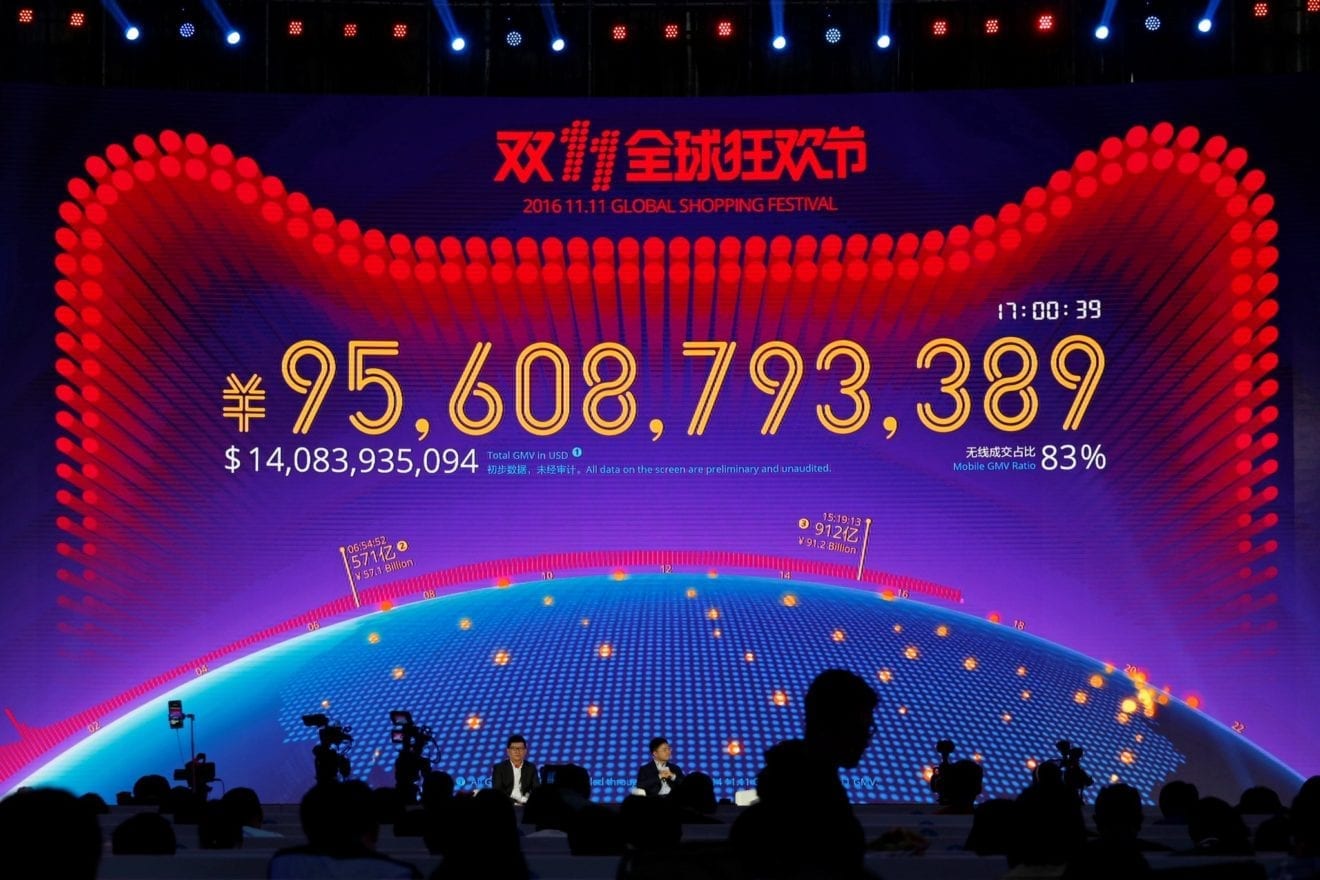
    In its tenth edition, the event has grown into the world’s largest shopping festival where 180,000 brands participate and consumers take less than two hours to spend a phenomenal 100 billion yuan ($14.5 billion).

    It is an event in its own right. Not an imitation, but something that that consistently pushes the boundaries in terms of content, tie-ins and consumption. In 2012, sales for Singles’ Day first surpassed Cyber Monday and Black Friday in the US.

    And so effectively targeting buying power has been a focus for many international marketers. Given the volume of purchases and the willingness of Chinese consumers to embrace new technologies, it is also a true testing ground for brand owners.

    Three major changes are to take our from this year’s 11.11.

    Mini-programs take centre stage

    For brands and retailers, mini-programs have become a core marketing channel.

    Considering WeChat’s active user traffic of one billion, this comes as no surprise.

    Within WeChat’s ecosystem, mini-programs provide connectivity between social, content and payment. For example, retailers in a shopping mall can distribute free parking vouchers using mini-programs and they will be able to generate information on the arrival time and spending habits, as well as which customers own a car.

    According to official figures from WeChat, as of July 2018, it had over one million mini-programs with users opening them four times per day on average.

    A survey by China’s big data service provider QuestMobile has identified the most important functions of a mini-program: effectively combining online and offline activities; sharing customer information; serving as a standalone e-commerce platform; and the ability to combine the physical aspects of a promotional campaign with social marketing.

    Growth in short videos

    Data reveals companies using short video sharing platforms, such as TikTok and Kuaishou, received the majority of the 11.11 targeted advertising traffic.

    Community is king

    In China there are Social+ platforms that present a lucrative opportunity for both content and word-of-mouth marketing. Xiaohongshu, which is backed by Alibaba, has 150 million users consisting of the social media generation born in the 90s. They use the platform like Facebook and are highly influenced by shopping tips and insight from celebrities.

    A completely different interest group is Babytree, an online parenting platform that uses a similar vertical marketing model and presents another attractive opportunity for advertisers.

    These platforms provide an engaging forum for like-minded people and are realising the tangible benefits of teaming up with major e-commerce operators.

    All the above changes highlight how brands and consumers are moving away from purely a transactional shopping experience. Instead, it’s more collaborative and relationship-based, changing the dynamics of e-commerce. There is ample evidence of this phenomenon developing in other markets.

    Lessons from the East

    At $30.8 billion, the online sales of 11.11 surpassed this year’s figures for Black Friday ($6.22 billion) and Cyber Monday ($7.9 billion) in the US. But both these figures for the US represent a 24% and 20% respective increase on last year.

    While the results illustrate a gap in retail ecosystems between the two largest economies, there is clearly a growing preference by US consumers for digital channels rather than elbowing through crowded stores the day after their Thanksgiving dinner.

    In a poll by Periscope By McKinsey in October 2018, roughly a month before the sales, nearly half of the respondents (48%) said that they plan to shop more online while fewer (28%) said they plan to do so in-store.

    China’s highly sophisticated online shopping behaviour has leapfrogged the development of retail that has been commonplace in most Western countries. In doing so, it now sets the world standard in e-commerce.

    Any marketers who want to successfully compete in this huge and attractive market need to be digital and mobile led in their strategies. But 11.11 does not just represent an opportunity for sales in China. The trends and habits should be understood as they will provide the inspiration for other markets where online spending is also growing.

    Brands that can adapt these successful models may well be able to transfer success.

  • South Koreans spending more on Chinese online stores

    South Koreans spending more on Chinese online stores

    South Koreans are spending more at Chinese online stores, according to credit-card spending data. Purchase records from November 1-26, compiled by the big data centre at Shinhan Card, showed a 9.8 per cent increase from last year in the value of goods bought from overseas internet sites. The number of transactions was up 16.6 per cent year on year.

    Chinese online stores outperformed rivals from other countries. AliExpress took 9.5 per cent of the purchases, up from 6 per cent in 2016 and 6.1 per cent last year. It ranked second after Amazon’s 16.3 per cent.

    Taobao, another Chinese Internet shopping site, grew from 2.3 per cent in 2016 to 3.3 per cent last year and to 4.4 per cent this year, raising it to the third most-used overseas online marketplace. Alibaba made it to the top 10 for the first time this year with 1 per cent.

    The shift is stark when comparing the purchases during Black Friday in the US and Singles Day in China. This year, overseas shopping during Singles Day rose 35 per cent. Black Friday purchases stopped at a 9 per cent gain.

    Data showed 70.8 per cent of purchases during Singles’ Day were for goods priced up to 50,000 won (US$44.32). Shoppers in their 30s and 40s remained the biggest clients, but the number of those in their 20s increased 1.9 percentage points from last year.

  • Big success for Korean retailers during shopping festivals

    Big success for Korean retailers during shopping festivals

    South Korean retailers enjoyed a big sales boost from annual shopping extravaganza they launched in November to join the world’s major shopping events like Black Friday in the U.S. or Single’s Day in China. According to industry sources on December 2, Lotte Department Store, one of the country’s retail majors saw its sales from Nov. 1 to 29 grow 1.1 percent against the same period last year. Sales of its hypermarket affiliate Lotte Mart also gained 1.7 percent over the same period.

    Home appliance sold especially well during the big sales period, recording a 12.5 percent jump in revenue compared to the same period last year. High-end products were also showed sharp growth – sales of expensive hanwoo or Korean beef soared 25.8 percent on year and luxury fashion items up 9 percent.

    E-Mart., another leading big-box store chain also held a mega sales event in November, slashing prices of nearly 2,000 items worth 300 billion won (US$267.4 million). It sold 180 tons of hanwoo in just four days, doubling sales against the same period last year.

    Online retailers enjoyed even bigger growth in sales through major discount events. G Market and Auction hosted Big Smile Day sales event from Nov. 1 to 11 and their sales transaction amount more than doubled compared to the same period a month earlier.

    11st.com that runs its biggest sales event on Nov. 11 every year said its daily transaction amount on this year’s big sales day reached a record high of 102 billion won. Last year, it recorded 64 billion won through the same event.

    WeMakePrice Inc. also held bargain sales from Nov 1 to 11 this year. It said the transaction amount over the period jumped 77 percent to 230 billion won compared to the same period last year. By volume, it was up 15 percent on year. The company estimated transaction amount to hit a record high of 600 billion won in November.

  • What is Black Friday like in the Philippines?

    What is Black Friday like in the Philippines?

    After Singles’ Day, the annual Black Friday shopping frenzy is back. A decades-old tradition celebrated every year the day after Thanksgiving, Black Friday marks the unofficial start of the Christmas shopping season in America.

    Together with its more recent online counterpart Cyber Monday, the sales have become a major global event over the past few years as online shopping has brought the bargains to the rest of the world.

    So what is exactly Black Friday like in emerging developing countries like the Philippines? What are Filipinos consumers’ expectations?

    Large discounts expected

    Customers will not waste the opportunity to save money on shopping.

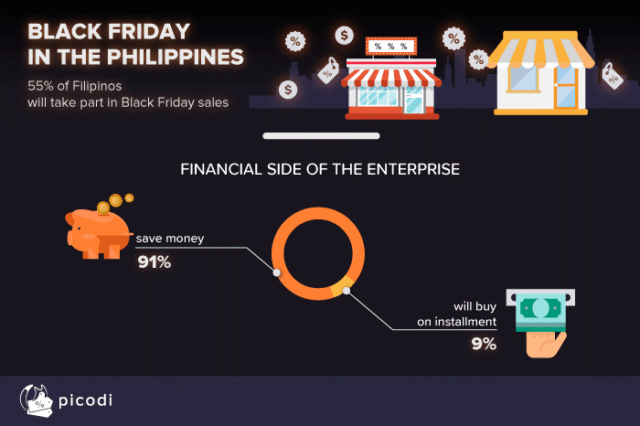
    55% of Filipinos admitted that they’re going to take part in the upcoming Black Friday sales and 91% of shoppers save money prior to Black Friday just to shop on this day.

    Let’s remember that Black Friday sales are usually associated with electronics and housewares which are the best-selling products.

    The remaining 9% declared that they are going to buy on installments.

    38% of consumers are planning to buy 2-3 products, and 36% are going to go on a shopping spree and buy more than 5 items.

    What’s more, 59% of buyers already have an idea what’s going to end up in their baskets. This can be due to the infinite number of guides to what is worth buying and how to find the biggest discounts.

    Black Friday symbolically opens the season of pre-Christmas sales. That is why it is a great opportunity for those who start searching for gifts in advance.

    38% of consumers will take advantage of Black Friday exactly for this purpose—to buy Christmas gifts.

    However, in the Philippines Black Friday is also an occasion to get a present for yourself as it is the intention of 67% of consumers.

    What does an average shopper looks like?

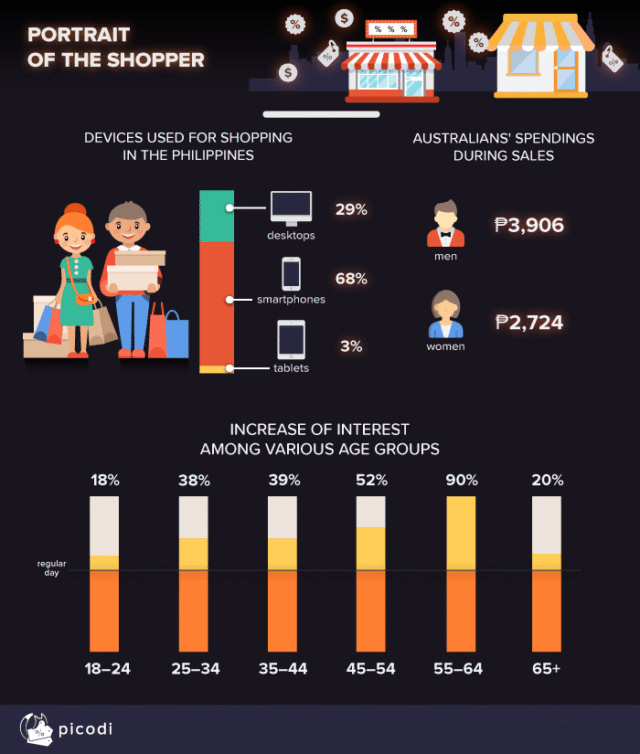
    Spending differences vary by sex. Indeed, an average man will spend more money on sales than an average woman: 3906 PHP and 2724 PHP respectively.

    When it comes to age the biggest interest for Black Friday discounts was among people aged 55-64 and 45-54.

    Statistics also say that mobile devices dominated desktops with 68% of consumers shopping on their mobile phones and 29% on desktops.

  • Korean brands stars on China’s Singles’ Day

    Korean brands stars on China’s Singles’ Day

    South Korean retailers benefited from another record-setting Nov. 11 Singles Day shopping extravaganza led by Alibaba Group of China. Since 2009, Chinese retail giant Alibaba Group has transformed Singles’ Day, which falls on Nov. 11, into an online shopping festival with large discounts offered for 24 hours.

    Over 40 percent of shoppers made purchases from international brands, said Alibaba.

    Among the countries that sold products to Chinese customers on Sunday, Korea ranked third after Japan and the United States.

    Korea placed at No. 3 on the list in 2016, but fell two ranks last year after the deployment of the U.S.-led terminal high altitude area defense (Thaad) antimissile system.

    The incident soured relations between the two countries and provoked a boycott movement against domestic brands in China.

    The exact volume of Korean goods purchased on Sunday was not disclosed, but it was evident that the shopping spree had an impact on local companies, as some of them reported record-breaking figures on Monday.

    Korea’s top beauty and personal care brand LG Household & Health Care Ltd. said on Monday that overall cosmetics sales during this year’s around-the-clock shopping gala rose 50 percent from a year ago at Tmall Global, a major e-commerce platform managed by China’s Alibaba Group.

    Sales of household items also jumped 73 percent during the same period.

    LG Household & Health Care raised 23 billion won (US$20.3 million) in sales of its flagship cosmetics label the History of Whoo during this year’s Singles Day event, up 72 percent from last year.

    Sales of luxury cosmetics brand su:m37 also jumped 82 percent during the same period mainly driven by increased demand for its Water-Full skin-care product line.

    The brand sold 26,500 sets of Water-Full line on November 11, up 208 percent from a year ago. It sold 24,400 sets of its Time Energy skin moisturizing solution, up 48 percent during the same period.

    Korea’s largest cosmetics company AmorePacific Corp. also scooped up sales on Sunday event.

    Sales of Yoonjo Essence, an activating serum of its premium cosmetics brand Sulwhasoo, hit 10,000 in just 60 seconds after launching sales at Tmall.

    Pre-order sales of Hera’s Rouge Holic lipstick also quintupled this year from last year.

    Korea’s fashion and retail conglomerate E-Land Group that manages 19 brands on Tmall raised 72.3 billion won in revenue on November 11 alone.

    Korea’s largest manufacturer of instant noodles Nongshim Co. also raked in record sales of 800 million won at Alibaba’s online shopping mall Taobao on the event day, more than tenfold from its daily average sales and up 25 percent from last year.

    The company attributed record sales to its top-sellers Shin Ramyun and Kimchi Ramyun.

    Alibaba clocked in sales of US$30.8 billion in the 24-hour shopping gala that began at 12 a.m. Sunday, beating last year’s US$25.3 billion.

  • China’s slowing economy also slows Singles Day

    China’s slowing economy also slows Singles Day

    China’s slowing economy was the primary reason for the slowing growth of sales on Alibaba’s Singles Day on Sunday. This year marked the 10th anniversary of the online shopathon, and while everyone expected a new record Gross Merchandise Volume (GMV) would be set, no-one was sure whether the spectacular 39 per cent growth rate of last year would be bettered. It wasn’t.

    While the total volume of transactions this year was 213.5 billion RMB (US$30.8 billion), the growth was a more moderate 27 per cent. Singles Day still dwarfs similar events in the US, such as Black Friday ($8 billion) and Cyber day ($6.6 billion). But are there early signs the gloss is starting to wear off?

    Pascal Martin, partner at OC&C Strategy Consultants, says the striking topline Singles Day numbers demonstrate Chinese consumers continue to love these big commercial events, which allow them to try new premium brands – normally out of reach – at more affordable price points. “Singles Day is therefore a great opportunity for brands to reach out to new customers and more and more of them are excited to join the party.”

    Martin says the reduced sales growth for Singles Day reflects a slowing Chinese economy, a view backed up by Alibaba’s recent announcement that its growth for the year would be 5 per cent lower than it initially forecast. The ongoing trade war and more cautious consumer sentiment were also factors, combined with growing competition from other big promotional events such as JD’s recent 618 shopping festival, which generated a GMV of $24.7 billion over 18 days (40 per cent growth year on year) and the high number of promotional opportunities during the year, such as Spring Festival, Labour Day in May, and Golden Week.

    Martin says growing competition from e-commerce sites that offer everyday super-low prices such as Pinduoduo, an upstart e-commerce company that went from zero to 350 million customers in just three years. “Prices on Pinduoduo are hard to beat round-the-year and the application has become hugely popular in China’s smaller cities and towns.”

    Three remarkable features

    Meanwhile, Martin says there were three remarkable features of Singles Day this year:

    New Retail: There were more brand partners this year, both online and offline, leveraging Alibaba’s New Retail ecosystem. “For example, Tmall’s 3000+ convenience stores, Hema and RT Mart supermarkets, Suning and Auchan, were all part of the event. Altogether 200,000 brick and mortar stores joined the party.”

    Globalisation: Singles Day has expanded beyond China through Lazada, the Southeast Asia platform owned by Alibaba. “We saw increased participation of international brands that are taking advantage of the Tmall Global platform – which is the number one by far among Chinese cross-border platforms – to get introduced to Chinese consumers without having to build a direct presence in China.”

    Diversification: The event is moving beyond just being about consumes purchasing products, it is also increasingly about purchasing a variety of services such as food delivery on Ele.com, videos on Youku to mobile games on UC, theatre tickets on Taopiaopiao, music on Xiami music and travel on Feizhu.

    Martin believes given China’s slowing economy Chinese consumers are becoming more cautious and the fact that Singles Day is now in its 10th year, it is less of a big news story. “There might be some consumer fatigue setting in.”

    Obstacles moving forward

    Martin believes three main challenges need to be addressed to sustain the growth momentum of massive commercial fairs like 11.11.

    Firstly, given the growing competition from other promotional events, Alibaba will have to continue to reach out to consumers earlier and earlier, and to expand the scope of the event even more broadly.

    “Another challenge is to continue to ensure flawless delivery for millions of parcels all over China in such a short amount of time. As the event grows, the logistical challenge becomes greater and greater. The number of parcels delivered during this year’s event hit 1 billion on Tmall alone. That’s a huge jump over last year’s 812 million parcels. Additionally, although brands don’t like to talk about it, there is a significant challenge in taking care of huge quantities of returned goods. Singles Day is a massive test bed for Alibaba’s backbone infrastructure: the network of partners that make it all possible, from payment to delivery to data management, as well as AI and cloud technologies that are put to work to ensure a successful event.

    “Finally, 11.11 has become much more than a commercial fair, it is now a major annual milestone in China’s cultural calendar. To keep the event fresh and exciting, Alibaba will need to continue to surprise Chinese consumers with entertainment and festivals around the event. This year, the double 11 gala event featured Miranda Kerr, Mariah Carey and Cirque Du Soleil, but no current big stars. Is this enough to continue to excite consumers, particularly younger generations?”

  • Alibaba breaks record Singles Day sales

    Alibaba breaks record Singles Day sales

    E-commerce giant Alibaba has reported a 27 per cent increase in the gross merchandise value of goods sold during yesterday’s 11.11 shopping festival. Total GMV of Singles Day sales settled through Alipay reached RMB213.5 billion (US$30.7 billion), setting a much-anticipated record – with more than 40 per cent of consumers buying through international brands. Last year’s event brought in $25.3 billion in GMV.

    According to Alibaba, RMB6.9 billion ($992 million) of GMV was settled in the first one minute and 25 seconds, and RMB69.3 billion ($9.967 billion) in one hour and 48 seconds.

    Comparatively, Amazon’s recent Prime Day sales were estimated to have reached approximately US$4.2 billion by Wedbush Securities analyst Michael Pachter.

    Australia, Japan, the US, South Korea and Germany were among the top countries selling in the event, with 230 markets having participated.

    Australian supplement retailer Swisse ranked as the top brand imported into China through the promotion.

    “Today we witnessed the strength and rise of China’s consumption economy, and consumers’ continued pursuit to upgrade their everyday lifestyles,” Alibaba Group CEO Daniel Zhang said.

    “Participation from the entire Alibaba ecosystem enabled our brand and merchant partners to engage with consumers like never before.”

    According to Texas A&M University’s Professor Venkatesh Shankar, customers globally want to buy both online and in-store, from any device and through any payment method, while getting a high level of customisation and service.

    Singles Day’s popularity across the world suggests a new chapter of computer-enhanced shopping experiences has begun..

    As the Chinese middle-class grows, retailers around the world are offering their own Singles Day offering in order to service a burgeoning market.

    “The global retail market is adjusting to China’s rising economic power, and Chinese customer’s desire for AI-enhanced mobile shopping experiences,” Shankar wrote.

  • Singles’ Day boosts Korean brands

    Singles’ Day boosts Korean brands

    China’s massive Singles’ Day shopping spree provided a huge boost to Korean retailers, with some companies posting their highest sales figures ever. Since 2009, Chinese retail giant Alibaba Group has transformed Singles’ Day, which falls on Nov. 11, into an online shopping festival with large discounts offered for 24 hours.

    Other ecommerce giants like JD.com soon followed suit, making Singles’ Day into a Chinese version of Black Friday, although much bigger.

    At Alibaba, the number of transactions on Nov. 11 has steadily increased since the event began in 2009.

    Despite concerns that the ongoing trade war between the United States and China may have put a break on the income growth of middle-class Chinese consumers this year, Singles’ Day once again broke records.

    Chinese shoppers purchased a total of 213.5 billion yuan ($30.6 billion), worth of goods on Sunday, a 27 percent surge from last year’s record. The year-on-year growth rate was slower than last year’s 39.3 percent.

    Over 40 percent of shoppers made purchases from international brands, said Alibaba.

    Among the countries that sold products to Chinese customers on Sunday, Korea ranked third after Japan and the United States.

    Korea placed at No. 3 on the list in 2016, but fell two ranks last year after the deployment of the U.S.-led terminal high altitude area defense (Thaad) antimissile system. The incident soured relations between the two countries and provoked a boycott movement against domestic brands in China.

    The exact volume of Korean goods purchased on Sunday was not disclosed, but it was evident that the shopping spree had an impact on local companies, as some of them reported record-breaking figures on Monday.

    Food company Nongshim, famous for Shin Ramyun instant noodles, set a new record for Singles’ Day revenue since it launched online sales in China in 2013.

    The company sold 5 million yuan worth of instant noodles at ecommerce website Taobao on Sunday. This was a 25-percent increase compared to last year’s Singles’ Day and 10 times the average sales made at the Chinese ecommerce website per day.

    The No. 1 best seller for Nongshim was a multipack of its eight most famous noodle brands, including Shin Ramyun, Neoguri and Kimchi Ramyun.

    “We organized huge promotional events ahead of Singles’ Day, as well as collaborating with [social media influencers in China] to air live videos of cooking Shin Ramyun,” the company said.

    Eland Group’s Chinese office sold 444 million yuan worth of fashion goods through ecommerce website Tmall.

    Based on sales records, the fashion group focused on presenting a wide array of outerwear like coats and jackets. A padded jacket from its kid’s brand, Paw in Paw, sold over 20,000 units during Singles’ Day.

    Beauty companies also did well. At LG Household & Health Care, cosmetics sales increased 50 percent compared to last year’s Singles’ Day. Daily necessities jumped even higher by 73 percent year on year. Its brand, The History of Whoo, LG’s biggest success in China, sold 23 billion won ($20.2 million) worth of products, a 72 percent increase year on year.

    Although LG did not disclose the entire sales volume, the company spokesman said that “this year has set a record for Singles’ Day.”

    Rival Amorepacific unexpectedly set positive records as well. The company has been struggling after it lost Chinese consumers in the Thaad row. On Sunday, it generated 37 percent more sales compared to Nov. 11 last year. Several products from brands like Sulwhasoo and Laneige that were prepared for the Singles’ Day promotion sold out.

  • Chinese Singles’ Day courts Vietnamese consumers

    Chinese Singles’ Day courts Vietnamese consumers

    Promoted by Alibaba in China for more than 10 years, Singles’ Day is now courting Vietnam with great fervor. More than a week before “Singles’ Day’ which falls on Nov. 11, major shopping firms in Vietnam had begun to update their mobile applications with a range of games designed to ‘hype up’ consumers.

    These included shaking the phone to earn coins (shopping vouchers), discount lotteries and ‘easter eggs’ giving specific discounts, and many more.

    Few retailers explain why Nov. 11 was chosen as the date for this promotional event, which some hail as “the biggest discount of the year.”

    Consumers and online businesses both acknowledge, however, that the marketing race building up to the day has been very fierce.

    The most boisterous claims came from Singapore based e-commerce group Lazada, which announced that it will gift 110,000 vouchers worth $10 million.

    General manager of Lazada Vietnam, Zhang YiXing, said he had spent the last three months fine-tuning Lazada’s app and working with vendors for the Nov. 11 event.

    Although they have no reason or specific connection with Alibaba, other e-commerce sites are not missing the opportunity to profit from Singles’ Day. Industry insiders remark that with competition so fierce, the ‘big players’ are implementing emulation strategies to grab whatever advantage they can get at.

    In particular, businesses do not want to stand idle during an event which increases the traffic and revenue of its rivals. So they’ve all jumped on the Singles’ Day bandwagon and made it spread further.

    “E-commerce is the most developed industry in Vietnam and also the most competitive,” said Tran Ngoc Thai Son, founder and CEO of e-commerce company Tiki.

    On the Tiki website, the company hails Nov. 11 as the “legendary sales season”, introducing a lottery to win laptops, phones and shopping vouchers with a total value of up to VND10 billion ($431,980).

    Meanwhile, Shopee, a consumer Internet platform provider based in Singapore, has called this day the “Super Sale.” The company has also launched a game consumers can play to earn rewards and has been promoting a different product line each day to attract attention before the official event.

    Lotte.vn has also jumped into the fray in dramatic fashion, calling the event the “Nov. 11 shopping war”, while Adayroi, run by Vietnam’s biggest private conglomerate Vingroup, has launched a full week of promotions from Nov. 1-11 with its “Sale Season”.

    Experts say that in addition to price, this years’ competing retailers have also focused more on branded goods and after-sales service.

    “Technology is no longer a challenge for Vietnam’s e-commerce sector but consumer confidence. Now choosing products and discounts from a trusted retailer is also important, not just price,” said Le Hai Binh, vice president of the Vietnam E-commerce Association.

    “Delivery and after-sales services are competitive advantages that cannot be ignored in this race.”

    Lucrative day

    Although not as fierce as this year, last Nov. 11 had made ‘a killing’ for retailers, encouraging them to step up promotions this year.

    According to data released by France-based commerce marketing company Criteo, retail sales of online shopping sites in Vietnam during the last Single’s Day campaign increased 245 percent, compared with ordinary days in the year, and marked a 70 percent increase in traffic.

    Last Nov. 11, traffic increased the most in the evening, from about 9 p.m. onwards. Shopping time “peaked” at 11 p.m., which is one hour before promotions end, so consumers were rushing to finish their shopping.

    The two most popular items last year were home appliances and electronics, with sales soaring by over 276 percent and 266 percent respectively compared to ordinary days.

    Silvia Siow, Criteo’s chief customer strategy manager for Southeast Asia, Hong Kong and Taiwan, said that these two categories were best sellers because of their high value. People tended to wait for promotions to cash in on significant discounts in absolute terms. Siow also said that Nov. 11 was playing a growing role in Southeast Asia, not just Vietnam.

    He said the real gains from Nov. 11 were not in sales but an expanded customer base and increased market share.

    “Sales are important, but traffic is more important. Increased traffic may represent newcomers who arrive and discover or rediscover products. “

    The heat of the Nov. 11 race in Vietnam is expected to last many years as it is the second most dynamic e-commerce market in Southeast Asia, behind Indonesia.

    Economist Simon Baptis, CEO of Asia region for the Economist Intelligence Unit (Economist Group) said: “Vietnam will be one of the fastest growing economies in the region with real growth constant at a high level between 2019 and 2023.

    “Reinforcing consumer confidence in e-commerce and electronic payment systems is also a need of the period.”

  • What is Singles’ Day like in the Philippines?

    What is Singles’ Day like in the Philippines?

    It all started with a few students from Nanjing University who decided to break away from the monotony of being single for one day. They chose 11.11 because of the solitary implications of the number 1 which symbolize being single. However, this simple celebration turned into one of the largest shopping days in the world.

    It turns out that this event gained great interest also in Southeast Asia.

    According to Google, in Philippines the popularity of Singles’ Day has increased more than four times in the last five years.

    Who’s taking part in Singles’ Day? What are the behaviours of consumers on that day? 

    Shopping therapy for the young and lonely

    Who shops on Singles' Day

    So, who exactly takes part in Singles’ Day?

    57% are actually women.

    In accordance with the event’s name, three out of four consumers are single.

    Of course, not only singles went on a shopping spree.

    An increase in interest, although not as significant as among singles, can also be noted in the group of people in relationships.

    The interest in Singles’ Day is especially apparent among young Filipinos.

    Compared to a regular day, the number of transactions on Singles’ Day among people aged 18-24 grew by 1022%.

    However, getting great discounts is not restricted to younger people as there is a noticeable interest in this shopping festival among all age groups.

    The day for singles to indulge themselves

    What and how Filipinos buy on 11.11

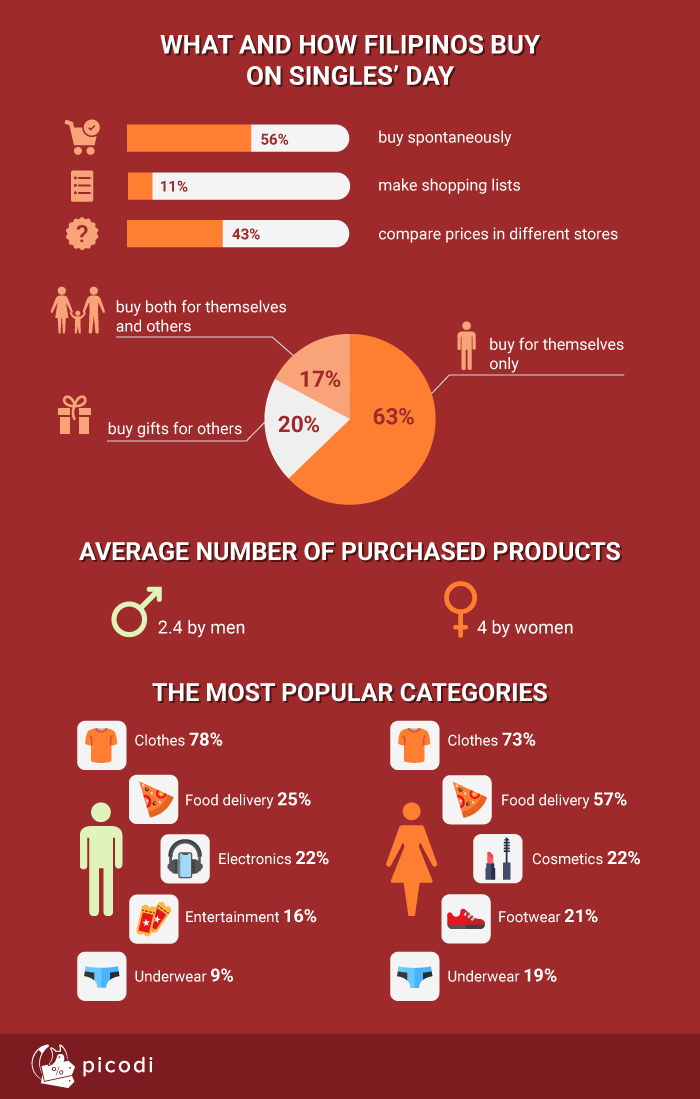
    More than half of Filipinos do not prepare for the Singles’ Day shopping craze but buy impulsively on that day.

    43% compare the prices in different stores while 11% make lists before shopping.

    It looks like most people treat 11.11 as an occasion to meet their desires rather than an opportunity to execute a well-thought-out shopping plan.

    On top of that, more than 60% of consumers buy things just for themselves and only one-third buy gifts for other people on that day.

    An average man buys less than an average woman—2.4 and 4 products respectively.

    The most desirable items among men are clothes, delivery food and electronics. Similarly, women buy mostly clothes, delivery food and cosmetics.

    Shopping fever in the middle of the day

    Shopping behaviours on Singles' Day

    It’s not surprising that Filipinos buy more than usual on Singles’ Day.

    The number of online transactions increased significantly with 970% more purchases compared to a regular day.

    On average, a Filipino is willing to spend 3050 PHP on a Singles’ Day shopping spree and sales reached a peak right in the middle of the day, at 1 PM.

    Mobile users far behind

    Singles' Day: Devices types and brands

    70% of consumers use desktops when doing their shopping on Singles’ Day.

    Only 26% of Filipinos make their purchases on mobile phones.

    Most of the transactions are made on Apple devices, followed by Samsung, OPPO, Asus and Huawei appliances.