Tag: Singles Day

  • Singles’ Day boosts Korean brands

    Singles’ Day boosts Korean brands

    China’s massive Singles’ Day shopping spree provided a huge boost to Korean retailers, with some companies posting their highest sales figures ever. Since 2009, Chinese retail giant Alibaba Group has transformed Singles’ Day, which falls on Nov. 11, into an online shopping festival with large discounts offered for 24 hours.

    Other ecommerce giants like JD.com soon followed suit, making Singles’ Day into a Chinese version of Black Friday, although much bigger.

    At Alibaba, the number of transactions on Nov. 11 has steadily increased since the event began in 2009.

    Despite concerns that the ongoing trade war between the United States and China may have put a break on the income growth of middle-class Chinese consumers this year, Singles’ Day once again broke records.

    Chinese shoppers purchased a total of 213.5 billion yuan ($30.6 billion), worth of goods on Sunday, a 27 percent surge from last year’s record. The year-on-year growth rate was slower than last year’s 39.3 percent.

    Over 40 percent of shoppers made purchases from international brands, said Alibaba.

    Among the countries that sold products to Chinese customers on Sunday, Korea ranked third after Japan and the United States.

    Korea placed at No. 3 on the list in 2016, but fell two ranks last year after the deployment of the U.S.-led terminal high altitude area defense (Thaad) antimissile system. The incident soured relations between the two countries and provoked a boycott movement against domestic brands in China.

    The exact volume of Korean goods purchased on Sunday was not disclosed, but it was evident that the shopping spree had an impact on local companies, as some of them reported record-breaking figures on Monday.

    Food company Nongshim, famous for Shin Ramyun instant noodles, set a new record for Singles’ Day revenue since it launched online sales in China in 2013.

    The company sold 5 million yuan worth of instant noodles at ecommerce website Taobao on Sunday. This was a 25-percent increase compared to last year’s Singles’ Day and 10 times the average sales made at the Chinese ecommerce website per day.

    The No. 1 best seller for Nongshim was a multipack of its eight most famous noodle brands, including Shin Ramyun, Neoguri and Kimchi Ramyun.

    “We organized huge promotional events ahead of Singles’ Day, as well as collaborating with [social media influencers in China] to air live videos of cooking Shin Ramyun,” the company said.

    Eland Group’s Chinese office sold 444 million yuan worth of fashion goods through ecommerce website Tmall.

    Based on sales records, the fashion group focused on presenting a wide array of outerwear like coats and jackets. A padded jacket from its kid’s brand, Paw in Paw, sold over 20,000 units during Singles’ Day.

    Beauty companies also did well. At LG Household & Health Care, cosmetics sales increased 50 percent compared to last year’s Singles’ Day. Daily necessities jumped even higher by 73 percent year on year. Its brand, The History of Whoo, LG’s biggest success in China, sold 23 billion won ($20.2 million) worth of products, a 72 percent increase year on year.

    Although LG did not disclose the entire sales volume, the company spokesman said that “this year has set a record for Singles’ Day.”

    Rival Amorepacific unexpectedly set positive records as well. The company has been struggling after it lost Chinese consumers in the Thaad row. On Sunday, it generated 37 percent more sales compared to Nov. 11 last year. Several products from brands like Sulwhasoo and Laneige that were prepared for the Singles’ Day promotion sold out.

  • Chinese Singles’ Day courts Vietnamese consumers

    Chinese Singles’ Day courts Vietnamese consumers

    Promoted by Alibaba in China for more than 10 years, Singles’ Day is now courting Vietnam with great fervor. More than a week before “Singles’ Day’ which falls on Nov. 11, major shopping firms in Vietnam had begun to update their mobile applications with a range of games designed to ‘hype up’ consumers.

    These included shaking the phone to earn coins (shopping vouchers), discount lotteries and ‘easter eggs’ giving specific discounts, and many more.

    Few retailers explain why Nov. 11 was chosen as the date for this promotional event, which some hail as “the biggest discount of the year.”

    Consumers and online businesses both acknowledge, however, that the marketing race building up to the day has been very fierce.

    The most boisterous claims came from Singapore based e-commerce group Lazada, which announced that it will gift 110,000 vouchers worth $10 million.

    General manager of Lazada Vietnam, Zhang YiXing, said he had spent the last three months fine-tuning Lazada’s app and working with vendors for the Nov. 11 event.

    Although they have no reason or specific connection with Alibaba, other e-commerce sites are not missing the opportunity to profit from Singles’ Day. Industry insiders remark that with competition so fierce, the ‘big players’ are implementing emulation strategies to grab whatever advantage they can get at.

    In particular, businesses do not want to stand idle during an event which increases the traffic and revenue of its rivals. So they’ve all jumped on the Singles’ Day bandwagon and made it spread further.

    “E-commerce is the most developed industry in Vietnam and also the most competitive,” said Tran Ngoc Thai Son, founder and CEO of e-commerce company Tiki.

    On the Tiki website, the company hails Nov. 11 as the “legendary sales season”, introducing a lottery to win laptops, phones and shopping vouchers with a total value of up to VND10 billion ($431,980).

    Meanwhile, Shopee, a consumer Internet platform provider based in Singapore, has called this day the “Super Sale.” The company has also launched a game consumers can play to earn rewards and has been promoting a different product line each day to attract attention before the official event.

    Lotte.vn has also jumped into the fray in dramatic fashion, calling the event the “Nov. 11 shopping war”, while Adayroi, run by Vietnam’s biggest private conglomerate Vingroup, has launched a full week of promotions from Nov. 1-11 with its “Sale Season”.

    Experts say that in addition to price, this years’ competing retailers have also focused more on branded goods and after-sales service.

    “Technology is no longer a challenge for Vietnam’s e-commerce sector but consumer confidence. Now choosing products and discounts from a trusted retailer is also important, not just price,” said Le Hai Binh, vice president of the Vietnam E-commerce Association.

    “Delivery and after-sales services are competitive advantages that cannot be ignored in this race.”

    Lucrative day

    Although not as fierce as this year, last Nov. 11 had made ‘a killing’ for retailers, encouraging them to step up promotions this year.

    According to data released by France-based commerce marketing company Criteo, retail sales of online shopping sites in Vietnam during the last Single’s Day campaign increased 245 percent, compared with ordinary days in the year, and marked a 70 percent increase in traffic.

    Last Nov. 11, traffic increased the most in the evening, from about 9 p.m. onwards. Shopping time “peaked” at 11 p.m., which is one hour before promotions end, so consumers were rushing to finish their shopping.

    The two most popular items last year were home appliances and electronics, with sales soaring by over 276 percent and 266 percent respectively compared to ordinary days.

    Silvia Siow, Criteo’s chief customer strategy manager for Southeast Asia, Hong Kong and Taiwan, said that these two categories were best sellers because of their high value. People tended to wait for promotions to cash in on significant discounts in absolute terms. Siow also said that Nov. 11 was playing a growing role in Southeast Asia, not just Vietnam.

    He said the real gains from Nov. 11 were not in sales but an expanded customer base and increased market share.

    “Sales are important, but traffic is more important. Increased traffic may represent newcomers who arrive and discover or rediscover products. “

    The heat of the Nov. 11 race in Vietnam is expected to last many years as it is the second most dynamic e-commerce market in Southeast Asia, behind Indonesia.

    Economist Simon Baptis, CEO of Asia region for the Economist Intelligence Unit (Economist Group) said: “Vietnam will be one of the fastest growing economies in the region with real growth constant at a high level between 2019 and 2023.

    “Reinforcing consumer confidence in e-commerce and electronic payment systems is also a need of the period.”

  • What is Singles’ Day like in the Philippines?

    What is Singles’ Day like in the Philippines?

    It all started with a few students from Nanjing University who decided to break away from the monotony of being single for one day. They chose 11.11 because of the solitary implications of the number 1 which symbolize being single. However, this simple celebration turned into one of the largest shopping days in the world.

    It turns out that this event gained great interest also in Southeast Asia.

    According to Google, in Philippines the popularity of Singles’ Day has increased more than four times in the last five years.

    Who’s taking part in Singles’ Day? What are the behaviours of consumers on that day? 

    Shopping therapy for the young and lonely

    Who shops on Singles' Day

    So, who exactly takes part in Singles’ Day?

    57% are actually women.

    In accordance with the event’s name, three out of four consumers are single.

    Of course, not only singles went on a shopping spree.

    An increase in interest, although not as significant as among singles, can also be noted in the group of people in relationships.

    The interest in Singles’ Day is especially apparent among young Filipinos.

    Compared to a regular day, the number of transactions on Singles’ Day among people aged 18-24 grew by 1022%.

    However, getting great discounts is not restricted to younger people as there is a noticeable interest in this shopping festival among all age groups.

    The day for singles to indulge themselves

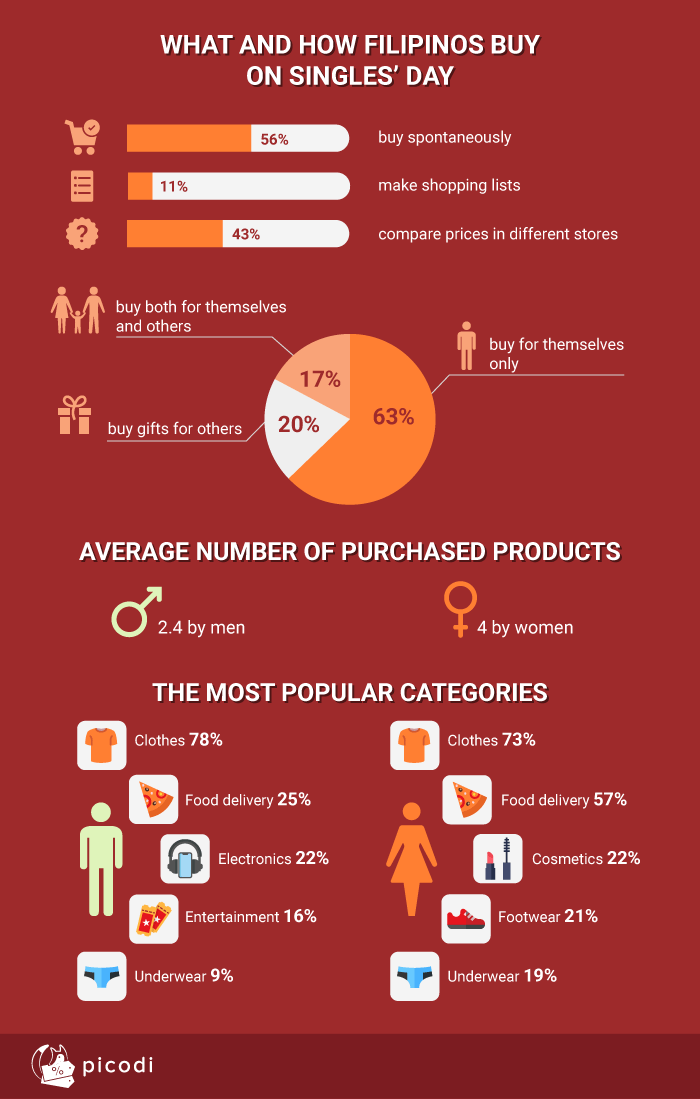
    What and how Filipinos buy on 11.11

    More than half of Filipinos do not prepare for the Singles’ Day shopping craze but buy impulsively on that day.

    43% compare the prices in different stores while 11% make lists before shopping.

    It looks like most people treat 11.11 as an occasion to meet their desires rather than an opportunity to execute a well-thought-out shopping plan.

    On top of that, more than 60% of consumers buy things just for themselves and only one-third buy gifts for other people on that day.

    An average man buys less than an average woman—2.4 and 4 products respectively.

    The most desirable items among men are clothes, delivery food and electronics. Similarly, women buy mostly clothes, delivery food and cosmetics.

    Shopping fever in the middle of the day

    Shopping behaviours on Singles' Day

    It’s not surprising that Filipinos buy more than usual on Singles’ Day.

    The number of online transactions increased significantly with 970% more purchases compared to a regular day.

    On average, a Filipino is willing to spend 3050 PHP on a Singles’ Day shopping spree and sales reached a peak right in the middle of the day, at 1 PM.

    Mobile users far behind

    Singles' Day: Devices types and brands

    70% of consumers use desktops when doing their shopping on Singles’ Day.

    Only 26% of Filipinos make their purchases on mobile phones.

    Most of the transactions are made on Apple devices, followed by Samsung, OPPO, Asus and Huawei appliances.

  • Tmall, Swire Properties launch New Retail initiative

    Tmall, Swire Properties launch New Retail initiative

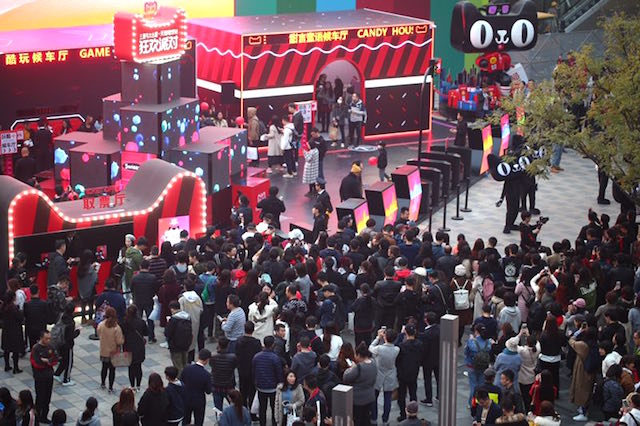
    Alibaba Group’s Tmall and Swire Properties are launching a New Retail initiative creating tailored retail experiences at Swire Properties’ five shopping malls in Mainland China. The partnership will bring benefits to customers in time for Alibaba’s 11.11 Global Shopping Festival on Sunday with Taikoo Li Sanlitun in Beijing the first brick-and-mortar shopping mall in Mainland China to experience this year’s 11.11 “red packet rain” this week.

    Swire Properties will introduce Tmall’s New Retail technologies at five of its developments: Taikoo Li Sanlitun and Indigo in Beijing; HKRI Taikoo Hui in Shanghai; Taikoo Hui in Guangzhou and Sino-Ocean Taikoo Li in Chengdu. The five New Retail initiatives include Tmall Smart Stores, a Tmall Pop-Up Store, Interactive Idol Engagement Photo Booths, Smart Nursery Rooms and a Smart Parking Service.

    Tmall Smart Stores: Shoppers will enjoy a seamless online and offline shopping experience from order to delivery (for participating physical stores). By signing up as members of selected brands, customers can instantly receive details on the latest promotions, and enjoy a return service by simply using their digital devices.

    Tmall Pop-Up Store: Tmall will open an interactive pop-up store featuring cutting-edge technology at Taikoo Li Sanlitun. This nine-day promotion during the Festival will offer shoppers in-depth and enhanced experiences.

    Interactive Idol Engagement Photo Booth: Fans will have a chance to ‘virtually interact with’ and snap a photo with their idol. This is the first-of-its-kind check-in hot spot in Mainland China.

    Smart Nursery Rooms: These offer mothers a relaxing and private space where they can nurse their babies at shopping malls. Vending machines will also offer essential nursing necessities.

    Smart Parking Service: By linking Alipay with their car license plates, drivers can pay parking fees with ease. This service will save drivers 80 per cent of the time usually spent on paying the parking charge and exiting the car park.

    “At Swire Properties, we are always looking for new ways to innovate and integrate the latest technologies into our business, so that we can bring unique experiences to our customers,” said Han Zhi, director, retail at Swire Properties. “Our collaboration with Tmall is a powerful example of digitisation. By harnessing rapidly developing online technologies and big data, our goal is to define the New Retail shopping experience.

    “This year marks the 10th anniversary of Taikoo Li Sanlitun and Alibaba’s 11.11 Global Shopping Festival, both of which have grown in leaps and bounds the past decade. We’re confident that our partnership, which also celebrates this milestone, will set a new benchmark in our respective industries and in the digital space.”

  • High Suning profit increase reported

    High Suning profit increase reported

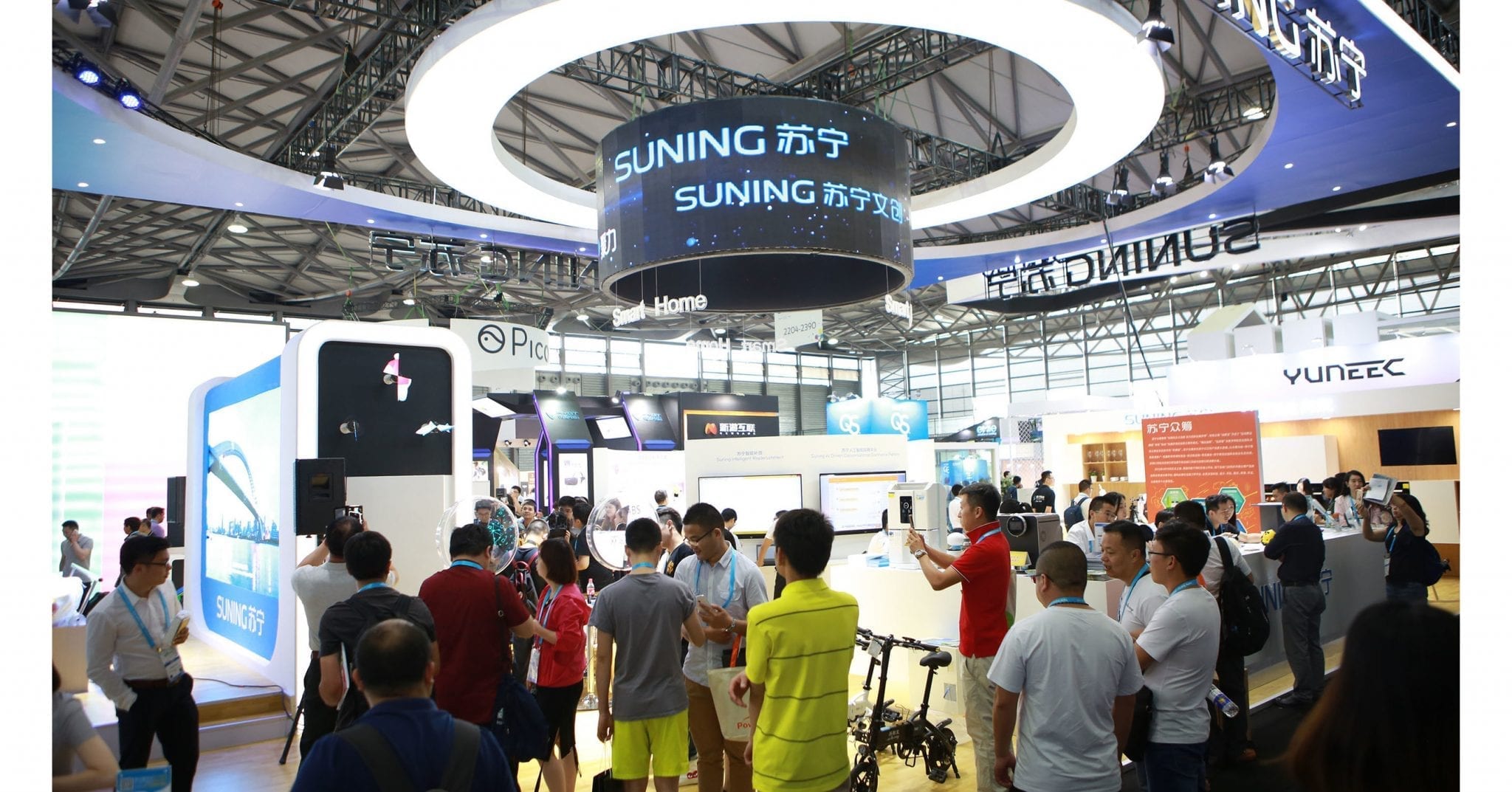
    Chinese O2O retailer Suning has posted RMB172.97 billion (US$24.79 billion) in operating revenue in its third quarter performance report. The result shows a 31.15 per cent year-on-year increase on the reported figure during the first three quarters this year. The company also generated a net profit of RMB6.127 billion ($878 million), an increase of 812.11 per cent over the same period last year.

    The company credits the result to the strength of Suning’s fast-growing online sales comparative to other e-commerce platforms.

    Suning currently has more than 382 million registered users. It operates 6292 direct-sale physical stores and 1453 Suning retail cloud franchise stores.

    Suning says it will provide free delivery in the days approaching the holiday the 11.11 Singles Day shopping spree and will not raise its delivery fees on the day.

  • Alibaba Group Puts Spotlight on Indonesian Brands

    Alibaba Group Puts Spotlight on Indonesian Brands

    Chinese e-commerce giant Alibaba launched a special section for Indonesian products on its platform on Friday to promote the country’s best products to more than a billion Chinese consumers. The section, known as the Indonesian Pavilion, debuted on Alibaba’s Tmall Global, a platform dedicated to helping international retail brands and entrepreneurs reach out to the Chinese market despite not having a presence in the country.

    Indonesian Ambassador Djauhari Oratmangun and Ryan Wang, general manager of public affairs at Tmall, inaugurated the special section during an event in Shanghai.

    The Indonesian Pavilion was launched in time for Alibaba’s 2018 11.11 Global Shopping Festival, the world’s largest one-day shopping event, which takes place on Nov. 11 every year.

    The section will initially offer five leading Indonesian food and beverage brands: Indomie instant noodles, Kapal Api packaged coffee, Richeese biscuits, Yan Ty Ty swallow’s nests and Papatonk shrimp crackers.

    Through Tmall’s integrated service center, brands can increase consumer awareness of their products ahead of the upcoming shopping festival.

    Chinese consumers will also have a chance to learn about Indonesia’s cultural richness and exotic tourist destination, which will also be featured on the platform.

    This forms part of Alibaba’s ongoing initiatives over the past few years to support Indonesian startups and small and medium enterprises.

    Jack Ma, Alibaba chairman and co-founder, serves on Indonesia’s digital economy board, advising the government on how to best nurture and implement digital technology to drive development.

    The government and Alibaba are also discussing ways to help Indonesia train local talent in the digital field and increase innovations in financial technology.

  • Singles Day 2018 faces delivery challenges

    Singles Day 2018 faces delivery challenges

    Alibaba and its partner retailers will face a massive challenge ensuring flawless delivery of millions of parcels all over China and beyond given the expectations of further growth on Singles Day 2018 next week.

    “As the event grows, the logistics challenge becomes bigger and bigger,” observes retail analyst Pascal Martin, partner at OC&C Strategy Consultants.

    “During last year’s event 812 million parcels were delivered just on Tmall. Observers are betting that this year’s milestone might be more than 1 billion parcels.”

    And, says Martin, although brands don’t like to talk about it, there is also a huge challenge in taking care of large quantities of returned goods.

    “11.11 is a massive test bed for Alibaba’s backbone infrastructure: the network of partners that make it all possible, from payment to delivery to data management, as well as AI and cloud technologies that are put to work to ensure a successful event.”

    Alibaba’s Cainiao Smart Logistics Network says it has upgraded its technology to cope with the expected increased volumes from 11.11 this year. The company boasts more than 30 million sqm of warehousing worldwide and a logistics field force of more than 3 million people.

    Domestically, Cainiao has opened a new robotic warehouse, expanded its Internet of Things (IoT) systems and built out its platform’s last-mile reach. For cross-border deliveries, more than 1000 shipping containers and 51 charter planes are booked, ready to speed orders across the world.

    Cainiao VP Ben Wang says while nobody knows how many orders Singles Day 2018 will generate, the logistics company needs to keep upgrading systems, anticipating growth and seeking higher efficiency, because of customer expectations.

    “It was only five years ago that parcel orders surpassed 100 million for the first time. Back then it took nine days to deliver the first 100 million parcels,” said Wang. “Last year, it took less than three days (2.8 days) to deliver the same number of parcels. Consumers increasingly want faster, better delivery, so that’s what we’re doing. This year, we’re striving to achieve a new high, leveraging the beauty of scale and technology.”

    Delivery “within minutes”

    Cainiao’s preparations this year also reflect the changing demands of logistics in the New Retail era. For the first time, goods ordered during 11.11 will be delivered directly from stores to customers during the Festival – sometimes within minutes. Short-distance delivery services will be available in more than 280 cities.

    “Cainiao is the logistics backbone of Alibaba’s New Retail strategy,” Wang said. “We are providing an online and offline, cross-platform supply-chain solution to merchants and enabling them to cut inventory costs, while increasing operating efficiency, especially around 11.11 ­– the busiest season of the year. Ultimately, consumers will enjoy a brand-new shopping experience, as delivery service will always be on-demand.”

    Martin expects Singles Day 2018 to include more partners, not only online but also offline, leveraging Alibaba’s New Retail ecosystem. For example, Tmall 3000+ convenience stores, Hema and RT Mart supermarkets, Suning and Auchan, will be fully integrated into the event.

    The event will also be expanding beyond China through Lazada, the Southeast Asia online platform owned by Alibaba.

    “We expect to see participation of an increasing number of international brands that are taking advantage of the Tmall Global platform – number one by far among Chinese cross-border platforms – to get introduced to Chinese consumers without any direct presence in China for many of them.”

    And diversification will be another key factor in this year’s event, he says.

    “It’s not just about purchasing products, it’s also increasingly about purchasing a variety of services, from videos on Youku to mobile games on UC, theatre tickets on Taopiaopiao, music on Xiami music, travel on Feizhu, etc… All of this will not happen without challenges.”

    Yet another test, says Martin, is for Alibaba to expand the event beyond its group companies.

    “Right now, most of the non-Tmall companies participating in the 11.11 event are Alibaba Group companies. Getting non-group companies to embark on the 11.11 band wagon will be the next step to sustain continued growth of the event in future years.

    “Finally, to keep the event fresh and exciting, Alibaba will need to continue to surprise increasingly demanding Chinese consumers with entertainment and festivals to delight them around the event. 11.11 has become much more than a commercial fair, it is now a major annual milestone in China’s cultural calendar.”

    Last year’s 11.11 event saw GMV reach 254 billion RMB (US$36.6 billion) including 168 billion RMB on Tmall alone. That turnover represented a 43.5 per cent increase over the 2016 GMV.

    Singles Day 2018 will mark the event’s 10th anniversary.

  • Alibaba to thank New Retail for Its record sales

    Alibaba to thank New Retail for Its record sales

    Continuing momentum in Alibaba Group’s New Retail business helped drive a 56 per cent year-on-year growth in sales for the quarter to December 31.

    The performance of the New Retail category – which combines its online (non-marketplace) and fast-growing offline retail businesses, including investments in Sun Art Retail and other established businesses – was a core highlight of the quarter, according to CEO Daniel Zhang.

    “Alibaba had another great quarter driven by the continued strength of the Chinese consumer and the wide and innovative range of services we provide for merchants and consumers,” he said.

    “We are excited by the continued momentum in New Retail, which came to life during another record-breaking 11.11 Global Shopping Festival. We expanded the scale and footprint of our New Retail initiatives with the vision of delivering true convergence of the online and offline consumer experience through mobile and enterprise technology.”

    Maggie Wu, CFO, said the group’s core business generated significant free cash flow of US$7.1 billion during the quarter, “enabling us to invest in New Retail, cloud computing, digital entertainment and globalisation”.

    Revenue from core online commerce (marketplace) activities rose 57 per cent to US$11.257 billion and from cloud computing by 104 per cent to $553 million. Digital media and entertainment sales rose 33 per cent to $832 million.

    The number of annual active consumers on Alibaba Group’s China retail marketplaces reached 515 million, an increase of 27 million from the year to September 30.

    Net income was $3.586 billion with operating margin was 31 per cent and adjusted EBITA margin for the core e-commerce business 53 per cent.

    Group highlights

    Alibaba summarised group highlights in its earnings statement, including:

    Taobao: Artificial Intelligence (AI) drove user engagement, with the Taobao app’s intelligent personal recommendations and innovative content formats continuing to drive strong growth in user engagement, conversion and annual active consumers. “We continue to invest in machine learning technologies which we apply to use cases that match consumer intent and product selection to deliver the best consumer experience.”

    Tmall: Tmall recorded 43 per cent year-on-year growth in physical goods GMV during the quarter, reflecting robust growth across all major categories including apparel and accessories, consumer electronics (mobile phones) and FMCG. “Tmall continues to be the platform of choice for the world’s top brands, with Givenchy, Giorgio Armani Beauty and Volvo establishing Tmall flagship stores and Longines, Hennessy, Dom Perignon and Baccarat joining our Luxury Pavilion in this quarter.”

    11.11: Last year’s annual November 11 Global Shopping Festival exceeded the previous year’s records, with GMV settled through Alipay on Alibaba’s marketplaces up 39 per cent year-on-year to $25.9 billion. “The continuous success of this record-breaking event is enabled by our resilient and scalable technology, as well as payments and logistics infrastructure that is capable of operating at massive scale.”

    New Retail: Rapid expansion through partnerships and innovative technologies included the opening of five new Hema fresh grocery stores in Shanghai, Beijing, Ningbo and Suzhou, taking the network to 25 at year end. “Hema exemplifies the convergence of online and offline retail by leveraging our in-store proprietary technology, digitised supply chain system, consumer insights and mobile ecosystem to provide a seamless experience for consumers.”

    In November, Alibaba formed a strategic alliance with Sun Art Group, the leading hypermarket and supermarket chain by revenue in China with over 440 stores nationwide. “Through this partnership, we aim to equip traditional retailers with our proprietary technology and know-how in online offline convergence to implement their digital transformation. In addition, the partnership with Sun Art will also enable us to accelerate the expansion of our New Retail offerings with national scale.

    International:  Alibaba’s cross-border and international retail businesses continue to show strong growth. Revenue from international commerce retail business reached $727 million in the, representing 93 per cent year-on-year growth, driven by its Southeast Asian platform Lazada and its global retail marketplace AliExpress. “While the markets for Southeast Asia and cross-border commerce remain very competitive, they are in the early innings of the game. We are optimistic about the long-term secular growth prospects of our international markets and will therefore continue to make significant investments for market share growth and focusing on the best customer experience.”

    Cainiao Network: Alibaba’s logistics division, Cainiao Network, processed 812 million orders during the 11.11 event. Cainiao Network operates an electronic shipping label system that standardises shipping data into structured formats, which enables efficient pick-and-pack operations for merchants and sorting and routing operations for delivery partners. “The advantages of this system have resulted in broad adoption by merchants and logistics service providers, both on and off our platforms, putting us in position to serve the growing consumption economy in China and roll out our New Retail strategy.”

    Cloud Computing:  Cloud computing revenue grew 104 per cent year-over-year to $553 million, driven by both robust growth in paying customers and revenue mix toward higher value-add product.  “In the December quarter, Alibaba Cloud launched 396 new products and features and continued to introduce proprietary AI technologies to tackle real-world challenges, such as traffic planning and optimising efficiency in manufacturing and airport operations. Alibaba Cloud continues to expand its customer base across a variety of industries.”

    Alibaba Cloud customers include Watsons China, carmaker Geely, and Beijing Capital International Airport.

    Digital Media and Entertainment: During the quarter, Youku video’s daily average subscribers more than doubled year-on-year, driven by several original drama series and shows that became popular hits with users.

    AI and innovation: Alibaba says its AI-powered voice assistant, Tmall Genie, surpassed 1 million unit sales since its official launch in July and the end of the year. “Tmall Genie is supported by a growing collection of sales and services and is an effective vehicle for offering a comprehensive set of every-day living applications within the Alibaba ecosystem,” the company said.

    In January, Alibaba’s Institute of Data Science Technologies (iDST), its AI research arm, developed a deep-learning neural network for natural language processing that scored higher than humans on a Stanford reading-comprehension test, the first time a machine has outperformed humans on such a test. “This development underscores Alibaba’s commitment to technology research which we believe builds the foundation for our growth in the long run.”

    Ant Financial: Alibaba Group agreed to take a 33 per cent equity stake in Ant Financial that will strengthen its strategic relationship pursuant to the series of agreements reached with Ant Financial in 2014. “We believe deepening our relationship through an equity stake in Ant Financial will bring key strategic benefits to us, including advancing our New Retail strategy with mobile payments, increasing user acquisition and retention through collaboration with the Alipay digital wallet (Alipay Wallet), and enhancing the execution of our international expansion.”

    The number of Alipay Wallet’s daily active users more than doubled during the quarter on a year-on-year basis.

  • Black Friday crushes Singles’ Day Chatter in Southeast Asia

    Black Friday crushes Singles’ Day Chatter in Southeast Asia

    Bigger is not always better – or so retailers are discovering following the conclusion of the biggest shopping extravaganzas.

    While Singles’ Day hit a record US$25.3 billion dollars in sales, it was Black Friday and Cyber Monday that dominated social media chatter in Singapore, Malaysia and Indonesia.

    Meltwater, a global media intelligence company, tracked online reactions in the lead-up to – and during – Singles’ Day, Black Friday and Cyber Monday and found that over eight in ten conversations (82.92%) online were focused on Black Friday and Cyber Monday.

    “The rise of Singles’ Day in recent years has been astronomical, breaking records every year and drawing interest from around the globe. While it’s clear that Chinese consumers are spending and talking about Singles’ Day, this massive spend and conversation in China seems to have translated poorly to other markets in Southeast Asia. Black Friday and Cyber Monday still prevail, highlighting the fact that these markets have yet to be fully penetrated by the Chinese phenomenon,” said Neil Brennan, Area Director, Meltwater Japan and South East Asia.

    Meltwater tracked online perceptions across Facebook, Twitter, Instagram, YouTube, blogs, forums, message boards and review sites from 28 October to 28 November 2017.

    Indonesia generates maximum buzz

    Regionally, Indonesia led the way driving the highest volume of online chatter with 88.6% of conversations centered around Black Friday and Cyber Monday.

    Out of the three markets monitored, Singapore generated the most social media buzz for Singles’ Day, accounting for 22.14% of the conversations, followed closely by Malaysia at 21.97%.

    Share of Voice Regional Singapore Malaysia Indonesia
    Singles’ Day 17.08% 22.14% 21.97% 11.4%
    Black Friday & Cyber Monday 82.92% 77.86% 78.03% 88.6%


    Alibaba for the win

    Conversations across all countries typically revolved around finding good deals and offers from specific retailers. It is noteworthy that Alibaba was a major source of online chatter thanks to its record breaking sales figures. Lazada, backed by Alibaba, also drew a considerable amount of chatter following their Singles’ Day push. The largest trending topic in Indonesia was Taman Anggrek, a famous mall located in Jakarta, known for being one of the biggest in Southeast Asia.

    Trending Keywords Black Friday & Cyber Monday Singles’ Day
    Regional
    1. Sales
    2. Amazon
    3. Best Buy
    1. Alibaba
    2. Lazada
    3. China
    Singapore
    1. Black Friday Sales
    2. Free Shipping
    3. Amazon
    1. Lazada Sale
    2. Taobao Buying Guide
    3. Qoo10 Deals
    Malaysia
    1. Amazon
    2. Black Friday Sales
    3. Cyber Monday Sales
    1. Alibaba
    2. Singles’ Sale
    3. China
    Indonesia
    1. Amazon
    2. Best Buy
    3. Black Friday
    1. Taman Anggrek
    2. Singles’ Sale
    3. Alibaba


    How the platforms stacked up

    A majority of the conversations took place on Twitter, Instagram and online forums. Twitter emerged as the top platform contributing to more than half of all conversations about Singles’ Day and over 85% of chatter on Black Friday and Cyber Monday.

    # Top Three Platforms – Black Friday & Cyber Monday
    1 Twitter – 86.51%
    2 Instagram – 6.81%
    3 Forums – 6.53%


    # Top Three Platforms – Singles’ Day
    1 Twitter – 57.92%
    2 Instagram – 29.67%
    3 Forums – 11.68%


  • Is Singles Day still the world’s biggest retail event?

    Is Singles Day still the world’s biggest retail event?

    As Americans prepare to savor the year’s best holiday sales opportunities, an even bigger sales extravaganza just took place in China: Singles Day.

    Singles Day is China’s annual e-commerce event, which takes place on Nov. 11 (hence its nickname, “11.11”), and this shopping phenomenon inspires consumers to buy things for themselves — especially if they are not currently in a relationship.

    Singles Day 2017 certainly lived up to the massive marketing hype by smashing global sales records yet again. The event earned $38 billion in total sales, with $25.3 billion from Chinese e-commerce giant Alibaba alone, up 42% from last year’s total of $17.8 billion.

    These results prove Single’s Day is the biggest retail event in the world — and it’s only getting bigger. Singles Day 2017’s success also reflects the stark contrast between booming Asian markets and the contraction of retail markets in Western countries, including store closures, bankruptcies and consolidation.

    China’s favorable market factors

    To take advantage of growth opportunities abroad, an increased number of U.S. and global retailers have expanded into China through cross-border e-commerce.

    Retailers around the world must understand the following emerging consumer and market trends, which have contributed to China’s retail expansion — especially if they are considering entering China in 2018.

    • Economic prosperity: The size of China’s middle class continues to surge, increasing 55% between 2015 and 2020. In addition, their increased affluence has led to a “consumption upgrade,” as Chinese consumers are now more likely to buy premium merchandise.
    • Tech-savvy consumers: Mobile sales accounted for an astounding 90% of total Singles Day sales. The convenience and efficiency of integrated mobile payment made it easy for Chinese to shop from anywhere.
    • Savvy shoppers: Increasingly discerning Chinese consumers often prefer foreign products for certain categories for their safety, quality and prestige. However, on Singles Day, shoppers prioritize irresistible pricing and smooth logistics. Top-selling categories for cross-border e-commerce include mom and baby, healthcare and nutrition products; on Singles Day, shoppers prefer apparel and footwear, cosmetics and consumer technology, and product placement is essential, as online visibility correlates with higher sales.
    • Regulatory influences: The Chinese government has agreed to postpone restrictions on imported products until at least December 2018, making cross-border e-commerce more attractive and lucrative for foreign retailers. In addition, China’s removal of the One-Child Policy has led to a mini baby boom — and major growth for companies selling mom and baby products.

    Proof cross-border e-commerce is hot

    As a result of these market trends, U.S. and global retailers (and consumers) are paying more attention to Singles Day than ever before. While Alibaba accounted for 66% of total Singles Day sales, we certainly see the theme of greater globalization of this sales event, as 2017 is only the second year that international goods have been available for sale in China on Singles Day. This year, on Amazon China’s website, 7.3% of sales came from overseas, compared to 5.4% of sales on Tmall (Alibaba’s online marketplace) and 4.9% of sales on JD.com (another Chinese e-commerce powerhouse).

    Early results show U.S. and foreign retailers don’t need to have a gigantic marketing budget like Amazon or Alibaba to succeed on Singles Day.

    One American retailer selling online in China hoped to achieve sales of 300 orders per day by December 2018; instead, the company shattered that goal, earning more than 1000 orders in a day, ahead of Singles Day. The retailer prepared well by stocking bestselling products in its Hong Kong warehouse for faster delivery; these few SKUs accounted for 15% of Chinese Singles Day orders. The campaign also boosted sales growth by 276% and the number of new users by 200%.

    Key success factors in China retail

    To succeed in China, especially on Singles Day, U.S. and foreign retailers need to invest in product placement; proactive and abundant stocking; competitive price offers; and fast, effective logistics.

    In summary, due to multiple advantageous market conditions in China’s retail market, more U.S. and global retailers are paying attention to, and participating in, Singles Day promotions using cross-border e-commerce. If your company plans to enter China in 2018, consider how you will adapt to these market trends to win in China’s retail market — and potentially earn explosive sales on Singles Day 2018. Here’s an infographic summarizing the results of a Singles Day campaign by one of Azoya’s clients:

    Franklin Chu is managing director U.S. for Azoya International, a provider of turnkey cross-border e-commerce solutions to assist retailers looking to expand into China through a cost-effective and lower risk method. To date, over 35 retailers in 11 countries are partnering with Azoya to expand into China with ease, including French fashion retailer La Redoute, Australia’s largest pharmacy group, Sigma, as well as Feelunique, the largest online beauty retailer in Europe.

  • More online super sales for Asia online market

    More online super sales for Asia online market

    While the US formulated online super sales, such as this week’s Black Friday, Asia has adopted the concept with a vengeance.

    In fact, China has increasingly been exporting Alibaba’s Singles Day (11.11) event, which this month racked up a massive US$35 billion in sales. November is the favoured month for this new consumer mania, offering the Singles Day, Black Friday and Cyber Monday sales.

    Both Black Friday and Cyber Monday themselves have been catching on in the Asia Pacific, growing by 29 per cent last year, according to global payments company WorldPay.

    It says that despite forking out $17.8 billion on Singles Day last year, Chinese consumers still went hunting Black Friday bargains, with overall spending on the day up by 37 per cent from the previous year. In Hong Kong, the rate of growth was 32 per cent, and in Singapore 21 per cent.

    While retailers are among the biggest Black Friday winners, new WorldPay data suggests this year could also be a great opportunity for savvy APAC businesses in the travel and digital sectors. In Hong Kong, spending with travel and airlines saw a 30 per cent surge last year, with Singapore figures up 20 per cent as travellers jumped online to search for flight and hotel deals.

    Not just retailers

    Shoppers are also increasingly seeking out bargains for digital content such as subscriptions, e-books and on-demand box sets. Black Friday spending in this sector last year grew 62 per cent in Hong Kong and 14 per cent in Singapore.

    Not just retailers can benefit from Black Friday, but also a range of e-commerce businesses, says WorldPay Asia Pacific GM Phil Pomford.

    “While Black Friday and Cyber Monday have typically been the realm of retailers, a more diverse range of businesses are now recognising they can also take can take advantage of this special online opportunity.

    Shoppers during this time are highly engaged, proactive and looking for a wide range of online deals, so the potential to reach new customers and strengthen brand loyalty is huge, regardless of sector.

    “E-commerce businesses should set themselves up for success by ensuring their websites are prepared for heavy traffic, and offer simple payment options to drive shopping-cart conversions. They might also consider following the example of Amazon and kickstart Black Friday deals a week early.”

    Black Friday online sales surpassed $3 billion last year and are expected to rise this week, says Adobe Digital Insights, as buyers seek to avoid long queues and lost hours in retail stores.

    In Southeast Asia, Google searches for “Black Friday” have surged over the past five years, and 12 months ago major offline/online retailers like Robinsons, Sephora and Zalora offered generous discounts for the event.

    “Many industries rely on this event to make up a large portion of their fourth-quarter sales, in particular toys and games,” says Euromonitor International senior toys and games analyst Matthew Hudak.

    ‘Sure to jump on’

    Digital campaign company RTB House says Black Friday last year attracted 106 per cent more people to online stores, with 204 per cent more transactions.

    “We anticipate conversion rates surging this time,” says RTB House Southeast Asia country director Chandra Kuncara. “Customers who missed out on Singles Day will be sure to jump on this event.”

    He says personalised retargeting is an important selling tool during Black Friday. With AI technology and deep-learning algorithms, marketers can highlight most-desired products for each individual customer.

    More purchases mean more packages being shipped, and international courier service FedEx is again expecting to handle a record number of packages over the peak holiday shopping period, which starts on Monday and runs to December 24. This year it is expecting 380 to 400 million packages.

    The growth of cross-border e-commerce is turning the peak shipping season into a global phenomenon, says FedEx. For instance, 37 per cent of Singles Day purchases in China last year were from international brands or merchants. Cross-border shopping is expected to make up 20 per cent of e-commerce sales by 2022, led by Asia Pacific.

    “While an online purchase takes just a few clicks, logistics providers are working hard behind the scenes powering every moment,” says FedEx Express AsiaPacific president Karen Reddington. “Our business is the backbone of the e-commerce market.”

    Meanwhile, while shoppers scramble for Black Friday bargains this week, outdoor retailer REI is closing its 154 US stores for the third consecutive year, offering its nearly 12,000 employees a paid holiday. It is truly going against the tide by also putting a hold on online orders.

  • China faces waste hangover after Singles’ Day buying binge

    China faces waste hangover after Singles’ Day buying binge

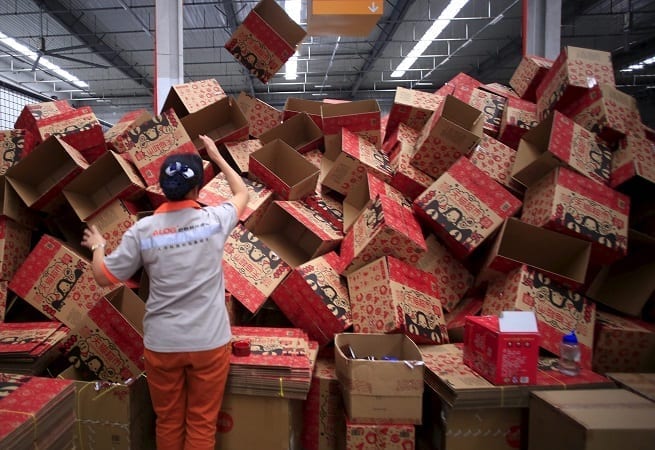
    China’s Singles’ Day online discount sales bonanza on Saturday saw bargain-hungry buyers spend over $38 billion, flooding the postal and courier businesses with around 331 million packages – and leaving an estimated 160,000 tonnes of packaging waste.

    The annual Nov. 11 buying frenzy is a regular fillip for giant online retailers like Alibaba and JD.com, but the mountains of trash produced from just one day of conspicuous consumption have angered environmentalists.

    “Record-setting over-consumption means record-setting waste,” said Nie Li, toxics campaigner at Greenpeace, which estimates this year’s orders will produce more than 160,000 tonnes of packaging waste, including plastic, cardboard and tape.

    Total sales from Singles’ Day hit 254 billion yuan ($38.25 billion), with 1.38 billion orders placed, state media reported. Around a quarter of the total sales involved household electric devices or mobile phones.

    China’s State Post Bureau (SPB) said postal and courier companies are having to deal with at least 331 million packages, up 31.5 percent from last year.

    Greenpeace described the annual promotion as a “catastrophe for the environment” that not only creates waste, but leads to a surge in carbon emissions from manufacturing, packaging and shipping. In a report published last week, it estimated that total orders last year produced 52,400 tonnes of additional climate-warming carbon dioxide.

    E-commerce firms have drawn up measures aimed at solving the problem, and aim to replace cardboard boxes with reusable plastic ones that courier companies can share. They have also experimented with biodegradable delivery bags and tape-free boxes, but Nie said the efforts were still not enough.

    “China’s online retail giants have taken few real steps to reduce delivery packaging waste,” she said. “Ultimately, packaging that we throw out after one use is not a sustainable option.”

    A spokesman for JD.com said it is “continually improving ways to better reduce waste and pollution” and, among other measures, aims to raise the proportion of biodegradable materials in its packaging materials to 80 percent by 2020.

    Alibaba’s Cainiao logistics arm said in emailed comments that it had launched initiatives aimed at minimising its environmental impact. “We are committed to work closely with different stakeholders to protect the environment and contribute to the sustainable development of the industry,” it said.

    MOUNTAINS OF WASTE

    China’s packaging waste problems are not confined to Singles’ Day.

    Official data shows China’s courier firms delivered around 20 billion orders in 2015, using 8.27 billion plastic bags, 9.92 billion packing boxes and enough sticky tape to go around the globe more than 400 times.

    Overall deliveries continue to surge, with the number of packages expected to hit 50 billion next year, up from 30 billion in 2016, according to forecasts by the SPB.

    But even that’s only a small part of China’s mounting waste problem, with large sections of the country’s soil and water contaminated by untreated industrial, rural and household trash.

    With China’s major cities producing around 2 billion tonnes of solid waste a year, they are already surrounded by circles of landfill known in Beijing as the “seventh ring road”.

    China has also struggled to finance the infrastructure required to handle surging volumes of discarded white goods, consumer electronics and batteries.

    Despite massive production volumes that have left the country dependent on imported raw materials, overall recycling rates in industries like steel, glass or textiles remain way behind their international counterparts.

    On top of that, China has only just started to impose restrictions on imported waste, which stood at 47 million tonnes in 2015.

    Recycling of foreign and domestic trash was traditionally handled by migrant workers, known as “scavengers”, who ripped apart discarded goods in back-street workshops.

    But rising economic prosperity means fewer people seek to make a living recycling waste, and tougher environmental regulations have forced small-scale recyclers to close.

  • Alibaba’s Singles’ Day Sales Hit $10 Billion in one hour

    Alibaba’s Singles’ Day Sales Hit $10 Billion in one hour

    the frenzied annual celebration of consumption and commerce that is China’s much larger version of Black Friday — began as a protest of sorts against Valentine’s Day, propelled by college students in the 1990s.

    The event’s date, written numerically as 11/11, was associated with unattached singles, known as “bare sticks.”

    This year’s shopping festival entered new territory, blazing past $1 billion within two minutes of the holiday, starting at midnight on 11 November.

    Singles’ Day is now inextricably linked with Alibaba, the Chinese e-commerce leviathan that in recent years has turned the holiday into an online — and occasionally brick-and-mortar — mercantile extravaganza. It routinely eclipses Amazon’s yearly Prime Day promotional event.

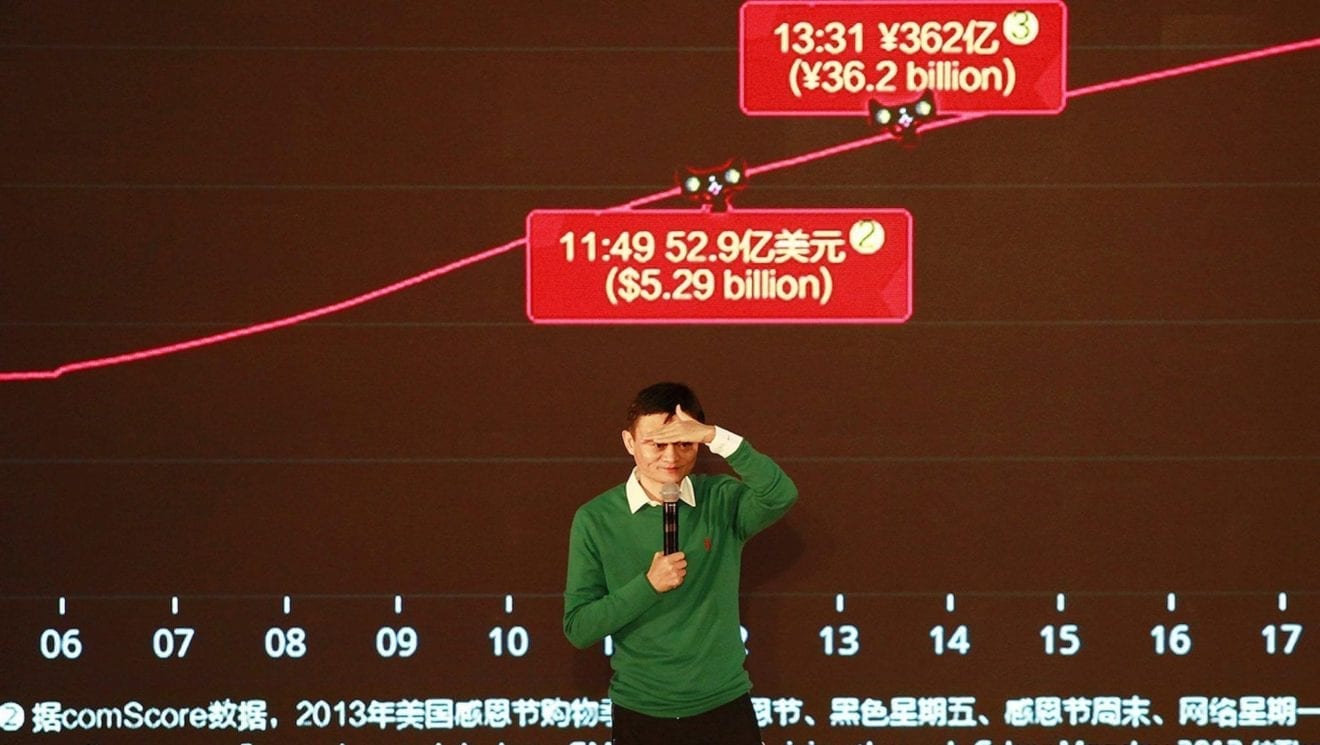
    In July 2017, Prime Day generated an estimated $1 billion in revenue during its 30-hour sale window, resulting in what Amazon called its “biggest day ever.” A little more than an hour into this year’s Singles Day, sales had already exceeded $10 billion.

    The event has evolved into a cultural phenomenon. On Friday night, Alibaba hosted a lavish gala in Shanghai, directed by one of the producers behind the 2016 Academy Awards.

    Celebrities such as Nicole Kidman, Pharrell Williams and Maria Sharapova helped count down the moments before the 60,000 participating global brands released their Singles’ Day deals to shoppers.

    One offer, from the Chongqing-based online alcohol brand Jiang Xiao Bai, allowed 33 fast-moving customers to make a single payment of 11,111 yuan, or $1,673, for a lifetime supply of a grain liquor known as baijiu.

    Singles’ Day, which is largely powered through Alibaba’s Tmall marketplace, will test the company’s logistics network. The company promised delivery within an hour for certain products and, in advance of the shopping festival, converted nearly 100,000 stores across China into “smart stores” capable of processing payment using facial recognition and other advanced technologies.

  • Singles’ Day trumps Black Friday and Cyber Monday combined

    Singles’ Day trumps Black Friday and Cyber Monday combined

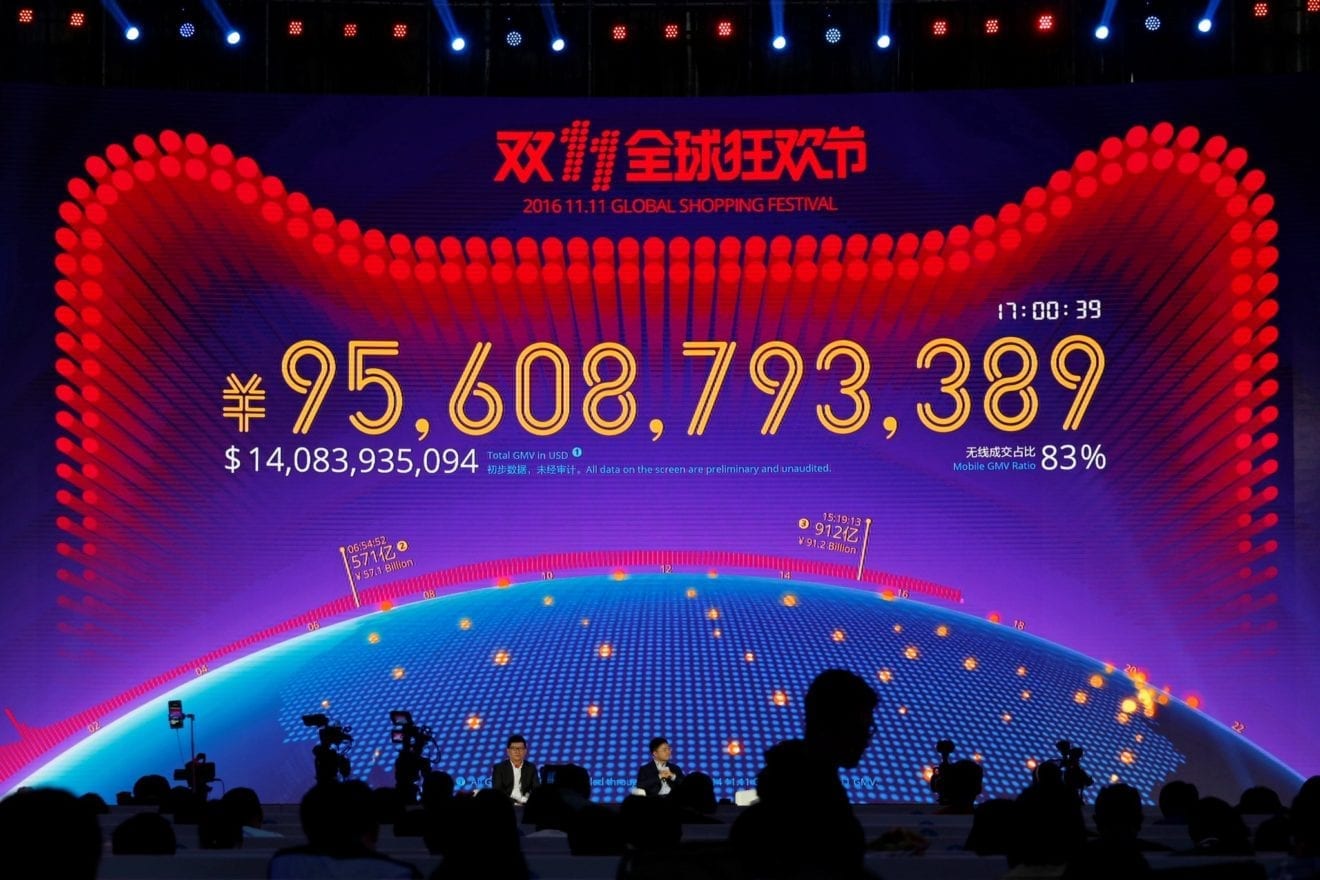
    Alibaba, the Chinese e-commerce giant, said on 11 November 2017 its Singles’ Day sales extravaganza hit $25.4 billion, smashing its own record from last year and cementing it as the world’s biggest shopping event.

    Once a celebration for China’s lonely hearts, Singles’ Day has become an annual 24-hour buying frenzy that exceeds the combined sales for Black Friday and Cyber Monday in the United States, and acts as a barometer for China’s consumers.

    As tills shut midnight on Saturday, Alibaba’s live sales ticker registered 168.3 billion yuan, up 39 percent from 120.7 billion yuan in 2016. The dollar figure was up more steeply due to the strength of the yuan against the greenback in 2017.

    The event began soon after a star-studded event in Shanghai late on 10 November 2017. As midnight hit, a deluge of pre-orders helped drive a billion dollars of sales on Alibaba’s platforms in the first two minutes and $10 billion in just over an hour.

    “In terms of scale it just dwarfs any other event out there,” said

    Ben Cavender, Shanghai-based principal at China Market Research Group.

    At just past the halfway mark, the headline gross merchandise volume swept past last year’s dollar total just shy of $18 billion. Shortly afterward, sales surpassed the 2016 total in the local currency.

    The event gets shoppers around China scouting for bargains and loading up their online shopping carts, while delivery men – and robots – brace for an estimated 1.5 billion parcels expected over the next six days.

    “This is a big event for China, for the Chinese economy,” Joseph Tsai, Alibaba’s co-founder and vice chairman, said. “On Singles Day, shopping is a sport, it’s entertainment.”

    Tsai said rising disposable incomes of China’s “over 300 million middle-class consumers” was helping drive the company’s online sales — and would continue. “This powerful group is propelling the consumption of China,” he said.

    The final total — more than the GDP of Iceland or Cameroon — leaves other shopping days in the shade. Cyber Monday in the United States saw $3.45 billion in online sales last year.

    Investors closely watch the headline number, though some analysts say the way it is calculated is too opaque. The U.S. Securities and Exchange Commission launched a probe into Alibaba‘s accounting practices in 2016, including into its Singles’ Day data. That investigation is as yet unresolved.

    Last year, the sales number rose by nearly a third at the eighth iteration of the event – though that was slower than the 60 percent increase logged in 2015.

    Slower growth?

    At Alibaba’s Friday night gala on 10 November 2017, the company’s co-founder and chairman, Jack Ma, hosted guests including the actress Nicole Kidman, singer Pharrell Williams and Chinese musicians and film stars such as Zhang Ziyi and Fan Bingbing.

    Singles' Day trumps Black Friday and Cyber Monday combined 5

    The excitement around the shopping blitz, however, masks the challenges facing China’s online retailers such as Alibaba and JD.com Inc., which are having to spend more to compete for shoppers in a broader economy where growth is slowing.

    “A lot of the lower hanging fruit has been picked and there’s increased competition for a share of consumer spending,” said Matthew Crabbe, Asia Pacific research director at Mintel. The sale did though beat his forecast of 20 percent growth.

    Online retailers were being forced to push offline as well as overseas to attract new shoppers, and the overall online retail market was close to “saturation,” raising questions about whether current rapid growth could be sustained.

    “They’re having to spill over out of the purely online realm into the wider consumer market,” Crabbe said.

    This has sparked deals to buy bricks-and-mortar stores in China, and overseas tie-ups, especially in Southeast Asia. Technology, too, has been key, with virtual reality dressing rooms and live fashion shows to attract shoppers.

    Alibaba also said it had turned 100,000 physical shops around China into “smart stores” for this year’s event. Goods perused by people at the stores, but then bought and paid for on Alibaba’s platforms, were added towards the sales total.

    China Market Research Group’s Cavender said brands were also increasingly making smaller price cuts to avoid “margins getting killed,” and were often asking for deposits in advance. In previous years, prices were often halved.

    Fu Wenyue, a 23-year-old dresser in Shanghai, said offers this year were smaller but more “personalized” as brands used big data to hone their targets. Fu spent 4,000 yuan on clothes, cosmetics and kitchen utensils in pre-event sales, and kept shopping on the day.

    “In actual fact, I think I spent even more than I did last year,” she said.

  • Boom predicted for China Singles’ Day

    Boom predicted for China Singles’ Day

    Three days out from China Singles’ Day, retail experts are predicting Alibaba’s annual e-commerce sales event will continue to set records.

    With the Chinese online giant expanding it to a 24-day shopping and entertainment bonanza, the global marketing hype is likely translate to record cross-border e-commerce demand, according to marketing research company eMarketer Retail.

    Global payments processor Worldpay has released new data showing that last year’s event grew by 39 per cent globally. When sales peaked, Worldpay was processing 44,505 payments a minute.
    Meanwhile, more and more international brands have been opting to participate in this year’s 11.11 shopping festival.

    Worldpay’s transaction data supports findings from the Global eCommerce Leaders Forum (GELF), which revealed the rise in consumer spending power in China is translating into growing sales on international e-commerce sites as growing numbers of shoppers seek genuine products from trusted global brands.

    Fastest growth

    Retailers in Australia and Hong Kong are seeing the fastest growth, with sales rising by 105 and 71 per cent year on year respectively, says Worldpay. While the volume of sales has plateaued in Mainland China, the average spend per purchase continues to rise at a rate of 9 per cent.

    “Since its inception as a local celebration of singledom, Singles’ Day has risen to become the world’s top grossing-online shopping holiday, and the event knows no boundaries,” says Worldpay Asia Pacific GM Phil Pomford.

    “For international businesses looking to break into the huge Chinese e-commerce market, November 11 should be an important landmark in the calendar year.

    eMarketer Retail analyst and editor-at-large Andria Cheng agrees. “For international brands this event will continue to mark Alibaba’s biggest pitch and showcase for them to get on board its platform and test the waters regarding Chinese consumer demand and promise,” she says

    “The fact more than two-fifths of this year’s 140,000 brands at the shopping extravaganza come from outside of China speaks to the continued international hope and bet that Chinese consumers will pick up the slack left by the slowing domestic growth for many brands.”

    Threefold increase

    According to marketing technology company Criteo, sales on Singles’ Day have increased threefold, with shoppers browsing online up to four days earlier.

    “This makes it the main sales peak of the season, impacting most retail categories, and is a major opportunity for both shoppers and retailers,” says Criteo GM Alban Villani, who covers Southeast Asia, Hong Kong and Taiwan.

    Analysing more than 5.1 million online transactions in Southeast Asia between October 1 and December 31 last year, it found that retail sales spiked by 254 per cent on November 11.

    Between November 9 and 12 there had been a rise of 28 per cent in average online traffic on key retail companies’ websites, and shoppers had started buying as early as November 7.

    Shoppers are increasingly buying via apps, accounting for nearly half of all transactions and 73 per cent of mobile transactions.

    Meantime, a forecast from eMarketer Retail shows that retail e-commerce sales in China will grow by 33.1 per cent this year to reach $1.13 trillion, representing 23.1 per cent of total retail sales.

    Retail m-commerce, which includes products and services ordered via mobile devices, will increase by almost 42 per cent in China this year, reaching $881.96 billion, and accounting for nearly three-quarters of all retail e-commerce sales, says eMarketer Retail.

    Close competition

    Alibaba says $18.2 billion worth of products were sold on its platforms during Singles’ Day last year, up 32 per cent from the previous year. By comparison, says eMarketer Retail, JD.com’s 618 Festival, which involved 18 days of discounts from June 1 to 18, was reported to have brought in $17.6 billion this year.

    Worldwide e-commerce sales are expected to reach $2 trillion this year. Almost half of these sales will be generated by consumers in China. eMarketer Retail says retail e-commerce sales worldwide will increase at four times the rate of retail sales this year, jumping 23.2 per cent to $2.2 trillion.

    Also, Alibaba has overtaken Google this year to be the second company to Facebook for display ad revenue, with a spend of $14.62 billion.

    Meanwhile, Worldpay has advice for retailers opting in to the Alibaba festival… “To turn browsers into buyers, it is essential to tailor the online shopping experience to local tastes. For Chinese consumers, this means focusing on your mobile proposition. Shoppers expect to use their preferred payment option – increasingly e-wallets like Alipay and WeChat Pay.”

    For Singles’ Day last year, Worldpay processed a total of 14.9 billion transactions altogether worth £451.1 billion (US$594.1 billion).

    Worldpay provides payment technology and services to about 400,000 customers. It can process payments across 146 countries and 126 currencies, helping its clients accept more than 300 different types of payment.