Tag: supply chain

  • How to make the most of the Asian food retailing boom

    How to make the most of the Asian food retailing boom

    Asia’s consumers are expected to spend US$5.9 trillion on food, beverages, and tobacco by 2018, making up 60 per cent of global expenditure in this category.

    This means retailers need to expand aggressively, scaling up in new markets and keeping their supply chains adaptable to target more customers to make the most of the Asian food retailing boom. The middle class population in Southeast Asia is projected to grow to 400 million by 2020 and businesses that fail to scale will miss out on this tremendous market opportunity.

    Food retailing is all about delivering the best customer experience through high on-shelf availability (OSA), wide stock variety, and immaculate product quality to drive sales. Whether you are a convenience store chain, supermarket, or hypermarket, the goal is to build and retain a loyal customer base while keeping operating costs low to ensure prices remain competitive. However, food retailers in Asia Pacific face a unique set of roadblocks.

    Countries across the region are at different stages of development. With geographic diversity, companies face significant challenges when it comes to taking advantage of the growth possibilities. This will prove problematic, especially with Asia Pacific’s status as the world’s largest and fastest growing B2C eCommerce region. Consumers will expect faster, better services from food retailers as their threshold for waiting times lower in the “on-demand” age.  A recent announcement by Kantar Worldpanel forecast online grocery sales will be worth US$150 billion by 2025 – currently South Korea and Japan hold the first and second spots on the global e-commerce grocery market with Taiwan in the fifth position and China coming in sixth.

    The Four Ingredients of Supply Chain Success

    Asian food retailers , especially those selling fresh or frozen products, face issues due to the time-sensitive nature of the products which spoil quickly if not kept in the right conditions. Delivering chilled or frozen food across long distances is difficult due to infrastructure and asset availability, with options such as local sourcing or storage not always feasible. In light of these factors, it is critical to change the mindset to view the supply chain as a strategic business enabler driving competitive advantage, rather than a backend function focused on transport and storage. Here are four key ingredients to get you on your way.

    1. Take a fresh look at your supply chain

    Make a commitment to review your supply chain from end to end. What you need to look out for are potential cost inefficiencies and gaps in service performance, and understand the underlying reasons why these occur to help identify appropriate new solutions. For example, can you automate packing processes to speed up your deliveries down the line? Are you facing over- and under-stocked inventories because you cannot accurately anticipate supply and demand? Getting these questions answered is vital to your success. One route is to engage a consultant to assist. However, a specialist supply chain partner with extensive expertise will not only help with the review and design, but also has the capability to deliver. But also think about the long-term strategy and predicted expansion so that the new design is fit not just for today, but for your future business.

    1. Streamline your operations end to end

    Facilities, people, transportation, and technology are the ingredients within your supply chain that influence your overall business performance. Hence, it is important to make the right investments and realise the maximum benefits through continual review and optimisation.

    You can begin by analysing your truck fleets and find ways to fully use their capacity and improve routing. New designs and technologies enable delivery trucks to have different temperature zones to transport ambient, chilled, and frozen products in the same vehicle – enabling food products to be consolidated and transported using a single vehicle rather than needing to run multiple vehicles to the same location. And to accelerate deliveries, transport management systems provide insight and data analysis to determine the quickest and most cost-effective routes – incorporating telematics and real-time tracking gives full visibility throughout the journey which can lead to far more efficient unloading processes at the receiving end. Often, retailers can leverage a specialist 3PL like DHL and its existing investments in resource, technology, facilities and assets, such as trucking, to reduce retailers’ cash outflow and deliver a competitive cost-per-unit. In addition, a good supply chain management (SCM) partner with inroads in emerging markets can offer effective consultation on building delivery networks in new territories.

    1. Add visibility and control

    Gaining more control over your supply chain empowers you to navigate and anticipate any potential disruptions to food product deliveries. The first step is to improve visibility over inventory levels to maximise OSA whilst minimising spoilage – it’s a fine balance to manage and focus on the detailed insights of supply and demand patterns. Inventory optimisation manages stock cost effectively, balancing stock holding with customer service levels by taking into account availability, requirements, and lead time variability.

    A high level of inventory is not only capital intensive but also expensive to service through increased indirect spend, such as warehousing, transport, and procurement. Hence, not only will inventory optimisation reduce logistics costs, but drive excellent service to create satisfied customers by having the right stock at the right location.

    By looking at inventory holding, you can then make informed decisions about your storage requirements, and whether other options are more suitable. For instance, instead of using a conventional warehousing model, you can complement it with cross-docking for fast-moving goods. This speeds up distribution and reduces warehousing space as stock is not moved into storage. You can also consider hybrid inventory models to make the most of your existing warehouse facilities. Effective solutions can help you achieve an average inventory age of between 15 and 30 days which brings the additional benefit of improving cash flow. Achieving these metrics is not easy but specialist knowledge, experience, and sophisticated systems are the catalysts to creating a lean and responsive operation.

    1. Innovate to deliver

    Innovation has become a critical differentiator for food retailers in recent years. Automated sorting and storage retrieval solutions can speed up picking processes and shrink warehousing footprints; packaging technologies can quickly create promotional packs with minimal labor requirements; and IT system development will enhance customer experience should shoppers switch from purchasing in-store to online, where they will have home delivery or “click and collect” options. These are just a few developments and there are many more taking place to help meet the ever-increasing customer expectations when making decisions.

    Get Your Supply Chain Right

    Supply chains are no longer just “part of the organisation” for today’s food retailers. An adaptive and flexible supply chain is the difference between winning and losing the market – given the escalating demands of customers. You must understand your customers, and then focus on those elements which are most important to them to drive sales. Whether you are competing on price, convenience, or quality or even a combination of all three, these best practices will give you a head-start in creating an integrated supply chain that will bring advantages now and into the future.

    If you are part of the Asian food retailing industry, you need to start re-thinking your supply chains today to meet the challenges of tomorrow.

    -Dean Eichorn-

  • How 3D printing will shake up the supply chain

    How 3D printing will shake up the supply chain

    Consumers today are already familiar with personalizing their favorite treats by molding them into unique shapes or printing edible messages on cakes, chocolate and flowers, among others. What if you could customize any product in the future to suit your preference – from shoes to even houses? While some may perceive this to be a pipe dream, the fact is that this is actually a reality. New Balance just introduced 3D printed shoes last April, and in China, Huashang Tengda successfully built a two-storey house in just under two days!

    3D printing is also known as additive manufacturing, a process that allows us to seemingly create objects such as bicycle frames and toys out of thin air. Manufacturing and supply chains have typically been all about assembly lines, warehousing and shifting products outwards from the point of manufacture. 3D printing is now revolutionizing the way products are manufactured and distributed.

    With the advent of 3D printing, individualized products can be designed, produced, delivered, and serviced in new ways. To start, organizations can leverage a product innovation platform that supports direct communication with customers and network partners from conceptualization to production. Consumers today love to customize everything and anything, and 3D printing makes this both possible and affordable. Organizations can now evolve beyond demand-driven supply chains to enable demand-driven manufacturing, furthering customer centricity and personalization.

    3D printing is also transforming the manufacturing industry, making it more digitized and in the process throwing out all the traditional rules of the game. Essentially, 3D printing changes who is in control. Analog manufacturing used to be the realm of huge companies that have the resources to invest and produce large quantities of the same good. These companies need to have the capital to support research, prototyping and focus groups to identify products that will please the critical mass, and marketing to promote that same product to large volumes of consumers. On top of that, delivering the products to consumers requires complex supply chain and retail channels.

    In contrast, 3D printing allows complex items to be produced on demand, eliminating the need for assembly lines. With 3D printing, the supply chain has the potential to become more efficient, more local and globally connected. Manufacturers are using 3D to respond to dynamic, real-time customer demands, reduce inventory and slice into transportation costs while dramatically compressing the time needed to ship products.

    Imagine this: Without the need for huge capital outlay, manufacturers do not need to set up factories at permanent locations. All manufacturers need is a 3D printer in local markets or regional production hubs, solving a number of large problems. The ability to bring manufacturing local will provide a way to significantly reduce carbon footprint. If you add the benefits of timeliness, cost reduction, and the freedom to print multiple materials and properties, you start to understand the impact 3D printing can have on society.

    Supply chains have a reputation for being boring, complicated, and uninteresting. But with the advent of the digital economy and 3D printing technologies, all of this is about to change. As the digital supply chains become both disruptive and important within the next few years, supporting the supply chain and the manufacturing floor to boost productivity will have ripple effects throughout any industry. The future of supply chain will be more collaborative and integrated with suppliers, retailers and even product planning and design.

    Where supply chain used to be the most inelastic piece in the journey from manufacturing to customer delivery, 3D printing will be the catalyst and enabler to reimagine a supply chain that can dynamically respond to customer requirements and expectations. In addition, we are going to see more of these advanced efficiencies permeating production activities as 3D printing continues to rise past the hype and into everyday manufacturing.

    In 2013, Wohlers Associates, a consulting firm that specializes in 3D printing, predicted that the sector would grow to $10.8 billion by 2021. The firm now forecasts even greater and faster growth, with the industry reaching $21.2 billion in 2020. That’s because while the firm is skeptical about the value of low-end, consumer-oriented printers, they are positive that more and more industrial clients – especially manufacturers – will be buying and implementing high-end, expensive 3D printers.

  • Gravity’s transport app offers real time shipping schedules

    Gravity’s transport app offers real time shipping schedules

    Gravity Supply Chain, a developer of cloud-based apps that helps companies modernize the management of their global supply chains, released RTM (Route-to-Market), a new tile for its Transport app that provides up-to-date sailing schedules for over 50 major ocean carriers, over 250,000 port pairs covering over 90 percent of the world’s container capacity. Transport RTM is an advanced solution that enables logistics providers to deliver these capabilities directly to their customers as part of their end-to-end supply chain visibility and execution solution.

    The Transport RTM tile offers a sailing schedules search engine 3PLs and supply chain managers can use to select any global port pair and date range, and instantly see all sailing options. Uploading information related to contracted rates with various shipping lines enables users to create lists of routes that can be filtered by factors such as quickest sailing route and cost.

    “RTM is the newest feature of our mission to create one holistic data hub that provides our users with the real-time information they need to view, control, share and execute sourcing, supply, transport, inventory and selling activities anywhere in the world,” said Darren Palfrey, COO, Gravity Supply Chain. “This is especially valuable to 3PLs struggling to close the  technology gap between what shippers need, and what all but the industry’s largest players can offer.”

    The RTM tile is available today at no additional cost to all Transport app users. The Transport app integrates with your transportation partners and systems and automates the creation of packing lists, advance ship notices and compliance documents, and provides real-time tracking so retailers, brands and product companies know where their products are at all times with real-time tracking visibility. Transport is one app in Gravity’s suite of apps that make up its cloud-based end-to-end supply chain management and logistics platform.

  • Henkel opens global supply chain hub in Singapore

    Henkel opens global supply chain hub in Singapore

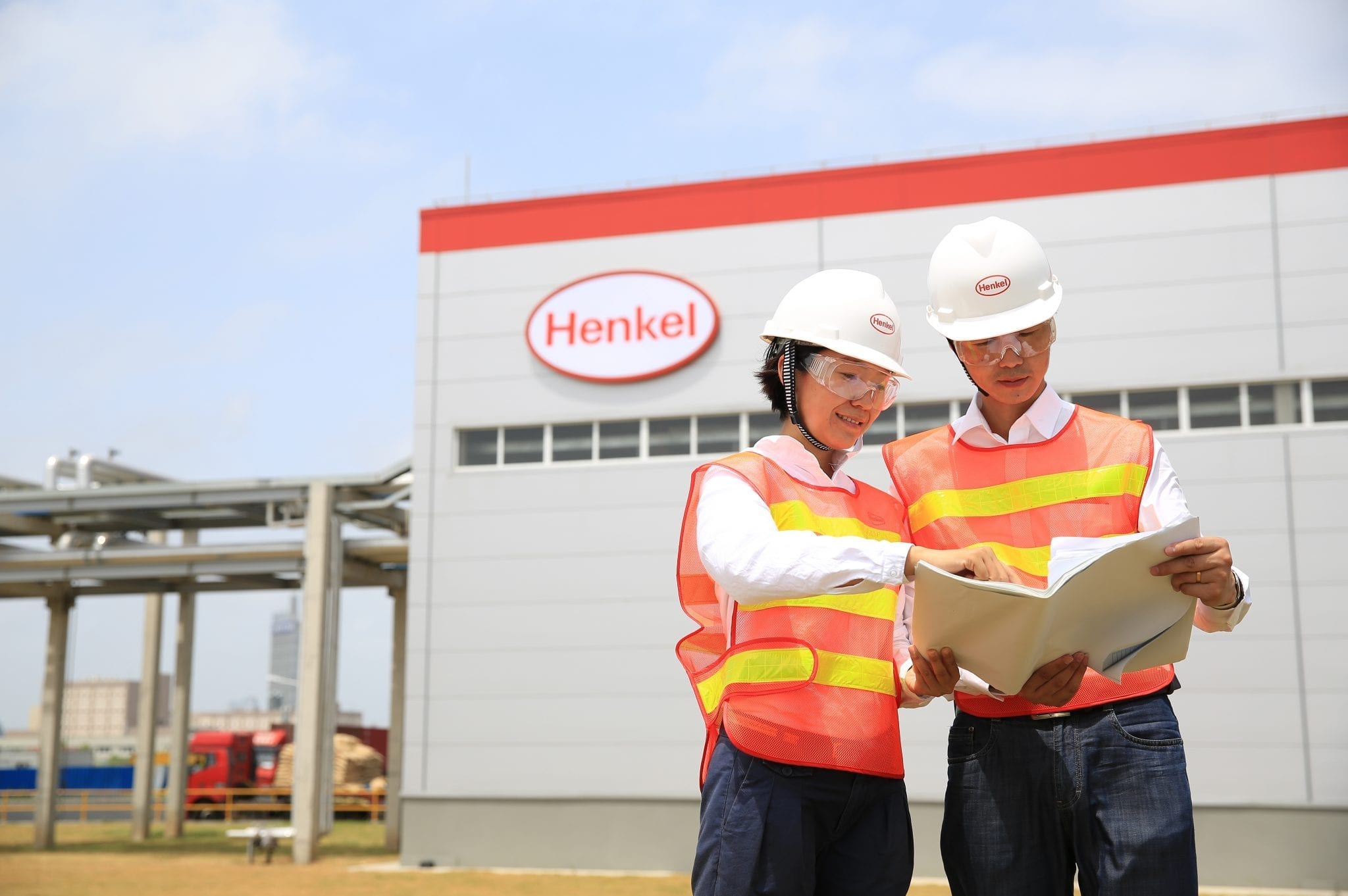
    Henkel has officially opened its global supply chain hub in Singapore. This is a major milestone which follows the successful set-up of the company’s global supply chain headquarters in Amsterdam. Working closely together, the two hubs in Amsterdam and Singapore will steer Henkel’s strategic initiative to consolidate all its supply chains company-wide around the world.

    A single global supply chain is a key initiative of Henkel‘s strategic priority to continuously simplify the organization in order to drive operational excellence and build a scalable business model, increasing Henkel’s competitiveness in terms of speed, agility and efficiency. As such, the initiative will be a key driver for realizing the company’s vision to be ‘a global leader in brands and technologies’.

    The global hubs will centrally manage the purchasing, production and logistics processes of Henkel’s three business units – Adhesive Technologies, Beauty Care and Laundry & Home Care. The effort spans across supply planning, sourcing, manufacturing, inventory and distribution. This harmonization across the entire company will lead to higher process standardization, improved customer service levels and enhanced efficiency.

    Bertrand Conquéret, Corporate Senior Vice President of Global Purchasing at Henkel, said, “Together, the Amsterdam and Singapore global supply chain hubs will steer Henkel’s biggest initiative in business transformation. Singapore was selected for its excellent logistics capabilities, availability of supply chain talent and geographical location in the heart of Asia, which is a key growth market for Henkel.”

    Singapore also serves as a conduit to the trade routes that extend to India and the Middle East and Africa region. Both Singapore and Amsterdam are amongst the largest sea ports and logistics centres in the world. With their strategic locations, the two global hubs are well-positioned to manage the supply chains that connect all our markets globally.

    Notably, the new global supply chain hub builds upon the success of Henkel Singapore, which was established in 1983 and serves as a strategic business and technical services sub-regional hub for the company’s adhesive and beauty care businesses in Southeast Asia.

    Thomas Holenia, Managing Director of the global supply chain hub in Singapore and President of Henkel Singapore, said, “Our successful business presence here of more than 30 years and the global supply chain hub provide a strong foundation for developing Singapore into a global centre of excellence for Henkel – through the implementation of best practices in supply chain management, sustainability, digitalization and talent management.”

    In terms of sustainability, the Singapore hub is partnering with suppliers and business partners to continually improve the sustainability impact across the entire value chain.

    Digitalization is a key component of the global supply chain hub, enabling the standardization and harmonization of data and processes across the businesses and functions. It creates transparency on the vast amount of data on customers, products, raw materials and logistics. This improves the exchange of knowledge significantly, brings consistency in customer service and enables managers to make informed decisions faster resulting in quality processes across markets.

    With a corporate culture that strongly promotes diversity and inclusion, the global supply chain hub currently employs an international and cross-functional team of more than 14 nationalities. In the global supply chain hub, employees from purchasing, supply chain, operations and IT collaborate with other departments as an integrated team on a common agenda. As a result, the team is able to harness the diversity of knowledge, insights and experiences to deliver best solutions.

    In its ramp-up phase, the global hub is in the process of hiring new graduates and experienced managers. It is working closely with the National University of Singapore and Nanyang Technological University to identify local talents who have a global mind-set and strong leadership skills. With an inclusive corporate culture and attractive career development opportunities, Henkel aims to be an employer of choice.

    Chan Ih-Ming, Director of Consumer Businesses for the Singapore Economic Development Board (EDB), said, “Henkel’s decision to house one of its two global supply chain bases in Singapore marks a significant milestone in the Henkel-Singapore partnership. Henkel’s expansion in Singapore is testament to our strategic position as a key supply chain control tower for both Asia and the world. This investment also builds on the growing community of German companies – both Mittelstand and multi-national companies – that are using Singapore as a business hub for the region.

    “The EDB will accelerate our work with companies to equip the Singapore workforce with the right capabilities to seize the exciting professional opportunities in the logistics industry, such as those created to enable Henkel’s sustainable supply chain.

    Dr Steffen Koch, Acting Head of Mission of the German Embassy in Singapore, congratulated Henkel on choosing the city-state to base its global supply chain hub, and said, “Singapore’s prime geo-economic location at the core of the dynamically developing Asia, its business-friendliness as well as its highly efficient ports and airport make it an ideal choice for all kinds of logistical operations.”

    Dr Tim Philippi, Executive Director of the Singaporean-German Chamber of Industry and Commerce (SGC) congratulated Henkel on opening the new global supply chain hub in Singapore, which is a highly desired location in Southeast Asia for its favourable business environment. “The SGC is tasked to promote bilateral business relations between Singapore and Germany and as a chamber, we welcome companies such as Henkel as they contribute towards the bilateral relations between our two nations.”

  • DHL eCommerce expands presence in China

    DHL eCommerce expands presence in China

    DHL eCommerce has opened a Distribution Centre in Shenzhen as part of its effort to expand its presence in China by at least another 50 percent.

    The new centre will support the manufacturing and online retail sectors. It can handle 18 million shipments per year and will allow shipment and clearance of e-commerce exports across the globe. It will also consolidate international outbound shipments in Southern China and will provide customer service support for locally-based online merchants.

    “We see significant potential in China’s e-commerce sector, particularly between China and the U.S., where we’ve seen triple digit growth since 2015,” said Charles Brewer, CEO of DHL eCommerce in a press statement.

    “With China accounting for more than 40 percent of global retail e-commerce sales in 2015, our investments in China demonstrate our focus on developing efficient and reliable logistics services, to bring high quality e-commerce services to Chinese retailers and meet changing consumer expectations.”

    DHL eCommerce is also making serious plans to expand existing distribution centres in Shanghai and Hong Kong – the centres will be able to handle 48 million and 71 million shipments a year, respectively.

    “Since its launch last July, the DHL eCommerce Shanghai Distribution Centre has seen a 700 percent increase in the volume of e-commerce goods being shipped out of China. With our plans to expand our existing capabilities in Shanghai and Hong Kong, we are confident that this will provide our customers with the fullest support they need, in order to reach their global customer base,” said Malcolm Monteiro, CEO of DHL eCommerce in Asia Pacific.

  • Mobile, millennials to drive retail innovation

    Mobile, millennials to drive retail innovation

    Mobile commerce, millennials and faster fulfilment will drive retail innovation this year, according to commercial supply chain specialist Manhattan Associates.

    It predicts a rapid migration to more personalised shopping, with mCommerce presenting big challenges as well as inspiring innovation.

    Emerging Asia is still the fastest-growing region of the global economy, says the company, with strong labour markets and a growth in disposable income expected, especially in Southeast Asia. This means a continued rise in consumer spending along with mounting pressure for retailers to keep up with consumers and their rising expectations.

    “Millennials particularly demand seamless experiences across multiple channels, as well as more and slicker order and fulfilment options,” says Manhattan’s Southeast Asia MD Richard Wright.

    This means retailers must make informed choices about not only what is right for the consumer, but also right for the business.

    Wright says retailers will have to make some fundamental changes this year to address growing consumer demand, expectations for a more personalised shopping experience and increased use of mobile technology.

    “We have identified five key areas in which retailers can focus attention, not only to achieve customer satisfaction but also to drive business growth and profitability.”

    He defines the five key areas as:

    • Making the shopping experience personal and frictionless,
    • Recognising the power of millennials,
    • Embracing mobile technology to achieve customer-centric retailing success,
    • Delivering faster; and
    • Being more flexible with returns.

    “The anonymous shopping experience has had its day,” says Wright. “On the back of digital personalisation success, retailers are turning their attention to the in-store experience, recognising both the rise in customer expectation and the differentiation personal service can offer.”

    He says this experience can range from recipe ideas and ingredients lists in supermarkets to intuitive, customer-inspired fashion recommendations. “Retails have the chance to transform the in-store engagement.”

    Research by the group last month has shown that tailored shopping experiences will encourage more shoppers to engage with the in-store experience. In a consumer survey, 49 per cent of respondents said they would interact more with store staff members if the shopping experience was personalised.

    “When a shopped reaches the point of sale, give them tailored discounts, recommendations based on their shopping history, and even style tips matched to their recent purchases,” the group suggests.

    Manhattan Associates also says personal shopping is back. “It is time for retailers to redefine the role of stores, embrace technological innovation that drives both service enhancements and operating margins, and engineer a cultural shift that will enable staff to reinforce brand value and deliver personalised service across every channel.”

    There is a need to redefine the role of the store assistant. As consumers become ever more connected, store assistants need the knowledge, skills and desire to offer the best possible shopping experience.

    Dissatisfaction impacts brand reputation

    “Failing to give customers what they want will result in dissatisfaction and more complaints, which can have a longer-term impact of brand reputation and sales.”

    In Malaysia alone, says the company, the National Consumer Complaints Centre received 41,531 complaints in 2014, a 28 per cent increase for the previous year.

    Retailers can avoid such dissatisfaction by educating their store staff, but more is needed than just product information, says Manhattan Associates.

    Frontline staff need access to stock levels across all stores, warehouses and distribution hubs so they can sell the entire network of available inventory rather than just the stock in an individual store.

    Having an overview of enterprise stock and being able to offer delivery alternatives will keep customers loyal.

    “We predict that many retailers will being emulating the experiences of companies like Parkson, and change their structure so the store assistant plays a fundamental part in the buying process from start to finish, and acts more as a personal advisor.

    “However, a cultural change such as this cannot happen unless it is championed from the top down. Board-level executives need to buy into the potential results possible from investment in staff and customer experience initiatives.”

    Manhattan Associates believes millennials, who constantly interact with the online world, are frequent yet demanding shoppers.

    “We think it is time for millennials to take the lead on what they would like from a retail experience, and help retailers drive new strategies and initiatives. With 40 per cent of Millennials happy to give up cash completely, and 91 per cent opting to use a self-service checkout, it is clear these 18 to 34-year-olds shop differently to the traditional retail model. They adapt to technology quickly and expect retailers to do the same.”

    Another finding from the company’s research is that customers shopping via mobile devices spend up to 66 per cent more than those solely shop in a store. But as mobile devices now play a more important role in not only browsing and buying, but also paying for goods, the potential is even greater.

    Manhattan Associates predicts that retailers will use more beacons this year to augment the in-store experience.

    “Not only are these devices cost-effective, they communicate directly with smartphones through Bluetooth, meaning stores can lure in passing customers with offers and discounts.”

    Store assistants can also use mobile technologies to enhance the shopping experience. Tablet devices can enable assistants to deliver a personalised experience. They can access an online product catalogue populated with a shopper’s purchasing history, wish lists, online shopping cart and return history, improving their ability to up-sell and cross-sell.

    Meanwhile, POS technology is transitioning from fixed-point transactions to mobile engagement, offering payment acceptance “on the go” for all of a customer’s orders in a single transaction. This can be by cash, cheque, credit or such systems as Apple Pay.

    Advanced mobile POS technology can handle the most complex return situation with the least amount of friction, regardless of which channel initiated the order or how the customer chooses to receive credit.

    While price is the main attraction for 67 per cent of shoppers, across both online and in-store shopping, fast delivery is important for 51 per cent, and flexible returns for 42 per cent.

  • Nearly 40 percent of Asian food retailers unaware of logistics costs

    Nearly 40 percent of Asian food retailers unaware of logistics costs

    More than 1 in 4 food retailers in some of Asia’s fastest-growing economies expect to grow by 10 percent or more this year, according to research commissioned by DHL Supply Chain, the global market leader for contract logistics solutions.

    Based on interviews with more than 300 industry decision-makers in India, Indonesia, Thailand and Vietnam, Hungry for Growth: Logistics Trends in Asia’s High-Growth Food Retail Markets also found that the majority of food retailers – more than 6 in 10 – predict significant growth of 6 percent or more this year as a result of expanding populations and rising income levels.

    DHL_Supply-Chain_Micrographic_04-03

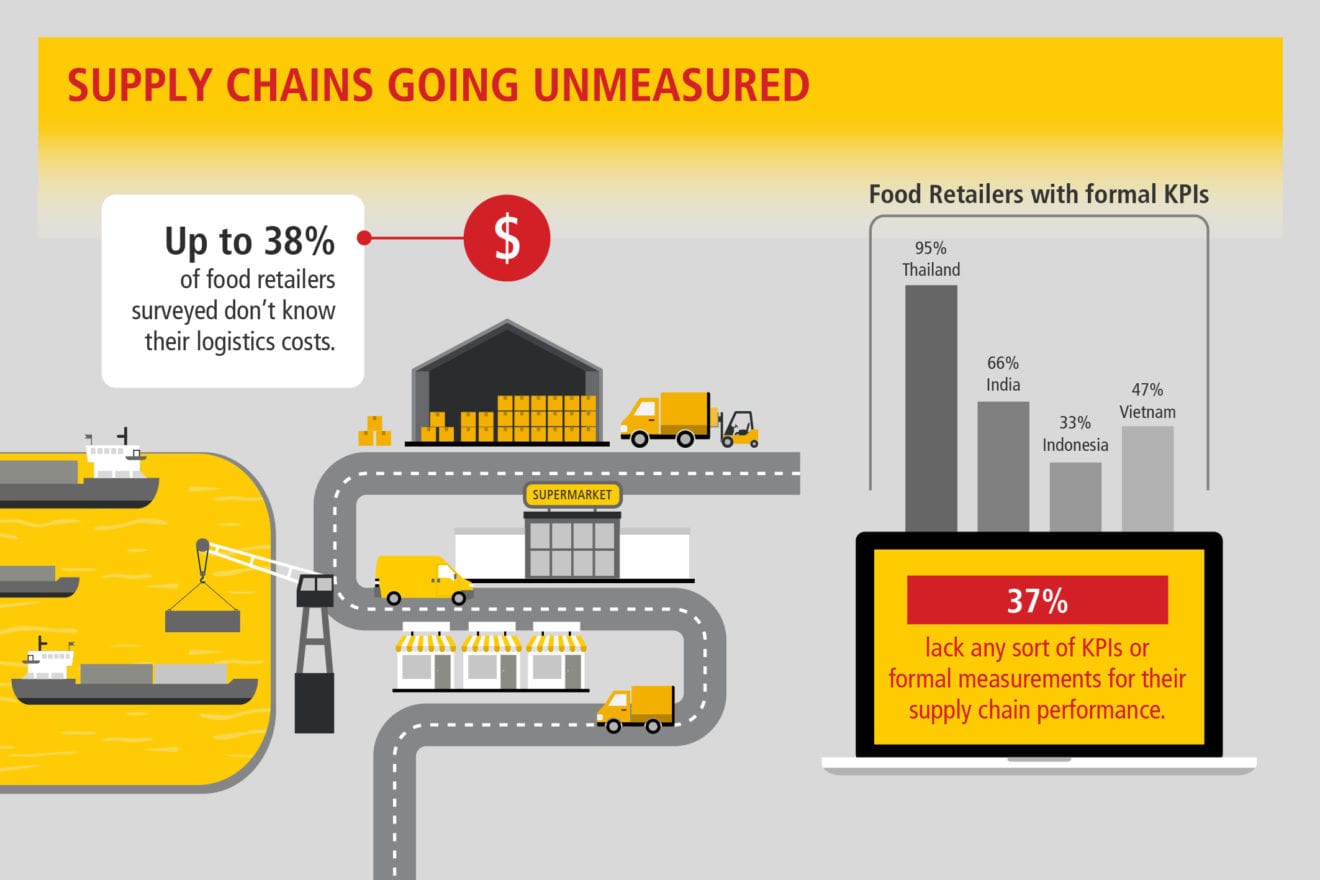
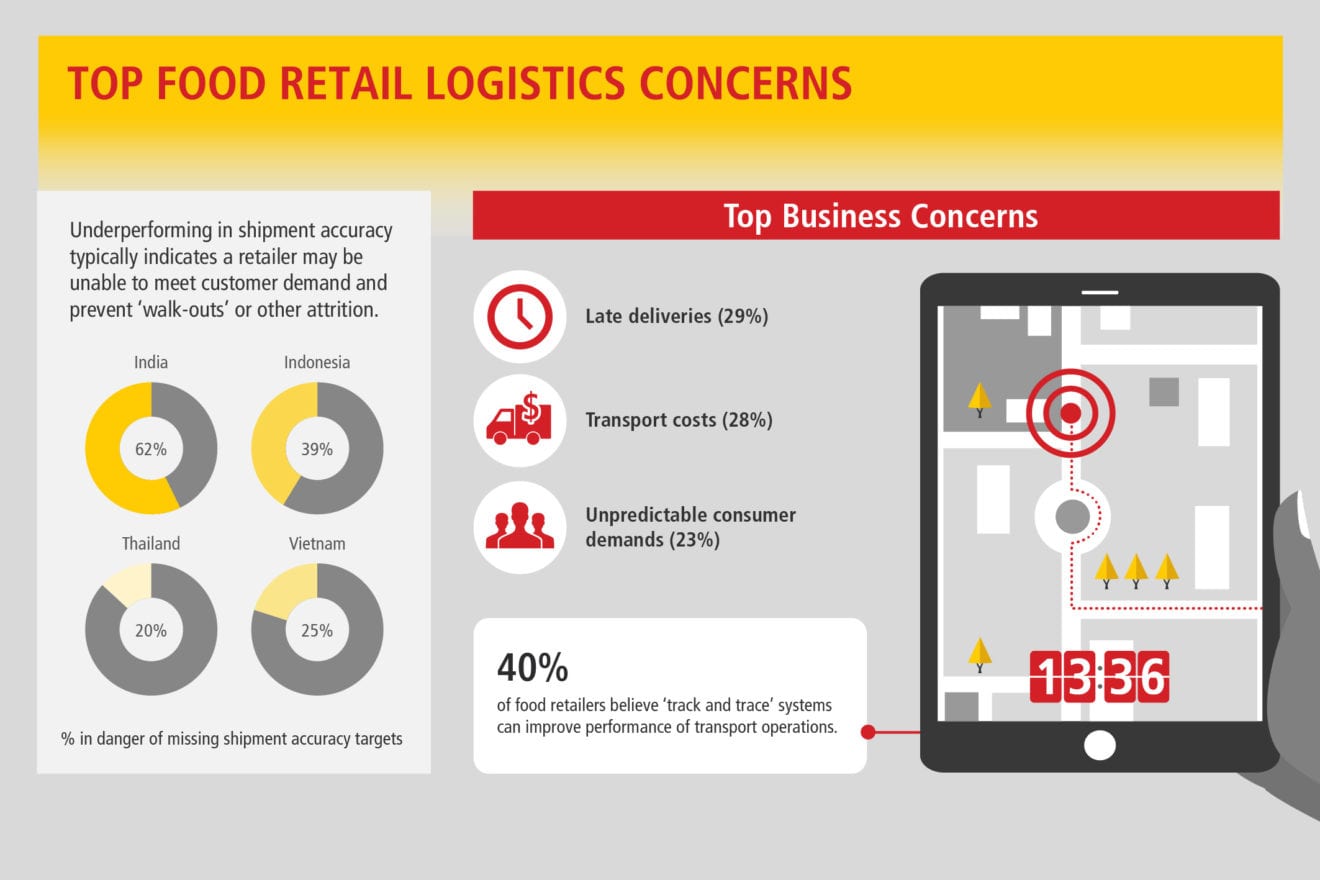
    However, the report also found that up to 38 percent of those surveyed were unaware of their total logistics costs, while 37 percent lacked any KPIs or formal measurements for their supply chain performance – potentially impacting their ability to keep shelves stocked and orders filled as demand and competitive factors grow increasingly complex.

    “Rapid increases in purchasing power, coupled with surges in demand driven by population growth, will yield obvious expansionary benefits to food retailers,” said Dean Eichorn, Vice President – Retail, DHL Supply Chain Asia Pacific. “However, any food retailer’s success is ultimately dependent on the agility of their supply chains when faced with demand volatility, seasonal fluctuations, and other complex market factors. Asia’s food retail industry looks set to undergo significant growth in the next year, and only with greater understanding and control of their logistics operations will companies be able to take advantage of new opportunities.”

    The research found that food retailers are increasingly at risk from unpredictability on both demand and supply sides of their operations. In the four countries surveyed, late supplier deliveries were most commonly cited as food retailers’ top concern, while 36 percent admitted that demand volatility had a major impact on their businesses. Issues around supply chain performance and costs varied around the region: fuel, labor, and imbalances between supply and demand ranked amongst retailers’ top cost issues.

    “Many of these concerns are amplified because a large number of food retailers don’t have visibility of their logistics operations, let alone the resources or subject expertise to improve and optimize them,” said Eichorn. “Food retailers need reliable, agile supply lines if they’re to focus on their core competencies and compete. At DHL, we believe this agility only comes from being able to manage the supply chain as an end-to-end process across transport, warehousing, and value-added services in a way that’s rapidly scalable without creating extra complexity.”

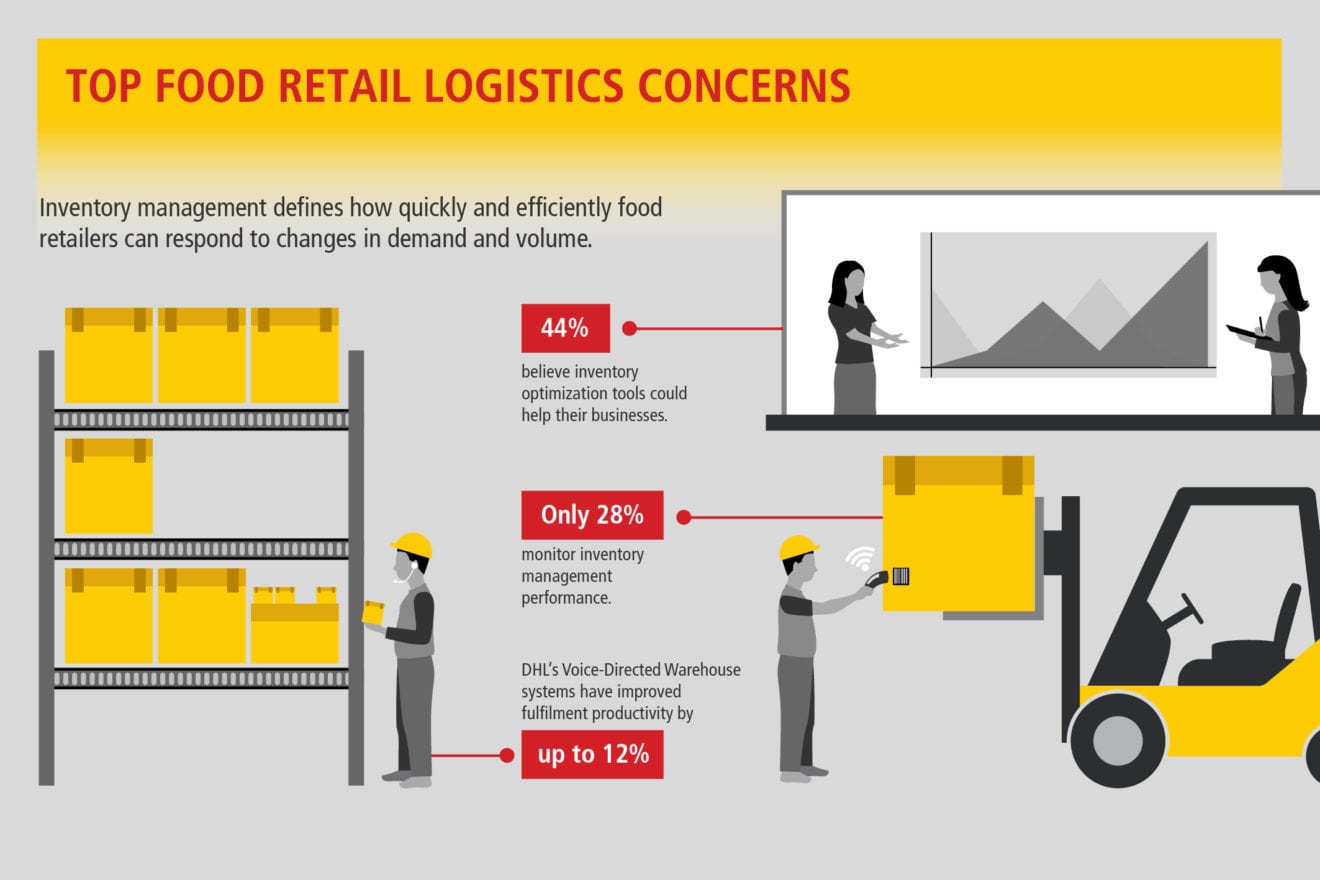
    The research also found that more than 60 percent of food retailers have not outsourced any aspects of their supply chains, suggesting that retailers who actively adopt third-party logistics solutions stand to gain significant “first-mover advantages” against their competition. Of those surveyed, 44 percent believe inventory optimization technologies would be beneficial to their overall performance, while 38 percent see advanced transport management services, like “track and trace”, as helping them improve reliability in meeting demand.

    DHL_Supply-Chain_Micrographic_04-04

    “Asia’s food retailers recognize the need to innovate and change, but the technologies and process transformations required to do so aren’t their domain of expertise – and nor should they be,” said Eichorn. “The key to growth and expansion in Asia’s food retail industry, and those of other developing regions where we’re seeing similar trends, will be how effectively operators can take advantage of third-party expertise and managed solutions in everything from technology to end-to-end supply chain management. For food retailers looking to leapfrog their competition and stay on top of growth’s complexity, the time to embrace advanced supply management principles is now.”

    About the Research:

    Commissioned by DHL Supply Chain and conducted by Redshift Research, the Hungry for Growth report draws on responses collected between December 2014 and April 2015 from more than 300 food retail professionals in India, Indonesia, Thailand and Vietnam. The report defines “food retail” as referring to retailers who sell food to consumers primarily for off-premise consumption, including (but not limited to): grocery stores, convenience stores, hypermarkets, supermarkets, and specialist stores like butcheries and bakeries.

    The full report can be downloaded from https://www.dhl.com/hungryforgrowth.