Retail News CRM

Tag: Topshop

  • Asos to sell Topshop apparel through Nordstrom US stores

    Asos to sell Topshop apparel through Nordstrom US stores

    Online fashion group Asos has partnered with US retailer Nordstrom in a joint venture that will see Topshop clothes sold in physical stores again for the first time since the brand collapsed last year.

    The deal sees Nordstrom, which first struck a deal with the former Arcadia brand nine years ago, buy a minority stake in the Topshop, Topman, Miss Selfridge and HIIT brands that were bought out of administration by Asos earlier this year. No financial terms were disclosed.

    Asos said: “The joint-venture will help drive the growth of these brands and paves the way for exploration of a new wider strategic partnership aimed at building greater awareness and engagement in the US and Canadian market.”

    It is the first time Asos, which sells fashion aimed at 20-somethings, has struck a deal with a retailer with physical stores, having always only traded online in the past.

    Nordstrom has 350 brick-and-mortar stores in North America and a strong online business, which Asos hopes to tap into, despite having a strong internet presence of its own in the region.

    Asos will retain operational and creative control but will collaborate on reaching a larger customer base. This includes “an edit of the best Asos brands launching across Nordstrom.com and in selected high-impact Nordstrom stores”.

    The move is a significant one for Asos and comes five months after it bought the brands from administrators for Sir Philip Green’s Arcadia empire for £330 million.

    But while the retailer bought the brands, it decided not to take on the 70 stores, including the flagship site at London’s Oxford Circus, affecting around 2,500 workers.

    Asos boss Nick Beighton said: “With its long-established connection to Topshop, extensive US consumer insight, and unparalleled reach right across North America, Nordstrom is the right partner to help Asos accelerate the growth of our Topshop and Asos brands in this key market.

    Nordstrom president and chief brand officer Pete Nordstrom said: “We could not have found a better partner in Asos, the world leader in fashion for the 20-something customer.”

    The deal will help Nordstrom improve its assortment and services for millennials and a growing cohort of Generation Z shoppers, he said in an interview.

    “There’s a big opportunity for us to be more meaningful to 20-something customers and to young customers,” Mr Nordstrom. It also makes sense, after a year of retail dislocation, to strike a deal with an online-only fashion company like Asos, he said.

    “Particularly with the pandemic, what we thought was going to happen with the online business overtime ended up happening very quickly because stores were shut down,”

    Topshop and Nordstrom first teamed up in 2012, with the brand selling a range of clothes in the retailer’s US stores. It was part of the UK fashion brand’s first foray into the United States and eventually led to several Topshop stores in US cities.
  • Topshop, Topman join Asos’ stable of brands

    Topshop, Topman join Asos’ stable of brands

    Topshop’s ‘disgusted’ staff today revealed they were officially told they’d lost their jobs two hours after Asos announced its £330million takeover on Twitter – as Sir Phillip Green’s family is ‘set for £50m’ from the sale.

    The outraged workers, numbering around 2,500, ripped into the online retailer as it was revealed that their former boss Sir Philip Green and his family are expected to gain £50million from the fire sale as experts told MailOnline that the Topshop, Topman, Miss Selfridge and HIIT brands and their warehouses full of stock had been flogged ‘on the cheap’.

    ASOS reveled in the deal after winning a battle with rival Boohoo to grab the crown jewels of Sir Philip’s Arcadia empire after its collapse last year. It said on Twitter: ‘The rumours are true… @Topshop & @Topman are now part of the ASOS family’.

    But one Arcadia employee said minutes later: ‘Nice way to find out I’ve lost my job, ASOS, great move for the people.’ Another added: ‘Thanks for informing me I’ve lost my job, after 10 years. Very compassionate.’ And a third said: ‘It’s actually disgusting. I’ve worked for Topshop for two years and my own manager found out through Sky News as the administrators didn’t inform us.’

    ASOS hopes the deal will help it grow in the US. The sale will see 300 shops shut down and 2,500 store staff lose their jobs. But it will ‘look at’ saving Topshop’s flagship Oxford Street store, which would be its first and probably only high street shop, meaning the deal announced to the stock market this morning will leave more ‘big holes’ in UK’s ailing high streets as fast fashion companies hoover up collapsed retail brands.

    Sir Philip Green’s family will reportedly pocket £50million from the sale of Topshop – yet the shop’s 1,000 suppliers are expected to get less than 1 percent of any cash owed to them, it has emerged. Sir Philip is still worth an estimated £930million despite the disintegration of his retail empire.

    Green’s Aldsworth Equity, which is incorporated in the British Virgin Islands and controlled by his wife Lady Tina, is owed £50million due to an interest-free loan made to Arcadia in 2019. This will be paid back to the Greens before cash is handed to any suppliers, landlords, and HMRC.

    ASOS, run by Scotland’s richest man Anders Holch Povlsen, worth £6.1billion, has bought the Topshop, Topman, Miss Selfridge, and HIIT brands from administrators for £265million. They also paid another £65million for current and pre-ordered stock.

    Topshop’s sale came after an extraordinary collapse of a brand that was the biggest fashion chain on the high street just a decade ago. The brand had showstopping collaborations with designers including supermodel Kate Moss who was pictured holding hands with Sir Philip when she helped open its New York branch in 2009 – Topshop’s first in the US. Thousands camped overnight outside stores to buy Kate’s designer clothes.

    In 2012 Arcadia Group was delisted from the London Stock Exchange when it was bought by Green’s Taveta Investments group for £850million. Its success contributed to him getting a knighthood and earning the nickname: ‘King of the High Street. Now Arcadia’s crown jewels have been sold for £330million including all its clothes and accessories.

    Guy Elliott, retail analyst at consultancy Publicis Sapient, told MailOnline today: ‘Asos’ acquisition of Arcadia brands Topshop, Topman, and Miss Selfridge is a quick move to acquire some valuable consumers and brand assets ‘on the cheap’.  I think it is disappointing and somewhat short-sighted that they are not keeping any of the brand stores. That to me feels like a bad longer-term decision’.

  • Topshop, Topman leaving Singapore

    Topshop, Topman leaving Singapore

    Topshop and Topman Singapore are to close its last store in VivoCity and move online this Thursday (September 17).

    Topshop and Topman brand manager Wing Tai Retail told The Straits Times that the brands will focus on an omnichannel retail strategy to suit consumer preferences, maintaining a presence on its own online store as well as on Zalora.

    Last week, the brands ran a ‘limited time’ sale promotion where customers could get one free item for every two bought at its VivoCity store, to help reduce stock levels. A sign displayed in the store said it is moving out on September 17.

    Topshop’s exit from Singapore follows the announcement of the closure of its 14,000sqft store in Hong Kong’s Central next month to move online, after seven years in the city.

    Topshop and Topman entered Singapore with the first store at Orchard Road in 2000. The brands are managed by Wing Tai Retail, which also manages other international brands including Adidas, G2000, Dorothy Perkins, and Uniqlo.

  • Topshop quits Hong Kong

    Topshop quits Hong Kong

    British fashion label Topshop will close its 14,000sqft flagship in Hong Kong when the lease comes up for renewal in October, the latest in a string of mid-level international retailers to exit the territory.

    And watch brand Swatch has shuttered its prime Central store, which now has a writ apparently seeking unpaid rent taped to its doors.

    In partnership with Lane Crawford, Topshop launched in Hong Kong in 2013, the opening of its Central flagship on the corner of Queens Rd and Pottinger St drawing huge queues. At the time, the company said it was the first step of an expansion program into Mainland China.

    The brand opened a further two stores – in Admiralty and Causeway Bay – but these were short-lived as, despite early excitement from consumers, the brand’s local popularity waned.

    When the flagship store was opened, Topshop reportedly paid about US$384,000 a month in rent, but when it renewed the lease in 2017, it negotiated a rate of half that.

    Topshop will continue to sell online in Hong Kong, despite not retaining a physical store presence.

    Meanwhile, Swatch Group has closed its high-profile store in the heart of Central, apparently owing to the landlord overdue rent.

    A writ has been posted to the front of the shuttered door filed by Vember Lord Ltd and served six days ago.

  • Topshop parent wins lifeline in crucial vote

    Topshop parent wins lifeline in crucial vote

    Topshop parent Arcadia Group has been given a lifeline by its creditors and landlords after a Company Voluntary Arrangement (CVA) was approved yesterday.

    The vote was delayed last week after it became clear it would not gain the 75 per cent approval needed to proceed. However it appears a change of heart by the pension regulatory body secured the arrangement.

    Arcadia Group is now free to close a further 23 stores and will receive reduced rent on nearly 200 others.

    CEO Ian Grabiner said he is confident about the group’s future now the deal has been accepted, promising to provide customers “with the very best multi-channel experience, deliver the fashion trends that they demand, and ultimately inspire a renewed loyalty to our brands that will support the long-term growth of our business”.

    “After many months of engaging with all our key stakeholders, taking on board their feedback, and sharing our turnaround plans, the future of Arcadia, our thousands of colleagues, and our extensive supplier base is now on a much firmer footing,” he said.

    “From today, with the right structure in place to reduce our cost base and create a stable financial platform for the group, we can execute our business turnaround plan to drive growth through our digital and wholesale channels, while ensuring our store portfolio remains at the heart of our customer offer.”

    However Chloe Collins, senior retail analyst at GlobalData, said that although Arcadia’s CVA has been approved, it is not surprising it faced backlash from some landlords who have doubts about the retailer’s future.

    “Arcadia’s leading brands – Topshop and Topman – still have a strong following among millennials, however many of the other, such as Miss Selfridge and Dorothy Perkins, are now irrelevant in a highly saturated market and chances of revival are slim, leading landlords to question whether other retailers could offer their spaces more longevity,” she said.

    “The decision to add Topshop and Topman to Asos’ branded offer as part of Arcadia’s turnaround plan is wise to increase the brand’s reach, especially internationally. However it is crucial that the £60 million invested into advancing Arcadia’s digital platforms includes competitive and convenient delivery methods to rival Asos and maintain traction on the brand’s individual sites.”

    Collins said the £75 million invested by Green into its physical stores will be too thinly spread as even after the planned closures Arcadia will have around 500 stores left.

    “These stores have been neglected for far too long and are now unable to match competition which moves in favour of experience-led shopping.”

  • Topshop future in stretch as crucial vote delayed

    Topshop future in stretch as crucial vote delayed

    The future of fashion label Topshop is in limbo after a crucial vote on a Company Voluntary Arrangement for parent Arcadia Group was delayed last week.

    Arcadia’s chairman Sir Philip Green is trying to gather approval from creditors for a scheme which would see them convert debt to future equity and rents reduced on UK stores in return for sa further investment by Green’s family of £50 million (US$63.8 million). The scheme would also see 23 stores shuttered in the UK and the closure or sale of all 11 of Topshop’s US stores – on top of 25 UK store closures already planned.

    “Against a backdrop of challenging retail headwinds, changing consumer habits and ever-increasing online competition, we have seriously considered all possible strategic options to return the group to a stable financial platform,” Arcadia CEO Ian Grabiner said when unveiling the CVA last month.

    “This has been a tough but necessary decision for the business.”

    But a meeting of creditors – who include suppliers landlords and pension funds – was postponed last week when it became clear support would fall short of the 75 per cent required for it to be approved. That vote will now likely be held this week. However if it fails, creditors may call in administrators opening the possibility of a sale of Arcadia’s brands, which also include Miss Selfridge, Dorothy Perkins, Evans and Topman.

    UK retail industry sources say landlords are especially cynical to the CVA, casting doubts on whether Green can revive the troubled business in an era of dwindling high-street retail sales and growing e-commerce.

    One major retail landlord told The Business of Fashion that cutting rents to Arcadia to help its survival would be “quite a tough message to communicate to other tenants paying full rent”.

    Arcadia’s like-for-like sales reportedly fell 7.5 per cent in the year to August 2018, with total sales down 10.5 per cent to £1.7 billion. That decline was largely due to a 20 per cent slump in Topshop sales.

    The chances of Green’s plan did receive a boost last week after The Pensions Regulator and Pensions Protection Fund indicated their support. That followed a commitment by Sir Philip’s wife Lady Tina Green to invest a further £100 million in the fund to protect staff.

    Lady Green has also promised landlords who accept the deal a 20 per cent share of the proceeds should Arcadia be sold.

  • UK fashion retailer New Look to exit China

    UK fashion retailer New Look to exit China

    Embattled UK fashion retailer New Look is to quite China, closing some 130 remaining stores. The move follows a strategic review of the China business announced back in June, when the company put the brakes on an ambitious 450-store rollout plan after opening just 148.

    New Look has appointed property specialist CBRE to find new tenants for the 130 remaining stores in the country.

    In March, South African-owned New Look signed a Company Voluntary Arrangement with its creditors and landlords in the UK allowing 60 stores there to be closed. Chairman Alistair McGeorge at the time cast doubt on the future of the China plans announced by former CEO Anders Kristiansen.

    New Look’s China exit comes two months after rival chain Topshop terminated a franchise agreement with local partner Shangpin “by mutual agreement”.

  • Topshop Topman end franchise agreement with China’s Shangpin

    Topshop Topman end franchise agreement with China’s Shangpin

    British apparel group Arcadia has terminated its contract with Chinese franchisee Shangpin to represent its Topshop brand in the PRC.

    Arcadia chairman Sir Philip Green had announced plans to open 80 stores in the region with the Chinese franchise partner in 2016 said that it signalled “the start of a unique, exciting and exclusive partnership that will cement Topshop and Topman’s mission of becoming truly global businesses”.

    None of the planned stores eventually opened.

    A spokesperson for the brand said “Topshop, Topman and Chinese franchise partner Shangpin have reached a mutual agreement to an early termination,” but the UK company nonetheless considered China a “hugely significant market for development”.

    The company said it continues to seek opportunities to grow Arcadia’s brands in China.

  • JD Sports continues Australia expansion

    JD Sports continues Australia expansion

    The JD Sports Perth store in Westfield Carousel will open on 30 August and the new store in Brisbane’s city centre will open on 20 September 2018.

    In April 2017, JD Sports was brought to Australia by local retail agent Hilton Seskin, whose Next Athleisure firm also brought out from the UK Topshop and Topman, which filed for administration only a few years after, before being rescued by parent company, Arcadia Group, effectively saving it from exiting the market.

    However, JD Sports has exploded in Australia in the last twelve months and expanded rapidly on the continent, opening nine stores on the east coast, namely in bigger cities such as Sydney and Melbourne.

    The opening in Perth will see the retailer enter the west coast of Australia for the first time, already a burgeoning online market for the brand, according to Seskin, since JD Sports launched its e-commerce platform in Australia upon entry.

    “The move into Perth is highly anticipated as Western Australia has always interacted with the brand, even before we launched a physical store — it was actually the number one traffic location for online users prior to launch,” said local retail distributor, Hilton Seskin, in a statement.

    Compared to fast-fashion and apparel, the sportswear retail market is relatively unsaturated in Australia, meaning big name international chains are starting to stake their claim via physical and online store debuts.

    However, competition is heating up for JD Sports. France’s Decathlon has since launched in Australia in December 2017, prompting local retailer Super Retail Group to rebranded its sporting brands Rebel Sport and Amart stores to simply Rebel last year.

  • Topshop poised for bricks-and-mortar debut in China

    Topshop poised for bricks-and-mortar debut in China

    British retailer Topshop is about to make its Mainland China debut – opening its largest store in the world in Shanghai.

    To date, the fashion chain has opened just three stores in greater China – all of them in Hong Kong, where it made its debut in 2012. While the company has recently been closing stores in Australia, Spain and other markets, the company sees huge potential in China, despite its late arrival there. (Brands like H&M and Zara have had a China presence for a decade).

    A three-story flagship Topshop China store will open on Middle Huaihai Road offering more than 3400sqm of selling space. Huaihai Road is Shanghai’s most prominent retail high street strip featuring giant flagships from Uniqlo and Victoria’s Secret along with smaller maisons for luxury brands.

    While Topshop China has lacked a brick-and-mortar presence on the mainland until now, Topshop has maintained an online presence, forming an exclusive partnership with luxury-oriented e-commerce venture ShangPin.com in 2014.

  • Topshop Australia returns online via The Iconic

    Topshop Australia returns online via The Iconic

    UK fast-fashion darling Topshop and brother brand Topman have returned to the Australian e-commerce sphere, partnering up with The Iconic for their online comeback.

    The Iconic will now sell and distribute — from its Australian website and fulfilment centre—a selection of Topshop and Topman products to its online clientele.

    “Our customers are at the heart of everything we do at The Iconic – from curating a world-class range of local and international brands to continuously innovating our technology for a seamless shopping experience,” said Patrick Schmidt, CEO at The Iconic.

    “Topshop and Topman are two brands we know Aussies love – we want to keep bringing our customers the biggest and best brands in the world, which is why we’re thrilled to be welcoming Topshop and Topman to The Iconic family,” he said.

    The Iconic confirmed the full Topman range and women’s denim line launched from 31 October 2017. A full range will be available by the end of November 2017.

    The partnership comes following Topshop’s recent $30 million collapse in Australia. The Arcadia-owned retailer had to close its online store in May 2017, after launching its Australia-dedicated e-commerce platform just weeks before.

    The closure of multiple stores soon followed across Australia and New Zealand, including all its concession stores in leading Australian department store chain Myer.

    After three months of putting a deal together, company representatives said in August that brand owner Arcadia would buy chunks of the business and take over the running of four stores from the Australian franchisee. The surviving stores are in key locations Sydney, Bondi Junction, Melbourne and Brisbane’s CBD.

    The Iconic, part of Global Fashion Group, sells 700 brands and 45,000 products via its website. It launched in 2011.

  • China’s singles day VS black friday

    China’s singles day VS black friday

    For the past few years, Black Friday has become a focal point for many US and UK retailers – and for media outlets hungry for images of shoppers bursting into stores in pursuit of posh televisions. The event, supposedly named after the moment when retailers move into profit for the year, has quickly escalated into a four-day shopping festival. But it is not the only game in town – or even the biggest.

    Black Friday falls the day after Thanksgiving in the US (November 23 this year) and is followed up by a long-weekend extravaganza which culminates in the online-focused “Cyber Monday”. It has recalibrated, and brought forward, many consumers’ pre-Christmas shopping plans.

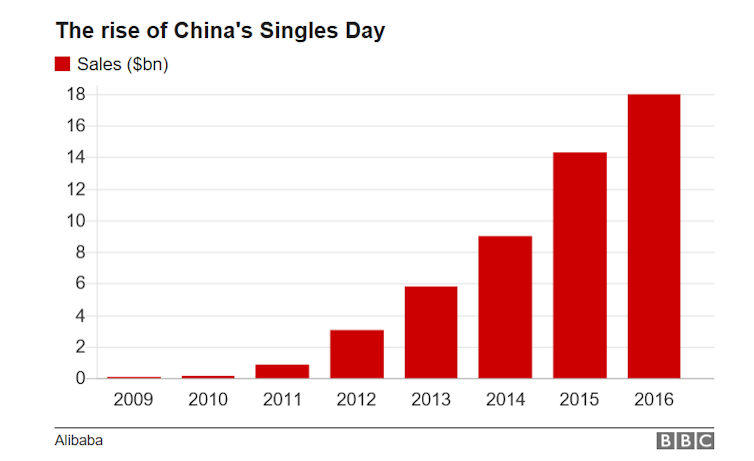
    However, unlike Black Friday, China’s November 11 “Singles Day” is still predominately focused on local consumers and completely dominated by one online retailer – Alibaba. The economic impact of Black Friday is dwarfed by this online one-day retail festival from China. Singles Day has gone under the radar for most of the general public in the West, but in 2016, Chinese shoppers spent an incredible US$17.8 billion in 24 hours on the Alibaba online platform – China’s Amazon equivalent.

    This online sales bonanza shifts more goods than the Black Friday and Cyber Monday sales days in the US combined. Black Friday in the US saw online sales hit a record of just over US$3 billion in 2016.

    Origins

    Singles Day started as an obscure “anti-Valentine’s” celebration for single people in China back in the 1990s. The popular story is that it was started by students at Nanjing University who celebrated their singledom by treating themselves. It takes place on November 11 every year and is sometimes known as “bare sticks holiday”, after the way the date is written (11/11).

    The event is also known as “Bachelors’ Day”, and it’s not hard to see why. China has a surplus of males caused by years of the government’s “one child” policy. By 2020, sociologists expect the gender imbalance to have widened to 35m and by 2030, it is estimated that one in four Chinese men in their late 30s will never have married. That is a big market.

    Black Friday was, of course, initially driven and then “exported” to the UK and other markets by major US retailers, specifically Walmart and Amazon. In China, it was the e-commerce giant Alibaba which adopted Singles Day in 2009, just as online shopping started to explode.

    It has now become a day when everyone, regardless of their relationship status, buys themselves gifts. Alibaba spotted this as a chance for retailers to generate interest and excitement and to boost sales in the lull between China’s Golden Week national holiday in October and the peak Christmas season.

    Like much of the global growth in online sales, Singles Day has been driven by mobile. Nowhere is this more stark than in China where, with 1.3 billion smartphone users, mobile shopping is huge. Around 37 per cent of Chinese shoppers buy products using their phones, compared to the global average of 13 per cent.

    We’ve seen that Alibaba’s sales numbers for Singles Day are astonishing. And the growth has been too. The chart below shows how Singles Day sales for Alibaba have risen over the past seven years. Last year alone, sales were up 32 per cent on the previous year.

    Alibaba/BBC, Author provided

    According to Alibaba, during the event on 2016 they processed more than a billion payment transactions in total, with 120,000 transactions per second at peak and their distribution system processed more than 657m delivery orders.

    Analysts have predicted this year’s event could see Alibaba rack up sales of US$20 billion despite a slowdown in China’s economy, partly due to it having a broader audience.

    Copy cats

    Of course those kinds of numbers attract the interest of Western retailers too and the 2016 event saw 37 per cent of total buyers purchasing products from international brands or merchants. Companies like US retailers Costco and Macys as well as Britain’s Top Shop and House of Fraser have marketplaces on Alibaba’s Tmall site have already got involved.

    And, for the first time, Alibaba’s 2017 Singles Day festival will bring more than 100 Chinese brands to overseas buyers, offering special promotions targeting over 100m overseas Chinese consumers in Asia and around the world.

    There is one rather sensitive obstacle to the adoption of Singles Day in the UK, however. The eleventh day of the eleventh month is Armistice Day when Britain marks the end of World War I and the nation remembers all those who have died in military service. There will be many who think it distasteful to run a shopping event on that day. However, as David McCorquodale, head of retail at KPMG, pointed out: “Singles Day in China is the biggest promotions day in the world. [The date] will stall its entry to the UK, but not forever.”

    Given the rapid globalisation of most retail trends and the way online retail now allows immediate access to millions of products from thousands of manufacturers, it is indeed impossible to envisage that Singles Day won’t extend it’s reach, in some form, to Western consumers very quickly.

  • Hong Kong retail start recovering

    Hong Kong retail start recovering

    A “steady if cautious” Hong Kong retail recovery is clearly underway, according to a report from Savills released today.

    “The retail sector is slowly coming to life after four years of painful adjustment which has seen the emergence of a ‘tenant’s market’, a rare occurrence in Hong Kong’s landlord-dominated retail scene,” observed Simon Smith, head of research and consultancy with Savills.

    Over recent months, he said, retailers have been taking the opportunity to upgrade for little or no extra cost and examples include Pandora which moved within IFC Mall and Hourglass, which runs Patek Philippe, relocating within Tsim Sha Tsui from the Imperial Hotel to a better site in the Holiday Inn.

    In further evidence of upgrade demand, Harry Winston has taken the space previously occupied by Ferragamo in the Mandarin Hotel and will open in early 2018. Alternatively, retailers are cutting overheads as they find that renewal negotiations are yielding significant savings as landlords discover a new pragmatism.As reported, Topshop has renewed the lease on its Queen’s Road Central store at a discount of about 50 per cent.

    While landlords of high street shops remain on the back foot, larger shopping centres, such as  Harbour City, IFC Mall and New Town Plaza, are proving relatively immune to the downtown, says Smith.

    In IFC Mall, Italian menswear brand Boggi opened recently while Brunello Cucinelli has launched a new flagship in the same mall.

    “As street-shop rents have fallen heavily while centre rents have only seen a minor adjustment, the gap between the two has narrowed considerably and tenants are now finding that a prime street front pitch can be a viable alternative to taking space in a nearby mall. This is the narrowest the gap has been since 2009 and represents a return to the norm after seven years of major gains in street shop rents.”

    Strength in regions

    Savills also notes that regional and district malls such as Popcorn in Tseung Kwan O and Tuen Mun Town Plaza are doing relatively well.

    “Hong Kong’s tight geography, excellent transport infrastructure and dense retail environment has helped this type of mall defend against the threat from online. The appeal of air conditioned spaces in the summer months and the lure of enhanced F&B offerings have also helped boost the appeal of local malls. We have also seen landlords putting more effort into marketing campaigns with better events, more pop-up stores and creative TV and online advertising,” said Smith.

    “Most malls now have a very well-established cyber-presence via websites and apps. Click-and-collect is making some limited headway locally, with brands such as Zara, Burberry, L’Occitane, Watson’s Wine, Chow Sang Sang and Starbucks all offering the service.

    “In a mixed market some trade categories are performing well and pharmacies in particular are expanding aggressively at the moment. Not every landlord wants them but they are often prepared to pay above-market rents. F&B is also out-performing, driven in part by a richly valued stock market and rising wages.”

    Nick Bradstreet, head of retail with Savills, said luxury fashion is turning around in Hong Kong even though brands have been closing stores in Macau and Mainland China over the past year or so. Luxury sales in China have actually surged over the past six to nine months.

    “Cosmetics retailers are reporting fairly stable business, but after a period of rapid expansion, many brands are still culling store numbers. Electrical goods retailers are consolidating in what is a very competitive marketplace,” he said.

    Savills prime street shop rental indices remained flat over the third quarter while rents in prime malls continued to drift off marginally. The latest September retail sales figures from government recorded a seventh consecutive month of rises attributable in part to a strong inbound tourist numbers. Jewellery, watches, clocks and valuable gift sales outperformed, rising by 14.7 per cent year-on-year, with strong growth also noted for medicines, cosmetics and Chinese drugs.

  • Topshop Hong Kong saves money in rent

    Topshop Hong Kong saves money in rent

    Renewing the lease for its Queen’s Road shop in Central, fashion brand Topshop Hong Kong has halved the rent.

    It now has a rate of HK$1.5 million (US$192,000) a month for its 12,000sqft (1100sqm) store on one of Hong Kong’s busiest shopping streets, reports Asia real-estate intelligence group Mingtiandi.

    The new deal gives the UK-based retailer of youth-oriented apparel and accessories another three years in the podium of the Asia Standard Tower for around $125 a square foot per month. Topshop had balked at the $3 million it had been paying for the space since signing its previous lease in 2013, the Hong Kong Economic Times reports.

    The cut-rate deal is the latest sign of an adjustment in Hong Kong’s retail real-estate scene as landlords scramble to deal with fashion brands and luxury retailers scaling back their footprints in the face of declining sales and recalibrated expectations, says Mingtiandi.

    It represents a return to leasing rates seen before a surge of demand from fashion brands prompted a rents rise several years ago. Topshop moved into its Queen’s Road space in 2013 after agreeing to double the amount former tenant Chinese Arts and Crafts had been paying for the street corner.

    Swatch last month took over two underground shops in the Central Building on Pedder Street for about $350 a square foot per month, after Hugo Boss moved out midway through its lease. Signing its lease in 2014, Hugo Boss had been paying more than double the rate that Swatch negotiated.

    At the end of its lease, jewellery retailer Chow Tai Fook walked away from the underground shop for which it had been paying $3 million a month in Nathan Road, Mongkok. The landlord has been looking for a tenant to take over the space at $1.5 million a month, says Mingtiandi.

    In Causeway Bay, Prince Jewellery and Watch is reported to have renewed its lease of a six-storey, 7300sqft shop on Russell Street for $1.8 million a month, about 38 per cent less than it had been paying since 2013.

  • UK parent steps into salvage Topshop in Australia

    UK parent steps into salvage Topshop in Australia

    Topshop and Topman have been salvaged in Australia, with Sir Philip Green and his UK-based Arcadia Group stepping in to take over the business.

    Administrators, Ferrier Hodgson, today made the announcement of the successful restructure of the fashion chains in Australia, which sees the sale of certain assets to Top Shop / Top Man (Australia) Limited, an entity controlled by the Arcadia Group.

    Four retail stores located at Gowings and Bondi Junction in Sydney, Emporium in Melbourne and Brisbane City will now be operated by the UK based retailer.

    “The Administrators are delighted with the outcome of our discussions with Topshop/Topman as it finalises a successful restructure and right-sizing of the business in Australia,” said Ryan Eagle, joint administrator alongside Ferrier Hodgson partners James Stewart and Jim Sarantinos.

    “Throughout this process we have considered the optimal operational structure of the business, ensuring the brand will continue in the local market and to preserve a significant number of jobs within the business”

    A Topshop/Topman spokesperson said the company is “excited to operate directly in the Australian market and look forward to delivering unparalleled fashion to our customers”.

    “We are delighted to be offering more than 290 jobs within the Australian market at Topshop and Topman.”