Tag: UBS

  • UBS Sets its Sights on China

    UBS Sets its Sights on China

    UBS hopes to grow its wealth management business in China, and as the country slowly opens up its financial sector, it could soon challenge local players that currently dominate the market, said Edmund Koh, President, UBS Asia Pacific, who spoke to Christine Tan in the latest episode of Managing Asia, broadcast on CNBC on 24 May.

    I think China is going through the same process Hong Kong and Singapore went through over the last 20 years but they will accelerate given the advancement of technology and also the internationalization of the Chinese population. So currently, it’s dominated by the local banks through more of retail wealth management but not the sophistication that is needed for legacy planning, said Koh.

    I think amongst the foreign banks, to be number one is there for the taking because nobody is really dominating that area,» he added, noting «For China, you have to be patient.

    Under his leadership, UBS’ invested assets in the region have grown by about 70 percent, Koh estimated. UBS crossed the $400 billion mark for invested assets in Asia Pacific in the first quarter of 2019, making it the first wealth manager in the region to reach this milestone.

    The bank saw strong growth in Asia, with record net new money inflows of $16.3 billion in the first quarter of 2019, a $10 billion jump from the year before, where it saw inflows of $6.3 billion in the same period, and just short of the $17.2 billion it brought in over the whole of 2018.

    He said hopes his team, under the leadership of wealth management Asia Pacific co-heads Amy Lo and August Hatecke, will soon be able to reach $500 billion. «I would tell them if they are any good, it should be less than two years. That’s how long I would give it myself,» Koh said.

    Managing the UBS’ 23,000 employees in the region and maintaining its position as the leading private bank in the region is no easy task, but Koh said his secret is self-belief, energy and purpose.

    My purpose, along with my colleagues, has been very clearly articulated. If we don’t do well, people will be unemployed because we manage some of the biggest families that are huge employers around the region. That drives me. It’s not the 50 basis points of loan spread or 75 basis points of investment. That is just part of the process.

    Koh, who in October 2018 became the first Singaporean to hold the position of president of UBS Asia Pacific, was previously the bank’s head of wealth management for Asia Pacific and country head Singapore. He joined UBS in 2012 as head of wealth management for Southeast Asia, following stints at Taiwan’s Ta Chong Bank, where he served for four years as president and director, and DBS Banks, where he was managing director and regional head, consumer banking from 2001 to 2008.

  • UBS Quarterly Profit Down Drastically

    UBS Quarterly Profit Down Drastically

    The Zurich-based bank’s net profit for the first quarter dropped to $1.1 billion Swiss francs from $1.6 billion a year ago, it said in a statement on Thursday. A 6.5 percent cut in spending wasn’t enough to offset UBS’ 16 percent tumble in revenue. Last year’s quarter also included an 241 million franc pension credit.

    The result follows a warning last month from CEO Sergio Ermotti that the first quarter – traditionally the strongest in banking – was the toughest in years. Crosstown rival Credit Suisse on Wednesday posted an 8 percent hike in profits for the same period, following an eventful three-year restructuring.

    Profit before tax at UBS’ flagship private bank slid nearly 22 percent: fees dropped because the bank managed fewer assets and commissions fell because clients stopped trading, particularly in Asia. «The first quarter of 2019 was characterized by challenging market conditions, which improved towards the end of the quarter and into April», CEO Ermotti said.

    Nevertheless, clients brought $22.3 billion in fresh assets to the wealth arm, which translates to a healthy 4 percent rate of growth. The bulk came from Asia, where UBS has banked heavily on China as the region’s biggest and fastest-growing wealth market.

    Meanwhile, profits at UBS’ investment bank plummeted by nearly two-thirds, where foreign exchange trading was the only bright spot. A downturn in Europe and the Middle East as well as Asia hit stock and bond trading and advising on deals. The unit eked out a meager 7 percent return on equity in the quarter.

    UBS said it is on track with measures such as stretching out technology projects, slowing hiring, reducing contractors, and pruning travel and entertainment costs – a bid to cut another 300 million francs in spending. «Benefits from these measures should come in the second half of the year, supporting our attractive capital return plan for the year», UBS said.

    Ermotti was more measured than Thiam’s buoyancy in his outlook, saying UBS expected global growth has slowed, but that UBS stands to gain because it is so regionally and operationally diversified. UBS’ rising asset base will bolster recurring income at its private bank and asset management units, the bank said.

  • UBS Signs for New Office Lease in Singapore

    UBS Signs for New Office Lease in Singapore

    UBS will move to 9 Penang Road, where the firm will take up all eight floors of office space at the redeveloped Park Mall building.

    UBS Singapore has signed a lease to take up all the office space of the redeveloped Park Mall building at 9 Penang Road, developer SingHaiyi Group and its joint venture (JV) partners Suntec Reit and Haiyi Holdings announced on Wednesday in a press release.

    The firm, which was mulling over a move to consolidate its One Raffles Quay and Suntec City offices in Singapore, will occupy 381,000 square feet of office space across two towers and eight floors at the development, which is expected to be completed by the end of the year. UBS will relocate there in the second half of 2020.

    The 10-storey grade A office building located at the gateway to the Orchard Road shopping belt and close to the Civic District and CBD will house the firm’s 4,000 Singapore employees, as well as its UBS University, which provides training and development programmes for employees across the region.

    «The move will allow us to bring employees currently working at One Raffles Quay and Suntec City under one roof to enhance collaboration, as well as offer new capacity for future growth in Asia Pacific,» August Hatecke, country head of UBS Singapore, said in the press release.

  • Investor Groups Attack UBS

    Investor Groups Attack UBS

    UBS faces pressure from shareholders ahead of an investor meeting next month. The opposition centers around a nearly $12 million windfall for CEO Sergio Ermotti and a prolonged French legal tussle.

    UBS’ investor meeting on May 2 promises to be a heated one: U.S. investor group ISS is recommending shareholders deny UBS’ management and board for 2018 a so-called dispensation, which is a peculiarity of Swiss securities law which exempts managers from liability for their actions.
    The move adds to opposition to UBS’ pay practices from Glass Lewis, which last week said it will oppose the Swiss bank’s compensation report. Geneva-based Ethos views the 73.3 million Swiss franc ($73.1 million) bonus pool for UBS’ top 13 executives as inappropriate given the poor performance of the Swiss bank’s stock last year.

    CEO Sergio Ermotti is taking home 11.9 million francs in so-called realized compensation after contingent capital instruments that UBS gave him in 2012 matured. At the helm since 2011, Ermotti is Europe’s best-paid banking CEO. His bonus for 2018 is 4.5 times his salary (the metric is capped at 5 times his yearly salary). In contrast to Glass Lewis and Ethos, ISS said UBS’ pay practices by and large reflect those of the wider financial industry.

    The wealth manager has justified the pay with the fact that UBS’ net profit rose 12 percent on the year, its capital is solid, and it bought back 750 million francs worth of its own shares last year. Ethos criticized that shareholders suffered a nearly one-third drop in the value of their shares during that time.

    From 2016 until last year, shareholders sucked up a more than 28 percent tumble, far more dramatic than the 1.8 percent fall in the wider banking sector, Ethos said. «Ethos believes that UBS must introduce a performance target taking into account the relative performance of the bank’s share price», said the group, which holds sway with many of Switzerland’s weighty pension fund voters.

    The «nay» from ISS on releasing board and management for 2018 is purely pre-emptive, the shareholder advocate said – it is the first time since the financial crisis that shareholders have mounted opposition against top executives.

    ISS issued the recommendation in view of UBS’ long-running French criminal troubles, where the bank was recently hit with a 4.5 billion euro ($5 billion) fine (the bank shredded the decision and faces at least another two years of appeals process). The shareholder group said the move would simplify any potential legal steps against members of the C-suite later. Ermotti and chief lawyer Markus Diethelm are the architects of a pugnacious legal strategy in France.

  • China, Hong Kong, Kowloon Team Heads Change at UBS

    China, Hong Kong, Kowloon Team Heads Change at UBS

    Following a realignment of its senior regional management last week, Swiss bank UBS has now rejigged its middle management, or country team heads as they are referred to at the bank.

    Kenny Wai, country team head for Kowloon, has resigned from the bank after seven years with UBS having previously been a desk head for both the Hong Kong and China International markets. In May 2018, Wai was made country team head for Hong Kong when Adeline Chien was promoted to a larger role as head of Hong Kong. Prior to UBS, Wai worked variously in compliance and as a client advisor, most recently at Merrill Lynch.

    His responsibilities will be taken up by Wai Man Chiu who joined UBS last year from Hang Seng Bank where she led a team of 30 colleagues. When she assumed the role of country team head at UBS, several members of her team from Hang Seng followed her to the Swiss bank. Most notable amongst them were desk head Jonathon Yeung and client advisors Aubrey Cheung, Connie Chan, and Raymond Yung.

    According to an internal memo seen from Marina Lui, the newly appointed head of wealth management China, she confirms the resignation of Wu Ya Ju, country team head of China International. Wu had been with UBS since 1996, starting as a client advisor with the bank. She is believed to be retiring from the industry. Also retiring is Philip Mak, country team head Hong Kong Domestic.

  • UBS Exploring Office Move in Singapore

    UBS Exploring Office Move in Singapore

    UBS is considering to move its office out of the central business district, according to local media reports. UBS is likely to consolidate its Singapore office footprint by relocating from One Raffles Quay and Suntec City to 9 Penang Road, according to a report in Business Times.  Market sources said that the commercial terms of a potential lease for 9 Penang Road have been more or less finalized, but the deal is still pending for approval by the top brass in Switzerland.

    The site, which is coming up on the former Park Mall site opposite Dhoby Ghaut MRT Station, would provide a different type of space for the bank. The motivation appears to be a desire by the bank to operate in a larger, campus-style, facility, rather than cost savings.

    Surprising Move

    Many office leasing observers were somewhat surprised that UBS, Asia’s largest wealth management bank, is considering moving out of the financial district into Penang Road, which is not a typical headquarters location for a major bank.

    However, 9 Penang Road may have its own appeal, given it is a stone’s throw from the prime Orchard Road shopping belt and the location offers good connectivity. Dhoby Ghaut station is an interchange for the North-South, North East and Circle lines.

  • Asian Private Banking Abuzz with UBS China Fiasco

    Asian Private Banking Abuzz with UBS China Fiasco

    Onshore China, and its rapidly growing billionaire population, is a target for most private banks in the region. UBS has arguably the best-established franchise in the competitive onshore market. Chinese regulators require foreign banks such as UBS to obtain licenses in each jurisdiction that they operate. UBS opened branches in both Beijing in 2014 and Shanghai in 2016 offices, amidst much fanfare and presumably at great cost.

    Due for Interview Next Week

    A female relationship manager at Switzerland’s biggest bank this week was detained at the airport in Beijing, according to a source familiar with the matter. The authorities allegedly held the UBS banker on grounds of illegally soliciting business, the source told.

    The relationship manager may have violated stringent Chinese onshore regulations, which declare illegal the marketing and sale of offshore financial products.

    The banker will be interviewed by Chinese authorities next week, according to information obtained. She has however received back her passport, which had been confiscated. The reasons for her detention remain unclear.

    Strong Message

    The Swiss bank will not comment on the detention of one of its bankers, but said that it had very stringent rules set for its bankers. «This is a strong message from the regulator that it will not tolerate fly in banking,» says one senior banker at another Swiss finance firm. The practice of «flying in» bankers, ostensibly for legitimate onshore reasons ranging from client meetings to golf trips – was one favored by many banks in capital controlled markets such as Taiwan and India.

    It was, however, abandoned as banks – Swiss wealth managers in particular – ran into trouble with regulators in these onshore jurisdictions.

    «Breached Lines»

    «Chilling» is how another senior manager at a European bank described the developments. «The fact that it is a UBS banker – and not one at a smaller shop – is indicative of how determined the regulator is,» he explains.

    A head of Taiwan business at another private bank says, «the line continues to be breached several times in onshore markets,» but it is likely there will be systemic reluctance among both bankers and their banks after the latest incidence.

    Hands-Off in China

    What this means for banks that have made deep investments in the China onshore market and are under considerable pressure to «move out of investment phase» is unknown. For the savvier ones, this is likely to be an inflection point.

    «It is certainly hands-off China for the moment and we will implement no-fly restrictions in any case where it is ambiguous whether the purpose of the visit is strictly onshore,» confirms the senior manager.

  • Ex-UBS Executive Director Joins HSBC

    Ex-UBS Executive Director Joins HSBC

    A former Executive Director, Wealth Management at UBS, Singapore, has crossed the street to take up a senior role with rival HSBC Private Bank.

    In a statement HSBC Private Bank said: «We can confirm the appointment of Shang-Wei Chow as a Market Head, Domestic (Singapore) team at HSBC Private Bank, effective 3 November 2016. His appointment underpins our continued efforts to enhance our client servicing capabilities and deepen our engagement with clients.»

    Chow is a seasoned private banker with nearly 15 years of experience managing client relationships and wealth portfolios in Southeast Asia. As a Market Head of the Domestic team he will be responsible for new business development and deepening existing client relationships in line with HSBC’s strategy. Prior to joining the bank he was Executive Director, Wealth Management at UBS, Singapore.

    A Year of Change

    HSBC has seen numerous changes to its Singaporean private bank throughout 2016 including the departures of HSBC veterans Rob Ioannou to DBS and Michael Hua to LGT Private Bank.

    HSBC Private Bank in the city-state has also appointed several new bankers including a Head of Investment Counselling together with a new Head of Ultra High Net Worth Investment Counselling.

  • Wal-Mart’s deal with China’s JD.com may be copied by others

    Wal-Mart’s deal with China’s JD.com may be copied by others

    When the world’s largest retailer makes a move, other retailers pay attention. Wal-Mart Stores Inc.’s decision to enter into a strategic alliance with the second largest Chinese e-commerce retailer, JD.com Inc., may inspire others to seek out local partnerships to make inroads in this major market.

    “For some in the industry, this will be a ‘Good Housekeeping’ seal of approval,” said Christian Magoon, chief executive officer of Amplify Investments, which recently launched the Amplify Online Retail ETF IBUY, -0.52% .

    “If Wal-Mart is comfortable and, with their scale, couldn’t crack the Chinese market on their own, it will be a case study for others. It could be a bellwether moment to see if this strategic partnership is the best model.”

    Wal-Mart announced Monday that it will sell its Yihaodian website to JD.com and receive about 5% of the company’s total shares outstanding. Wal-Mart WMT, +0.51% will open a flagship Sam’s Club China store on JD.com JD, +0.33%  and leverage the online retailer’s supply chain assets.

    Wal-Mart has had problems growing in the Chinese market, amid food regulatory and food safety controversies.

    “Wal-Mart was trying to go on its own and I think this is kind of a throwing in the towel,” Magoon said. At the same time, it is an acknowledgment that Wal-Mart needs to grow in China to be in a good position for the future. “If Wal-Mart is going to compete, they’re going to have to go big,” Magoon said.

    To compete in China, retailers have to go online, said Charlie O’Shea, Moody’s lead retail analyst.

    “JD.com has a solid platform online in China, and we know China’s online business is expanding rapidly because they’re not at the level of brick-and-mortar like the U.S.,” said O’Shea.

    JD.com also has a proprietary system that allows them to control the “last mile” with customers, or the final leg of the delivery process that gets merchandise into the buyer’s hands. O’Shea describes the last mile as “critical.”

    Analysts at UBS view the deal as a “good move on many levels,” though Wal-Mart’s share price may not reflect that.

    “While this deal isn’t a needle mover for Wal-Mart shares, it shows the retailer can be shrewd when the opportunity presents itself,” the bank wrote in a Monday note.

    UBS believes there are more opportunities like this one in the retailer’s portfolio, which currently spans 28 countries.

    “Wal-Mart has identified China as its highest potential international growth market,” they wrote. “We believe it remains fully committed to this geography, despite the sale.”

    UBS rates Wal-Mart stock at neutral with a price target of $67.

    Wal-Mart shares were up 0.4% in Tuesday trading, and up 16.5% for the year so far. JD.com shares are down 0.4% in Tuesday trading, and down 35% for the year so far. The S&P 500 is up 2.1% for the year to date.


  • UBS optimistic on Australia, Japan real estate markets

    UBS optimistic on Australia, Japan real estate markets

    UBS Asset Management is optimistic on the Australian and Japanese real estate markets, according to its latest Asia Pacific quarterly outlook report. Amid a challenging macro conditions, transaction volume for commercial real estate fell 12% y-o-y in 2015. However, Japan and Australia bucked the trend as domestic lenders eased their credit policies on account of improving fundamentals and collateral quality.

    Toh Shaowei, UBS Asset Management director of research and strategy for Asia Pacific, says: “Broadly speaking, the near-term condition in APAC region is still challenging and there is a ‘longer winter’, but the long-term fundamentals remain strong. We see a few macro themes and continue to monitor them.”

    In Japan, household spending is likely to be the main driver of economic growth on the back of ongoing wage rises, healthy job market and lower oil prices. Negative interest rates have also boosted capital expenditures. Notably, these expenditures have focused largely on new product development, R&D and efficiency saving measures to counter aging population and labour shortages.

    Occupancy rates and rents for Japan’s key office markets have also trended up due to limited new supply and steady demand from large corporates. These corporates have benefited from Bank of Japan’s asset purchases, lower borrowing costs and weaker currency which boosted earnings.

    The leasing market in the Japanese logistics sector remains robust on the back of increasing demand for same day deliveries from end users and growth of online shopping. However, rising supply from new developments are likely to restrict overall rental growth.

    In Australia, Sydney and Melbourne led the recovery in the office leasing market as the country shifts its growth model from the mining sector and resource-rich state. Finance and insurance, professional services and the technology, media and telecommunications sector are the key drivers of demand for office space. Meanwhile, net absorption level in resource-rich states of Queensland and Western Australia continue to lag but is gradually stabilising, says UBS.

    Separately, robust demand from international retailers looking to gain exposure to the Australian market have strengthened the rents and occupancy rate of prime retail space. However, secondary retail space is expected to continue to underperform amid subdued wage growth and increasing penetration of online retailers. UBS anticipates near-term rental growth to remain below historical averages as households allocates a higher share of their incomes to healthcare and education.

    On the home front, the outlook for Singapore’s real estate market remains challenging in the near term. The clampdown in foreign labour supply and an elusive labour productivity gain have lifted business costs and dented corporate sentiments. Coupled with a supply onslaught, UBS expects the overall office sector performance to remain depressed over the next two years.

    UBS expects the weakness to be broad-based across all property segments. Singapore’s retail rents are likely to witness a flat to marginal declines over the next 12 months while sluggish manufacturing outlook is clouding the overall prospects for the industrial property sector.

  • UBS Capitulates, Slashes Hang Seng Forecast

    UBS Capitulates, Slashes Hang Seng Forecast

    As China devalues yuan and the U.S. is on track to raise rates, Hong Kong, whose currency is pegged to the dollar, is in trouble.

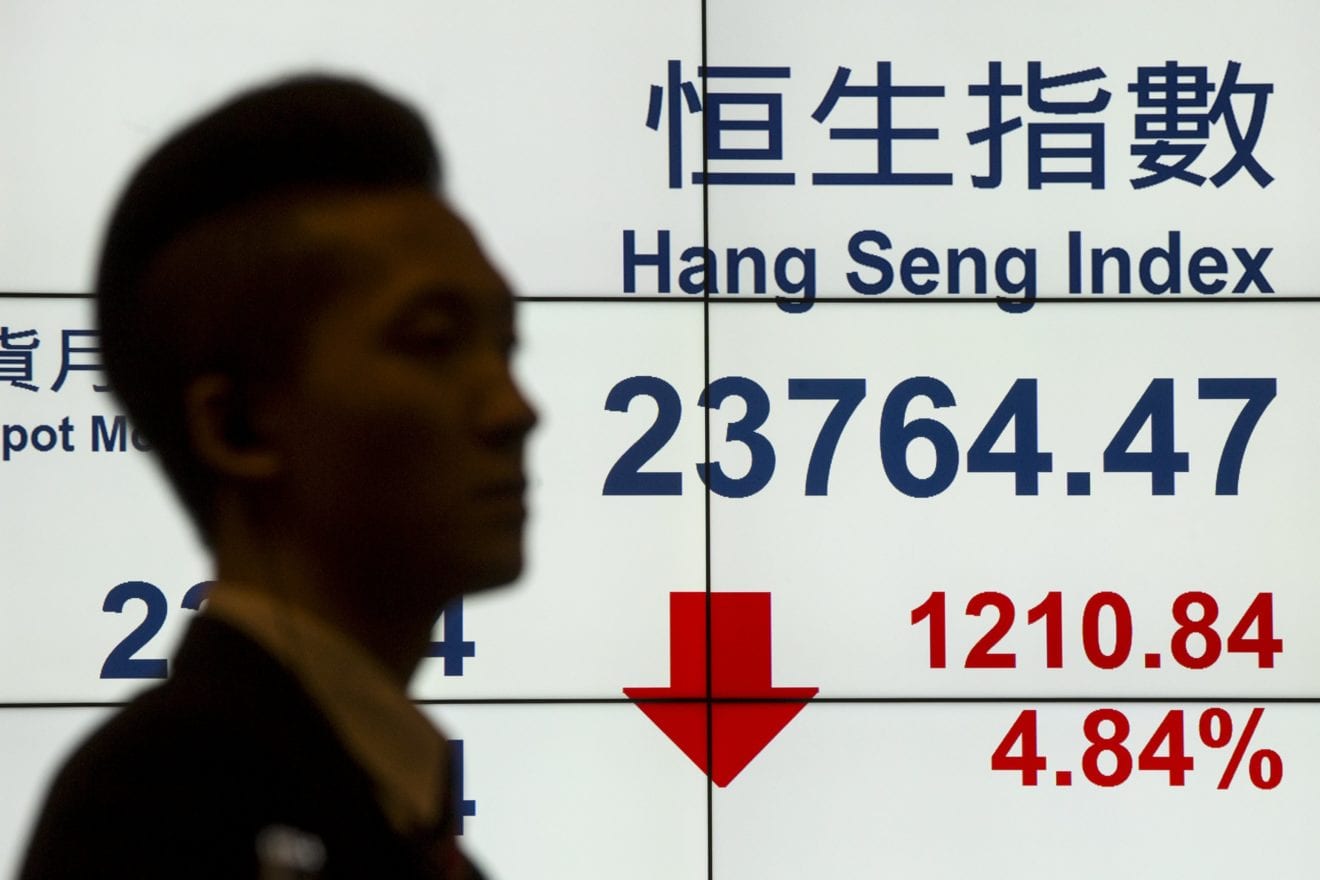
    Forecasting “black sky”, UBS now sees the Hang Seng Index to end the year at 19,775, another 5.5% downside from its current level. The Hang Seng Index has fallen by about 25% since its late April high.

    Apart from China slowdown, “we have seen a combination of the three pillars of Hong Kong’s economy weakening (tourism and re-export) or showing signs of weakness (property),” wrote Spencer Leung.

    The Hang Seng Index is now valued at only 9.4 times forward earnings, a good 0.8 times standard deviation below its 2-year average, but “the current valuation of Hong Kong equity may not be attractive enough to compensate for potential earnings downside.” UBS estimates Hong Kong companies’ earnings could drop 31% next year.

    It is not easy for retail businesses to operate in Hong Kong, because the rent is simply too high. UBS estimates that ground-level stores in prime shopping districts in Hong Kong will have to see their rental expenses drop 70% from their peak to break even. Last week, U.S. handbag bag Coach closed its flagship shop in the Central shopping district.

    Overnight, the iShares MSCI Hong Kong ETF rose 0.5%.