
Tag: united states

  • Shinsegae Chairman Joins US-Led AI Supply Chain Push

    Shinsegae Chairman Joins US-Led AI Supply Chain Push

    Shinsegae Group Chairman Chung Yong-jin met senior United States officials in Washington on Thursday, expanding the Korean retail group’s role in a US-led artificial intelligence supply chain initiative.

    The Korean retail giant partnered with US startup Reflection AI in March, and the two companies are currently working to establish a joint venture and select a site for a large-scale AI data center in Korea.

    Washington Backing for Korean Infrastructure

    Chung attended the launch of Foundry School at the Donald J. Trump Institute of Peace after an invitation from US Vice President JD Vance and the US Department of State. Run jointly by the State Department and Stanford University, the program trains technical talent and entrepreneurs for strategic industrial sectors.

    US Under Secretary of State for Economic Affairs Jacob Helberg called the Shinsegae alliance with Reflection AI a template for allied economic security under Washington’s Pax Silica framework. The initiative aligns supply chains across semiconductors, artificial intelligence, advanced manufacturing and power generation among allied nations.

    Attendees included US Secretary of State Marco Rubio and House Republican Majority Leader Steve Scalise. Corporate leaders present included Meta President Dina Powell McCormick, Micron Technology CEO Sanjay Mehrotra and Applied Materials CEO Gary Dickerson.

    “Successfully leading an advanced-industry supply chain alliance centered on the US is the task of our time,” Chung said during discussions in Washington.

    From Department Stores to Server Racks

    Shinsegae is pivoting from traditional store networks into digital infrastructure. Department store operators across Asia face margin pressure in physical formats. That pressure is driving conglomerates to seek revenue from digital services, logistics networks and cloud infrastructure.

    Securing backing from Washington gives Shinsegae diplomatic standing and potential hardware access that purely domestic competitors lack. Execution carries risk. Developing and powering high-density data centers requires heavy capital expenditure and massive grid capacity in an already constrained Korean energy market.

    Next Steps for Joint Venture

    Talks in Washington build on an initial agreement signed in March, when Shinsegae and Reflection AI agreed to pursue a dedicated data center project in South Korea. That deal was the first project designated under the State Department framework promoting allied AI expansion.

    Both companies are now finalizing terms for the joint venture entity. They are reviewing prospective sites across South Korea ahead of formal construction filings.

  • NIQ and Similarweb Partner to Launch AI Commerce Measurement in Q4 2026

    NIQ and Similarweb Partner to Launch AI Commerce Measurement in Q4 2026

    NIQ and Similarweb are collaborating on an Agentic Commerce Measurement solution to help brands, retailers and technology platforms track purchases made through artificial intelligence, with an initial version scheduled for Q4 2026.

    The collaboration combines NIQ’s product intelligence, consumer behavior data and retail sales measurement with Similarweb’s digital signals across generative AI platforms. Together, the two New York Stock Exchange-listed companies will connect AI discovery to measured sales outcomes.

    Five tracking pillars

    The planned solution will initially focus on 5 areas across the buying journey: consumer intent, agentic shelf visibility, product content readiness, AI-driven traffic and AI-driven conversion into verified omnichannel purchases.

    Initial monitoring will cover major generative tools including ChatGPT, Gemini, Google AI Mode, Perplexity and Claude. These analytics feed directly into NIQ’s Commerce Intelligence ecosystem, which links brand product catalogs with enterprise retail operations.

    AI is becoming a new commerce channel, and NIQ intends to make it measurable. Our clients want to know where AI is already influencing their business, how quickly that influence is growing and what they should do about it.

    The shift to agentic checkouts

    Protocols such as Google’s Universal Commerce Protocol and OpenAI’s Agentic Commerce Protocol prompted the project. Both frameworks allow autonomous software agents to research, evaluate and purchase merchandise inside a single chat window without redirecting the shopper to a traditional storefront.

    For consumer brands and multi-brand merchants, automated shopping removes the classic digital shelf where banner placements and search bidding drove conversion. Brands drop out of the basket entirely if an AI agent filters options down to two choices based on structured technical metadata they lack.

    Catalog hygiene and algorithmic bias pose immediate hurdles for suppliers. A brand cannot buy sponsored placement inside an autonomous agent if the underlying Large Language Model cannot parse the product description or confirm inventory in real time.

    Platform coverage and next stages

    Integration relies on NIQ’s existing enterprise analytics tools, Optiq and ConnectAI, which feed commercial data directly into corporate workflow software. Similarweb previously built out dedicated digital footprint tools to capture referral traffic from generative artificial intelligence search portals.

    NIQ and Similarweb plan to reveal initial product categories and regional test markets ahead of the fourth-quarter rollout in 2026.

  • Philip Morris Tops $11 Billion in Net Revenue as Smoke-Free Sales Hit 42 Percent

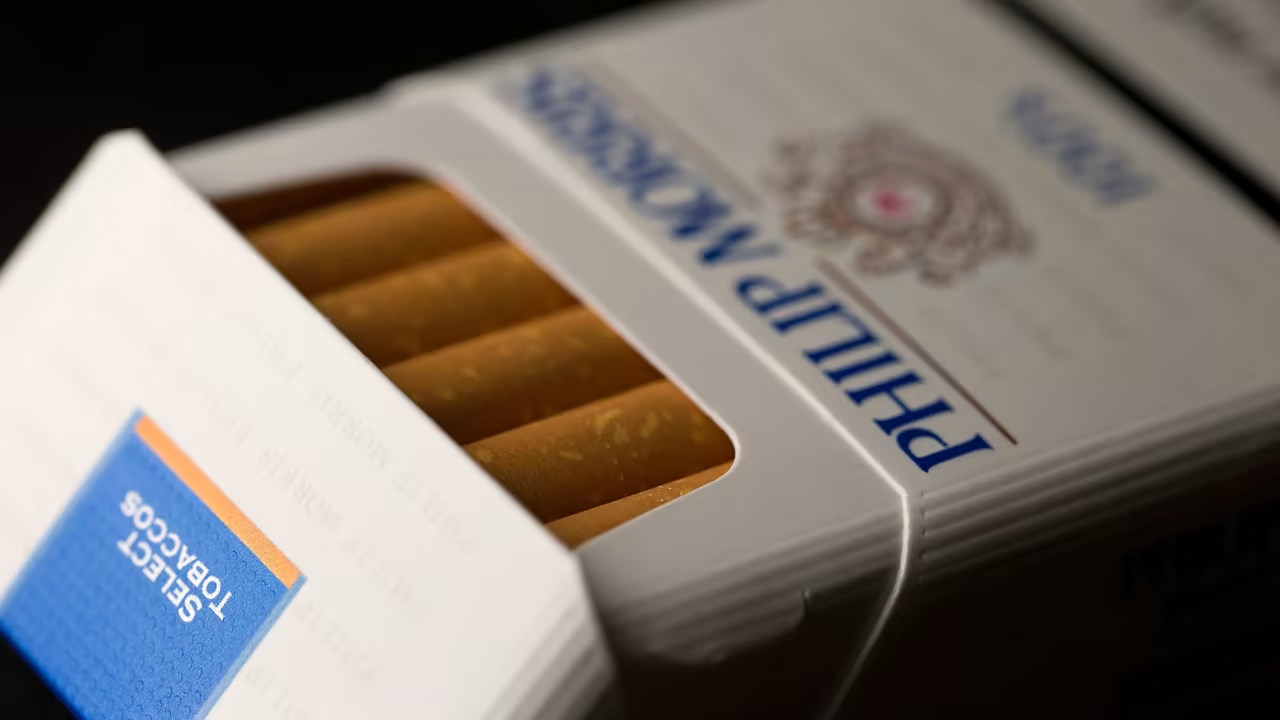
    Philip Morris Tops $11 Billion in Net Revenue as Smoke-Free Sales Hit 42 Percent

    Philip Morris International generated more than $11 billion in net revenues during the second quarter of 2026. Higher international sales of heated tobacco and oral nicotine alternatives drove the total.

    Organic top-line growth reached close to 8 percent. That lifted the smoke-free category to 42 percent of total group net revenues across the first six months of the year.

    Operating income climbed 11 percent on an organic basis. In currency-neutral terms, adjusted diluted earnings per share rose 14 percent, or 15 percent in dollar terms. IQOS heated tobacco systems and VEEV vapes led non-combustible volume gains abroad. Meanwhile, the conventional cigarette unit held gross profit growth through higher pricing and steady category share. In the oral nicotine business, ZYN shipments rose 2 percent year on year to 2.9 billion pouches, helped by early distribution of the new ZYN ULTRA variant.

    Portfolio shift across retail channels

    Convenience retailers and travel hubs across Asia-Pacific and Europe now face a permanent rebalancing of shelf space. In Japan and South Korea, heated tobacco adoption outpaces traditional smoking in major cities. Tobacco fixtures there function increasingly like consumer electronics displays. Retailers with early distribution deals for IQOS consumables continue to capture higher basket values from repeat device and heatstick purchases. Traditional corner shops reliant solely on combustible cigarette cartons face shrinking margins.

    Across Southeast Asia, the transition creates immediate inventory complications for convenience store operators. Regional regulators take fragmented stances on reduced-risk products, ranging from outright bans to regulated imports. Retailers in open markets must tie up working capital in multi-brand hardware alongside conventional packs. That creates inventory turnover risks if consumer adoption lags manufacturer targets.

    Pricing power and regional performance

    Cash flow from conventional cigarettes continues to fund smoke-free production facilities and clinical testing. Higher prices in emerging markets offset volume declines in mature combustible territories, keeping category margins steady. Group CFO Emmanuel Babeau pointed to sequential gains in the United States after a slow start to the year, alongside momentum across wider international markets.

    We reported close to plus 8% organic top line growth, reaching over $11 billion in quarterly net revenues for the first time.

    Transition timeline and next targets

    Full-year 2025 performance set the foundation for the latest quarter. Smoke-free alternatives reached 109 commercial markets worldwide that year, topping 50 percent of total net revenues in 27 national territories. The company counted more than 43 million legal-age consumers using its reduced-risk lines by late 2025, broadening out from early adoption hubs in Japan and select European test cities.

    Management presents its next strategy update at the Barclays Global Consumer Conference on September 8, 2026, where commercial execution figures for the ZYN portfolio expansion will face investor scrutiny.

  • Victoria’s Secret Profit Tripled in Second Quarter Despite Sales Miss

    Victoria’s Secret Profit Tripled in Second Quarter Despite Sales Miss

    Victoria’s Secret nearly tripled its profit in the second quarter and lifted its full-year earnings guidance, overcoming a narrow top-line sales miss that rattled equity investors.

    Higher merchandise margins drove the profit surge as shoppers bought more lingerie and apparel at regular price points rather than clearance discounts.

    Margin Gains and Product Overhauls

    Chief executive Hillary Super faces scrutiny from financial markets to prove that the turnaround plan can deliver consistent revenue expansion alongside margin gains. The recovery strategy relies on fresh product lines, tighter brand positioning and the return of a revamped fashion show.

    Full-price sell-through provided the foundation for the quarterly improvement. By pulling back on heavy discounting, the apparel group protected profitability across its physical store fleet and digital sales channels.

    The Balance Between Price and Volume

    For store operators and regional franchisees, the profit rebound confirms that higher retail pricing can offset sluggish foot traffic and cautious consumer spending. Yet relying entirely on margin expansion without broad sales volume growth carries structural risk in competitive markets.

    Rival innerwear and athleisure brands continue to fight for floor space and customer wallet share across shopping centres. Landlords and retail partners need steady transaction volume to support retail footfall, not just cleaner balance sheets from lower inventory markdowns.

    The Turnaround Path

    The latest quarterly report follows multiple management efforts to reposition the brand away from outdated marketing concepts and rebuild credibility with mainstream apparel shoppers. Earlier restructuring phases focused on rationalising store networks, overhauling product assortments and adjusting wholesale partnerships.

    Attention now shifts to whether the upcoming fashion show and new seasonal merchandise can lift revenue through the second half of the financial year.

  • Tim Cook Steps Down as Apple Chief Executive and Hands Reins to John Ternus

    Tim Cook Steps Down as Apple Chief Executive and Hands Reins to John Ternus

    Tim Cook will step down as Apple chief executive to become executive chairman, handing control of the 4.5 trillion dollar company to hardware chief John Ternus.

    The transition ends a 15-year tenure that increased Apple’s annual sales from 108 billion dollars to 416 billion dollars, with net profit surging fourfold to 112 billion dollars.

    Cook will guide Apple’s government relations and trade strategy between Washington and Beijing starting September 1. A regulatory filing shows Ternus receives a base salary of 3 million dollars and an annual equity target of 55 million dollars beginning in 2027. Cook will draw an annual salary of 2 million dollars effective September 26, alongside a 45 million dollar target award in restricted stock units.

    The Asian Manufacturing Pivot

    Ternus inherits a hardware empire undergoing its biggest geographic realignment since the launch of the original iPhone. Apple is shifting assembly lines outward from mainland China to insulate its retail pricing from tariffs and geopolitical disputes. The company plans to manufacture the majority of US-bound iPhones in India by the end of 2026, while routing AirPods and iPad assembly through Vietnam.

    Cook built Apple’s initial dominance on Chinese factory scale, but the post-pandemic supply map demands distributed capacity. For electronics retailers and component suppliers across Asia, the succession confirms that Apple’s diversification away from single-country manufacturing will continue under a hardware-focused chief executive.

    Hardware Strategy and Artificial Intelligence

    Beyond factory logistics, Ternus faces immediate product hurdles across consumer markets. Wearables generated 35 billion dollars in fiscal 2025 sales from devices like the Apple Watch and AirPods, yet the 3,499 dollar Vision Pro headset struggled to capture high volumes. Apple also scrapped its decade-long electric vehicle program in 2024 and continues working to catch rivals in artificial intelligence features and voice assistance.

    The new leadership team must now execute the late-2026 India iPhone production target without eroding gross margins across the 2.5 billion active device base.

  • Uber to Cut 3,300 Jobs in Global Push Toward Robotaxis

    Uber to Cut 3,300 Jobs in Global Push Toward Robotaxis

    Uber Technologies is cutting roughly 3,300 jobs, or 10 per cent of its global workforce, to streamline management and fund an autonomous driving push. The retrenchment is the company’s largest round of dismissals since May 2020, when it shed 6,700 workers during the pandemic.

    Chief executive Dara Khosrowshahi announced the restructuring in a staff memo on September 2. The reductions target middle management rather than operational staff, with the company seeking to eliminate bureaucratic bottlenecks that slowed product decisions.

    Stripping Management Layers

    The overhaul cuts the number of workers positioned seven or more reporting tiers below the chief executive by 20 per cent. Internal teams with only one or two direct reports will shrink by nearly half, while several operational divisions will merge across regional hubs.

    Remote work will also contract sharply. Uber will cap fully remote positions at about 1 per cent of its total headcount while enforcing its existing policy requiring three days a week in the office. The platform finished 2025 with approximately 34,000 global employees.

    Unlike other technology peers cutting headcount this year, Khosrowshahi did not attribute the dismissals to artificial intelligence tools. Industry tracker layoffs.fyi recorded more than 123,000 tech redundancies across roughly 390 businesses in 2026, many citing automated workflow gains.

    Redirecting Capital to Autonomous Fleets

    Savings from the payroll cuts will help finance more than US$10 billion in planned autonomous vehicle investments. Uber wants to secure its position as a central booking marketplace for driverless fleets operated by external partners, countering threats from standalone operators such as Waymo and Tesla.

    Tensions with autonomous developers have escalated as suppliers expand their own direct-to-consumer networks. Waymo currently operates driverless vehicles through the Uber app in Austin and Atlanta, but it is rolling out into additional metropolitan areas independently.

    For mobility operators across Asia and Western markets, the transition to robotaxis threatens the traditional middleman fee structure built on gig workers. While Southeast Asian operators continue to rely on human drivers, platform valuations increasingly hinge on controlling autonomous dispatch software rather than maintaining large administrative headcounts.

    Uber shares gained 2 per cent in pre-market trading following the announcement, after dropping nearly 8 per cent earlier in the year. The company must now deploy its autonomous capital budget while renegotiating fleet supply pacts across key urban markets.

  • John Ternus to Take over as Apple CEO as Tim Cook Becomes Executive Chairman

    John Ternus to Take over as Apple CEO as Tim Cook Becomes Executive Chairman

    Apple chief executive Tim Cook will step down after 15 years, handing leadership of the US$4.5 trillion tech company to hardware head John Ternus.

    Cook expanded Apple from a US$350 billion business into the world’s most valuable hardware maker before preparing to shift into the executive chairman role in September.

    Hardware leadership and AI priorities

    Ternus takes charge as Apple faces growing pressure across artificial intelligence development and device assembly. Having run Apple’s hardware engineering division, he oversaw major product portfolios across iPhone, Mac, and iPad product cycles.

    Cook built Apple’s post-2011 growth on rigorous manufacturing coordination and deep consumer distribution networks. His operational playbook turned the brand into a retail powerhouse across China, Japan, and newer retail growth corridors such as India and Southeast Asia.

    Production footprint and next steps

    For electronics supply chains in Asia, the executive change lands as hardware brands reshape procurement and expand production footprints beyond mainland China into India and Vietnam. Regional competitors are simultaneously pushing rapid consumer AI deployments to test Apple’s premium smartphone sales.

    Ternus takes the top post this September as Cook moves into the board chairmanship.

  • TCL Sues Samsung in US Court over Alleged Mini LED Television Claims

    TCL Sues Samsung in US Court over Alleged Mini LED Television Claims

    Chinese electronics manufacturer TCL sued Samsung in Los Angeles federal court, accusing its South Korean competitor of falsely marketing standard screens as Mini LED televisions.

    The complaint targets Samsung’s M Model line, which launched in March at price points below TCL’s entry-level display range. TCL claims the rival sets contain conventional LED hardware rather than the smaller, high-contrast diodes required for true Mini LED performance.

    Dispute Over Screen Technology

    According to the filing, TCL held the lead in US Mini LED television sales between 2023 and 2025 after pricing its units below Samsung’s premium lines. TCL attorney R.C. Harlan stated that Samsung peddled a recycled product line as a supreme tier model to claw back retail buyers.

    Samsung rejected the claims on Tuesday. The company said it intends to vigorously defend itself in court and stands fully behind the accuracy of its product specifications.

    Fight for US Market Share

    Chinese display makers have steadily squeezed South Korean rivals by scaling up advanced panel manufacturing in mainland factories, driving down retail prices across Western markets. While Samsung built its dominance on premium OLED and Quantum Dot hardware, TCL used competitive Mini LED pricing to erode Samsung’s volume share in major retail chains.

    TCL is asking the court for an injunction to halt Samsung’s Mini LED marketing claims alongside unspecified monetary damages. The case now moves toward initial procedural hearings in the Central District of California.

  • Koala Revenue Rises 20% to $332 Million as Japan Sales Jump

    Koala Revenue Rises 20% to $332 Million as Japan Sales Jump

    Australian furniture retailer Koala posted a 20 per cent rise in annual revenue to $332.3 million for the fiscal year ended June 30.

    Growth in overseas markets offset tighter consumer spending at home, lifting pro forma EBITDA by 139 per cent to $27.9 million.

    Japan and American Sales Fuel Expansion

    Domestic sales in Australia rose 10.7 per cent to $166.7 million during the twelve-month period. International divisions expanded at a much sharper clip.

    In Japan, revenue climbed 23.5 per cent to $89.4 million, carried by demand for sofa beds and mattresses. The United States registered the fastest geographic growth, where sales jumped 67.6 per cent to $74.9 million. Koala also entered the United Kingdom during the fiscal year.

    Direct-to-consumer furniture makers across the Asia-Pacific region have spent two years navigating softer home goods demand and volatile shipping rates. Koala’s performance in Tokyo shows that flat-pack formats tailored for compact urban living continue to find traction outside Australia even when consumer sentiment cools.

    Bottom Line and Public Markets

    Operating margins improved across core product lines, supported by new releases in sitting furniture. Constant-currency revenue grew 24 per cent across the group.

    “FY26 was a defining year for Koala,” chief executive and co-founder Dany Milham said, noting the completion of the company’s listing on the Australian Securities Exchange.

    Market attention now shifts to initial sales figures from the United Kingdom and customer uptake of the expanded seating lines in the first quarter of fiscal 2027.

  • Cryptex Allocates 4.88 Percent XRP Weighting in US Digital Asset ETF Filing

    Cryptex Allocates 4.88 Percent XRP Weighting in US Digital Asset ETF Filing

    Cryptex Finance assigned a 4.88 percent weighting to XRP in an amended registration statement submitted to the US Securities and Exchange Commission for its proposed Digital Market Cap ETF. The fund, set to list under the ticker BAGZ, tracks a diversified digital asset index where XRP held a 4.36 percent baseline weight before eligibility screens.

    The filing includes language suggesting Ripple could retain higher quantities of XRP from its monthly escrow distributions if federal rules become clearer, directing those tokens toward liquidity for stablecoin and foreign exchange trading pairs. That language appeared without an attributed source or direct confirmation from Ripple representatives, drawing scrutiny from institutional market watchers and legal analysts who follow cross-border digital payment infrastructure.

    Escrow releases and market liquidity

    Ripple locked 55 billion XRP into 55 monthly escrow contracts of 1 billion tokens each to ensure predictable distribution. Under current ledger mechanics, the company cannot unlock tokens ahead of schedule, but it regularly decides how much of each released tranche returns to new escrow contracts. Historically, Ripple returns between 60 percent and 80 percent of each monthly 1-billion token release, keeping the remainder for operational reserves and institutional sales.

    Retaining a higher portion of monthly releases would expand secondary market circulating supply for cross-border liquidity rails. For digital asset fund managers and trading desks operating between Asia and North America, any shifts in circulating XRP balances directly alter transaction depth on major exchange corridors.

    Regulatory timeline for the CLARITY Act

    Cryptex tied its liquidity assumptions to legislative momentum around the CLARITY Act, a federal measure designed to provide an explicit regulatory framework for digital asset markets in the United States. The Senate Banking Committee cleared the bill in May on a 15-9 vote.

    Procedural action on the bill heads to the Senate floor in September, where broader legislative debate will determine whether digital asset issuers gain the regulatory protections required to restructure their asset distribution models.

  • Bitcoin Leads Crypto Recovery with 1.55 Trillion Dollar Market Cap

    Bitcoin Leads Crypto Recovery with 1.55 Trillion Dollar Market Cap

    Bitcoin rebounded to 77,676 dollars following a 22 per cent rally over 14 days, outpacing Ethereum and XRP in market resilience despite prolonged sector-wide corrections throughout 2026.

    The two-week market surge followed an announcement by the US Treasury that it would double long-end bond buybacks, forcing traders to liquidate roughly 3.3 billion dollars in short positions across crypto derivatives. Ethereum climbed 29 per cent to 2,440 dollars during the same window, while XRP advanced 33 per cent to 1.38 dollars.

    Institutional Inflows Support Spot Valuations

    Institutional demand continues to anchor Bitcoin trading volumes. US spot Bitcoin exchange-traded funds recorded 242.24 million dollars in net inflows on August 27, extending an uninterrupted nine-day buying streak. Corporate buyers including Strategy and sovereign holders such as El Salvador expanded their balance sheet holdings, constraining circulating liquidity across primary exchanges.

    Ethereum relies on structural supply limits rather than spot ETF velocity. Network validators have staked nearly 47 per cent of total circulating Ethereum, locking up volume as institutional asset managers test tokenized bonds and equities on the network.

    XRP recorded 155.98 million dollars in net inflows across spot funds over a three-week period without a single day of net redemptions. The token’s circulating supply stands near 62 billion coins, giving it an 86 billion dollar market cap compared to Ethereum’s 294 billion dollars and Bitcoin’s 1.55 trillion dollars.

    Legislative Filings and Price Resistance

    Regulatory decisions in Washington now dictate secondary market pricing for alternative tokens. The US Senate faces a cloture vote on the CLARITY Act on September 15, which aims to formally classify XRP as a digital commodity under federal law.

    For digital asset treasuries across Asia and global trading desks, Bitcoin remains the primary defensive allocation during macro tightening cycles. While high-beta assets like XRP gain faster during sharp liquidity squeezes, Bitcoin holds nearest to its prior peak, trading 38 per cent below its October 2025 high of 126,198 dollars compared to a 64 per cent deficit for XRP.

    Traders now track the September 15 Senate vote alongside daily US spot ETF subscription data to gauge whether institutional accumulation can sustain current price floors.

  • Thai Exports Jump 21.6% in July on Surging Global Tech Demand

    Thai Exports Jump 21.6% in July on Surging Global Tech Demand

    Thai exports jumped 21.6 percent year on year in July, powered by surging international demand for artificial intelligence and technology hardware. Outbound shipments beat analyst expectations of a 17.75 percent increase, extending momentum from a 20.8 percent rise recorded in June.

    Data from the Ministry of Commerce showed imports surged even faster, climbing 36.7 percent during the month. That gap left Thailand with a monthly trade deficit of $3.61 billion, pushing the cumulative shortfall for the first seven months of 2026 to a record $34.35 billion.

    Tech demand fuels outbound shipments

    Shipments to the United States, Thailand’s largest export destination, increased 45.3 percent in July compared with the same month last year. Deliveries to China rose 15.2 percent. Across the first seven months of 2026, total exports gained 18.2 percent, following an overall expansion of 12.9 percent across 2025.

    Stronger tech orders prompted the Ministry of Commerce to raise its full-year export growth projection to more than 11 percent, up from an earlier target of 8 percent.

    Transshipment scrutiny and factory output

    The persistent gap between inbound and outbound volumes adds friction to Bangkok’s trade relationship with Washington. United States officials continue to monitor Thailand over transshipment risks, examining whether goods originating in China pass through Thai logistics channels to circumvent trade barriers. For regional supply chain operators, the expanding import volume shows how heavily Thai electronics and export assembly lines rely on foreign components.

    Domestic industrial activity showed modest recovery alongside trade flows. Thailand’s manufacturing production index rose 0.46 percent year on year in July, beating market expectations of a 1.0 percent drop and reversing a revised 2.4 percent decline in June.

    Factory output is now projected by the Ministry of Industry to expand 0.25 percent across 2026, trimmed from an earlier forecast range of 1.0 to 2.0 percent.

  • Coach Targets 10 Billion Dollars in Sales by 2028

    Coach Targets 10 Billion Dollars in Sales by 2028

    Coach plans to reach 10 billion dollars in annual sales by 2028, up from its current 7 billion dollar revenue base. The expansion relies on growing international store networks, pushing deeper into ready-to-wear and footwear, and recruiting younger shoppers.

    The brand generates the vast majority of revenue for parent company Tapestry Inc., which recently reported 8 billion dollars in annual sales. Chief executive officer and brand president Todd Kahn, who took the helm in 2020 after joining as general counsel in 2008, is steering the push as the label marks 85 years since its founding in 1941.

    Expanding Global Footprint and Gen Z Reach

    Attracting Gen Z buyers sits at the center of the sales roadmap. Coach has broadened its assortment beyond signature leather handbags into ready-to-wear lines, footwear collections, dedicated brand cafes, and circular fashion initiatives like Coachtopia.

    Creative director Stuart Vevers continues to lead product design, balancing heritage leather craftsmanship with youth-focused styling. Kahn noted that while the company started as a small workshop run by immigrant artisans on 34th Street in Manhattan, preserving core leather craft remains essential to its identity as an accessible luxury house.

    From Leather Workshop to Tapestry Growth Engine

    Department store distribution once dominated accessible luxury, but direct retail networks and localized experiential spaces across Asia, Europe, and North America now anchor the brand’s margins. Rivals in the premium leather goods category face tighter consumer spending, yet Coach has maintained price discipline and direct-to-consumer momentum across international markets.

    Tapestry will measure progress against the 10 billion dollar milestone across its quarterly filings leading up to the fiscal 2028 deadline.

  • Simon Property Group Revenue Jumps 20 per Cent as Retailer Leasing Surges

    Simon Property Group Revenue Jumps 20 per Cent as Retailer Leasing Surges

    Simon Property Group lifted second-quarter revenue by 20 per cent to US$1.79 billion as retailer demand pushed occupancy across its global portfolio to 96 per cent.

    The shopping centre landlord completed more than 1,200 lease deals during the three-month period, up 20 per cent year over year, with rent spreads on new leases gaining 17 per cent.

    First-half revenue reached US$3.548 billion, also up 20 per cent compared to the same period in 2025. Net after-tax income attributable to stockholders fell 13.1 per cent to US$483.1 million in the quarter, leaving first-half profit flat at US$962.7 million. Funds from operations totaled US$1.185 billion in the second quarter and reached US$2.293 billion across the first six months.

    Outlet conversions and tenant mix

    Average base minimum rent across the US properties rose 6.3 per cent to US$62.42 per square foot. The landlord is carving up approximately 1 million square feet of shuttered Saks Off 5th outlet space into smaller parcels, which chief executive Eli Simon said will lift rental revenue on those boxes from US$18 million to US$44 million.

    Leasing demand spanned athleisure, home goods, Gen Z apparel, and Asian beauty and collectables brands entering physical formats. Food and beverage operators form another core target, with incoming restaurant projects expected to generate between US$400 million and US$500 million in incremental sales across regional centres.

    Global footprint and Asia presence

    The company ended June with 175 malls and premium outlets in the United States, 16 Mills properties, and 42 international centres. Its Asian footprint comprises 19 locations, led by 10 properties in Japan and seven in South Korea.

    Asian outlet centres operated through joint ventures continue to capture cross-border retail traffic, serving as low-risk entry points for brands testing overseas demand without committing to high-street flagships. RetailNews Asia tracks how western mall operators increasingly count on Asian beauty, lifestyle, and character-merchandise concepts to fill medium-sized vacancies left by shrinking traditional apparel chains.

    Management allocated all first-half capital expenditure toward densification, hotel additions, and residential mixed-use redevelopments rather than new ground-up mall openings, with re-leasing work on the remaining outlet vacancies scheduled through 2027.

  • Coty Full-Year Revenue Drops Five per Cent to US$5.8 Billion Ahead of Gucci License Loss

    Coty Full-Year Revenue Drops Five per Cent to US$5.8 Billion Ahead of Gucci License Loss

    Coty posted a five per cent decline in full-year net revenue to US$5.8 billion as the beauty group prepares to surrender its lucrative Gucci license.

    Fourth-quarter adjusted EBITDA dropped 26 per cent to US$93.6 million, dragging operating margins down 270 basis points to 7.4 per cent. Like-for-like sales in the final quarter slipped one per cent to US$1.3 billion, prompting Coty shares to fall 7 per cent in after-hours trading after management withheld financial guidance for fiscal 2027.

    Markus Strobel, Coty executive chairman and interim chief executive, designated fiscal 2027 a transition year focused on lowering fixed overheads. The departure of Gucci Beauty will trigger an additional drop in revenue and profit in fiscal 2028.

    Fixed costs and new fragrance licenses

    Management plans to counter the Gucci exit by cutting fixed corporate costs and expanding newer licensing contracts. The pipeline relies on cosmetics under Marc Jacobs Beauty alongside fragrance agreements with Swarovski, Etro and Marni.

    GlobalData managing director Neil Saunders noted that replacing Gucci volume requires stronger performance from remaining prestige lines, especially across department stores and travel retail networks. Retail OCD chief executive Barney Stacher cautioned that cost reductions cannot compensate for weak brand heat across mass colour cosmetics lines such as CoverGirl, Rimmel and Max Factor.

    Mass beauty shelf pressure

    Fragrance sales continue to generate cash across Asian metropolitan markets, but Coty’s mass cosmetics portfolio faces intense shelf competition from nimble regional and domestic beauty labels. Rebuilding brand visibility in physical retail and digital storefronts requires targeted product development rather than broad promotional discounting, according to Pepperdine Graziadio Business School marketing professor Kimber Maderazzo.

    Coty will deliver the final decisions from its strategic review of the Consumer Beauty unit by the end of 2026 before the Gucci transition takes effect in fiscal 2028.