Tag: UOB

  • UOB Launches Entrepreneur Networking Initiative

    UOB Launches Entrepreneur Networking Initiative

    Banks in Asia continue to place strong emphasis on entrepreneurs, including UOB, which has launched a networking initiative for knowledge-sharing and collaboration opportunities within the segment.

    Members of «The Business Circle» will be able to tap into the bank’s network of entrepreneurs to learn from one another, facilitating cross-industry, cross-border connections and collaborations.

    Family firms are a significant contributor to Asia’s continued economic growth, accounting for 34 percent of the region’s gross domestic product, said Frederick Chin, UOB’s head of group wholesale banking and markets.

    Having worked with businesses across generations, we know that experience, expertise, and creativity can take any business to greater heights and we want to help them in that process.

    In addition to connections, The Business Circle will also run masterclasses and workshops covering topics such as diversification, digitalization, and cross-border expansion.

    Overseas trips will also be organized with the first one planned Chengdu and Chongqing in November this year. The trip will allow 50 members to visit Liangjiang New Area’s Digital Economy Industrial Park and Hema, Alibaba’s tech-driven supermarket.

    More than 300 business owners attended the launch of The Business Circle yesterday from Singapore, China, Indonesia, Malaysia, Myanmar, and Thailand.
  • UOB Completes Indonesian Asset Manager Acquisition

    UOB Completes Indonesian Asset Manager Acquisition

    UOBAM is strengthening its franchise in Southeast Asia through its expansion into Indonesia, the region’s largest market, with the acquisition of PG Asset Management.

    UOB Asset Management, a wholly-owned subsidiary of UOB, has completed its acquisition of a 75-percent stake in Indonesia’s PG Asset Management (PGAM), the bank said in a media statement on Wednesday.

    The Jakarta-based asset manager, which also has a branch in Surabaya, conducts conventional and structured fund management activities, including managing mutual funds, hedge funds, private equity and REITs, for retail and institutional investors.

    «We see immense potential in Indonesia’s asset management industry, driven by its economic development, increasing affluence and rising demand from individuals and institutions for investment solutions to protect and to grow their assets,» Thio Boon Kiat, Group CEO of UOBAM, said about the acquisition.

    The deal, valued at S$2.25 million, was previously announced in November 2018.

    In the statement, UOB said it is optimistic about Indonesia’s asset management industry, given its «favorable demographics and positive economic outlook.» It noted that the country’s mutual fund industry rose 11 percent year-on-year in 2018, with the industry valued at IDR536.88 trillion (S$52.2 billion) as of end-July 2019, citing data from the country’s Financial Services Authority

    PGAM was founded in 2011 and holds an investment management license in Indonesia. Its other shareholder is Multikem Suplindo, a wholly-owned subsidiary of Celebes Capital.

    UOB Asset Management manages 55 unit trusts in Singapore and is one of the largest unit trust managers in terms of assets under management, with S$33.6 billion ($24.9 billion) in clients’ assets as of end-June 2019, according to the bank. It now operates in eight markets across Asia: Brunei, China, Indonesia, Japan, Malaysia, Singapore, Taiwan and Thailand.

  • UOB Legally Demands $4 Million Debt Payment From Equipment Supplier

    UOB Legally Demands $4 Million Debt Payment From Equipment Supplier

    Singapore-listed heavy equipment supplier, Hoe Leong, said it received a statuary demand from a law firm acting on behalf of UOB, seeking payment of about 5.7 million Singapore dollars.

    The statutory demand, issued by law firm Allen & Gledhill on behalf of UOB, seeks payment within 21 days from the date of receipt. The payment relates to a loan borrowed by logistics firm Arkstar Voyager, a wholly-owned subsidiary of Hoe Leong which is also its guarantor.

    Whilst Hoe Leong had said in July that a letter of demand from UOB would not affect the group’s business, it said this week that «with the statutory demand from UOB, the company is unable to reasonably assess its financial position»

    The company is presently seeking legal advice and is engaging with UOB to remedy the situation, it added.

    Hoe Leong’s board made a voluntary request to suspend the trading of its shares «with immediate effect, pending resolution of the situation.

    It assured investors that it currently has sufficient funds in its UOB account to settle outstanding payments up to August 31, 2019. It added that the group’s viability was dependent on continued support from creditors and adequate cash flow generation to repay debt obligations due in the next 12 months, barring any material external headwinds.

  • UOB Opens Hanoi Branch

    UOB Opens Hanoi Branch

    The bank’s first branch outside Ho Chi Minh City comes a year after the incorporation of UOB (Vietnam), the bank’s Vietnam subsidiary.

    United Overseas Bank (UOB) has announced the opening of its first branch in Vietnam’s capital Hanoi, marking the bank’s first foray out of Ho Chi Minh City, where it has operated a representative office since 1993.

    Our new branch reflects our continued confidence in the country as we seek to serve more customers in both the northern and southern parts of Vietnam. It will enable us to connect customers to the opportunities that Vietnam offers and to support Vietnamese companies in seizing opportunities across ASEAN and further afield, Wee Ee Cheong, UOB deputy chairman and chief executive, said about the milestone in a press statement.

    UOB (Vietnam) CEO Harry Loh noted the significance of Hanoi as an important gateway for the country’s fast-growing northern cities.

    UOB was the first Singapore bank to open a branch in Vietnam in 1995. In 2017, UOB received a foreign-owned subsidiary bank (FOSB) licence from State Bank of Vietnam, which enabled it to extend its branch network beyond Ho Chin Minh City and to offer its products and financial solutions to businesses and consumers located in other cities.

    The bank said the new branch reflects UOB’s commitment to providing its financial services and solutions to more customers across the country.

  • UOB Partners With Chinese WeWork

    UOB Partners With Chinese WeWork

    UOB China partners with major Beijing-based co-working space provider Ucommune to provide its clients with favorable rental solutions while also accessing their new Chinese client base.

    In addition to access to over 200 co-working spaces in China, UOB’s startup and SME clients will gain preferential rates for office rentals and conference room bookings, member discounts and access various networking opportunities from Ucommune.

    The firm was founded in 2015 as «UrWork» and is currently the second-largest co-working space provider after WeWork.

    In exchange, Ucommune’s individual and corporate members will gain access to the UOB banking platform for various needs including FX solutions, wealth management products and virtual accounts. The two will also support Chinese startup and SME expansion in Southeast Asia.

    Ucommune is among a growing network of co-working space providers that UOB has partnered within the region. Others include Common Ground (Malaysia), WORQ (Malaysia), Toong (Vietnam) and 80RR Fintech Hub SG (Singapore).

  • UOB Taps Malay Trade Associations for SME Clients

    UOB Taps Malay Trade Associations for SME Clients

    UOB seeks to expand its banking base in Asia’s small to medium-sized enterprises with the latest targeting of trade association in Malaysia.

    The bank will collaborate with three trade associations (SME Association of Sabah, Malaysia-China Chamber of Commerce (Sabah) and the Sabah-China Chambers of Commerce) in Sabah representing more than 300 SME owners.

    UOB will extend lending facilities and cross-border financial solutions to expand into new markets. In addition, the bank will also offer sharia-compliant financing solutions «at competitive rates and flexible tenures as well as extend government-guaranteed, collateral-free financing schemes administer by local authorities.

    UOB Malaysia’s team of dedicated advisers from across the region will connect SMEs in Sabah with government agencies, trade and industry associations and professional service providers to help them invest and expand across Asia,» said UOB Malaysia managing director and country head of wholesale banking Ng Wei Wei.

    According to UOB’s head of Islamic banking, Mohd Fohauzi Muridan, Islamic financial solutions could be the natural fit for businesses attempting to achieve sustainable goals or create businesses linked with related ecosystems.

    In green technology, for example, Fohauzi notes strong Islamic financing demand for renewable energy, sustainable building and township projects, waste management and transportation projects.

    Given the social and environmental focus embedded in Islamic banking, coupled with its acceptance in Malaysia, Islamic banking can play a leading role in financing SMEs that are committed to achieving sustainability goals, he said. «The ethos of Islamic banking makes it a natural ‘ethical’ financier for such projects.»

  • Strong Wealth Management Flows Drive Q2 Growth at UOB

    Strong Wealth Management Flows Drive Q2 Growth at UOB

    The bank’s strong second quarter was driven by strong wealth management flows, higher credit card volume and higher trading income. UOB’s net earnings grew in the second quarter to S$1.17 billion ($850 million) – 11 percent higher year-on-year and 8 percent higher than the previous quarter, due to improvements in both interest and non-interest income, the bank reported in a filing to Singapore Exchange before the market opened on Friday.

    UOB’s net interest income grew 7 percent to S$1.65 billion, while net fee and commission income increased 6 percent to S$527 million, with strong wealth management flows and higher volume in credit cards and loan-related fees.

    Non-interest income rose 33 percent to S$403 million, driven by higher trading income and gains from investment securities.

    UOB’s net earnings for the first half of 2019 grew 8 percent year-on-year to reach a record S$2.22 billion ($1.61 billion), while total income rose 9 percent to reach S$4.99 billion on the back of strong loan growth and higher trading and investment income. Net interest income grew 8 percent to S$3.24 billion, net fee and commission income stayed flat, and non-interest income rose 36 percent to S$743 million, with stronger gains in trading income and investments.

    The bank reported «healthy income growth» across all business segments compared to 2018 – Group Retail saw 7 percent income growth to S$2.07 billion, led by income growth from high affluent customers, while Group Wholesale Banking saw a 9 percent income growth to S$2.06 billion, led by volume growth and stronger contribution from the investment banking and treasury businesses.

    UOB cited higher staff, revenue-related and IT-related expenses as behind a 10-percent growth in total expenses, reaching S$2.2 billion. Its cost-to-income ratio saw a marginal increase to 44.1 percent.

    Our results reflect the relevance of our strategies in connecting our customers to opportunities across the region, deepening their engagement through our omnichannel approach and offering them the right solutions through our ecosystem partnerships, Wee Ee Cheong, UOB deputy chairman and chief executive officer, said in a statement.

    UOB declared an interim dividend of 55 cents per ordinary share, up from 50 cents the year before.

  • UOB and Zilingo tie up to drive the growth of ASEAN’s fashion industry

    UOB and Zilingo tie up to drive the growth of ASEAN’s fashion industry

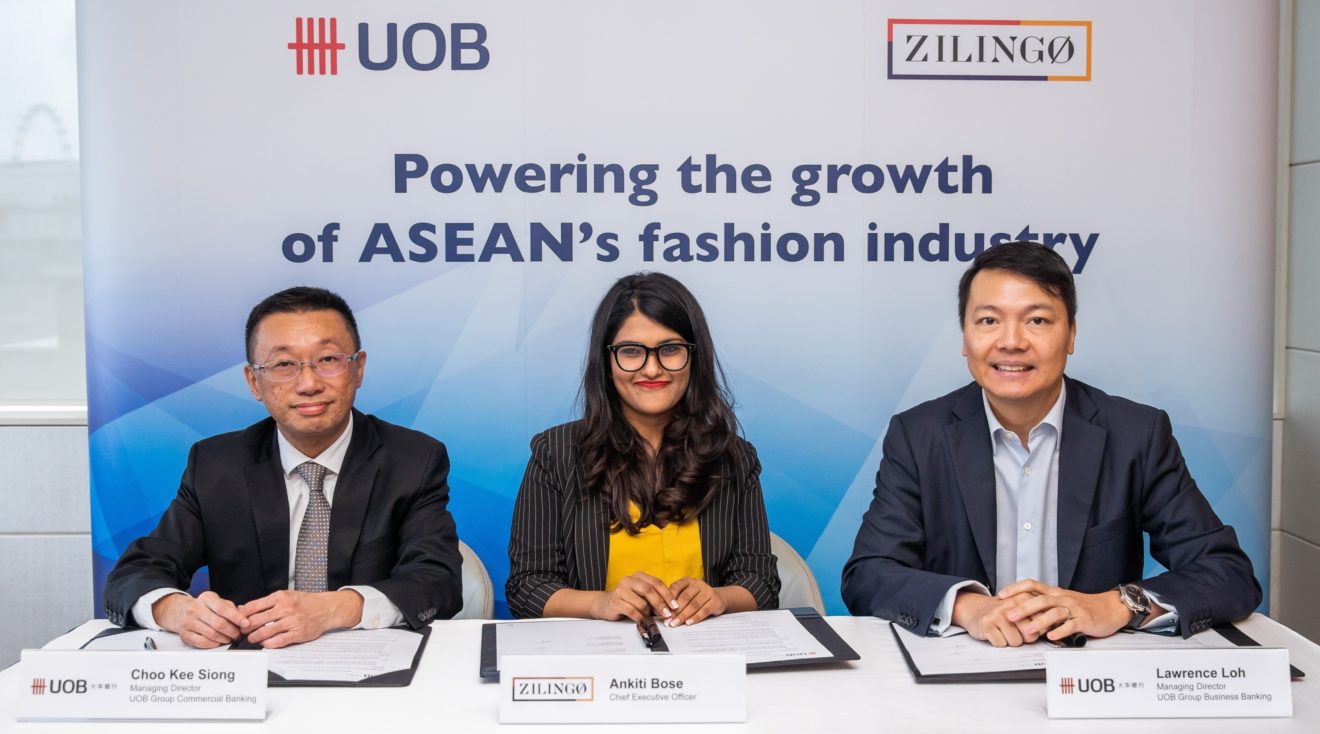
    United Overseas Bank Limited (UOB) and Zilingo, a fashion and lifestyle e-commerce platform, today announced that they have signed a Memorandum of Understanding (MOU) to support the growth of ASEAN’s fashion industry. Under the MOU, businesses on Zilingo’s platform, which are mostly small- and medium-sized enterprises (SMEs), will be able to access UOB’s banking solutions through the e-commerce platform. The greater access to banking solutions will enable Zilingo’s merchants and manufacturers across the region to manage their cash flow better and to grow their businesses more efficiently and easily.

    Ms Ankiti Bose, CEO and Co-founder, Zilingo, said, “Through this collaboration with UOB, we want to reaffirm our commitment towards empowering merchants and manufacturers with everything they need to run their business. Where businesses may find difficulty in accessing capital due to insufficient financial records, Zilingo’s unique position as a connector of the fashion supply chain will allow us to leverage a bird’s eye view of the supply chain to make a comprehensive assessment of the business’ capabilities and value proposition”.

    Mr Choo Kee Siong, Head of Industry Groups, Group Commercial Banking, UOB, said, “At UOB, we have been working with various ecosystem partners to offer our banking products and services to companies across entire supply chains, helping them pursue growth strategies and seize business opportunities. Through our MOU with Zilingo, fashion businesses across ASEAN will be able to access our comprehensive range of banking solutions seamlessly to meet their operational and financial needs.” In addition to supporting Zilingo’s merchants, UOB will also explore support for the e-commerce platform in a number of other areas, from cash management and foreign exchange services to workplace banking services

  • UOB Expands SME Accelerator Program

    UOB Expands SME Accelerator Program

    UOB has announced that it is bringing its business transformation program to Malaysia, following successful editions held in Singapore (2018) and Thailand(2019), the bank announced on Friday.

    The three-month-long «Jom Transformation Program» run by UOB innovation accelerator The Finlab aims to help businesses in Malaysia adopt technology to drive productivity and growth.

    As part of the program, they will be matched with technology partners to address their concerns and to pilot the implementation of the solution. Participants will be able to gain the skills and knowledge in areas such as business process re-engineering and digital marketing, the bank said.

    Businesses will also be matched with mentors, including the Chinese Chamber of Commerce & Industry of Kuala Lumpur & Selangor, the Malaysian Association of Tour and Travel Agents, Maxis, the Malaysia Digital Economy Corporation and SME Corporation Malaysia, who will be able to advise them on how to increase operational efficiency, expand and scale across Southeast Asia,

    Malaysian businesses will be able to tap the combined knowledge, experience and networks of these organizations to accelerate their transformation process, Pauline Sim, co-head, The FinLab, said

  • UOB Outlines Growth Priorities

    UOB Outlines Growth Priorities

    Amid rising global trade tensions and concerns over a synchronized global slowdown, UOB wants to focus on three areas for growth. UOB wants to focus on regional connectivity, ecosystem partnerships, and strong balance sheet/quality earnings to harness growth, the bank said at its Corporate Day held in Singapore on Wednesday.

    In such an environment, it is even more important that we focus on the fundamentals and not lose sight of our main objectives, UOB’s chief executive Wee Ee Cheong underlined.

    In his keynote address, he added that with rising global trade tensions and concerns over a synchronized global slowdown, it was essential that the bank focused on its key priorities.

    At UOB, this rests on our consistent approach of putting our customers at the center, he said. The Corporate Day covered how UOB will continue to build on its regional operating model, to invest at scale in digital and new technology, to equip its people for the future and to drive productivity and performance.

    Currently, the bank has more than 40 percent of group operating profit derived outside of Singapore. Of this, close to 80 percent comes from operations in Southeast Asia and Greater China. «We expect these numbers to go up as we strengthen our regional connectivity, collaborate in win-win partnerships to tap intra-regional flows and the region’s rising affluence for growth,» Wee added.

    Southeast Asia has the third largest population globally, after China and India. The region also has a young population, with 384 million people below 35 years old.

    Given Southeast Asia’s prospects, the bank will continue to make significant investments in developing its digital capabilities to make banking simpler, smarter and safer across all its network. «Throughout the region, we have invested in an omnichannel approach: engaging our customers across a range of touchpoints that best suit them – offline or online, physical or digital or a combination. This is because we know that digital is not the only way that our customers want to be served,» Wee said.

    The impact of UOB’s omnichannel approach is enhanced by the ecosystems which the bank has forged with like-minded partners for the customer’s benefit.

  • UOB Launches Comparison Website for Utilities

    UOB Launches Comparison Website for Utilities

    United Overseas Bank on Monday launched Singapore’s first online utility marketplace by a bank, as part of the Open Electricity Market initiative. United Overseas Bank (UOB)’s utility marketplace will add to an existing array of comparison websites under Singapore’s Open Electricity Market initiative by the Energy Market Authority. Featuring 10 utility providers on a single website, customers can now search and sign up for the best deals for electricity, gas, water, broadband and TV services.

    With utility bills making up an average of about 10 percent of monthly household expenses, we want to help people stretch their household budget, said Jacquelyn Tan, UOB’s head of personal financial services Singapore in a media statement.

    With more than 50 different plans offered by electricity retailers under the Open Electricity Market rollout, Singapore consumers could find it time-consuming to find the right electricity plan.

    The UOB Utility Marketplace aims to make it easy for consumers to compare providers and plans through its Electricity Price Plan Recommender. Users simply need to indicate if they prefer a fixed price or discounted price plan, their preferred subscription tenure, and their monthly electricity bill budget.

    A list of suitable electricity plans and potential savings will then be generated based on their selection. Consumers are then directed to the electricity partner’s website to sign up for their plan of choice. In all, the process takes less than 10 minutes to complete, the bank said.

  • UOB Partners Local E-commerce Platform To Mine Opportunities

    UOB Partners Local E-commerce Platform To Mine Opportunities

    United Overseas Bank has partnered with a popular e-commerce platform to build ecosystem partnerships. This follows a string of partnerships announced with other high profile online platforms.  United Overseas Bank (UOB) announced a regional alliance with local e-commerce platform Qoo10 on Monday, complementing the bank’s efforts to help small businesses seize opportunities in the digital economy. Qoo10, with more than three million buyers, is the top e-commerce platform in Singapore.

    «Our alliance with Qoo10 enables us to extend our touchpoints to provide small businesses with the financing they need directly on the e-commerce site, helping them to take advantage of opportunities quickly as they arise,» said Lawrence Loh, Head of Group Business Banking at UOB.

    In January this year, Qoo10 launched QuuBe, a blockchain-based e-commerce platform which already has more than two million products on the marketplace. Through the alliance, Qoo10 will be able to tap UOB’s holistic suite of financial solutions to help consumers and merchants buy and sell products more easily on both the Qoo10 and QuuBe platforms.

    «Partnering established and trusted allies such as UOB enables us to empower our merchants and customers with readily accessible solutions that provide greater financial flexibility in running a business or making purchases,» says Ku Young Bae, CEO of Qoo10.

  • UOB Lends For Largest Logistics Parks In Japan

    UOB Lends For Largest Logistics Parks In Japan

    United Overseas Bank has provided a financing facility for a real estate platform to acquire prime Tokyo Bay land with the purpose of building one of the largest master-planned logistics parks in the country.

    The Singapore bank on Tuesday announced that its Tokyo branch has signed an agreement to provide a non-recourse $179 million (20 billion yen) financing facility to ESR’s entities so that the real estate developer can acquire land in Yokohama, Kanagawa Prefecture, Japan. Last month, ESR announced that it has bought land in Yokohama for the purpose of building one of the largest master-planned logistics parks in Japan.

    «Through harnessing our product expertise and the strengths of our established regional network, we are committed to helping ESR expand its presence in the Asia Pacific. We look forward to extending our support to include cash and risk management solutions to assist ESR in optimizing its cross-border business operations and cash flow,» said Lim Lay Wah, Head of Global Financial Institutions Group, UOB, in a media statement.

    The transaction marks the first collaboration between UOB and real estate platform ESR in Japan, both companies said. ESR Sachiura TMKs are the onshore entities incorporated in Japan for the purpose of developing the ESR Yokohama Distribution Centre (ESR Yokohama DC) project, one of the largest master-planned logistics parks in the country.

    «With the support of UOB and other leading institutional investors, we are set to build ESR Yokohama DC as a flagship development not only for ESR’s growing network of best-in-class facilities but also for the burgeoning Japanese logistics property market,» said Stuart Gibson, co-CEO of ESR.

    Located within the Greater Tokyo Bay area with swift access to Tokyo’s central business district and major logistics infrastructure, ESR Yokohama DC will initially comprise two modern, four-story logistics facilities incorporating ESR’s human-centric design and state-of-the-art building specifications.

    With a total gross floor area of 393,226 sqm out of a total buildable area of over 700,000 sqm on site, the project is expected to be one of the largest multi-phased logistics parks currently under development in Japan in both size and value. The total investment for the first phase development is estimated to be more than $1 billion.

    In addition to the loan from UOB, ESR will use the equity investments from its capital partners, including Equity International and a major US pension fund, to fund the land acquisition. ESR is the largest Asia-Pacific focused logistics real estate platform by gross floor area (GFA) and by the value of the assets owned directly and by the funds and investment vehicles it manages.

    Cofounded by its senior management team and Warburg Pincus, ESR and the funds and investment vehicles it manages are backed by preeminent investors including APG, SK Holdings, JD.com, CLSA, Goldman Sachs, CPPIB, Ping An and Allianz Real Estate.

  • M1 taps UOB for QR code payment

    M1 taps UOB for QR code payment

    Singapore operator M1 has partnered with the nation’s United Overseas Bank (UOB) to offer PayNow as a payment mode for M1 customers.

    Under the agreement, M1 customers can now make mobile payments for purchases via PayNow at all M1 Shop outlets, as well as make monthly bill payments via PayNow by scanning the QR Code on the bill.

    M1 is the first communications provider in Singapore to enable retail customers to make e-payments via PayNow, providing customers with an additional payment option, in addition to existing payment modes. UOB is the key provider of PayNow Corporate services to M1, and will help enable the safe and hassle-free scan-and-pay experience for M1’s customers.

    To pay for in-store purchases, customers need to scan a dynamic QR Code that is generated at the counter using the mobile banking application of any PayNow participating banks with QR scanning functionality. Customers can also use PayNow to pay for their monthly bills by scanning the dynamic QR code on their bill statement. Customers can complete the payment by confirming the transaction details that have been automatically filled in, such as the payment amount and recipient.

    “Today, about eight in 10 consumers in Singapore have adopted e-payments and PayNow is a very convenient e-payment platform which will enhance our customers’ payment experience. This new initiative is one of many, as part of our digitalization journey to deliver a seamless digital experience for our customers,” M1 CMO  P. Subramaniam said.

  • UOB Prices First Panda Bond

    UOB Prices First Panda Bond

    United Overseas Bank announced it has priced Singapore’s first Panda Bond at 3.49 percent, one of the lowest rates among all Panda bonds. The Singapore based lender UOB said that its three-year, 2 billion renminbi (S$404 million) offering garnered strong demand with a subscription rate of 2.7 times from asset managers and commercial bank investors across Asia. Thirty-eight percent was placed to China’s onshore investors and 62 percent to international offshore investors.

    «Our participation in China’s onshore debt market, one of the largest globally, enables us to grow our presence in China as the country continues to liberalize the renminbi and its financial markets. Further, through this offering, we can diversify our funding sources and continue to tap the increased connectivity between China and ASEAN arising from the Belt and Road Initiative to serve our customers’ needs,» said Wee Ee Cheong, CEO of UOB, said in a media statement.