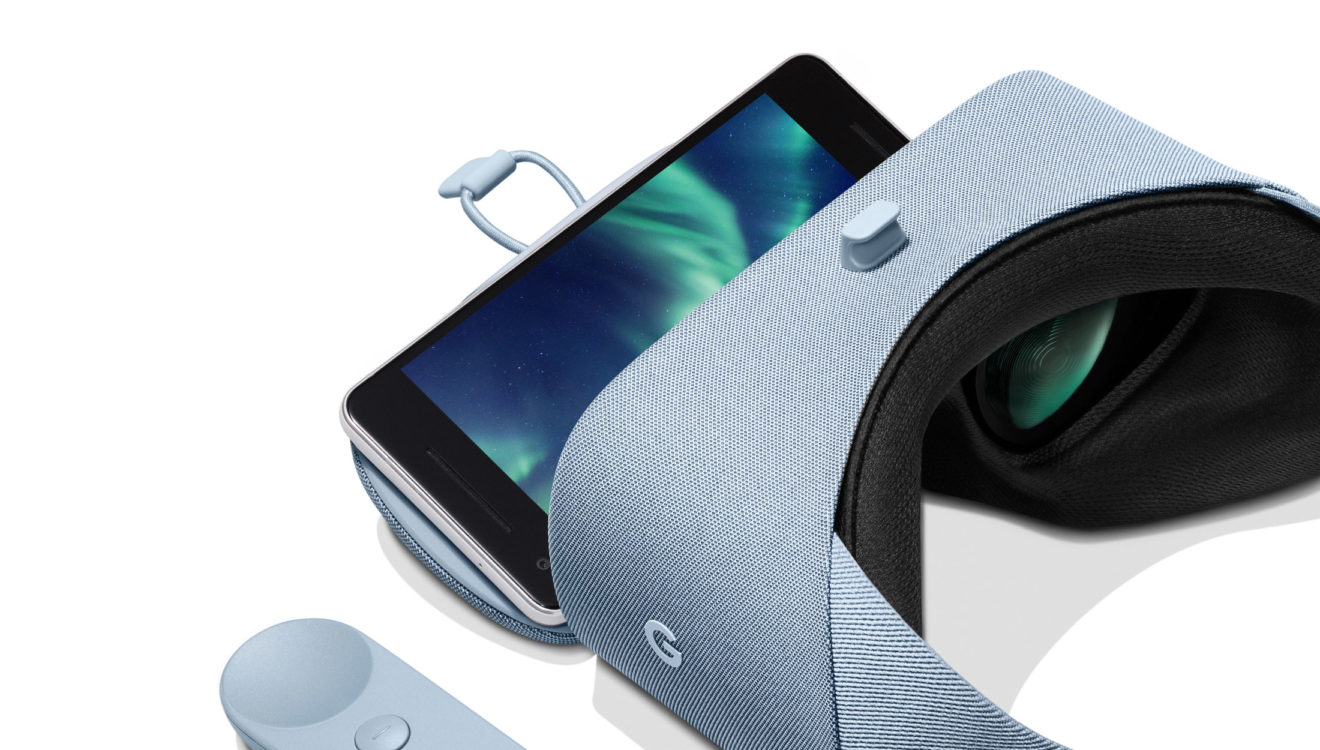
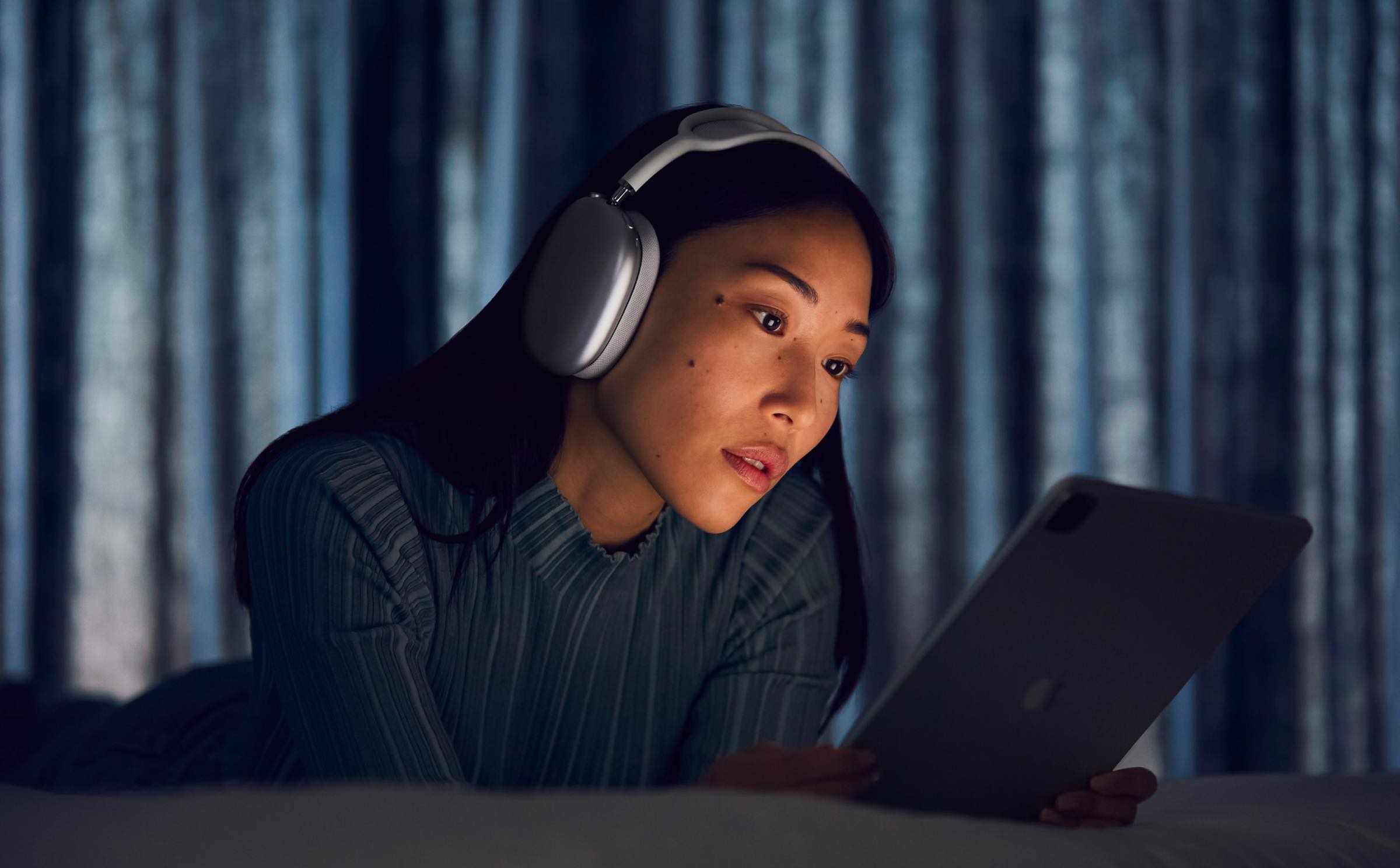
Apple is expected to release its Reality Pro mixed reality headset later this year with virtual reality (VR) and augmented reality (AR) features. According to SamMobile, during today’s Unpacked event, Samsung announced that it will also build a Mixed-Reality headset with help from partners Google and Qualcomm. Samsung did hint that the device will be arriving soon. Samsung referred to the wearable as an Extended Reality (XR) device.
Virtual Reality immerses the user in an environment that can range from the batter’s box at Yankee Stadium to a lounge with a giant screen that will show streaming content. Augmented Reality takes a live feed and places computer-generated data on top of it. A good example of AR is the “Live View” feature on Google Maps for those walking. The display shows a live feed from the rear camera and computer-generated arrows are superimposed over the feed to show the user which way to go.
The Samsung XR headset will use a specialty Qualcomm chipset and the Korean manufacturer told The Washington Post that Meta and Microsoft are also partnering with Samsung to produce the XR headset. The Post reported that the head of the project said that the platform and the software need to be only “somewhat ready for the device to be a success.” The company is looking to avoid the mistakes made by other firms who entered this space but didn’t have the software ready in time.
While no possible price tag was mentioned for Samsung’s XR wearable device, Apple’s Reality Pro will reportedly cost $3,000 and will be able to quickly switch between VR and AR. It is believed to be the most complicated product that Apple has ever made.
Samsung has been in the headset business before as it introduced the Gear VR headset in 2015 powered by the Galaxy Note 4’s 5.7-inch QHD SuperAMOLED display. After a few years, production of the device came to a halt. Samsung then tried its hand at manufacturing a standalone Mixed Reality headset for PCs which also was discontinued by the company.
Hiroshi Lockheimer, Google’s SVP in charge of Platforms and Ecosystem, said, “An exciting space where Google has been investing in for a long time across both experiences and technology is AR and VR. These technologies are integral to the new phase of computing as it can change the way we interact with people and information to get things done in the real world.”
So now the Apple-Samsung rivalry will go beyond smartphones, tablets, and smartwatches to include Mixed Reality headsets.
Worldwide revenues for the Artificial Intelligence (AI) market, including software, hardware, and services for both AI-centric and AI non-centric applications, totaled $383.3 billion in 2021, an increase of 20.7% over the prior year, according to an International Data Corporation (IDC) Worldwide Semiannual Artificial Intelligence Tracker. IDC expects the AI market value will reach nearly $450 billion in 2022 and maintain a year-over-year growth rate in the high teens throughout the five-year forecast.
“Across all industries and functions, end-user organizations are discovering the benefits of AI technologies, as increasingly powerful AI solutions are enabling better decision-making and higher productivity,” said Rasmus Andsbjerg, associate vice president, Data & Analytics at IDC. “The reality is, AI offers solutions to everything we are facing at the moment. AI can be a source for fast-tracking digital transformation journeys, enable cost savings in times of staggering inflation rates and support automation efforts in times of labor shortages.”
AI software again accounted for the largest share of the overall AI market in 2021. Combined, the four AI software categories – AI application delivery & deployment, AI applications, AI system infrastructure software and Artificial Intelligence platforms – delivered more than $340 billion in market value in 2021, with AI applications representing nearly half the total. Artificial Intelligence platforms delivered the strongest year-over-year growth at 36.6%, albeit from a smaller baseline.
Within the AI applications category, AI customer relationship management (CRM) applications and AI enterprise resource management (ERM) applications each delivered about 16% of the category total. The remainder was delivered by the myriad of other AI applications available in the market. With nearly 300 companies vying for opportunities to gain share, the AI applications market remains highly competitive.
IDC’s AI tracker also shows that AI-centric applications, in which AI technologies are central and critical to the function of the application, continued to slowly grow their share of the AI software market. In 2021, AI-centric applications captured 12.9% of the market, up 29.3% year over year. The remainder of the market was held by AI non-centric applications, where AI technologies are integral to certain workflows of the application, but if those technologies were removed, the application would still be able to function.
Similarly, the deployment of AI software to the cloud continues to show steady growth. In 2021, 47.3% of AI software purchases were deployed to the public cloud, an increase of 4% over 2020 and 8.4% over 2019. IDC expects cloud deployment of newly purchased AI software to surpass on-premises deployments in 2022.
The AI services market saw its total value increase 22.4% year over year to $24 billion in 2021. Client demand for expertise in developing production-grade AI solutions helped the AI IT services category grow 21.9% year over year to $18.8 billion. The AI business services category grew 24.2% year over year as organizations sought assistance on AI governance, business processes and talent strategies.
AI hardware was both the smallest ($18.8 billion) and fastest growing (38.9% year-over-year growth) segment of the AI market. The hardware growth was driven by efforts to build dedicated AI systems capable of meeting the increased compute and storage demands of AI models and data sets. While both AI servers and AI storage delivered strong growth in 2021 – 39.1% and 32.9%, respectively – server purchases were notably larger at $15.6 billion.
Virtual/Augmented reality is commonly viewed as the next frontier in mobile technology. Hence, many companies are making efforts to engage with it sooner rather than later, so as to ensure that they beat the competition to the punch. And while many are just now entering the market like Apple, some are already veterans in VR/AR… in a way.
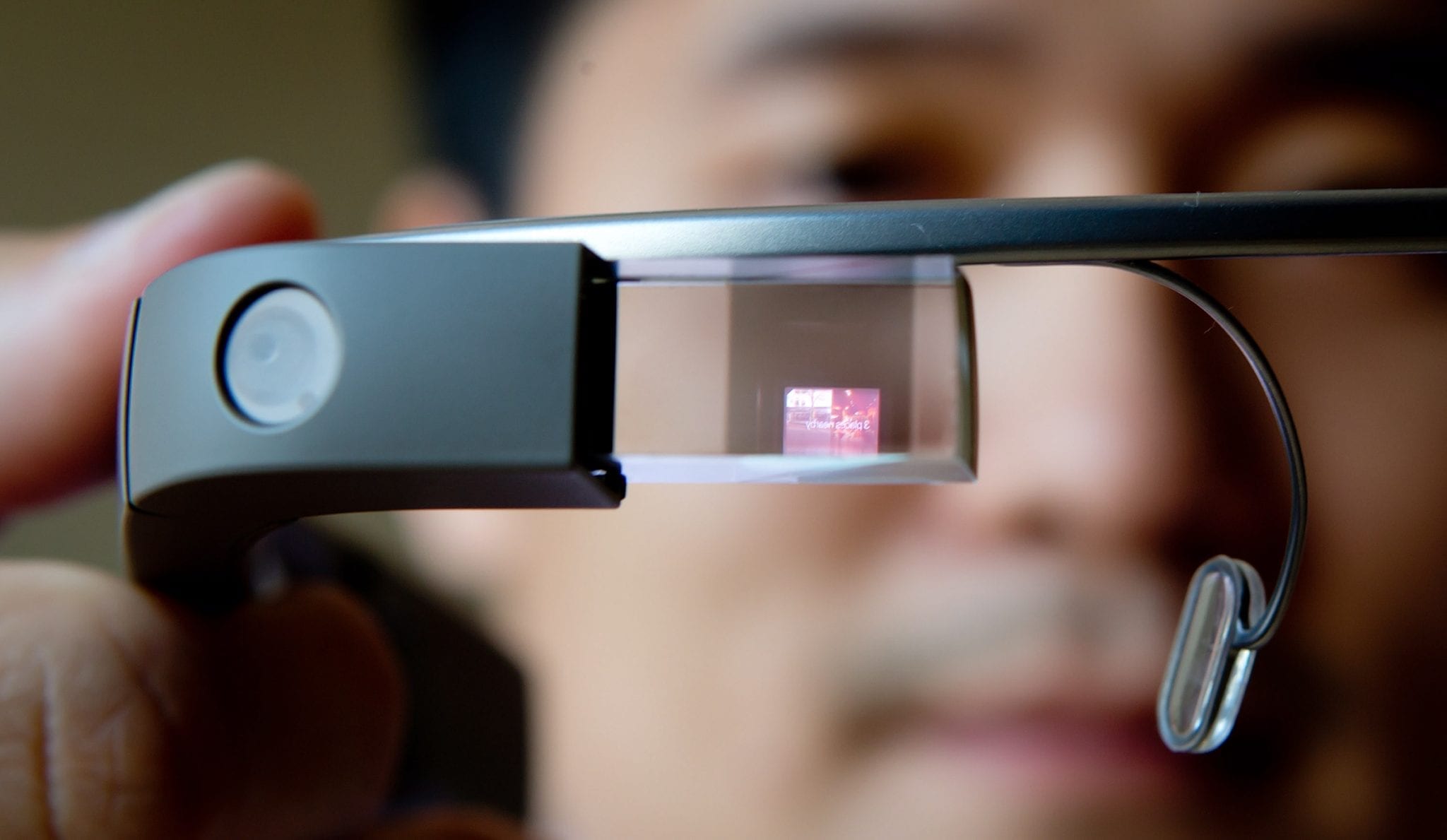
We are of course referring to Google. The company notoriously flopped nearly a decade ago with Google Glass, but this time around the tech giant is doing its best to get VR/AR right. Some time ago, the first bits of information concerning Google’s “Project Iris”, the codename for the company’s upcoming VR/AR headset.
In its original report, where we disclosed a number of interesting details about Project Iris, which was then in its early stages of development. It seems that Google’s VR/AR headset has come a long way since, given that field testing is already underway
Google will be testing a small number of prototype units to better understand how the headset fares under everyday circumstances. Google even published a blog post on the matter. The main features that will be tested are “translation, transcription and navigation”.
The tests will be conducted according to a set of strict privacy guidelines. The prototype units will resemble ordinary glasses and the testers will have to undergo special training and comply with a number of privacy measures.
These steps show a decisive move on Google’s part to learn from its mistakes with Google Glass. Whether it will be enough to make Project Iris a success remains to be seen. For reference, most pundits expect Google to release its VR/AR headset sometime around 2024. Hence, there is still a long way to go. We will have to wait and see.
Asia/Pacific (excluding Japan) (APEJ) spending on augmented reality (AR) and virtual reality (VR) technologies will grow with a CAGR of 42.4% from 2021 to 26 and reach $16.6 billion by 2026, according to a report by the IDC. The penetration of the wireless-first strategy amongst enterprises, industries, and public sector organizations will drive AR/VR technology investment. However, from a retail consumer perspective, there is a lack of consumer-friendly AR/VR technology, which will change over the next couple of years. Vendors will improve VR goggles and AR for smart glasses and phones, and disrupt augmented audio technology, thereby offering promising growth opportunities to the consumer market.
“The impressive market growth for AR/VR technologies is driven by organizations’ demand for a new immersive experience in the way they do business and interact with clients and employees. But vendors also need to respond to AR/VR consumer applications to not miss out on high growth opportunities in the next few years,” says Dr. Lily Phan, Research Director for Future of Work, IDC Asia/Pacific.
Education, healthcare, discrete manufacturing, process manufacturing, and professional services are the highest spending industries, and will dominate over the forecast period. These five industries registered 65% of 2022 spending for commercial use cases among the 19 industries covered by IDC. Training emerged as one of the top three investment priorities for four out of five industries listed above. Collaboration is gaining incremental impetus, with education, discrete manufacturing, and professional services being the forerunners in adopting AR/VR technologies.
“Customer agility is one of the primary aspects driving investment in AR/VR technology. It helps in improving the customer journey by offering an immersive experience,” says Abhik Sarkar, Market Analyst at IDC Asia/Pacific IT Spending Guides, Customer Insights & Analysis.
The top five use cases captured nearly 60% of the total 2022 investment. Training captured the largest revenue share in 2022 and grew by 44.7% from 2021. With collaboration, it will capture a spending share of 30.1% in 2022. For the enterprise VR users, metaverse will act as a collaborative space for partners, employees, and customers. VR gaming is the most significant contributor to the consumer industry owing to users’ immersive and enhanced gaming experience.
Investments in VR contributed to around 66% of the total market in 2022. It is driven primarily by the growth of consumer market adoption of virtual reality games. Spending on VR training and collaboration will also lead to VR technology investments during the forecast period. As far as AR is concerned, training, retail showcasing, and industrial maintenance will lead to increased investments. In both the reality types, hardware showcases maximum investment in 2022 followed by software, and services. This trend is expected to stay the same over the forecast with hardware growing at a CAGR of 48.1%, software at 47.1%, and services at 20.8%.
There is no denying that Apple and Google are rivals. Think of all the battles they have fought on the field over the dead wallets and credit cards of consumers. There is the iOS vs. Android battle which has been turned by consumers posting on tech forums into the Uncivil War. There are competing apps such as the up-and-coming Apple Maps vs. the currently reigning champion, Google Maps.
And now that Google has taken the Pixel to a new level for hardware, the Pixel 6 series is a true iPhone challenger. But as Bloomberg’s Mark Gurman reminds us in the latest edition of his weekly Power On newsletter, Apple has a newer rivalry that might lead to another tech war. This rival is Meta Platforms Inc., the company you probably still think of as Facebook.
It’s not that Facebook and Apple haven’t had verbal battles before and we all remember when Apple CEO Tim Cook told the media that he would never make his customer the product like Facebook does (this came in the aftermath of the Cambridge Analytica scandal that saw 87 million Facebook subscribers have their personal data sold without their permission). Facebook CEO Mark Zuckerberg criticized Apple’s App Tracking Transparency feature for damaging small businesses.
But now it appears as though the Facebook-Apple skirmish will be more than just a war of words. Back in October, we passed along a photo of a smartwatch that Meta is supposedly going to release next year. With looks borrowed from Apple, the upcoming wearable will also include a camera for video chats. As Gurman points out, if Meta can successfully integrate video chat with its timepiece, Apple will have no choice but to add a similar feature for the Apple Watch using its FaceTime platform.
Both Apple and Facebook are rumored to release mixed-reality headsets next year. Mixed reality includes both virtual realities (VR) and augmented reality (AR). Facebook, which already makes the Oculus brand of VR headsets, calls its mixed reality device by the codename of Project Cambria. Apple’s mixed-reality product is expected to be a premium device sold at a premium price (in the area of $2,000 Gurman forecasts) vs. the Meta device which will probably be more affordable than Apple’s headset.
Virtual reality immerses the headset wearer and makes him feel as though he is in a different location and even a different time period. Augmented reality places an overlay over a real-time image. Both companies could feature content for their mixed reality headsets that would allow users to exercise at different venues using VR. As Gurman suggests, Apple could make its Fitness+ exercise app available for its mixed reality headset.
One area where Apple may or may not decide to get in Meta’s face is with home products. Meta has its smart display and video chat products that it calls Portal and even offers a battery-powered mobile unit called Portal Go. These devices use Facebook Messenger and WhatsApp for video chat and Alexa as its voice-activated digital assistant.
Apple has its HomePod smart speakers. The full-sized model was released at a ridiculously high price of $349 before Apple slashed the price. A year ago it launched the HomePod mini, which at $99 has seen more demand than the OG model ever did. Gurman says that Apple is about to get more involved in such devices and points out two such products that Apple is rumored to be working on.
One of the two devices is a smart screen that might end up competing with the Portal lineup, and the Amazon Echo Show. The other product reportedly combines a speaker and a TV set-top box with a camera.
While the Apple-Google battles have been genteel for the most part, the Apple-Meta battles should be closer to a rough and tumble street fight.
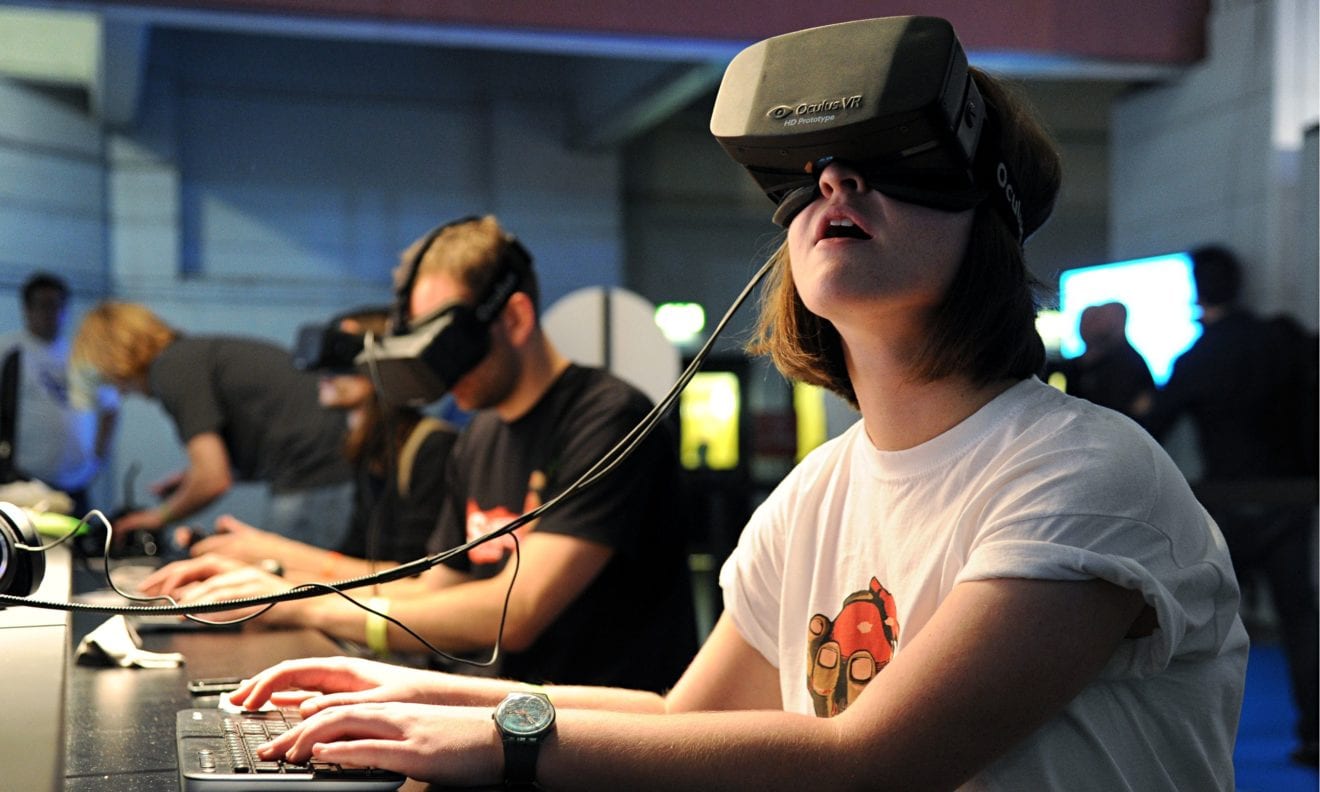
The Facebook-owned Oculus Quest 2—one of the leading headsets in the world of virtual reality—has been enjoying gargantuan sales this year, with Facebook reporting that this particular model “outsold not just its predecessor, but all of its predecessors combined” in 2021. However, that figure is about to take a hit as all sales of the Oculus Quest 2 have been put on hold for a few weeks due to a safety concern.
Reportedly, only 0.01% of customers have been experiencing such irritation, with even these cases being very mild in their vast majority. However, a select few of them have been reported as quite severe, and for this reason, Facebook has chosen to pull the entire product and prevent further cases and perhaps a lawsuit in the future.
This didn’t come out of the blue, however. The Oculus Quest 2 VR headset has been in the stores since last October, and people have been speaking up every so often for a very long time, posting pictures of their reddened skin on social media such as Reddit and Facebook.
In April, Facebook suddenly addressed the issue, claiming they looked into the matter and found no real concern:
“After conducting a comprehensive investigation into this issue, we did not find any contamination or unexpected substances in our manufacturing process. We identified a few trace substances that are normally present in the manufacturing process which could contribute to skin discomfort, and while these were already at levels below the industry standard, out of an abundance of caution we changed our process to reduce them even further. We’ve confirmed with expert dermatologists and toxicologists that these levels are considered extremely low. While this issue has only been reported by a very small percentage of Quest 2 users, with these changes, we believe that users are even less likely to experience irritation resulting from any substances in the foam facial interface. We encourage any customer who experiences irritation from using Quest 2 to contact Oculus Support for a facial interface replacement.”
Somehow, this announcement didn’t fix the very real problem (surprise, surprise!) and many users continued to experience the blistering that whatever chemical was used in the foam seemed to be causing. Finally, a few days ago, Facebook apparently finally decided to face the problem and fix it for users once and for all.
The company has paused sales of the Oculus Quest 2 on a global level, and the hold will last for a full month—resuming on August 24—while Facebook fits every single Quest 2 box around the world with a protective silicone cover that goes over the problematic foam (which, by the way, is also removable).
Today, we’re introducing a new silicone cover for all customers globally, including as part of a joint voluntary recall of the Quest 2 removable foam facial interface with the U.S. Consumer Product Safety Commission (CPSC) and Health Canada. In addition, we’ve been communicating with global regulators and are taking the extra step of temporarily pausing sales of Quest 2 globally while we work to include the new silicone covers in all Quest 2 packages. The new silicone cover fits over the Quest 2 removable foam facial interface and starting on August 24, all Quest 2 headsets will come with a silicone cover included in every box. For more information, please visit the Oculus blog.
Anybody who already owns the Oculus Quest 2 and wishes to get one of the protective silicone covers for free, can simply contact the company by following these instructions published on the official page.
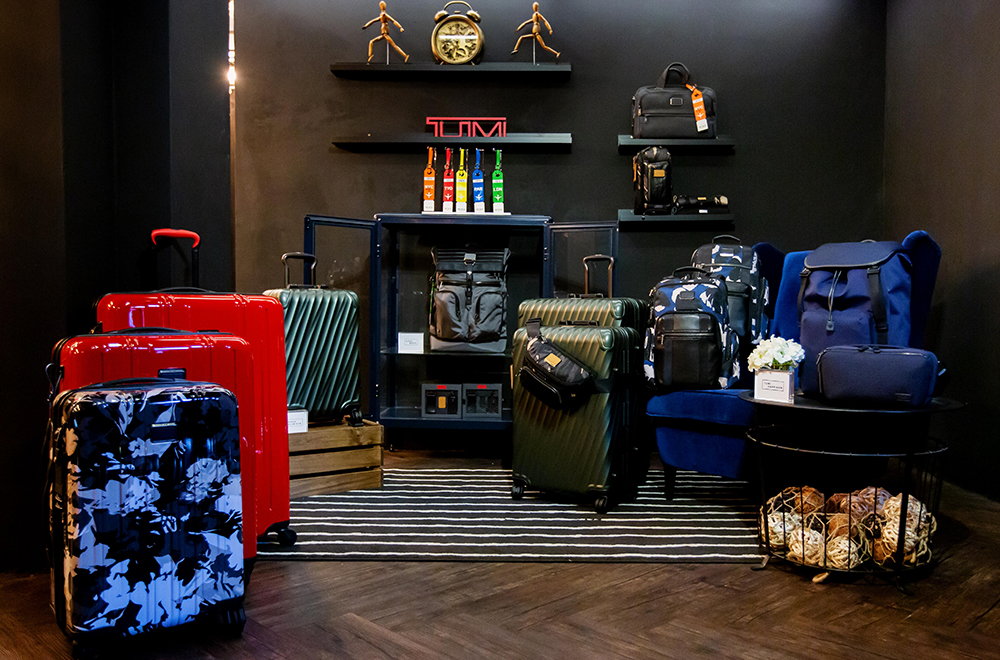
TUMI, the leading international travel, lifestyle, and performance luxury brand, launches the breakthrough TUMI Virtual Store to debut its Spring 2021 collection, delivering an immersive and enhanced omnichannel experience to customers in Asia Pacific and the Middle East.
Ushering in a creative new age of digital retail that connects fans with the brand like never before, the TUMI Virtual Store inspires customers to embark on a journey through thoughtfully designed interactive touchpoints. Guests can explore the Virtual Store’s life-like visual presentation to discover TUMI products via 360° 3D and AR implementations and shop the Spring 2021 collection. They can engage with shareable social photo moments at TUMI’s Magic Mirror and play Instagram and WeChat mini-games.
Further enhancing the overall TUMI O2O (“Online to Offline” also “Offline to Online”) shopping experience, the Virtual Store is connected to other TUMI shopping channels via its Chat & Shop function allowing for seamless customer movement to the point of purchase. Customers exploring the Virtual Store can easily connect with sales associates to ask questions and place orders, or via the connected local e-commerce websites. Furthermore, those visiting the TUMI physical stores in the region can explore the TUMI digital landscape via in-store kiosks, for an enhanced offline experience.
With the goal of being everywhere, the customer is, the Virtual Store adds another dimension to TUMI’s evolving omnichannel retailing approach. As another pioneering landmark, the launch of the TUMI Virtual Store sees TUMI rollout its first-ever Regional Livestream Event, bringing all APAC and Middle East customers together digitally to unveil Spring 2021, 7pm GMT+8, Thursday, 4th February 2021: https://virtualstore.tumi-asia.com/
“The TUMI Virtual Store is an incredible milestone for the brand. For the last few years, we have been pioneering new digital experiences and looking to enhance and elevate the customer journey. Our new Virtual Store is part of this holistic approach to connect with customers wherever they are. Accelerated digitization and shifting customer habits brought on by 2020 have reinforced this direction and shown that we must continue to create exciting, meaningful interactions both in the physical and digital worlds.
Through the TUMI Virtual Store and our Regional Livestream Event, we are excited to welcome fans to experience the latest innovation from TUMI and our new Spring 2021 collection,” says Adam Hershman, Vice President of TUMI, Asia Pacific and Middle East.
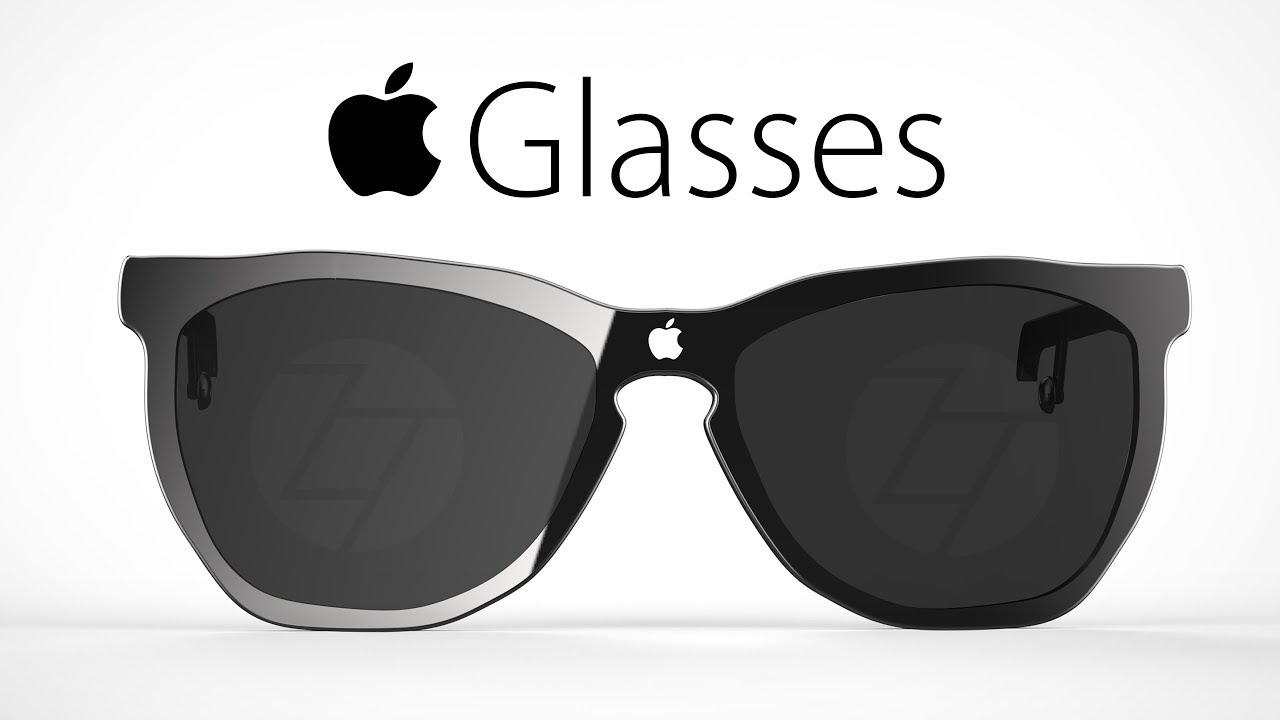
By now, many of you know that Apple’s next big thing is NOT going to be the HomePod. Actually, for a few years now, analysts have been expecting Apple to introduce AR glasses as soon as 2020-2021. There have been two schools of thought here; one is that this will be a standalone device while others, including reliable TF International analyst Ming-Chi Kuo, expect your iPhone to carry the brains of the headset. Kuo, in fact, says that production on the Apple Glasses will start no later than the second quarter of next year.
A couple of patent applications filed by Apple reveals a pair of features that the company is apparently working on for the headset which has been dubbed Apple Glasses. The patent applications were submitted with the U.S. Patent and Trademark Office (USPTO) in February. The first one, titled Scanning Mirror Display Devices, discusses the technology that uses lasers and mirrors to project images directly into the eyes of the person wearing the glasses in lieu of a display. This could be done in a way to support Augmented Reality (AR) by allowing the images to be overlayed over a real-world view. The patent application says that this technology might be used to replace “overly complex, bulky, and uncomfortable to wear” head-mounted displays.
The second patent application, Magnetic Sensor Based Proximity Sensing, uses magnetic sensing technology to detect the position of a user wearing a special glove on his or her hand. This could be used to control VR or AR features on the Apple Glasses through the use of hand gestures. A person wearing the headset would also don the gloves which have special material on the fingertips.
Last month, a report stated that Apple had decided to terminate the Apple Glasses project, but that might not have been the case based on subsequent reports. In fact, just 10 days after that story made the rounds, a huge leak revealed that the tech giant was working on a mixed-reality headset supporting both AR and VR. The glasses will supposedly offer 8K resolution of 7680×4320 for each eye. The device has a codename of T288, according to this leak, and uses a newly developed operating system called rOS for reality Operating System. A 5nm chip will reportedly power the glasses and TSMC is expected to start producing components using this process starting next year.
The same report said that Apple’s headset would also include eyebrow and jaw sensors to determine the expression being made by the user, hand sensors (which might include the technology found in the second patent that we discussed in this article), sensors to track the eyes and left and right cameras. Many of these features were also discovered in a patent that Apple filed with the USPTO this past March.
Back in June of 2017, analyst Gene Munster, now with Loup Ventures, said that the Apple Glasses would end up being bigger than the iPhone. At the time, Munster said, “In 10 years we expect the iPhone will be around, but be a much smaller part of Apple’s business as Apple Glasses slowly gains market adoption.” The analyst originally expected the glasses to launch in 2020, but changed that forecast to December 2021 back in May. Munster forecasts that 10 million Apple Glasses will be rung up during the device’s first year on the market.
ID cards, laptops and business trips will no longer be necessary, according to SK Telecom, when the 5G network-based smart office environment becomes an industry norm. The mobile carrier showcased its smart office technology test bed in Jongno District, central Seoul, Wednesday. Currently, about 300 SK Telecom employees are working at the space set up roughly a month ago by renting out three floors in the Centropolis building.
At the entrance to the office, SK Telecom has facial recognition technology manning the security desk. Due to privacy issues, only employees who have agreed to register their biometric information can pass through the gate without an ID card.
Inside the office, a display panel shows seat reservations. The screen shows all available seats inside the office, similar to the systems seen in university libraries and also shows who is in which seat. When designing the smart office, SK Telecom made it into an open space so employees can freely move around. The display even shows how many toilet cubicles are available for immediate use, although in this case employee names aren’t shown.
The carrier said it used roughly 2,300 sensors, including on the ceilings, CCTV and even doorknobs in the bathrooms that track relevant data on employees’ work patterns inside the office. The data collected will be used to develop smart office solutions packages for enterprise customers.
The desks in the office come with desktop computers connected to mobile routers that convert 5G signals into super-fast Wi-Fi. Beside the computer monitor is a docking station for smartphones. The so-called virtual desktop infrastructure enables employees to bring up what they were working on with their personal computers on the desktop computer using the cloud. Unlike simply mirroring a smartphone display, the phones become an authorization medium that allow the computer to verify which work files are downloaded from the cloud.
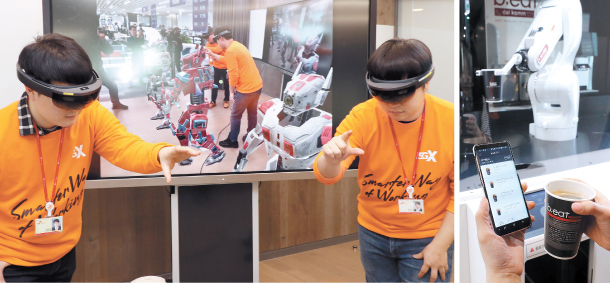
At one side of the office is a space for so-called telemeetings that could cut down the need for frequent business trips. SK Telecom said it used its “T real telepresence” technology to invite multiple users into a virtual space where participants can have meetings while watching videos or 3-D designs of game characters and buildings together.
After donning Microsoft’s HoloLens, this reporter was invited to a telemeeting to discuss the design of a game character.
Within the virtual meeting, attendees were able to see and walk around a moving 3-D game character while interacting with the avatars of other people in the meeting.
The experience wasn’t perfect – the field of view was small and constantly looking around was necessary in order to follow everything that was going on, but the potential of the technology to greatly reduce the need for business trips was evident.
Other technologies already being used in the office included a barista robot and artificial intelligence-based autonomous vending machine, which can track employee purchases with camera sensors.
Would any of these innovations be possible without 5G network?
According to SK Telecom, yes. But, while all of these technologies are possible on the existing 4G LTE network, the new high-speed network, touted to be 20 times faster when fully commercialized, offers faster and more stable internet connection even when a million devices are connected at once.
In essence, 5G ensures that all these systems work seamlessly without their huge data usage interrupting networks or slowing down work.
“Dependency on landline internet will be reduced and high-capacity data will be delivered fast enough for real-time telemeetings with 5G,” said Shin Seung-ho, a manager from SK Telecom’s media lab under ICT center.
LG U+ is partnering with Google to produce three-dimensional (3-D) virtual reality (VR) video, the company said Friday. Ha Hyun-hwoi, CEO of the mobile carrier, said augmented reality (AR) and virtual reality offerings demonstrate to customers the potential of next-generation 5G networks. He made the comments during a press briefing Wednesday at the Consumer Electronics Show in Las Vegas.
He added that LG U+ is determined to become the leading player in AR and VR, and the partnership with Google is a stepping stone in achieving that goal.
According to LG U+, the smallest mobile carrier in the country, with 3-D VR video, viewers feel they are actually at a sports stadium or a performance hall. The technology requires 10 times the bandwidth when compared with two-dimensional high-definition videos, which is why the faster and higher-capacity 5G network is crucial to the mass production and distribution of VR video, LG said.
The two companies will first establish an equally-invested fund and develop 3-D VR video in the first half of this year. LG U+ will take charge of design and production. The mobile carrier will also have rights to local market distribution. Google’s YouTube will own retail rights globally. The Korean company said its collaboration with Google will continue following the development of pilot material.
The first offerings will be centered on videos of globally-popular K-pop stars. A tour around K-pop star homes, following the star for the whole day and backstage tours are some of the ideas suggested so far, LG said.
The video will run exclusively on YouTube and LG U+’s over-the-top (OTT) VR content platform. OTT refers to streaming entertainment that is delivered directly to users over the internet without going through intermediaries, like television.
The move by LG U+ comes after SK Telecom inked partnerships earlier this month with three local broadcasters – KBS, MBC, and SBS – to create an OTT media service that can counter Netflix.
It also announced during CES a partnership with Sinclair Broadcast Group to cooperate on media technologies.
Ha said dependence on OTT will grow together with the commercialization of 5G and that SK Telecom has made a “good choice in partnering with local broadcasters.”
LG U+ plans to fight competition with its partnership with Google as well as Netflix. Under an agreement reached in November last year, Netflix programing is aired exclusively through LG’s internet protocol TV platform.
Industry big boys aren’t the only companies exhibiting at this year’s Consumer Electronics Show (CES). Over 1,200 start-ups have set up at the event’s Eureka Park, reserved for smaller companies, to capture the attention of consumers and possibly become the next unicorn (a start-up valued at over $1 billion).
Of the start-up companies from Korea, those that developed through the “Israeli start-up” model have grabbed the most attention from the media. The model refers to companies with a weak capital base that grows with investment from other IT companies or venture capital firms. Many Korean start-ups that took part in CES this year got investments from IT giants such as Naver or Kakao.
Augmented reality (AR) and virtual reality (VR) company LetinAR is one of the hottest start-ups. LetinAR produces smart glass lenses that makes use of “Pin Mirror” technology. The company incorporates the pinhole effect, which makes vision clearer by looking through a small hole, and applies it for use in VR and AR.
LetinAR also created a lens that provides vision of up to 80 degrees. While humans can see up to 150 degrees, existing products are typically limited to 50 degrees.
“The 80-degree vision is like looking at a 120-inch TV from a meter away [3.28 feet],” said Choi Kyung-on, a director at the company. “If our product becomes commercialized … we will be able to release smart glasses the size of large conventional glasses within three years.”
While smart glasses got a lot of headline in 2013 with the introduction of Google Glass, the product failed due to the difficulty of developing a lens with a wide-viewing angle.
Meanwhile, beauty artificial intelligence (AI) start-up lululab won the CES Innovation Award in the biotech sector for its AI skin care assistant Lumini.
The device analyzes skin conditions such as its wrinkles and pores and provides product information and recommendations personalized for a user.
“[Users] can use personalized AI skin analysis service without the help of a store employee,” explained Choe Yong-joon, CEO of lululab.
The company was born in Samsung Electronics’ start-up incubator, C-Lab.
AMO Lab is another promising start-up from Korea. The company, which got investment from Naver last September, specializes in products that improve users’ quality of sleep.
The company recently developed AMO+, a device worn like a necklace, which sends out minute electrical signals to the body to improve sleep.
According to recent test results, users’ parasympathetic nervous systems became active when wearing the device.
“We are currently discussing collaboration with U.S. and European companies after prototype development,” said Kim Min-kyu, CEO of AMO Lab.
WELT, another alumnus of Samsung’s C-Lab, gained attention for releasing a smart belt in collaboration with French luxury brand S.T. Dupont. WELT’s smart belt can be used for two months with a single charge and provides basic health information.
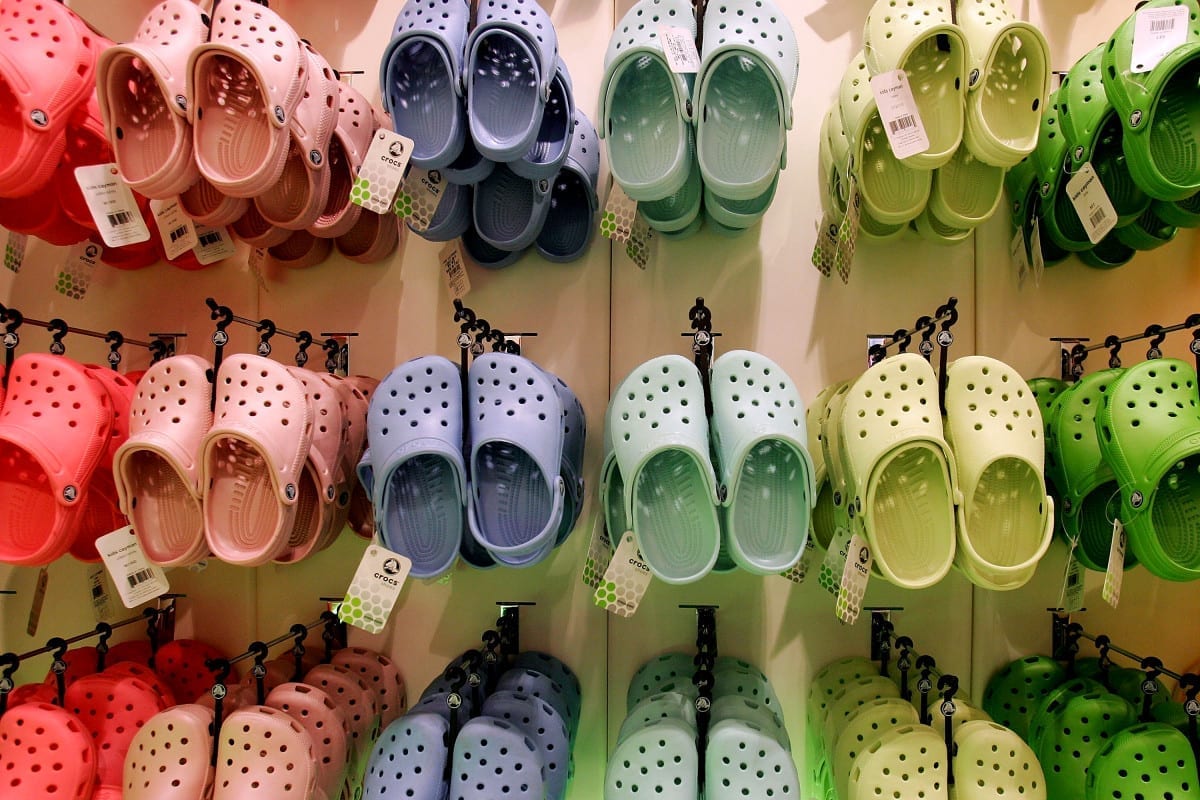
The new store, which spreads across 625 sq. ft., is Crocs’ third store in the city and 5th in the state of Tamil Nadu. Boasting a premium location at VR Mall, the hub for luxury and international brands in Chennai, the store promises to strengthen the reach of the iconic brand in the state capital.
Since the opening of its first store in India in 2008, Crocs has successfully carved a distinct positioning for the brand amongst the Indian consumers akin to its global positioning and is growing at a robust pace with presence across 50 cities in India.
Crocs, which is known globally for its iconic Clogs, is turning towards India to fuel its next phase of growth. India is currently the 6th biggest market for Crocs globally with a high double-digit growth year on year.
Metro Shoes, the national franchise partner of Crocs India, will be operating this 100th store located in Chennai. The partnership with Metro Shoes began in 2014 which has helped the iconic footwear brand in expanding its reach to over 50 cities through its EBO operations.
Speaking on occasion, Deepak Chhabra, CEO & MD, Crocs India, said, “We are excited on reaching the century mark in India. India is one of the rare markets where even after opening 100 stores we still feel under-penetrated. Our absolute focus for the next phase of geographical expansion will continue to be on top 6 metro cities across the country along with state capitals. Exclusive brand stores are a very significant part of our growth strategy. In addition to aggressively growing our EBOs, we will be strengthening our presence in Tier-II cities via MBOs and Kiosks. Further, e-commerce will remain an integral part of our distribution strategy and help us reach out to consumers where our brick and mortar presence is limited. Region-wise South India, due to its demographics and very high brand recall, contributes the highest amongst all regions in the country and will remain an integral part of our India growth strategy.”
Commenting on the occasion, Rafique Abdul Malik, Chairman & MD, Metro Shoes, said, “We would like to congratulate Crocs India on the launch of their 100th store and are confident that this is just one of many more milestones to follow. Metro Shoes is glad to partner with a brand which despite being just 16 years old has an iconic status with probably the highest brand-recall across the globe. India as a nation has a high affinity for open shoes and sandals owing to the climatic conditions, making Crocs highly relevant in this market.”
With its unique brand awareness and break-through product innovations, Crocs is progressing towards becoming India’s top non-athletic casual footwear brand. Other than its EBOs, Crocs asserts its strong presence in MBO channels through which its overall offline reach extends to more than 150 cities via 1,500 + points-of-sale. Additionally, it caters to 20,000+ pin codes translating to 400 cities via its e-commerce presence.
Over the past 16 years, Crocs has sold more than 350 million pairs of shoes worldwide. Crocs as a brand will continue to focus on clogs and sandals, along with new product innovations and extensions of the current product line. This year, Crocs India launched LiteRide™, Drew Barrymore ♥ Crocs Collection, Crocband™ Platform Collection, and Luxe Lined Collection. Last year internationally, the brand has associated with designers like Balenciaga and Christopher Kane bringing in some exciting trends to the runway which further elevated the appeal of the iconic clog in fashion space.
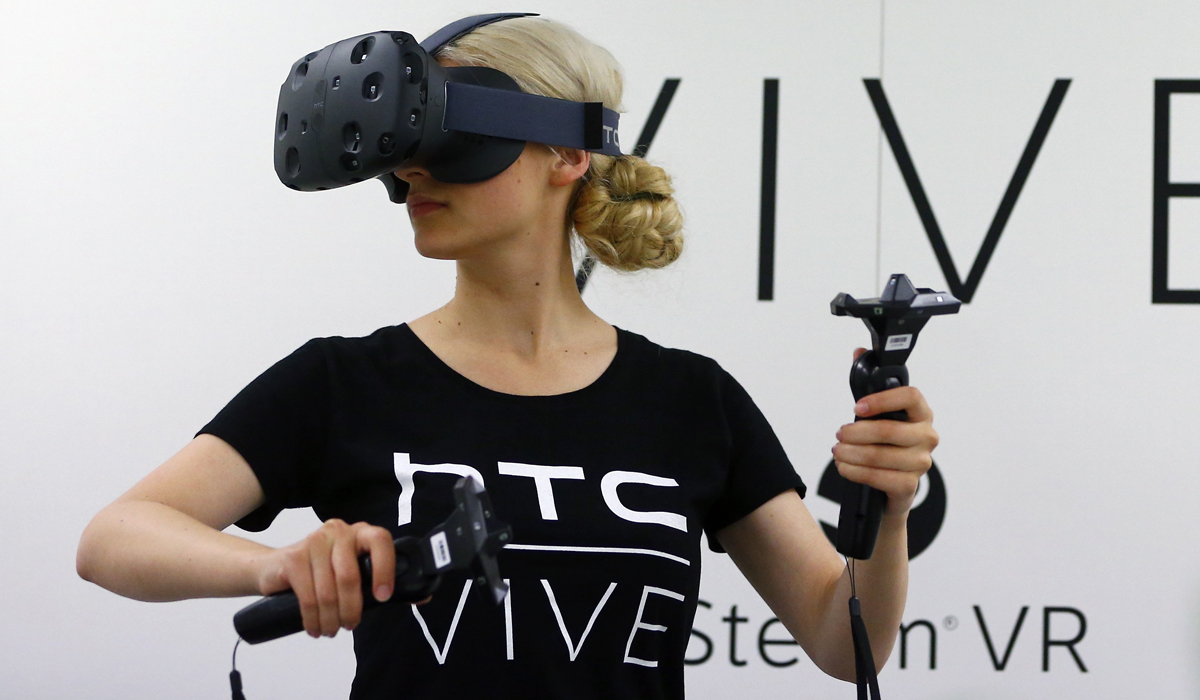
Taiwanese smartphone maker HTC has opened the doors of its first global flagship store for its Vive VR headset. The Shenzhen store will offer consumers the chance to experience VR technology in a relaxed in-store environment. The brand wants consumers to build a better understanding of how VR works, the content available, and how it can enhance their lives – through entertainment and practical applications.
HTC launched its first Vive headset three years ago and is now a predominant player in the Chinese VR market, claiming 82 per cent market share at one point last year.
It is now partnering with video game maker Ubisoft Entertainment, Warner Brothers and the McLaren Formula 1 team to participate in the China Digital Entertainment Expo and Conference, nicknamed ChinaJoy, where it will have a VR gaming carnival.
HTC has long been running at a loss as sales of its handsets fall in the highly competitive smartphone market and it sees VR technology as an opportunity to return to profitability.
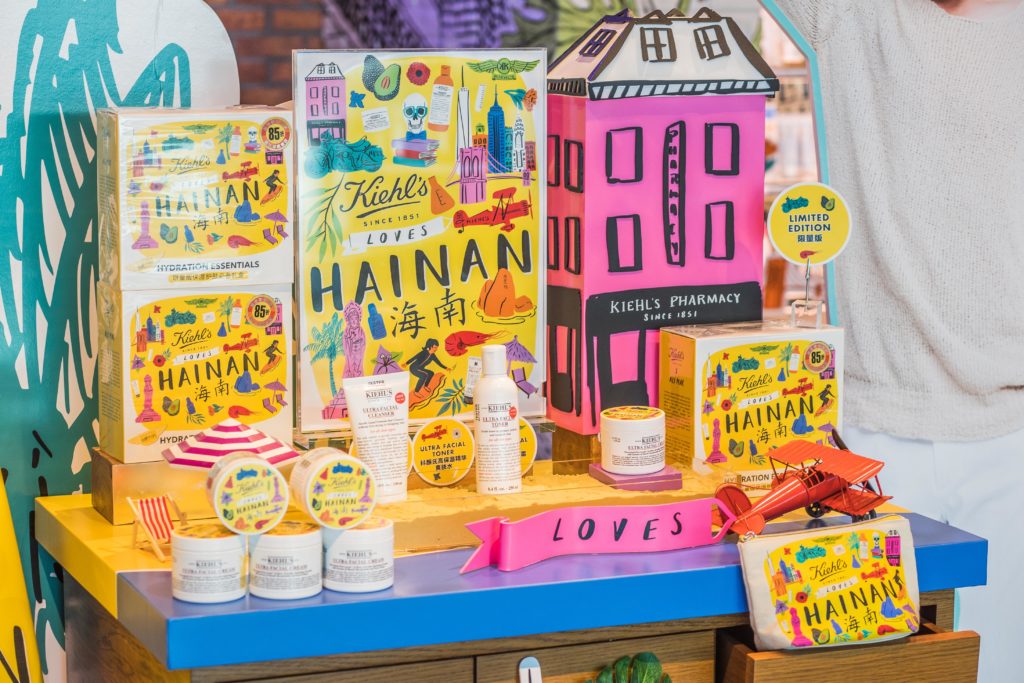
L’Oréal-owned skincare brand Kiehl’s is leveraging star power and immersive digital technologies for the third edition of its annual ‘Kiehl’s Loves’ campaign, titled ‘Kiehl’s Loves Around the World 2018’. The campaign was officially launched in Hainan last month with an influencer-driven mega event and an immersive pop-up featuring augmented reality (AR) technology and digital retailtainment – a first for the brand.
In another first, Kiehl’s has appointed some of the region’s top celebrities to front the campaign, which will run in nine locations across Asia Pacific travel retail: Hainan, Bangkok, Jeju, Seoul, Beijing, Shanghai, Hong Kong, Macau and Taiwan.
These celebrities will serve as “adventurers” in the travel-themed campaign, each representing a specific location.
South Korean singer Hwang Chi-Yeul has been chosen as the campaign’s “global explorer”, representing Kiehl’s home city of New York.
Joining him as local “city hosts” are Chinese singer Wang Ziyi (representing Hainan), Chinese actor Dong Zijian (Beijing), Chinese fencing athlete turned singer and actor Dong Li (Shanghai), Taiwanese singer and actress Emma Wu Ying-chieh (Taiwan), and Hong Kong Cantopop singer and songwriter Pakho Chau (Hong Kong).
Kiehl’s Loves is a global campaign that celebrates the countries and cities served by Kiehl’s worldwide.
Following in its annual tradition of working with internationally acclaimed artists, this year Kiehl’s has teamed up with New York-based graphic designer and illustrator Ali Mac to create limited-edition packaging for Kiehl’s products.
Ali Mac has designed artwork for more than 50 international Kiehl’s locations, combining symbols of the brand’s heritage with visual icons that are characteristic to each city’s local culture and DNA.
Besides product packaging, the fun and colourful artwork will also be featured on travel-themed items such as totes bags, pouches and luggage tags.
Kiehl’s Loves Around the World 2018 kicked off in Hainan, China, with an immersive pop-up store that ran from 1–29 September at China Duty Free Group’s Sanya International Duty Free Shopping Complex.
Located at the level 1 concourse, the pop-up was designed to highlight Kiehl’s bestselling products using AR technology to create a disruptive, engaging experience.
It comprised a number of themed areas – a nature room, an adventure room and a Kiehl’s 1851 apothecary – with digital touchpoints to engage shoppers.
Scanning the QR code on WeChat called up AR features that illustrated product information and directed users to the Kiehl’s e-commerce site and the Kiehl’s store on level 2 of the shopping complex, driving O2O (offline-to-online/online-to-offline) conversion.
A digital photo booth also provided photo opportunities and encouraged sharing on social media. Thanks to AR technology, shoppers could find out more about the products via WeChat.
On 22 September, L’Oréal Travel Retail Asia Pacific and China Duty Free Group (CDFG) celebrated the campaign launch with a high-profile promotional event, attended by key opinion leaders (KOLs) and media from China.
Global campaign ambassador Hwang Chi-Yeul and Hainan ambassador Wang Ziyi made special appearances at the event, where they played games and interacted with their fans.
Thanks to their participation in Chinese reality shows, both singers have amassed a significant following in China, with more than five million Weibo fans each.
Terry Chua, CDFG-Sunrise Group Merchandising Director of Perfumes & Cosmetics, commented: “Kiehl’s Loves Around the World is a 360 campaign. It has targeted communications on WeChat, and they have invited celebrities and KOLs which appeal to the younger generation – the Millennials and Generation Z. On top of that, it’s important that we have sufficient stocks to cater to demand and are well prepared in terms of design and safety, so that customers can have an enjoyable experience when they come to the Kiehl’s pop-up and leave with nice memories. This kind of continuous investment in brand building will continue to keep Kiehl’s at the top of the consumers’ minds.”
Following Hainan, the Kiehl’s Loves Around the World 2018 campaign will continue its travel retail roll-out this month in Seoul.
A similar consumer engagement event will take place downtown, with another appearance by global ambassador Hwang Chi-Yeul.
L’Oréal Travel Retail Asia Pacific General Manager of Kiehl’s Adele Zhang told The Moodie Davitt Report that China and Korea were natural choices when it came to selecting the locations for hosting events as they both have very good travel retail shopping environments and are very advanced in engaging millennial consumers.
“We believe that travel retail is a great showcase to promote the brand and to engage customers. Of course, we have some constraints in the airports with space etc., but with downtown duty free shops we have more flexibility.” she said.
The Kiehl’s Loves campaign taps into the demand for exclusive gifts in travel retail and creates a Sense of Place, a trend that has been pioneered by Kiehl’s for years, Zhang said.
The digitalisation of the campaign, through e-commerce and digital/social media, allows Kiehl’s to reach out to millennials and better engage them, she added.
The use of AR technology to highlight the brand heritage also helps to create memorable experiences.
Looking ahead, Zhang is looking to continue the strong growth of Kiehl’s and make it a leading skincare brand.
“Kiehl’s is not a media-driven brand, and we don’t invest heavily in above-the-line. The brand relies on two things: word-of-mouth and high-quality, effective products. Kiehl’s can be categorised as a lifestyle brand, and it originates from New York so it’s perceived as a fun and hot brand, so I think we can do something different from other brands.
“We hope to make Kiehl’s a brand that is desired by young people. When they think about brands with high-quality products and 100% natural ingredients, we want Kiehl’s to be at the top of their minds,” she said.
View the gallery below for photos of the event (8 images) :
Kiehls Loves Hainan CDF Mall 1 1
黄致列在科颜氏全球第一家Kiehls Loves快闪店 1024×682
Kiehls Loves Hainan Pop up Exterior 1 edited 1024×682 1
Storefront is pushing the boundaries of the retail industry by giving brands for the first time ever the opportunity to rent Virtual Reality pop-up stores right on its platform.
Retailers and e-commerce brands can now launch a virtual, fully customisable store powered by Obsess’ VR technology, featuring their own inventory and choosing any layout, decor and style.
The ‘Future of Retail’ is retail everywhere, according to Storefront
Storefront is making retail accessible to anyone in the world by now giving customers a unique selling and buying experience through Virtual Reality, in addition to its current retail space offerings. Now, anyone has the ability to experience a physical store with the ease of online shopping.
“We see this Virtual Reality pop-up store as creating a new category between e-commerce and a physical retail space. It’s a great in between,” says Joy Fan, Storefront’s CCO.
Get a taste of (virtual) reality
With this new partnership with Obsess, brands and retailers can now easily book space through a New York City, Los Angeles, or San Francisco themed virtual store.
Now with this virtual pop-up store, e-commerce brands can get a branded store environment without the need to invest in a physical space – just yet.
“Our goal is to bring the visual merchandising and curation of retail stores into online shopping to make it a more guided and enjoyable experience,” explains Obsess founder and CEO Neha Singh.
By booking this virtual reality experience, brands will be able to increase digital engagement, reduce costs, create more traffic and acquire new data.
A unique initiative that allows Storefront to open all doors to all ideas.
About Storefront
Storefront is the world’s largest marketplace for short-term retail space rental, making it possible for brands to sell their idea anywhere; for space owners to activate their space with a click and for consumers to buy local; globally.
Storefront’s platform powers more than 10,000 listings, which represent more than 30 millionsqft of retail space. The company offers greater access to spaces in leading retail cities around the world, including Hong Kong, New York, Paris, London, Milan, Amsterdam, Los Angeles and San Francisco.
Since its launch in 2013, it has helped thousands of brands all over the world, including Google, Samsung, L’Oréal, Everlane, Shopify, Indiegogo; open temporary retail stores.