Tag: whatsapp

  • WhatsApp delays the implementation of its new terms and privacy policy

    WhatsApp delays the implementation of its new terms and privacy policy

    For the first time in many years, it looks like Facebook is taken into consideration users’ feedback. After informing its 2 billion users that WhatsApp is going to update its terms and privacy policy, forcing them to share data with Facebook and third-party associated companies, the social giant has taken a step back.

    Facebook is now giving WhatsApp users three extra months to decide whether or not they agree with the new terms and privacy policy, the company announced this week. Along with the new deadline, WhatsApp clarified some of the misinformation running around after its initial announcement.

    The update includes new options people will have to message a business on WhatsApp, and provides further transparency about how we collect and use data. While not everyone shops with a business on WhatsApp today, we think that more people will choose to do so in the future and it’s important people are aware of these services. This update does not expand our ability to share data with Facebook.

    Also, Facebook announced that it will do a lot more to clear up the misinformation around how privacy and security work on WhatsApp in the coming weeks. That being said, Facebook will no longer suspend or delete WhatsApp accounts that don’t agree with the new terms and privacy policy on February 8. Instead, Facebook will “go to people gradually to review the policy at their own pace before new business options are available on May 15.”

  • Millions of WhatsApp users join Telegram as Facebook forces them to give up their data

    Millions of WhatsApp users join Telegram as Facebook forces them to give up their data

    Facebook informed WhatsApp users last week that in order to continue to use the app, they will have to agree with the company’s updated privacy policy. That wouldn’t be unusual unless the new policy requires WhatsApp users to allow the company to share their information with Facebook and its associated firms.

    About three years ago, WhatsApp introduced this option with the promise that it will “help operate, provide, improve, understand, customize, support and market it services and offerings,” but users could opt-out from this trial.

    Unfortunately, this has become mandatory this year, so those who don’t comply won’t be able to use WhatsApp starting February 8. Well, it looks like Facebook’s decision had drastic repercussions for its customer database.

    Telegram, a similar messenger service with a lot less users, has just announced a surge in the number of active users immediately after Facebook’s announcement. First, the founder of the company, Pavel Durov, pointed out that Telegram surpassed 500 million monthly in the first week of January 2021.

    More importantly, soon after WhatsApp announced the new changes, Telegram reported a massive surge in a number of users. No less than 25 million users joined Telegram in the last 72 hours. According to him, most of them are coming from Asia (38%), Europe (27%), and Latin America (21%).

    Apparently, this is an important increase compared to last year, when “just” 1.5 million users signed up every day. Durov went on to say that while Telegram had surges of downloads before, “this time is different.”

  • Facebook could be forced by the U.S. to sell Instagram and WhatsApp

    Facebook could be forced by the U.S. to sell Instagram and WhatsApp

    Facebook is going to be spending a lot of time in court after the U.S. Federal Trade Commission (FTC) and almost every U.S. state sued the social media company today. At issue is the “buy or bury” strategy used to snap up rival firms and keep smaller competitors away. Facebook was charged in two lawsuits of using its financial power to buy out rivals. In 2012, Facebook spent $1 billion to buy Instagram, which at the time was a photo-filter related app.

    Eventually, Instagram added a Stories feature that made it extremely popular. At the beginning of this year, Instagram had 1 billion monthly active users and an estimated valuation over $100 billion.. That means that Facebook was the beneficiary of one of the most profitable transactions ever made with a profit of more than $99 billion on paper. Two years later, Facebook paid $19 billion for the messaging app WhatsApp. By the time that deal closed, the rise in Facebook’s shares turned the value of the purchase to more than $21 billion.

    Both federal and state regulators want the deals to be overturned even though both were approved by the FTC years ago. If the regulators do agree to start the process of overturning the Instagram and WhatsApp deals, you can best believe that there will be legal challenges initiated by Facebook. 46 states are taking part in the suit with Alabama, Georgia, South Carolina and South Dakota sitting on the sidelines. New York Attorney General Letitia James, speaking on behalf of the coalition of the 46 states, Washington, D.C. and Guam that are suing Facebook, said, “For nearly a decade, Facebook has used its dominance and monopoly power to crush smaller rivals, snuff out competition, all at the expense of everyday users.” James said that Facebook acquired the companies before they got big enough to challenge Facebook.

    Jennifer Newstead, Facebook’s general counsel, called the lawsuits “revisionist history” and said that antitrust suits don’t exist to punish successful companies. She added that Instagram and WhatsApp became successful after Facebook spent billions of dollars on improving the apps. Newstead added that “The government now wants a do-over, sending a chilling warning to American business that no sale is ever final.” She pointed out that because of the merger, consumers benefited from the decision to make WhatsApp free. Prior to the deal, WhatsApp used to cost $1 to download and a dollar per year for service.

    Facebook co-founder and CEO Mark Zuckerberg did not help his own cause with a statement he made in 2008. According to at least one antitrust expert, Zuckerberg wrote in an email “it is better to buy than compete.” Seth Bloom of Bloom Strategic Counsel made an interesting point when he said that it will be hard for the government to “order divestitures of many years ago.” The transactions made by Facebook that are being challenged are six to eight years old and many courts would probably refuse to order Facebook to give up Instagram and WhatsApp. Daniel Morgan, a portfolio manager at Synovus Trust in Atlanta, Georgia, said, “I do not know if the FTC or DOJ will be successful in breaking Facebook up. I’m assuming this will be dragged out in the courts as FB defends itself.” Back in July, Zuckerberg made it clear that Facebook will “go to the mat” to defend itself against a federally ordered divestiture. The executive called the government’s actions “an ‘existential’ threat.”

    Interestingly, breaking up big tech seems to be something that both Democrats and Republicans are agreeing on. Both sides have been in favor of breaking up Google and Facebook. Many see the legal actions against the two tech firms as being the biggest antitrust cases against tech since Microsoft’s antitrust case from 1988.

  • WhatsApp launches Carts for small businesses to sell in app, online

    WhatsApp launches Carts for small businesses to sell in app, online

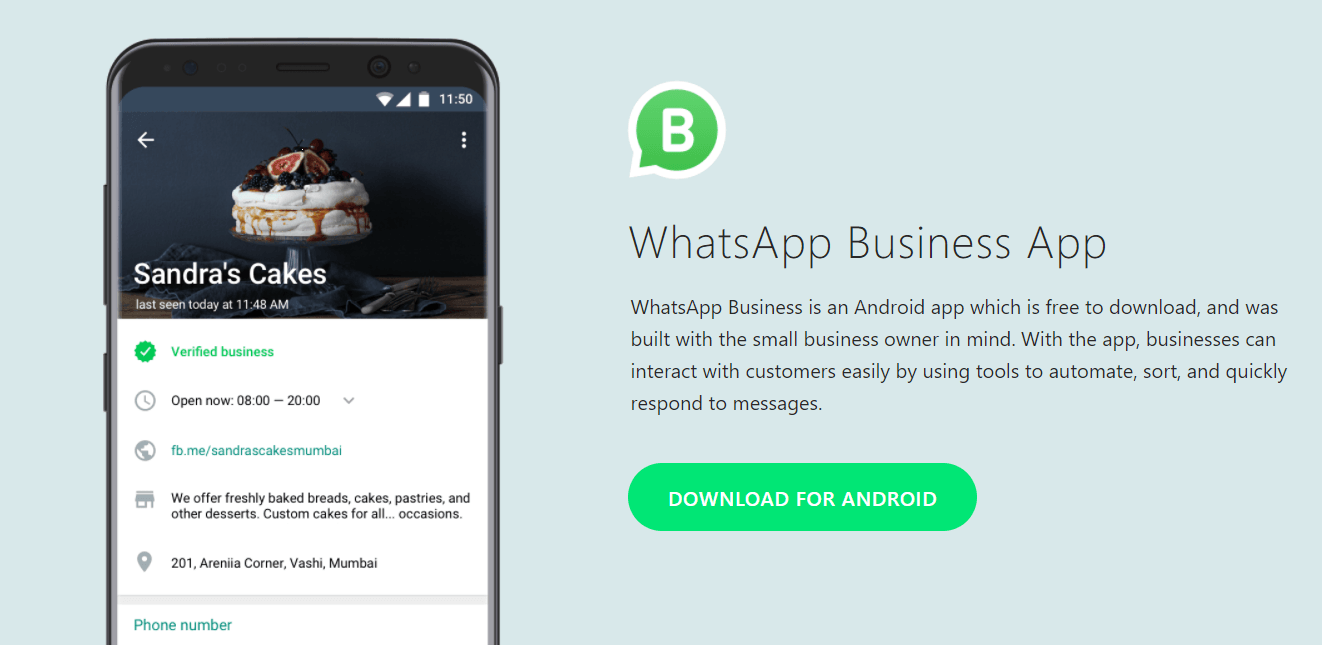
    WhatsApp has added a feature called Carts to its business app, offering a more “seamless and intuitive” shopping experience on the chat program.

    The Carts feature will allow customers to quickly add goods or services they want from a business’ catalog, and then send the order as one message to the business. WhatsApp says this makes it easier for customers to order products and for businesses to keep track of order inquiries.

    Due to the Covid-19 pandemic, a significant number of small businesses in Hong Kong and Singapore have moved their focus to digital tools like WhatsApp Business to keep close connections and high interactivity with their customers.

    The app has turned into a potential channel for brands as about 175 million people around the world message a WhatsApp Business account every day. This trend in conversational commerce is rising across many industries – from fashion and beauty, to food and beverage, and even home and living.

  • WhatsApp adds new filters for storage management

    WhatsApp adds new filters for storage management

    One day after WhatsApp detailed the Disappearing Message feature, the social app is bringing yet another important improvement to its users: new filters for storage management. For those who are using smartphones with low storage, the new filters are going to be of great use.

    An update is now rolling out to Android users that will allow them to review, bulk delete items and free up space much easier than before. The update introduces a new design for the storage management tool, which can be found in Settings / Storage and Data / Manage Storage.

    Also, whenever your phone’s storage is getting close to being full, WhatsApp will notify you via a warning card in the Chats tab. You can even see how much of the disk is full thanks to the storage meter that’s now sitting at the top of the screen.

    More importantly, thanks to the new filters, WhatsApp users can order files by size whenever they want to free up some space. A preview tool for media files is available as well, allowing users to see what they’re deleting at a glance.

    According to WhatsApp, the new update that adds the new filters for storage management is rolling out this week, so be patient if you don’t see it yet on your phone.

  • Face unlock support coming soon to WhatsApp on Android

    Face unlock support coming soon to WhatsApp on Android

    WhatsApp already offers users security features that allows the lock of the app using various methods. The easiest form of protection involves the fingerprint sensor, but there’s another one that’s just as easy to use, yet unavailable for WhatsApp users: face unlock.

    It looks like WhatsApp is recognizing that there are phones that don’t feature a fingerprint sensor, so owners have to rely on other methods of protecting their WhatsApp conversations. If your phone does feature support for face unlock, you’ll be happy to know that you’ll soon be able to use it with WhatsApp.

    A new WhatsApp update has been submitted through the Google Play beta program, which adds two important features. The first one is the ability to join a group call even after you missed the initial invitation.

    The second major feature we expect WhatsApp to release soon is face unlock support. A new “Biometric lock” menu has been added in the new beta version of WhatsApp, which will replace the current “Fingerprint lock” menu.

    The new panel confirms that WhatsApp will let users authenticate with fingerprint, face, or other unique identifiers to open the app. As the title says, the new security features have been spotted in the Android version of WhatsApp, although there’s no telling when they will be available for everyone.

  • WhatsApp upcoming feature lets you use the same account on multiple devices

    WhatsApp upcoming feature lets you use the same account on multiple devices

    WhatsApp is testing new features all the time and we often learn about them before release. One of the important features that we hope to see coming to WhatsApp is the option to use the same account on multiple devices.

    A new report coming from WABetaInfo confirms WhatsApp is now testing this new feature that allows users to have the same WhatsApp account on up to four devices. In that regard, a new UI that will manage all linked devices is now in the works at WhatsApp.

    The new UI is meant to enable users to add new devices to their WhatsApp account or remove them if they need to. To add new devices to your WhatsApp account, you must use a code that will sent to you via SMS or WhatsApp Chat. The procedure hasn’t been finalized since the feature is still in the works, but it’s probably the easiest and most secure way at the moment.

    The new option to add multiple devices on the same WhatsApp account is not yet available in any of the beta versions of the app, but the new Linked Devices UI does show up in one of the beta iterations.

  • WhatsApp update will close vulnerability that leaves messages unencrypted

    WhatsApp update will close vulnerability that leaves messages unencrypted

    Apple iPhone users that rely on WhatsApp’s end-to-end encryption might not realize that there is an opening that could allow a hacker to read their messages. According to the WhatsApp FAQ page, WhatsApp messages that are backed up in iCloud are not protected by the app’s end-to-end encryption. However, an update is coming to shut this vulnerability. A WhatsApp iOS beta includes a change that “enables the encryption of chat histories hosted on iCloud, including media” through the settings on the WhatsApp app.

    If WhatsApp decides to go ahead and include the feature in an upcoming update to its public iOS app, authorities, hackers, and even Apple will be shut out from reading your unencrypted text messages. Essentially, the update would extend the end-to-end encryption available from WhatsApp to messages being stored in iCloud. And at the same time, WhatsApp is working on the same protection for its chat backups on Android.

    Just as WhatsApp chats backed up in iCloud aren’t covered by end-to-end encryption, neither are the chats that Android users back up on Google Drive. The new feature could be available on the WhatsApp beta for Android version 2.20.73 and is called “Protect Backup,” which pretty much is self-explanatory. Until it becomes part of WhatsApp for Android and iOS, just keep in mind that despite the end-to-end encryption found on the app, if you back up your chats to iCloud or Drive, you are leaving them vulnerable to being read. There isn’t any evidence that this has been exploited, but it is something that every WhatsApp user should be aware of.

    It appears that WhatsApp’s iOS users are more excited by the coming addition of support for QR codes. This is a feature that will allow users to create personal QR codes to help others find them. QR code support will also be available for Android totin’ WhatsApp users soon.

  • WhatsApp and JioMart commence e-commerce rollout

    WhatsApp and JioMart commence e-commerce rollout

    Indian conglomerate Reliance Industries has partnered with Facebook’s WhatsApp messaging service to pilot its new online food and grocery channel JioMart in an attempt to redesign Indian retail.

    Last month, Facebook invested US$5.7 billion in Jiomart, to take a 9.99 percent interest in the digital platform and set a foundation for a joint venture with Reliance.

    JioMart, which has its own dedicated user base, will use WhatsApp’s extensive social reach to allow consumers to access the store’s e-commerce channel via web links shared on the platform. The service assigns any orders made to a nearby store, connecting small offline retailers and enabling them to expand digitally – a critical sales function during the coronavirus pandemic.

    JioMart plans to onboard 30 million offline retailers to Indian consumers’ smartphones.

    Data and analytics firm GlobalData has estimated the service to achieve ₹678 billion (US$8.9 billion) within three years.

    “Recently, JioMart tested its grocery ordering system through WhatsApp in the suburban areas of Mumbai, India,” said GlobalData retail analyst Hrishabh Kashyap. “That gave a glimpse of one of the many services Jio and Facebook can offer. The two popular communication platforms will work together to enable their consumers to interact with nearby stores online to place an order, allowing the retailer to retain its customers through digital association.

    “The pandemic might just have given the necessary push to the massive physical retailer network in India by forcing the retailers to go digital in order to sustain their businesses and thereby insulating them from the even more rapid shift online.”

  • WhatsApp claims surveillance company used US-based servers to spy on users

    WhatsApp claims surveillance company used US-based servers to spy on users

    In May 2019, WhatsApp identified and fixed a loophole that enabled cybercriminals to install spyware on smartphones just by ringing the victim’s phone. The video calling system was exploited in particular and it did not require users to answer the calls.

    Around 1,400 users were affected, including journalists and human rights defendants in at least 20 countries. Later in October, the attack was blamed on the Israeli spyware developer NSO Group, also known as Q Cyber Technologies.

    Facebook, which owns WhatsApp, is now saying that US-based servers were used by the NSO Group to target WhatsApp users using signature Pegasus software.

    The social media company says that Los Angeles-based hosting service QuadraNet’s server was used over 700 times during the attack to install malware on the devices of WhatsApp users between April and May 2019. The spyware developer is also accused of using an Amazon-hosted remote server to launch attacks.

    When Facebook sued the surveillance firm in October, the NSO group denied the allegations, claiming that its technology is only sold to government clients.

    However, now that Facebook is accusing it of using US-based servers to stage attacks, it could weaken the software developer’s case. That’s because NSO had earlier said that it couldn’t run operations in the US.

    Additionally, Facebook has also challenged NSO Group’s claim that the case should be dissolved as its government clientele grants it immunity and also because of jurisdictional technicalities. Facebook says the company hasn’t named even one country it sold software to and it has provided no proof, such as a document, which proves its role was only operational. This could have helped absolve the spyware maker of the action of its clients. Basically, the NSO Group wants to get off scot-free just because governments seemingly use its products and Facebook isn’t buying that.

    The NSO Group, on the other hand, is still standing its ground. The company has reiterated that the Pegasus software doesn’t work in the US.

  • WhatsApp doubles the limit of participants in group audio and video calls

    WhatsApp doubles the limit of participants in group audio and video calls

    We told you less than a week ago that WhatsApp plans to increase the limit of participants in group audio and video calls, but we didn’t know by how many and when exactly it will happen. If you’re using the beta version of WhatsApp, we’re happy to tell you that group audio and video calls feature has been upgraded to accommodate more participants.

    As the title says, WhatsApp has decided to double the number of users who can participate in a group audio and video call. WABetaInfo reports that the latest beta version of WhatsApp increases the limit of participants to 8, whereas the app would only accept a maximum of 4 participants previously.

    To start using the new feature, all your contacts must use the same version of WhatsApp. Then, you must tap the New Group Call option in the Call tab and choose up to 7 more contacts from your list who you wish to invite in a group audio or video call.

    Apart from increasing the number of participants that can join audio and video call groups, WhatsApp implemented some other small, but helpful changes. For example, the call button that you use in groups will now allow users to directly start a call with group members if the group has 4 or fewer participants.

    If the group has more than 4 participants, you will be able to choose the contacts you want to add to the group call immediately after tapping the call button. Once again, these improvements are only available in the WhatsApp beta for Android (v.2.2.128), but we suspect they will be rolled out to the general public very soon.

  • WhatsApp to increase group audio and video call limit in upcoming update

    WhatsApp to increase group audio and video call limit in upcoming update

    The current global crisis has led to an increase in communication services usage, but it looks like they’re able to cope with the demand for the time being. Even though it seems that there’s enough bandwidth to accommodate the spike in usage, many of these services require improvements.

    WhatsApp is in the process of upgrading its mobile apps with a couple of improvements that are meant to allow multiple users to participate in audio and video calls. WABetaInfo has learned that WhatsApp plans to extend group audio and video call limit on Android and iOS devices.

    Currently, WhatsApp users can initiate group calls with up to 4 participants, but a future update will increase the number of participants that you can invite in a group call to at least 6. It’s unclear what the final number will be, but we do know that WhatsApp will apply the same enhancements to the video call group feature.

    Neither of these improvements is available in the beta version of WhatsApp yet, but they are evident in some strings of code discovered by WABetaInfo. The changes are expected to be implemented in both Android and iOS versions of WhatsApp, but we don’t know when exactly they will be rolled out.

  • WhatsApp for iOS to make it trickier to share images and links with recent contacts

    WhatsApp for iOS to make it trickier to share images and links with recent contacts

    Recently, WhatsApp has been fighting misinformation in regards to the coronavirus pandemic and has therefore introduced some restrictions on its app. This time, however, a new update is supposedly going to further restrict the app, but not because of COVID-19-related reasons. The change is said to affect only the iOS version of the popular messaging app.

    WABetaInfo reports that a feature for easy sharing of images and links on iPhone devices is going to be removed in the latest WhatsApp beta version. The feature was introduced earlier this year and is referred to as share sheet integration, which allowed, after long-pressing on what you want to share, to select a person in a list of recently used WhatsApp contacts and share the item without opening the app first.

    Unfortunately, though, this simple-looking feature seems to be proving unstable and its removal seems not to be related to the fight against the coronavirus misinformation. Reportedly, a lot of users have been complaining from crashes when using the feature.

    You will still be able to share links and images to your WhatsApp contacts, but you will have to first tap on the WhatsApp icon, which will reportedly then open the app. Additionally, the feature could be returned to the app at a later stage if the app’s developers find a way to assure it’s more stable.

  • New WhatsApp beta reveals a long-awaited advanced search option and more secure backups

    New WhatsApp beta reveals a long-awaited advanced search option and more secure backups

    Recently, WhatsApp has been getting a lot of features, most of which are related to the fight against the coronavirus misinformation spread. However, this time, the new features are not COVID-19 related. There is a new beta for WhatsApp Android that has been revealed and WABetaInfo reports that it is offering us some appealing functionalities.

    Firstly, there is a feature referred to as “Advanced Search Mode” which will offer a possibility to easily search for media, such as photos, videos, GIFs, links and audio, as well as documents, in the messages. The search feature is still under development for Android users and already available in the beta for iOS, but there is no official information when it will be rolled out and if it will be available at all. However, it will be very helpful for people who have a lot of messages to filter in order to find that one link.

    Another feature in WhatsApp’s beta for Android is related to the automatic download. When enabled, which will be by default, the option will not automatically download frequently forwarded images, videos, documents and voice messages and will, therefore, help you save data.

    Last but not least: here comes the more secure password-protected backup option. The feature to backup your chat history is already available for WhatsApp users and the data is saved to Google Drive, but with the new update, you will be able to protect your backups with a password. However, the password will not be stored on Google Drive, neither will it be synced to Facebook’s servers, so if you forget it, you won’t be able to access your data.

    The aforementioned features are not available globally yet, they are a part of the beta version of WhatsApp. If you would like to test future versions of WhatsApp, you can register from this page on Google Play, even though, currently, the page says that no more testers are allowed at the time being.