Retail News CRM

Tag: zte

  • ZTE and IPMA partner for innovative project management in Philippines

    ZTE and IPMA partner for innovative project management in Philippines

    ZTE has signed an MOU (Memorandum of Understanding) on strategic cooperation with International Project Management Association (IPMA) Philippines in Manila. The strategic cooperation between IPMA Philippines and ZTE Philippines further recognizes ZTE’s mature corporate project management capability.

    This is ZTE’s first overseas IPMA corporate membership, and the company has become a corporate member simultaneously certificated by IPMA International and IPMA Philippines.

    IPMA is a non-profit international academic organization, with commitment to promoting professional development of international project management. IPMA, PMP and PRINCE2, are known as the three major international project management organizations. IPMA’s membership certification is widely recognized, representing the highest-level certification of project management across the globe.

    At the ceremony, IPMA Philippines and ZTE Philippines principally agreed on joint development and win-win collaboration. IPMA will invite ZTE to deeply participate in industry symposiums, industry forums and professional training meetings, as well as joint application for telecommunications-related awards and reviews of outstanding project management cases. In return, ZTE will give its priority to the interviewees who have passed the IPMA certification.

    “With the development of its business in the Philippines for more than 15 years, ZTE has extensive experience in project management and project delivery,” said Jin Zhichao, General Manager of ZTE Philippines. “ZTE is keen to explore and learn excellent experience and effective management approaches from different industries or IPMA corporate members, further improving the level of ZTE’s project management and corporate competitiveness. At the same time, we are willing to share our own experience with them.”

    “I am looking forward to the cooperation between the two parties. IPMA has been developing project management competencies for years, and regularly organized various symposiums and forums every year,” said Prof. Mariano Roque Senga, Chairman of IPMA Philippines. “I hope ZTE, as a leading enterprise in the field of telecommunication engineering, can participate in exploration and in-depth cooperation with other corporate members on project management approach.”

  • ZTE Lands Largest Share of China Mobile 10G GPON ONT Tender

    ZTE Lands Largest Share of China Mobile 10G GPON ONT Tender

    Bandwidth-intensive 4K video, gaming and IPTV applications, coupled with emerging 5G and IoT services, spur unprecedented demand for higher bandwidth.

    According to the Global System for Mobile Communications Association (GSMA), the number of IoT connections will reach close to 25 billion by 2025. In addition, a surge in connected devices in homes and across industries makes it pressing for operators to evolve toward gigabit broadband, through the adoption of passive optical networking (PON) technology, to deliver gigabit experiences.Data from the consultancy Global Market Insights shows that global shipments of GPON products crossed 250 million units in 2021. The GPON market is forecasted to grow at a compound annual growth rate (CAGR) of over 10% from 2022 to 2028. A market segment that contributes to significant GPON growth is fiber-to-the-home (FTTH), which is essential for the implementation of smart home applications like home automation and home security.

    Large-scale deployment of newer services requires the evolution of GPON to 10G GPON. Many operators across the globe are deploying 10G GPON to provide higher bandwidth and lower latency. In China, which is a frontrunner in gigabit construction, the three major operators have been accelerating 10G GPON deployment in recent years.

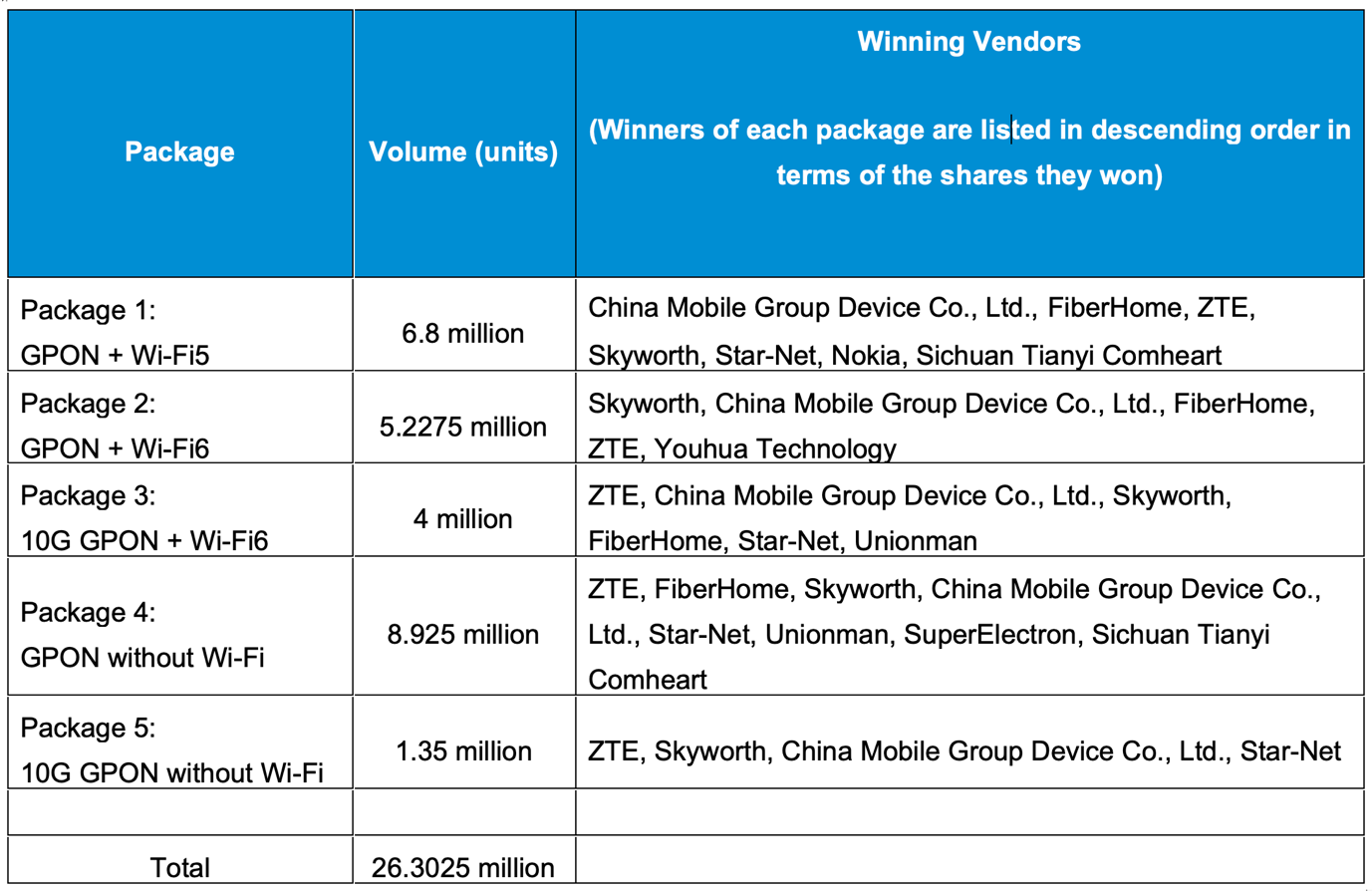
    In May 2022, China Mobile announced the results of its optical network terminal (ONT) tender for 2022-2023. With a total volume of 26.3025 million units, the tender represented the largest centralized procurement of ONTs by any operator in the Chinese market this year, drawing participation from numerous vendors.

    Based on the tender results, ZTE clinched a portion of all the five bidding packages and was the top winner in three of them. In the two packages for 10G GPON with Wi-Fi 6 and 10G GPON without Wi-Fi, ZTE landed the largest share, which testifies to its leadership in the commercial deployment of 10G GPON technology.

    ZTE ranked first for shipments of PON ONT devices with a 33% share of the global market in 2021, according to research firm Dell’Oro Group.

  • ZTE COO Xie Junshi: Digitalization is the key to greater societal resilience

    ZTE COO Xie Junshi: Digitalization is the key to greater societal resilience

    At the post MWC22 sharing session recently organized by the GSMA, Xie Junshi, EVP and COO of ZTE, explored several exciting new trends in scenario-based 5G applications, mobile technologies, and industry development in an increasingly digitalized world.

    Xie noted that digitalization in the volatile, uncertain, complex and ambiguous (VUCA) era is continuously strengthening the “immune system” of our society, playing an irreplaceable role in tackling not only the current pandemic but also long-term public health issues such as ageing populations while promoting sustainable development. With digitalizationaccelerating around the world, both the technology and market are changing disruptively, creating more innovations and greater potential. To maintain a competitive edge, CSPs are pursuing the transformation to DSPs. Focusing on scenarios and value creation, ZTE aims to work jointly with all partners to build a digital and intelligent ecosystem.

    Below are the highlights of Xie’s sharing:

    Accelerating global digitalization is boosting the society’s immune system

    Digitalization is the key to greater societal resilience in the post-pandemic era. Whether in telecommuting, online collaboration, or digital factories, digitalization provides support for our lives and helps guarantee the health of the entire economy. Digitalization is also playing a pivotal role in tackling VUCA and population aging while promoting green, low-carbon, and sustainable development.

    Driven by scenario and value, both the market and technology are changing disruptively. The diverse range of exhibitors and fascinating content at MWC 2022 highlight the evolution from mobile Internet to IoE and AIoE, marked by ubiquitous 5G connectivity, AI advancement, cloud-network convergence, and new technologies. Today, without a doubt, global digitalization is accelerating, creating more technological innovations and greater market potential. To maintain a competitive edge, CSPs are pursuing the transformation to DSPs.

    In every industrial revolution, higher efficiency has always been the most critical factor. This current revolution of digitalization is no exception. At MWC 2022, most of the digital innovations presented by exhibitors, including ZTE, focus on higher efficiency. For instance, ZTE shared innovations for simplified infrastructure, efficient and intelligent operations, as well as agile innovations for achieving growth in the second curve of digital services. ZTE has also adopted scenario-based approaches to realize the ultimate experience and efficiency, promoting sustainable development and future technological advancements.

    Sustainable development is the key goal of enterprises, while the key to promoting 5G application in the to-B field lies in three aspects

    For 5G networks, consumers look forward to a better experience, while enterprises look for lower costs, higher efficiency, and business growth. So far, in the to-B field, 5G technology has been widely applied to verticals. For example, to assist or replace manpower, 5G-powered automated guided vehicles (AGVs) are used in flexible production lines, 8K machine vision for more efficient quality inspection, and unmanned or remotely controlled machines to assist in operations.

    To facilitate greater breakthroughs in the to-B field, however, it is important to achieve collaboration with operators and enterprises where every party stands to benefit. Together, there are three aspects to work on: creating and sustaining competitive differentiation, developing effective business models to speed up value creation, and exploring the path to mass customization.

    Competitive differentiation means that ZTE can provide unique and optimal solutions, and hence stand out from the competition. When delivering 5G solutions for verticals, it is important to determine whether 5G technology is indispensable, or whether the 5G-powered solutions have unparalleled advantages over others. This is how competitive differentiation can be sustained.

    As for speeding up value creation in the early stage of 5G application, it is important to focus on customers’ pain points and distinctive needs in fragmented scenarios. On this basis, ZTE can explore more scenarios in different fields, so as to accelerate the development of 5G application in the to-B field.

    To achieve higher profitability, mass customization is the optimal choice. This is why ZTE aims to build underlying capabilities of digital infrastructure and component-based cloud capabilities. Through flexible orchestration of such capabilities, agile innovation can be implemented, meeting the requirements of different applications in various scenarios. In addition, this allows ZTE to continue to build successful experience across different scenarios and consolidate a strong digital foundation, to enable rapid iteration and continuous evolution.

    Evolving consumer expectations drive 5G application in the to-C field, and joint efforts are required for building the infrastructure and ecosystem

    The rapid development of the mobile Internet is driven by evolving consumer expectations and improving human capabilities. The same will be true for the application of 5G in the to-C field. For example, consumer demands boost the development of applications that can provide real-time, immersive, and interactive audio-visual experience, such as UHD videos, AR and VR applications, and cloud gaming. This has been a trend in countries with wide 5G network coverage, including China and South Korea. With 5G technology, we can now watch live sport events with a panoramic view, freely zoom in or out, and switch between different camera positions. In this way, consumers can stay at home and enjoy personalized and immersive experiences in real time. In order to make the much talked-about metaverse a reality, we need to enhance network capabilities, computing power, and storage capabilities, for which 5G technology plays a vital role.

    To promote 5G applications in the to-C field, wide and deep network coverage is of great importance. More specifically, we need optimal, cost-effective 5G solutions that can guarantee continuous and intensive network coverage both outdoors and indoors, even on high-speed trains, airplanes, and ships. ZTE has already made many innovations in the to-C fields. In addition, easy-to-use and cost-effective terminals, together with different kinds of content services, will help give rise to improved applications in a stronger and healthier ecosystem.

    ZTE is committed to building a “1+2+3” digital ecosystem.

    The next major chapter of 5G development will start with the arrival of 5G-Advanced. While 3GPP Releases 15, 16, and 17 represent the first phase of 5G standards, 5G-Advanced marks the start of the second. Following up on 5G commercial deployment and empowerment of verticals worldwide, 5G-Advanced focuses on better user experience and more industry applications.

    In December 2021, together with its industry partners, 3GPP approved a work package for its Release 18, marking the start of 5G-Advanced evolution. The work package includes 28 study or work items in a variety of scenarios, including eMBB, real-time interactive new media, network intelligence, IoT featuring high-precision positioning and low power consumption, IIoT, integrated sensing and communication (ISAC), fused location, and satellite-cellular network integration. These efforts will bring us brand new capabilities, applications, and experiences. Toward 5G-Advanced, ZTE will continuously work with industry partners to promote technological innovation and industrial transformation.

    To gain a firm foothold in this process of network evolution, ZTE is always committed to building a “1+2+3″ digital ecosystem, looking to address key pain points and create greater value for customers.

    So what exactly is ”1+2+3”?

    “1” refers to a solid foundation consisting of chipsets, algorithms, and architectures. ZTE continuously strengthens its foundation to gain momentum for growth.

    “2” refers to intelligence and security, which are crucial to 5G networks and business.

    “3” refers to capability, performance, and efficiency, which should be continuously improved through innovations and are key to the prosperity of 5G.

    With the evolution to 5G-Advanced, ZTE will work with industry partners and advance technological innovations to reinvent a digital world.

    China’s 5G development will make greater contributions to global industries and markets.

    As of January 2022, a total of 1.425 million 5G base stations have been built in China, making 5G networks available in over 98% of counties and 80% of towns. Mobile 5G connections now exceed 518 million. More crucially, over 10,000 innovative 5G use cases have been created, which span the fields of manufacturing, health care, education and transportation.

    In the 5G era, China has been an active contributor in many aspects:

    • The moderately advanced pace of network construction in China has boosted the growth of the 5G industry.
    • China has continued exploring and promoting large-scale 5G application, consolidating the foundation of the entire industry.
    • China actively pushes forward the co-building and sharing of networks for higher resource efficiency.

    China has a wide range of wireless scenarios and a sound foundation provided by its digital economy, and is witnessing the growth of huge potential in consumer markets and various industries. With the moderately advanced pace of 5G network construction, excellent network coverage and guaranteed performance, China’s unique environment is set to produce a range of more applications and continuous innovation, and contribute to global industries and markets.

    Video link to Xie’s sharing at MWC22 :

    https://res-www.zte.com.cn/MediaFiles/4/F/4/%7B4F48E19C-7979-4844-861C-99C0759DA7F4%7D202204151635.mp4
     

  • AIS, Qualcomm and ZTE debut world’s first 5G NR-DC showcase with 2.6GHz and 26GHZ in Thailand

    AIS, Qualcomm and ZTE debut world’s first 5G NR-DC showcase with 2.6GHz and 26GHZ in Thailand

    AIS, Qualcomm Technologies, Inc. and ZTE have jointly announced the world’s first 5G NR-DC (new radio dual connectivity) showcase in the field with 2.6GHz and 26GHz, achieving 8.5Gbps peak downlink speed and 2.17Gbps peak uplink speed with a single mobile device. As part of the joint effort, this collaboration combines two major 5G frequency bands, sub-6 and 5G mmWave, to enhance the capabilities of Thailand’s 5G network and extend the 5G application landscape.

    The test was conducted at the AIS commercial 5G site in Korat, Thailand, using a smartphone form-factor test device powered by Snapdragon® X65 5G Modem-RF System, and ZTE’s latest mmWave AAU network infrastructure equipment.

    The NR-DC was implemented with one 100MHz carrier in 2.6GHz, and four 200MHz carriers in 26GHz. The test achieved 8.5Gbps peak downlink speed and 2.17Gbps peak uplink speed demonstrating the extraordinary capability and flexibility of NR-DC for diversified requirements from individual consumers and industry leaders.

    This NR-DC showcase drives the commercial progress of 5G mmWave into the fast lane in Thailand. AIS, Qualcomm Technologies and ZTE are together committed to accelerating and growing 5G for capability enhancement, efficiency improvement and application boundary extension.

    “AIS’s key goal is to develop the smart 5G network as a national infrastructure with investments of 30,000-35,000 MB,” Wasit Wattanasap, head of nationwide operation and support business unit at Advanced Info Service Pcl. (AIS), commented, “We are the licensee holding the most spectrum in low band, mid band and high band or mmWave, which has the outstanding feature of rapid data transmission with low latency. We have never stopped deploying innovations to level up the network, including 5G Non NSA/SA Voice over new radio (VoNR) and 5G carrier aggregation (CA), to provide increasingly improved experiences to Thai customers, which was our intention when we joined the auction for spectrum.”

    “Most recently, we have continued our collaboration with ZTE and Qualcomm Technologies, to jointly trial 5G NR-DC technology. It is a crucial step to combine different 5G spectrum, 2600 MHz (mid Band) and 26GHz (high Band) in a world-first. This enables downloads of up to 8.5 Gbps, and uplinks of up to 2.17 Gbps. This trial gave us a wider channel for the signal and extremely low latency. For instance, there could be streaming games online (cloud game), controlling driverless vehicles and commanding robots remotely in real-time. Moreover, the trial supports the development of new models of chipsets in the future, to speed up data transfer even more.”

    “This cooperation highlights how AIS is the only provider using its licensed spectrum of every waveband for development to support business growth in various dimensions. It is also continuous transformation and updates for Thai consumers. Taking this joint-trial as a good start, we are confident that AIS 5G network is ready to expand the use of mmWave technology and support growth of the business sector in various aspects,” concluded Wasit.

    “Our collaboration with AIS and ZTE proves the feasibility of deploying 5G mmWave in Thailand,” said ST Liew, vice president, Qualcomm CDMA Technologies Asia-Pacific Pte. Ltd. and president, Qualcomm South East Asia. “Qualcomm Technologies believes that 5G mmWave will be the key to unlocking the full potential of 5G. The possibility is endless and we are proud to take the first step in bringing the full benefits of 5G mmWave to the country.”

    “We’re pleased to work with AIS and Qualcomm Technologies to achieve this milestone, which lays a technology validation foundation for 5G mmWave commercialization,” said Mei Zhong Hua, senior vice president, ZTE Corporation. “With broader 5G opportunities enabled by mmWave, we will join hands with partners to continuously drive mmWave development, create ultimate experiences and usher in a wonderful 5G era.”

  • ZTE partners with Converge ICT to deliver XGS-PON services in the Philippines

    ZTE partners with Converge ICT to deliver XGS-PON services in the Philippines

    ZTE, together with Converge ICT, is about to launch commercial 10-Gigabit-capable symmetric passive optical network (XGS-PON) infrastructure in South Luzon and the Visayas in the Philippines by May 2022.

    Converge is the first operator to provide residential XGS-PON services in the Philippines. ZTE will cooperate with Converge to expand the commercial range of XGS-PON in the coming years, effectively boosting the evolution of the local network. Currently, ZTE ranks first globally in terms of market share in the customer premises equipment (CPE) segment, according to IHS.

    In this XGS-PON project, Converge selected ZTE to further strengthen their cooperation. ZTE employs multiple XGS-PON devices with ultra-high bandwidth, such as F8648P and Flex PON technologies, for a smooth evolution from GPON to XGS-PON.

    In addition, ZTE has begun its tests on its WiFi 6 ONT and Mesh WiFi products and will provide high-quality and comprehensive XGS PON solutions and products. ZTE’s ONT has a 10 GE downlink port to satisfy users’ high-speed access requirements.

    “In the future, we will continue to work with ZTE to build a stable and efficient network in the Philippines,” said Ronald G. Brusola, chief technology officer at Converge. “The next few years will be a window period for 10GPON development. We hope to work with ZTE to build a fixed broadband network that everyone can afford.”

    “With our 10GPON connectivity up and running, we expect faster and greater things for businesses that utilize this technology,” Jesus Romero, chief operations officer at Converge said. “With our continued partnership with ZTE, we are confident in providing our clients that competitive advantage.”

    “Converge and ZTE have maintained a good long-term partnership. ZTE has been providing Converge with stable and high-speed broadband access products and services. With 20 years of experience in the multimedia field, ZTE has built a professional R&D team of nearly 1,000 engineers,” said Wan Min, managing director of the ZTE Philippines. “With engineering delivery experts across the globe and rich experience in industrial cooperation, ZTE will continue to focus on technological evolution and service innovation in the big video sector, helping Converge develop ultra-high definition video services and set an excellent example for operators in Southeast Asia.”

  • ZTE and China Mobile launch SPN intelligent fault diagnosis system

    ZTE and China Mobile launch SPN intelligent fault diagnosis system

    ZTE Corporation and the Liaoning branch of China Mobile have verified the rule/policy-based SPN intelligent fault diagnosis system on the intelligent management, control and analysis platform ZENIC ONE (UME) and deployed it across Liaoning province in China.

    4GThe system, jointly developed by ZTE and China Mobile, orchestrates the policies for the diagnosis flow through innovative flexible programming of fault diagnosis rules. Thereby, the intelligent management and control system can quickly respond to and meet the requirements of O&M staff to implement minute-level fault location.

    In traditional PTN/SPN network operation, it is difficult to develop alarm-relativeness rules, so the location of substantial faults depends on the experience of senior O&M engineers. The diagnosis usually takes several hours with low efficiency. ZTE has found a new way of fault diagnosis to flexibly orchestrate diagnosis rules and policies in accordance with service scenarios to improve the efficiency of fault diagnosis and location.

    Based on the cloud native and microservice architecture of the ZENIC ONE (UME), ZTE integrates the SPN intelligent fault diagnosis system onto the ZENIC ONE (UME) as an independent tool. This system uses the knowledge graph to build the diagnosis rules and develop the diagnosis process through a series of atomized diagnosis rules, which can be independently programmed by Drools. At the same time, the system adopts the jBPM workflow graphs and flexibly orchestrate rules and policies for different service scenarios, thereby enabling one-touch fast fault diagnosis and location of 4G and 5G base stations backhaul services.

    ZTE and China Mobile have verified the fault diagnosis function of the system in 4G and 5G base station backhaul service interruption and packet loss scenarios on the existing network in Liaoning province. The faults are successfully located through backtracking and review of faults history. The fault location time is shortened from hours to minutes, and the graphical diagnosis policies and flows are completed by one touch. The system significantly reduces the O&M difficulty in existing network and highly improves the O&M efficiency.

    Moving forward, ZTE and China Mobile will continue using AI technologies to promote system self-learning and enrich application scenarios such as mobile apps. On this basis, both parties will further implement closed-loop management from fault diagnosis to automatic service recovery, and push autonomous networks to evolve its service guarantee capability from L2 to L3.

  • China Mobile and ZTE complete first URLLC live network verification

    China Mobile and ZTE complete first URLLC live network verification

    ZTE together with China Mobile Research Institute, the Guangdong branch of China Mobile, and MediaTek, has completed all the test items of URLLC key technologies in Guangzhou, China. This is the first URLLC (ultra-reliable low-latency communication) verification on the live network in the industry.

    The verification, by virtue of ZTE’s end-to-end network equipment and MediaTek’s M80 chip platform, was conducted on the commercial 2.6GHz 5G network, including all items like low bit rate MCS/CQI form, R15 mini-slot, slot repetition and PDCP (packet data convergence protocol) duplication. The test results show that the air interface delay is reduced by about 20%, and the reliability of the locations with medium and good signal strength is up to 99.999%.

    URLLC is one of the three basic applications of 5G. As a key factor for entering the industry verticals, URLLC accelerates the development of 5G network. In the future, with wide 5G industrial applications, URLLC can be applied in various scenarios such as AR/VR, smart grid, remote driving and industrial control, which have special requirements for low-latency and high-reliability connections. The verification has passed laboratory IODT (interoperability development testing), Beijing Information Port laboratory acceptance, and Guangzhou commercial outfield testing and acceptance, proving that ZTE’s base station equipment and technical solutions can meet URLLC requirements for low latency and high reliability in terms of both functionality and performance. In addition, through the flexible combination of standard technologies and implementation solutions, the 5G wireless network capability system for URLLC scenarios is formed to meet the differentiated requirements of industries, laying a solid foundation for the applications of URLLC in industry verticals and boosting the rapid development of digital economy.

    Moving forward, ZTE and China Mobile, together with other industry partners, will strengthen cooperation to explore diversified application scenarios to enhance the ultimate low-latency and high-reliability capability of 5G network. All of them will actively promote the application of URLLC in industries, and facilitate the digital transformation of industry verticals and the development of innovative services in China.

  • ZTE and China Unicom jointly complete PoC of computing power network service scheduling

    ZTE and China Unicom jointly complete PoC of computing power network service scheduling

    ZTE and China Unicom have jointly completed Proof of Concept (PoC) of computing power network service scheduling.  This PoC, based on the SDN+SRv6 Policy framework, achieves flexible scheduling of value-added services across multiple resource pools, and completes integrated scheduling of computing power network. Thus, it provides a basis for further exploration into the application of computing power network and lays foundation for future commercial deployments of computing power network.

    The computing power network is a new focus of the development of the digital economy and intelligent society. By introducing new frameworks and technologies, it implements integrated scheduling of computing, storage and network resources, and optimizes resource utilization and user experiences. Therefore, accelerating the development of the computing power networks has become one of the most important strategies of operators.

    China Unicom proposed the concept of “computing power network brings new value” for the first time at Network 5.0 Summit in June 2019. Taking the transport network based on computing and cloud integration as the basic architecture of CUBE-Net 3.0, China Unicom proposed the “ultimate, elastic, intelligent and simplified” computing power network and aimed to build it as the first computing power “engine” of the digital economy.

    ZTE and China Unicom have been jointly promoting cooperation on computing power network, actively exploring cutting-edge technologies and innovations, and continuously investigating deployment scenarios of computing power network, to achieve a win-win of computing power network.

    At CCSA TC3, ZTE and China Unicom developed the industrial standards of the computing power identification system and led the researches in computing power network DevOps and microservice-based SRv6 computing power network.

    In this PoC, the network value-added service scheduling, based on the computing power status perception, was set as the basic scenario. Virtual value-added services were deployed in multiple resource pools, and streaming media AI reasoning services were used based on the computing power network service orchestration system developed by China Unicom Research Institute.

    In this PoC, the unified scheduling of computing power and network in many specific scenarios, including the initial state, service overlapping, intra-resource pool scheduling, inter-resource pool scheduling and service fallback have been verified via the collaboration of the service orchestration system, network controller, cloud management platform, and computing power gateway, so as to achieve prototype service flow stickiness and find the nearest service provisioning location of computing power network.

    ZTE and China Unicom defined the instantiated scenarios, selected value-added service types, designed service flows, and selected overlapped service types to complete end-to-end service demonstration and acceptance.

    Moving forward, ZTE will make further innovations in collaboration with China Unicom. By virtue of the CUBE-Net 3.0 architecture, ZTE will continue to promote the evolution of networks from basic connections to computing power network integration. Also, ZTE will assist China Unicom in achieving a new computing power network with advanced architecture and high security to deliver high-quality services.

  • ZTE chosen by China Telecom in core router centralized procurement

    ZTE chosen by China Telecom in core router centralized procurement

    ZTE has been selected by China Telecom in the operator’s core router centralized procurement 2021, with the core router ZXR10 T8000 gaining a market share of 30% in the CR-A1 (single device) section, and winning the CR-A2 (cluster) section with the highest score in the overall ranking.

    The purchased equipment will help China Telecom build its super core nodes for the operator’s 163 backbone network.

    China Telecom, with the aim of building new information infrastructure based on cloud-network synergy, adheres to the ideology of “network as a basis, cloud as the core, and cloud-network integration”. China Telecom is carrying out the overall network architecture optimization of the MAN and the 163 backbone network, to improve the network capability and capacity, increase network utilization, and build efficient new cloud networks.

    ZTE provides ZXR10 T8000-18 core router, a large-capacity, high-performance platform, which is safe, reliable, and easy to maintain and expand to transport integrated services and support the full-service operation of China Telecom.

    As a high-end flagship router of ZTE, the ZXR10 T8000 core router has been operating stably for ten years and has been deployed in 26 provinces, including autonomous regions and municipalities, in China. In China Telecom’s first batch of core routers and switch centralized procurement in 2019, ZTE obtained the largest shares in both the single device and cluster sections.

    In the operator’s core router centralized procurement in 2020, ZTE won the second-largest shares in sections CR-A1 and CR-A2 to build the international egress nodes of the 163 and CN2 backbone networks. In November 2020, ZTE deployed the equipment in the Shanghai Information Park, Node I of ChinaNet, serving as the international ingress/egress communication hub of ChinaNet. In May 2021, the ZXR10 T8000 obtained a share of 30%, ranking ZTE second-place in the P equipment section in China Telecom’s CN2-DCI network expansion centralized procurement 2020.

  • ZTE deepens partnership with China Telecom Global in Hong Kong

    ZTE deepens partnership with China Telecom Global in Hong Kong

    ZTE Corporation has signed a strategic cooperation agreement with China Telecom Global Limited in Hong Kong.

    According to the agreement, both parties will further deepen their strategic cooperation in cloud network services, ICT, data centers and global operation in the DICT field.

    “China Telecom and ZTE have a long-standing partnership. In the overseas markets, ZTE has become one of our major equipment suppliers since we started the project from scratch in Philippines in the second half of 2019,” said Mr. Donald Tan, CEO of CTG. “ZTE delivered the project with speed and quality, reaching a new milestone for our cooperation.”

    “As to the key strategic planning in the next few years, I believe that both CTG and ZTE will continue to strengthen the strategic cooperation and build a comprehensive, in-depth and long-term partnership to create synergies for future growth,” Mr. Tan added.

    “China Telecom has always been one of ZTE’s most important partners. Through CTG’s project in Philippines, our cooperation has started to expand in the overseas markets, which is greatly valued by ZTE,” affirmed Mr. Xiao Ming, SVP of ZTE Corporation.

    “Currently, ZTE has achieved the high-level delivery of the project in Philippines, and we believe in the future, both parties will deepen our cooperation and share more excellent experience with each other to take our cooperation to the next level.”

    Moving forward, ZTE and China Telecom Global will stay committed to the cooperation on cloud network services, ICT, data centres, digital transformation, compliance and risk control. The two parties are set to make full use of their comprehensive resource advantages and jointly expand overseas markets for a win-win future.

  • ZTE receives 2021 Global Server Product Innovation Award by Frost & Sullivan

    ZTE receives 2021 Global Server Product Innovation Award by Frost & Sullivan

    ZTE Corporation has been presented with 2021 Global Server Product Innovation Award by Frost & Sullivan, based on the investigation and analysis of 2021 global server product market, as well as the research and evaluation on mainstream server competitors within the industry.

    This award is to honor ZTE Corporation’s continuous innovation and progress in the global server product market, its technology leadership position in the industry, and its contribution to the overall development of the server industry.The reform of IT infrastructure is the engine of the digital transformation of enterprises. Regarding the rapid increase in data traffic in the era of the digital economy, enterprises’ IT infrastructure requires stronger computing power to deal with the massive data. Meanwhile, due to differences in products and services and different application scenarios, each type of industry has also formed diversified and customized needs.

    Under this background, the opportunities and challenges coexist for the server vendors. In terms of computing power, simply expanding data centers might help in dealing with data, but it also makes the data centers’ structure more complicated and harder to conduct operations and maintenance. Regarding this difficulty, companies and organizations require not only powerful data processing capabilities, but they also want more intelligent operations and maintenance, and simpler deployment methods of IT equipment.

    In terms of differentiated demands, servers, the infrastructure platform for enterprises’ IT systems, are required to respond to a large number of service requests and process services. In addition, companies and organizations in related industries have also proposed more differentiated requirements on performance, reliability, adaptability, and flexibility of servers.

    For instance, the financial enterprises rely on servers, storage and cloud operating systems to build a stable and reliable financial cloud platform; the telecom enterprises need to effectively assist customers in the reform of “network moving with the cloud” and “cloud and network integration”. The power enterprises require to ensure the power market safety and under control, and provide a stable and smooth operation environment for the national grid information system, etc. Products or services that can better meet the differentiated needs of various industries will stand out under the change.

    In the new era of servers becoming high performance, high reliability and diverse computing power, coupled with companies in related industries put forward higher requirements on the server performance, reliability, adaptability and flexibility. ZTE keeps up with the trends, constantly innovating technology and launching new products to meet new requirements:

    In the aspect of data processing, The G4X server newly introduced by ZTE uses 2 Intel Xeon third-generation extensible processors (Ice Lake) with a single processor up to 40 cores. Its performance is at the top level of the industry, providing an efficient engine for enterprises in the process of digital transformation.

    In the aspect of meeting the needs of multiple industries, ZTE G4X server boasts four to eight built-in heterogeneous and intelligent computing acceleration engines, which can satisfy the requirements of various scenarios of artificial intelligence, image processing and industrial control, etc.

    In the aspect of server reliability, ZTE G4X server can effectively meet the server reliability requirements of government, finance, railway, power grid and other enterprises. For instance, all ZTE servers are designed and produced based on telecom equipment standards. The reliability of the products is also verified by telecom product requirements, and can be efficiently adapted to the business environment of enterprises.

    In the aspect of environmental adaptation, ZTE adopts stringent standards for verification from R&D and design to producing and manufacturing. For example, to verify and improve ZTE G4X server’s reliability under high-stress environmental conditions, the server is tested at high and low temperatures ranging from 0 to 50 degrees. Moreover, to improve the protection capability of ZTE’s products in complex environments, ZTE uses a higher level of 6-8kV test standards. Furthermore, to identify extreme working conditions of products and continuously improve the product design, ZTE also conducts a HALT (High Accelerated Life Test) test.

    In the aspect of flexibility, ZTE G4X server realizes a flexible combination of “1 product, 2 chassis and 7 models” through modular design, effectively reducing O&M costs and deployment time for enterprise customers. It even refreshes world records of SPEC CPU performance tests, setting new world records in floating-point calculation and integer calculation performance tests.

    Overall, ZTE G4X server features ultimate performance, flexible expansion, high reliability and efficient O&M, providing new momentum for the digital transformation of various industries.

    Frost & Sullivan Best Practices awards recognize companies in a variety of regional and global markets for demonstrating outstanding achievement and superior performance in areas such as product revenue, technological innovation, customer service and strategic product development. Industry analysts compare market participants and measure performance through in-depth interviews, analysis, and extensive secondary research to identify best practices in the industry.

    Frost & Sullivan’s analysts and consultants continuously research a wide range of markets across multiple sectors and geographies. As part of this ongoing research, it identifies companies that have successfully introduced new and innovative products into their markets, with emphasis on product innovation and customer value. This involves extensive primary and secondary research across the entire value chain of specific products. Against the backdrop of this research, Frost & Sullivan is pleased to recognize ZTE Corporation for 2021 Global Server Product Innovation Award.

  • ZTE’s BIERin6 multicast approved by IEFT

    ZTE’s BIERin6 multicast approved by IEFT

    ZTE Corporation announced that the BIERin6 (BIER in IPv6 Networks) multicast solution led by ZTE has been approved as Proposed Standard by the IETF(Internet Engineering Task Force).

    The approval indicates that the telecommunications industry has reached an agreement on the technical principles of BIERin6, which is a key step towards commercial applications.

    In the 5G era, large-bandwidth services, such as network live streaming, multi-party conference, and IPTV live broadcasting, are booming rapidly. A growing number of users bring enormous bandwidth pressure and challenges to the networks. However, most services adopt the unicast. Therefore, with the aim of networks optimization, the multicast has become an inevitable trend.

    Bit Index Explicit Replication (BIER), as a new type of multicast technology, provides simple deployment, stable network status and high service scalability, and allows operators’ IP networks to provide users with flexible and controllable multicast services. Currently, BIERin6 is the best option for BIER deployment in the IPv6 networks, and also paves the way for the operators’ future IP network architecture.

    ZTE has been taking the leading position in the field of BIER multicast. In October 2017, ZTE worked out the BIERin6 solution together with its partners. After extensive and in-depth discussions, by July 2019, more vendors had become supporters. In November 2020, ZTE released the white paper on BIER Multicast solution.

    In December 2020, ZTE and the Nanjing Purple Mountain Laboratories jointly completed the first BIER multicast field trial in China, and first deployed and tested BIER multicast services in the existing network.

    Moving forward, with the end-to-end service capability of BIER and BIERin6 multicast, ZTE will be committed to the network construction of its partners in the 5G era, and accelerating the commercialization of BIER and BIERin6 multicast.

  • ZTE reveals innovative 5G devices at MWC 2021

    ZTE reveals innovative 5G devices at MWC 2021

    ZTE Corporation, a major international provider of telecommunications, enterprise, and consumer technology solutions for the mobile internet, today has revealed its next-generation 5G Indoor CPE MC8020, and shared its plans for the next under-display camera smartphone at Mobile World Congress 2021. Also, ZTE’s much-awaited devices can be seen at Mobile World Congress from 28 June through 1 July 2021 at 3F30, Hall 3, FIRA GRAN VIA.

    ZTE is integrating its capabilities and expertise across handsets, mobile broadband, terminal chipset modules, and peripheral products to create a smarter 5G ecosystem. A variety of 5G products will be applied into four major application scenarios, specifically health, travel, education and entertainment.

    During Mobile World Congress, attendees can experience the connected 5G ecosystem through products on display, including the ZTE 5G Portable CPE MU5001, ZTE 5G Indoor CPE MC8020, ZTE Watch GT, ZTE LiveBuds and more.

    ZTE is globally recognized for industry-leading 5G terminal devices and technical innovations such as its flagship smartphone ZTE Axon Series.

    The newly launched ZTE Axon 30 Ultra ushers in the next era of mobile imaging technology with its Trinity Camera System, consisting of three 64MP cameras and an 8MP periscope zoom camera. Its high-powered system leverages the triple cameras to achieve new possibilities, such as capturing simultaneous shots for narrative-level storytelling, taking full-focus photos from long, medium, and close-up distance with one click.

    Soon, ZTE will unveil the second-generation under-display camera smartphone, marking another breakthrough in under-display technologies that aims to enhance the display experience.

    The third-generation ZTE 5G Indoor CPE MC8020 supports both 5G SA and NSA modes, as well as Sub-6GHz and mmWave spectrum bands. Featuring the exclusive zlink Boost technology, the device enables dual-path convergence of 5G and wired broadband, allowing dual gigabit access.

    Additionally, the ZTE 5G Indoor CPE MC8020 employs the latest Wi-Fi 6 AX5400 access technology, delivering 200 percent faster access speed than that of the previous generation. The four-way omnidirectional high-gain antenna provides a high-speed 5G network for up to 128 Wi-Fi users simultaneously.

    Since the official appointment of Ni Fei as the new CEO of ZTE Mobile Devices, ZTE has gathered customer and industry insights to address pain points and ride big industry trends, accelerating the rollouts of innovative and highly-recognized products.

    ZTE also integrated its three major smartphone brands, ZTE, Nubia and RedMagic. The integration brought the Nubia Z30 back to market with its heritage of innovation. Furthermore, in partnership with Tencent, ZTE has rolled out the new RedMagic 6, one of the most powerful gaming smartphones in the market.

    ZTE has been investing in its brand with an eye set on next generation and the use of 5G. Most recently, ZTE has collaborated with the Director Zhang Yimou to produce high-quality television spots and appointed the famed Liu Haocun as ZTE’s new brand ambassador.

    ZTE plans to strengthen its direct-to-consumer relationships through offline retail sites. The company is stepping up construction of offline channels with plans to build 5,000 retail sites by the end of 2021. ZTE has completed construction of 3,000 ones to date. Shoppers can visit ZTE’s first 5G experience store in Shenzhen this summer.

    In Q1 2021 , ZTE’s consumer business has achieved year-on-year revenue growth of more than 60% largely driven by the integration of brand, product, and channel – a reply to ZTE’s strategic return to the terminal market.

  • ZTE provides wireless coverage to the second highest peak in the world

    ZTE provides wireless coverage to the second highest peak in the world

    ZTE Corporation, a major international provider of telecommunications, enterprise and consumer technology solutions for the mobile internet, together with a local operator in Pakistan, has built a base station and completed several kilometers of wireless coverage around the station at the K2 base camp for the world’s second-highest peak on the border between China and Pakistan, with the aim of building a strong communication network for climbers.

    The altitude of K2, the second-highest peak in the world after Mount Qomolangma, is 8611 meters. It’s about 200 kilometers from the villages at the foot of the mountain in northern Pakistan to the K2 base camp. On the way to the K2 base camp, the mountain is steep and the environment is harsh. Compared with Mount Qomolangma, its difficulty and risk for climbers are higher and more challenging. It is one of the most popular peaks that climbers hope to conquer. However, there was no signal coverage along the K2 before April 2020, so it was very difficult for climbers to communicate in case of an emergency. The death rate of the climbers, who trek toward the K2’s summit, is as high as 25%.

    In order to fill the signal gap along the climbing route of K2, ZTE assisted the local operator in completing the construction and provisioning of the base station at the K2 base camp with an altitude of 5100 meters before the peak climbing season in 2021, so as to provide 24×7 stable network services for climbers in the area.

    The signal strength, speed rate, effective coverage distance, and other technical indicators of the base station have reached the desired level, providing stable and high-speed communication experiences for climbers, and effectively guaranteeing high-quality communication and timely information transmission for climbers.

    Since the establishment, the base station has provided communication services for hundreds of climbers. ZTE and the local operator will continue to work together to ensure the communication quality of the station, so as to protect the life security of climbers in this harsh environment.

  • ZTE records more than RMB 45 billion in patented technology value

    ZTE records more than RMB 45 billion in patented technology value

    ZTE Corporation, a major international provider of telecommunications, enterprise and consumer technology solutions for the Mobile Internet, has been included among major participants and setters of the global 5G standards for leading the world in 5G technology, patents, standards, industries, and terminals, according to the latest report “Challenges and Prospects for China’s Telecommunications Industry and Intellectual Property Market” by established investment management company Jones Lang LaSalle (JLL).

    According to the report, ZTE has also been ranked in the first tier of global patent layout in recognition of its contribution to the research and standard settings of the global 5G technology. To date, ZTE’s patented technology value has exceeded RMB 45 billion.

    Committed to creating value for customers through the accumulation of high-quality patents and aimed to be a “digital economy road builder”

    With the advent of the digital economy era, a new generation of mobile information technology like 5G, has developed into a key driving force for the digital transformation and upgrading of the entire society. Enhancing independent technological innovation and strengthening the cultivation and layout of high-quality patents are playing an important role in the development of China’s enterprises. As a major contributor to the global 5G standards, ZTE insists on building its stronger core competence and continues to research and develop in key technologies and basic sciences. The company has invested more than RMB 10 billion on a yearly basis in the R&D over the past years. In 2020, its R&D spending reached RMB 14.8 billion, accounting for 14.6% of its operating revenue.

    As 5G technology becomes mature and gains increasing popularity, major global manufacturers are building their core competitiveness in the iterative patent layout. ZTE has launched a high-quality patent layout in many 5G-related fields. The company constantly strengthens its innovative R&D capabilities to maintain its competitive advantages in the domestic and international markets. Furthermore, by virtue of its global strategic layout,the company continues to bring its customers innovative products and high-quality services, and is committed to creating value for its customers as a “digital economy road builder”.

    ZTE, backed up with its high R&D spending and continuous technology accumulation, has filed over 80,000 global patent applications by March 2021, and accumulated more than 38,000 granted patents globally, including 4,270 chip patent applications and more than 1,800 granted patents. According to the latest report “Who is leading the 5G patent race?” published in February by IPlytics, ZTE has been included global top 3 for its sustainable leadership in 5G declared Standard-Essential Patents(SEP) to ETSI.

    Efficient operation strategies effectively driving the conversion of innovation achievements, boosting high-quality growth of the intangible assets

    With the significant improvement of the innovation and creation capabilities, ZTE has been constantly strengthening the utilization of intellectual property (IP). In addition to reinforcing the cultivation and layout of high-value patents, ZTE proactively promotes the application, conversion and implementation of patents under highly efficient operation strategies. On the one hand, it makes efforts to increase the alignment of patent applications and technology R&D with market demand, while continuously improving the quality of patent applications. On the other hand, with the establishment of a management system across the entire IP life cycle, IP management is performed in all workflows including R&D, marketing, procurement, production design and sales and so on. In this way, a well-conceived and efficient patent protection network is built to promote the high-quality growth of the commercial value of the company’s intangible assets.

    “As one of China’s high-tech companies in global competition, ZTE is fully aware of the value and significance of independent R&D and technological innovation. The company has maintained powerful investment in R&D for decades and has accumulated a large number of innovative technological achievements,” said Hu Yi, Vice President and Head of the Intellectual Property Department at ZTE Corporation. “Some of these achievements have been transformed into high-tech products to help ZTE expand overseas markets like Europe and North America, and some of them have developed into intangible assets including intellectual properties, such as patents.”

    “With the progress of the times and the development of the industries, ZTE actively seeks how to further explore and leverage the value of intangible assets. The company reaches patent cross-licensing with mainstream companies in the telecoms industry, thereby achieving rapid iteration of new technologies and products through commercial interactions and promoting telecoms industry technologies to further impact vertical industries.”

    “Besides, we collect reasonable R&D investment through transfers, licensing, and other management methods to build a closed-loop of sustainable development of “Innovation – Operation – Re-innovation”. In the past few years, ZTE’s intellectual property income has grown steadily, which has brought cash benefits to the company and will continue to create predictable benefits. It is estimated that our intellectual properties will bring nearly RMB 4.5-6 billion revenue to the company during the period from 2021 to 2025.” added Mr Hu Yi.

    As the best practitioner of global innovation and intellectual property commercial value, ZTE has always regarded intellectual property as the core strategy for enterprise development. Moving forwards, ZTE will continue to improve its core competence by enhancing the quality of intellectual property creation, and the efficiency of utilization and management of IP. While achieving a good balance between technological innovation investment and intellectual property return, ZTE will join forces with all partners to promote high-quality development of the IP ecosystem, and empower the digital and intelligent transformation and upgrading of society.