Author: Mei Ling Tan

  • JD sales jumps as shoppers reached 300 million

    JD sales jumps as shoppers reached 300 million

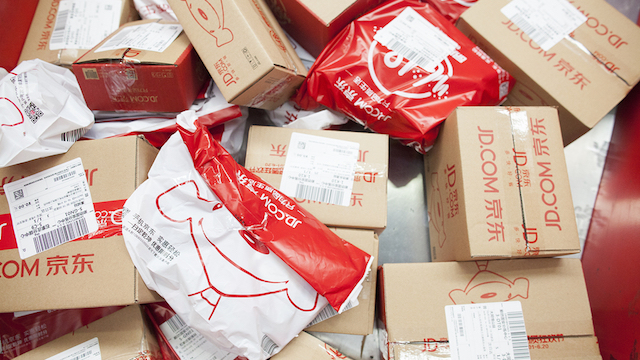
    JD sales lept 25.1 per cent in the third quarter, to RMB104.8 billion (US$215.3 billion). “We are pleased to report solid results for the third quarter, with our core JD Mall business driving consistent growth under its highly experienced management team,” said CEO and chairman Richard Liu.

    “JD’s commitment to convenient, reliable service and high-quality, authentic products continues to translate into an increasingly loyal user base. Our ‘Retail as a Service’ strategy is also gaining traction as we provide a wide range of partners with innovative retail infrastructure solutions,” he said.

    Annual active customer accounts increased to 305.2 million in the year to September 30, from 266.3 million at the same time a year earlier.

    Net income from continuing operations attributable to ordinary shareholders for the third quarter was RMB3.0 billion (US$400,000), three times more than for the same period last year.

    “JD’s strategic focus on improving customer experience helped drive strong performance across the business,” said Sidney Huang, JD’s CFO. “We will continue our disciplined strategy of investing in key technologies as we focus on optimising operations and driving economies of scale over the coming quarters.”

    Among highlights of the quarter was the signing of a raft of major international brands to the JD platforms, including L’Occitane de Provence, House 99, Hera, Salvatore Ferragamo,  Furla, Gieves & Hawkes, Kent & Curwen, Cerruti 1881 and D’Urban. JD’s dedicated luxury platform Toplife welcomed John Galliano, Buccellati and Shang Xia among others.

    As at September 30, JD had some 200,000 merchants on its online marketplace, and 175,366 full-time employees.

  • Promising market for luxury rental services raises

    Promising market for luxury rental services raises

    A growing community of Korean women primarily in their 20s to 40s prefer renting high-end goods from subscription services such as Series Eight, The Closet and Reebonz Korea. Asked why they chooses to rent their wardrobe, they said the introduction of luxury goods rental services helped her prioritize living expenses and limit unnecessary spending on personal shopping.

    By paying a monthly subscription fee of 79,000 won (US$70), Reebonz customers, for example, can rent up to two bags a month. Customers opting for pricier premium plans are given the option to rent a bag from the most expensive or popular brands for up to 10 days for prices ranging from 9,800 won to 19,800 won.

    “Subscription-based business models have not seen much success in the local market compared to other countries. But, because luxury goods’ prices are so high compared to the low purchasing power of Koreans in their 20s and 30s, the (subscription) services are expected to see substantial growth in South Korea,” said Choi Kang-sik, a professor of economics at Yonsei University.

    Choi said that with more women wanting to rent luxury goods, rental companies must better communicate with luxury brands in order to bring better products to the table.

    “The power of luxury brands will always see an upward trend. The difference, now, will be that consumer groups won’t be women visiting department stores. It will be the luxury rental companies who will be supplying the bags to the original customer base,” he said.

    Even though popular American designer rental services such as Bag Borrow or Steal and Rent the Runway launched a decade earlier, designer subscription services garnered attention from local consumers starting in 2016, according to Series Eight CEO Kim Tae-hyun.

    Kim, who co-founded Reebonz Korea with current chief Ha Dong-gu, left Reebonz to launch the startup Series Eight under the Value Art Architect Group last year.

    On the surface, the two companies share similar concepts with regards to lending customers a hand in renting high-end products.

    If Reebonz sticks to a subscription model, Series Eight and its six-member team envisions a shopping platform beyond just a rental service where women can rent high-end bags whenever and for however long they please.

    “We essentially did not want to give the idea of pressuring women to pick a bag every month just because they are paying a certain amount. The pressure in itself ruins the shopping experience,” Kim said.

    In order for a business to be successful on a subscription-based model, it needs to provide convenience, value for the money and personalized experiences. Consumers will cancel services that do not deliver unique, excellent personalized experiences, according to Choi.

    Park Sun-young, juggling being a mom and public relations director at an ad agency in Seoul, appreciates such unique value from subscription services. Unlike her younger colleagues who seem to have time to go shopping, Park would rather save money and time by renting her wardrobe online.

    “I think young women may feel it’s weird to rent designer clothing and carry handbags that are ultimately not theirs. But, look inside your closet. How many bags are just sitting on the shelf collecting dust?” Park posed.

    “Being a mom and having a job, the rental services make my shopping experience something I look forward to at the end of the night before I go to bed. Just scroll down, look through the catalogue and click order.”

  • Vietnam’s VinFast presents models, prices

    Vietnam’s VinFast presents models, prices

    VinFast, a subsidiary of Vietnam’s biggest private firm Vingroup, presented three models and their prices at its maiden show in Hanoi Tuesday afternoon. Its five-seat sedan Lux A2.0 and seven-seat SUV Lux SA 2.0, which had already been revealed to the public for the first time at the Paris Motor Show last month, cost VND800 million ($34,305) and VND1.136 billion ($48,709) respectively.

    The smaller hatchback Fadil, presented for the very first time, costs VND336 million ($14,410).

    These prices are exclusive of a 10 percent value added tax.

    The company said it was announcing favorable prices for the “initial phase.” The original prices of the hatchback, the sedan and the SUV are VND423 million ($18,140), VND1.336 billion ($57,300) and VND1.818 billion ($78,000) respectively, it said.

    VinFast surprised industry insiders by completing its first two units, the SUV and the Sedan, within one year.But VinFast did not say for how long the promotional prices will last or how many cars will be produced in the initial phase.

    Its first two models are built on frames from BMW. Their components have been engineered by Canadian firm Magna International’s Magna Steyr, while design work was done by Italian design house Pininfarina.

    The small hatchback, Fadil, meanwhile, was developed from the background of the Opel Karl Rocks model in the European market. Its structure is almost equivalent to the latest Chevrolet Spark generation.

    Attending the exhibition, Prime Minister Nguyen Xuan Phuc said building strong Vietnamese brands means promoting patriotism, self-reliance and self-esteem and building a consumer culture in Vietnam.

    “I hope more Vietnamese companies and entrepreneurs follow in the footsteps of VinFast to express an aspiration to dominate the domestic market and reach out to the international level.”

    Vietnam’s population is around 93 million, larger than South Korea, but car consumption is only around 300,000 units a year, he said. Previously, Mike Dunne, an independent industry analyst who has spent more than three decades in Asia, said that he doubted VinFast cars would generate much demand in a country with an average income of $2,385 last year.

    While there is little doubt the market would grow, it won’t happen fast enough to absorb VinFast’s production, planned at 250,000 vehicles annually, he added.

    There are only 358 businesses in the auto industry in Vietnam compared to 2,500 in Thailand, according to the Ministry of Industry and Trade. Over 90 percent of auto parts are imported, it added.

  • Palace skate wear to make debut in Tokyo

    Palace skate wear to make debut in Tokyo

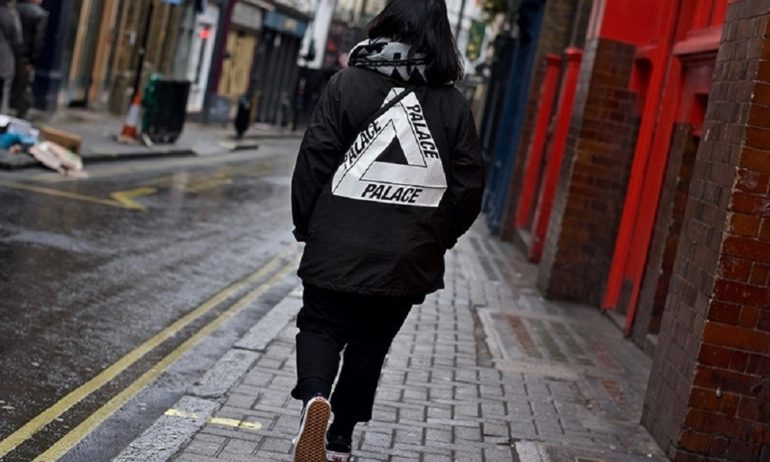
    Cult-classic skate brand Palace opened its first store in Tokyo, opting for the Japanese capital to debut its logo-ed fashion and apparel in the archipelago Asian nation.nThe British street label first announced the Tokyo location via Instagram, in a short teaser film featuring actor and comedian Jonah Hill, which was a similar store reveal stint used by Palace to unveil its New York store.

    Marking the new Shibuya district store, which took place November 3, the London brand has released a series of fashion items exclusively for the new location.

    The Tokyo capsule features pieces referencing Japan, including a Mount Fuji graphic hoodie.

    In the mix is also a limited-edition “P.A.L.A.C.E” branded leather card holder, luggage tag and passport cover, as well as “Made in Scotland, Designed in London” rainbow knitwear, in collaboration with fellow Briton Pringle of Scotland.

    Founded in London in 2009 by Levent Tanju and Gareth Skewis, Palace has in the last nine years garnered a cult-style following among skaters by toying with industry conventions.

    It is known for flipping 90s skate videos upside, promoting the kitschy side of the era’s VHS tapes, as well as its now globally recognised Palace logo, which features on oversized hoodies, sweaters and other streetwear pieces.

    It has been in collaboration with Adidas since 2015 and has also previously collaborated with Reebok and Oakley. Most recently, it has teased an upcoming collaboration with Ralph Lauren in Japan.

    Palace currently operates locations in London and, since spring 2017, New York’s SoHo neighbourhood.

    Palace Tokyo’s official address is 2F & 3F, 5-9-20 Jingumae, Shibuya-ku in Tokyo, Japan.

  • Global luxury goods sales drop: Bain

    Global luxury goods sales drop: Bain

    New data from Bain & Company shows global luxury goods sales will struggle to maintain growth, as the US-Sino trade war and other geopolitical events impact on consumer confidence.

    In June, Bain said the personal luxury goods market was “on a tear” this year and would grow by between 6 per cent and 8 per cent at constant exchange rates to reach €276-281 billion. It said the market could reach €390 billion globally in sales by 2025.

    But now, Bain has released a more tepid projection of €260 billion and a growth rate of 5 per cent this year.

    It has pared back its 2025 projection of personal luxury goods sales to €320-365 billion, slashing €35 to €70 billion off its forecast in just five months.

    And it cautioned that even this figure may be under threat saying “socio-political issues, commercial policies, and potential short-term soft recessions could make this road to growth a bumpy one in the short term”.

    The Bain & Company Luxury Study was released in Milan in collaboration with Fondazione Altagamma, the Italian luxury goods manufacturers’ industry foundation.

    In June, Bain said Mainland China is expected to account for the lion’s share of growth this year. “We forecast this market to grow by 20-22 per cent … Brands are learning how to cater to local consumers, often young and heavily influenced by social media.”

    China kept close to its projections, rising 20 per cent, albeit with the year still not over.

    “Chinese consumers are leading the positive growth trend around the world. Between 2015 and this year, their purchases in Mainland China contributed twice as much growth as their spending abroad. Their share of global spending has continued to rise (now estimated at 33 per cent of global luxury spend, up from 32 per cent in last year), while the share of Mainland China has also risen to 9 per cent (up from 8 per cent in last year). In Mainland China, luxury sales grew 18 per cent at current exchange rates to €23 billion (20 per cent at constant exchange rates), driven by rising demand rather than by price increases,” the report said.

    Claudia D’Arpizio, a Bain partner and lead author of the study, said luxury purchases in Japan softened slightly this year, pushing brands to find new solutions to bring consumers back to stores. However, retail sales still grew at 3 per cent at current exchange rates to €22 billion. “Increased consumption from tourists in Japan is prompting brands to rethink their distribution models.”

    Across the rest of Asia retail sales grew 7 per cent at current exchange rates to €39 billion, due to dynamic growth in South Korea, driven by strong local consumption. Brisk growth in other Asian countries – Singapore, Thailand and Taiwan – also contributed while Hong Kong and Macau benefitted from Chinese purchases.

    Europe lagged in 2018 due to a strong Euro that impacted tourists’ purchasing power. Local consumption was positive overall, despite mixed country performance, helping to boost retail sales 1 per cent at current exchange rates to €84 billion.

    The Americas grew 5 per cent at current exchange rates to €80 billion. “A positive US economy boosted disposable income and overall luxury spending from locals, even as brands remained wary of continued economic prosperity,” the report said. “However, the strong dollar impacted tourists’ spending from Asia and Latin America. Canada and Mexico were strong players in the region, while political uncertainties derailed Brazil’s performance.”

    In other areas, there was nil growth, holding at €12 billion, mainly due to stagnation in Middle East brought on by a recent government spending restriction.

    Luxury online

    The retail channel grew 4 per cent this year, with three-quarters coming from like-for-like sales growth. Wholesale channels grew at only 1 per cent, brought down by high-end department stores still trying to recover, and a slow-down among specialty stores facing tough competition from online.

    Luxury shopping online continued to accelerate this year compared with physical channels, growing 22 per cent versus 2017 to €27 billion.  The US market made up close to half of online sales – 44 per cent– but Asia is emerging as the new growth engine for luxury online, slightly ahead of Europe. Accessories remained the top category sold online, ahead of apparel; beauty and hard luxury (jewellery and watches) were both on the rise.

    Brands are catching up to other online players, comprising 31 per cent of sales, compared to e-tailers (39 per cent) and retailers (30 per cent).

    “New technologies are at once enriching the online and mobile shopping experiences, while potentially putting role of physical channels at risk,” said Federica Levato, a Bain partner and co-author of the study.

    “The luxury store-opening path is slowing down, leading to channel consolidation in the future. Brands must therefore rethink their physical channels and evolve their role from point-of-sale to point-of-touch, and use new technology to enhance customers’ in-store experiences.”

    Luxury consumers getting younger

    The report concluded that younger generations are becoming increasingly more important luxury brands. This year, Generations Y and Z contributed 100 per cent of the total luxury market growth, compared with 85 per cent last year. Bain predicts Generation Z, which today comprises just 2 per cent of the market will account for 10 per cent of it in 2025.

  • Jeju Air inks $4.4 billion deal to purchase 40 new planes

    Jeju Air inks $4.4 billion deal to purchase 40 new planes

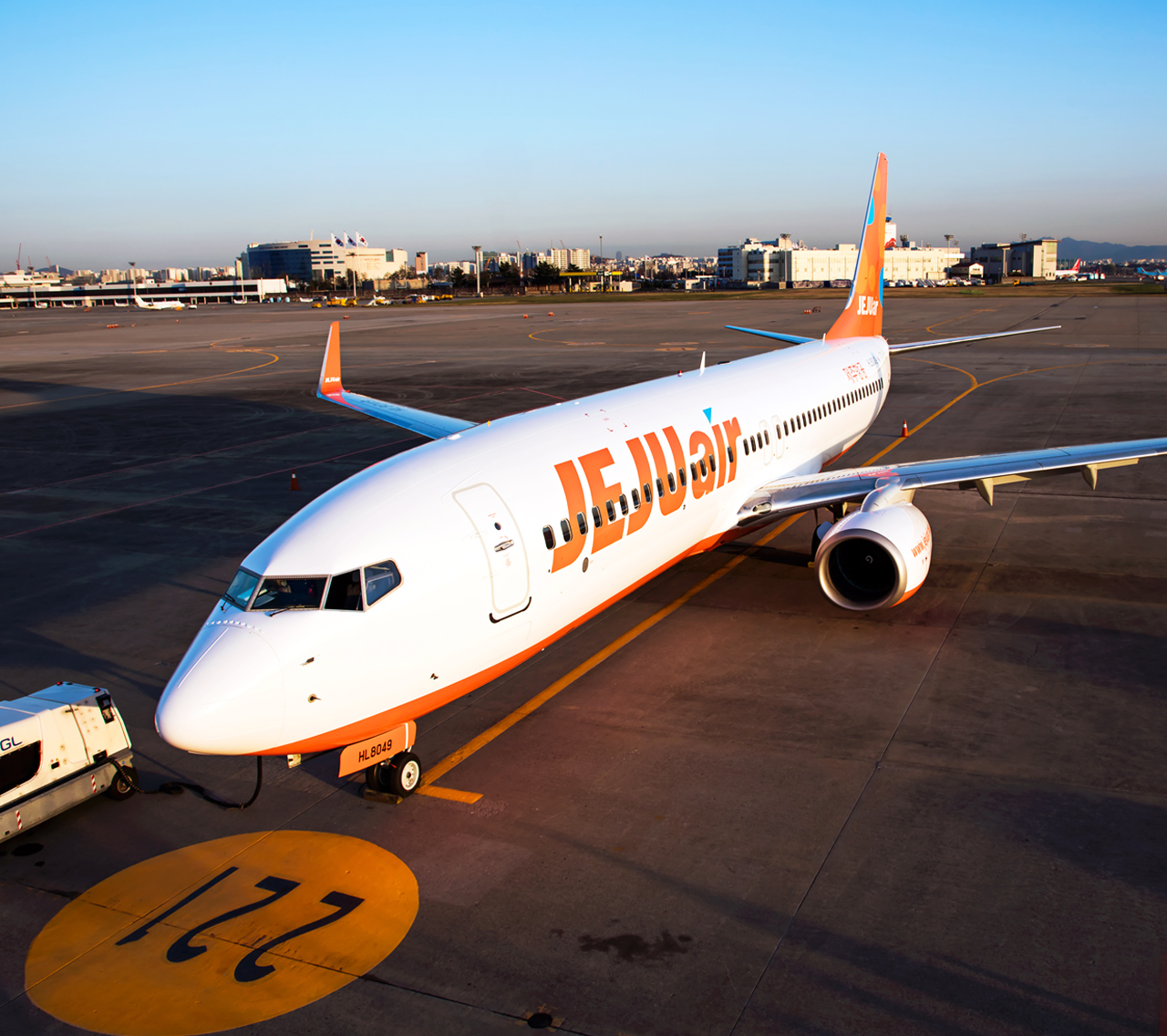
    Jeju Air, Korea’s biggest budget carrier by sales, said, on Tuesday, that it inked a $4.4 billion deal for 40 new planes, with the delivery set to begin in 2022. Jeju Air has decided to buy Boeing’s new B737 MAX passenger jets to strengthen its fleet, the company said in a statement.

    The low-cost carrier plans to assign the 189-seat B737 MAX on its mid and long-haul routes as they are more fuel efficient than the planes it currently operates, a company spokeswoman said over the phone.

    The new jets have a range of some 6,500 kilometers, 1,000 km more than the B737-800NG that the company currently operates.

    In the January-September period, net profit jumped 31 percent to 84.86 billion won ($75 million) from 64.61 billion won a year earlier. Operating profit climbed 14 percent to 95.82 billion won from 83.79 billion won during same period. Sales were up 28 percent to 941.93 billion won from 734.78 billion won.

    Jeju Air said it is on track to achieve sales of over 1 trillion won this year on the back of a strengthened fleet and profitable routes.

  • Korean lifestyle brand Mumuso enters Indian market

    Korean lifestyle brand Mumuso enters Indian market

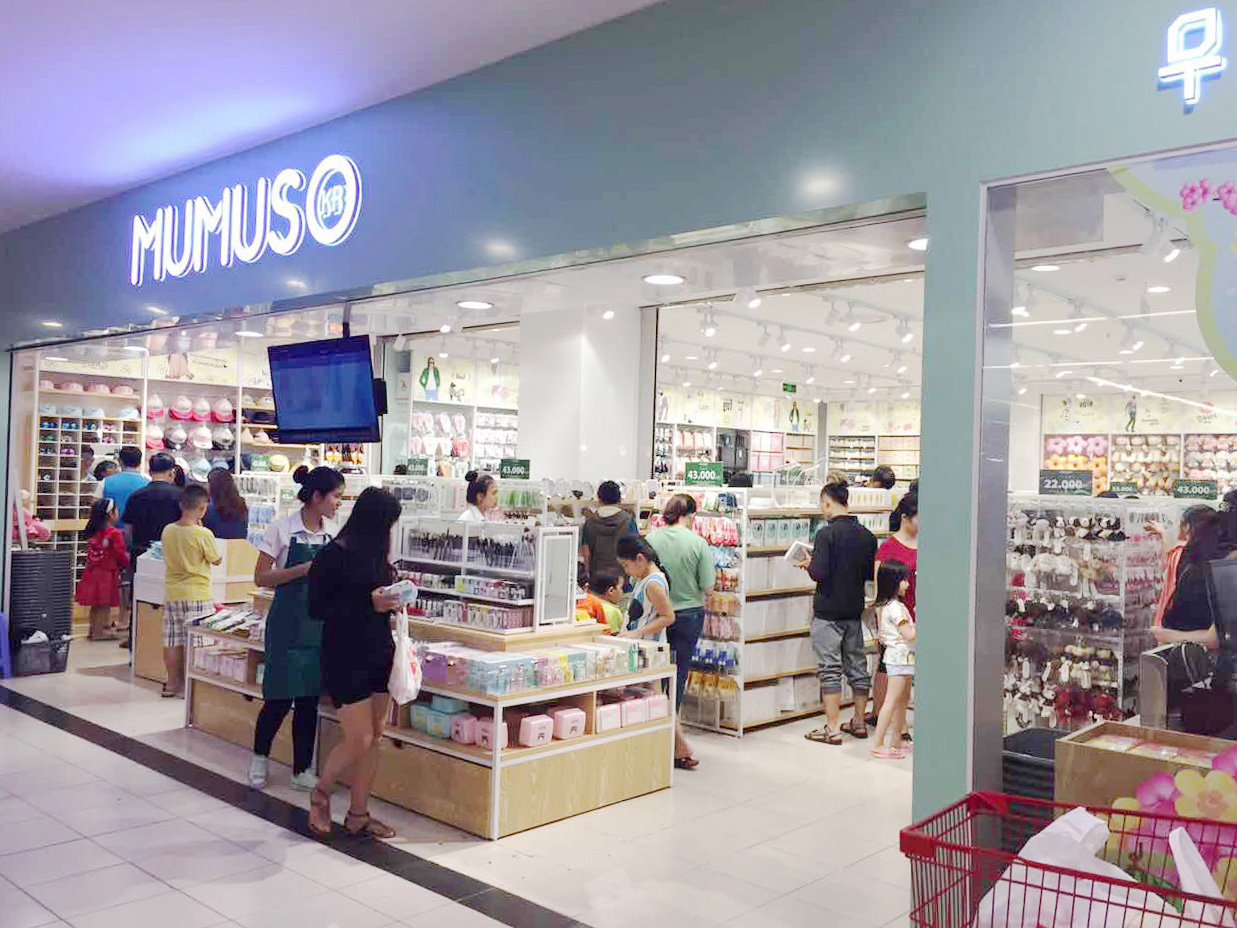
    East Asia’s affordable lifestyle brand Mumuso has announced its expansion plans in Kolkata while opening its first store. Mumuso is eyeing the Indian market aggressively with new stores in different parts of the country, a senior executive said.

    With a strong presence in over 30 countries across the world, the Korean lifestyle brand Mumuso has entered into the Indian Market and plans to open around 300+ stores by 2022 with an average investment of Rs 80 lakh to Rs 1.2 crore which will be spent towards setting up these company-owned and franchise stores. The brand is planning to open outlets pan India with its market reach in cities likes Kolkata, Hyderabad, Siliguri, Bangalore, Delhi, Mumbai, Surat, Durgapur, Chennai and so on.

    Mumuso India — the Indian entity of Mumuso —whose offerings include accessories, stationery, small electronics and lifestyle items, sources these mostly from South Asian nations such as Malaysia, Singapore, China, Indonesia and Korea.

    India has seen a sharp rise in the demand for lifestyle products in the recent years. Mumuso has product categories from Health and Beauty, Fashion Home Accessories to Apparel, Accessories, Digital Products and more. The products offered by the brand are not only beautiful, functional, high-quality and affordable but also provides relaxing and pleasant shopping experience to the customer.

    Speaking on the occasion, Raunak Agarwal, Managing Director, Mumuso India said, “Our expansion strategy is to set up 300+ outlets all over India along with entering the e-commerce market as online shopping has seen a big boost in India in recent years. We are also looking to source from Indian companies specially apparels and small leather products. The company will look to have 300-odd stores by mid-2022. India, being a fast emerging market for retail industry, we are expecting an escalated growth in a short span of time. Indian market has a big potential, where we believe our creative range of products will enhance the rich experience of customers since it’s an international brand with high quality and valued pricing.”

    He added, “There has been a high demand for the trendy and affordable products as far as lifestyle is concerned. People not only look forward to quality and style but also affordability. With Mumuso coming into the picture, people won’t have to travel to different stores for their needs, but just walk into our showroom and get their products. Mumuso brand always adheres to the principle of selling products with reliable quality and affordable price, strictly observes to the borderline of high quality, strives to improve the upper limit of taste and price ratio and provides well-designed products, continuously optimizes the supply chain service system to reduce the cost, creating relaxing and light-hearted shopping experiences for consumers.”

  • Thailand: fourth-most-profitable global tourism destination

    Thailand: fourth-most-profitable global tourism destination

    According to the UN World Tourism Organization, Thailand outranks every other nation in Asia when it comes to tourism spend. Last year, it collected $57 billion in international tourism receipts, nearly doubling Macao ($36 billion), Japan ($34 billion), Hong Kong ($33 billion), and China ($33 billion).

    Globally, the only countries that out-earn Thailand in terms of tourism dollars are France ($61 billion), Spain ($68 billion), and the United States—which handily takes the gold medal, at $211 billion.

    It all comes down to volume. Foreign arrivals could hit 40 million next year, which is more than half the country’s population.

    “In Thailand, you’ve got something for everybody,” says Rebecca Mazzaro, a specialist for bespoke outfitter ATJ. “From the private island with the private villa to amazing street food meals that only cost a couple bucks, it has a diversity and variety that exists in few other markets. It’s no surprise lots of people are going—and spending,” she says.

    A Coming Luxury Boom

    Though gaps in the WTO’s data make it difficult to ascertain the per-visitor spend in each of these countries, given recent and forthcoming developments, that number is likely to be rising.

    “There’s no question that historically Bangkok—and Thailand in general—has always been perceived as a value destination,” says John Blanco, general manager of the forthcoming five-star Capella Bangkok. “But there has been a real effort to shift that perception.”

    Mastercard’s annual Global Destination Cities Index recently ranked Bangkok as the most-visited city in 2017 for the third year in a row.

    The study, based on undisclosed public data sources, rather than cardholder transactions, indicates that travelers shell out $173 for a day in the Thai capital, compared to $537 in Dubai or $286 in Singapore.

    This year, it forecasts travelers will spend an additional 14 percent more.

    By next year, the city will have gained even more opportunities to spend, such as superlative new resorts from Four Seasons, Rosewood, Mandarin Oriental, and Waldorf Astoria, plus a $1.6 billion Bal Harbour-esque mixed-use retail development called Icon Siam.

    “There’s a lot more meat on the bone now,” Blanco says of luxury offerings in the capital.

    Dino Michael, global head of Waldorf Astoria Hotels and Resorts, agrees. “We’ve been noticing the upscaling of Bangkok for a few years,” he tells Bloomberg. “The consumer has become more sophisticated; the dining scene has become more sophisticated.”

    Among Bangkok’s selling points, he says, are strong infrastructure and airlift, a “depth and breadth of tourists,” and an ingrained culture of hospitality. For tourists and brands thinking about charting the region, Michael adds, “It’s world renown—and an obvious starting point.”

    The Pitfalls of Popularity

    There may be a price to pay for popularity, particularly on Thailand’s beaches and islands.

    Already, throngs of partygoers on commercial yachts have done so much damage to the pristine marine ecosystem of Maya Bay—the picturesque backdrop to Leonardo DiCaprio’s 2000 film The Beach—that the area closed for four months earlier this year to recover.

    Unable to bounce back fast enough, it’s now being closed indefinitely. That follows similar measures in nearby Koh Khai and Koh Tachai islands, where coral was being destroyed at devastating rates.

    In Phuket, Mastercard’s 12th-most-visited destination in the world, there’s been a sharp decline in the local turtle population, correlated with the rise in beachside pollution. It’s led 70 hoteliers to band together to promote sustainability and encourage better etiquette among travelers.

    And in Thailand’s north, the dramatic growth of tourism has led to a sobering spike in unethical wildlife tourism, often centering around elephants and tigers.

    The capital, meanwhile, has stayed largely out of the way of these visitor-related troubles—perhaps because it’s hard(er) to justify bad behavior in a city with 40,000 Buddhist temples.

    “Of course, red light tourism is alive and well—like it or not,” says Catherine Heald, founder and chief executive of Asia outfitter Remote Lands. “But ultimately, tourism has really lifted the local economy.”

    At $57 billion a year, there’s no denying that.

  • Vietnam’s first private airport set for Christmas launch

    Vietnam’s first private airport set for Christmas launch

    Vietnam’s first private airport near the world-renowned Ha Long Bay is getting finishing touches for a Christmas day opening. The 325-hectare (803 acres) airport at Van Don District, northern Quang Ninh Province cost VND7.7 trillion (more than $330 million) and can handle 2.5 million passengers a year and 1,250 per hour.

    It is expected to focus on services to Northeast Asian destinations such as South Korea, Japan, Taiwan, and China and also Southeast Asian ones like Thailand, Malaysia, Singapore and Cambodia.

    Domestically, flights will mostly be to southern and central regions.

    Dinh Viet Thang, head of the Civil Aviation Authority of Vietnam (CAAV), said the airport could handle the largest of aircraft.

    Construction had begun in 2015.

    Real estate conglomerate Sun Group, who owns it, is completing licensing procedures now so that the first flight can land on December 25.

    It now has gates for four aircraft and the number will be increased to seven by 2030.

    According to the CAAV, the private airport will have to follow all regulations in terms of aviation safety and security like all other airports in the country.

    Airlines served almost 80 million passengers in the country in the first nine months of this year, up 12.1 percent from a year ago.

    The number is expected to cross 100 million for the very first time this year.

  • China’s 300-billion Daigou business: What’s next after the government crackdown?

    China’s 300-billion Daigou business: What’s next after the government crackdown?

    As aftershocks of the clampdown on Daigous continue to reverberate through the luxury shopping community in China, e-commerce platforms are rising to fill the gap.

    The launch of China’s new e-commerce law, coupled with the 928 Daigou crackdown at the Pudong International Airport in Shanghai, has stirred up uncertainty in the global luxury industry.

    In fact, LVMH share prices reportedly fell in early October due to fears of a slowdown in Chinese spending.

    Earlier this month, Luxury Society attended the live seminar “Reinterpreting the 300-billion Daigou market” hosted by Tencent media.

    During a debate, luxury e-commerce platform OFashion’s CEO Xiao Yu and N5 Venture Capital’s founder Xiao Yiwei shared their insights on how luxury buying will likely evolve in the post-Daigou era.

    According to Xiao Yu, the estimated Chinese luxury spending in 2018 is 600 billion RMB and Daigou purchases account for half of that, making it an estimated 300-billion industry.

    Without Daigou, what is the next best alternative for Chinese consumers looking to buy authentic luxury goods at lower prices?

    First, let’s revisit the 928 daigou crackdown in Shanghai’s Pudong airport and take a look at how China’s 300-billion Daigou industry is in danger.

    What Happened During The 928 Daigou Crackdown

    September 28 2018 marked an important date in the history of Chinese luxury consumption.

    In Shanghai Pudong airport, all passengers returning from Seoul were stopped by Chinese customs for baggage inspection.

    Seoul has been a classic shopping destination for Daigous to obtain global brands at a discount. More than 100 passengers from same Seoul-Shanghai flight were found guilty of illegal imports.

    It was every Daigou’s living nightmare.

    One of them relayed the unfolding events through WeChat text messages. Screenshots of this message thread eventually made its way online.

    The messages read,

    “In the line to pay my fine”

    “I was live streaming in duty free shop during the day, but live streaming fine payment during the night (face palm emoji)”


    Source: Sohu, A Daigou’s WeChat record of 928 crackdown got popular online.

    Whether as a full-time profession or simply a hobby, the Daigou business is one based on relationships.

    In fact, the first clients of most Daigous are generally from his or her own social network.

    Since Daigous operate in a legal gray area and rely solely on private transactions, customers often have a hard time verifying the authenticity of their purchases.

    Needless to say, seeking redress in the case of fraud is difficult or near impossible.

    Within the last decade or so, Daigous have become rather ubiquitous.

    Chinese netizens often joke on social media that “everyone has a Daigou friend on his/her WeChat”, or “Daigou is our generation’s best marketing guru”.

    Rumors of Daigous making a minimum of $100k USD a year and buying houses while still in college flood the internet, making the Daigou profession both a mysterious and highly coveted one in China.

    On September 28, however, this all came to a screeching halt.

    Within a night, the image of Daigous as self-made businessmen was reduced to that of illegal importers.

    Chinese Luxury Consumers Have Changed

    The Daigou business flourished in China largely because of strong domestic demand for global luxury products. This demand is quickly changing.

    During the seminar, OFashion’s CEO Xiao Yu offered his observations on shifting consumer tastes by analyzing the purchase data of its platform’s 3 million active buyers.

    Here are our major takeaways.

    1. Chinese Consumers Love Buying “Hits”

    The biggest difference between luxury consumers from China and those from mature markets is that Chinese consumers prefer mainstream “hit” items, while mature market consumers also buy a brand’s long-tail (niche) products.

    2. Entry-Level Luxury Sells Best

    Out of all the luxury product categories, entry-level items with a price range of 2000-5000RMB (430-730USD) exhibit the strongest sales performance.

    3. Consumer Tastes Have Diversified

    While Chinese consumers concentrated their research on highly famous luxury brands in the past, they are now much more receptive to niche brands.

    Bestselling product styles have also shifted from traditional classics like the Salvatore Ferragamo ballet flat, to streetwear brands.

    Additionally, Chinese consumers are now searching more about domestic brands compared to four years ago, when most searches were about established global brands.

    4. The Lipstick Effect Doesn’t Quite Apply In China

    Considered an entry-level luxury product, lipsticks have been selling like hot cakes in the Chinese market recently.

    While the “lipstick effect” – a global economic theory that postulates the correlation between beauty product sales and economic downturns – may hold true in many markets, industry professionals have stressed that it might not necessarily be the case in China.

    While China might be in the midst of a lipstick craze, experts have noted that lifestyle brands that are inspiring, soulful, and fun, can still rise to the top of the market quickly.

    How Platforms Can Rise To The Challenge

    Now with the individual Daigou business in danger, it’s time for luxury cross-border platforms to shine.

    As the live seminar’s two speakers noted, inefficiency is still a huge pain point in the cross-border industry.

    That said, cross-border solutions aiming to improve efficiency would likely to grow fast.

    As the luxury buying business faces tightening controls by regulators, consumers are turning to professional buyers, reliable platforms, or buyer’s platforms — a combination of the former two.

    Besides established luxury e-commerce platforms such as Tmall Global, JD’s Toplife, Secoo and VIP, platforms that specialize in serving professional buyers are booming, too.

    Tmall Global’s Luxury Direct has turned buyers into consultants and made fashion-consulting service a selling point.

    The platform’s “About” page reads, “Our buying team takes orders straight from fashion weeks and selects products from brand official showrooms all across Europe.”

    OFashion’s app “Buyer Box”, an app targeting professional buyers, has even a CRM (Client Relationship Management) system for users to personalize a client’s order.

    Source: Tmall Luxury Direct’s page
    Source: OFashion’s BuyerBox app


    The rise of these cross-border buying/selling platforms come at a welcome time and provide consumers with more choices.

    But the degree to which they will be able to overcome logistical issues eventually gain traction in the market remains to be seen.

  • Reliance to open Pottery Barn in India

    Reliance to open Pottery Barn in India

    Williams-Sonoma and Reliance Brands plan to launch Pottery Barn and West Elm in India through a franchise agreement. The opening of the brands’ first stores will be in Mumbai in early 2020, along with the launch of e-commerce websites.

    President and CEO of Williams-Sonoma Laura Alber said the partnership with Reliance marks part of the company’s continued global expansion. “We are looking forward to opening our first stores in Mumbai and introducing our distinctive brands, excellent customer service, and exceptional products to customers in India.”

    Executive VP, Global of Williams–Sonoma Ronald Young said the company currently operates its own and franchised stores across the world with company-owned stores in the US, Canada, Australia and the UK.

    “Our franchise network includes countries throughout the Middle East, South Korea, the Philippines and Mexico. Adding Reliance to our franchisee network is a significant step in our continuing global expansion.”

    President & CEO of Reliance Brands Darshan Mehta said the company is confident of the  success of Pottery Barn and West Elm in India, believing the brands’ heritage and designs will resonate with Indian consumers.

  • Why you should adopt more diverse influencers?

    Why you should adopt more diverse influencers?

    Diversity, or lack thereof, is at the forefront of fashion industry discussions, with runways and advertising campaigns constantly—and rightly—scrutinised. Less has been said about diversity among prominent influencers, the new drivers of sales who are celebrated for their authenticity and ability to connect with customers.

    Thin, light-skinned women aren’t the only clothing shoppers, so why are so many of them the go-to for brands as they put together campaigns?

    Now several influencers, and a handful of talent agencies that represent them, are leading the charge to shake up the staid and stale landscape.

    They’re creating their own campaigns to highlight opportunities and content possibilities—along with #YouBelongNow, there are the hashtags #SupersizeTheLook and #ChicAtAnyAge — putting together initiatives to encourage and celebrate new voices in a greater range of ethnicities, sizes, and ages.

    The problem, many say, stems from the fact that the people organising the campaigns are not thinking about diversity when it comes to casting. It’s a continuation of the narrow view of beauty historically depicted in advertising, contends Jennifer Jean-Pierre Maull, a Haitian-American blogger and photographer from Washington, D.C with almost 16,000 followers on Instagram. “We need to change what we consider beautiful, we need to change what we consider marketable,” she said.

    Consider trendy online retailer Revolve: known for its influencer trips to far-flung corners of the globe, documented glamorously and exhaustively for its 2.6 million Instagram followers.

    Last January, as its squad took to the beach in Thailand, the attention turned from glowing to heated over the lack of diversity in its ranks. A shot of more than a dozen light-skinned swimsuit-clad slender women garnered more than 700 comments. A commenter tagged the picture #RevolveSoWhite.
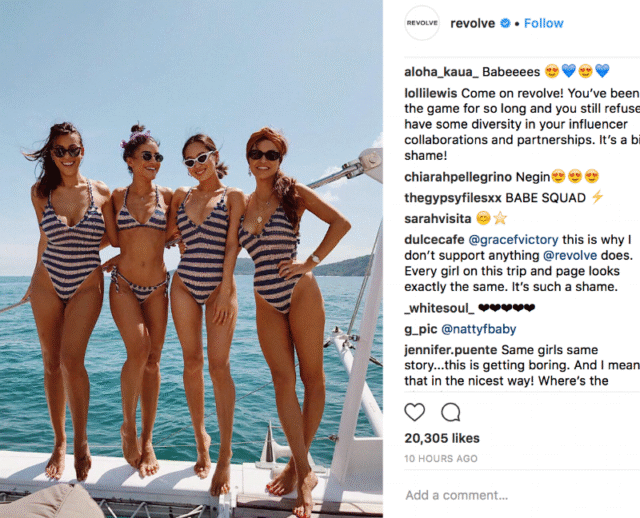
    Revolve, which recently filed for an IPO and generated sales of $400 million last year, has never been a brand to highlight diversity, but whether or not that has had an effect on its sales is unclear.

    Revolve’s earned media value (EMV) dropped during the controversy to the brand’s lowest for the year, at $83.8 million. That cannot be solely attributed to the controversy, however, but “to the natural ebb and flow of events and campaigns.” And the dip was temporary: Revolve’s EMV bounced back to more than $140 million in each of the subsequent two quarters.

    In the firestorm, Valerie Eguavoen saw an opportunity.

    As the moment drew headlines, the North Carolina-based blogger and social justice advocate seized the chance to launch a new Instagram handle, @YouBelongNow, designed to celebrate people of all ethnicities, religions, sexualities and clothing sizes.

    “There are so many women who I could have seen on that trip, who belong in this space,” she said. “We have to get rid of this narrative that we don’t exist or it’s hard to find us.”

    Jean-Pierre Maull has kept tabs on what talent agencies she booked gigs with and which ones she hasn’t. In the latter camp was Fohr, based in New York and co-founded by James Nord. Over the summer, Nord addressed the Revolve controversy in a YouTube video, calling the retailer out for its practices while also suggesting it could be intimidating for brands to reach out to new influencers. Jean-Pierre Maull penned her response in a lengthy blog post. “Our POC (people of colour) community is not an alien force,” she wrote. “It is not hard to send a POC blogger the same pitch email that you send to others.”

    She emailed Nord, requesting to talk with him, one of many ongoing discussions Nord has had in recent months. “I leaned on this group of amazing women who did call me out,” he said.

    “Sometimes we just need to open up the conversation instead of just being angry,” Jean-Pierre Maull said. “Those in power must be self aware enough to see where they may be lacking or not doing enough.”

    One result of the chats Nord has had is a new mentoring program, called Freshman Class, to promote underrepresented influencers. More than 1,600 influencers applied, and 85 finalists were chosen. The ten winners include Alysse Dalessandro, queer plus-size fashion blogger; Ali Hemsley, a fashion influencer with a focus on chronic illness and mental health; and Destin Grayson, a menswear blogger. The winners will be flown to New York for three days of educational and networking opportunities.

    Nord hopes to help newer and lesser-known influencers build a network that can serve as sounding board, to discuss opportunities and pay rates.

    Jean-Pierre Maull said she was worried the initiative would seem like “someone need to swoop in and save” POC bloggers.

    The result, she says, has been anything but; it’s helping establish even more of a sense of community.

    “There is no lack of diversity in influencers, there is a lack of diversity in influencer campaigns,” Nord said.

    Relatability is a crucial part of influencer effectiveness, which is all the more reason why influencer campaigns should feature a more diverse range.

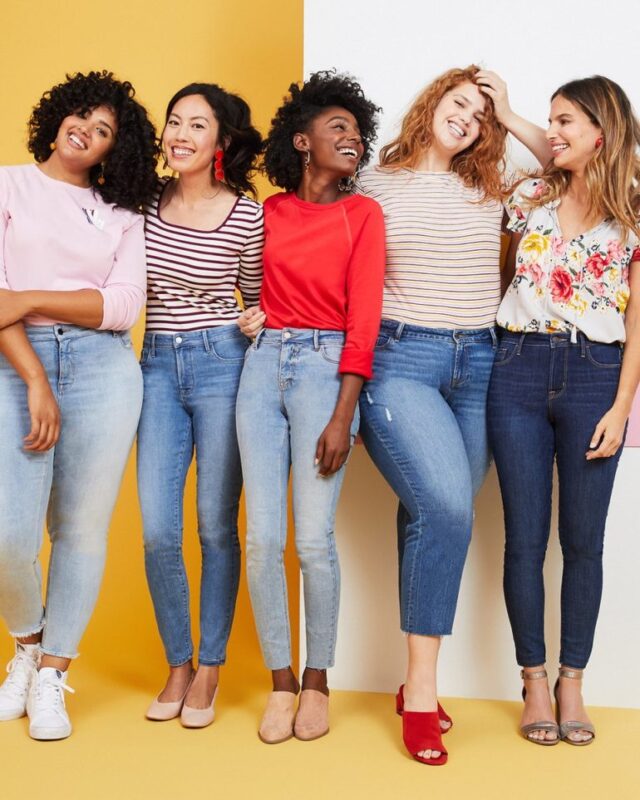
    Old Navy, a division of Gap Inc., looks for a range of sizes and family compositions in its influencer casting, then features them as models in its social feeds and digital marketing.

    “We’re looking for someone who people can see themselves in,” said Liat Weingarten, Old Navy’s vice president of brand communications.

    So far this year, Old Navy’s top two performing social posts featuring people (not just product), based on number of likes, comments and shares, are diverse group shots of influencers.

    One, highlighting dresses from its #SizeYES campaign, received more than 11,000 likes and more than a hundred comments. “My first thought when I saw this was: love this beautiful, diverse group of models!” wrote one commenter. “More of this, please!”
    And then there’s Revolve competitor Fashion Nova, which uses its Instagram account to highlight women of all ethnicities and sizes in its barely-there clothing.

    Its influencer hashtag, #NovaBabe, drove $54.1 million in earned media value from the second half of last year through the first half of this year.

    Mentions for @fashionnovacurve, the account for its plus-size line, generated $61.5 million in EMV.

    Followers are watching what brands are doing closely, too, said Scout the City blogger Sai De Silva.

    “When I go to events, I feel like there’s no one like me,” said Silva, whose followers have asked why she was the only woman of colour or woman with curly hair at a party “I live in New York City, how could there not be one other Puerto Rican [influencer]?”

    Influencers are finding that being proactive is the only way to move the conversation forward.

    Max Stein, founder and chief executive of agency Brigade Talent, said some of his clients will ask who else is participating before agreeing to a campaign, in the context of making sure a brand or company aligns on values—not just aesthetic. “It’s important to them that [diversity] is a value of the brand that they choose to partner with,” he said.

    However, not all brands are responsive in the way an influencer might want them to be.

    “There is sometimes a lack of cultural awareness and cultural sensitivities,” said Jaia Thomas, co-founder of The Presley Group, a management agency promoting diversity within the influencer space.

    Thomas, an entertainment lawyer, pointed to the time one of her African American clients was asked to do a post about watermelon. “There’s a long history of racial tropes and stereotypes associated with African-Americans, an affinity for watermelon being one of them,” Thomas said. “It’s important for there to be African-Americans in the room when creating social media campaigns so they can quickly and easily identify these stereotypes and ensure companies steer clear of them.”

    So, when will brands wise up? The enthusiasm that comes with a highly-engaged, targeted follower base is a big selling point in today’s noisy marketing field.

    “I don’t have a million followers,” said Katie Sturino, the force behind the handle and site The 12-ish Style. “What I do have is an audience that believes in what I’m saying and believe that if I’m showing them something, I like it.”

    Sturino’s best-performing content comes from two popular hashtags on her own account, both calling attention to sizing deficits within the industry. She recreates stars’ ensembles in #SupersizetheLook, with photographs of herself in similar outfits, performing 77 percent better than her average posts.

    Sturino also started the #MakeMySize hashtag, pairing pictures of herself in garments that are too small with captions asking brands to make a broader range of sizes, performing 65 percent better than her average posts.

    Sturino wishes more brands would take the time to find new personalities, and involve those newcomers earlier in the product-development process. “You pay them to wear the clothes, why don’t you pay them for their opinions, too?” she said.

  • Indonesia’s Garuda Shares Soar on News of Sriwijaya Deal

    Indonesia’s Garuda Shares Soar on News of Sriwijaya Deal

    National flag carrier Garuda Indonesia’s share price surged 19 percent on Thursday after the airline said it had taken over operational control of low-cost rival Sriwijaya Air. The move is seen as an effort to help Sriwijaya improve its financial performance, while potentially expanding Garuda’s market share to challenge Indonesia’s largest airline company, the Lion Air Group.

    Garuda announced the joint operation through its subsidiary, Citilink Indonesia, on Wednesday after signing an agreement with Sriwijaya Air and NAM Air – both under the Sriwijaya Air Group – on Nov. 9. The partnership could also be escalated to share ownership in the Sriwijaya Group, Garuda said in the statement.

    The joint operation will give the flag carrier a combined 46 percent share of the country’s domestic aviation market, while the country’s largest budget carrier, Lion Air, controls 51 percent, according to the Sydney-based CAPA Centre for Aviation.

    The remainder of the market is shared by the local unit of Malaysia-based AirAsia, charter service Susi Air and Jakarta-based Trigana Air Service.

    “The joint operation is intended to help the Sriwijaya Air Group improve its operational and financial performance to help Sriwijaya fulfill its commitments to third parties, including those within the Garuda Indonesia Group,” Garuda managing director Askhara “Ari” Dhanadiputra said in a statement.

    Sriwijaya Air planned to undertake an initial public offering last year, but its weak financial performance put a stop to that.

    The carrier suffered a loss last year due to rising fuel costs and the weaker rupiah after three profitable years. Most of Sriwjaya’s revenue is in rupiah, while the carrier’s expenses are mainly in US dollar, including fuel, aircraft maintenance and debt.

    According to Garuda’s financial report, Sriwijaya owed the flag carrier around $9.33 million as of Sept. 30 this year for the overhaul of 10 CFM56 turbofan aircraft engines.

    “We hope the partnership will help restore the financial performance of the Sriwijaya Air Group amid increasing competition in the domestic aviation industry. We believe the Garuda Indonesia Group has an excellent ability to manage the airline business,” Sriwijaya Air managing director Chandra Lie said.

    Price War

    Domestic air traffic in Indonesia more than tripled over the past decade as rising prosperity and lower fares made flying affordable for more people.With 129 million passengers in 2017, Indonesia is the world’s 10th-largest aviation market and it is projected to continue growing.

    Transportation Minister Budi Karya Sumadi expressed hope that the consolidation between Citilink, Sriwjaya Air and NAM Air would also help end a ticket price war among local airlines.

    “We hope this would end the price war and establish a new price equilibrium that covers the costs and margins to allow every airline to grow,” Budi said on Thursday.

    His ministry has long held the view that airlines’ race to the bottom in their price offerings would put pressure on their finances, which could make them more likely to neglect safety precautions.

    Budi said the joint operations between Citilink and Sriwijaya could also help to reduce redundancy on some of the country’s busiest routes and divert resources to other destinations.

    “There are many airports in eastern Indonesia that want to be served,” he said.

  • Xtep Sports opens sportswear store in India

    Xtep Sports opens sportswear store in India

    Hong Kong-headquartered Xtep Sports has opened its first Indian flagship store, in Bengaluru. The Xtep group, which specialises in footwear and sportswear, currently has 6035 stores in 31 Mainland China provinces as well as in Vietnam, Nepal, Saudi Arabia and Spain. The company was founded by Ding Shui Po, now its CEO, in 1999 as an original equipment manufacturers for global sports brands. It launched its own label in 2002.

    The company is reportedly planning to open five stores in India by the end of this year and will also sell through local online marketplaces.

  • Semen Indonesia Snaps Up LafargeHolcim Unit to Bolster Market Lead

    Semen Indonesia Snaps Up LafargeHolcim Unit to Bolster Market Lead

    Cement maker Semen Indonesia is buying the local unit of Swiss rival LafargeHolcim for around $917 million, as it seeks to extend its dominant position in Southeast Asia’s largest market. Semen Indonesia said in a statement it had signed a deal to acquire LafargeHolcim’s 80.6 percent stake in Holcim Indonesia, which is the third-biggest cement producer in the country.

    A fully owned subsidiary of the state firm would launch a mandatory offer for the remaining shares owned by public shareholders, it said.

    “In the competitive environment of the national cement industry, the combination between Semen Indonesia and Holcim will be stronger and larger,” Semen Indonesia president director Hendi Prio Santoso said.

    The company said the acquisition will boost its total cement capacity to 53 metric tons per annum. Analysts say this will give the combined entity a total capacity share of about 50 percent, in a market that has 15 companies.

    Sources familiar with the matter said Malaysian infrastructure company YTL Corp and privately owned Chinese firm Hongshi Cement had also been among the final bidders but the strategic fit with Semen Indonesia helped LafargeHolcim’s Indonesian unit to win the auction.

    The initial round of the auction drew interest from about a dozen companies, including from Japan, the Philippines and other countries, the sources said.

    YTL and Hongshi declined to comment.

    A spokeswoman for LafargeHolcim said it had received strong interest from bidders for its Indonesian business but declined to give details on the parties involved.

    Though President Joko “Jokowi” Widodo’s infrastructure push has fueled a boom in the building of airports, roads and housing projects, an aggressive expansion in the industry and entry of newer players such as Anhui Conch has created excess capacity and a price war in the last few years, analysts say.

    Semen Indonesia has secured financing from local, regional and international banks such as BNP Paribas, said the sources, who declined to be named as complete details of the deal have not been announced.

    “This secures Semen Indonesia’s position as a market leader for many years. Cement prices are improving and there is significantly less new capacity coming,” one source said.

    In an August report on potential consolidation in the Indonesian cement industry, Deutsche Bank analysts said: “A bull-case scenario would be that domestic consolidation reduces the number of players competing in the overcapacity market, supporting higher ASP [average selling prices] and a profitability recovery.”

    “A bear-case scenario would be a prolonged condition in which the industry loses its pricing power due to the new players’ strategy to overtake market share,” the report said.

    Semen Indonesia said the acquisition would give it significantly larger capacity and broader product portfolio and geographical footprint, while LafargeHolcim, the world’s largest cement maker, said in a separate statement that it was selling the business as it reviews its portfolio to improve its financial strength.

    LafargeHolcim’s local unit has four cement plants with a capacity of 14.8 metric tons per annum and 30 ready-mix plants, Semen Indonesia said.

    It was advised by BNP Paribas, while LafargeHolcim was advised by Citigroup.