Author: Mei Ling Tan

  • Unilever to Test New Packaging-recycling Tech in Indonesia

    Unilever to Test New Packaging-recycling Tech in Indonesia

    Consumer goods giant Unilever on Wednesday said it has opened a new facility in Indonesia as part of a pilot project for introducing a new technology for recycling sachets used to hold shampoos and other products.

    Single-use sachets are widely sold in developing and emerging markets such as Indonesia. The Anglo-Dutch company said billions of such packages — including its own — are sold every year, but that recycling them has long been a problem due to technological hurdles.

    To address this, Unilever said it has developed a technology it calls the CreaSolv Process together with the Germany-based Fraunhofer Institute for Process Engineering and Packaging IVV.

    “With this innovative pilot plant we can, for the first time ever, recycle high-value polymers from dirty, post-consumer, multilayer sachets,” said Andreas Maurer, head of the plastic recycling department at Fraunhofer.

    The facility, in Sidoarjo, East Java, will “test the long-term commercial viability of the technology.” If successful, it will be applied in other developing markets, especially in Southeast Asia, said Sancoyo Antarikso, director for governance and corporate affairs at Unilever Indonesia.

    The company plans to work with local waste collectors, waste banks and retailers to help collect used sachets. “Using this approach, we’ll be able to reduce our environmental footprint, while creating economic value and potential additional incomes for the communities, the recycling industry and other stakeholders,” Antarikso told reporters.

    Unilever Indonesia hopes the Indonesian government will promote the concept of separating household waste to make collecting sachets easier. Currently, most Indonesian households do not separate their recyclable and nonrecyclable waste, as the country’s outdated waste management system is not yet capable of accommodating the practice.

    Indonesia produces an estimated 0.5 million to 1.3 million metric tons of plastic marine debris every year, making it the second-largest producer of plastic waste polluting the world’s oceans after China, according to a study published at the Science journal in 2015.

    The new recycling facility will initially be able to process 3 tons of plastic sachets every day. Antarikso said once the operations prove viable from the business side, Unilever will let a “business partner” take over to handle commercial-scale production. He added that Unilever will use the end products as materials for packaging, which is expected to reduce costs.

    David Blanchard, chief R&D officer at the parent company, said: “We intend to make this tech open-source and would hope to scale the technology with industry partners, so others — including our competitors — can use it.” Unilever said it wants all of its plastic packaging to be “fully reusable, recyclable or compostable” by 2025.

  • Japan April exports rise for fifth straight month

    Japan April exports rise for fifth straight month

    Japan‘s exports rose in April to mark the fifth straight month of gains, an encouraging sign that more robust overseas demand could underpin a steady economic recovery.

    Exports rose 7.5 percent in April from a year ago, below the median estimate of 7.8 percent annual growth, finance ministry data showed on Monday. It followed a 12.0 percent rise in March.

    The data also showed Japan’s trade surplus with the United States narrowed.
    Japan’s exports are expected to continue rising as global economic growth gains momentum, but concerns about U.S. President Donald Trump’s pledges to adopt protectionist trade policies cloud the outlook for export-reliant Japan.

    The drop in Japan’s trade surplus with the United States, however, could take some pressure off Japan as it makes it more difficult for Trump to justify criticising Japan for its trade practices.

    Exports to the United States increased 2.6 percent in April from a year ago, rising for the third straight month. But Japan’s trade surplus with the United States fell 4.2 percent in April from a year ago to 586.7 billion yen ($5.27 billion).

    Imports surged 15.1 percent versus the median estimate for a 14.8 percent increase.

  • Vietnam’s retail market is promising, but there are pitfalls

    Vietnam’s retail market is promising, but there are pitfalls

    Family Mart has had losses in Vietnam, Thailand and Indonesia. Reuters quoted Koji Takayanag, president of FamilyMart UNY, which now owns the second largest convenience store chain in Japan, as saying that the chain has decided to stop injecting more money into Family Marts in Vietnam.

    According to Tri Thuc Tre, Parkson reported another loss of VND20 billion in Vietnam in the first quarter of the year, which means a total loss of VND50 billion in the last nine months of the fiscal year.

    Parkson Retail Asia has two subsidiaries in Vietnam – Parkson Hai Phong Co Ltd and Parkson Vietnam Company Ltd. The latter has two subsidiaries – Parson Vietnam Service Management Company Ltd and Parkson Hanoi Company Ltd.

    Parkson Hanoi which manages two buildings Parkson Keangnam and Parkson Viet Tower. Both shopping malls have shut down (the former in January 2015 and Viet Tower in mid-December 2016). Also in 2016, Parkson Paragon in HCMC also stopped operation.

    Though FamilyMart has taken a big loss, it will stay in Vietnam. While some retailers have left, others have arrived. Aeon Mall has announced the construction of a second mall in Hanoi.The Malaysian retailer’s fiscal year will end in three months, but analysts don’t think the business performance of the year will be satisfactory. Parkson’s managers have admitted that it is more and more difficult to do business in Vietnam as the market is getting more crowded.

    Other retailers have left, including Metro Cash & Carry, Best Carings, Wonderbuy, HomeOne and Sapomart.

    Meanwhile, market analysis firms, in their latest reports, say that Vietnam is a lucrative market.

    Phap Luat quoted Pham Thanh Cong from Nielsen Vietnam as saying that it is among the top three markets of investors.

    David Tan, CEO of Abeo Vietnam, said the Vietnamese retail market in 2016 was valued at $118 billion with the 10 percent growth rate. Of this, revenue from food service reached acrecord high of $41 billion.

    In fact, though the Vietnamese market is attractive, it has become ‘cramped’ with the presence of many retailers, both foreign and Vietnamese.

    According to Cong, there are 20 supermarket brands in Vietnam, while other countries have only five.

    A report of the Ministry of Industry and Trade shows that Vietnam has more than 700 supermarkets, 132 shopping malls and hundreds of convenience stores. By 2020, Vietnam is expected to have 1,200-1,500 supermarkets and 180 shopping malls, while traditional markets still exist.

  • YTL uses 4G to “leapfrog” region

    YTL uses 4G to “leapfrog” region

    Malaysian mobile operator YTL plans to speed up the pace of digital innovation as it challenges incumbents in its home market, says the company’s CEO Wing K Lee.

    Lee is set to address the CommunicAsia2017 Summit today on the subject of “A Nationwide 4G Leapfrog.” He says YTL’s six-year journey from Wimax start-up to operator of Malaysia’s first 4G LTE service in June last year has “lifted the standard of competitiveness” on mobile internet.

    Although granted a Wimax license at the same time as other new competitors, YTL took longer to go to market with its product and spent more time building its geographical coverage.

    It followed up its original 2010 launch with its LTE network, built by network partner Samsung Electronics, which also offers VoLTE. The network covers around 85% of Malaysia with data speeds as high as 100 Mbps.

    YTL’s “digital roadmap” and experience serves as a regional case study on “leapfrogging”: using new technology in a greenfield environment to create better infrastructure than more advanced areas which developed their tech infrastructure earlier on legacy frameworks.

    “As a completely greenfield player, we had the good fortune to start from a clean slate, free of legacy processing and thinking,” says Lee. “So we created a digital-first experience-from automation to care-for both our customers and our dealers.”

    Skill-sets of the century

    Another game-changer came four years ago, when YTL won an open tender from Malaysia’s Ministry of Education to provide 4G broadband in all public schools.

    The operator has partnered with Google to deploy 4G Chromebooks to schools throughout Malaysia, integrating Google Apps for Education into its cloud-based learning platform which supports 10 million students, teachers, and parents.

    Cloud cover over Malaysia

    Given the national footprint, YTL uses a cloud-based approach to enable “anywhere, anytime learning” and instill a “21st century skill-set” in young Malaysians.

    Lee says the way forward for YTL was to continue to invest in the cloud to create a new platform to deliver value.

    The education project, he says, was a good example of how the company wants to use connectivity in a transformative way to create new services and products, often in collaborative partnerships.

    “We won’t play the same game as legacy players,” he says. “We’re just getting warmed up and will continue to speed up the pace and diversity of innovation.”

  • Bisnis Travel Indonesia teams up with Zurich Indonesia

    Bisnis Travel Indonesia teams up with Zurich Indonesia

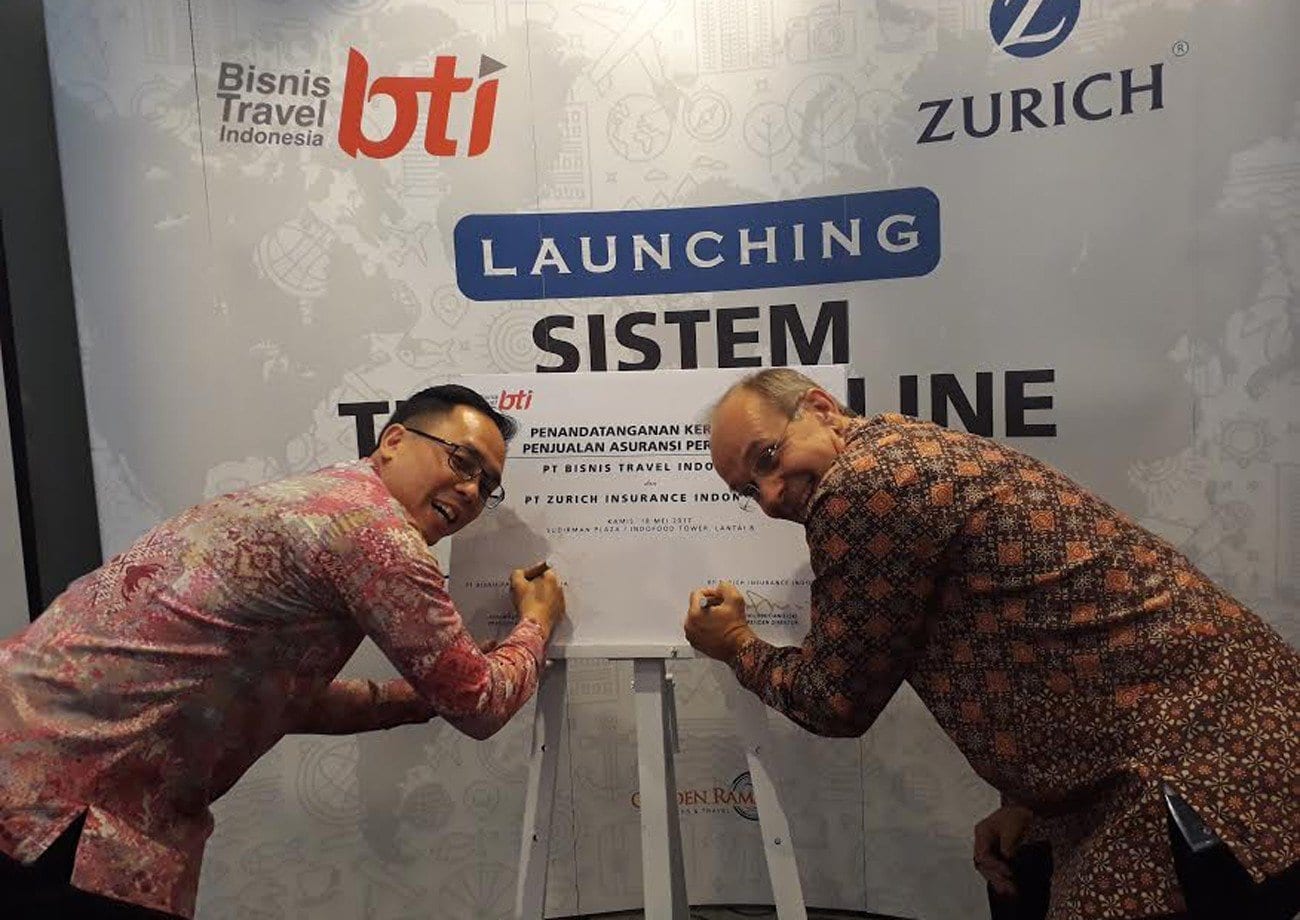
    Online travel portal Bisnis Travel Indonesia (BTI) is teaming up with Zurich Indonesia, the local unit of a Switzerland-based insurance company, by including Zurich Indonesia’s travel insurance on BTI’s list of products.

    Previously, BTI’s offered its members included airline tickets, hotel reservations and tour packages.

    “Through the partnership with Zurich, we want to expand options for our members,” BTI’s president director Johan Kurniawan told reporters during the partnership signing ceremony in Jakarta on Thursday.

    With the agreement, BTI’s portal will provide its members with three travel insurance products from Zurich Indonesia: Zurich Domestic Travel, Zurich Umrah/ Haj Travel and Zurich Passport.

    BTI aims to sell up to 600 travel insurance policies through its portal this year, Johan added.

    BTI is an online travel portal powered by Golden Rama Tours & Travel, a travel company established in Indonesia in 1971.

    About 90 percent of the portal’s members are individual travel agents, while the rest are office-based travel agents.

  • New Zealand optimistic of reviving TPP trade deal

    New Zealand optimistic of reviving TPP trade deal

    New Zealand will be trying to win over other members this weekend when TPP ministers get together in Hanoi on the sidelines of an APEC meeting.

    New Zealand is increasingly optimistic that the 11 remaining countries of the Trans-Pacific Partnership (TPP) will move ahead with the trade deal despite the withdrawal of the United States, Trade Minister Todd McClay said.

    Alongside Japan, New Zealand will be trying to win over other members this weekend when TPP ministers get together in Hanoi on the sidelines of an Asia-Pacific Economic Cooperation (APEC) meeting.

    “I don’t think we should expect any big decision from that ministerial meeting, but certainly I would hope for a very clear direction as far as the process is concerned,” McClay told.

    U.S. President Donald Trump dumped membership of the TPP as one of his first acts in an “America First” policy aiming at bringing manufacturing jobs back to the United States.

    McClay said he thought the original timetable for members to ratify TPP by next March still made sense. So far, only Japan and New Zealand have ratified the deal, but McClay said he believed others would follow.

    “I’ve been talking to many of them and visiting a lot of countries. They all have said at this stage they’re interested in the process and want to stick with it,” he said.

    Among the biggest challenges is keeping Vietnam and Malaysia on board. Their main benefit from TPP would have been greater access to U.S. markets. Without that, there is less impetus for them to make tough reforms on everything from freeing labour rights to strengthening intellectual property protection.

    McClay visited both countries recently.

    “It certainly feels like there is greater interest in moving forward today then there was a couple of months ago,” McClay said.

  • Sompo Japan to Release in Indonesia Weather Index Insurance for Farmers

    Sompo Japan to Release in Indonesia Weather Index Insurance for Farmers

    Sompo Japan Nipponkoa Insurance will start selling insurance products that compensate farmers hit by drought in Indonesia as early as this autumn.

    Earlier this month, Sompo Japan signed a memorandum to partner with BMKG, Indonesia’s meteorological bureau, to gather weather data. The Japanese insurer will provide weather index products that pay a certain amount to contract farmers when rainfalls drop below the forecast amount of the past three months.

    Such technologies and services provided by companies in disaster-prone Japan are likely to become promising exports to Southeast Asia. With an insurance premium of 50,000 rupiah ($3.76), contract farmers will be entitled to recuperate up to 500,000 rupiah if a drought occurs.

    Sompo Japan is narrowing down potential insurance agencies to partner with, such as local financial institutions. The company plans to test-run products in some areas as early as this autumn and go full swing in 2018.

    Sompo Japan started selling weather index insurance products for banana producers in Thailand in 2010 and in the Philippines in 2014. The company plans to release policies in Myanmar as soon as it gets government approvals.

    The company plans to boost its lineups of countries of sale and products to increase contracts fivefold to 30,000 in Southeast Asia by 2025.

    In the wake of increasing damage due to drought caused by unusual weather patterns, governments in Southeast Asia are taking measures to improve infrastructure, such as building irrigation facilities and providing financial coverage for damage claims.

    There are two major strategies for dealing with climate change. One is climate change mitigation, which is any action taken to reduce greenhouse gases such as carbon dioxide. The other is adaptation, which is the ability of a system to adjust to climate change to moderate any potential damage.

    The Paris Agreement, an international framework implemented to slow global warming, requires countries to set a goal of cutting greenhouse gases and taking adaptation measures. Emerging and developing countries — which are often hit by drought and heavy rains — are showing interest in the adaptation route.

    The United Nations Environment Programme, or UNEP, estimates the costs of adaptation could range from $140 billion to $300 billion a year by 2030, and between $280 billion and $500 billion a year by 2050.

    The market for adaptation solutions is expected to spread globally with the help of multinational funds and local governments. Some companies have started offering products and services catering to these demands.

    Japanese companies are well-positioned to help developing countries adapt to climate change, such as by contributing to better infrastructure, developing cultivation technologies so crops can withstand warmer temperatures, and increasing preparedness for power outages.

    However, Mari Yoshitaka, chief consultant of Mitsubishi UFJ Morgan Stanley Securities, said many Japanese companies have not shown much interest in the global adaptation business. But focusing on environmental measures needed to cope with the situation presents business opportunities.

  • Global spending on consumer video services to hit $314b in 2017

    Global spending on consumer video services to hit $314b in 2017

    Global spending on consumer video media services will total $314 billion in 2017, a 4.2% increase from 2016, according to Gartner.

    Pay-TV services is the largest spending segment and is on pace to represent 90% of the total market, totaling $282 billion in 2017.

    In 2017, emerging Asia/Pacific (20.8%) and Middle East and North Africa (17.4%) are forecast to record the highest growth in end-user spending on consumer video media services.

    Earlier this year, China Mobile began offering its pay-TV service free of charge to its premium subscribers for the first two years of a new contract. “This will lead to an influx of new subscribers in the pay-TV marketplace. However, it will also bolster price competitiveness and put negative pressures on the ARPU of the overall pay-TV market,” said Fernando Elizalde, principal research analyst at Gartner.

    Moreover, internet-delivered linear TV services have already launched in India and the Middle East, and Gartner expects these services will commence across all emerging regions by 2018. “We estimate that, incentivized by lower prices, one million households in emerging regions will enter the pay-TV market through an internet TV service by 2020,” said Elizalde.

    “The dramatic difference in the price of these packages compared with traditional pay-TV packages will also put downward pressure on ARPUs overall.”

    Transactional video on demand (T-VOD) offers consumers the ability to access a wide variety of content, from either managed pay-TV providers or over-the-top (OTT) companies such as Amazon, Google or Apple. “OTT-VOD sources are changing the landscape,” said Derek O’Donnell, senior research analyst at Gartner.

    “OTT-VOD services are the fastest-growing segment in the VOD landscape and eroding pay-TV providers’ share of revenue. OTT-VOD sources began outperforming traditional pay-TV sources in 2016.”

    O’Donnell added that the availability of premium-priced 4K content will increase end-user spending on T-VOD content in mature regions, from $160 million in 2017 to $400 million by 2020. In emerging regions, increased competition in the T-VOD marketplace from unmanaged providers and increased threats of piracy will put negative pressure on T-VOD prices. End-user spending on T-VOD services in emerging markets will decrease gradually each year, starting in 2017, by about $60 million to almost $445 million by 2020.

    Global consumer spending on subscription-based video on demand (S-VOD) services will total $18.7 billion in 2017, an increase of 28% from 2016.

    The average consumer adoption of S-VOD services is 10 percent in 2017, with an average ARPU of $7.41. The highest ARPUs are in Japan ($12.10), Mature Asia Pacific ($10.84) and North America ($9.60).

    “Consumers will not subscribe to more than three services,” said O’Donnell. “This is because of price and content discovery fatigue. Consumers are having to go through each application separately to find content, which can create fatigue.”

    Universal search is the key to driving further penetration, which will allow consumers to search for content across all their S-VOD services. “However, this is a ‘holy grail’ in the industry as providers, such as Netflix and HBO don’t want to cooperate,” added O’Donnell. “Therefore, true universal search is still some years away.”

    “Currently, there is a market for niche subscription video services and established streaming providers. However, as the market matures, we forecast more consolidation around the fewer companies that can innovate and set themselves apart from the juggernauts within the industry,” said O’Donnell.

  • Foreign cafes’ struggle in Vietnam

    Foreign cafes’ struggle in Vietnam

    Australian-owned Gloria Jean’s Coffees recently decided to close its last store in Vietnam, ending a 10-year stint in Hồ Chí Minh City and Hà Nội due to slow expansion, high rents and an unsuitable business model.

    Gloria Jean’s Coffees arrived in the country in 2006 after a local firm signed a franchise contract with it expecting the business would develop well like it did in Thailand and Malaysia.

    This was based on the fact that the chain served Arabica coffee, a relative novelty in Việt Nam where the robusta bean rules.

    Việt Nam, the world’s number two coffee producer after Brazil, is known to have one of the fastest growing coffee retail markets, along with Indonesia, Turkey and India.

    However, the Australian coffeehouse chain was only able to open six outlets in Hồ Chí Minh and one in Hà Nội in the first six years.

    Nguyễn Phi Vân, the first franchisee of Gloria Jean’s Coffee in Việt Nam, told that the demise was due to the adoption of a business model that had been developed in Australia for the local and regional markets.

    Later on, even after Gloria Jean’s Coffees International allowed its franchise in Việt Nam to make some changes to its products to adapt to local people’s tastes, the going remained really tough due to many reasons including fiercer competition from both foreign and domestic rivals like Starbucks, The Coffee House, Phúc Long, Urban Station, and Trung Nguyên.

    Gloria Jean’s Coffees is not the only foreign cafe whose business has failed in Việt Nam.

    Last year New York Dessert Café (NYDC) said goodbye to its customers in Việt Nam via its Facebook page, promising to “return someday.”

    Brought to Việt Nam in 2009 by a Singapore Group, NYDC used to be one of the most popular foreign coffee chains in HCM City. It had expected to open 20 outlets in Việt Nam.

    What when wrong for the foreign cafés?

    Many coffee industry insiders said in the food and drink sector, the coffee area in particular, it is not easy for foreign players in Việt Nam even if when they have famous brands.

    Some foreign coffee chains serve normal customers in their native countries but only affluent ones in Việt Nam.

    Because of this they often choose prime locations in major cities for their shops, meaning very high rents and skyrocketing overheads.

    Not surprisingly, their prices are often two or three times the prices at local cafes.

    The attractiveness of foreign coffee products is also affected by their localisation: some beverages are made under foreign formulas but with domestic materials, meaning they do not seem “authentic” and put off foreign customers in Việt Nam.

    However, locals too do not enjoy coffee made using foreign formulas and prefer local cafes.

    The increasingly fiercer competition is another important factor contributing to the foreign coffee chains’ failure.

    Market observers pointed to the increasing dominance of affordable local coffee chains like Passio Coffee, The Coffee House, Phúc Long, Highlands Coffee, Urban Station, and Trung Nguyên.

    These have also intensified investment in design and décor to give foreign cafes a run for their money in terms of looks.

    Besides, customers there can get comfort foods that foreign cafes do not have such as phở (phở), bún (vermicelli soup), bread, hủ tiếu (rice noodle soup), and rice.

    But according to analysts, international coffee brands continue to be interested in the Vietnamese market.

    US chain PJ’s Coffee opened its first outlet in HCM City recently and a second within two months. It hopes to have at least 10 additional stores in the next five years.

    A spokesperson for TRG International, the franchisee of PJ’s in Việt Nam, said each shop would be different and are based on lessons from the former.

    This is also seen at Starbucks, where each shop has its own style with a specific group of customers in mind.

    Banks await debt trading market

    Banks’ bad debts now seem to be lower than in previous years. But the total amount remains high, affecting the lenders’ business as well as their goal of reducing interest rates.

    An analyst at a securities company said that as of March 31 Sacombank had the highest bad debts rate, an estimated 4.89 per cent, followed by Eximbank with 3 per cent, BIDV with 2.14 per cent, and MB with 1.35 per cent.

    Data from the State Bank of Việt Nam (SBV) indicates that the banking sector’s bad debt rate as reflected in balance sheets is under 3 per cent.

    Some banks may however have significant amounts of off-balance sheet assets and liabilities.

    In December 2016 the bad debts reported in balance sheets, bad debts managed by the Việt Nam Asset Management Company (VAMC), and latent bad debts was around 8.86 per cent of total outstanding loans, according to the SBV data.

    The VAMC’s handling of bad debts is too slow, according to banks and many of them are looking for ways to buy back the bad debts they had earlier sold to it, hoping to settle them by themselves.

    Some of them even plan to trade bad debts.

    At shareholders meeting this year, the bosses of many lenders like VIB, OCB, VietinBank, Techcombank, MB, SCB, ACB and VPBank proposed plans to buy back most of their bad debts from the VAMC.

    Vietcombank has already bought back all its bad debts totally worth VNĐ4.3 trillion (US$184.43 million).

    Analysts said the reason for this is that sooner or later the Government would force the banks to put all their bad debts in the balance sheet instead of allowing some to be off it.

    So buying back the bad debts from the VAMC makes sense since they can keep it all in one place to make things less unwieldy.

    So why did they not take this route in the first place instead of selling to the VAMC?

    The chief of a bank admitted that the VAMC had come to the rescue of the banks in their darkest hour.

    Analysts said thanks to consigning their bad debts to the VAMC for a few years, the banks have had the time and conditions to recover enough to handle their bad debts by themselves.

    Besides, most lenders had expected the VAMC to miraculously fix their bad debts, and this had not happened, they said.

    But not all banks are capable of buying back their bad debts, only those that have low bad debt rates of under 1.5 per cent and abundant resources.

    Some also plan to participate in the debt selling and buying market.

    At its recent shareholders meeting, Vietcombank tabled a proposal to set up a debt selling and buying company for approval.

    Last week the bank got a licence from the SBV for debt trading.

    VIB shareholders also approved a plan to buy debts estimated at VNĐ6 trillion (US$264.32 trillion) from credit institutions.

    Market observers see a trend, saying many banks are keenly awaiting a debt market, which is expected to take shape soon.

    Another encouraging sign for banks is that their bad debts are becoming attractive to investors since more than 70 per cent have properties as collateral and the real estate market is recovering strongly.


  • Vietnamese-French entrepreneur interested in local tourism startups

    Vietnamese-French entrepreneur interested in local tourism startups

    Vietnamese-French businessman Pascal Pham said he plans to invest in tourism startups in Vietnam. Club director of leading French communications group Skyboard, Pham said the first element that alerted him to Vietnam was the extraordinary Vietnamese diaspora in Silicon Valley and Europe.

    “We live in a global world, in France for example, a Vietnamese was the co-founder of Sparrow which was bought by Google for $25 million. We need to be connected to be successful, from Europe to the U.S., from the U.S. to Southeast Asia.”

    The second element was the excellent training computer scientists receive here in Vietnam, making it “a strong international culture and an interesting territory to audit.”

    The local culture in Vietnam is unchanged but opportunities are growing while risks remain unchanged. Young people are better trained, the economy is part of a growing region, and the appetite for success is confirmed by major groups such as tech giant FPT motivating interest in Vietnam, Pham told.

    “I want to invest in innovative tourism because it is the DNA of our start-up incubator in Paris,” said Pham.

    He is also interested in the Vietnam Innovative Startup Accelerator (VIISA), a mechanism that gave him the opportunity to discover the first steps of the innovation ecosystem and create an incubator in Europe a few years ago.

    Asked for advice about raising funds for Vietnamese startups, the lecturer from the Sorbonne University said they need a balanced team of expert marketers, good engineers and an international vision from the beginning.

    In order to go globally, Vietnamese startups should prepare a tested and effective economic model that does not follow existing models, and make good use of their resources and technology.

    A co-founder of the Paris-based T3 Business Forum, which represents tourism, transport and technology startups, Pham said Vietnamese startups can benefit indirectly from a new inflow of capital under new French President Emmanuel Macron’s plan to create a huge sovereign fund for startups with Germany.

    Southeast Asia has to convert its appeal into success stories in new technologies, and FPT has been leading the way.

    “With a strong common goal, Vietnam can become a powerful leader in this exciting quest. Networks are the most underestimated asset. I’m here to bring my network,” he said.

  • Asia ahead of the digital engagement curve

    Asia ahead of the digital engagement curve

    Asian economies are more digitally engaged relative to their global peers at similar stages of development, according to Deloitte.

    The company’s second edition of its Voice of Asia series shows that Asian economies are leveraging digital technologies to help them leapfrog development hurdles, resulting in them winning the race on connectivity.

    Asia has become the center of global economic growth and by embracing digital, it will continue to lead global economic growth over the coming decade.Ric Simes, Deloitte Australia Economist explained that, “digital technologies have been synonymous with rapid and evolving change over the past four decades. While we have made significant progress, we are only at the tip of the digital iceberg when it comes to what’s possible in the future. When applied on a global scale, we can see that Asian economies and societies are at the forefront of this revolution. Asia is leading the way in how digital developments can enable individuals, businesses and governments to do things differently and, often, more efficiently.”

    As the fastest growing region in the world and a significant driver of global economic growth over the past decade, Asia is assuming the digital leadership position in the 21st century. According to the Deloitte digital engagement indices for government, business and consumers, Asian economies are ahead in digital engagement terms, with almost all Asian countries above the world average.

    Government and business engagement is high relative to the rest of the world, with individual engagement about average. The Deloitte digital engagement index scores each countries’ Networked Readiness Index (NRI) against GDP per capita, showing that every country in Asia apart from Myanmar has above average levels of digital engagement for the level of their economic development.

    Singapore and Hong Kong are world leaders, while the large population bases in countries such as China, India, Indonesia and Vietnam have considerable opportunities for the future. In middle-income countries in Asia, governments have been able to maintain strong growth agendas based on policies in areas such as trade, infrastructure and savings. Today, these countries are pursuing growth agendas with digital taking a leading role.

  • Richemont acquires 5% stake in Dufry

    Richemont acquires 5% stake in Dufry

    In big breaking news, Richemont Luxury Group has taken a stake of just over 5% stake in the world’s leading travel retailer Dufry.

    Under Swiss Stock Exchange (SIX) regulations, any holding of more than 3.0% must be publicly disclosed with 24 hours. Richemont Luxury Group is the direct shareholder while the beneficial owner/persons that can exercise the voting rights at their own discretion is Compagnie Financiere Rupert of Geneva, Switzerland.

    Richemont has picked up 2,693,856 rights and voting rights, respectively and precisely 5.000001 % as a percentage of voting rights.

    The surprise news comes hot on the heels of HNA Group of China acquiring 16.79% of Dufry.

    Richemont owns several of the world’s leading luxury goods companies, with particular strengths in jewellery, luxury watches and premium accessories.

    The Group’s luxury interests encompass several of the most prestigious names in the sector, including Cartier, Van Cleef & Arpels, Piaget, Vacheron Constantin, Jaeger-LeCoultre, IWC Schaffhausen, Panerai and Montblanc.

    Richemont’s arch luxury goods rival LVMH is the majority shareholder in Dufry sector peer, DFS Group. Co-Founder Robert Miller remains DFS’s co-owner.

    In the year ended 31 March 2017, Richemont posted a -4% decrease in sales, which it said reflected a growth in retail sales offset by a decline in wholesale business. Operating profit fell -14%.

    The second half of the year, though, saw an improvement. The USA, Richemont’s largest market, resumed growth while Mainland China, now the Group’s second largest market, enjoyed strong growth along with South Korea, the UK and Macau.

  • Nokia, Mitsubishi develop ultra-fast BTS amplifier

    Nokia, Mitsubishi develop ultra-fast BTS amplifier

    Nokia Bell Labs, Mitsubishi Electric and the Center for Wireless Communications at University of California San Diego in the US have jointly developed a new envelope-tracking power amplifier with the potential to significantly enhance the energy efficiency of next-generation base stations.

    The gallium-nitride power amplifier supports modulation bandwidth up to 80MHz, four times wider than the signals used in other envelope-tracking power amplifiers.

    This translates to a gain efficiency of 41.6% in wide-bandwidth operation, Nokia said, making it a promising candidate for 5G base stations.

    Next-generation wireless systems are using complex modulated signals with large peak-to-average power ratio and extra-wide modulation bandwidth, which will require power amplifiers to operate most of the time at backed-off power levels that are well below their saturation levels.

    But the efficiency of power amplifiers is generally significantly degraded at backed off levels. While envelope-tracking power amplifiers are considered a promising solution to this problem, so far the supply-modulator circuit has been the bottleneck limiting modulation bandwidth.

    The new prototype uses Mitsubishi Electric’s high-frequency GaN transistor technology and Nokia Bell Labs’ real-time digital pre-distortion system to help remove this bottleneck and achieve wider modulation bandwidth, the companies said.

    Technical details of the system will be presented during next month’s IEEE MTT International Microwave Symposium in Hawaii.

  • Time for ocean shippers to digitize is now

    Time for ocean shippers to digitize is now

    Digitization is rapidly transforming the ocean container shipping industry, according to INTTRA, a neutral electronic transaction platform, software and information provider for the ocean shipping industry.

    In a new whitepaperBlueprint 2032: How Technology Transforms Ocean Container Shipping – INTTRA reports that the pace of technology innovation is accelerating as businesses seek new and more efficient ways to optimize.

    “Digitization is now a competitive necessity,” says John Fay, CEO of INTTRA. “We’ve reached a tipping point in the global shipping industry when information technology is now the primary means for CEOs and their companies to achieve and increase long-term profitability. We are enabling shippers to rethink processes, and to digitize their operations through our unique position as a neutral service provider.”

  • Chinese demand for supercars races ahead at full-speed

    Chinese demand for supercars races ahead at full-speed

    Chinese demand has helped boost supercar sales around the globe to double-digit growth, according to a new report by automotive market research company Jato. While the United States remains the largest market for ultra-luxury car sales, China is close behind at number three, with demand last year jumping 54 percent to about 4,400 units. To compare, the second biggest market, the UK, only saw a 15.6 percent growth.

    Jato cites Forbes’s swelling billionaire list as evidence for the increasing demand for ultra-luxury automobiles around the globe—overall, supercar sales are up by 16 percent in 2016 from the previous year. China added 65 billionaires for a total of 400 to the list last year, the most of any country on the list, and its role in the supercar market reflects this.

    Supercars, which include brands like Aston Martin, McLaren, Bentley, and Ferrari, have long been valued by Chinese consumers for boosting their status quo, but the report notes that supercar brands are increasingly innovating to respond to changing consumer needs. For example, many of the automakers have recently introduced luxury SUVs to their lineup, of which have witnessed a major market in China as families are getting larger. There is also more demand for sustainable vehicles, especially in China, where environmental concerns like pollution are rampant. Luxury car brands have been quick to respond—out of the 10 brands featured in Jato’s report, nine of them have announced plans for releasing electric or hybrid automobiles.

    While supercar brands are no doubt having good luck with the Chinese consumer in general, many are also now having to consider how the emerging affluent in China are getting younger and more digitally savvy. Maserati, an ultra-luxury brand that wasn’t on Jato’s list, made an effort to reach this market by opening a Tmall store, but others have room to grow when it comes to bridging their online presence with call to actions to bring customers into their showrooms. And with surging demand, the opportunity to reach China’s digital natives is likely only growing wider.