Author: Mei Ling Tan

  • AirAsia, budget carrier set to soar in Asean open skies

    AirAsia, budget carrier set to soar in Asean open skies

    Low-cost airline groups and manufacturers of smaller passenger aircraft will be among the main winners after Southeast Asia’s open skies agreement finally came into effect last month, although airport capacity constraints could limit the benefits.

    Ratification of the Association of Southeast Asian Nations (ASEAN) open skies agreements by Indonesia and Laos in April lifts restrictions on capacity and competition, allowing airlines to launch unlimited flights from their home to any point in the region subject to airport slot availability.

    Hubs like Singapore, which have a clear expansion plan, could gain from an increase in air services, as will budget carriers which are ideal for a region where no two points are more than a few hours apart, say analysts.

    “Airlines can launch any number of international flights as the market can support,” said Alan Tan, an aviation law professor at the National University of Singapore. “Travellers can thus look forward to more flights at more competitive prices.”

    Dominant low-cost airlines like Malaysia’s AirAsia , Indonesia’s Lion Air, and Philippine carrier Cebu Pacific plan to do just that.

    AirAsia, for example, wants more international flights from the Philippines and Indonesia, a spokeswoman said. This will help its affiliates, which have found it tough to break into the domestic market in those countries.

    “Improved connectivity in the region will be a boon to tourism and strengthen ASEAN as an economic union,” the spokeswoman said.

    Full service airlines like Thai Airways, Garuda Indonesia and Philippine Airlines, which have lost market share to budget carriers over the last decade, say they plan to use their long-haul network to connect passengers to their Southeast Asia services.

    The Singapore Airlines group has an additional advantage, given its ability to operate services using two premium brands and two low-fare subsidiaries, analysts say.

    The opening up of regional destinations can also boost manufacturers of 70-130 seater aircraft, like Brazil’s Embraer , Canada’s Bombardier and ATR, a joint venture between Airbus and Italy’s Finmeccanica.

    These planes can serve some routes more profitably than the larger Airbus A320s and Boeing 737s, they say.

    “Many of the region’s airlines are beginning to recognise the potential advantage of right-sizing and the ratification of ASEAN open skies, we feel, will simply accelerate the process,” said Mark Dunnachie, who leads Embraer’s aircraft sales in the Asia-Pacific.

    HUBS LIMIT GROWTH

    While there will clearly be winners from the open skies deal, the full gains could be limited by airport constraints.

    Bangkok’s Suvarnabhumi Airport, Ninoy Aquino International Airport in Manila, and Jakarta’s Soekarno-Hatta International Airport serve Southeast Asia’s three biggest domestic markets of Thailand, the Philippines and Indonesia respectively.

    All have reached full capacity with congestion and delays the norm, creating spillover problems for smaller airports in those countries as well.

    “Unlimited flight capacity is meaningless if airport and slot congestion remains unaddressed by governments,” Tan said.

    Singapore’s Changi Airport is the exception. Despite having relatively little domestic traffic, it has three terminals which can handle 66 million passengers and served 55 million in 2015, the most in Southeast Asia. Work has begun on two more terminals.

    Such long-term national aviation policies are needed due to the lengthy gestation period for terminals and runways, said Vinoop Goel, Asia Pacific director for airports at the International Air Transport Association (IATA), a global airline trade body.

    IATA estimates that ASEAN countries can add almost 25 million jobs and $298 billion to the region’s GDP by 2035 if they invest in aviation infrastructure. This is up from 11.6 million jobs and $144.4 billion to GDP in 2014.

    “Clearly, failing to tackle airport infrastructure will have an economic cost,” Goel said.

  • Woori Bank to offer insurance products in Indonesia, Vietnam

    Woori Bank to offer insurance products in Indonesia, Vietnam

    South Korea’s commercial bank Woori Bank will join hands with local insurance companies to provide insurance service and products from its global outlets starting with its local unit in Indonesia.

    According to bank sources, the bank will be able to sell insurance products of Hanwha Life Insurance Co. through its Indonesian unit Bank Woori Saudara in the second half of this year. The bank wants to establish up to 300 outlets across the globe and decided to add insurance service, a bank official said.

    Hanwha Life Insurance’s Indonesian operation was established in October 2013 and currently has eight branches and 1,200 insurance planners. It will sell savings insurance products like variable annuity through 131 Bank Woori Saudara outlets. The partnership will be a win-win arrangement for the two since they can save costs by mixing business and sharing business.

    Depending on demand, Woori Bank will also sell non-life insurance products of Samsung Fire & Marine Insurance Co. and KB Insurance Co. via its Indonesian operation.

    Woori Bank will also target Vietnamese bancassurance market in partnership with Hanwha Life Insurance. The bank has two branches in Ho Chi Minh and Hanoi in Vietnam. Since the branches have the license to sell bancassurance products, it plans to sell saving insurance products of Hanwha Life Insurance and later products of Samsung Fire & Marine.

    Hanwha Life ranked eighth in terms of new insurance contracts in Vietnam last year. The insurer has 12,500 insurance planners in 54 branches.

    According to Woori Bank, the Indonesian life insurance market has almost doubled from $5.3 billion in 2010 to $9.8 billion in 2014. Vietnam showed similar growth.

  • Shinhan Bank officially launches its Indonesian operations

    Shinhan Bank officially launches its Indonesian operations

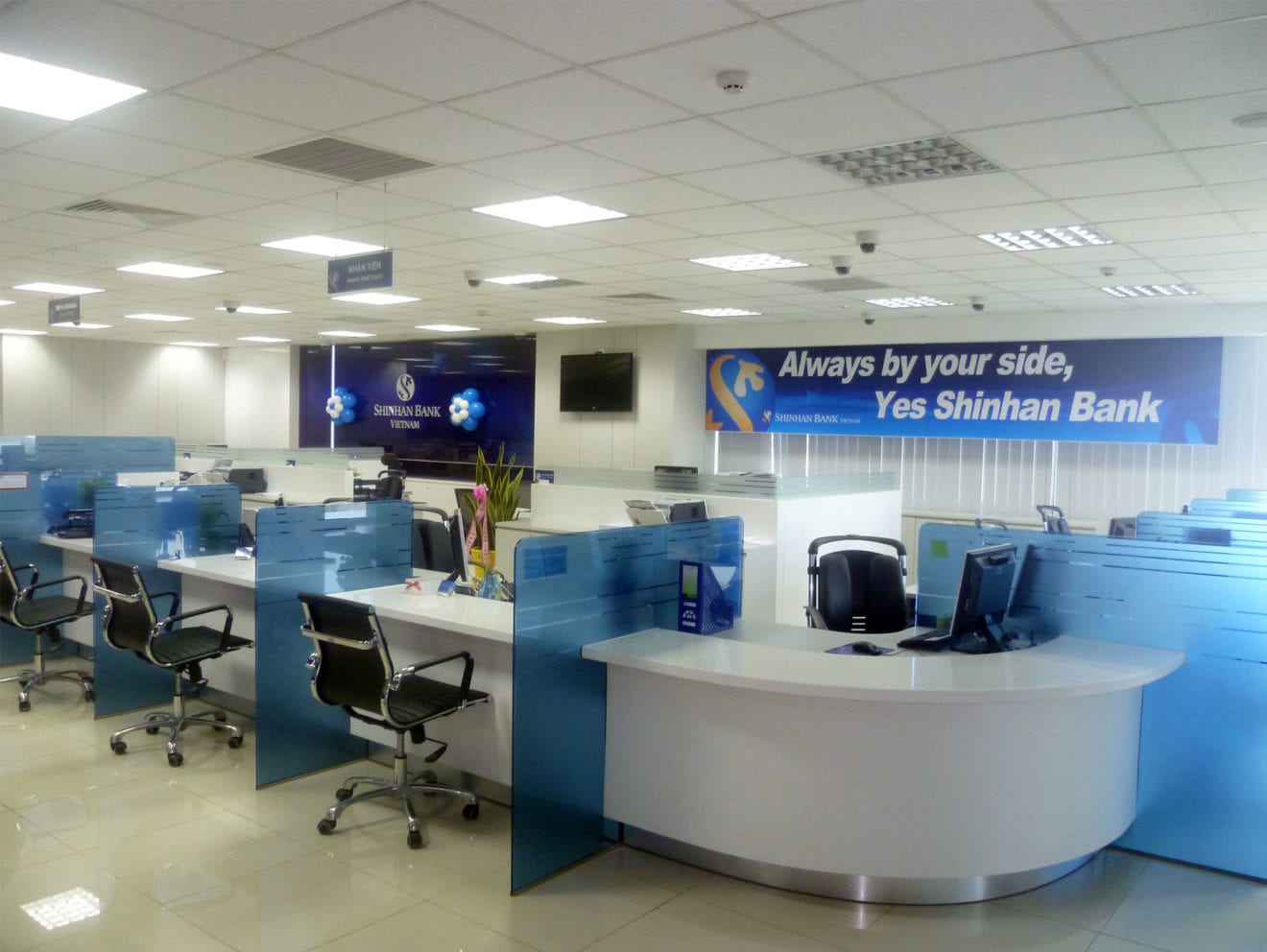
    South Korea’s Shinhan Bank has embarked on operations in Indonesia via Shinhan Bank Indonesia, a move that is expected to help the Korean bank expand its presence not only in the Southeast Asian country but also across Asia.

    Shinhan Bank said on Tuesday it officially launched Shinhan Bank Indonesia, which was renamed from Bank Metro Express (BME), a Jakarta-based bank with 19 branches that was acquired by the Korean bank last year. Shinhan Bank Indonesia is newly headquartered in the International Financial Center Tower 2 in Jakarta, the capital city of Indonesia.

    The kickoff of Shinhan Bank Indonesia’s operations follows a series of launches of the Korean bank’s overseas operations in other Asian countries such as Japan, China and Vietnam in recent years. The latest overseas operation is expected to help Shinhan Bank achieve its ambitious goal to build an extensive financial network across Asia.

    The Korean bank also aims to merge Shinhan Bank Indonesia with Centratama Nasional Bank (CNB), another Indonesian bank that it took over last December, later this year. The Indonesian bank has 41 branches across Surabaya, the second biggest city in Indonesia, and other cities in Java Island.

    Once the merger is complete, the Korean bank would have 60 networks across Indonesia, the world’s fourth most populous country. It currently has 141 overseas networks across 19 countries. It would also be the first in the Korean banking industry to purchase two offshore banks and merge them.

    Cho Yong-byung, the president of Shinhan Bank said at the launching ceremony on Tuesday that he expects the merger of the two Indonesian banks would set a new milestone in Indonesia.

  • Globe trials use of TV white space for broadband

    Globe trials use of TV white space for broadband

    The Philippines’ Globe Telecom has become the first operator in the nation to pilot using TV white space frequency for mobile broadband.

    The operator is collaborating with the ICT office of the Department of Science and Technology to trial use of the spectrum for broadband service delivery in multiple areas of the Philippines.

    Globe senior vice president for network technologies strategy Emmanuel Estrada said building additional cell sites to meet demand has proven to be a major challenge, with construction of a single site typically involving around 25 permits and at least 8 months of lead time.

    “We hope that making use of available spectrum would enhance bandwidth capacities and allow our network to transmit enormous amount of data at faster speeds,” he said.

    Estrada added that TV white space technology is also expected to help Globe roll out broadband to rural areas with low population density, where it is not economically viable to used fixed broadband technology.

    TV white spaces are the unused frequencies between UHF and VHF broadcast TV channels, located in the range of 54-MHz to 806-MHz. The long range and strong signal penetration of these frequencies make them well suited to telecoms services.

  • Mujosh Malaysia home to first international concept store

    Mujosh Malaysia home to first international concept store

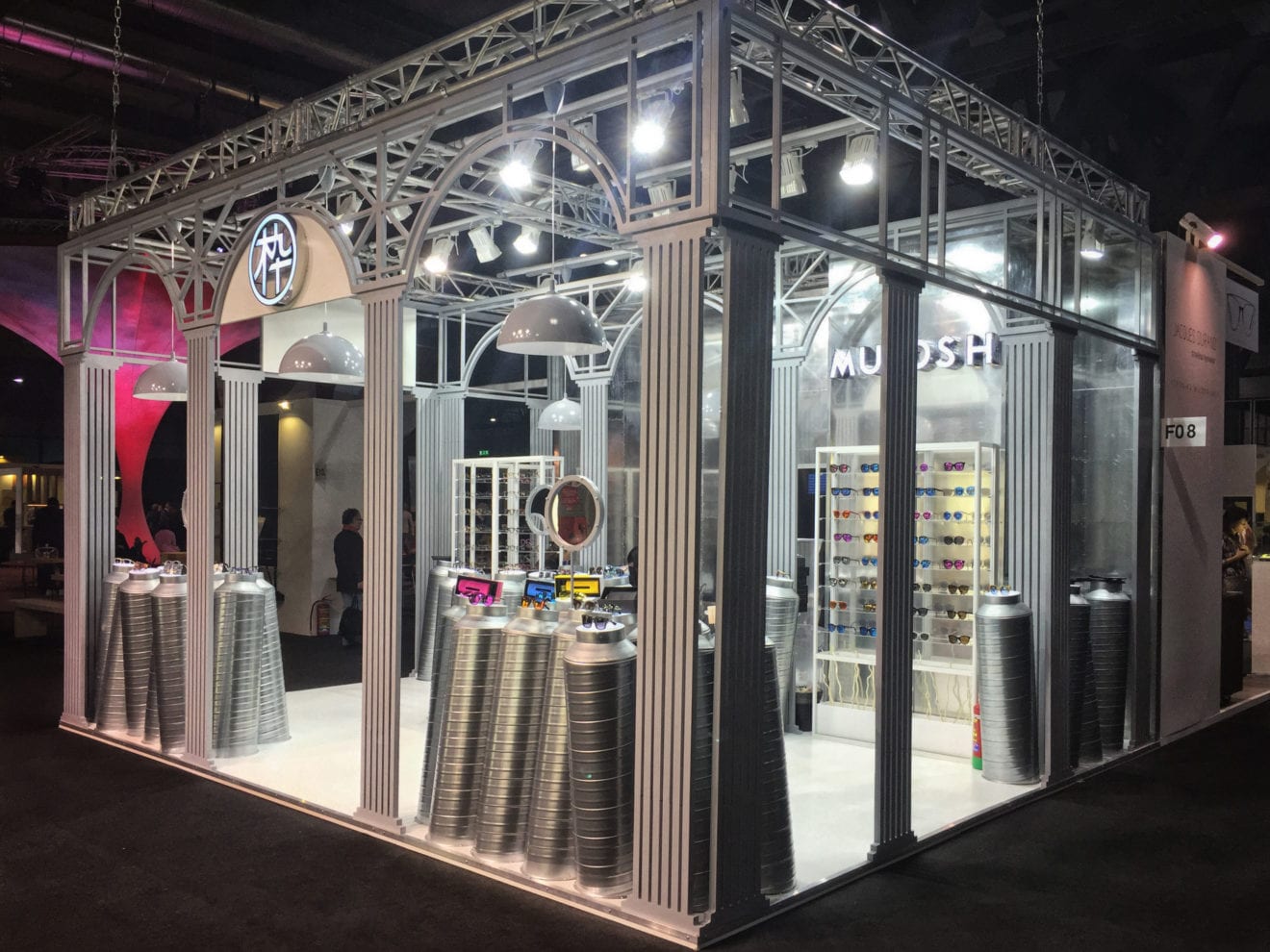
    Hong Kong eyewear retailer Mujosh has opened its first overseas concept store in Kuala Lumpur.

    The Mujosh Malaysia store is located in the Pavilion Kuala Lumpur at the heart of the Bukit Bintang retail district.

    Mujosh says by combining “industrial chic, nature and retro design style”, the concept store is aiming to bring a unique experience to customers.

    Owned by Photosynthesis Group, Mujosh is the first brand to go international since its parent company started its international business expansion at the beginning of 2015.

    “Malaysia is the first place we chose after deciding to expand into the international market,” said Grace Zhang, GM of international business division of Photosynthesis Group.

    “We are pleased to achieve another ‘first’ for the company here. We are still in search of international business partners with the goal of bringing our brands to more places and customers in the world.”

    Founded in 2010 by a group of young creatives who believe glasses are not only tools to improve eyesight, but also fashion accessories to differentiate wearers and make them stand out from the crowd, Mujosh has been growing steadily in Asia. Last month it opened a smaller store in Singapore.

  • Brightcove unveils product enhancements

    Brightcove unveils product enhancements

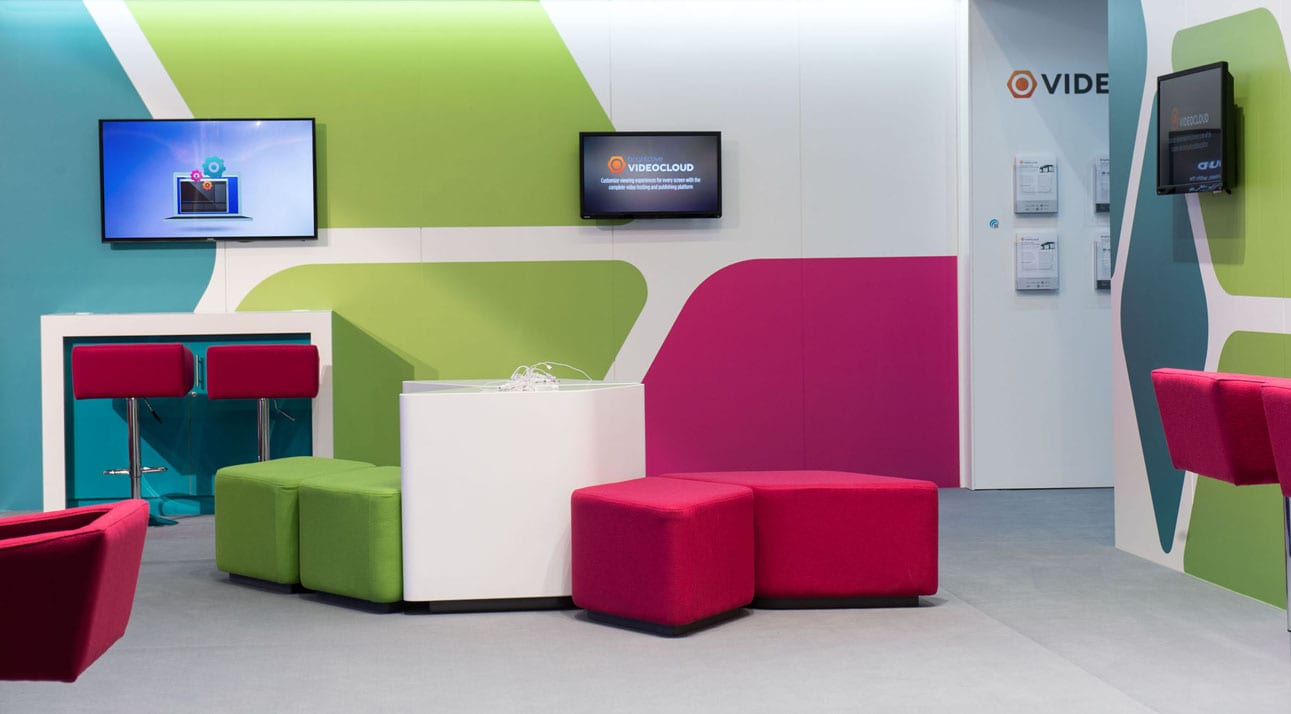
    Brightcove unveiled a series of product enhancements and technology innovations for its video platform and gave a sneak peek of its upcoming roadmap for the remainder of the year at its annual conference, PLAY 2016.

    The following products and enhancements were announced. First, the turnkey OTT solution for media companies and content owners — OTT Flow — which enables customers to rapidly deploy high-quality, direct-to-consumer, live and on-demand video services across platforms with no up front development costs.

    Second, Zencoder UHD Support now provides media companies with the ability to deliver 4K UHD content to devices of all types by adding support for UHD features.

    Third, Brightcove Audience has added a Salesforce integration that alerts sales teams about the viewership behavior of  individual prospects and customers. It also now enhances marketers’ ability to drive conversion and ROI from their video marketing initiatives by delivering new custom forms with call-to-action capabilities.

    Fourth, Brightcove customers can now easily provide their viewers with personalized programming to grow audiences and increase engagement through a new partnership between Brightcove and IRIS.TV.

    Fifth, the Brightcove Player now features support for 360 video. The feature is available now in beta for desktop browsers including Chrome, Firefox, Edge, and IE 11/Windows 8.1.

    And sixth, media companies can now expand their content libraries and create incremental revenue streams through a new content marketplace integrated into Video Cloud.

  • AccuWeather expands reach via Apple TV app

    AccuWeather expands reach via Apple TV app

    AccuWeather launched the all-new AccuWeather app for Apple TV, which further expands AccuWeather’s global reach across platforms by enabling users access across devices and locations.

    Apple TV users can now quickly and easily zoom in and out on radar conditions locally or anywhere in the world.  The enhanced AccuWeather app for Apple TV also provides highly detailed weather forecasts including AccuWeather’s patented MinuteCast minute-by-minute forecast with precipitation type and intensity for the next two hours, as well as start and end times, hyper-localized by Apple TV location.

    Additional new features include AccuWeather’s Day by Day 15-Day Forecast, expanded view of hourly weather forecasts, and AccuWeather RealFeel Temperature.

    The app offers an expansive variety of weather HD video content available from any news and information provider.

    “AccuWeather continues to demonstrate its commitment to an expansive global digital strategy with this application,” said Steve Smith, President of Digital Media for AccuWeather.  “Viewers can rely on AccuWeather’s personalized, exclusive weather experience on Apple TV, in addition to the AccuWeather iOS app, for weather information and updates with Superior Accuracy.”

    AccuWeather is the only app in the weather category to offer expanded language support on Apple TV, meeting localization needs with more than 100 languages and dialects. The app also provides real-time global severe weather alerts and warnings for Apple TV users.

  • StarHub, MCC launch Mandarin edutainment channel

    StarHub, MCC launch Mandarin edutainment channel

    StarHub TV and MyChinaChannel (MCC) have launched a dedicated Mandarin edutainment channel for kids aged three to 12, with a mix of cartoons and live action shows.

    In addition to offering carefully curated content from China, MaxToon—which is owned and distributed by MCC—will also develop locally produced content to cater to the needs of Singaporean audiences.

    The content will emphasize the importance of character development and values such as kindness and care for others. Young viewers can look forward to catching MaxToon from 6am to 12 midnight, with four hours of fresh content everyday. There will be Chinese subtitles made available for selected programmes.

    In June, a brand new variety talk show called Kids’ Talk, will be the first locally produced program to debut on MaxToon. In Kids’ Talk, the host will engage its young guests on various topics of the day.

    Through the eyes of these innocent, young minds, viewers will be able to enter the children’s world—as these young guests assume different roles such as a parent, a Member of Parliament, or as themselves—and give their interpretations and perspectives on the topics.

    To ensure a good lineup of educational yet entertaining content, MCC will also be partnering Marshall Cavendish Education to co-create a kids’ reality programme in the last quarter of this year.

    Called Young Runners, the series will see kids race against one another in a game where the pedagogy and content advice will be mapped to the MOE curriculum, testing kids on their Mandarin proficiency.

  • Thailand’s AIS launches prepaid broadband

    Thailand’s AIS launches prepaid broadband

    Thailand’s AIS has launched the nation’s first prepaid fixed broadband service, introducing a 15Mbps speed plan for a 500 baht ($14) monthly top-up fee.

    AIS has set a target of becoming Thailand’s second largest broadband player by 2019, citing comments from a senior executive at the company.

    The operator launched commercial fixed broadband services in April last year and had 450,000 subscribers as of December. AIS plans to increase this to 1 million by 2018 and 2 million by 2019.

    In order to achieve its growth ambitions AIS has allocated 7 billion baht to extend its fiber network to cover 24 provinces this year, and a further 10 billion baht to expand this to 40 provinces in 2017.

    Meanwhile rival Jasmine International, whose subsidiary Triple T Broadband operates landline broadband services under the 3BB brand – has retaliated by slashing the price of its 50Mbps plans to 700 baht per month, from 2,500 baht.

  • Ooredoo Myanmar launches 4G services

    Ooredoo Myanmar launches 4G services

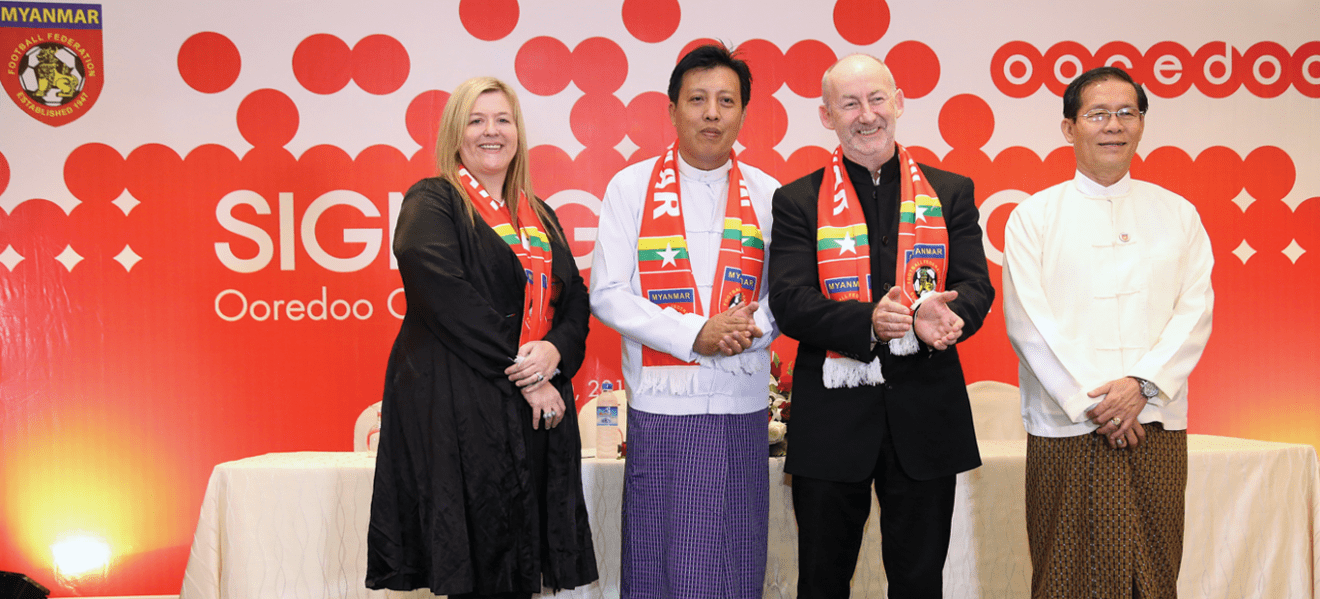
    Ooredoo Myanmar has become the nation’s first operator to launch 4G services as part of a staged rollout.

    The operator has introduced 4G in parts of Yangon, NayPyiTaw and Mandalay, according to an FAQ on the company’s website.

    The company plans to cover half of Yangon’s townships, around 90% of NayPyiTaw’s townhips and all of Mandalay with the service.

    Over the next couple of months, Ooredoo Myanmar plans to upgrade around a quarter of its more than 3800 cell sites to 4G.

    But further rollouts will require more spectrum and cell sites, according to CEO Rene Maza. Ooredoo Myanmar plans to continue to expand its 4G network as it acquires these assets.

    Myanmar’s new Ministry of Transport and Communications recently revealed plans to auction 2600-MHz spectrum as part of its 100-day plan.

    Ooredoo Myanmar is offering 4G services at the same price as its existing 3G offerings.

    The operator’s main rival Telenor Myanmar is also gearing up to launch 4G services following successful tests in Yangon, Mandalay, Myawaddy and Muse.

  • Singapore government to spend $2b on ICT this fiscal

    Singapore government to spend $2b on ICT this fiscal

    Singapore’s soon-to-be-formed Government Technology Agency (GovTech) will continue to partner the ICT industry and invest in technologies such as data analytics, ICT infrastructure, and platform-as-a-service to develop citizen-centric services.

    GovTech, which will be established at the end of this year, will replace the Infocomm Development Agency of Singapore (IDA) and aim to lead technological transformation in government.

    The agency is expected to continue to partner the industry to co-create such digital solutions and will be calling for a projected S$2.82 billion ($2.04 billion) of ICT tenders across fiscal year 2016.

    These ICT tenders will comprise mainly infrastructure and ICT security bulk contracts due to some multi-year contracts ending in FY16, as well as contracts relating to agency-specific systems. Last year, SMEs accounted for more than half of the total contracted value of ICT tenders.

    One key focus for government procurement this year will be to enhance ICT infrastructure to better support the data and digital services needs of a Digital Government in a Smart Nation.

    For example, increased data center virtualization will allow the government to modernize its hosting of ICT applications and ensure faster time to production for new digital services.

    Wi-Fi will be extended to more areas within government schools to support smart learning. The government will also continue to invest in its cybersecurity efforts, with a bulk tender for IT security services to be called in this fiscal year.

    “We want to empower Singapore with possibilities through technology. To do that, investment in infrastructure is necessary so that innovative citizen-centric services can be built and enhanced on a strong foundation,” IDA managing director Jacqueline Poh said.

    “There will be opportunities abound for the government and industry to collaborate and build a smart nation together.”

  • Demand for inflight broadband in APAC hits new heights

    Demand for inflight broadband in APAC hits new heights

    Airlines in Asia-Pacific are seeing soaring demand for inflight broadband service, with a majority of passengers in the region expecting to have such services onboard, a new survey said.

    The survey, conducted between August 2015 and March 2016, garnered respondents from more than 9,000 passengers in Asia, Australasia, Europe, and Central and South America who had taken a short, medium or long haul flight in the past year and carried at least one personal device onboard the aircraft.

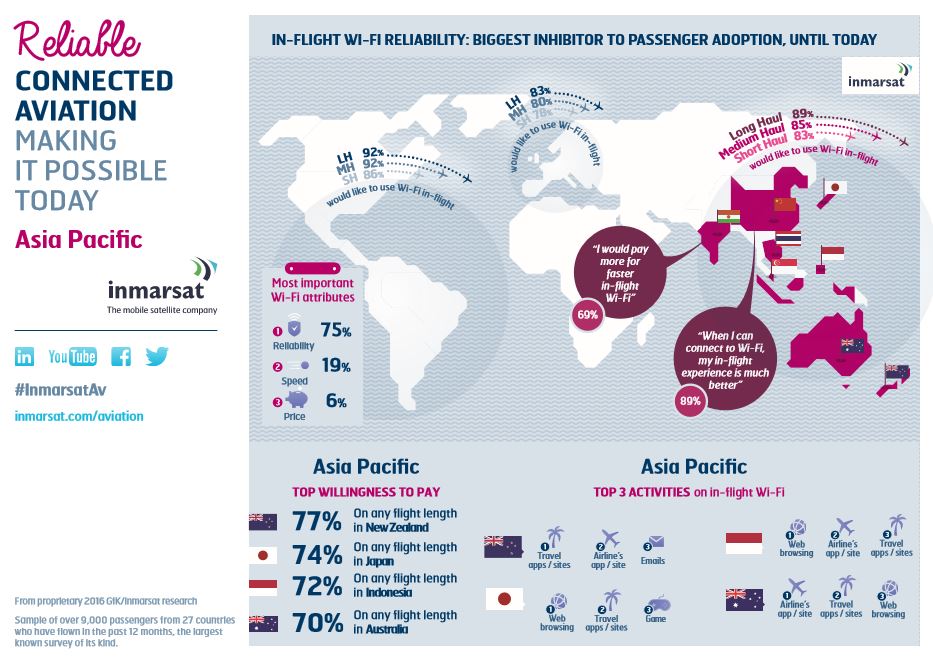
    According to the survey, conducted by Inmarsat and market research firm GfK, nine out of ten respondents from the region say the availability of onboard connectivity would influence their choice of airline, while over two thirds are willing to pay for the service.

    Meanwhile, 54% and 57% of Asia Pacific passengers would choose inflight broadband as a preferred service in short-haul and long-haul flights, compared to only 16% and 18% choosing traditional in-flight entertainment (IFE) as their preferred onboard service.

    Business flyers are even more likely to recognize the value of paying for high-speed onboard connectivity than vacationers, with 74% of business travelers surveyed indicating they are willing to pay more for faster inflight broadband compared to 62% of leisure travelers.

    The survey revealed that 64% of passengers felt that in-flight broadband can deliver all of their onboard entertainment needs. This highlights an opportunity for airlines to use in-flight broadband to increase ancillary revenues, as the majority of passengers are willing to pay for the service, with 68% of passengers under 34 years old and 55% of passengers over 45 years old willing to pay for unlimited internet usage during a flight.

    When it comes to the quality of the inflight broadband service, passengers are most concerned about reliability (that a connection does not drop out or cut off), availability (that the connection is available throughout the flight), and speed of the connection.

    Inflight WiFI reliabilityThe survey showed that quality is even more important than price in Asia Pacific, as passengers are prepared to pay more for a quality service. Some 72% of flyers in Asia Pacific would prefer not to use broadband that is of poor quality with 62% stating they would pay more for faster in-flight broadband
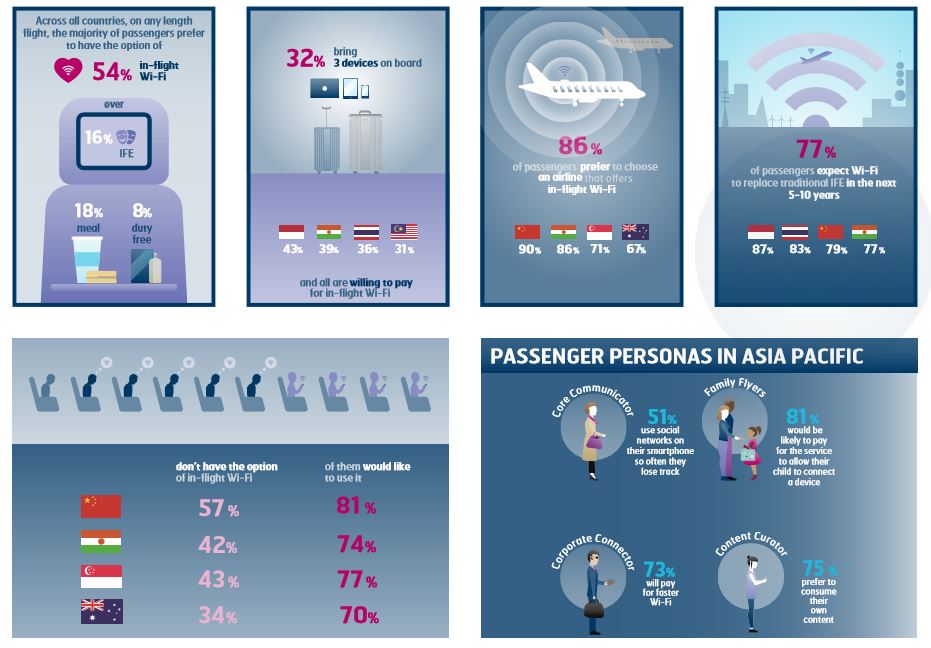


    “Our survey has highlighted a growing appetite for fast, reliable and consistent broadband in the air, with more than half of Asia-Pacific passengers preferring in-flight connectivity over a meal or traditional IFE,” said Bill Peltola, Asia Pacific regional director at Inmarsat Aviation.

    “Although three-quarters of Asia Pacific flyers would like to try onboard broadband in the future, only 3% of aircraft operating in Asia Pacific today offer the service, highlighting the potential for airlines to use it as a differentiation point to attract more customers.

    The inflight broadband connectivity survey

  • Nokia could cut up to 15,000 jobs

    Nokia could cut up to 15,000 jobs

    Nokia could cut as many as 15,000 jobs worldwide as part of the cost-cutting program associated with its merger with Alcatel-Lucent, union officials estimate.

    A Nokia union steward as stating that based on the information received so far, the union estimates that the job cuts are likely to be around 10,000 to 15,000 jobs.

    This would represent as much as 14% of Nokia’s current global workforce of 104,000.

    So far Nokia has revealed plans to cut around 1,000 jobs in its home market of Finland, 1,400 positions in Germany and 400 in France. But Nokia has also agreed to create 500 R&D jobs in France as part of its compromise to win French government support for the Alcatel-Lucent takeover.

    A Nokia spokesperson declined to confirm or deny the figure to Reuters or give any updates on its negotiations with employee representatives. The company is conducting these negotiations in around 30 countries.

    The cost cutting program has the aim of cutting operating costs by around €900 million ($1 billion) by 2018 by reducing the overlaps between Nokia and the former Alcatel-Lucent.

    The program is also aimed at responding to the ongoing slowdown in the network infrastructure market. Nokia is forecasting a decline in network sales for the current financial year.

  • Chinese sports brands back in the race

    Chinese sports brands back in the race

    A government-backed campaign to encourage healthy living is helping give Chinese sports brands traction again in the domestic consumer market.

    After three tough years with the slowing economy and over-expansion following the Beijing Olympics in 2008, the brands are ready to compete again, thanks to cutbacks in store networks and more choice in online sales channels.

    When Beijing was preparing to host the Olympics, sportswear companies began to expand aggressively, with leading brands adding nearly 1000 points-of-sale each every year between 2007 and 2011, according to Hong Kong brokerage and investment group CLSA analyst Dawei Feng.

    However, sales were undermined by cheap knock-offs and competition from expanding overseas fashion chains such as H&M, Uniqlo and Zara.

    Between 2012 and 2013, China’s biggest sports brand Anta closed 900 shops across the country. Also cutting stores from 8255 to 6133, Li Ning became profitable last year after three years of losses.

    Anta has been working with its stores on marketing, says Bloomberg Intelligence analyst Catherine Lim. It also started a children’s brand after China scrapped its one-child policy.

    Anta, which holds distribution rights to the Fila brand in China, is the official sportswear sponsor of the Chinese Olympic Committee.

    China’s five publicly traded sportswear companies have a combined market value of about $9.4 billion, or less than a 10th of Nike, the world’s largest sporting-goods maker.

  • Asia drops Burberry profit

    Asia drops Burberry profit

    Hong Kong has been blamed for a further decline in Burberry profit and a consequential cutback of staff and products.

    The British luxury goods brand has reported an 8 per cent fall in adjusted pre-tax profit to £421 million in the year to March 31 on flat revenue of £2.5 billion.

    In an earnings call, CFO Carol Drinkwater said trading in Hong Kong and Macau, which account for about 8 per cent of sales, remained tough, but the group’s stores there are still profitable, and all luxury brands were affected.

    “Conditions remain extremely challenging,” she said.

    As Andy Hall, explains, retail like-for-like sales were down by 1 per cent globally.

    But that was entirely due to falling demand in Hong Kong and Macau, where Burberry and its peers have had to contend with a collapse in demand for luxury goods. Excluding the two territories’ figures, same store sales rose a more respectable 3 per cent.

    “While the Burberry brand retains appeal globally, wider economic conditions and trading in traditionally lucrative Asian markets has dampened footfall, and hurt luxury players like Burberry the most,” said Hall.

    CEO Christopher Bailey is now looking to create a more efficient retail operation – with a £100 million cost reduction plan to be implemented over the next two years to restore profit growth and appease increasingly nervous shareholders while it weathers the Hong Kong storm.

    The company plans to cut between 15 and 20 per cent of its products across all its range, focus more on handbags and eliminate about 100 jobs.

    “I am mindful we are embarking on this plan at a time when our industry is facing significant challenges,” said Bailey, who has seen the company’s market value fall by about 37 per cent over the last 12 months.

    Handbags have higher margins and the company is not selling as well as rivals Louis Vuitton and Prada in that category.

    Furthermore, Burberry is aware it needs to increase its sales per square foot, currently estimated at around 1600 euros a year, a third that of Louis Vuitton and also well behind Moncler and Prada.

    Bailey has conceded Burberry is not as good as its rivals in “retailing basics”. It now plans to make its stores more productive by further tailoring ranges for local customers, improving customer service, increasing staff training and reviewing merchandise to highlight a reduced, simpler range of product.

    Hall says a renewed focus on in-store service and productivity would bring Burberry in line with the focus of luxury peers and would create a leaner, fitter operation with which to take the blows being dealt by a declining global demand.

    “Burberry’s decision to streamline its product ranges, at the same time as introducing some new products such as its Scarf Bar and new male fragrances, demonstrates its commitment to innovation, and attempts not to be left behind by other luxury fashion players.”

    Hall says Burberry has a lot of attributes in its favour and the collapse in demand in Hong Kong is unlikely to be its undoing.

    “However, with the retailer now re-focusing its efforts on retail (which accounts for 73 per cent of group revenue), it is crucial it continues to make pro-active improvements to the business. Examples of this – such as its reshaping of the fashion-show calendar, and imminent relaunch of its Burberry.com website, will help the brand to retain strong recognition, and ensure it holds its appeal even as the wider trading backdrop remains challenging,” said Hall.