Category: Finance

Retail News Asia is committed to providing both local and global retailers with the latest Finance news throughout the Asian market. This on a daily base.

  • Wirecard Dupe With Hollywood Methods

    Wirecard Dupe With Hollywood Methods

    The collapsed German fintech’s sacked operating chief went to the extreme – and adventurous – lengths to bamboozle auditors, according to a German report.

    Jan Marsalek – recently added to Interpol’s most-sought fugitives list after going AWOL in June – led more than one life: by day, the 40-year-old Austria was the right-hand-man to Wirecard boss Markus Braun. Out of business hours, Marsalek’s manifold commercial and political pursuits included plans for recruiting 15,000 Libyan militiamen, for example.

    The 40-year-old Austrian’s lives seem to have overlapped, according to a report in Germany’s Manager MagazinMarsalek probably duped auditors from EY by hiring actors in the Philippines and setting up sham bank offices when auditors visited to check on 1.9 billion euros ($2.25 billion) of Wirecard’s money, it said, citing a KPMG forensic report.

    The billions, of course, are missing, Wirecard is in wind-down, Braun and others are being criminally investigated, and Marsalek dropped out of sight after being sacked eight weeks ago. According to media reports, he may be hiding out in Moscow protected by the GRU, Russia’s army intelligence unit. Marsalek’s lawyer didn’t comment to the outlet.

    The Wirecard scandal has spread to German regulator Bafin, which is being sued by Wirecard investors for allegedly overlooking warning signs. Germany’s top finance and economic ministers are also under fire, while lenders like Commerzbank are taking hefty provisions due to their exposure to the Munich-based company.

  • DBS Finances Floating Solar Farm

    DBS Finances Floating Solar Farm

    The bank is the sole financier for one of the world’s largest inland floating solar photovoltaic systems to date. DBS Bank has provided a $40 million loan facility to Sembcorp Industries to build a 60 megawatt-peak (MWp) floating solar photovoltaic (PV) system on Tengeh Reservoir in Tuas, Singapore, the bank announced on Thursday.

    The reservoir, scheduled to begin full commercial operations in 2021, covers an area of around 32 hectares and will generate enough energy to power about 16,000 four-room HDB flats, offsetting about 32 kilotons of carbon emissions annually, which equivalent to taking approximately 7,000 cars off the roads.

    As part of its transition to a low-carbon economy, Singapore aims to achieve a solar target of at least 2 gigawatt-peak (GWp) by 2030. With this project, Sembcorp will be one of the largest renewable energy players in Singapore with approximately 240 MWp of solar capacity in the country.

    Enabling renewable energy financing is at the core of DBS’ agenda and is one of the key tenets of our sustainability strategy, Lim Wee Seng, DBS Bank’s head of Energy, Chemicals, and Infrastructure, said about the investment.

    DBS seeks to differentiate itself in renewables financing – capturing financial advisory opportunities so we shape and influence early, Lim said.

    The bank was previously an advisor for Taiwan’s largest floating solar project and also Taiwan’s largest ground-mounted solar project, and earlier this year garnered four new advisory mandates across solar, wind and geothermal assets in Indonesia, Taiwan and Vietnam.

  • Visa launches “Team Shop Chat Thai” lucky draw campaign to help power Thailand’s economic recovery

    Visa launches “Team Shop Chat Thai” lucky draw campaign to help power Thailand’s economic recovery

    Visa, the world’s leader in digital payments, today announced the launch of “Team Shop Chat Thai” lucky draw campaign offering rewards to Visa cardholders.  The campaign is a collaborative effort led by Visa, along with its bank and merchant partners, to stimulate local economic activities and support Thailand’s economic recovery.

    Under the campaign, Thai shoppers stand a chance to win prizes worth up to 2,000 baht when spending a minimum of 1,000 baht per receipt on their Visa cards, including credit, debit or prepaid.

    Prizes include a 2,000 baht hotel stay, Thai Smile air tickets to the value of 2,000 baht, and 1,000 baht worth of entry tickets to tourist destinations in Bangkok, Pattaya, Chiang Mai and Phuket.  The total prize pool will see 2,000 prizes to be given away worth a total of 3,000,000 baht.  The campaign runs from today to 30 September 2020.

    Visa has recently announced its cooperation with the Tourism Authority of Thailand (TAT) to expand the acceptance of digital payment locations in Bangkok and five major tourist cities across the nation in a bid provide local businesses with a more hygienic digital payment option and help recapture consumer confidence. Visa has also collaborated with Thailand’s leading FinTech companies to make it easier and faster for Thai social commerce sellers, including individual sellers and small businesses on social media platforms, to accept Visa card payments.

  • Citi-Backed Data Management Firm to Expand in APAC

    Citi-Backed Data Management Firm to Expand in APAC

    U.K.-based enterprise data management company Solidatus said it will accelerate its growth plans in the region, following a strategic investment by Citi.

    Citi, the first major investor in the startup, will also implement the Solidatus platform internally at a global enterprise level, according to an announcement on Tuesday.

    Solidatus’ software helps organizations to gain greater insight and control of complex data across operational and technological ecosystems, which allows them to both satisfy regulators and react quickly to change. Its clients include retail giant Walmart and Deutsche Bank.

    The Solidatus solution will support Citi’s ongoing commitment to change management, helping our global infrastructure to stay agile, efficient and robust, Chris Hayward, Citi chief data officer, said in the announcement.

    Solidatus said it sees great opportunities in the Asia-Pacific market, and opened its Singapore office in 2019, which functions as its regional headquarters as it sets its sights on growth in Southeast Asia and China.

    The Singapore office is led by information technology and banking industry veteran John Berven, who previously spent almost 18 years at State Street, most recently as its head of real money FX sales in Hong Kong and Singapore.

  • DBS to Train Staff in AI and Machine Learning

    DBS to Train Staff in AI and Machine Learning

    The bank hopes to equip its employees with skills in these areas, under a partnership with cloud services provider Amazon Web Services (AWS).

    DBS Bank will accelerate the use of artificial intelligence (AI) and machine learning (ML) across its business by training its staff in these skills with the launch of the AWS DeepRacer League, the bank announced on Tuesday.

    As part of the program, DBS staff will learn the basics of AI and ML through hands-on online tutorials and will use their knowledge in programming an autonomous model race car to compete in a virtual racing environment. The bank hopes to train some 3,000 employees, including its senior leadership, by the end of the year. The league is the largest among Asian-headquartered enterprises and one of the first in the world to be organized at scale by a financial institution, the announcement said.

    Employees are also encouraged to develop their talent beyond the bank’s league and compete globally – the bank said six of its employees have already qualified for the AWS DeepRacer Championship Cup to be held in Las Vegas later this year.

    We have never believed in limiting digital expertise to a small team. Instead, we passionately believe in democratizing technology skillsets among all employees, so that they can run alongside the company as we advance on our digital transformation together, Paul Cobban, DBS chief data and transformation officer, said.

    DBS said it is preparing for the next stage of its digital transformation efforts and has been leveraging AI and ML in areas such as advanced credit risk management, and to provide accurate self-service digital options to its retail customers based on their digital footprint.

  • Lu Partners Thai Bank to Grow Digital Wealth Management

    Lu Partners Thai Bank to Grow Digital Wealth Management

    The Singapore-based subsidiary of leading Chinese retail fintech Lufax has announced a strategic partnership to meet rising demands for digital financial services in Thailand.

    Lu will work with Kasikornbank to jointly build a digital wealth management platform, which will be jointly operated and managed by both parties, to serve retail investors in Thailand, the company announced in a statement on Monday.

    The world is about to enter another wave of digital disruption as big players like commercial banks morph into fintech organizations. It is imperative that we quickly adjust ourselves and strengthen our capabilities to seek new business opportunities, Kattiya Indaravijaya, Kasikornbank CEO, said about the partnership.

    Established in 1945, Kasikornbank is the fourth-largest commercial bank in Thailand, with 17.3 million customers, including 12.7 million online users. The bank has been actively promoting the digitization process in recent years, and is committed to providing a full range of financial services through digital platforms to its customers.

    Lu International, Lufax’s first international arm, was set up in Singapore in 2017. Since then, it has grown its operations and market reach, which now spans several markets in Asia, with over 380,000 registered customers.

    The company said it plans to capitalize on growth opportunities for financial services in up-and-coming economies throughout and beyond Southeast Asia.

    «We will continue to grow our capabilities in Southeast Asia, extending our footprint in the region to meet the needs of our customers and support the business growth of our partners,» Kit Wong, Lu International CEO, said.

  • AEON Thailand Foundation donates computers and school necessities to The Thai Red

    AEON Thailand Foundation donates computers and school necessities to The Thai Red

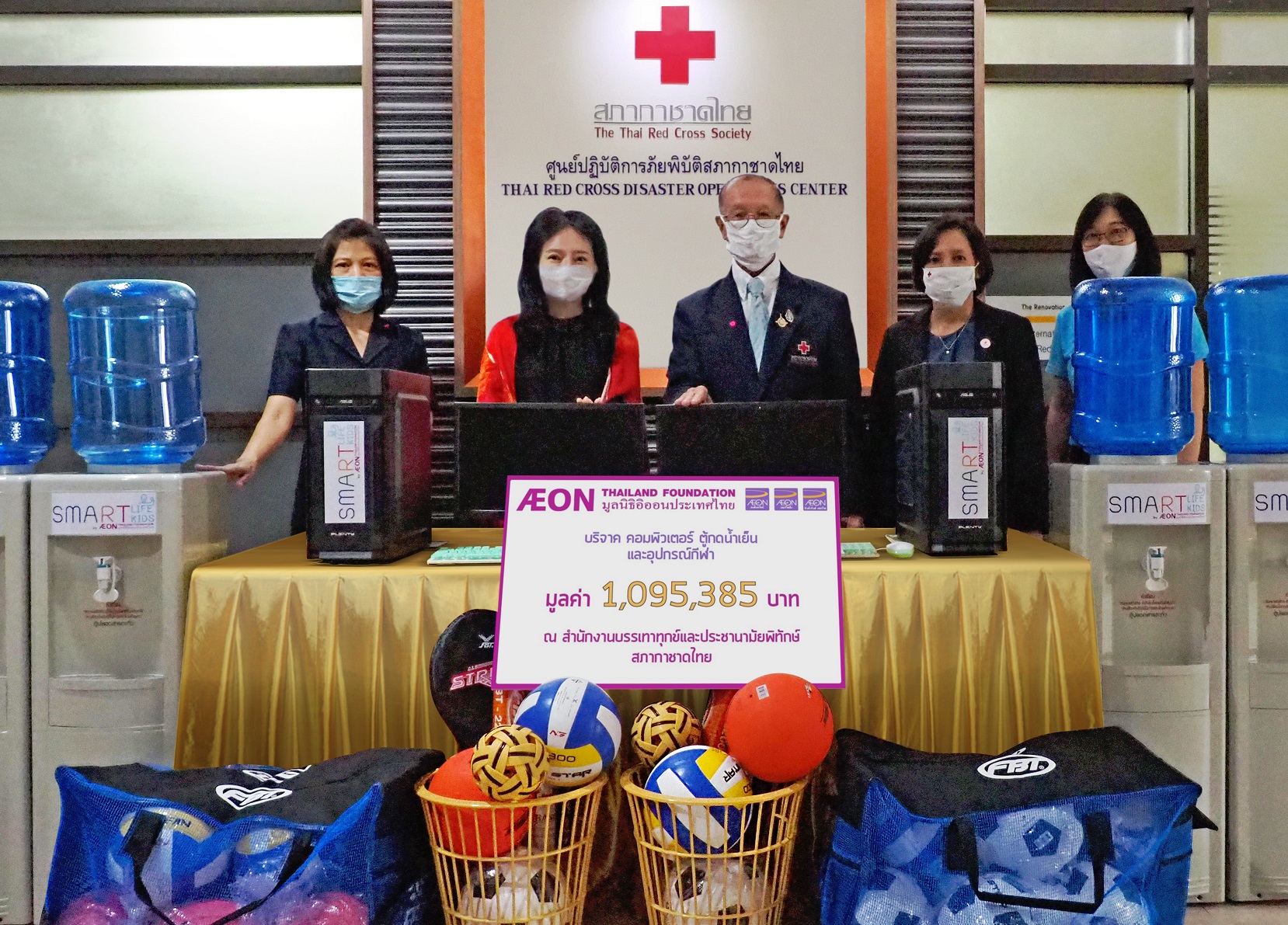
    Ms. Suporn Wattanavekin (2nd from left), chairman of AEON Thailand Foundation donated computers, sport equipment, and water dispensers valued 1,095,385 Baht to Relief and Community Health Bureau, The Thai Red Cross Society, received by Lt.Gen.(Rtd) Amnat Barlee, M.D., Director (at the center). The supplies will transfer to schools and unprivileged communities nationwide. One of AEON Thailand Foundation’s mission is to make better living for local areas across Thailand.

  • UBS Asia Head Promises Higher Return

    UBS Asia Head Promises Higher Return

    Asia will contribute a much higher percentage to UBS’ earnings going forward, according to Edmund Koh, the head of the company’s business in the region. One reason is the region’s faster recovery from the corona-crisis.

    Asia contributed 30 percent to the profit of UBS in the first half of 2020, the first time that the region has had such a major impact on Switzerland’s largest bank. While Asia previously contributed with a share of between 14 and 20 percent of group earnings, the division now aims to go beyond 30 percent, said Edmund Koh, the head of UBS Asia-Pacific in an interview.

    The Asian economies seem to be emerging from the pandemic-induced slump much earlier than European and American economies, which is one of the main reasons for the surge in the contribution of the region to UBS earnings. UBS Asia-Pacific pretax profit jumped 71 percent to $233 million in the second quarter compared with a year earlier.

    With plenty of liquidity in the market and very low-interest rates, clients went shopping for higher yields in the first half, which meant that trading was brisk and invested assets rose, according to Koh.

    The banker expects the good earnings momentum to persist throughout the second half of 2020, with July being described as «pretty good». Koh told the newspaper that based on the team’s performance in the first half and since he would expect the unit to maintain the result and end the year on an all-time record.

    The U.S. elections and the economic slump in parts of the world most affected by the pandemic will create more «nervousness» in the market in the second half, which will present more opportunities for investors, Koh added. Overall, trade and consumption will fuel economic growth in Asia in the second half, which gives the bank reason to remain «risk-on» in the region. Singapore and India are the equity markets most preferred by UBS in Asia.

    Koh also suggested that the banking industry may suffer in coming quarters as government support measures end. Still, with UBS being in the market for the wealthy clientele, it is likely to be less affected by the risk of bad debt.

  • OCBC Partners Asset Manager for New Fund

    OCBC Partners Asset Manager for New Fund

    The co-branded solution to address investor needs during times of stress and uncertainty and has a built-in dollar-cost averaging feature. French asset manager Amundi and OCBC Bank on Wednesday announced the launch of the Amundi-OCBC Momentum Fund – a mixed-asset product that invests in global bonds and equity ETFs.

    According to its prospectus, the Momentum Fund lets the portfolio manager initiate dollar-cost averaging for the investor. The fund leverages the cost-averaging effect when it systematically allocates assets from an initial pool of fixed income securities to equity ETFs, which helps to average out the costs of investing into equities and position the fund for a potential equity market recovery. Investors are also paid a quarterly dividend of up to 3 percent per annum.

    The fund is the first co-branded tie-up between the two partners, though OCBC has been distributing four other products from Amundi, according to the bank’s website.

    Investors should stay invested in the market and not wait for blue skies. They should manage risk by investing carefully and staying diversified across asset classes and by taking on risk gradually over time through regular investments – in other words – dollar-cost averaging. This can benefit investors by potentially lowering the average cost per unit of an investment, especially during times of volatility, Tan Siew Lee, OCBC’s head of wealth management, Singapore, said about the new fund.

    The bank noted the benefits of a multi-asset strategy in an uncertain economic environment, as it provides relative stability over equities. The fund has a target allocation of 50 percent global bonds and 50 percent global equity ETFs, with a maximum of 25 percent into non-investment grade bonds.

    DBS Bank also recently launched a multi-asset fund with Schroders that includes a unique decumulation share class targeted at retiree investors, with exposure to a range of investment growth themes across Asia.

  • DBS Brings Automated Supplier Financing to Construction Sector

    DBS Brings Automated Supplier Financing to Construction Sector

    The solution aims to improve productivity and remove inefficiencies in the sector’s procurement and payment processes.DBS Bank has partnered with Singapore fintech Doxa to pioneer a procure-to-pay solution for Singapore’s construction sector, according to an announcement on Thursday.

    DBS worked with the main contractor Tiong Seng Group and its supplier network to validate the construction industry’s process flows and develop a solution to eliminate manual administrative processes that plague the industry. The solution, Doxa Connex, digitalizes and automates the majority of the manual procurement and payment processes and documentation, which could lead to a reduction in administrative fees and processing costs of at least 50 percent, the statement said.

    «Covid-19 has accelerated the need for many industries to turn to digital solutions to continue operating safely even amid manpower constraints, and the construction sector is no exception. Proactive and timely digital transformation will put construction companies in good stead for recovery and growth when economic activity picks up and demand for construction services resumes,» Chew Chong Lim, DBS managing director, and global head of real estate, institutional banking, said.

    The construction sector accounts for more than 4 percent of Singapore’s gross domestic product but has been slow to embrace technology along the construction value chain. The announcement cited a recent study by Autodesk and IDC that said only 2 percent of construction firms have automated most of their manual processes.

    Tiong Seng is keenly aware of the need to embrace Integrated Digital Delivery (IDD) in the entire value chain of the built environment sector. We have thus made digitalization one of our core drivers for industry transformation, John Keung, Chairman of Tiong Seng Contractors, said about the launch of Doxa Connex.

  • ABN Amro Overhauls Corporate Bank

    ABN Amro Overhauls Corporate Bank

    Following a review by its new CEO, the bank will wind down all of its non-European corporate banking operations and stop providing trade and commodity finance.

    «We will serve clients in segments where we can achieve scale, so we will focus on the Netherlands and Northwest Europe, where we will invest and grow,» CEO Robert Swaak, who was appointed in January, said in comments with the bank’s second-quarter results, published Thursday.

    Going forward, the bank’s Corporate & Institutional Banking (CIB) will focus on clients in Northwest Europe and Clearing and will exit all non-European corporate banking activities. Trade & Commodity Finance activities will be discontinued completely, and Natural Resources and Transportation & Logistics will be limited to Europe, while it will impose stricter lending criteria and credit limits, the bank said on Tuesday.

    Non-core activities, which comprise around 45 percent of CIB’s client loans, representing approximately 35 percent of CIB’s RWA and over 10 percent of total RWA, are expected to be wound down in the next three to four years and will affect around 800 full-time employees, of which 150 are in the Netherlands.

    A Netherlands-based spokesperson for ABN Amro said that the schedule of winding down for non-core activities has not been set and that it will differ based on business line and region. In Singapore, only its Clearing desk will remain.

    We can not yet say exactly how many jobs in Singapore are impacted. This will also be worked out in the coming period, the spokesperson said.

    The bank had one of the largest exposures of any bank to the collapse of Singapore oil trading company Hin Leong, at around $300 million. It also had a smaller exposure to Zenrock Commodities Trading, another scandal-hit Singapore oil trading firm.

  • Standard Chartered Partners with Juwai IQI to Redefine the Client Experience

    Standard Chartered Partners with Juwai IQI to Redefine the Client Experience

    Standard Chartered and Juwai IQI have announced a partnership across their networks to redefine the client experience of banking and property investment. Juwai IQI’s real estate agent network IQI Global has 10,000 agents across offices in 15 countries, while Standard Chartered has a presence in 59 countries.
    Abrar A. Anwar, Managing Director and CEO of Standard Chartered Malaysia said: “Real estate is a vital asset class for our clients as a means to diversify their investments. This collaboration offers Juwai IQI’s clients access to Standard Chartered’s comprehensive range of property loans and mortgage solutions to help them achieve their property ownership dreams.”
    Juwai IQI Executive Director Kashif Ansari said: “The majority of property investors use finance to leverage their returns. Investors also have many other financial needs, from private banking to personal loans and credit cards. Standard Chartered is one of the world’s leading banking groups. Together, we can improve both the banking and property investment experience for our mutual clients, and even save them money.
    “Both Standard Chartered and Juwai IQI are leaders in the application of data for business growth. By combining our knowledge, we expect to be able to improve existing services and offer new opportunities to our clients.
    “The partnership between Standard Chartered Malaysia and Juwai IQI will help to provide our mutual clients with the resources and opportunities they need to be successful.”
  • Standard Chartered Taps Microsoft for Digital-First Strategy

    Standard Chartered Taps Microsoft for Digital-First Strategy

    As its preferred cloud platform provider, Microsoft will help the bank make its vision for virtual banking, next-generation payments, open banking and banking-as-a-service a reality.

    Standard Chartered has established a three-year strategic partnership with Microsoft to accelerate its digital transformation through a cloud-first strategy, according to an announcement on Tuesday.

    As part of the partnership, Standard Chartered will adopt Microsoft Azure as its preferred cloud platform to meet its need for resilient data centers and cloud services with the highest security and regulatory standards. The bank will also leverage Microsoft’s artificial intelligence (AI) and analytics capabilities to automate banking processes and deliver hyper-personalization of its products and experiences for customers, and its employees globally will also adopt Microsoft’s collaboration, office productivity and document management tools to advance digital workplace transformation.

    «he pandemic has shone a spotlight on the need for businesses and banks to be resilient from a risk mitigation, cost, and security perspective. With the increasing trend of an always-on digital economy, commercial and consumer clients are looking for applications and services that empower them to do online banking from anywhere, flexibly and efficiently,» Bhupendra Warathe, chief technology officer, cloud transformation at Standard Chartered, said about the bank’s digital-first strategy.

    The bank’s core banking and trading systems and new digital ventures such as virtual banking and banking as-a-service will be cloud-based by 2025, and it will also adopt a cloud-first principle for all new software developments and major enhancements, the announcement said.

    The first set of capabilities to move to Azure will be Standard Chartered’s trade finance systems, which will facilitate seamless cross-border trade for the bank’s corporate and institutional clients.

    Covid-19 has further accelerated drive to digitize banking services, and we are determined to be at the forefront,» Standard Chartered group CEO Bill Winters said in a LinkedIn post about the announcement.

  • HSBC Private Banking Names Southeast Asia Market Heads

    HSBC Private Banking Names Southeast Asia Market Heads

    Less than four months after the exit of single ex-market head of Singapore and Malaysia, HSBC Private Banking promotes two internally to head the respective markets.

    HSBC Private Banking named Ken Ng as market head for Singapore and Gary Goh as market head for Malaysia, replacing the former dual-head Chow Shang-Wei who resigned earlier this year after a four-year stint, according to a statement.

    Ng is an HSBC veteran, joining the British lender in 1995 with experience across wealth management, corporate banking and risk. He joined the private banking arm in 2014 and was previously a desk head.

    Goh has 23 years of experience in the financial industry and joined HSBC Private Banking in 2019 from Standard Chartered Private Bank where he headed the Singapore market. Previously, had also worked at UBS Wealth Management, as a desk head for its Chinese entrepreneur segment, as well as at Credit Suisse and Citigroup.

    Although the bank is running an accelerated global overhaul which includes 35,000 job cuts, it remains in growth mode in Asia especially following a restructuring that created a $1.4 trillion wealth and personal banking unit. The unit has set various expansion targets, including up to 3,000 hires by 2024 in its Guangzhou and Shanghai offices.

    In the latest duo appointments, the bank added that it would seek to double its Singapore wealth and personal banking unit over five years as part of its «efforts to cement Singapore’s role as a prime international wealth center.

    Southeast Asia is home to some of the fastest-growing economies spurring the next generation of wealthy entrepreneurs,» said Philip Kunz, Southeast Asia head of global private banking. «Singapore and Malaysia sit at the nexus as many entrepreneurs look to expand regionally.

    In the last 12 months, HSBC has been actively rostering senior positions in its private bank with a string of hires and internal appointments.

    Last month, the private bank promoted another duo – Jeffrey Yap and Adam Lau – as Southeast Asia head of investment services and product solutions and the newly created role of APAC head of market solutions, respectively. It also expanded to its Greater China product and investment teams in late 2019 with the addition of Lina Lim, ex-J.P. Morgan; Rocky Cheung, ex-DBS; and Simon Hwang, ex-Citi.

    Other senior moves included the hire of ex-Deutsche exec Lavanya Chari as the global head of products, investment and collaboration; ex-J.P. Morgan exec Sharon Oh as chief operating officer; and the appointment of Cynthia Lee as APAC head of private wealth solutions.

  • SGX to Expand Equity Derivatives Shelf

    SGX to Expand Equity Derivatives Shelf

    The bourse is adding 13 Asia ex-Japan and emerging markets Asia regional and single country futures to its shelf of benchmark equity derivatives.

    The new futures are based on Net Total Return (NTR) and Price Return indices calculated by FTSE Russell, which has approximately $16 trillion in reported fund assets under management (AUM) tracking its benchmarks.

    SGX said the benchmarks of the new future, which cover Indonesia, Malaysia, Philippines, Taiwan, Thailand, and Vietnam, addresses customers’ «increasing demand for institutional-grade exchange solutions in Asia which offer superior operational and capital efficiency.»

    The new contracts are expected to be certified by the Commodity Futures Trading Commission (CFTC), enabling US investors to trade them directly from within the U.S.

    SGX currently has the largest and most liquid FTSE and MSCI equity index derivatives for Asian markets.

    Michael Syn, head of equities at SGX, said its collaboration with FTSE Russell is the «next step in further developing and advancing SGX’s Asia-access waterfront.»

    «We look forward to bringing investors even more asset-class opportunities within the pan-Asian capital structure, based on broad strategies, sectors, and themes,» Syn said.