Category: Finance

Retail News Asia is committed to providing both local and global retailers with the latest Finance news throughout the Asian market. This on a daily base.

  • Standard Chartered and IFC Offer Trade Finance Facility

    Standard Chartered and IFC Offer Trade Finance Facility

    It will be used to help sustain trade flows in developing countries and narrow the gap in global trade finance.

    Standard Chartered and the International Finance Corporation (IFC), a member of the World Bank Group, are partnering on a $1 billion facility to boost trade financing in emerging markets the two parties announced in a press release on Wednesday.

    This arrangement will allow the two partners to equally share the risk of trade flows of a portfolio of small and medium-sized enterprises and is expected to enable $4 billion in trade finance in Asia, the Middle East and Africa in the next three years.

    The announcement noted the $1.5 trillion global trade finance gap and said the facility will bring trade finance to local and regional companies, some of which are credit-constrained and rely on bank trade facilities to manage cash flows and purchase raw inputs.

    Paulo de Bolle, senior director of IFC’s Financial Institutions Group called the facility a «unique partnership that can help counter de-risking trends in developing countries and support real-sector demand for trade finance.»

  • OCBC Bank named World’s Best Consumer Bank byGlobal Finance

    OCBC Bank named World’s Best Consumer Bank byGlobal Finance

    OCBC Bank has been named the World’s Best Consumer Bank by international financial publication Global Finance. This comes on top of the ‘Best Bank in Asia-Pacific’ title that Global Finance awarded to OCBC Bank in April 2019. Mr Raymond Chee, General Manager of OCBC Bank’s New York Agency, was at the 20th World’s Best Bank Awards ceremony in Washington D.C. to receive the latest honour.

    Mr Ching Wei Hong, Chief Operating Officer of OCBC Bank, said: “We are honoured to be recognised as a global leader in consumer banking. This award is a testament to our unceasing obsession with customer-centricity. Competition is a constant in the consumer banking industry and consumers are constantly on the lookout for innovative products and services that blend seamlessly into the rest of our daily lives.

    “As we drive deeper customer engagements through our digital transformation, we will continue to maximise the value we offer to each customer by placing his or her needs, aspirations and ideals at the centre of our every product, service, process and policy.”

    Mr Joseph Giarraputo, President and Editorial Director, said: “Singapore consumers are benefiting from OCBC Bank’s early adoption of digital channels, with instant approvals for key banking products. By making use of the national data repository, MyInfo, as well as its own systems, OCBC is able to authenticate customers in real time and to pre-fill application forms with personal details. The bank has eliminated pain points for clients and is leading the way in frictionless banking. OCBC’s strong presence in Asian countries other than Singapore enables it to offer the same model in the rest of the continent.”

    Global Finance winners were selected based on performance over the past year and other criteria including reputation and management excellence. Global Finance made the selections after extensive consultations with corporate financial executives, analysts and bankers throughout the world.

    Most recently, OCBC Bank was the first in Singapore to enable customers to use their voice to perform banking transactions and access services, and the first in Singapore to enable cash withdrawals at ATMs using QR codes.

    OCBC Bank was the first bank in Southeast Asia to launch a robo-investment service that enabled customers to start investing and growing their wealth in a simple and self-directed way.

    OCBC Bank was the first bank in Singapore to allow customers to instantly open and use a new bank account, leveraging MyInfo and OCBC Bank’s digital KYC process; digital applications and instant approvals of OCBC’s most popular savings account, the OCBC 360 Account, have since grown three-fold. Also available is instant approval of online applications for products like personal loans and credit cards.

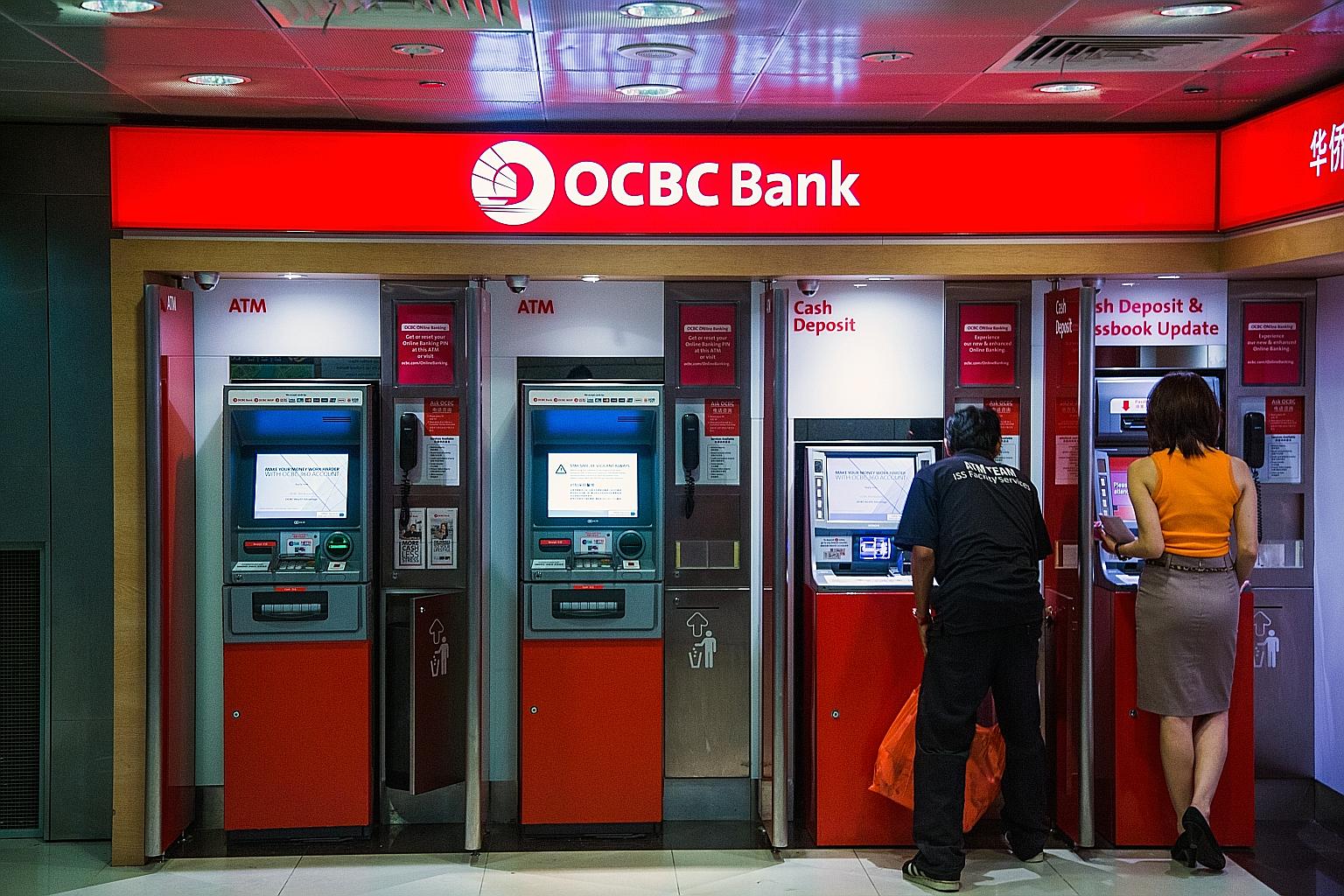
    OCBC Bank has earmarked $14M to roll out its new-age ATMs and digital service kiosks at 35 branches by 2020. This will enable customers to get their banking done without having to queue. Fifteen per cent of over-the-counter branch transactions have since been migrated from the teller counter to these machines.

    OCBC Bank was first bank in Singapore to offer a free online will writing service to help Singapore citizens and residents prepare their own wills within 10 minutes.

    The FRANK by OCBC banking programme created in 2011 remains the only programme in Singapore to provide millennials with banking products and solutions designed for them as they go from being students in tertiary education to entering the workforce as young professionals. FRANK by OCBC offers millennials deposit accounts, credit and debit cards, insurance, investment products and study loans.

    OCBC Bank has had the highest number of winners across the financial industry for four consecutive years at the Association of Banks in Singapore (ABS) Excellent Service Awards, and were also honoured with the Highest in Retail Banking Customer Satisfaction by J.D. Power’s 2018 Singapore Retail Banking Satisfaction Study. This year, the bank also won top honours for ‘Best ATM Innovation’ and ‘Best Self-Service Banking’ at The Digital Bankers Global Retail Banking Innovation Awards 2019.


  • Merlin Entertainments takes on global digitalisation with Adyen’s payment platform

    Merlin Entertainments takes on global digitalisation with Adyen’s payment platform

     Adyen, the payments platform of choice for many of the world’s leading companies, has partnered with Merlin Entertainments plc a global leader in location-based, family entertainment, to consolidate its payments experience across more than 130 attractions in 25 countries around the world.

    Adopting Adyen’s single payments platform supports Merlin Entertainments’ future expansion globally by transforming payments from a bottleneck into a seamless process that improves the experience for its customers while driving conversion rates.

    Merlin Entertainments is one of the world’s largest attraction operators with global attractions like LEGOLAND Parks and Discovery Centres, Sea Life and Madame Tussauds. Adyen will process payments across all services under Merlin Enterprises, ranging from quick-service restaurants, hotels and accommodation, retail, annual memberships, wearables and ticketing.

    “Given the nature of our business, our brands span across hospitality, restaurants, hotels and theme parks. Adyen’s platform will consolidate our various payment solutions under a single platform across our entire global business. Merlin sees significant opportunity from the increasing importance of digital and technology, allowing for enhanced guest experiences,” Mark Allsop, Chief Digital Marketing and Information Officer at Merlin Entertainments, comments, “With Adyen accepting transactions from all channels, whether that be eCommerce, mobile, Point of Sale (POS), kiosk or wearables, our guests get shorter wait times, faster entry to attractions and convenient payments with a simple tap or swipe. The new payment solutions form part of our wider strategy to improve loyalty, drive revenue and continue to deliver high guest satisfaction across our resorts”

    Customer experience is the central focus for Merlin’s guests. Payments can form a big part of that overall experience, reducing wait times for food, faster admissions to attractions and a range of payment alternatives to suit foreign tourists. Adyen’s global payment platform also helps the company achieve its growth objectives within its existing portfolio, and to support the roll-out of new attractions and accommodation around the world.

    “Merlin Entertainments saw 67 million visitors across its diverse portfolio of attractions last year. The likes of wearable technology and tokenisation are the next step in customer experience and seamless payments and Merlin Entertainments is at the forefront of this deployment across hundreds of different locations” said Roelant Prins, CCO of Adyen. “Merlin can now take full control of its payments architecture across all channels, simplifying a complex challenge faced by many merchants today.”

  • Standard Chartered Loses Major China Private Banking Veteran

    Standard Chartered Loses Major China Private Banking Veteran

    A longstanding Standard Chartered private banking veteran and 10 others have resigned from the British lender.

    Boris Kwok, a seasoned Greater China team head at Standard Chartered’s private banking arm, exits after joining in 2003. His departure is accompanied by 10 others, all of whom are from the Greater China and North Asia (GCNA) team which Standard Chartered called the «top contributor» to its private banking business.

    When contacted, a spokesperson for the bank confirmed the resignations but added that a majority of «very senior» private bankers remained with the firm and that it was «confident that the team will continue to provide superior client service.»

    Kwok’s move follows the departure of Srinivas Siripurapu, former private banking regional head for ASEAN and South Asia, who was quickly replaced by Cedric Lizin, who joined from UBS, where he was last its Dubai-based wealth management head.

    But despite its talent retention headwinds, Standard Chartered claims to have stayed on course in its hiring strategy. According to its spokesperson, the bank has hired 20 relationship managers year-to-date which is on track with expectations.

  • HSBC Ups Employee Childcare Benefits in India

    HSBC Ups Employee Childcare Benefits in India

    HSBC’s India arm has upgraded its female employee benefits, allowing reimbursement for daycare costs for their children up to the age of six.

    This marks an increase in the maximum age of a child from the previous two years old. For those seeking daycare reimbursement, each child is entitled per month to Rs 18,000 ($250) in Mumbai; $190 in National Capital Region, Bengaluru and Pune; and $141 in other cities.

    Mothers that do not wish for daycare reimbursement can receive a fixed $141 per month and HSBC claims to be the sole provider of such benefits.

    «With this policy, we have gone a step further to empower our women employees so that they can balance work life and motherhood better,» said Vikram Tandon, head human resources, HSBC India. This policy provides our working mothers the flexibility to choose the best from multiple childcare options for an extended time period.

  • Singapore’s Multi-Currency War Heats Up With Revolut Launch

    Singapore’s Multi-Currency War Heats Up With Revolut Launch

    After amassing more than 8 million customers, the tech unicorn has landed in Singapore, its second market outside Europe.

    After much anticipation, U.K. challenger bank Revolut has rolled out its services in Singapore. Customers can now open an account from their mobile phones and start spending worldwide in over 150 currencies at the real exchange rate without hidden fees.

    The digital-only bank had already been beta-testing its services over the past year and amassed 30,000 customers on its waiting list when it launched in the city-state on Wednesday.

    Revolut’s introduction promises to heat up the already competitive multi-currency war, which includes competitors YouTrip and in the near future, InstaReM and TransferWise.

    Revolut account holders get a multi-currency travel debit card and an account that supports the Singapore dollar and 13 other currencies, with another 14 more including, Indian rupees, Malaysian ringgit and Philippine pesos, to be added in the coming months, a press release said.

    Customers also get free worldwide ATM withdrawals, peer-to-peer money transfers, and foreign exchange, and its app integrates budgeting and savings management functionalities. Accounts are free, but the Premium account ($9.99 per month) and Metal account ($19.99) offer additional features and limits.

    At its launch event on Wednesday, the firm said it is working on bringing features that are already available in other markets, like cryptocurrency trading and commission-free stock market trading, to customers in Singapore.

    Revolut was founded by former Credit Suisse trader Nik Storonsky and former Deutsche Bank systems engineer Vlad Yatsenko in London in 2015 as a digital alternative to traditional banks. It has raised more than $336 million in funding from venture capital firms, and is valued at $1.7 billion.

    The firm opened its Asia-Pacific hub in Singapore office in 2018, where it employs 20 people. It plans to triple its headcount in the coming months.

    It plans to launch in the U.S. and Canada later this year.

  • UBS Reveals Client Overcharging Claims in Asia

    UBS Reveals Client Overcharging Claims in Asia

    Wealth management clients in Hong Kong and Singapore may have been overcharged, UBS said, adding that it is working with authorities and intends to reimburse affected customers.

    UBS claimed that it had identified and reported instances in which its global wealth management clients in Hong Kong and Singapore «may have been charged inappropriate spreads for bond transactions between 2008 and 2015.

    UBS intends to reimburse affected customers on a basis agreed with the relevant authorities,» the bank said in its third quarter report. UBS expects the relevant authorities will subject UBS to reprimands and fines as a result of their investigations.

    Despite the regulatory worries, Asia continues to be a primary growth driver for the bank, as evidenced by the latest figures. UBS’s global wealth management business posted net new asset of $10.9 billion in Asia, boosting the region’s total invested assets to $420 billion.

  • UOB Launches Solar Industry Ecosystem

    UOB Launches Solar Industry Ecosystem

    United Overseas Bank (UOB) on Tuesday launched U-Solar, the first solar industry ecosystem in Asia to power the development and adoption of renewable energy across Southeast Asia.

    Through U-Solar, the bank connects businesses and consumers in order to aid each play their role in their collective efforts to transition to a low-carbon economy, UOB said in a media statement on Tuesday. Malaysia is the first ASEAN country in which UOB is rolling out its U-Solar ecosystem.

    «A sustainable energy industry is key to maintaining healthy development of the economy and community. In working together with our ecosystem partners and customers to open up and to tap opportunities in the solar power industry, we can create a positive economic and social impact,» said Wee Ee Cheong, deputy Chairman and chief executive officer.

    Supporting The Value Chain

    Through U-Solar, the bank offers a suite of financial solutions to support the solar power value chain, from solar project developers, engineering, procurement and construction (EPC) contractors, as well as the end-users of solar power, including consumers and companies. In supporting the growth of the solar power industry, UOB provides solar project developers with solutions in green financing, such as «sukuk», project loans and portfolio financing, as well as cash management services.

    For EPC contractors, the bank offers end-to-end contract-based financing solutions, from bid bonds and letters of credit issuance to performance guarantees and working capital facilities. Through U-Solar’s online portal, the bank also connects these industry players to potential customers seeking solar power solutions for their factories, offices or homes. To promote the adoption of solar power by the end-users which include companies and consumers, U-Solar offers a one-stop shop for them to plug easily into the services offered by UOB’s partners across the region.

    UOB Malaysia’s collaboration with leading local solar energy service providers, starting with ERS Energy, PlusSolar and Solarvest, will offer installation, commissioning, operations and after-sales service packages for solar power systems to help business and homeowners.

    The launch of UOB’s U-Solar program as an ecosystem play caters to the concerns of the solar industry, whereby it is intended to be Asia’s first integrated solar energy marketplace across UOB’s key Southeast Asia markets – Singapore, Malaysia, Thailand and Indonesia. I am proud that UOB has chosen Malaysia to be the first country to launch this program, said YB Yeo Bee Yin, Minister of Energy, Science, Technology, Environment and Climate Change, Malaysia (MESTECC) at the launch of U-Solar in Malaysia.

    Through our research and engagement with our customers, we observed that many of them think that using solar power requires intensive upfront capital and is costly to maintain. With U-Solar, we hope to help our customers understand better the benefits of using solar power and to address their concern of costs by providing them with flexible repayment plans at competitive market rates, said Wong Kim Choong, chief executive of UOB Malaysia.

    U-Solar offers two flexible solutions to help Malaysian companies adopt solar power with little upfront capital. Companies can purchase a solar power system for their factory or office with the corresponding green loan offered by UOB Malaysia, and can also apply for a two percent rebate under the government’s Green Technology Financing Scheme 2.01 for their purchase.

    They can also benefit from the government’s tax incentives under the «Green Investment Tax Allowance and Green Investment Tax 1A» scheme introduced by the Ministry of Finance Malaysia in April 2018 to accelerate the expansion of green investments by companies via financing from participating financial institutions. Alternatively, businesses can sign up for a long-term solar power leasing agreement with the Bank’s U-Solar partners.

    For homeowners, UOB Malaysia offers on U-Solar’s online portal a zero percent interest installment plan of up to 36 months for the purchase of a solar power system. Customers can also enjoy zero upfront costs for services provided by the bank’s U-Solar partners including on-site assessment, installation and maintenance of their solar power panels and systems at their residences.

    Through our collaboration with Malaysia’s market-leading solar power service providers, ERS Energy, PlusSolar and Solarvest, we hope to drive greater adoption of solar energy across Malaysia. It will also help support the Sustainable Energy Development Authority Malaysia’s Net Energy Metering programme and MESTECC’s renewable energy target of 20 percent in the national power generation mix by 2025, Wong said.
  • HSBC Setting Up Malaysian Asset Management Arm?

    HSBC Setting Up Malaysian Asset Management Arm?

    HSBC is reportedly setting up an asset management business in Malaysia in the midst of a major job-axing exercise.

    It is in the midst of setting up its team, looking to hire a CEO, CIO, and so on, according to a report from Malaysian media , citing an anonymous source.

    The process is such that you need to have a basic set-up and concurrently apply for a license from the Securities Commission Malaysia. A Malaysia-based spokesperson for HSBC declined to comment, according to the report.

    Assets under management (AUM) in Malaysia’s asset management market posted single-digit growth in four out of the last five years, according to a report by Nomura Institute of Capital Markets Research, with a contraction in 2018. This is a stark contrast with the 23.5 percent CAGR (compound annual growth rate) from 1999 to 2007. As of 2018-end, the industry’s AUM totaled around 744 billion Malaysian ringgits ($178 billion).

    Concurrently, Bank of Singapore agreed to acquire local asset manager Pacific Mutual Fund for $8.5 million in June, pending regulatory approval. Synergies from the acquisition are expected to result in more than just expanded distribution.

  • Chinese Fintech Investigated for Fake Government Threats

    Chinese Fintech Investigated for Fake Government Threats

    Chinese fintech firm 51 Credit Card is being investigated for threatening delinquent borrowers by pretending to be fake government officials.

    The Hong Kong-listed credit card management app allegedly hired external debt collectors acting as government officials, according to an Hangzhou police statement, and is suspected of «picking quarrels and provoking troubles».

    Complaints against the firm have been received by police since September and the firm confirmed earlier this week that an on-site investigation had been conducted by authorities.

    Our lack of training and oversight on partner companies has led to some radical behaviors in the communication with our borrowers, and it hurt certain borrowers, chairman and chief executive Sun Haitao said. «We are very sorry about that.»

    51 Credit Card noted in a statement that it was fully cooperating with the investigations and denied rumors that personal user data from the firm had leaked or been stolen. It also added that assets had not been frozen and that the firm had sufficient cash and assets to protect lenders and investors.

    51 Credit Card was founded in 2012 and the platform today boasts 83 million registered users and the management of over 138 million credit cards, according to its September interim report.

  • UBS Seeks Full Ownership of China Onshore Securities Firm by 2020

    UBS Seeks Full Ownership of China Onshore Securities Firm by 2020

    UBS continues to act as a pioneering foreign bank in mainland China taking full advantage of the accelerated timeline for foreign ownership cap removals by seeking full control of its securities joint venture by 2020.

    The accelerated removal of the ownership caps for securities companies means that UBS is expected to be permitted to increase its stake in UBS Securities China from the current level of 51 percent to 100 percent by 2020, the bank said during its quarterly result announcement this week. The exact effective date remains to be clarified.

    In July, Chinese authorities announced the removal of foreign ownership limits for securities, insurance and fund management companies next year, introduced a year earlier than planned.

    Others have also been actively taking advantage of Chinese liberalization including Citi which is reportedly setting up a wholly-owned onshore securities business.

  • CIMB Wants A Bigger Bite Of Singapore SME Banking Share

    CIMB Wants A Bigger Bite Of Singapore SME Banking Share

    CIMB Bank plans to double its market share from 3 percent to 6 percent by 2021 for its small- and medium-sized enterprise (SME) banking business in Singapore.

    One of the lender’s efforts to do so is the launch of its Asean-China Halal Corridor initiative last year, which is a trade network linking halal businesses across China and the region. The initiative – which encompasses agribusiness, cosmetics, food and beverage, fashion and pharmaceuticals – has seen a growing interest among SMEs here, with strong participation in a recent CIMB halal corridor workshop.

    Among the segments that we see (venturing abroad), a lot of cross-border SME regional flows are manufacturing and trade, F&B (food and beverage) including the halal market, and the agricultural commodity sector, said Yong Jiunn Run, head of CIMB commercial banking.

    China’s halal sector is expected to reach $1.9 trillion by 2021, and there is a potential customer base of 266 million in ASEAN and China. Along the process of aiding F&B companies to obtain halal certification, the bank found that this group of SMEs usually proceeds to obtain Islamic financing to tap potential Muslim investors, giving a lift to its SME banking segment.

    Since 2014, the Malaysia-headquartered bank has seen a take-up rate among SMEs for Islamic financing grow by more than 48 percent per annum in the past five years.

    Besides tapping on Islamic finance, the bank recently refreshed its current account offering for businesses, also known as CIMB BusinessGo (BizGo), to provide a unique offering.

    First launched in January 2017, the new bundle aims to address SMEs’ needs in the market that are not being met by the current incumbents, said Ian Chan, CIMB Bank Singapore’s co-head of transaction banking and regional head of digital banking.

    New features include free FAST (Fast And Secure Transfers) transactions, best forex rates guaranteed for transfers to Malaysia, and interest rates of up to 1.88 percent per annum, amongst the most competitive in the market. It’s a product we revamped for two reasons – first and foremost, it’s CIMB’s 10-year anniversary in Singapore, Chan said.

    Secondly, we also want to shout out to the market that we want to grow our SME segment and help our clients to expand their businesses into ASEAN.

    While CIMB is evaluating an application for the digital banking licenses that are up for grabs in Singapore, Yong is against the idea of pursuing the license just for the sake of it.

    If you want to go into the digital bank arena, what customer pain points are you trying to solve? That’s very key as it goes back to basics. If those basics can be achieved without going digital, then what do you really want to achieve? he asked.

  • OCBC Joins Singtel’s Mobile Payment Alliance

    OCBC Joins Singtel’s Mobile Payment Alliance

    OCBC became the first Singapore bank to join Singtel’s VIA mobile payment alliance, boosting the mobile operator’s regional payment network. Thailand’s Kasikornbank has also joined the alliance earlier.

    By the first quarter of 2020, OCBC Bank customers will be able to go cashless when they travel to Thailand or Japan. They will be able to make QR code payments at more than 1.7 million merchant partners on VIA’s network using the OCBC Pay Anyone app, in Singapore dollars and at competitive and transparent exchange rates.

    This long-term partnership with Singtel is another key milestone in our journey to drive digital payment adoption among our customers and address their digital payment needs. Customers will have the ability to travel overseas and use OCBC Pay Anyone at over 1.7 million merchants’ acceptance points, reducing their need to carry cash, said Ching Wei Hong, OCBC Bank’s Chief Operating Officer in a media statement on Monday.

    The partnership would help the bank’s customers eliminate the hassle of changing and carrying foreign currencies, said Arthur Lang, CEO of Singtel’s International Group.

    OCBC customers stand to enjoy the ease and familiarity of using their local app for cashless purchases when they travel, in turn boosting the customer base of our VIA merchants. Our partnership with OCBC comes from a shared vision to offer a seamless payment experience that caters to the needs of consumers and drive the growth momentum for cross-border mobile payments in Asia, said Lang.

    Currently, the OCBC Pay Anyone app enables OCBC Bank customers to make QR code payments to merchants, and peer-to-peer e-payments leveraging QR codes, any recipient’s Singapore mobile number or PayNow, directly from the customer’s bank account.

    From November 2019, OCBC Bank customers in Singapore who are Singtel Dash users will also be able to top up their Dash accounts quickly and seamlessly with OCBC Pay Anyone integrated on the Dash app. We look forward to deepening our collaboration with OCBC as we build the financial services ecosystem together, added Lang.

    Moving forward, Singtel and OCBC will also explore linking their rewards and merchant programs. The VIA alliance, which was launched in October 2018, aims to unify the region’s fragmented payment scene by creating an interoperable network in the Asia Pacific, both companies said.

    Currently counting AIS GLOBAL Pay and NETSTARS among its alliance members, VIA is expanding to include Thailand’s Kasikorn Bank’s K PLUS, Axiata Digital’s Boost Malaysia and Indonesia’s LinkAja. This will see the alliance grow to reach some 50 million consumers and 2.1 million merchants across Singapore, Thailand, Malaysia, Indonesia, and Japan.

  • UOB and RHT Chestertons Ties Up In App

    UOB and RHT Chestertons Ties Up In App

    RHT Chestertons Valuation and Advisory have tied up with UOB Business Banking to launch Singapore’s first instant indication guide for commercial property.

    Within the «Real Commercial» app developed by Soreal Prop and United Overseas Bank (UOB), one can find an online platform that provides the value indication guide for local commercial strata-titled properties to the user within a minute, as compared to 30 minutes or more using the normal method.

    This instant indication range guide platform was developed over nine months, with RHT Chestertons providing the valuation methodology to develop a matrix which can generate a current range of values for the particular strata-titled commercial property based on the address and size, the real estate advisory firm said in a media statement on Monday.

    While these robo-valuation models are in demand by financial institutions, it cannot entirely replace the human element in the valuation process, the advisory firm notes. «Human input is still required to assess properties like landed factories, shophouses, hotels and dormitories, etc. as there are other intangible factors affecting value associated with the various property types,» the firm wrote in a report.

    David Ng and Eleen Chia who have years of experience in the valuation of REITs (Real Estate Investment Trusts), initial public offerings, land parcels, mortgage security, acquisitions and disposals, currently helms RHT Chestertons’ Valuation & Advisory.

    If demand for such service is strong, RHT Chestertons may enhance the platform to include residential strata-titled properties too. Addressing the need to improve on the quality of valuation reports in the future, RHT Chestertons is now providing analytics to assist clients to have a better understanding of property values. Such analytics include, but not limited to value behavior charts in particular districts and estimated projection of property values based on past trends.

    RHT Chestertons has developed a matrix that allows a range of values to be generated using recent transaction records, past valuations, and current rental data. This allows the user, property agent or buyer, to work out through the app the loan amount needed, and hence to proceed immediately with the loan application process with UOB. A formal valuation report will then be instructed to be issued by RHT Chestertons when the loan is to be disbursed.

  • Private Banks Don’t Put Their Fees on the Internet

    Private Banks Don’t Put Their Fees on the Internet

    Asymmetries of information are a big issue in the provision of medical services. If a patient with a stomach ache doesn’t know what to do about it he will consult his medical adviser, in other words, his doctor. The doctor, in turn, will analyze the problem and propose a solution, a therapy.

    Given his advantage of information, the doctor has the means to influence the degree of medical advice and an opportunity to earn money from the prescription of drugs. He can suggest that the patient should return to his surgery in two days’ time for a check-up or agree with the patient to return only if the therapy doesn’t work within two days.

    Normally, the patient will not be able to judge which of the suggested procedures makes more sense for him. A doctor with extra capacities thus has a way of generating additional income if need be. A tried and tested measure against this supply-induced demand is to limit the number of medical surgeries.

    It is definitely worth looking at both the disclosed and the hidden costs. As advisory services in private banking aren’t measured in minutes, unlike those of medical doctors, the symptoms of asymmetries of information aren’t the same. It is worth looking at both the disclosed and the hidden costs. The prices of private-banking services aren’t publicly known because of the discretion of the providers.

    To be precise: private banks aren’t displaying their fees on the internet. This makes it hard for an inexperienced client to determine whether the price offered for advisory services or wealth management mandate is fair or not. This is true in particular because these prices normally depend on the size of assets, the strategy chosen and occasionally also on the frequency of advice given. Clients with little know-how thus risk paying too much for the service.

    Fees charged for advice and wealth management services at least be disclosed to the client. Many providers, however, are burying other costs in the products they recommend to their clients. For instance, even experts are finding it hard to detect the margin applied to a structured product. After all, who is able to decide whether a particular option was fairly priced or not? The more complex a product is used, the bigger the asymmetry of information and the more options there are to add more margin.

    Thanks to the asymmetries of information, it is relatively easy for financial services firms to increase their margin at the expense of the client, both openly and covertly. What is the driving force behind this exploitation of their position of power?

    The goal of profit maximization springs to mind first. If you aim for the biggest profit possible in a short period of time, the temptations are much stronger than for the provider with a long-term perspective. It would be salutary for many clients to join an annual press conference and hear the management proudly display how they managed to increase their client margin.

    The compensation system deserves particular attention. Companies that promise to pay high bonuses to relationship managers for selling as many of the bank’s own products as possible, clearly don’t have the best interest of clients as their focus. But even the compensation components that look innocuous at first sight can quickly turn problematic: a relationship manager whose bonus depends on the size of assets under custody won’t likely tell his client to pay back a mortgage as it would lower his tally of assets under management.

    Clients who suspect that their relationship manager doesn’t act in their own best interest should demand to know how his compensation is being calculated. Ideally in writing to avoid becoming the victim of obfuscation.

    In the past years, whenever there was a problem in financial services, the cry for the regulator wasn’t slow in coming. Is it possible to regulate away asymmetries of information? In part for sure: service providers could be forced to publish their prices on the internet or disclose product margins.

    But discretionary powers for the latter of the two are so big that regulation would hardly help much. Competition is fully capable of solving the problem. The behavior of clients is decisive. They should care about issues involving their assets at least to a minimum degree. Nobody will benefit from a failure to act despite being dissatisfied.

    Unfortunately, most clients overestimate the complexity of changing their bank and only a few know that most companies will assume the majority o