Category: Finance

Retail News Asia is committed to providing both local and global retailers with the latest Finance news throughout the Asian market. This on a daily base.

  • Tenity and GFTN Join Forces to Shape the Future of Fintech

    Tenity and GFTN Join Forces to Shape the Future of Fintech

    Partnership Between Tenity and GFTN to Propel Global Fintech Expansion

    Singapore and Switzerland Unite for Fintech Sovereignty

    In an exciting development for the fintech sector, Singapore-based Global Finance and Technology Network (GFTN) has teamed up with Swiss incubator Tenity. This partnership aims to enhance European fintech sovereignty while creating substantial opportunities for start-ups on the global stage. The collaboration was formalized through a Memorandum of Understanding (MoU), marking a significant step toward more robust public-private collaborations across Europe, Asia, and the Middle East.

    Advancing Fintech Ecosystems

    Tenity and GFTN’s partnership will foster greater exchanges within fintech ecosystems, merging Tenity’s experience in start-up acceleration with GFTN’s mission to harmonize innovation with regulatory standards. By focusing on financial inclusion and advancing sustainable digital systems, both organizations are poised to make a significant impact on the evolving fintech landscape.

    Supporting a Global Fintech Vision

    Founded by the Monetary Authority of Singapore (MAS), GFTN is an influential force behind premier global fintech platforms, including the Singapore Fintech Festival and the Point Zero Forum in Switzerland. “This partnership reflects our belief that Europe plays a vital role in shaping the global fintech landscape,” said Sopnendu Mohanty, CEO of GFTN, just ahead of this year’s Point Zero Forum in Zurich.

    Creating Connections Across Continents

    Tenity boasts six innovation hubs across 15 countries, collaborating with 65 corporate partners and aiding over 1,600 start-ups through its various programs. CEO Andreas Iten emphasized the importance of collaboration in fintech, stating, “Fintech doesn’t grow in silos – it scales through partnerships, policy alignment, and shared infrastructure. This MoU is about building those bridges between founders and regulators, Europe and Asia, ambition and action.”

    Implications for the Retail Sector and Consumers

    As GFTN and Tenity pave the way for a more interconnected global fintech environment, retail businesses and consumers stand to benefit from enhanced financial products and services. By promoting innovation and fostering inclusivity, this strategic alliance could redefine consumer experiences and significantly influence the broader retail landscape.


  • Bitcoin broker Relai has launched a new offering in collaboration with Sygnum Bank.

    Bitcoin broker Relai has launched a new offering in collaboration with Sygnum Bank.

    Those looking to access short- to medium-term liquidity from their Bitcoin holdings can now do so through Lombard loans.

    Relai is introducing the possibility for private, qualified investors to take out Bitcoin-backed loans. The aim is to provide clients with liquidity in euros or Swiss francs without having to sell their Bitcoin holdings.

    According to a statement from the startup, founded in 2019, the offering provides wealthy private clients and SME customers with a new level of financial flexibility. With this product, Relai becomes the first broker in Europe to enable Bitcoin-backed loans. No details regarding the loan conditions were disclosed.

    Milestone For A Startup

    This setup allows clients to continue betting on a potential upward trend in Bitcoin’s value or to avoid triggering taxable events, the company adds.

    This partnership with Sygnum Bank is a major milestone for us as a startup, said Julian Liniger, CEO and co-founder of Relai. Bitcoin-backed loans are a groundbreaking innovation for our high-net-worth clie

  • Fintech Revolution Boosts Efficiency in Financial Services Sector

    Fintech Revolution Boosts Efficiency in Financial Services Sector

    Thriving Even in Economic Uncertainty: XYZ Company Announces Expansive Growth Strategy

    In a surprising revelation that has energized market watchers and retail news observers alike, XYZ Company recently announced a robust expansion plan which promises to dramatically increase its market footprint. The strategy, comprised of both physical and digital growth metrics, reflects a powerful response to the burgeoning consumer demand within the retail sector.

    Strategic Expansion Amidst Rising Consumer Demand

    XYZ Company, renowned for its innovative approach in the retail industry, has unveiled plans that include opening new stores in key high-traffic areas while also enhancing their online presence to capture a broader digital audience. This dual focus aims to leverage the growing trend where consumers increasingly embrace both in-person and online shopping experiences.

    Boosting Digital and Physical Footprints

    In the digital realm, XYZ is set to launch an upgraded e-commerce platform. Enhanced user interfaces and streamlined shopping processes are expected to improve customer satisfaction and drive online sales. Simultaneously, the new physical stores will not only broaden XYZ’s geographical reach but are also designed to provide unique, immersive shopping experiences, setting them apart from competitors.

    Employment Opportunities and Economic Impact

    With the expansion, XYZ Company anticipates the creation of multiple new jobs across various sectors of the economy: from retail associates and customer service representatives to logistics and supply chain experts. This growth is not only a boon for employment but also likely to spur economic activity in newly targeted regions.

    Implications for the Retail Sector and Consumers

    XYZ Company’s expansion strategy underlines a critical evolution in the retail industry, highlighting how businesses can thrive by blending innovative digital strategies with traditional brick-and-mortar strengths. For consumers, this expansion means more choices, improved shopping experiences, and enhanced accessibility to products and services. The retail sector might well take a leaf out of XYZ’s book, pushing towards a more integrated and consumer-centric future.

    By strategically positioning themselves in this manner, XYZ Company is not only expanding its brand presence but also setting new standards for consumer engagement and market growth in the retail domain.

  • UBS Adds Global Crisis as Possible Downside Scenario

    UBS Adds Global Crisis as Possible Downside Scenario

    Wary of the potential for the escalating trade war to materially destabilize the macro environment, UBS has revised its assessment of possible downside scenarios, including the risk of a global crisis.

    In the first quarter earnings report of UBS, the Swiss banking giant revised its list of expected credit loss (ECL) models, economic scenarios that could play out as well as their weightings. This was due to prevailing economic and political conditions, most notably from the rapid escalation of the trade war under US President Donald Trump.

    As of 31 March 2025, there was a high degree of geopolitical and macroeconomic uncertainty, including uncertainty relating to tariffs that could be introduced by the US government after that date and the economic consequences thereof, the bank said.

    The actual announcing of the tariffs in April 2025 was subsequent to the reporting date. UBS has assessed the situation based on the uncertainties that existed on the reporting date and has exercised judgment.

    Adjusted Predictions

    As a result, UBS has adjusted its forecasts with the replacement of the stagflationary geopolitical crisis scenario with a «global crisis scenario» (15 percent chance) which targets risks such as sovereign defaults, low interest rates and significant emerging market stress. The «mild debt crisis scenario» has also been replaced with a mild stagflation crisis scenario (30 percent chance) with assumptions of rising rates alongside declines in GDP and equities.

    It applies a 50 percent chance to its baseline scenario of relatively stable economic conditions, down from 60 percent at the end of 2024.

    UBS is closely monitoring the current market situation, and it will carefully assess developments, potentially revisiting the narratives and weightings in the second quarter of 2025, the bank added.

  • Arizona Legislature pushes for a state bitcoin reserve

    Arizona Legislature pushes for a state bitcoin reserve

    The Arizona Legislature approved a pair of bills Monday that could pave the way to create the country’s first state Bitcoin reserve.

    The fate of the bills, which mimic President Donald Trump’s moves on the national level, is now in the hands of Democratic Gov. Katie Hobbs. 

    The pair of bills, both led by Republicans and passed largely along partisan lines through the House and the Senate, would allow the state to invest up to 10% of its public funds in digital assets like bitcoin. According to a 2023 audit, Arizona holds more than $30 billion in state-managed assets.  

    If Hobbs signs them into law, Arizona will become the first state to have its own cryptocurrency reserve. If Hobbs uses her veto power, the bills are dead. 

    A spokesperson declined to comment on how she plans to proceed. 

    Republican state Sen. Wendy Rogers, who sponsored one of the pieces of legislation, said it’s in Hobbs’ best interest to sign the legislation. “Crypto and bitcoin have a huge following nationwide and in Arizona. They are wildly popular with the youth and independents,” Rogers said, adding: “I certainly hope she signs it, because she can take credit and it will make her look good.”

    Trump announced a “strategic crypto reserve” in March, but the announcement bothered some cryptocurrency supporters after he posted on his social media platform that the reserve will include lesser-known cryptocurrencies besides bitcoin, which are more prone to volatility. 

    Barrett Marson, a Republican political consultant based in Phoenix, said GOP members of the Arizona Legislature are taking their cues from Trump. “Arizona Republicans are nothing if not attuned to what Trump is doing and always finding a way to replicate that here in the state,” Marson said. 

    Marson, who said he isn’t sure whether Hobbs will sign the bills or veto them, said he believes crypto’s mercurial nature is likely to be a consideration. “Gov. Hobbs will undoubtedly consider how volatile bitcoin can be when she decides whether to sign or veto this effort,” he said. 

    But Rogers isn’t concerned. “I do not have any concerns about the volatility of bitcoin simply because if you zoom out on all of the charts, it always increases in value,” she said, before she argued that bitcoin is a “hedge against inflation.” 

    “I can’t speak for the other cryptocurrencies, as those need to be analyzed on an individual basis,” she said.

  • HSBC Scores Above other Banks

    HSBC Scores Above other Banks

    The British-Asian bank HSBC, which is also active in Switzerland, delivered a good operating result in the first quarter. Investment banking, asset management and International Wealth and Premier Banking performed particularly well. However, net profit was lower following the Group’s reorganization.

    In the first quarter of 2025, HSBC increased pre-tax profit adjusted for one-off effects such as divestments and currency effects by 11 percent to 9.8 billion dollars. Adjusted revenues increased by seven percent to 17.7 billion dollars, as was reported in a press release on Tuesday.

    The bank points to growth in the wealth management business in the IWPB and Hong Kong business segments. This was supported by higher client activity in the foreign exchange, bond and equity market business due to high market volatility.

    On balance, however, the London-based bank earned less. Following extraordinary income of 3.7 billion dollars from divestments in Canada and Argentina last year, net profit fell by 3.2 billion or 32 percent to 6.93 billion dollars.

    New Share Buyback Program

    The announcement of a new share buyback program with a volume of USD 3 billion should please shareholders. A 2 billion program was completed last year.

    Our strong results this quarter demonstrate the momentum of our earnings, the discipline in executing our strategy and the confidence in our ability to achieve our goals, sayd CEO Georges Elhedery.

    Elhedery took over the management of the bank last September and undertook a far-reaching restructuring. HSBC has merged its commercial and investment banking activities and intends to concentrate on its strengths such as the private client business in the UK and Hong Kong. This also includes cost savings of 1.8 billion dollars over the next two years.

    HSBC generates the majority of its income in Asia and, as one of the world’s largest commercial banks, would be exposed to major risks in the event of a trade dispute between the USA and China. The management asserts that a conservative approach to credit risk means it is well-positioned to overcome the challenges ahead. In a scenario with significantly higher tariffs, the bank expects a direct impact on earnings in the low single-digit percentage range and credit losses of around 500 million dollars.

  • Revolut Continues Its Unstoppable Growth

    Revolut Continues Its Unstoppable Growth

    The British fintech company, now active in around 30 countries, continued its rapid growth last year. Revenue rose by 72 percent to £3,1 billion, according to the annual report published on Thursday. That equates to approximately 3,41 billion francs.

    Pre-tax profit increased by an impressive 149 percent to £1,09 billion, while net profit rose by 130 percent to £790 million.

    By the end of 2024, Revolut’s global customer base had grown by 38 percent to 52,5 million. In comparison, HSBC, the UK’s largest bank, recently reported 41 million customers.

    The total transaction volume amounted to approximately £1 trillion, with 940 million transactions processed in December alone.

    Broader Range of Services

    We not only accelerated our customer growth and added almost 15 million new users globally, but also achieved deeper customer engagement, as our clients increasingly used a broader range of our services—both in the retail space and through Revolut Business, said CEO and co-founder Nik Storonsky.

    The company had already presented ambitious growth plans for the current year. We are making great progress towards our goal of 100 million daily active customers in 100 countries, Storonsky said.

    Expansion into Mexico, License for India

    In the coming months, Revolut will launch its Mexican bank, and it recently received its license for prepaid payment instruments (PPI) from the Reserve Bank of India. Ten additional license applications are currently pending worldwide.

    Usage of Revolut has grown not only in the UK and Ireland but across Europe, including Southern Europe and the Nordic countries. The company also plans to expand in the Asia-Pacific region and the Middle East.

    Costs Rise, Workforce Expands

    Costs rose by 50 percent in 2024 to £1,4 billion, with personnel expenses increasing by 60 percent to £794 million. The number of employees reached 10,133 by year-end, up from 8,152 previously.

    Swiss Ambitions

    In Switzerland, Revolut’s growth reached 29 percent among private customers and 41 percent among business clients last year. Swiss customers made nearly 70 million card and ATM transactions, a 30 percent increase from 2023. Domestic transactions rose by 29 percent.

    In early April, Switzerland head Julian Biegmann said that since March, Revolut has served over 1 million private customers in Switzerland. The neobank is represented in Zurich and Geneva with a total of 10 employees.

    In the UK, the privately held company, which claims a valuation of $45 billion, operates with a restricted banking license. Its EU operations are based on a full license in Lithuania. In Switzerland, Revolut recently enabled services such as QR code payments via a «virtual» Swiss IBAN.

  • Google Wallet now brings even more notifications to your lock screen

    Google Wallet now brings even more notifications to your lock screen

    Google Wallet is getting new features and improvements all the time, which is quite surprising for an app that was initially designed as a simple digital wallet. Over the years, Wallet has become so much more than just a digital wallet, as Google thoroughly added dozens of new functionalities that allow users to manage not just their payments cards, but also pass tickets, keys, and even IDs.

    The most recent Google Wallet update adds new features that are especially important for commuters. Starting today, Google’s Wallet digital wallet app will show in real-time the status of your train ride.

    You’ll be notified directly on your phone’s lock screen whether your train will be arriving on time or if it’s delayed. In order for these notifications to happen, users will first have to add their train tickets to the Google Wallet app.

    The bad news is this is not available for all railroad companies and, more importantly, only live in two countries: India and Canada. For the time being, Google Wallet users in these countries will be able to add their train tickets in the app if they’re from Indian Railways or Via Rail.

  • Goldman Sachs Benefits from the Turbulence

    Goldman Sachs Benefits from the Turbulence

    The Wall Street bank increased its profits significantly in the first quarter. The high volatility boosted trading income.

    Goldman Sachs increased its profit in the first quarter of 2025 by 15 percent to $4.74 billion or $14.12 per share.

    Revenues increased by 6 percent to $15.06 billion in the first three months. In the period from January to March, the financial institution posted earnings of – an increase of six percent.

    The turbulent markets led to a particularly strong increase in income from equity trading. Here, an increase of 27 percent to a record value of $4.2 billion was recorded. Income from trading in fixed-interest securities, foreign exchange and commodities rose by 2 percent to $4.4 billion.

    Our strong results this quarter demonstrated that in times of great uncertainty, clients turn to Goldman Sachs for execution and market insights, said CEO David Solomon. While we begin the second quarter in a significantly different environment than at the beginning of the year, we remain confident that we can continue to support our clients.

    By contrast, fees in investment banking fell by 8 percent to $1.9 billion in the quarter under review due to lower advisory fees.

    Income in the wealth management division fell by 3 percent to $3.68 billion due to losses in equities and bonds. At the end of the quarter, the bank managed record assets of $3.17 trillion.

    Morgan Stanley, J.P. Morgan Chase and Wells Fargo had already published their quarterly figures last week.

  • How the Banking Industry Drives Switzerland’s Economic Power

    How the Banking Industry Drives Switzerland’s Economic Power

    The banking association Swiss Banking has presented a study that underscores the importance of the financial industry for the Swiss economy. To ensure this remains the case, prudent strategic decisions and smart, focused regulation are needed.

    The study, commissioned by Swiss Banking (Swiss Bankers Association, SBA) and conducted by the consulting firm Oliver Wyman, concludes that the banking industry plays a key role in supporting economic growth and strengthening Switzerland’s capacity for innovation.

    In 2024, the Swiss financial sector contributed CHF 74 billion to the national economy, which corresponds to 9 percent of GDP. Of this contribution, 57 percent came from banking services (5 percent of GDP), and 43 percent from insurance and other financial service providers.

    Around 160’000 highly qualified professionals work in the banking sector. For each job in the industry, there is an additional job in another sector that depends on it. Annual tax contributions amount to CHF 7 billion, making banks one of the most important sectors in the Swiss economy. Every eighth tax franc comes from the financial industry, emphasized Swiss Banking President Marcel Rohner during the presentation of the study on Friday in Zurich.

    The Swiss financial center is considered one of the most important worldwide and is a key pillar for prosperity, innovation, and international connectivity in Switzerland. This has led to more favorable financing conditions and a lower interest rate level in Switzerland than abroad for many years, Rohner added. This represents an important competitive advantage for companies and also has positive effects for consumers.

    Another factor is the success in international wealth management,» said association CEO Roman Studer. Some of these assets also contribute to financing volumes.

    The industry provides efficient access to capital for both private and corporate clients – nationally and internationally. Especially for small and medium-sized enterprises (SMEs), a stable supply of credit is essential. There is a close symbiosis between the banking sector and the broader economy.

    The financial sector is growing, and much has emerged in recent years, said Rohner. He cited examples such as the relatively young financial service providers Swissquote and Partners Group, which are successful global publicly listed companies, as well as fully licensed digital asset banks like Amina and Sygnum. In 2024, there were 484 fintech firms.

    As a result, the financial ecosystem is deepening, and fintechs and banks are increasingly benefiting from one another. New markets are emerging with digital assets, such as crypto ETPs, ESG investments, or impact investments.

    To ensure that Switzerland’s financial center remains successful in the future, prudent strategic decisions are needed. Economic openness, smart and focused regulation, and a solid reputation, especially about money laundering or terrorism financing, are key to the financial center’s competitiveness.

    Regulation must be internationally aligned. This also includes robust and broad-based liquidity safeguards as well as solid and competitive capital requirements. We must and want to learn the right lessons from the Credit Suisse case, emphasized Studer. This includes liquidity safeguards and resolution capabilities. That must also apply to UBS.

    The only remaining major Swiss bank plays a crucial role in the ecosystem, from which smaller banks also benefit. «UBS is important on the corporate client side, and we need a global bank that can offer products and services others cannot, Rohner said.

    The position of the Swiss banking sector should not be taken for granted and must be protected,» he added. «We want to take good care of our financial center and shape it with ambition, in line with our tradition of excellence, trust, integrity, and stability. That’s how we stay globally relevant and future-ready. That is our responsibility – and our opportunity.

    When it comes to regulation and capital requirements for UBS, a middle ground will be found – I’m confident there’s no insurmountable divide.

    The fact that the political process is dragging on has both advantages and disadvantages. The extended timeline creates uncertainty, but also ensures that questions are addressed holistically rather than in isolation.

  • China pressures Shein against shifting its supply chain

    China pressures Shein against shifting its supply chain

    Fast-fashion retailer Shein is facing opposition from the Chinese government over its plans to shift some production out of the country, Bloomberg News reported on Tuesday, citing people familiar with the matter.

    China’s Ministry of Commerce has reached out to Shein and other companies, advising them against diversifying supply chains by sourcing from other countries, one person familiar with the matter told Bloomberg News.

    Bloomberg News said it wasn’t immediately clear which other firms were contacted by the commerce ministry.

    The requests came in the run-up to US President Donald Trump’s announcement on reciprocal tariffs that have sent firms scrambling for alternative ways to avoid additional import levies, the person told Bloomberg News.

    Shein did not immediately respond to a Reuters request for comment on the report.

    Trump’s harsher-than-expected tariffs have roiled markets globally, wiping trillions of dollars in value across assets, and elicited strong rebuke from China and additional tariffs of 34 per cent on all US goods.

  • Gold prices set new records twice in one day

    Gold prices set new records twice in one day

    Vietnam gold prices kept climbing to new historic peaks on Monday afternoon after setting records in the morning.

    Saigon Jewelry Company gold bar price rose 0.3% to a record VND101.8 million (US$3,980.45) per tael. It had earlier surged 0.8% to VND101.5 million.

    Gold ring price was up 0.29% to VND101.9 million per tael after jumping 1.2% to VND101.6 million in the morning. A tael equals 37.5 grams or 1.2 ounces.

    Globally, gold hit a record high and was set to post its biggest quarterly gain in over 38 years on Monday, as concerns over U.S. President Donald Trump’s tariff plans widening the global trade war and triggering an economic slowdown boosted bullion’s appeal, Reuters reported.

    Spot gold jumped 1.1% to $3,116.82 an ounce after hitting an all-time high of $3,128.06 earlier. U.S. gold futures was up 1.1% to $3,148.00.

    Gold, traditionally seen as a hedge against political and economic uncertainties, has risen over 18% so far this quarter, its biggest quarterly gain since September 1986.

    Interest rate cut bets, central bank buying and exchange-traded fund (ETF) demand are the other factors that have supported the rally. The rapid price rise prompted multiple banks to increase their 2025 price forecasts.

    Trump is expected to announce reciprocal tariffs on April 2, while automobile tariffs will take effect on April 3. On Sunday, Trump said he was “pissed off” at Russian President Vladimir Putin and would impose secondary tariffs of 25%-50% on buyers of Russian oil if he feels Moscow is blocking his efforts to end the war in Ukraine.

  • Stocks close 4th session in red

    Stocks close 4th session in red

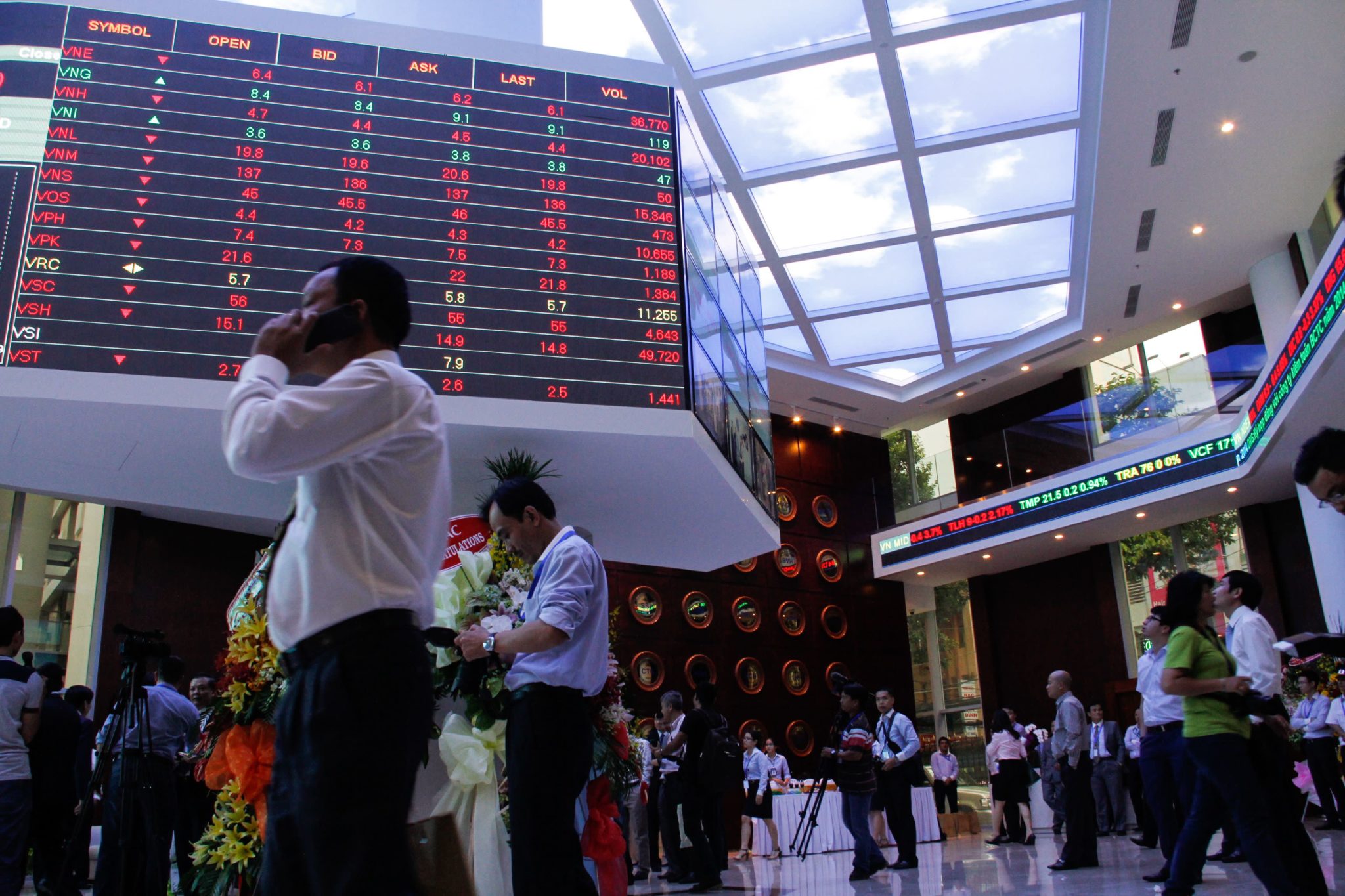
    Vietnam’s benchmark VN-Index fell 0.80% to 1,306.86 points Monday for the fourth session in a row.

    The index closed 10.60 points lower after dropping 6.35 points in the previous session.

    Trading on the Ho Chi Minh Stock Exchange increased by 24% to VND21.205 trillion (US$829.1 million).

    The VN-30 basket, comprising the 30 largest capped stocks, saw 20 tickers fell.

    GVR of Vietnam Rubber Group saw the biggest drop of 6.9%, BCM of Becamex Investment and Industrial Development followed with a 3.6% decline. MSN of conglomerate Masan Group was down 2.5%.

    Eight blue chips gained. MBB of lender MB rose 0.8%, TPB of private TPBank closed 0.7% higher, and VNM of dairy giant Vinamilk went up 0.5%.

    Foreign investors were net seller to the tune of VND1.28 trillion, mainly selling FPT of tech giant FPT Corporation and VNM.

    The HNX-Index for stocks on the Hanoi Stock Exchange, home to mid and small caps, fell 1.32%, while the UPCoM-Index for the Unlisted Public Companies Market went down 0.61%.

  • UBS Secures Key Regulatory Win in China

    UBS Secures Key Regulatory Win in China

    Swiss bank UBS is strengthening its presence in China after receiving regulatory approval to acquire a local securities firm fully.

    UBS will acquire an additional 33 percent stake in UBS Securities from Beijing State-owned Assets Management Co., Ltd (BSAM), thereby taking full control of UBS Securities in China. The big bank announced this on Friday, having received the corresponding approval from the China Securities Regulatory Commission.

    UBS Securities was the first foreign-invested, fully licensed securities joint venture in China in 2007. In 2018, UBS became the first foreign bank to take majority control of a Chinese securities firm – initially with a 51 percent stake, which was increased to 67 percent in 2022.

    UBS Securities is active in global banking, global markets, research and wealth management.

    UBS is proud of its long history in China and of serving clients in one of the most important and fastest-growing markets in the world. We will continue to invest in China as a central pillar of our growth ambition, further strengthening our leadership position in the region, said Group CEO Sergio Ermotti.

    The move to full ownership of UBS Securities is an important milestone for our integrated strategy in the region. It enables us to further expand our investment banking and wealth management offering in China. Not only will we be able to capitalize on the tremendous business opportunities as China’s financial sector opens up, but we will also gain better access to the unique wealth creation that we can support with our products, services and advice,» Iqbal Khan, President Asia Pacific and Co-President Global Wealth Management at UBS, said.

  • Blackrock Launches ‘Swiss’ Bitcoin ETP in Europe

    Blackrock Launches ‘Swiss’ Bitcoin ETP in Europe

    On Tuesday, Blackrock launched the iShares Bitcoin ETP, providing European investors with access to Bitcoin without the need to directly trade or hold the cryptocurrency.

    The securities are backed by Bitcoin held by Coinbase, which is also responsible for the custody solution and the process controls safeguarding the private keys. For the iShares Bitcoin ETP, the Bitcoins are transferred daily from the trading wallet to segregated offline wallets («cold storage»).

    There’s a lot of Switzerland in the iShares Bitcoin ETP. BlackRock Switzerland played a key role in its development, said Dirk Klee, Country Head for Switzerland.

    The iShares Bitcoin ETP carries a total expense ratio (TER) of 25 basis points, with a temporary reduction to 15 basis points in effect through the end of the year. The underlying Swiss special purpose vehicle (SPV) is exempt from Swiss stamp duty on both purchases and sales.

    Blackrock took its time before launching the iShares Bitcoin ETP. Ultimately, it was the evolution of the cryptocurrency space in recent years—combined with growing client demand—that prompted the firm to move forward.

    «We believe ETPs can play a key role in building a bridge between crypto and traditional finance, due to their efficiency and ease of use,» said Klee. For investors with appropriate governance frameworks and sufficient risk tolerance, a 1% to 2% allocation to Bitcoin in multi-asset portfolios is justifiable, he added.