Category: General

Retail News Asia is committed to providing both local and global retailers with the latest General Retail news throughout the Asian market. This on a daily base.

  • Shinhan Card to buy Indonesia’s Salim Group unit

    Shinhan Card to buy Indonesia’s Salim Group unit

    Shinhan Card will acquire a controlling stake in an Indonesian financial company as part of its expansion strategy into emerging markets, the credit card company said Thursday.

    “We will sign a deal next week in Jakarta to buy a 50 percent stake plus a share in Swadharma Indotama Finance from Indonesia’s Salim Group for a bit more than 10 billion won ($8.4 million),” a Shinhan Card spokesman said.

    Shinhan Card plans to hold a board meeting on Aug. 21 to approve the acquisition, with a signing ceremony scheduled on Aug. 26. It aims to launch a joint venture with a new name in Indonesia in November after receiving approval from financial authorities in the two countries in September, the company said.

    Shinhan’s local venture partner will be the existing shareholders who own the remaining stake in Swadharma Indotama Finance, the spokesman explained.

    The exact acquisition price will be decided at Shinhan Card’s board meeting next week, he said.

    “The acquisition is aimed at maximizing synergies between Shinhan Card’s 30 years of credit card business know-how and Salim Group’s nationwide retail networks,” the statement said.

    Salim Group’s businesses include telecommunications, automobiles, leasing, mining energy and foods. Salim Food is Indonesia’s largest food manufacturing company, it said.

    On top of strengthening Swadharma Indotama Finance’s existing businesses, Shinhan Card will seek an approval in Indonesia to enter the local credit card market late next year, the spokesman said.

    If everything goes as planned, Shinhan Card will be the first Korean credit card firm to sell its products and services to Indonesian customers. In fact, it is risky for a credit card company to begin business in foreign countries without accumulated customer data, it said.

    “We will beef up our overseas operations by making a presence in Indonesia following our recent advance to Kazakhstan. Particularly, we will focus on the credit card business in Indonesia in coming years,” Shinhan Card Chief Executive and President Wi Sung-ho said in the statement.

    In July, Shinhan Card opened its first overseas business entity, Shinhan Finance, in Almaty, Kazakhstan, initially to handle auto financing. It plans to sell small loans to individuals from September and introduce lease products from 2017, the spokesman said.

    In Kazakhstan, only banks are allowed to get into the credit card business. So Shinhan Card has to acquire a local bank if it wants to jump into the local credit card market, he said.

    Shinhan Card said it will continue to enter other emerging markets in Southeast Asia based on its experiences in Vietnam, Kazakhstan and Malaysia.

    In the January-June period, Shinhan Card posted a net profit of 352 billion won, up 11 percent from 318 billion won a year earlier, according to a regulatory filing.

  • Korea on sale

    Korea on sale

    In a bid to revitalise the national tourist market and domestic economy, withering in the wake of the Middle East Respiratory Syndrome (MERS) outbreak, Korea will go on sale.

    Branded the ‘Korea Grand Sale’, the 10 week long promotion will run from August 14 to October 31.
    Officials say that the sale will be the largest in scale since the event started.

    “We advanced the date of the Grand Sale, which usually took place in winter, out of desperation. We hope the sale can continue to bring tourists back to Korea instead of ending as a one-time event.”

    Criticised for offering discounts only to foreigners, officials said they are persuading participating companies to give discounts to local consumers as well.

    “Businesses in traditional markets and some convenience stores are showing positive responses towards the idea.”

    Benefits such as discounts for transportation and free WiFi modem rental services will be provided. In addition, the Korea Grand Sale Event Center located at Doota Square in Dongdaemun will provide translation services, information about tourism, beverages and special events.

    Han Kyung-ah, the executive secretary of the Visit Korea Committee, explained the intentions of the Korea on sale event: “We intend to attract tourists headed to Hong Kong and Japan towards Korea by providing abundant benefits.”

    Various promotions introducing Hallyu content and traditional culture will also occur.

  • London retailers revel in Chinese influx

    London retailers revel in Chinese influx

    Hong Kong retailers wondering where those cashed up, big spending Mainland Chinese tourists have been unzipping their wallets… here is your answer: London.

    According to the Retail Gazette, spending by Chinese Visa card holders rose 44.5 per cent in the UK in July – outstripping spending by tourists from France and Australia.

    Inbound tourists from China now account for more spending than those from any country except the US which retains top spot.

    Retail Gazette reports the growth in Chinese spending was strongest in supermarkets (up 79 per cent) and in high street stores (up 40 per cent).

    Shopping accounted for 40 per cent of Chinese tourists’ spending in the UK

    “China is one of the fastest growing sources of tourism income for the UK and it looks set to become an important driver of growth for the sector,” said Kevin Jenkins, UK & Ireland MD with Visa Europe.

    “Spending on cards has seen a significant boost as Chinese tourists travel to the UK, confident in the use of plastic overseas.

    “With shopping a top attraction for Chinese travellers, UK retailers are likely to consider additional ways to appeal specifically to this audience,” Jenkins said.

    “Pre-travel marketing, multilingual staff and new product lines in store may be three things we see more of.”

  • Robinsons Retail eyes new global brands to bring to PH

    Robinsons Retail eyes new global brands to bring to PH

    Gokongwei-owned Robinsons Retail Holdings, Inc. is in talks with other global brand owners as it continues to be on the lookout for other retail names it could bring to the Philippines.

    The company has set aside P6 billion to open up to 300 new stores and bring its current networks of 1,356 stores to 1,600 by yearend, said Robinsons president and chief operating officer Robina Gokongwei-Pe.

    “We may bring in other brands…we are still talking (with brand owners). “We will continue to be on the look out for potential acquisitions that could add value to the company,” she said.

    Robinsons Retail last month successfully brought to the country specialty coffee brand Costa Coffee, United Kingdom’s number one coffee chain.

    “We also expanded into the specialty coffee business with the recent opening of our first Costa Coffee store in Eastwood city last June 29. Costa Coffee is the number one coffee chain in the UK with 3,000 stores across 31 countries including the Philippines. Reception has been positive,” Gokongwei-Pe said.

    As such, Robinsons Retail is targeting to open four Costa Coffee stores this year.

    To fast track expansion, Robinsons Retail has also developed community malls dubbed as Robinsons Townsville with Robinsons Supermarket as the main anchor tenant.

    Jody Gadia, general manager of Robinsons Supermarket, said the size of these innovative community malls would range from 5,000 square meters to a hectare and that around 60 to 70 percent of leasable space would be occupied by Robinsons Retail’s various formats.

    The balance, he said, would be leased out to other tenants and establishments.

    “The whole idea is to get closer to targeted markets and provide them accessibility and convenience and meet their basic shopping needs. The choice of location is densely populated areas that cannot be served by other malls,” Gokongwei-Pe said.

    The group is aiming to open two of these community malls a year in the next five years but depending on the opportunities, the expansion target could increase to three to four a year.

    “The value proposition is you won’t get stuck in traffic. We opened one in Cavite and we’re also opening one in West Fairview this year,” Gadia said.

    Moving forward, Robinsons Retail may explore other formats such as e-commerce and possibly more food brands once it masters the coffee business.

    As of the first quarter of the year, Robinsons Retail had a total of 1,356 stores broken down as follows: supermarkets, 113; department stores, 42; DIY stores, 159; convenience stores, 473; drug stores, 330 and specialty stores, 239.

    In the first quarter of 2015, net sales grew to P19.7 billion, up 13.1 percent from P17.4 billion recorded in the same period last year.

    Sales from supermarkets accounted for bulk or 49.1 percent of total sales during the quarter. Department stores’ sales followed with a 15.1 percent share, DIY stores, with 11.2 percent, drug stores with 9.5 percent, specialty stores with 8.7 percent and convenience stores with 6.4 percent.

    Robinsons Retail is the second largest multi-formal retailer in the Philippines. It operates a wide spectrum of formats and brands — supermarket, department, convenience store, hardware and home improvement, convenience store, drugstore, consumer electronics and appliances store, international fashion specialty and beauty brands, toy store and one-price concept store.


  • Gold futures maintain losses after retail sales data

    Gold futures maintain losses after retail sales data

    Gold prices managed to trade above the psychological resistance of $1,100 per Oz on US day session Monday.

    Platinum for October delivery dropped Dollars (90.49 percent) to close at USD 995.00 per ounce. Spot prices earlier reached a three-week high of $1,126.31, 4.5% above last month’s low. Bullion rose in the previous five days.

    The rebound that began at the start of this week broke out above a prolonged consolidation pattern just above late July’s new 5-year intraday low of 1077. So far, there’s no telling how the Fed will react to China’s surprising currency devaluation, after some positive economic news earlier today.

    “Transparency is always better than having to guess what is happening in the market“, Michael Widmer, head of metal markets research at Bank of America Corp.in London, said by phone. Asian stocks turned mixed as investors weighed the implications of the surprise move, which seemed to end months of officially sanctioned yuan strength. “So some haven seekers have been returning”.

    Gold is ripping higher on Wednesday. It was likely a combination of a temporary slump in the US dollar as market players took profit of long USD trades, and a positivity that the lower renminbi and upcoming stimulus would revive China’s exports growth and subsequently commodity demand. There is also some market conjecture that perhaps this week’s events will cause the Federal Reserve to hold off starting its expected tightening of interest rates yet this year. “I think the point of “liftoff” is close”, Lockhart said in a speech to the Atlanta Press Club. That, however, was predicated on the assumption that the Fed would defer the interest rate hike beyond September.

    The dollar’s moves in U.S. trading were subdued, which meant the PBOC could set Friday’s reference below Thursday’s 6.4010, at around 6.39, said Sean Callow, senior currency strategist at Westpac. On Wednesday, the U.S. Department of Energy will release its own more closely watched figures on the same stockpiles. If the metal were as valueless as a pet rock, as one Wall Street Journal op-ed recently claimed, why would they bother to do this? “This is an act of desperation by the Chinese….”

    US central bankers could raise rates for the first time in almost a decade at a September 16-17 meeting.

    To the extent that the Chinese devaluation reflects economic weakness in China, this will be negative for large U.S. multinationals that do business in that country (and others affected by the currency wars). The government is scheduled to report both weekly jobless claims and July retail sales at 8:30 a.m. EDT.

  • Philippines records 27% hike in Indian tourists from Jan-May 2015

    Philippines records 27% hike in Indian tourists from Jan-May 2015

    The Department of Tourism (DOT), Philippines has welcomed about 31,245 Indian tourists during the first five months of this year, recording an increase of 27.40 per cent, compared with 24,525 tourist arrivals from India from January to May 2014. The destination also plans to welcome tourists to the Philippine Shopping Festival 2015 which will be held from October 23 to November 8, in association with the Philippine Retailers Association (PRA). This was informed by Verna Covar-Buensuceso, Director and Officer-in-charge, Market Development Group, Tourism Development Sector, Department of Tourism (DOT), Philippines, while speaking to the press at the recently concluded multi-city roadshow in New Delhi post travelling to Nagpur, Chandigarh and Lucknow.

    Comprising 11 trade partners from Philippines, this sixth roadshow by DOT Philippines was the biggest-ever delegation to India. The roadshows included interactive B2B sessions, education programmes and workshops and saw participation of over 300 key tour operators, MICE and up-market leisure operators.

    “We aim to achieve 100,000 Indian tourist arrivals by 2017,” said Glen Agustin, Chief Tourism Operations Officer, Market Development Group, DOT, Philippines. He elaborated that they conducted a familiarisation trip for Kolkata-based tour operators wherein participants interacted with their B2B counterparts in Philippines. This has yielded excellent results and the tourism has been booming from the Kolkata since then, he said. Moreover, about 600 tour operators and counting have been certified under the Philippines Specialist Program (PSP) which has indeed assisted tour operators to lure tourists from Tier-II cities as well. As per the trend this year, Indians are staying for seven days on an average and spending about USD 120 a day. Though the length of stay has increased, we look forward to increase the tourism spend as well, highlighted Agustin.

    Agustin felt that the progress has been quite impressive and DOT Philippines will continue to remain bullish on the Indian market. “India ranked as the 13th top source market for Philippines Tourism, and we firmly believe that it has a huge potential to up its ranking. Weddings, MICE and Film Tourism are some products which we are aggressively promoting in the Indian market as of now. More than half of the tourist arrivals in 2014 comprised MICE travellers, especially incentive. In the year going forward, we plan to participate in PATA Travel Mart from September 6-8 in Bengaluru, Karnataka and thereafter in the Outbound Travel Mart 2016 from February 18-20 in Mumbai,” revealed Agustin.

    Elaborating on the Philippine Shopping Festival 2015, Covar-Buensuceso, said, “It will be a two week-long sale where shopping malls and retailers in the Philippines will offer different discounts and promotions to entice people to shop and offer a unique shopping experience. In line with DOT’s ‘Visit the Philippines 2015’ campaign and PRA’s efforts in the development of the Philippine’s retail industry, the Philippine Shopping Festival aims to make the destination a new shopping hub in the Asia Pacific region,” added Buensuceso. She added that India is among the top 10 source markets to travel to newer destinations in Philippines such as Cebu, Davao, Palawan and Bohal along with the preferred ones such as Manila and Boracay.

  • Dollar struggles in Asia after lift from US retail sales

    Dollar struggles in Asia after lift from US retail sales

    The dollar was steady on Friday after China’s central bank appeared to have stopped guiding the yuan lower for now, easing concerns that a weaker Chinese currency could derail plans by the US Federal Reserve to raise interest rates.

    The dollar traded at 124.40 yen, flat from late US levels and above this week’s low of 124.21 yen. For the week, it was up about 0.1 per cent.

    Volume in Tokyo was relatively thin, with many businesses winding down for the mid-August Obon holiday. Although there are no public holidays, many people take summer vacations around this time, and some offices close.

    “Company people have gone on their breaks and left their orders with banks,” said Kaneo Ogino, director at foreign exchange research firm Global-info Co in Tokyo.

    Some commercial accounts would sell dollars above 125.50, he added.

    The euro fetched $1.1143, down slightly from late US levels. Still, it was up 1.6 per cent on the week, as the dollar has been hit by speculation that the US might not want a stronger dollar either if China pushes down the yuan.

    The euro got a lift this week as investors unwound euro-funded carry trades in the yuan and other emerging market currencies, which were hit hard by the devaluation.

    Emerging Asian currencies continued to fall on Friday, on track for steep weekly losses, with the Malaysian ringgit skidding to a fresh pre-peg 17-year low.

    On Friday, the People’s Bank of China set the yuan midpoint at 6.3990 yuan to the dollar, slightly stronger than Thursday’s levels.

    The central bank said on Thursday there was no reason for the yuan to fall further given the country’s strong economic fundamentals.

    Beijing’s moves some eased concerns that a cheaper yuan could trigger a “currency war”, or a competition among the world’s biggest economies to cheapen their own currencies to seek a competitive edge.

    US interest rate futures prices edged down and US bond yields bounced back as investors priced in an increased likelihood of a Fed rate hike in September. Solid US retail sales data also supported the case for an early rate hike.

    The dollar index, which tracks a basket of six major currencies, stood at 96.420 , off a one-month low of 95.926 hit on Tuesday.

    Still, market players are not sure how much more the dollar can gain, assuming the yuan could fall further in the face of a slowdown in the Chinese economy.

    “The latest concerns triggered by the sudden policy action may be subsiding a tad. But there is no change in the fact that the Chinese economy is slowing,” said Masafumi Yamamoto, senior strategist at Monex Securities.

    “I think the yuan has become overvalued as other countries tried to cheapen their currencies and it will keep falling, playing catch-up,” he added.

    While most major currencies saw limited moves on Friday, the New Zealand dollar fell after domestic retail sales had the slowest increase in two years, cementing expectations the Reserve Bank of New Zealand will cut rates.

    The New Zealand dollar traded down 0.5 per cent at $0.6535 , down about 1.3 per cent for the week.

  • Indonesian president Joko Widodo officially opens Indonesia Convention Exhibition

    Indonesian president Joko Widodo officially opens Indonesia Convention Exhibition

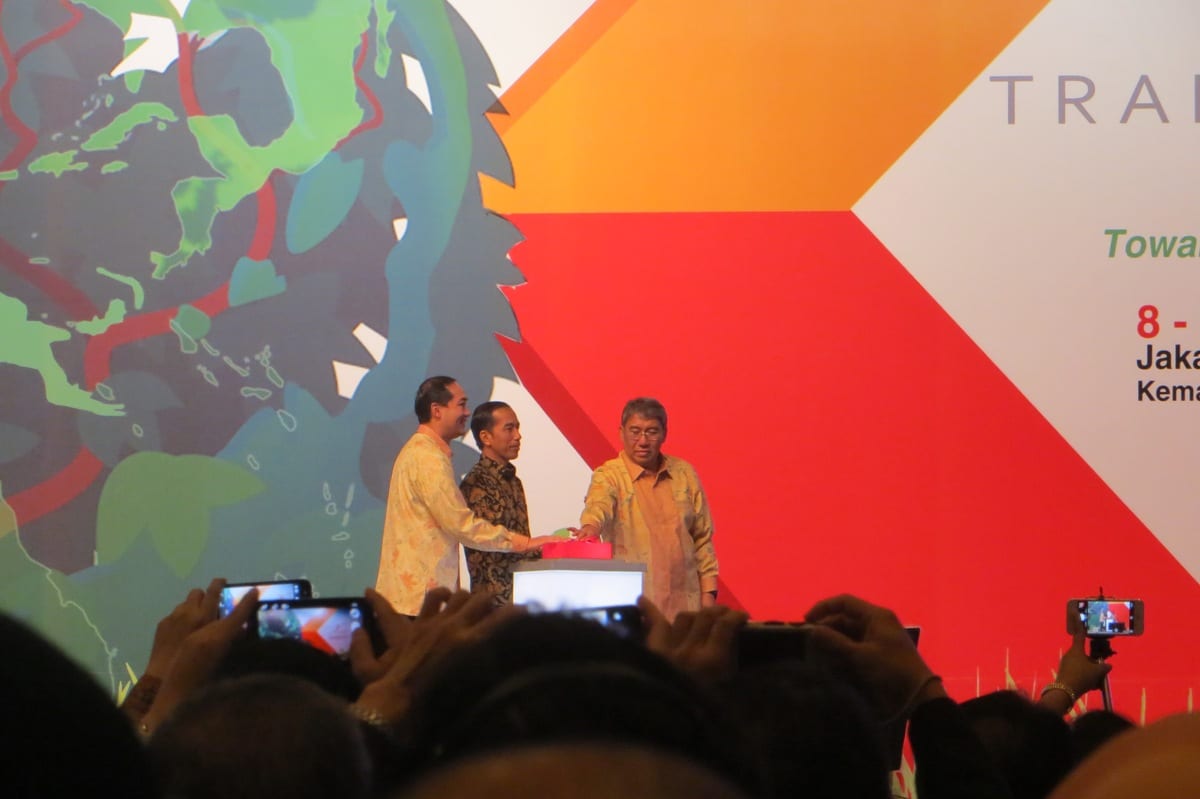
    Joko Widodo, President of Indonesia, participated in the grand opening ceremony of Indonesia Convention Exhibition, officially launching Indonesia’s newest trade fair and convention center. Indonesia Convention Exhibition was built by PT. IIE (Indonesia International Expo), a joint venture between Sinar Mas Land and Kompas Gramedia Group, Indonesia’s leading real estate developer and the country’s leading media enterprise, respectively. Deutsche Messe AG, one of the world’s largest trade fair companies, operates the facility.

    Indonesia Convention Exhibition is a 22-hectare project located in BSD City in the South Tangerang district. After stage one of construction, Indonesia Convention Exhibition currently offers 116,000 square meters of display area for events of all sizes. Attributes such as strategic location; capacity for hundreds of thousands of people; a large, user-friendly parking area; convenient transportation connections; and eco-friendly and energy-efficient infrastructure set new standards in the Indonesian exhibition landscape.

    Mark Schloesser, President Director of Deutsche Messe Venue Operations, said, “ICE features 10 exhibit halls on 50,000 square meters, 50,000 square meters of outdoor display area and a 4,000-square-meter convention center with 33 meeting rooms. With a broad range of facilities and world-class service, ICE fulfills the needs of all event organizers and represents the largest exhibition and convention center in South East Asia. Indonesia can be proud to be home to this international attraction. 

    Deutsche Messe AG

    With revenue of 280 million euros (2014), Deutsche Messe AG ranks among the world’s ten largest trade fair companies and operates the world’s largest exhibition center. In 2014, Deutsche Messe planned and staged 134 trade fairs and congresses around the world – events which hosted more than 41,000 exhibitors and 3.6 million visitors. The company’s event portfolio includes such world-leading trade fairs as CeBIT (IT and telecommunications), HANNOVER MESSE (industrial technology), BIOTECHNICA (biotechnology), CeMAT (intralogistics), didacta (education), DOMOTEX (floor coverings), INTERSCHUTZ (Rescue, fire prevention, disaster relief, safety and security), and LIGNA (wood processing and forestry). With about 1,200 employees and a network of 66 representatives, subsidiaries and branch offices, Deutsche Messe is present in more than 100 countries worldwide.

    Indonesia International Expo (IIE)

    Indonesia Convention Exhibition was built to promote further growth in Indonesia’s MICE (meetings, incentives, conferences, events) industry. To realize the project, Sinar Mas Land and Kompas Gramedia Group established a joint venture, PT. IIE (Indonesia International Expo), to manage the 22-hectare development in BSD City, South Tangerang. The newly opened 220,000-square-meter first phase includes Indonesia Convention Exhibition as well as a 4-star hotel with 295 rooms and parking facilities. Additional hotels, office buildings and additions to Indonesia Convention Exhibition will follow in the second stage of construction.

    Sinar Mas Land

    Sinar Mas Land is a leading property developer in South East Asia with more than 40 years’ experience in Indonesia. Sinar Mas Land is listed on the Indonesian Stock Exchange with the name PT. Bumi Serpong Damai Tbk (BSDE). With more than 50 large-scale projects in Indonesia plus 10,000 hectares of land holdings, Sinar Mas Land is recognized as the biggest and best-known property developer in Indonesia.

  • Fusionex eyes Philippines, fuelled by 26% jump in revenue

    Fusionex eyes Philippines, fuelled by 26% jump in revenue

    BIG data and analytics software company Fusionex International Plc will be widening its footprint in South-East Asia by expanding to the Philippines over the next few months, its fourth market in the region.
    The company, listed on the London Stock Exchange’s Alternative Investment Market (AIM), has a presence in Hong Kong, Macau, the United Kingdom and the United States; as well as its home base of Malaysia and South-East Asian neighbours Singapore and Thailand.

    Its expansion strategy is somewhat conservative, but it is already close to securing an anchor customer, Fusionex cofounder and managing director Ivan Teh told Digital News Asia (DNA) in Kuala Lumpur recently.

    “We have been spending time to ensure that we got the right partner, the right place, the right kind of ecosystem, infrastructure and setup.

    “We want to know the market first, so we don’t want to go in and waste two years only to realise the market is not suitable,” he said.

    One may wonder why Fusionex is eyeing the Philippines, where ICT spending is significantly lower than its home market even though its population is triple Malaysia’s.

    According to an IDC report, Philippines’ ICT spending is expected to reach US$6.76 billion this year. In contrast, according to a Gartner report, Malaysia’s ICT spending is estimated to be around RM65.1 billion (US$16.42 billion).

    But Teh, an inaugural DNA Digerati50, said Philippines is a good expansion destination for various reasons.

    “The retail market is booming over there. The shared services and outsourcing markets are exploding too,” he argued.

    According to a Manila Bulletin report, citing the Philippines Retailers Association, the country is expected to see 40 new malls open in 2014 and 2015. The association projected retail sales would reach P1.61 trillion (US$35 billion) by 2016 and P1.78 trillion (US$38 billion) by 2017.

    “Malaysia will remain to be our centre of excellence – a lot of the research and development will be done from Malaysia. Nevertheless, the Philippines is undeniably a booming market,” said Teh.

    For the six months ended March 31, 2015, Fusionex’s revenue increased 26% to RM31.6 million, while gross profit jumped 31% to RM24.9 million. [RM1=US$0.25 at current rates]

    The strong performance was mainly driven by its flagship big data analytics product Fusionex Giant , which has found over 25 customer wins since launch. These companies include the domestic unit Japanese retailer Aeon.

    Fusionex has managed to get other big-name customers this year, including AirAsia; Brother Industries Ltd, a multinational electronics and electrical equipment company headquartered in Nagoya, Japan; and Islamic insurer Syarikat Takaful Malaysia Bhd in Malaysia.

    But for now, all of Teh’s attention will be on ensuring its Philippines expansion goes according to plan, and also that the business runs smoothly post-launch.

    “It’s important for us to set up the right team and to hire the right people. We will also get some of our Malaysian employees to be there for a period of time, just to make sure we have a cultural transition.

    “Then, we want to grow the local talent as well,” he said.

  • Commissary reintroduces cooked poultry products in South Korea by Labor Day

    Commissary reintroduces cooked poultry products in South Korea by Labor Day

    Commissary shoppers in South Korea will begin to see cooked poultry products back on shelves by Labor Day.

    On July 13, the U.S. Department of Agriculture issued a revision to Korea’s embargo to allow heat-treated poultry and poultry products from the U.S. Learning the news, the Defense Commissary Agency quickly placed orders with its U.S. suppliers to restock the shelves of commissaries in South Korea with cooked poultry products.

    “Frozen dinners, pot pies, nuggets, lunch meats, franks, Lunchables and other popular cooked poultry products will begin to arrive by early September,” said Wayne Walk, DeCA’s zone manager in Korea. “With school starting back up, this is great timing for parents packing lunches and for anyone looking for easy-to-prepare meals.”

    South Korea’s embargo had restricted the entry of all poultry products into the country since last December when the U.S. announced the presence of avian influenza in live poultry flocks in Oregon and California, followed by additional outbreaks in other U.S. states.

    Uncooked poultry from the U.S. is still restricted by the embargo, but DeCA has alternate sources for uncooked poultry to replace many of the items it previously received from U.S. suppliers.

    “We offer fresh, uncooked chicken and eggs from Korea,” said Walk. “We have whole chickens, chicken breasts, boneless thighs and drumsticks. These products are not frozen and are ready to take home and cook immediately.”

    Commissaries also began offering chicken from Australia this month.

    “Shoppers will find Steggles of Australia chicken in the freezer section in tray packs,” said Walk. “Steggles is supplying our commissaries here in Korea with chicken products that have historically been popular with our shoppers – skinless, boneless breasts and thighs; tenderloins; wings and drumsticks.”

    “We’re working continuously to provide our customers with the very best service and product assortment,” said Walk. “The embargo has been an opportunity for DeCA to work a little harder to ensure military members and their families stationed in Korea have the products they need when they use their commissary benefit.”

    The USDA advises consumers to always follow proper handling and cooking processes when working with poultry. Food safety and avian influenza information can be found in the USDA Food Safety and Avian Influenza Questions and Answers, April 2015.

  • Hong Kong fund sales slide by 50%

    Hong Kong fund sales slide by 50%

    The Hong Kong fund industry saw net sales drop by almost a half in the first six months of 2015, new figures reveal.

    The Hong Kong Investment Funds Association (HKIFA) published data on Wednesday which cited a sharp fall in funds to $3.71bn (£2.38bn, €3.34bn).

    Bruno Lee, the chairman of HKIFA, blamed the decrease in sales on global market uncertainty, particularly around China mainland’s A-Share market, the Greek debt crisis, and the potential US interest rate rise. He said volatility in the global currency market was also to blame.

    “Retail investors should review their investment position regularly to ensure their investment strategy is aligned with their long-term personal financial objective and seek for professional investment advice if needed,” Lee said.

    Though net sales fell dramatically, gross sales saw a rise of 14% to $47bn in the first half of 2015, after hovering at $7bn in the first quarter, soaring up by more than $10bn in April, and then dropping back to $7bn towards the end of the second quarter.

    HKIFA said China-related and European equity funds were the key sectors which contributed to the surge in gross sales in the second quarter of this year.

    “The moderate growth in gross retail fund sales and higher equity fund sales percentage indicate a higher risk appetite amongst retail investors,” said Lee.

    HKIFA members are comprised of 82 fund management companies.  It also has 43 associate members, including lawyers, accountants, trustees and other professionals that are involved in the creation and administration of funds.

  • Lotte Group head issues apology for feud, vows reform

    Lotte Group head issues apology for feud, vows reform

    The head of South Korea’s Lotte Group yesterday vowed a new era of corporate governance and transparency as he apologized for the family feud engulfing the beleaguered retail giant.

    In an address broadcast live on TV, group chairman Shin Dong-bin also sought to deflect growing anti-Japanese sentiment surrounding Lotte, which was founded in Japan, but does 80 percent of its business in South Korea.

    Talking in accented Korean, the native Japanese speaker twice bowed deeply before the cameras in a show of contrition for the bitter and very public battle for corporate control that has pitted him against his father and elder brother.

    “The current dispute has occurred as we have failed to make efforts to improve corporate governance and enhance transparency,” Shin said.

    “We will be bold in reform in order to address concerns held by the people of Korea, our shareholders, contractors and employees,” he added.

    At stake in the Lotte feud is control of a sprawling conglomerate with 80 units across South Korea — spanning retail, amusement parks, hotels and chemicals — and total combined assets of about US$90 billion.

    Among other reforms, Shin said he would push for the public listing of the conglomerate, which effectively controls the South Korean business, while also streamlining the group’s complicated web of cross-holdings to enhance transparency.

    “Lotte belongs to Korea,” the chairman said, stressing that the group’s South Korean interests dwarfed the Japanese-based side of the business in terms of employee numbers and sales.

    “There has been little flight of capital back to Japan,” Shin said, adding that earnings made in South Korea had been plowed back into the domestic business.

    Lotte was founded in Japan in 1948 by Shin Dong-bin’s father — South Korean-born Shin Kyuk-ho, now 92 — and grew from a seller of chewing gum to a confectionary giant. It expanded to South Korea after Tokyo and Seoul normalized relations in 1965.

    The row within the Shin family has fanned the embers of the anti-Japanese public sentiment the group has long contended with in South Korea — largely due to the family members’ awkwardness with the Korean language.

    The battle for control of the conglomerate has pitted Shin Dong-bin against his father and his elder brother, Shin Dong-ju, with accusations of dirty tricks and attempted boardroom coups.

  • CNN Indonesia begins broadcasting today

    CNN Indonesia begins broadcasting today

    CNN Indonesia began broadcasting today marking a historic day for CNN International, Transmedia and the people of Indonesia.

    From brand new state-of-the-art news facilities located in the Transmedia broadcast centre in Jakarta, CNN Indonesia offers viewers a mix of national and international news, plus the latest in business and sport in Bahasa Indonesia.

    The start of CNN Indonesia TV follows the launch of CNNIndonesia.com in October last year. The digital platform is an integral component of the CNN Indonesia brand with the ability to reach Indonesians at home and abroad.

    Jeff Zucker, CNN Worldwide President: “This is an incredibly important day for us. To be able to extend our footprint locally and reach millions of Indonesians is hugely exciting and humbling. We are confident Transmedia will deliver first-class content that appeals to Indonesians all across the country.”

    Gerhard Zeiler, President of Turner Broadcasting International: “Turner is committed to Indonesia and committed to growth and development in the Asia-Pacific region. We welcome CNN Indonesia to the family and look forward to a long and successful partnership.”

    CNN Indonesia is part of a strategic effort by CNN International Commercial’s Content Sales and Partnerships Group. Its core business is to explore ways to reach more consumers locally, regionally and internationally by partnering with other leading media organisations. CNN Indonesia is the latest addition to the CNN family that includes CNN Philippines, CNN Turk and CNN Chile.

  • Singapore economy grows by 1.8% in Q2

    Singapore economy grows by 1.8% in Q2

    Singapore’s Ministry of Trade and Industry (MTI) announced on Tuesday that the Singapore economy grew by 1.8 per cent on a year-on-year basis in the second quarter, slower than the 2.8 per cent growth in the previous quarter.

    On a quarter-on-quarter seasonally-adjusted annualised basis, the economy contracted by 4.0 per cent, a reversal from the 4.1 per cent growth in the preceding quarter.

    The manufacturing sector contracted by 4.9 per cent year-on-year, extending the 2.4 per cent decline in the previous quarter. The sector was primarily weighed down by declines in the output of the biomedical manufacturing and transport engineering clusters.

    The construction sector expanded at a faster pace of 2.5 per cent year-on-year, supported by a pick-up in public sector construction works, compared to the 1.1 per cent in the previous quarter.

    The wholesale & retail trade sector grew by 5.0 per cent year-on-year, slightly slower than the 5.3 per cent expansion in the previous quarter. Growth was driven by both the wholesale trade and retail trade segments, with the latter being supported in turn by robust motor vehicle sales.

    The accommodation & food services sector contracted at a faster pace of 0.6 per cent year-on-year compared to the 0.1 per cent decline in the previous quarter. The slowdown in the sector was largely due to sluggish performance in the food & beverage segment.

    The finance & insurance sector posted growth of 7.1 per cent year-on-year, extending the 7.8 per cent growth in the previous quarter. Growth was largely underpinned by the fund management segment.

    The information & communications sector grew by 4.5 per cent year-on-year, moderating from the 4.9 per cent growth in the previous quarter. Growth was mainly driven by the IT & information services segment.

  • Mood darkens for trade in China

    Mood darkens for trade in China

    The business sentiment of Korean companies in China has worsened in the second quarter – particularly in the automotive and electronics sectors – mainly due to the slowdown in overall consumption in the Chinese market on the heels of a wobbling stock market.

    It was the second straight quarter that the business sentiment index remained below the 100 mark.

    According to a report by the Korea Institute for Industrial Economics and Trade (KIET) on Monday, the companies’ business survey index in the second quarter was 71, lower than 77 in the first quarter this year.

    The index reflects business sentiment, considering different business environments like quarterly profit performance, sales, costs and business regulations. As the index ranges from 0 up to 200, a number smaller than 100 means more survey participants expressed negative answers, while the index larger than 100 means more positive answers.

    The slump in business sentiment was the largest in automotive and electronic devices, two industries in which Chinese rivals are quickly catching up on Korean technologies and in which consumer demands change quickly.The survey was taken for a month from June 15, by the Korea Chamber of Commerce & Industry’s Beijing office and a Korean business association in China, on some 226 Korean companies operating in China. They were doing business in seven different sectors, ranging from electronics and automotive to chemical, textile and retail.

    Korean auto companies in China gave 45 points in the second quarter, a lot lower than the 94 points in the first quarter, during which the Chinese auto taste has quickly moved to favor sports utility vehicles (SUVs) that are more affordable than Korean autos.

    Korean electronics companies gave 54 points in the second quarter, also much more negative than the first quarter’s 88 points, after Samsung smartphones lost market share to Xiaomi and Huawei.

    Only Korean chemical and retail industries expressed positive assessments regarding their businesses in the second quarter, each giving 103 points and 100 points, respectively.

    Survey participants said the slowdown of demand in the Chinese domestic market was the main reason for their business hardships in the second quarter, followed by competition with Chinese rivals and elevated labor cost, which raised overall production costs.

    In the first quarter, a steep increase in labor costs was the main reason Korean companies found it hard to do business in China, reflecting the slowdown in the growth of the domestic economy.

    However, the Korea International Trade Association (KITA) rolled out a positive outlook on Monday that the Chinese economy will maintain its growth rate at the 7 percent range in the latter half of the year and Chinese investment is on its way to recovery thanks to state-led infrastructure building projects, which bring up both imports from other companies as well as local real estate transactions.

    The outlook said Korea’s export to China and local production of Korean companies will stay contracted until the third-quarter due to the unstable Chinese stock market and contracted consumption sentiment.

    The Chinese economy is forecast to rebound to last year’s level by the fourth quarter at the latest, the KITA outlook forecast, as the central government there is pushing policies to boost cash liquidity and the real estate market.

    “The sagging domestic economy made Chinese consumers lean towards frugal consumption, which helps local Chinese companies with advanced product quality gulping up market share against foreign products,” said Lee Bong-geol, a senior researcher at the Institute for International Trade at KITA