Category: Research

Retail News Asia is committed to providing both local and global retailers with the latest Research throughout the Asian market. This on a daily base.

  • How To Improve Your Company’s Finances

    How To Improve Your Company’s Finances

    Every business is bound to face some rock bottom numbers at some point — sales are not always going to be well above average and there are indeed going to be certain dry spells at times. In times like these, it is important to step back and take up new strategies to help make your numbers go back up, and hard balling with the same tactics stubbornly is not going to help the situation better. As such, there are many ways to improve your company’s finances, and all it takes is to look at the bigger picture and re-evaluate the steps that you need to take to prevent your company from plummeting further. It might even be helpful to use tools to make managing your finances a quicker process; in fact, here is a paystub generator tool to get you started. So without further ado, here are some steps you can take to hopefully help your company take a turn for the better.

    Organize Regular Team Meetings

    When the going gets tough, it may be increasingly tempting to skip out on meetings especially when everyone is mindlessly scrambling about to keep the boat afloat. However, this will cause more instances of miscommunication to arise, leading to ineffective execution of tasks and misalignment of goals. As such, organizing regular team meetings help to ensure that the team is on the same page with the same end goal in mind. This aids everyone in staying focused and being sure of what they need to do and when to get them done. Regular meetings also give your team opportunities to pitch and brainstorm possible business strategies to adopt, as well as the chance to regularly update one another on the progress of the entire company as a whole.

    Moreover, frequent team meetings will help boost the morale of your employees, which may help your business spring back to normal faster than you know it.

    Reduce Tax Burden

    Especially during times when your business is going downhill, it is useful to find ways to legally reduce the tax burden for your company. Depending on the state you are living in, it is incredibly useful to talk with your local tax accountants to find out your options in your area to reduce taxes. For example, some companies may find it useful to open up a SEP IRA on top of their Roth IRA since contributions made to the SEP account can be used to deduct from their taxes. This gives you the option of having more cash to keep, which you can use to clear the mountain of debts and payments to be made.

    Track Your Finances

    Though this is not only essential when your company hits the rut, it is always good practice to regularly check on your company’s finances to discern whether your money is put into good use. Start evaluating the budgets set aside for the different departments and see if there are areas that you can cut some costs. For example, cutting costs in the innovation tech department and pumping in more money in aggressive advertising on the relevant social media platforms might help draw customers to your brand.

    Apart from that, it is also wise to start tracking your investment decisions. Is your wealth growing? Are these investment decisions wise? More often than not, deciding whether your investment choices are worth it or not will take several months, but you should still keep your eye on them. Also, if there are several investment areas that have been reaping rewards, maybe closing the account will help your company secure cash to tide over your financial instability.

    Furthermore, some companies may get lost in the endless list of stalled projects and missed invoices that they may also miss out on client payments. Getting your finances back on track would obviously help if you, well, make sure you get paid. Catching up on these missed payments may give you access to a huge sum more than you can imagine, which will greatly help you level the negative account balance.

    Tackle Problems When They Arise

    It may seem second-nature to push back financial problems as each one comes, especially when you are already drowning in a heap of those. However, delaying solving these problems will not make it go away, and instead may cause you to incur additional fees and payments when they are past the deadline. Hence, a rule of thumb is to face any financial issues as soon as they arise. Even if you do not have the financial capabilities to do so, you should try to eradicate these problems by switching around your finances, or seeking a professional for financial advice to tide you through. These also help to minimize the impact of these pressing debts first, helping you to simultaneously assess how you can improve your cash flow management.

    Re-evaluate Your Mindset

    In the midst of a negative account balance, it is important to set your mind to it and develop a healthy mindset to tackle your problems. Just like maintaining your physical fitness, it is important to keep your emotional wellness in check as it forms the foundation of whether you can succeed or not. Instead of coming to work every day feeling dejected and helpless, channel your energy into cultivating a positive mindset, and believing that your business will eventually improve if you have the correct mindset. Making sure your employees feel the same will help your team more effectively and exacerbate the process to recovery.

    Conclusion

    While these are some of the most common ways you can improve your company’s finances, this list is definitely not a set of hard and fast rules that guarantee success. It ultimately depends on the type of strategies you adopt, according to how well you understand your business and the market. It requires a lot of perseverance and a ton of effort to keep your business afloat, and possessing such qualities will make the process of coming out of a financial rut a whole lot easier. If things get too rough, it will be helpful to speak to a professional to give you appropriate financial advice tailored to your situation and company.


     

  • Covid-19 has trapped US$111 billion of luxury spending in China

    Covid-19 has trapped US$111 billion of luxury spending in China

    Jeff Meng, a 25-year-old watch lover from a well-heeled Guangdong family, had US$22,800 burning a hole in his pocket. He could not find the Rolex Daytona watch he wanted, dubbed “panda” for its black-and-white face, anywhere in China.

    Thanks to the coronavirus pandemic that’s halted travel and disrupted networks of parallel importers, Chinese high-end shoppers like Meng – who collectively spend $111 billion a year on luxury goods, powering over a third of the global industry – are finding it hard to spend their cash.

    That’s forcing global luxury houses from Balenciaga to Montblanc to rethink how to reach Chinese consumers on the mainland, despite long-standing concerns that range from counterfeiters to powerful e-commerce platforms that set the rules. The halt to travel is also fuelling the rise of a second-hand luxury market in China as consumers seek certain styles or models they can’t find in local stores.

    Prior to the pandemic, two-thirds of Chinese luxury purchases were made overseas, according to consultancy Bain & Co. The spending took place either on shopping spree vacations or through resellers called “daigou”. Meaning to “buy on behalf,” these were platforms or individuals who used Chinese people living, studying or traveling abroad to purchase sought-after goods from boutiques in Europe or the US and bring them back home.

    “Now, travel is impossible, and daigou sellers are either back on the mainland or stranded in Europe,” said Meng. “The pandemic made me realize you can’t easily get what you fancy in China.”

    From Savile Row to Swiss watches, luxury rules have changed

    Cognisant of the potential of Chinese consumers who don’t travel overseas, luxury houses had already been rolling out plans to expand on the mainland. The pandemic has now hastened that shift and imbued it with urgency.

    With other factors like perceived anti-Chinese racism in western countries exacerbated by the coronavirus, and the Chinese government’s desire to bring spending home to boost its ailing economy, it’s likely that Chinese luxury buyers won’t revert to previous patterns even after the crisis passes.

    More than half of Chinese purchases for luxury goods will happen domestically by 2025, Bain & Co estimated in May, compared to a third in 2019.

    “Chinese feel unsafe in foreign countries, which is why they consume at home,” said Amrita Banta, MD at luxury consultancy Agility Research. “Brands should increase importing from foreign countries into China and offer a wider and well-priced range. They can now expand their reach to more cities — even smaller towns which have a propensity to spend.”

    E-commerce, live-streaming

    With China having largely contained its epidemic, including a new outbreak in Beijing last month, shoppers are spending again. This is set to boost the luxury market on the mainland as much as 10 percent this year, compared to a 45-per-cent plunge in the global industry, according to estimates by Boston Consulting Group.

    “Things are normal again internally, and we are seeing the results throughout our stores,” Richemont Chairman Johann Rupert said of China, where it has around 460 boutiques. “But they’re not traveling. Nobody is traveling. And until people feel sufficiently safe, I doubt that we will return to a pre-Covid stage.”

    The loss of Chinese travel spending has been cited as a blow to earnings by companies from LVMH to Moncler SpA in recent months. While luxury companies mostly do not break out Mainland China numbers, sales to Chinese tourists are likely to far outstrip revenue from local boutiques, analysts say.

    The trend of more spending within China “will push us to reconsider our store network,” said Jean-Marc Duplaix, CFO of Gucci-owner Kering SA during an April 21 earnings call. “It will lead to a clear re-shuffling of the distribution.”

    A wave of luxury brands like Prada, Miu Miu, Balenciaga, Piaget and Montblanc have opened virtual storefronts on Alibaba Group Holding’s Tmall luxury platform this year, some setting aside long-standing objections to working with third-party online channels.

    Brands like Louis Vuitton, Givenchy and Chloe have started using live-streaming to push products in China, a popular style of social commerce where an influencer speaks live to audiences for hours at a time, promoting and trying out items.

    In the past, luxury houses were worried about diluting brand prestige and losing control of customer data by working with Chinese internet giants like Alibaba, but the urgency of reaching Chinese shoppers has now eclipsed those concerns.

    “Most luxury brands were too reliant on their offline experience and they lacked presence outside major cities where there is no decent shopping mall,” said Jason Yu, MD at Kantar Worldpanel Greater China. “Counterfeits and resellers were also prevalent on e-commerce platforms in the past. But that is fast changing now.”

    Demand for some items has surged past supply in China. In May, Swiss watch exports to China fell 55 percent from a year ago, according to industry data, largely due to supply bottlenecks.

    “Due to the travel curbs during the pandemic, all the consumption power is locked inside China, so our sales there are growing,” said Alain Lam, the finance director of Oriental Watch Holdings. The high-end watch seller has 46 stores in mainland China. “But the supply is very tight, as Swiss factories are not yet fully returned to work.”

    Prior to the pandemic, luxury brands largely avoided stockpiling in China and kept local manufacturing to a minimum. Brands will now need to rethink how to avoid delayed stock and lost sales, said Agility’s Banta.

    Chinese shoppers desperate for certain items are turning to second-hand luxury platforms to procure them, fueling a surge of investment in such startups. Jeff Meng finally found his “panda” Rolex watch on one such platform called Ponhu (Beijing) Technology.

    Boosted by the pandemic, Ponhu’s gross sales will triple this year compared to last year, said founder Ma Cheng.

    JD’s used-goods platform Paipai saw sales in second-hand luxury goods jump 138 percent during the 18 days of its annual summer sale period in June compared to a year ago, including a record 300 Rolex timepieces changing hands. The demand for luxury watches, in particular, is due to the delay of new stock supply to Chinese retail stores, said Paipai’s luxury business manager Tony Yao.

    Rise of Hainan

    Facing its worst economic contraction since at least 1992, when official data was first released, China wants to keep spending within its borders.

    On July 1, China increased the tax-free shopping quota for travelers to its southern Hainan province, which has been designated a free trade zone, to 100,000 yuan annually per person from the previous 30,000 yuan. Sales on the first day of the new policy at four malls amounted to nearly 60 million yuan, reported state media.

    Some Chinese consumers say that the pandemic has unexpectedly shifted their perspectives: shopping at home can be convenient and pleasant in contrast to infrequent vacations or daigou platforms with no-returns policies.

    “I realize it’s so nice that I can try on the clothes in the malls, and salespeople treat me as a long-term client instead of just a tourist,” said Michelle Zhang, a finance executive from Fuzhou, Fujian province. “Even after global travel resumes, I will continue to shop more at home.”

  • Singapore Economy Contracts More Than Expected

    Singapore Economy Contracts More Than Expected

    Hit by the circuit breaker and widespread closures of businesses, Singapore has reported a 41.2-percent contraction in its economy for the second quarter of the year. Singapore has entered a technical recession, with its economy shrinking 12.6 percent year-on-year in the second quarter of 2020, following -0.3 percent growth in the first quarter, according to advance estimates by the Ministry of Trade and Industry published on Tuesday.

    A survey of economists had previously predicted a 10.5 percent contraction. MTI said the weak economic output could be attributed to the circuit breaker from April 7 to June 1, during which non-essential services and most workplaces were closed to limit the spread of Covid-19.

    Faring the worst was the construction sector, which contracted 54.7 percent from the year before and 95.6 percent from the first quarter, as a result of manpower disruptions and the closure of almost all worksites during the period. The service industry contracted by 13.6 percent from the year before (-37.7 on-quarter), with tourism-related sectors like accommodation and the air transport sector severely affected by global and domestic travel restrictions.

    The numbers clearly reflect the extent of the challenges facing our economy amid the COVID-19 pandemic and the hard work ahead of us to restore the economy, Chan Chun Sing, Minister of Trade and Industry, said in a Facebook post on Tuesday morning.

    We expect the recovery to be a slow and uneven journey, as external demand continues to be weak and countries battle the second and third waves of outbreaks by reinstating localized lockdowns or stricter safe distancing measures,» Chan said.

    In May, the Singapore government downgraded the city-state’s growth forecast for 2020 to -4 percent to -7 percent.

    The economy was one of the top issues on voters’ minds in the general election, held on Friday. Seeking a fresh five-year mandate, Prime Minister Lee Hsien Loong warned earlier in July of more retrenchments and that the worst of the economic downturn is yet to come.

    The ruling People’s Action Party kept its grip on power but fared disappointingly with 61.2 percent of the popular vote. The opposition Workers’ Party increased its representation in parliament to a record 10 seats of the 93 at stake.

  • 1 in 3 Australian casual workers lonely

    1 in 3 Australian casual workers lonely

    Research from Humanforce, a Sydney based global provider of workforce management solutions, has found that nearly one-third of Australia’s casual workers – including retail workers – have reported feeling lonely in the workplace, leading to lower employee engagement, and lasting customer experience consequences.

    More than 60% of casual workers surveyed said loneliness at work stemmed from the fact that they worked solo or with few colleagues, while 43% also said non-traditional work hours leads to less social interactions with others outside of work hours and 36% said there were limited interactions with management and the company.

    “With many of us having been asked to work from home full-time due to COVID-19, worker loneliness has become a big challenge for almost all types of workers,” said Bruce Mackenzie, Managing Director and Founder, Humanforce. “However, this is not a new issue for the 25% of casual workers that make up Australia’s casual workforce. Casual workers have always been more likely to work alone or with a small number of colleagues who frequently change, and on an unfixed and non-traditional schedule, which means they are at higher risk of loneliness.”

    Survey respondents said the flow on effect of loneliness was that 57% of casual workers had reduced motivation at work, 53% experienced lower job satisfaction and 41% faced mental health issues.

    “Our research shows that lonely retail casual workers face a range of challenges that undermine their ability to be fully engaged in their roles at work,” added Bruce. “Worker engagement is crucial to delivering the best customer experiences. And with those in the retail and hospitality industries currently facing an incredibly challenging business environment, customer experience is of the utmost importance in achieving ongoing sales and consumer loyalty.”

    More than half of casual workers surveyed said loneliness could be reduced through regular communication with casual workers from managers and the company, while an additional 40% said a casual worker reward program that recognises and values the work of casual employees and 39% said giving casual workers more control of the days/hours/shifts they work, would help.

    “To avoid loneliness and a lack of engagement, casual retail workers clearly need a higher level of communication, to receive more recognition and to be able to take control of their work days and shifts,” said Bruce. “Unlike fulltime employees, the issue of worker loneliness won’t disappear for casual workers when COVID-19 restrictions are eased. Therefore, casual worker employers must develop long-term approaches to helping keep employees connected, valued and motivated at work, in order to achieve the best results for the businesses now and into the future.”

    Advanced digital workplace engagement solutions are available that help employers leverage apps and digital tools that streamline two-way communication with casual workers and allow employees to take charge of selecting and changing their shifts, as well as rate their shifts so managers can monitor worker wellbeing.

    Find out more about Humanforce. 

    Methodology

    Humanforce surveyed 500 Australian part-time and casual workers in April 2020.

    About Humanforce

    Humanforce is a global provider of workforce management solutions for companies who need flexibility to manage complex workforces. Companies use Humanforce to manage everything from time and attendance, employee rostering, onboarding and availability. Humanforce has strong partnerships with industry leading payroll providers, with over 100 integrations and enable customer employees in over 9000 locations globally.

    Humanforce was founded in Sydney in 2002, and today has offices across Australia, New Zealand, Singapore and the UK. For more information: www.humanforce.com

    Media Contact:

    Corinne Nolte

    Mulberry Marketing Communications

    +613 9023 9110

    cnolte@mulberrymc.com

  • Digitalization key to helping Asian retailers emerge from Covid-19

    Digitalization key to helping Asian retailers emerge from Covid-19

    Retail business leaders in Southeast Asia see digitalization as the driving tool in returning to growth in the post-Covid-19 era according to a study by Ernst & Young.

    The responses reflect a slew of physical store closures as online platforms are increasingly becoming the key sales avenue for retailers during the pandemic.

    Bit, while digitalization is a very visible option in current times, an online strategy alone may be insufficient for retailers to stay profitable or successful in the long run, warns Ernst & Young ASEAN consumer products & retail sector leader Olivier Gergele.

    “We are seeing a fundamental shift in the retail industry that demands a rethinking of business and operating models.”

    According to the survey, 59 percent of retailers intend to digitalize their business within the next year, while 23 percent are looking at restructuring their businesses; 11 percent are seeking an exit due to non-performance, and 3 percent are intending to merge with another retailer.

    The majority of respondents (57 percent) saw improving topline performance through online sales and market listings as a clear and immediate priority, while 40 percent of those surveyed admitted to facing resource constraints. 61 percent of retailers surveyed are turning to work capital optimization to improve cash flow.

    “This crisis is fast-evolving consumer’s preferences, behaviors and values,” said Gergele. “Online retail penetration is expected to grow at an accelerating pace, and the industry’s economics will shift with e-commerce gaining a fair share of the profit pool.”

    The results of the survey suggested retailers in the region should focus on five key areas during the upcoming period: driving an omnichannel strategy; driving supply chain resilience; expanding offerings; engaging in timely M&A; and driving agility.

    “From what we have seen in previous crises, retailers that embrace change are more likely to emerge as leading businesses while those who persist in conducting business-as-usual may fall behind,” said Gergele.

  • The challenges, the opportunities: Post COVID-19 Lockdown Retail Trends

    The challenges, the opportunities: Post COVID-19 Lockdown Retail Trends

    The impact of COVID-19 on the Asian retail sector has been significant. The implementation of isolation measures led to many traditional retail businesses standing-down staff or closing. At the same time, other retailers experienced spikes in ecommerce orders and struggled to meet this unexpected demand.

    As restrictions on retail trading are being eased in many countries across the region in line with economic recovery plans, many retailers will be uncertain. After all, reopening physical stores for business while COVID-19 is still active in the community presents a considerable number of operational challenges. So, what should retail industry professionals understand ahead of reopening, or scaling up their operations? What will be the new ‘normal’ in a post COVID-19 lockdown world?

    Increased use of Mobile POS to eliminate customer bottlenecks

    Given social distancing measures remain in place for many countries across Asia, eliminating areas where people concentrate instore must be a priority. One of the largest bottlenecks of people within a retail store is the check-out counter, where customers must line-up to be served. While marking floors with safe-spacing points for customers to stand while waiting to be served may help at a rudimentary level, retailers should move away from fixed POS terminals that require customers to queue. Additionally, self-service POS may not be the answer either as they require customers to touch the same device over and over, and often don’t work when customers are using gloves. Mobile POS technologies built into mobile computers allow retail staff to assist customers with product information, stock availability and on-the spot transactions from anywhere in the store, eliminating the need for check-out lines or use of self-service.

    Retailers to take control of their reverse logistics operations

    Customer returns became more complicated for retailers when purchased items couldn’t be returned to stores due to closures and this resulted in larger volumes of mail-returns. Mail returns are often managed by reverse-logistics providers, who were themselves disrupted by COVID-19 social distancing rules for warehouse operations, which has led to lengthy delays in retailers receiving the stock again for resale. And if the stock being returned was seasonal, these third-party reverse logistics delays could result in products not being able to be resold at all. To ensure full control over the sales and returns supply chains, retailers should take control of their own reverse logistics operations to speed the time in which they receive returned stock for resale.

    Investment into inventory visibility needed

    Retailers operating across Asia cannot sell what they cannot see. Online order levels grew to record highs over recent months and many retailers were simply unable to keep up with demand, or find the right inventory to fulfil new orders. This resulted in many retailers resorting to cancelling sales, or only partially fulfilling them. The common cause for these issues is that the retailers’ own warehouse management systems (WMSs) were telling them that they had stock to sell, but because of the massive volumes going through their Distribution Centre (DC), often by the time that orders were ready to pick-and-ship, the inventory was no longer available. This false record of inventory arises when an older WMS is in place that does not update inventory levels in real-time. Asian retailers need to upgrade to a WMS that models demand and instantaneously updates inventory details to ensure an accurate picture of stock on hand for sale and shipment every time.

    ‘Fulfilling from store’ is the new standard for retail flexibility today  

    The consumer behavioral shift to online shopping , which has been accelerated by COVID-19, has increased the business case for an expansion of hybrid fulfilment methods that blend ecommerce and store resources. Hybrid fulfilment offers retailers increased flexibility enabling them to pivot, scale, adjust and respond as things change and return to normal. Fulfilling online orders in retail stores is a by-product of this new economy. Customers enjoy picking up online purchases in local stores, which satisfies their insatiable demand for immediacy and flexibility. Further, ship-from-store is vital in an age where ecommerce orders are booming and bricks and mortar operations are operating at much lower levels. Technologies exist today that support underutilised retail staff to handle store order picking, staging, packing, shipping for fast delivery and customer pickup.

    Learn, adapt, grow in a post lockdown world

    The Asian retail sector has faced immense challenges through the COVID-19 period. Many businesses are now trying to answer the question of how to deliver high levels of customer service while practicing social distancing and protecting staff, and those that closed their physical stores temporarily will be faced prospect of reopening with out-of-season stock. However, in every crisis there are learnings, trends and innovation. It will be those retailers that seek to understand and adapt that are best positioned to create better customer experiences, capitalise on opportunities and grow. 

    About Manhattan Associates

    Manhattan Associates is a technology leader in supply chain and omnichannel commerce. We unite information across the enterprise, converging front-end sales with back-end supply chain execution. Our software, platform technology and unmatched experience help drive both top-line growth and bottom-line profitability for our customers. Manhattan Associates designs, builds and delivers leading edge cloud and on-premises solutions so that across the store, through your network or from your fulfillment center, you are ready to reap the rewards of the omnichannel marketplace. For more information, please visit www.manh.com.au.

    Written by: Richard Wright, Managing Director Southeast Asia, Manhattan Associates


  • Online shopping in Singapore soars in Covid-19’s shadow

    Online shopping in Singapore soars in Covid-19’s shadow

    Online shopping in Singapore has surged since the outbreak of the coronavirus pandemic.

    Research from data and analytics firm GlobalData suggests the effect on the country’s e-commerce market will be long-lasting, estimated to reach US$9.5 billion this year. Previously, e-commerce grew at a compound annual growth rate of 15.4 percent between 2015 and 2019 to reach $6.2 billion last year.

    “The pandemic, which triggered fear of contamination, has resulted in a change in consumer buying behavior,” said GlobalData banking and payments senior analyst Sowmya Kulkarni. “Shopping centers are now being avoided and consumers are choosing online platforms for their day-to-day purchases.”

    A separate data-driven analysis of Covid-19’s impact on the digital behavior of Singapore consumers undertaken by multinational professional services firm Accenture predicts Singapore’s new digital economy will amass nearly $500 million.

    “The scale of the changes identified in our findings suggest a clear shift in Singapore’s consumer behavior and consumption, impacted by Covid-19 measures,” said Lee Joon Seong, an Accenture MD. “There is a strong likelihood that the shift will persist into phase one of the post-Circuit Breaker period and beyond, as movement restrictions and consumers cautions remain.

    “In the long run, he says, such shifts represent huge opportunities for online shopping in Singapore. “Companies that accelerate their digital capabilities to stay relevant to digital consumers will be able to seize opportunities and emerge victorious as we move into a post-Covid-19 world.”

  • Covid-19 virus outbreak will speed up the reshaping of global retail trends

    Covid-19 virus outbreak will speed up the reshaping of global retail trends

    “Customers today care less about the breadth of assortment and more about availability.”

    Covid-19 has accelerated key underlying global retail trends that were already reshaping the industry according to a new report by KPMG.

    The research finds that retail markets globally are changing and the industry is continuing to evolve while facing massive challenges from Covid-19 crisis. However, far from stopping or slowing change in the industry, the pandemic has sped them up.

    In its report Global Retail Trends 2020, KPMG’s retail sector experts identified four key trends which will continue to impact operators:

    • An evolving retail business model, with online platforms becoming the shopping malls of tomorrow.
    • An increasing desire to explain a ‘sense of purpose’ to consumers.
    • A rethink of the costs of doing business.
    • A stronger focus on customer choices.

    KPMG’s retail sector group predicts just two types of retailers will survive: those offering a limited yet curated selection and those offering unlimited selection.

    The report also concludes that retail leaders will think more clearly about their investments into three key areas: customer loyalty programs, customer data, and technologies aimed at making the shopping experience easier, safer and more efficient.

    “In the post-Covid-19 environment, consumers will place greater emphasis on both convenience and safety,” explains Jessie Qian, partner, head of consumer and retail at KPMG in China.

    “During the lock-down, we have seen brands and shopping centers using WeChat Mini-programs, online social groups and live streaming videos to reach consumers through new channels without the need for foot traffic.

    “Customer data has now become both an important and a valuable asset,” says Qian. “Brands and retailers will aim to use customer data to improve business efficiency and increasingly provide more targeted and personalized services.”

    She says that while many physical stores will return to growth when the Covid-19 crisis passes, consumers’ experience shopping online through necessity will impact shopping behavior in the future.

    KPMG’s report on global retail trends predicts that during the year ahead, ongoing challenges with supply, demand, and business continuity will force many retail groups to rethink their business models. This should spark “a new wave of innovation and competition in the industry”.

    For retailers, cementing customer relationships may be the key to maintaining commercial viability in a post-pandemic world.

    “For most retailers, that means leaning strongly into online sales, proving that speaking to customers and understanding their needs has become just as important as the bottom line,” says Qian.

    Alice Yip, partner, head of consumer and industrial markets, Hong Kong, at KPMG China, says Covid-19 has been a catalyst for change in Hong Kong’s retail sector, impacting different retail formats by varying degrees.

    “Retailers relying on traditional brick-and-mortar stores have taken a considerable hit, while online shops are increasing their trading volumes and attracting new customers. When preparing for a post-Covid-19 environment, Hong Kong retailers will need to revisit their business models to better connect sourcing, logistics, customer interaction, and product sales both online and offline.

    “The aggressive cost-containment strategies implemented in the midst of Covid-19 have shown retailers that they will need to go further if they hope to return their business to profitable growth. Retailers will increasingly need to leverage data and analytics to identify their most profitable stores, configurations and products, and based on this, make important decisions,” she says.

    “The Covid-19 pandemic has shifted customer expectations. Customers today care less about the breadth of assortment and more about availability.”

    That sentiment was echoed by Anson Bailey, partner, head of consumer and retail in Asia Pacific at KPMG:

    “As we see changing consumer behavior, business models are evolving with the rise of platforms in Hong Kong and retailers need to move quickly as the technology is accelerating and the speed of change is relentless,” he says.

    “Consumers have greater expectations from those online experiences in terms of unlimited selections, instant delivery, transparent pricing and more flexible payments. We are therefore going to see a greater focus and investment dollars on those e-commerce platforms.”

    The group predicts that in the light of new global retail trends, retailers will focus on improving transparency, and on helping society respond and recover from the current health crisis.

    They also expect leading retailers will move from having a purposeful brand promise to using their purpose as a guiding growth principle and “a decision-making lens”.

  • Organic food trends during Covid virus outbreak

    Organic food trends during Covid virus outbreak

    Australia has the world’s largest organic-certified area of land, so it comes as no surprise that 70 percent of Australians buy some form of organic food, contributing to the nation’s organic industry worth A$2.6 billion (US$1.67 billion).

    Half of Australians claim this motivation is based on personal health, being free from pesticides and OGM. The organic trend touches numerous categories from fresh fruit and vegetables as well as meat/poultry all the way to snacking and wine.

    Organic accounts for just over 5 percent of total packaged food and beverages in the grocery channel. Even though there is a lot of discussion around organic, it only accounts for a small portion of the market despite being widely spread.  The substantial price differential in most categories might be to blame.

    Even though 75 percent of the IRI shopper panellists state that they purchase locally grown over imported goods and over half are trying to purchase environmentally friendly products. Only 21 percent are actually willing to pay more for organic food.

    As we find ourselves currently in a period of heightened price sensitivity due to many Australians’ temporary unemployment as a result of Covid-19, it is interesting to turn towards trends, such as organic, that fulfill a need beyond the basics.

    Covid-19 heightened our focus on meeting our basic Maslow’s needs. Even though many shoppers claim to buy organic foods for health reasons, we also know that buying organic can be a status-seeking behavior and hence comply with individualistic needs. Due to the current financial uncertainty, many consumers report a stronger focus on finding the best deal at a time when over one-third of households report experiencing grocery affordability challenges and only 36 percent of households report maintaining regular spending.

    The poultry category has a substantial price differential with organic costing twice as much as non-organic. Knowing that only two in 10 shoppers are willing to spend more money for organic could explain the downward trend of organic poultry in the past year. Organic picked up some positive growth momentum since Covid-19 but is far behind overall poultry. This recent shift could be driven by out of stocks in the fresh poultry department as we know that 43 percent of shoppers experienced out of stocks for fresh meat since the beginning of March.

    Organic pasta sauces have been in decline prior to Covid-19 but have seen double-digit growth since. The price differential is only 30 cents per liter, which is more manageable than poultry, and despite the price gap has widened since February vs the prior MAT (from 20 cents per unit to 40), organic might have picked up some of the sales due to the widespread out of stocks in the category. Will shoppers continue buying organic sauces post Covid-19 as increased flavor, one of the claims of organic, might have won them over long-term?

    Covid-19 impacted retail liquor sales positively due to the temporary closure of pubs and restaurants. Despite only a few organic wine brands available, these have seen a slight increase in sales, however, the major growth came from the remaining category as an additional $4 on average per bottle doesn’t seem to be in line with the increased financial strain some Australians or possible the organic health credentials may not translate into a taste for Australian wine drinkers. It also highlights that organic is a choice that is made when a higher disposable income is available.

    Even though everyday routines have been impacted for more than 95 percent of Australian households, as the home has become the epicenter of life, and the catalyst for heightened self-care, organic food does not seem to fall into the consideration set for increased self-care. However, could there be an opportunity for the organic products purchased out of necessity to become included in the ongoing purchase repertoire?

  • The rising Pet Industry in Hong Kong

    The rising Pet Industry in Hong Kong

    The pet economy has experienced a hike over all these years in Hong Kong. It is one such industry that has raised numerous opportunities for pet businesses owing to the increased number of pet adoption by its citizens. This city takes you to the lap of nature with lush greens and mountains and large outdoor areas giving a home to the big-sized dogs.

    A growing industry in Hong Kong

    There are more and more families who are adopting pets in Hong Kong. A study revealed that there are more than 289000 families in Hong Kong who have pets in their homes according to the data gathered in 2015. Not only do they own pets for namesake to get a munchkin at home, but they use all their means to bestow their pets with proper care.

    These furry pets are no less than spoiled brats who are treated with all the luxuries and extravagance. Owing to this approach, many pet stores are being opened in Hong Kong, which provides all kinds of pet supplies ranging from pet food to pet products on a wide scale. The real reason behind the strengthening of the pet industry in Hong Kong is explained below:

    Demographical changes

    Hong Kong has faced a decline in the birth rate over quite a few years now, and as a resultant people are opting for late marriage which has bought a demographical change in the city.

    There are many people who welcome four-legged pets as their companions standing as the main behind the hike in the pet economy. Also, the city is a home to many elderly people which influences them to take a turn towards these innocent pets to spend their day with to kill their loneliness. Thus, you can very well understand more and more people are opting for pets which are causing a bang in the pet industry.


    A changed approach towards raising pets

    If you visit a home with pets in Hong Kong, then you will hardly find people who keep their dogs as dogs. Yes, you have heard it right, the pet owners treat their dogs as if they are just another housemate and you can easily figure it out by the love and care that they bestow on their furry friends.

    They also take care of their grooming needs, wellness, and beauty of their furry friends. This kind of a viewpoint of pet parents has welcomed pet industries with open hands that are able to cater to their pet requisites.

    Various kinds of pet services

    There are various kinds of pet services that have emerged over the years, which are facilitating the busy pet owners by their pet services. So even a busy person who couldn’t afford to devote time for their pets are getting pets due to pet services that they can avail, causing aggravation in the pet industry.

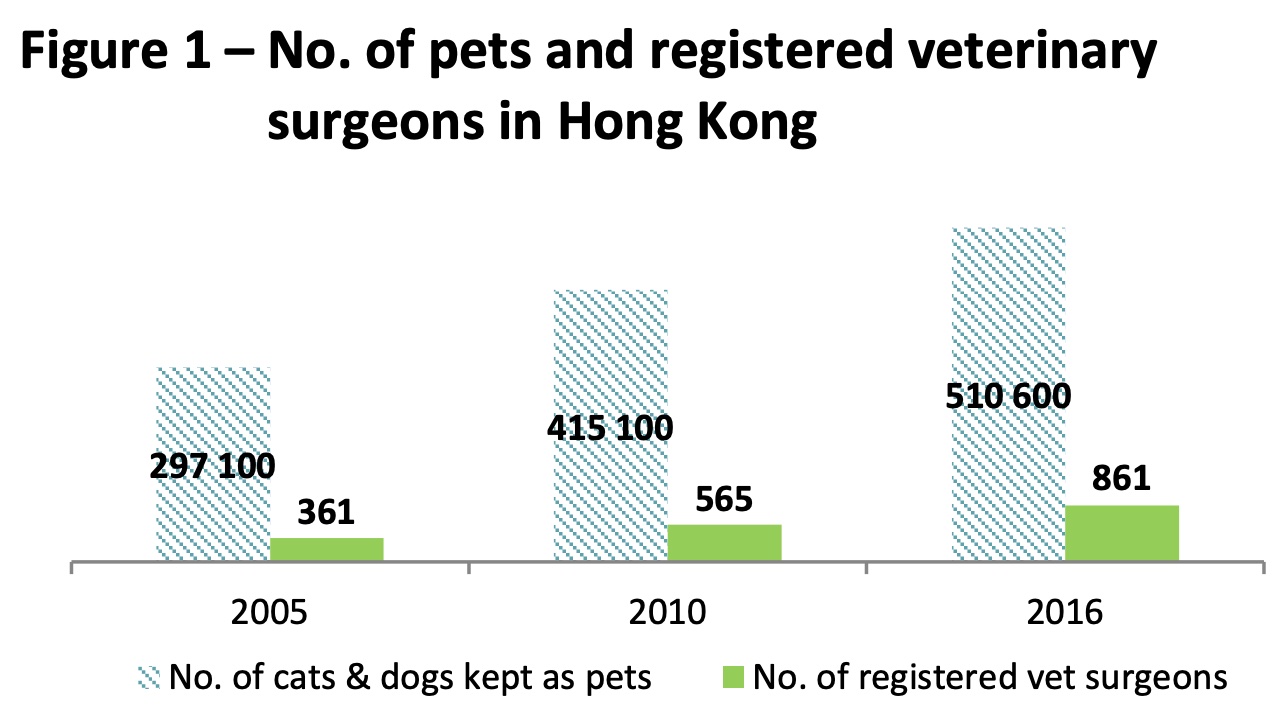
    For instance, the Legislative Council reported that, in 2016, 510600 domestic pets and 861 vet surgeons were registered in Hong Kong. Numbers are increasing since 15 years now.

    Pet parents spending in Hong Kong

    Pets hold special importance in the life of pet owners in Hong Kong. They treat their pets just like any other human companion, and they never step back from spending on their pets.

    We are not just talking about the millennial who can afford to do the same, but every pet owner tries their own tit and bit to provide their pets with the best they can.

    You can make it out by having a look at the growing pet industry in the city, which is spreading its root day by day. According to Statista , it is believed that the pet food segment in Hong Kong is on the verge of achieving growth by 5.9 % between the years 2018 to 2021.

    Also, there are new types of pet service businesses that are creeping up with the passage of days to facilitate the pet parents with all the care and attention that they need for their pets.

    Pet shops and stores have shown up a notable expansion in their business, opening up new retail chains and have also gone up to the extent of using omni channels to build their customer base. And, with more and more people adopting pets each day, this industry is undoubtedly going to experience a boom in the coming days. 

  • Work-from-home trend amplifying boom in home-furnishing sales

    Work-from-home trend amplifying boom in home-furnishing sales

    Sales of home-furnishing products in Singapore have more than doubled in the two months spanning February 1 to March 31.

    Data from fintech research firm Revolut suggests the 105 percent increase in sales has been brought on by Singaporeans setting up home offices in response to the coronavirus outbreak. Furniture retailers Courts saw growth of 92 percent during the period, whilst competitor Ikea experienced 128-per-cent growth.

    Work-at-home arrangements have also seen a rise in sales of stationery and school supplies by 15 percent, while spending on entertainment has increased 55 percent, largely due to purchases of digital goods on platforms such as Steam games (104 percent) and Nintendo (82 percent).

    “It is likely that the worldwide coronavirus pandemic has had a significant impact on the increase in online activity and transactions overall,” read a report from the firm, “as many more people find themselves at home”.

    Other significant sales data revealed by Revolut shows increases in do-it-yourself spending (44 percent); local e-commerce (35 percent) and in-store transactions (30 percent) in March; and online food delivery (150 percent).

    Meanwhile, data from South Korean e-commerce site SSG.com shows that sales of products relating to home entertainment doubled in the first half of February compared to previous months.

    Sales of home-interior related products rose more than 40 percent, while home training-related sales rose 35 percent.

    SSG.Com, the online shopping unit of retail conglomerate Shinsegae, said sales of products that allow children to make snacks using dough rose by 150 percent, while sales of baking mixes for pancakes, cookies and brownies rose by 152 percent.

    Coffee-related appliances such as espresso machines, coffee makers and coffee-bean grinders also gained popularity, with sales rising 74.5 percent and capsule-type coffee rising 25 percent, according to a report in Korea Bizwire.

    Meanwhile, sales of “home gardening” products or related products, which allow people to grow plants directly on their veranda also rose by 147.6 percent.

  • Videoconferencing Apps Under Scrutiny by Banks

    Videoconferencing Apps Under Scrutiny by Banks

    Video chat and conferencing apps have surged in popularity amid the shutdown caused by the Covid-19 pandemic, but they are facing renewed safety and privacy concerns.

    Standard Chartered bank has instructed its employees not to use videoconferencing app Zoom over privacy and security concerns, according to «Reuters,» which viewed an internal memo sent by chief executive Bill Withers, which also warned against using Google Hangouts for virtual gatherings.

    Among the security concerns, Zoom is facing is the lack of end-to-end encryption of meeting sessions, routing of traffic through China and zoombombing, when uninvited guests crash meetings.

    According to experts quoted in the report, these apps offer less encryption than Cisco’ Webex, Microsoft’s Teams, or Blue Jeans, which are typically used in the financial services industry.

    Standard Chartered is the first major global bank to ban the use of Zoom, as the use of digital communications tools surged after lockdowns were enforced to slow the spread of the Covid-19 virus.

    According to Zoom CEO Eric Yuan, its daily users reach 200 million in March, a twenty-fold increase over the previous maximum

    Among its measures to quell the global backlash against its perceived flaws, Zoom appointed former Facebook security chief Alex Stamos to advise it on safety and privacy matters.

    Singapore schools, which have moved to home-based learning, suspended the use of Zoom last week after hackers posted obscene images on screens. This follows Taiwanese and German governments’ curbs, as well as the New York public schools system, of the videoconferencing app.

    The Ministry of Education has since resumed the use of the app, after implementing enhanced security protocols, including centrally managing default security settings and consolidating security settings so they can be more easily activated.

  • COVID-19: How retailers can take control and lessen the impact

    COVID-19: How retailers can take control and lessen the impact

    Retailers and grocers have been some of the first businesses to be affected by the recent outbreak of COVID-19, as stores across the globe sell out of stock due to sudden surges in product demand.

    The virus, which continues to spread rapidly, is putting a huge strain on retailers as customers prepare for the worst, flocking to supermarkets to stockpile on supplies. Of the many regions affected by the COVID-19 pandemic, the South East Asia region was one of the first to see the demand for everyday products skyrocket as fears grew over the spread of the virus and the likelihood of disruption to normal life due to self-isolation. Over the past few weeks, items such as toilet paper, facemasks, soap, tinned food, disinfectant and food staples have been flying off the shelves as customers bulk-buy goods, leaving retailers scrambling to replenish their supply in time for the next wave of panicked customers.

    Real-time inventory insight

    Without a strong grasp of where goods are located in retail stores and supply chains, as well as where products are originally being sourced from, it is incredibly challenging for retailers in South East Asia to take control and maintain stability in their businesses.

    The COVID-19 pandemic is a reminder of just how important it is for retailers to have real-time insights into their product inventory, as well as stock suppliers, so that they can stay fully informed and react quickly to sudden market changes.

    Real-time transparency of the entire supply chain helps retailers to determine whether their product inventory is full enough to deal with spikes in demand, such as what is being experienced with COVID-19, and whether the products being supplied are coming from sources located in countries that are or could be impacted by COVID-19 restrictions.

    If suppliers are impacted and business as usual isn’t possible – due to reductions in their workforce and shutdowns affecting productivity – the flow on effect could be delays, halts or backlogs in both production and shipping of ordered goods.

    Maintaining business stability

    To maintain business stability at all times, retailers need a real-time view of product inventory and stock availability, at any point in the supply chain, including warehouse, transport, online shopping and in store. They also need a detailed list of all stock suppliers, which is always accessible and accurate.

    A centralised real-time viewpoint of what stock is in the supply chain and where it is located helps retailers to identify whether there is a need to order in more. This information also helps retailers to make assessments ahead of time around whether there is a risk that some of their usual stock sources and suppliers will have less of a capacity to deliver them product. If this is the case, retailers are then able to develop contingency plans like investigating what other suppliers are available for them to turn to as an alternative.

    Having just one single source of truth when it comes to inventory and stock suppliers available at any time and from any location, can help prepare retailers for challenging times. It means retailers can stay on the front foot and be ready for sudden increases in demand or last-minute changes in suppliers.

    Agile inventory fulfilment

    The current demands on supply chain operations during the COVID-19 pandemic is requiring retailers and grocers to quickly shift and reset their supply chains to be more reactive. For some businesses their supply chains are under much more pressure than ever before, even when compared to peak periods such as Black Friday and other sales events.

    Retailers are having to quickly get a grasp of their stock levels, stock turnover and short-term stock fulfilment needs, plus focus on heightened communication with suppliers, so they can quickly establish and execute an inventory strategy for this unprecedented situation.

    Inventory management is very difficult to get right when there are so many moving parts, and the current environment retailers are facing with COVID-19 has raised the stakes even more. Retailers always need full visibility of stock and suppliers  to help them take charge during uncertain times and give them full control of their business. This business agility allows them not only to keep up with current spikes in demand, but to sustain their profit margin and business stability into the future once things return to normal.

    By: Richard Wright, Managing Director, SEA, at Manhattan Associates

    For more information on how to ready your business for high demand periods, please visit www.manh.com/en-sg


  • How China retail is emerging from the coronavirus crisis

    How China retail is emerging from the coronavirus crisis

    Savills China Retail predicts a full recovery of the country’s retail sector post coronavirus will probably happen in the second half of the year.

    In a perspective on China retail’s recovery from the crisis, the real estate company describes the blossoming rejuvenation of shopping malls, restaurants, gyms and entertainment centers whose businesses were affected by lockdowns during and after the Chinese New Year period in late January.

    It says consumers are gingerly returning to stores as China’s coronavirus outbreak eases. Shopping malls in Shanghai are reporting footfalls at 30 percent of their pre-coronavirus levels. From this week, most shopping malls have adjusted business hours back to 10 am–10 pm and most retail tenants have reopened to the public.

    Anecdotal evidence suggested that it was already difficult to find parking or seats at coffee shops at Shanghai’s IAPM mall, and queues were reported outside some fashion stores.

    While some restaurants have shut down permanently after being unable to cover labor and rent costs during the affected period, those that survived have been allowed to reopen following an application process. Popular restaurants are once again popular after the coronavirus outbreak receeded.

    Most of the gyms in China have reopened excluding Beijing, introducing maximum capacity levels – allowing 50 people in at a time (per 30,000sqft) for a 90-minute period. After that time is up, gyms perform a full half-hour sanitization process before letting the next 50 people in to work out.

    Nightclubs and KTV venues have opened as of a few days ago in Shanghai and in most cities in China except Beijing, however, consumers are remaining hesitant to go to these places. Some entertainment parks remain closed, most likely on a voluntary basis.

    A limited number of domestic Chinese brands have collapsed at this stage, but more are likely during the next couple of weeks, due to cash flow challenges.

    Savills says international brands looking to expand in the China retail market have largely put those plans on hold.

  • China will drive massive global e-commerce transaction growth by 2024

    China will drive massive global e-commerce transaction growth by 2024

    Chinese growth will drive e-commerce transaction values up 43 per cent to US$4.8 trillion by 2024, according to new reporting by Juniper Research.

    The research showed Chinese e-commerce undergoing 62 per cent value growth over the next four years, bolstering global e-commerce value along with emerging markets in Latin America, Africa and the Middle East, among others.

    The report found that improvements in connectivity will enable the rise of e-commerce in new markets, thus urging payment providers to seek fresh revenue streams in emerging regions to offset slow growth in developed markets – with a particular emphasis on the potential of mobile payments that do not require a linked bank account, as mobile handset penetration is rising faster than banking penetration in young markets.

    “The popularity of mobile wallets is having a disruptive effect,” read material released by the firm, “with physical cards becoming less important to the payments market.”

    Accordingly, the research suggests that card networks must be proactive, by looking beyond the card, becoming involved in open banking initiatives and delivering omnichannel experiences for users.

    “Card networks must leverage their ability to invest in, and forge partnerships with, key players to gain scale in new areas, or they will fail to diversify their revenue streams and will be vulnerable to future disruption,” said research author Susannah Hampton.

    Juniper’s findings are published as Strategies for Payment Providers: Industry Trends, Opportunities & Recommendations 2020-2024.