Category: Telecom

Retail News Asia is committed to providing both local and global retailers with the latest Telecom & Telco news throughout the Asian market. This on a daily base.

  • DoCoMo 1H profit grows 27.8%

    DoCoMo 1H profit grows 27.8%

    Japan’s NTT DoCoMo grew its net profit for the six months ending in September by 27.8% to 405.41 billion yen ($3.87 billion), on the back of a 3.3% increase in revenue to 2.29 trillion yen.

    DoCoMo attributed the revenue growth in part to recovery of telecoms services revenue as a result of the growth in mobile data consumption of segments of its postpaid subscribe base.

    Expanding demand for smartphones and tablets and the growth in the number of DoCoMo Hikari fiber customers, as well as the operator’s smart life and other non-core businesses, also contributed to the gains.

    Total telecoms revenue grew 2.7% to 1.86 trillion yen. DoCoMo’s mobile subscriber base grew 6.5% to 72.9 million, with LTE customers up 19.6% to 41.28 million, while total docomo Hilari subscriptions grew to 2.53 million.

    ARPU increased 6.8% to 4.380 yen, driven by a 7.5% growth in data ARPU to 3,140 yen. But voice ARPU also grew by 5.1% to 1,240 yen, and MOU was up 3.8% to 136.

    Capex meanwhile reached 246.1 billion yen, up 12% from a year earlier, as DoCoMo invested in expanding the reach of its “premium 4G” service.

    Looking ahead to the full financial year, DoCoMo said the competitive environment has changed significantly, with competition intensifying due to the government’s pro-competition policy, the market entry by MVNOs and other factors. Technological developments have also brought about active competition and collaboration with players from other industries.

    But the company has raised its projected net income for the full year to 655 billion yen. This would compare to a net income of 548.4 million in the prior financial year. Revenue is meanwhile expected to grow to 4.61 trillion yen, from 4.57 trillion yen a year earlier.


  • HKBN Mobile launches Greater China 4G plans

    HKBN Mobile launches Greater China 4G plans

    Hong Kong Broadband Network’s new Mobile Services MVNO division has launched a line of Greater China 4G plans for corporate customers who frequently travel between mainland China, Hong Kong, Macau and Taiwan.

    The new mobile plans include data allocations shareable across the four markets via a single SIM. HKBN is using China Mobile Hong Kong’s 4G network to provide the service.

    HKBN secured an MVNO a license in July, and launched mobile services in September, introducing a range of consumer plans including a HK$446 ($57.50) unlimited 4G service.

    The new corporate 4G plans range from HK$198 for 1GB of data shareable across the four markets to HK$448 for 10GB of data.

    Each plan comes with unlimited voice calls and SMS, as well as free call management value added services during the contract period and free use of the MobileOffice Plus app, which allows smartphone users to remotely make and receive calls from their designated business number from anywhere.

    “With increasing business travelling between Mainland China, Hong Kong, Macau and Taiwan, cross-border data services are in high demand,” HKBN chief commercial officer for enterprise solutions Billy Yeung said.

    “By partnering with CMHK, we are best positioned to offer our customers high-value and cost-effective Greater China service plans.”

  • New Zealand to extend rural broadband initiative

    New Zealand to extend rural broadband initiative

    The New Zealand government has allocated a further NZ$150 million ($107.1 million) towards improving broadband connectivity in rural areas.

    The government has announced the next phase of the rural broadband initiative (RBI), a project to boost broadband coverage and speeds in the 25% of the population not due to be covered by the concurrent Ultrafast Broadband (UFB) project.

    Under the second phase of the RBI program, improved broadband will be delivered to communities unable to access broadband speeds of at least 20Mbps. The first phase of the program improved speeds for around 293,000 rural users.

    In addition, the government’s mobile black spot fund (MBSF) will improve the availability of mobile services in areas lacking coverage, including state highways and tourist areas.

    There are more than 200 blackspots listed in the government’s request for proposals, but not all locations will received coverage.

    “My aim is to provide high-speed broadband to the greatest number of under-served rural New Zealanders within the funding available, and give regional communities access to high-speed broadband. We also want to improve the reach of mobile services to support safety on State Highways and enhance the visitor experience for tourists,” communications minister Amy Adams said.

    “We’ve set an ambitious goal of ensuring that by 2025, 99% of New Zealanders will have access to broadband peak speeds of at least 50Mbps, and everyone will have at least 10Mbps. We’re interested in seeing how proposals for delivering coverage under the RBI2 and MBSF programmes show an upgrade path in line with this vision.”

  • India to have nearly 1b mobile subs by 2020

    India to have nearly 1b mobile subs by 2020

    India has become the second-largest mobile market in the world, and is on track to reach nearly 1 billion unique subscribers by 2020, according to the GSMA.

    A new report from GSMA Intelligence indicates that by the end of June 2016, 616 million unique users had subscribed to mobile services in India, making the country the second-largest mobile market globally.

    India is also expected to see a significant increase in mobile subscriptions, broadband and connectivity with almost a billion unique mobile subscribers expected by 2020. This marks a period of rapid development of the country’s mobile economy, according to the study.

    The country overtook the US in 2016 to become the world’s second-largest smartphone market with an installed base of 275 million devices.

    According to the report, improving affordability, falling device prices and operator investments in network coverage and quality will help deliver an additional 330 million unique subscribers in India by 2020, lifting the country’s penetration rate to 68% per cent of the population, an increase from 47% in 2015.

    India is also seeing an technology shift to mobile broadband services. The number of 3G/4G mobile broadband connections is forecast to reach more than 670 million by 2020, 48% of the total connection base.

    There will also be an accelerating move to 4G over this period. The number of 4G connections is forecast to grow rapidly, growing from just 3 million at the end of 2015 to 280 million by 2020. In addition, the industry is set to invest heavily, with operator capex growing to $34 billion for the period 2016 to 2020.

    “With this report, all signs point to a period of tremendous growth for India’s mobile economy, which will strongly support and enable the government’s ‘Digital India’ initiative aimed at providing broadband connectivity to all,” GSMA director general Mats Granryd said.

    “To fully realize India’s tremendous market potential, review and reform in key areas, including modernizing regulation and long-term planning for spectrum allocation, would accelerate mobile broadband access and adoption across the country,” he adds.

  • Huawei to launch NB-IoT solution in early 2017

    Huawei to launch NB-IoT solution in early 2017

    Huawei has revealed plans to commercialize its end-to-end narrowband IoT solution early next year, to help operators expand their IoT services into new markets.

    The vendor plans to release the world’s first 3GPP standards-based NB-IoT commercial system-on-a-chip, Boudica, that can be deployed with the Huawei LightOS operating system.

    Huawei has meanwhile unveiled SoftRadio, a software suite to help developers access NB-IoT open labs via the internet.

    The solution will also involve eNodeB base stations, an IoT packet core supporting flexible deployment of Core in a Box and NFV, as well as a cloud-based IoT connection management platform with big data capabilities.

    The converged NB-IoT offering will be tested in a large commercial trial this quarter before being released to the market in early 2017.

    “NB-IoT has unique advantages in supporting IoT applications. Huawei will help carriers accelerate the commercial adoption of NB-IoT and the maturing of the industry chain,” Huawei VP of marketing and solutions Jiang Wangcheng said.

    “The IoT project and the success achieved so far fully demonstrate this commitment of ours.”

    Huawei’s launch plans were announced at the Huawei eco-CONNECT Europe 2016 conference held in Paris last week.

  • Sunil Bharti Mittal named GSMA chairman

    Sunil Bharti Mittal named GSMA chairman

    Sunil Bharti Mittal (pictured), founder and chairman of India’s Bharti Enterprises, has been named as GSMA chairman from January 2017 to December 2018.

    Mittal, the first Indian to be elected as chair of GSMA, will oversee the strategic direction of the organization, which represents nearly 800 of the world’s mobile operators, as well as more than 300 companies in the broader mobile ecosystem.

    Mittal will succeed Jon Fredrik Baksaas, who will step down from the board at the end of 2016, after holding this position for the past three years. He was elected as a member of the GSMA board in 2008.

    “I am delighted to be elected as chairman of the GSMA, and look forward to working closely with the rest of the board, the GSMA leadership team and our entire membership to address the critical issues facing our industry and our customers,” said Mittal.

    “I am excited about what the next chapter holds for us, as we work to connect everyone and everything to a better future. In my new global role, I am also excited to support the ongoing mobile broadband revolution in India to boost the Government’s Digital India Program and its vision of broadband access for all.”

    The GSMA has also elected the new members of the board and re-elected Mari-Noëlle Jego-Laveissiere, executive vice president, Innovation, Orange Group as a deputy chair for a two-year period.


  • China Unicom developing 5G VR streaming tech

    China Unicom developing 5G VR streaming tech

    The China Unicom Network Technology Research Institute is working on a new use case for advanced technologies including 5G and VR – panoramic VR streaming of live video using drone technology.

    China Unicom and wireless broadband technology provider Baicells are developing a prototype mobile edge computing VR live video technology using Artesyn Embedded Technologies’ MaxCore mobile edge computing acceleration platform.

    The technology uses the emerging panoramic video collage algorithm and transmission protocol to provide VR video streaming from drones equiped with 360-degree high-definition cameras.

    Users can manipulate their perspective in real-time, providing a more immersive live VR experience.

    “This end-to-end solution can be applied not only to concerts, sporting events, films and other entertainment industries, such as the Mid-Autumn festival, live CCTV broadcasts using VR panoramic technology, but it can also be applied to public safety, emergency communication, UAV inspection, and much more,” Baicells research director Mingyu Zhou said.

    “We believe China Unicom and Baicells’ joint research and development can help users experience live HD VR video transmissions more quickly and smoothly.”

    “MEC provides a distributed computing environment for application and service hosting, bringing cloud technologies closer to the RAN and ultimately, closer to consumers,” Artesyn marketing VP Linsey Miller added.

    “Carriers are telling us that for these applications they need telco-grade features, which is Artesyn’s expertise.”

  • BT to build cloud infrastructure for Randstad

    BT to build cloud infrastructure for Randstad

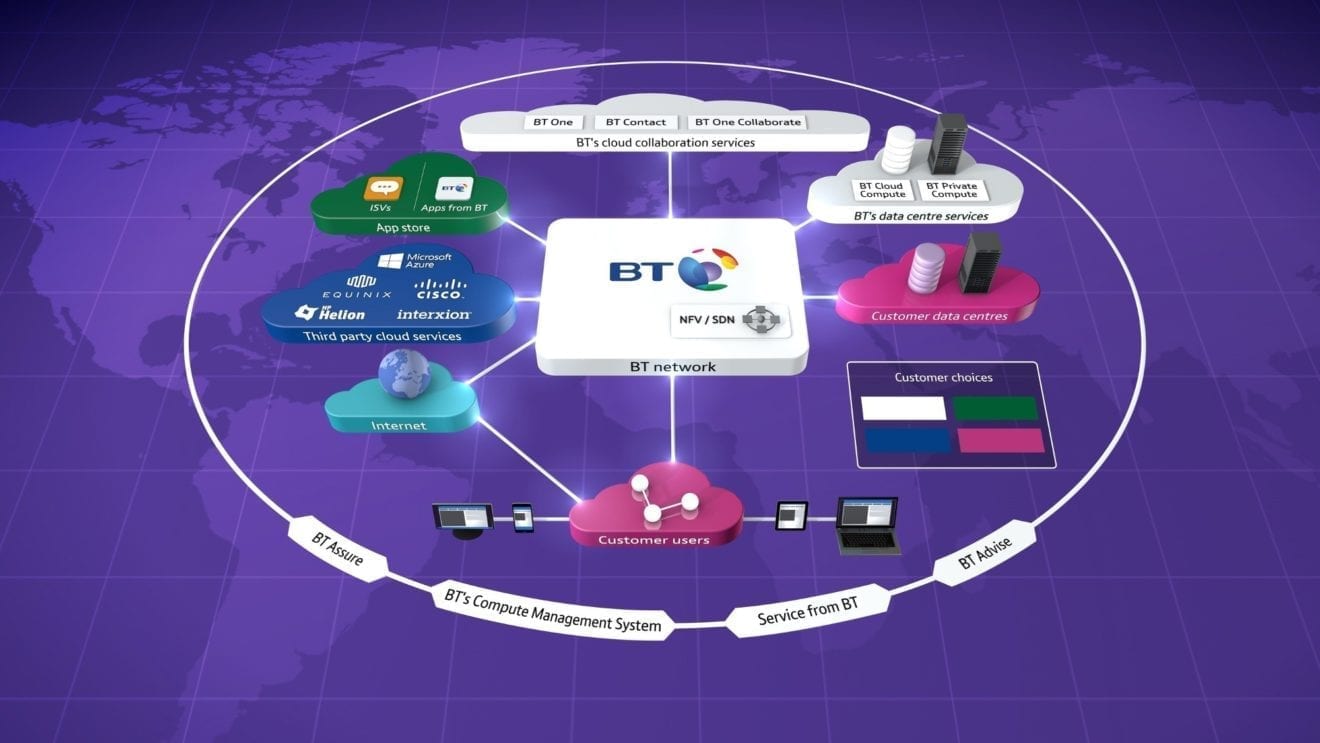
    HR services provider Randstad Group has contracted BT to build a new global IT infrastructure providing cloud connectivity to more than 3,500 sites worldwide.

    The network will connect 37 countries in Europe, North- and South-America, Middle East and Asia-Pacific.

    BT will consolidate, centralize and standardize Randstad’s network infrastructure, currently sourced from multiple domestic and regional providers. The new infrastructure uses BT’s IP Connect and Internet Connect services to combine the reliability and security of IP-based VPNs with the flexibility of internet connections.

    The network infrastructure will use BT’s Cloud Connect service to deliver high performance connectivity to multiple Amazon Web Services locations. In addition, BT One Cloud will deliver cloud-based voice services for Randstad’s 33,000 employees, hosted from data centers in Europe, North America and Asia. BT will also standardize Randstad’s in-office – fixed and wireless – networks.

    “We were looking for a global network and cloud services integration partner to help us gain more control over our network estate, increase efficiencies, maximize the benefits of the cloud and help accelerate our digital transformation,” said Bernardo Payet, general manager of Randstad Global IT Solutions.

    Payet said BT will take away the burden of managing a multitude of different suppliers and make it easier for us to implement new services for our employees and customers.

    “Our ambition is to be the leading global cloud services integrator, offering customers unparalleled choice, security, resilience, speed, flexibility and agility on their digital transformation journey,” BT Global Services president of Europe and global telecom markets  Corrado Sciolla said.

  • QVC Japan taps Verint to enhance quality assurance, customer experience

    QVC Japan taps Verint to enhance quality assurance, customer experience

    TV shopping firm QVC Japan is leveraging Verint Workforce Optimization in its in-country contact centers to drive operational improvements, as well as enhance the quality of calls and productivity of its customer service agents.

    QVC is also using and benefitting from Verint Speech Analytics, which continues to play an important role in its focus on customer engagement.

    Having used the Verint Workforce Optimization and Customer Analytics solutions for three years, QVC Japan is capturing, analyzing and acting on feedback from its customers to help ensure consistency in its service approach and deliver positive experiences.

    “QVC Japan was the first operation in the QVC global network to implement Verint’s workforce optimization and analytics solutions, and based on our positive results, we have gained a lot of attention,” said Masukawa, customer experience manager at QVC Japan.

    In particular, the combination of quality management and speech analytics helps us determine how best to maximize customer and other business insights coming into our operations and then apply them to new measures.”

    The QVC quality team was the first to introduce workforce optimization and speech analytics to the organization. In doing so, the business has increased quality scores, while enhancing productivity across its teams. Upon experiencing these results, QVC Japan’s customer experience division implemented the Verint Speech Analytics solution.

    By leveraging the data and valuable insights from the voices of its customers, the company says it is better able serve them, meet their expectations, and develop and launch compelling marketing initiatives and campaigns.

  • Airtel Q2 profit falls 4.9%

    Airtel Q2 profit falls 4.9%

    Bharti Airtel has reported a 4.9% decline in net profit for its fiscal second quarter, as the operator cut tariffs to prepare for competition from disruptive newcomer Reliance Jio Infocomm.

    India’s largest operator by subscribers reported a profit for the quarter ending September 30 of 14.61 billion rupees ($218.5 million).

    Revenue grew 5.6% year-on-year to 246.52 billion rupees, with India revenues up 10.1% to 192.19 billion rupees.

    But while total ARPU rose to 201 rupees from 193 rupees the year before, aggressive price cutting led to a decline in voice ARPU to 140 rupees from 132 rupees.

    Mobile data revenues grew 21% year-on-year to 45.36 billion rupees, thanks largely to a 62.2% year-on-year growth in Indian mobile data customers to 41.3 million. Mobile data revenues accounted for 24.7% of Indian mobile revenues for the quarter, up from 21.5% a year earlier.

    Africa revenues meanwhile grew 4.7% on an underlying bases. Airtel has divested its operations in Burkina Faso and Sierra Leone over the past two quarters, reducing its African footprint to 15 countries.

    “Our strong focus on enhancing customer experience and building a robust network has resulted in continued acceleration of revenue market share. Overall revenue momentum in India has been sustained during Q2 with a growth of 10.1% year-on-year,” Airtel CEO of India and South Asia Gopal Vittal said.

    “This is primarily due to the strong performance of our non-mobile businesses, which grew in aggregate at 18.8% year-on-year, albeit our mobile business has experienced a slowdown in growth due to free services being offered by a new operator.”

  • DDoS attacks caused StarHub broadband outages

    DDoS attacks caused StarHub broadband outages

    Singapore’s StarHub has blamed DDoS attacks originating from its customers’ own infected devices for two broadband outages over the past few days.

    At a press conference yesterday, StarHub announced the latest findings of an investigation into the outages on October 22 and 24.

    Both outages lasted for around two hours, leaving many home broadband customers unable to surf the web due to a spike in DNS traffic originating from infected machines.

    Because the traffic originated from StarHub’s own subscribers, it appeared legitimate. But when the attack was detected, StarHub manually filtered out the traffic from the infected devices to restore services for its other customers.

    StarHub announced it plans to send technicians to help customers clean up any infected devices at their homes.

    Singapore’s Cyber Security Agency and the Infocomm Media Development Authority have urged operators to strengthen their defense against DDoS attacks, and noted that this marks the first time Singapore has experienced such and attack on its network infrastructure.

    Darktrace managing director for APAC Sanjay Aurora said operators and ISPs are likely to find themselves increasing targets of attack.

    “The core infrastructure of telecommunications companies is a very desirable target for cybercriminals [but] gaining access is extremely difficult and requires deep expertise in specialist architecture,” he said.

    “What ISPs should be wary of, is the possibility of similar DNS amplification attacks on a more regular basis, given that they require relatively little skill and effort but can cause a large amount of damage. This makes them increasingly popular among hackers.”

    He said DNS-based DDoS attacks can impact networks by saturating bandwidth with malicious traffic, while also increasing volumes of support calls and negatively impacting  the customer experience and ultimately revenue.

    Aurora added that there is a possibility that the DDoS attack was caused by Mirai, the IoT botnet responsible for the recent DDoS attack against US-based DNS service provider Dyn. This attack used infected IoT devices.

  • Huawei applies machine learning to network control

    Huawei applies machine learning to network control

    Huawei has developed a prototype technology involving using machine learning to achieve intelligent, automated network traffic control.

    The vendor’s Noah’s Ark Laboratory has announced results of tests into Network Mind, a prototype technology designed to enable automatic detection and accurate prediction of traffic changes on a network, applying optimizations based on service changes.

    Huawei said Network Mind can facilitate the management of millions of network elements with millisecond response time.

    It uses cutting edge machine learning technologies such as online deep reinforcement learning and real-time big data mining

    The technology is being designed for operators and enterprises maintaining ultra-large networks. The prototype was first developed in December last year, and is being tested in collaboration with operators.

    Tests indicate that Network Mind is is up to 500% more efficient in realizing KPIs such as task completion or policy generation compared to existing template or heuristic algorithm-based optimization methods.

    Network Mind is also over 50 times more efficient when analyzing paths of large optical networks, which has the potential to reduce the time it takes to analyze use cases such as optical network failure prevention from 5 hours to as little as 6 minutes.

  • Ericsson appoints new CEO

    Ericsson appoints new CEO

    Ericsson has appointed long-time board member Börje Ekholm president and CEO, effective from mid-January.

    Ekholm will replace interim CEO Jan Frykhammar on January 16, who is standing in following the resignation of Hans Vestberg in July.

    Ekholm joins Ericsson from Patricia Industries, a division of Sweden’s Investor – Ericsson’s largest shareholder -where he is CEO. Prior to this he was CEO of Investor AB between 2005 and 2015, and has held positions at companies including Novare Kapital and McKinsey and Co.

    “I am very excited about this opportunity. As the networks and applications become even more important in a 5G connected world, our customers, and the industry, look for continuous innovation,” he commented.

    “I look forward to joining the great team at Ericsson and work closely with existing and new customers around the world in shaping the future of our industry.”

    Ekholm is also a board member of Alibaba and several other companies. He is based in the US, and will stay there when he takes the role. He will retain his position on the Ericsson board.

    Ericsson recently announced plans to cut 3,000 jobs in Sweden as part of the vendor’s ongoing cost cutting program.

  • SK Telecom Q3 profit falls 15.6%

    SK Telecom Q3 profit falls 15.6%

    SK Telecom has reported a 15.6% year-on-year decline in net profit for the third quarter to 322.1 billion won ($281 million), due to factors including the impact of Samsung’s Galaxy Note 7 recall.

    Operating revenue fell 0.4% to 4.24 trillion won due to a decrease in revenues at retail unit PS&M following the recall. ARPU also declined 2.1% year-on-year and 0.8% sequentially to 35,471 won.

    But revenue from SK Telecom and subsidiaries SK Broadband and SK Planet all increased quarter-on-quarter, and net income grew 10.7% over the same period due to equity-method income from semiconductor division SK Hynix.

    The operator added around 301,000 new subscribers during the quarter, taking its total to nearly 29.5 million. Of these, over 20.5 million are LTE subscribers, a penetration rate of 69.8% Monthly churn decreased by 0.1 percentage point to 1.4%.

    SK Telecom revealed that its mobile navigation T Map grew to reach 9.18 million monthly users by the end of September, around three months after its launch

    Looking ahead, the operator said it is focused on strengthening its core competitiveness as a mobile network operator, while using its nationwide LoRa and LTE-M IoT networks to deploy services that enhance customer convenience.

    “We expect that our strategy to fully open up major platforms including T Map and T Phone will lead to a successful outcome in the mid-to long-term,” SK Telecom CFO and head of strategy and planning Hwang Keun-joo said.

    “SK Telecom will accelerate its transformation into a next-generation platform company and keep developing customer-oriented products and services.”

  • Nepal Telecom receives 4G license

    Nepal Telecom receives 4G license

    Nepal Telecom has finally received a 4G operating license, clearing the company to launch services on January 1.

    Regulator the Nepal Telecommunications Authority has resolved to issue the license based on the detail rollout plan the operator submitted recently.   Nepal Telecom submitted the rollout plan after receiving initial approval for its 4G application earlier this month.

    With the decision, Nepal Telecom has become the market’s first operator to be cleared to launch 4G services. The operator will use the 1800-MHz spectrum it has been using for 2G services.

    Nepal Telecom plans to commence its rollout in the Kathmandu Valley area and Pokhara, before progressively expanding to other parts of the country.

    The operator had initially proposed to launch services on December 15, but the regulator has decided to delay the launch so the operator can smoothly complete the required preparatory works.

    Two other operators had applied for 4G licenses. One of these applications – submitted by Smart Telecom – has been rejected. The government has yet to make a decision on the second application, submitted by Ncell.