Tag: 5G

  • Honor introduces two new 5G phones, the X30 and the Play 30 Plus

    Honor introduces two new 5G phones, the X30 and the Play 30 Plus

    Continuing to celebrate its separation from Huawei, which allows it to install the Google version of Android on its phones, Honor today unveiled the X30 handset. The device sports a 6.81-inch LCD display with a resolution of 1080 x 2388, and thin side bezels that weigh in at 1.05mm. The screen refreshes 120 times each second for buttery smooth scrolling, enhanced animations, and more.

    Under the hood (another area where Honor is no longer restricted thanks to Huawei’s $15 billion sale of its former sub-brand) you’ll find a 5G Snapdragon 695 SoC built on the 6nm process node by TSMC. Compared to the MediaTek Dimensity 900 that powered the X20, the chip powering the new phone will deliver CPU and GPU performances 15% and 30% higher, respectively.

    On the back, the camera array includes a 48MP primary camera, a 2MP macro camera for extreme close-ups, and a 2MP depth sensor. There is a small punch-hole in front for the 16MP selfie snapper.

    Keeping the lights on is a 4800mAh battery that charges at 66W. At that rate, you might be able to juice up your phone to 80% in only 30 minutes. Memory ranges from 6GB to 12GB with storage options of 128GB or 256GB. Honor’s Magic UI 5.0 is found on top of Android 11 and the X30 will be available in silver and black (Las Vegas Raiders’ colors), gold and blue.

    The Honor Magic X30 is priced at CNY1,499 (equivalent to $235) for the base 6GB RAM/128GB model and rises to CNY 2,299 ($361) for the 12GB RAM/256GB variant. The phone goes on sale in China on Christmas Eve and Honor has yet to mention anything about a global version of the device. While the X20 had a limited release, Honor CEO Geroge Zhao has hinted at wider distribution of the X30.

    The executive said, “Through both online and offline channels, we have been able to expand our offerings to even more consumers,” he said. “We are grateful for the trust of our retail and carrier partners around the world and look forward to introducing more products together in 2022.”

    Also introduced today was the Honor Play 30 Plus. A less ambitious phone than the X30 is, the Play 30 Plus carries a 6.7-inch LCD screen that refreshes 90 times each second. It is equipped with MediaTek’s Dimensity 700 chipset and does support 5G. The phone comes with 4GB-8GB of memory and 128GB of storage. On the back is a 13MP camera with a 2MP depth sensor. In the front is a teardrop notch with a selfie camera that weighs in at 5MP.

    A 5000mAh battery is inside the handset although charging is no faster than 22.5W. The color options are the same as the four available for the X30 (silver, black, gold, and blue), and the software (Magic UI 5.0 on top of Android 11). The model with 4GB of memory and 128GB of storage is priced at CNY 1,099 (equivalent to $173). The version with 8GB of memory and 1238GB of storage trim and maxes out at 8GB RAM and 128GB storage which will set you back CNY1,499 ($235).

    Honor is also celebrating its freedom by announcing that it plans on becoming an “iconic global brand.” In a release, the company said, “HONOR spent the past year developing strategic collaborations with its global supply chain partners and established over 30 partnerships with leading suppliers including AMD, Intel, MediaTek, Microsoft and Qualcomm.”

    Honor CEO Zhao said, “Thanks to the support of our friends and partners over the past year, HONOR has been able to deliver on our promise to help consumers go beyond as well as expand our brand to provide both premium and accessible technology to a wider range of users. I am so proud of the industry breakthroughs we have introduced as a result of the dedication and passion of my colleagues and collaborations with our leading global chain partners.

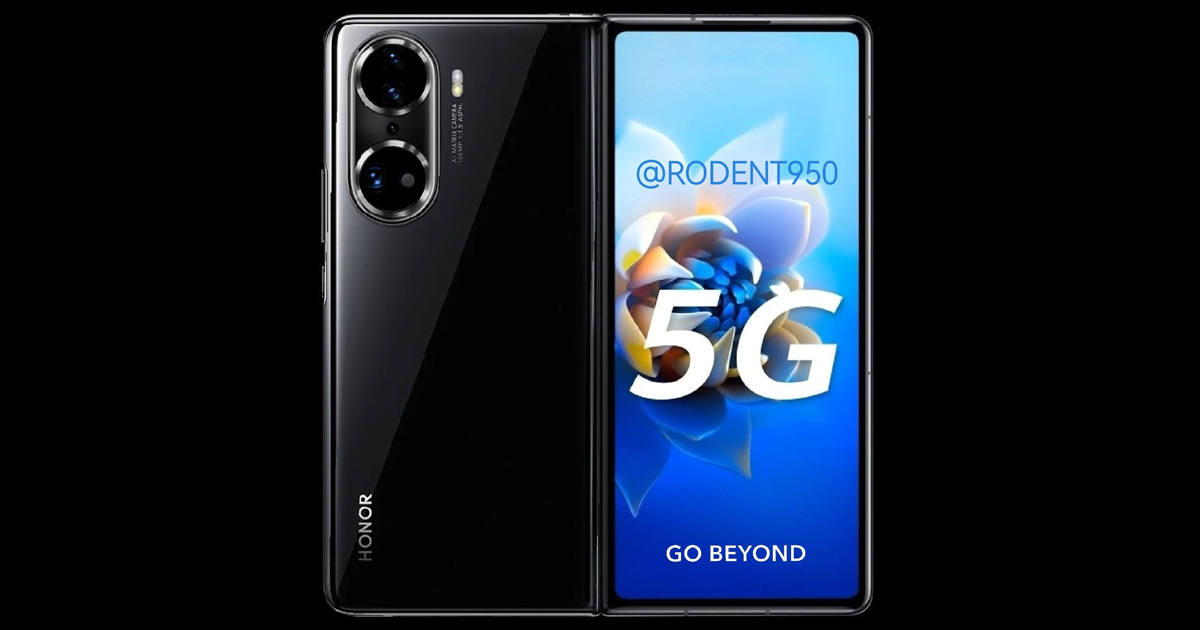
  • Check out this render of the 5G Honor Magic Fold

    Check out this render of the 5G Honor Magic Fold

    Talk about a foldable Honor handset started all the way back in February of this year when we passed along a report that the former Huawei sub-brand would release a foldable model later this year. Then in June, we let you know that the Honor Magic Fold was going to be inward folding like the Samsung Galaxy Z Fold 3.

    The Magic Fold is expected to be introduced sometime in the first quarter of 2022. But that doesn’t stop us from showing you renders of the device which were posted on Twitter. Similar to Samsung’s last two Galaxy Z Fold models, the exterior screen runs the complete length of the back of the phone’s left panel (when fully opened with the large tablet-sized display showing).

    Rumored specs for the device include an 8-inch display when the phone is fully unfolded, sporting a resolution of 2200 x 2480. An octa-core CPU is reportedly under the hood featuring one Cortex A-77 core running at a clock speed of 3.13GHz, three Cortex A-77 cores running at a clock speed of 2.54GHz, and four Cortex A-55 cores running at a clock speed of 2.05GHz.

    The chipset will be paired with 8GB of memory and 256GB of storage. The render shows a rear camera with a 108MP sensor for the primary snapper. After taking into account the likelihood of 9:1 pixel binning, it would appear that the device will deliver 12MP images. Besides the obligatory ultra-wide and telephoto cameras, we could see a 16MP camera grace the front of the handset for selfies and video chats.

    A 4500mAh battery could be called on to keep the lights on, and Android 11 will be pre-installed. No word on when to expect an update to Android 12.

    You might recall that Huawei ended up selling Honor last year to prevent the firm from having to abide by all of the restrictions placed on Huawei by the U.S. While it was a Huawei sub-brand, Honor could not access its U.S. supply chain which forced it to stop using Google mobile services (GMS). It also prevented the company from purchasing cutting-edge chips after a revised U.S. export rule prevented foundries using American tech from shipping cutting-edge chips to Honor.

    But once Honor became free after its sale to a consortium for a reported $15.2 billion, Honor was free to use the Google version of Android, and could receive shipments of any chip it wanted to buy. As a result, the Honor 50 Series was launched with the GMS version of Android and was powered by the Snapdragon 778G allowing the device to support 5G.

    Honor is rapidly growing in China with its third-quarter handset shipments in the country rising a whopping 96% on an annual basis. It now has a 15% slice of the Chinese smartphone market which is good enough for third place after Vivo’s leading 23% and Oppo’s 20%. Xiaomi is fourth, followed by Apple.

    While last year Huawei was the top smartphone brand in China with 30% of the market, the U.S. restrictions are biting and biting hard. Now, the beleaguered manufacturer has seen its share of the Chinese smartphone market declined to just 8%.

    Some Huawei executives are surprised that they continue to be on the U.S. Entity List. In 2019, then-President Donald Trump cited security as his reason for placing Huawei on the list. After all, both Huawei and ZTE are considered national security threats to the U.S. Exactly a year to the day that its inclusion on the Entity List had been announced, the U.S. changed its Export Rules that prevent a foundry using American technology to manufacture chips from shipping cutting-edge components to Huawei.

    It doesn’t appear that Huawei will be removed from U.S. restrictions for some time. Meanwhile, we should continue to see Honor go from strength to strength as it takes the knowledge it gained from being a Huawei sub-brand and uses it to move up the league tables in China.

  • Malaysia to finalize single 5G network decision

    Malaysia to finalize single 5G network decision

    Malaysia will finalize plans to pursue a single wholesale 5G network by January. This week, Malaysia’s communications minister Annuar Musa revealed that the cabinet is considering allowing several 5G providers after telcos voiced concerns that this would stifle competition.

    In February, the government announced plans to switch to a single wholesale network after initial plans to apportion spectrum to telcos. Under the existing plan, Digital Nasional Berhad (DNB), a state-owned company is mandated to deploy a national network to speed up 5G deployment and reduce deployment costs. However, this could risk hampering Malaysia’s digital competitiveness.

    In September, Julain Gorman, head of Asia Pacific, GSMA said, “Malaysia has a thriving mobile economy and a growing digital sector, but the Single Wholesale Network model proposal risks that. 5G technology is ready to be deployed rapidly, and Malaysian operators have already made significant infrastructure investments.”

    The GSMA expressed that “a nationalized monopoly will replace the competitive wholesale market” and render the industry “entirely reliant on wholesale access from DNB for 5G services”.

    In the meantime, DNB will be offering wholesale 5G services to telcos for free. This would commence next week and end 31 March 2021.

  • Nokia to power KDDI’s 5G networks with standalone core and monetization solutions

    Nokia to power KDDI’s 5G networks with standalone core and monetization solutions

    Nokia has announced that Japanese operator KDDI has selected Nokia’s 5G Core and Converged Charging software to support its transition to a fully automated, cloud-native 5G Core architecture.

    Nokia’s cloud-native 5G Core’s near zero-touch automation capabilities help operators drive greater scale and reliability. Following the evolution of KDDI’s networks to 5G standalone core, subscribers will experience lower latency, increased bandwidth and higher capacity.

    Nokia’s open 5G Core architecture gives KDDI the flexibility to be responsive to market demands while controlling costs by streamlining operations and unlocking crucial capabilities, such as network slicing. Developed around DevOps principles, Nokia’s 5G Core will automate the lifecycle management of KDDI’s networks, as well as enable continuous software delivery and integration.

    Nokia will also deploy 5G monetization and data management software solutions including cloud-native Converged Charging, Signaling, Policy Controller, Mediation and Registers to capture new 5G revenue opportunities, enhance business velocity and agility, and streamline the operator’s network operations.

    With Nokia’s monetization solutions, KDDI will be able to monetize new opportunities within the 5G economy. This includes 5G network slicing and network as a service offering, IoT and new business models for B2B2X services through a containerized, microservices-based solution that enables services-based integrations with new 5G network functions meeting standards requirements for 5G convergent charging systems.

    Other products in the deal include Nokia’s Digital Operations software, Cloud Operations Manager, NetAct network management system and Archive Cloud to automate the backup and storage of network data. Solutions will be deployed across Nokia cloud infrastructure, a cloud-native solution that integrates multi-vendor and multi-technology environments.

    Tatsuo Sato, Vice President and Managing Officer, Technology Planning, KDDI, said: “The deployment of Nokia’s solutions marks a key milestone in the evolution of our 5G architecture. The evolution of our 5G architecture will enable us to fully automate and provide better services to our customers. We are pleased to be continuing our strong relationship with Nokia.”

    John Lancaster-Lennox, Head of Market Unit Japan at Nokia, said: “We look forward to expanding our 25-year relationship with KDDI with the deployment of our standalone 5G Core solutions. With crucial monetization and operations functions, such as network slicing, KDDI will unlock key revenue opportunities and benefit from increased operational efficiencies as well.”

  • The 5G-enabled Honor 60 series to be unveiled on December 1

    The 5G-enabled Honor 60 series to be unveiled on December 1

    It’s been less than a month since Honor launched its mid-range 50 series, and the Chinese company has even more smartphones in the pipeline. And it’s not hard to guess the name of Honor’s upcoming devices since the Chinese company has already teased the official announcement.

    The upcoming Honor 60 series is expected to feature at least three different models: Honor 60, Honor 60 Pro, and Honor SE. Unlike the Honor 50 that packs a Snapdragon 778G 5G chipset, the upcoming phones are expected to be more powerful.

    It’s not yet been confirmed, but the Honor Pro 60 is rumored to pack a high-end Snapdragon 870 chipset. Also, the phone will be powered by a 4,500 mAh battery with 100W fast charging support. The regular Honor 60 model on the other hand will only support 66W fast charging.

    However, considering the Honor 60 series is supposed to be aimed at the mid-range tier, these rumors may be false, and the upcoming phones might end up with the same chipset inside as the Honor 50 series, or perhaps trade it for a MediaTek processor like the Dimensity 900.

    Thankfully, we won’t have to wait long for these important details. Honor confirmed the 60 series will be unveiled in China on December 1, which is less than a week from now.

  • Creating value with private 5G networks to transform industries

    Creating value with private 5G networks to transform industries

    Private 5G networks are on the rise as transformative applications support digitalization and IoT. Telecom Review Asia Pacific speaks to Wang Quan, vice president of ZTE Corporation, to find out how private 5G networks provide operators with new opportunities as 5G brings strong impetus for transformation across industries.

    How do private 5G networks add value to operators and transform industries?

    The concept of private networks is not exclusive to 5G. In the 2G, 3G, and 4G eras, industries with special requirements on network security and stability, such as railways, airports, power and oil already rely on customized private networks to power secure and robust connectivity. However, traditional private networks have their limitations – they are unable to support massive connectivity and can only be used to complement mainstream public networks. Increasingly, traditional private networks can no longer support the demands of real-time and remote operations in the intelligent era where man-machine interconnectedness grows.

    With the maturity of 5G technology and the dawn of Industrial 4.0, more enterprises are now embracing digital and intelligent transformation. To address future demands, enterprises that depend on traditional private networks are now exploring new network technologies.

    The need for deterministic networks in vertical industries with high demands on latency, reliability, and security makes private 5G networks the best choice going forward. For example, in extreme work environments such as mines, UHD videos, high bandwidth, and ultra-low latency are requirements to remotely control excavators and other industrial devices in real-time. In smart factories, a large number of sensors are connected to networks to carry out real-time automation and monitoring to execute safe processes.

    Across many industries, intelligent networks demand deterministic networks with low latency and low jitter. In these scenarios, private 5G networks are capable of providing customized SLA guarantees for a wide range of customized industrial applications, therein presenting enormous opportunities for operators to realize private 5G as a service to tap on new economic growth points.

    Can you tell us about the benefits of ZTE’s private 5G networks?

    As a key provider of integrated communications and information solutions, ZTE has always been at the forefront of private 5G networks innovations and applications.

    ZTE provides an all scenario private 5G network covering RAN, core network, transmission, industrial gateway and other end-to-end products. For example, ZTE’s dedicated industrial core network, industry 5GC (i5GC), integrates and optimizes more than 10 key network functions of the 5G core network, requiring just one server to complete the deployment of an entire network. This brings ease to deployment, especially in underserved areas with limited resources.

    In addition, ZTE’s iCube all-in-one cloud network solution supports customer-centric 5G industry private networks and edge cloud services. The solution offers agility and scalability as voice, BBU, OLT, MEC and industry applications can be loaded on-demand to provide customers with highly-customized integrated private industry cloud network services.

    ZTE’s private 5G network solution encompasses private network consultation, planning, design, customization, integration, installation, and deployment. This new “Private 5G as a Service” business model supports operators in rapidly customizing private 5G networks for industries.

    ZTE has also built Openlab, a center for innovation, to flexibly construct customized end-to-end private 5G networks and provide an incubation environment for 5G application innovation. Together with operators and industry partners, ZTE can incubate innovative solutions. To date, ZTE has joined hands with more than 500 partners to explore innovative 5G application scenarios across verticals including smart manufacturing, power grid, port, mining, healthcare, education, and agriculture. ZTE will continue to work with global operators and industry partners to fast-track industrial developments.

    Can you share with us ZTE’s latest innovations in cloud infrastructure? 

    Cloud platforms manage and shield underlying hardware through the hypervisor virtualization layer to provide services such as VMs, containers, and bare metals to achieve resource sharing. However, having the hypervisor virtualization layer deployed on the server results in server performance loss and serious security risks.

    ZTE’s new-generation cloud infrastructure addresses these concerns by uploading the management control module and hypervisor virtualization layer of the cloud platform from the server to the NEO cloud card. Only the lightweight hypervisor resides on the server, hence reducing the CPU load of the server to achieve zero performance loss. At the same time, the NEO card is pre-integrated with the hypervisor virtualization layer, such that users can conveniently deploy the layer to ensure ease of use.

    Suited for use with general servers, the ZTE NEO card enables server cloudification to be easily achieved by merely inserting the card into the server to power the widespread use of the private and public clouds.

    Network functions virtualization (NFV) has evolved from dedicated hardware to general hardware. The most important feature of NFV is that it provides unified operating resources for upper layer virtualized network functions. However, general hardware such as x86 does not meet large bandwidth and low latency requirements – found lacking in terms of data forwarding efficiency and data-parallel processing.

    As such, hardware acceleration is critical to improving network performance in the 5G network. Through hardware acceleration, the system can accelerate the decoupling between hardware and servers to achieve resource pooling and improve network resource utilization.

    There are two decoupling approaches for hardware acceleration – software and hardware decoupling for standardized hardware acceleration cards, as well as software and hardware decoupling for dedicated NE functions. To achieve unified management of NFV heterogeneous acceleration hardware, the ETSI has formulated the software framework standard of unified management for NFV acceleration hardware, while OpenStack provides a general hardware acceleration management framework.

  • Huawei, China Mobile to back Haier for 5G-powered smart manufacturing solutions

    Huawei, China Mobile to back Haier for 5G-powered smart manufacturing solutions

    Huawei and China Mobile are supporting Haier, China’s largest consumer electronics and home appliance producer, in successfully applying innovative manufacturing solutions combining 5G and mobile edge computing in its smart factories.

    Developed at the joint-innovation base established in February, the solutions integrate 5G edge computing with artificial intelligence and particularly machine vision in manufacturing environments. They are applicable to various manufacturing scenarios where they can perform a variety of functions. Haier has launched the technologies at seven smart factories in China, and plans to expand the implementation at 20 factories by the end of 2022.

    Huawei is expected to help Haier deploy the 5G solutions and transform about 100 of its manufacturing facilities globally within five years. The three also plan to offer the technologies to other leading manufacturers in China and abroad.

    5G provides manufacturers with a lot of bandwidth —up to 20GBps— and latencies as low as 1 millisecond. Mobile edge computing, one of 5G’s main features, delivers extremely low-latency cloud computing. However, it is still at a nascent stage for manufacturers aspiring to take advantage of 5G’s full capabilities.

    The solutions enable the implementation of high-performance machine vision in a manufacturing environment through low-latency connections between high-definition cameras, the AI modules at the factory site, and the training servers located off-site.

    Deployed on a 5G-enabled production line, machine vision saves manufacturers costs by rapidly performing QC checks with over 99% accuracy, at least 10% more accurate than without the function. Compared with the visual inspection performed by humans, machine vision delivers much fewer false-positive and false-negative results.

    The three partners also developed technologies to boost site and staff safety. Unlike traditional video surveillance systems that only have a recording function, AI surveillance can automatically create alarms in real-time when it detects anomalies on the factory floor. The technology can identify non-authorized individuals, process safety violations, and workers who aren’t where they should be.

    In addition, the new solutions help to efficiently coordinate the large number of people, machines, and materials involved on a complex production line as a whole. The solutions achieve this through high-definition cameras, 5G gateways, and smart industrial terminals that work in unison with the help of artificial intelligence.

    In future, the solutions will be further improved to provide “digital twins” visualization. Digital twin is the reproduction of a real and dynamic production floor into a virtual digital world, a meta-universe. Digital twin makes just-in-time preventive maintenance a reality and enables the simulation of changes to the production process before they are implemented. The three are also experimenting with how 5G environment can support automated guided vehicles to transfer items in warehouses or manufacturing lines more accurately and efficiently.

  • 5G: Enabling more than just connectivity

    5G: Enabling more than just connectivity

    5G, in many ways, is still in its infancy. The good news is that it is growing and evolving quickly. Much has been said (and written) about the theoretical benefits of 5G: High speeds, low latency and massive connection density. But, not many organizations understand what 5G actually means for their industrial environments. Many organizations—while intrigued by the possibilities of incorporating 5G into their operational and customer-facing processes—often lack the resources to experiment and invest in a long-drawn cycle of “unproven” innovation.

    Hence, it is important for organizations to work with suitable partners. They have the foresight and resources to further flesh out various 5G proof of concepts and understand how these concepts mesh with the organization’s broader digital transformation agenda.

    IDC has identified a few 5G use cases that will have maximum impact across verticals:

    Process automation and robotics
    5G addresses the challenges of today’s static manufacturing lines, increasing machines’ mobility. This reduces the time required to service the machines and allows them to be reconfigured on the fly. In addition to supporting such automation and robotics use cases on public networks through network slicing, the 5G network’s ultra-low latency will allow robotic controls to be processed at the edge, creating further opportunities to improve machine coordination and reduce costs.

    Cloud gaming
    5G and multi-access edge computing is going to further accelerate the adoption of mobile cloud-streamed gaming (CSG) services. When users are mobile and on a cellular network, their experiences often vary to a much greater extent today. This relative network unreliability puts mobile CSG services at a significant disadvantage versus wired/Wi-Fi services. The gaming market is set to explode as network operators bring more 5G mid-band spectrum online in the next few years.

    Autonomous vehicles
    The pathway to increased guided and vehicle autonomy will be largely built on the promise of 5G delivering Society of Automotive Engineers (SAE) Level 4 full self-driving vehicles, as well as accelerating SAE Levels 1 and 2 vehicle growth over the next five years. 5G-based cellular vehicle to everything (C-V2X) will significantly enhance all types of vehicular communication. 5G’s ultra-low latency and network slicing characteristics, together with edge cloud, will enable innovative applications, resulting in safer and more cost-effective transportation.

    Video analytics and surveillance
    Wireless has been somewhat problematic for applications such as video surveillance due to network capacity, reliability and security issues. IDC believes that 5G will propel wireless video surveillance to become a dominant force over the next five years. An increasing number of applications such as wireless perimeter control, aerial drones and home security systems will increase demand for wireless technology that can support high-resolution video securely. 5G along with edge compute will ensure secure and timely ingestion and processing of video feeds to help organizations make data-driven decisions in real-time.

    Immersive experiences
    5G provides organizations with exactly what is needed of networks to transform B2B2C consumer experiences by satisfying the appetite for immersive entertainment, gaming and broadcast experiences. In addition to mobile augmented reality/virtual reality (AR/VR) being used by field and repair technicians who operate far from a central office, there is a considerable opportunity for entertainment venues and sports arenas to provide a 360-degree VR experience at large-scale events such as sports meets and music concerts. Current network generations lack the throughput and capacity required to deliver high-definition content, but 5G, along with edge deployments, allows for ultra-low latency and processing times that are required to deliver a real-time and enhanced immersive experience.

    Industry 4.0 is acknowledged as a transformative series of initiatives around how we make and distribute goods. 5G is poised to have a significant impact across verticals such as manufacturing, healthcare, logistics, media and smart cities. IDC believes that a large number of organisations will boost spending on 5G in 2021-22. Asia Pacific (excluding Japan) regional Internet of Things use case spend across manufacturing, resources and infrastructure is forecast to hit US$295 billion in 2025. With such investments in play, organisations should look out for a service provider—with a platform-based approach to 5G, a broad partner ecosystem and a proven track record of helping organisations on their digital transformation journeys—to evaluate potential 5G use cases and get started early to gain a significant edge over their competitors.

  • TPG Telecom triples 5G coverage

    TPG Telecom triples 5G coverage

    TPG Telecom has reached over 85 percent 5G population coverage in ten of Australia’s largest cities and regions as it delivers a smarter 5G network faster following last year’s merger.

    Capable of delivering speeds of more than 400Mbps, 5G coverage is available in Sydney, Melbourne, Brisbane, Adelaide, Perth, Canberra, Gold Coast, Sunshine Coast, Wollongong, and NSW Central Coast.

    The milestone has been achieved with the launch of the company’s 5G standalone core, which connects devices directly to 5G without the need for a 4G connection, supercharging its 700MHz spectrum holdings.

    TPG Telecom Chief Executive Officer Iñaki Berroeta said the 5G standalone core is a game-changer for the company and its mobile and home internet customers.

    “This is truly a pivotal moment for TPG Telecom and sets us up to deliver 5G’s full potential,” Mr Berroeta said. “The upgraded core network has amplified our 700 MHz spectrum, tripling our 5G coverage and giving us greater reach across suburbs and in densely populated areas. This will give us a competitive boost going forward, with our 5G coverage on par or ahead of other mobile networks in many areas. It not only means more coverage in more places for mobile customers, it also significantly increases our 5G fixed wireless footprint.”

    “Two in three Australians are now covered by our 5G where they work and live, and with the first major device due to be upgraded to work with standalone 5G in just a few weeks, the new coverage is ready.”

    Mr Berroeta said the 5G standalone core was a multi-year project as part of the company’s 5G network roadmap.

    “This puts us firmly on the 5G map, and the project completion is a testament to our network team who skillfully navigated challenges including lockdowns and the 5G vendor restrictions,” he said.

  • Nokia deploys 5G standalone core network for Taiwan Mobile

    Nokia deploys 5G standalone core network for Taiwan Mobile

    Nokia announced that it has deployed its 5G standalone core network for Taiwan Mobile Co. to enable the operator to provide the most advanced 5G applications for enterprises and businesses, and to strengthen its network services and performance.

    The timely deployment includes Nokia’s voice core, cloud packet core, subscriber data management, signaling, network exposure, policy controller, cloud infrastructure, and security management for radio transport. With a 5G standalone core network, Taiwan Mobile can readily provide the most advanced 5G services such as network slicing and smart city solutions that require ultra-low latency and reliability.

    Nokia and Taiwan Mobile are long-standing partners and Nokia, as the sole supplier of Taiwan Mobile’s 5G network, is supporting the operator’s ‘Super 5G strategy’ focused on sustainability and digital transformation.

    Nokia leads the market in core network deployments, with 25 of the top 40 communication service providers relying on its core network products.

    Tom Koh, Senior Vice President and Chief Technology Officer, Technology Group, Taiwan Mobile, said: “Introducing SA to unleash the full potential of 5G beyond high-speed to further realize innovative use cases enabled by ultra-low latency and massive IoT is our strategic mission in the 5G era. We are delighted to reach this milestone with Nokia to bring the first true 5G network into Taiwan. Owning the agility of network slicing to swiftly customize the network for accommodating different use cases, Taiwan Mobile will be able to accelerate time-to-market to provide a wide variety of services for everyone and everything and to free enterprises to embrace Industry 4.0. The SA technology is built from cloud architecture, infrastructure-agnostic by design, which paves a critical step to a full software agile virtualization network. It unlocks the use cases with distributed cloud for low latency service with local breakout needed. Taiwan Mobile’s true 5G network will become the innovative engine for consumers to experience as well as verticals to deploy applications without limits.”

    Susanna Patja, Head of Cloud & Network Services, Greater China, Nokia, said: “We are very pleased that the Nokia 5G Standalone Core network is now up and running, on schedule, for Taiwan Mobile. This provides Taiwan Mobile with exceptional capabilities in terms of machine-to-machine communication, extreme automation, and reliability that enables critical 5G uses for enterprises; and does so with the knowledge that this standalone network will continue to function seamlessly with non-standalone networks.”

  • 5G innovations and policy-making key to digital evolution in the Asia Pacific

    5G innovations and policy-making key to digital evolution in the Asia Pacific

    In conjunction with Huawei’s 12th Global Mobile Broadband Forum (MBBF), Telecom Review Asia Pacific interviews Daisy Zhu, vice president of Huawei Wireless Marketing to learn about the direction of 5G evolution and key trends that shape the development of the wireless industry in the Asia Pacific region.

    We are in the dawn of a new digital age where 5G represents a milestone in the advancement of mobile communications. In just over 5 years since the ITU released its vision for 5G, there are now 176 commercial 5G networks around the world, deployed over 1.5 million base stations to more than 500 million 5G users. Recognized as a key driver for the digital economy, 5G has a transformative impact on lives and societies where it is deployed.

    In the consumer market, where average 5G download speeds are now 10 times faster than 4G and HD video buffer times reduced from 3 seconds to just half a second, Daisy Zhu, vice president of Huawei Wireless Marketing cited notable network growth as 5G offers enhanced user experiences on more immersive OTT content and applications. The use of artificial intelligence (AI) and virtual reality (VR) to create better-simulated experiences is, in turn,also fuelling new economic activities such as live streaming.

    Across industries, the road to commercial 5G adoption has been fraught with difficulties, but countries have made significant strides. Since it has been commercialized 2 years ago, 5G now supports industrial digitalization through more than 10,000 scenarios in over 20 industries worldwide.

    Sharing China’s success in 5G deployment, Zhu said, “In China, 5G is on a fast development track to accelerate the digital transformation of verticals such as coal-mining, steel manufacturing, port operation, and new media. Across these industries, 5G-based digital applications have helped yield improved quality and increased production efficiency while reducing costs to positively impact various sectors.”

    Innovation that balances performance, coverage, and energy consumption

    Of the 176 countries where 5G has been rolled out, about 80%-90% have adopted high bandwidth, large capacity TDD, which when combined with Massive MIMO, can boost peak to deliver the promise of 10 Gbps real-time, immersive experiences. Massive MIMO can also deliver better energy efficiency per bit, compared to conventional antenna units, to help mobile network operators reduce their carbon footprint and meet their carbon neutrality objectives.

    Even though network traffic is projected to multiply hundredfold in a fully connected digital world, the World Economic Forum estimates that digital technology can reduce 15% of global carbon emissions by 2030. As a global ICT leader, Huawei dives into innovative ways to help mobile network operators build green, low carbon networks to address higher energy consumptions led by a global ramp up in data traffic.

    Zhu highlighted Huawei’s MetaAAU, a technological breakthrough in Massive MIMO coverage and energy efficiency launched during the MBBF 2021. Designed to strike an optimal balance between performance, coverage, and energy consumption, Huawei’s MetaAAU uses ultra-massive antenna arrays to significantly increase antenna gains and yield improved output or transmit power of an antenna unit. Without compromising on coverage, the MetaAAU reduces power consumption by about 30% compared with traditional AAU modules.

    Huawei’s C-RAN solution is another green network architecture that helps network operators reduce electricity consumption. Featuring a centralized BBU, C-RAN simplifies site construction as equipment rooms are no longer needed at base stations. As a result, air-conditioning can be decommissioned to significantly reduce on-site energy consumption by up to half.

    Evolving into digital service providers

    As innovations such as 5G, IoT, and cloud take centre stage in a digital era, network operators are challenged to first undergo digital transformation.

    To capture new growth, Zhu opined that “network operators must move away from the traditional model of selling connectivity to adopting a multi-dimensional role as content providers, cloud service providers, and system integrators”.

    South Korea’s network operators, for instance, create unique content so that they do not have to rely solely on OTT providers for content. As system integrators, network operators are tasked to help verticals integrate applications on the cloud to fully digitalize. Since SMEs form the backbone of the economy in the Asia Pacific, Zhu stressed that network operators should tailor solutions to address the needs of SMEs.

    To support greater, more diversified, and more stringent demands from both the consumer and enterprise markets, Huawei proposes the “1+N” 5G target network as the one fundamental network to provide continuous and large bandwidth coverage for “N” types of capabilities.

    In the case of the consumer market, a “1+N” network provides continuous large bandwidth coverage to deliver seamless roaming experiences to subscribers. In the Asia Pacific, where manufacturing is a dominant industry, smart factories require 20ms latency and 99.99% reliability to support real-time decision-making powered by AI. Precision-positioning is another use case in smart factories that is best founded on a “1+N” network infrastructure so that high-performing capabilities can be localized to perform more sophisticated functions as needed to keep operational costs as low as possible.

    Policy-making recommendations in the Asia Pacific

    With global DOU expected to reach about 700G by 2030, Zhu highlighted the importance of licensing the 6GHz band as the next golden band – also the last available midband spectrum after the C-Band.

    Home to over half of the world’s population, Asia Pacific will witness an exponential surge in data consumption. Echoing GSMA’s recommendation, Zhu proposed that governments allocate 2GHz of 6 GHz mid-band spectrum so that network operators have adequate access to spectrum to meet the ever-increasing demand for data. In China, for instance, the entire 1.2 GHz in the 6 GHz band has been allocated – comprising 500 MHz for Wi-Fi and 700 MHz for IMT connection.

    “Compared to the mmWave spectrum band, the 6 GHz band has been tested and found more suited to power 5G as it can coexist with fixed satellite systems without causing any interference,” said Zhu.

    An enabler for the digital transformation of industries and sectors, 5G has the potential to boost the world’s GDP by $2.2 trillion. In the new digital society, IoT and NB-IoT will also power up to 100 billion connections by 2030. Zhu called on all ecosystem stakeholders to embrace digitalization to ride on the 5G wave.

    To advance 5G deployment, favorable industry policies are also critical. In Thailand, regulators ensure that spectrum auctions are reasonably priced so that network operators can invest in constructing 5G infrastructure for eventual rollout. Introducing spectrum instalments is another initiative that will not overly burden network operators.

    Finally, network operators can be discouraged from leaving purchased spectrum bands unutilized to jack up prices. To counter such practices, regulators can mandate network operators to improve network coverage quantitively in a given timeframe.

    Essentially, spectrum is a scarce resource. Proper spectrum management and sound policy-making will ensure equitable spectrum access for 5G to develop and mature, in turn spurring economic recovery, growth and resiliency in the region.

  • Globe Telecom deploys Infinera’s Auto-Lamda for 5G network upgrades

    Globe Telecom deploys Infinera’s Auto-Lamda for 5G network upgrades

    Infinera announced that Globe Telecom, Inc. (Globe), a major provider of telecom services in the Philippines, deployed Infinera’s Auto-Lambda solution, featuring autotuneable optics, to upgrade its existing 4G access and aggregation networks and in anticipation of providing future 5G services. By upgrading its access network with Infinera’s autotuneable optics technology, Globe can deliver more capacity on its existing network and scale to address bandwidth growth within its current network architecture while reducing both capital and ongoing operational expenses.

    Globe is the leading mobile network operator in the Philippines and offers one of the largest fixed line and broadband networks in the country. With what is believed to be the industry’s first widescale deployment of autotuneable optics over sophisticated amplified ring architectures, Globe is advancing innovation in its access network to address growing capacity demands while evolving its previously deployed IP network to support the increasing demands in mobile backhaul capacity for 5G. Utilizing Infinera’s Auto-Lambda solution, Globe can easily plug autotuneable dense wavelength-division multiplexing (DWDM) optics directly into its existing aggregation and access nodes, allowing its network to automatically tune each of the optical signals to the appropriate wavelength, which significantly simplifies deployment while increasing capacity.

    “In today’s environment, our customers are always online and want unhindered access and capacity. As one of the leading telecom services in the Philippines, we seek the best technology to support our nation’s connectivity needs,” said Jaeson Evangelista, Head Transport Planning at Globe Telecom.

    “Our network requires a solution that is easy to deploy and scalable to meet the increasing capacity needs of our customers. We chose Infinera’s Auto-Lambda solution because it provides the innovation and benefits our network needs, from operational simplicity and ease of deployment to cost savings and eliminating the need for new networking hardware. Additionally, Infinera’s autotuneable optics provide a unique solution that enables DWDM upgrades directly into third-party devices in our network, making installation and deployment easy for our engineers.”

    “Globe has a rich legacy in the Philippines for its telecommunication services and providing the country with unmatched connectivity,” said Nick Walden, Senior Vice President, Worldwide Sales at Infinera. “Globe’s deployment of Infinera’s Auto-Lambda solution highlights the benefits provided by Infinera’s innovation, including autotuneable optics that provide high-capacity access and aggregation DWDM networks without an extensive overhaul to an operator’s existing network infrastructure.”

  • MTN, Smart extend 5G roaming of Philippines to South Africa

    MTN, Smart extend 5G roaming of Philippines to South Africa

    MTN South Africa network will be the first mobile operator in Africa to provide 5G access to customers from the Philippines through its international roaming agreement with the Philippines’ leading mobile services provider, Smart Communications.

    The agreement delivers on MTN’s and Smart’s commitment to keeping its travelers connected and providing them with access to 5G; both at home and when traveling as capable devices become available.

    “We’re excited to launch 5G roaming in South Africa with Smart’s network because of what it means for customers,” said Arne Casteleyn, general manager – international roaming, MTN GlobalConnect. “With MTN Y’ello Connect Roaming Hub and our central roaming team, we never stop innovating, developing and deploying faster roaming services to provide our customers with access to a next-generation network.”

    Casteleyn further explained that providing 5G services for visitors coming to Africa is crucial to get the same data speeds as at home and to harness trends such as the Internet of Things (IoT). “We continue to ramp up the roll-out of 4G, VoLTE, and 5G roaming with the world’s top operators which proves MTN’s commitment to provide excellent roaming services to its travelers as travel restrictions ease with mass vaccinations.”

    “This is part of Smart’s commitment to bring our world-class services anywhere in the world by expanding our 5G roaming coverage in Africa, after our successful rollout with 46 partners in Europe, USA, Middle East, and Asia,” said Ray Arsenal, AVP and head of roaming partnerships.

    Established in 2018, MTN GlobalConnect is based in Dubai and its team is made up of more than 25 nationalities.

  • Australia opens application for low band 5G spectrum auction

    Australia opens application for low band 5G spectrum auction

    The Australian Communications and Media Authority (ACMA) has opened applications for the upcoming 2021 auction of 5G spectrum in the 850/900 MHz band.

    Low band spectrum forms the backbone of 5G connectivity in Australia. Spectrum in the sub‑1 GHz bands can carry signals across longer distances and is essential to the deployment of wide-area networks, such as mobile services and fixed wireless internet.

    ACMA Chair Nerida O’Loughlin said the allocation of 5G-optimised spectrum in the 850/900 MHz band will support new and existing operators to better deliver services across regional, rural and remote areas of Australia, as well as to major population centres.

    “The spectrum available in this auction will facilitate a wide range of new services that will benefit businesses and consumers across Australia,” Ms O’Loughlin said.

    The ACMA will auction 70 MHz of paired spectrum in the 850/900 MHz band across all of Australia. The application period runs from 1 September 2021 to 21 September 2021 with the spectrum auction scheduled to commence in late November/early December 2021.

    “We encourage all interested parties to apply during this window so they can participate in the auction in late 2021,” Ms O’Loughlin said.

    The spectrum auction is an opportunity for interested parties to bid for spectrum that will accommodate the deployment of 5G services in Australia.

    The ACMA has prepared an applicant information package (AIP) for interested parties, which provides a detailed auction guide, information on the spectrum available and starting prices.

    The auction forms part of the Australian Government’s plan to make 2021 the   Year of 5G. The ACMA auctioned high-band spectrum in the 26 GHz band in April this year for a total revenue of $647 million.

  • Powering 5G and beyond with satellites

    Powering 5G and beyond with satellites

    The development of 5G and its applications in the Internet of Things, where 1.8 billion active 5G connections are estimated by 2025, is generating greater interest in satellite solutions to fulfill the criteria of reduced network latency, increased data volume, and connection density. In areas where terrestrial networks are absent or found lacking, satellites can fill the gap to provide ubiquitous connectivity in an increasingly connected world.

    In powering the next wave of technological innovations, satellites offer coverage that surpasses terrestrial networks, delivering high-powered reliable connectivity and secure global mobility. Satellite connectivity plays a particularly significant role in maritime and aeronautical industries, as well as use in critical disaster relief and emergency response missions.

    Without a doubt, satellites are emerging as integral components in 5G networks to address the unprecedented surge in connectivity demand to ensure that consumers and enterprises have access to data anytime, anywhere. Advances in this field have also been rapid to keep up with the global digital evolution. Satellite connectivity, once synonymous with high costs and high latency, is now viewed in a new light with recent advancements. For instance, low earth orbit (LEO) constellations have gained momentum as a more cost-effective alternative to improve coverage area, improve quality and deliver low-latency connections, particularly for remote populations. Next-generation LEOs are launched to significantly increase bandwidth to benefit all rungs of societies.

    With satellites playing an important role in the global connectivity ecosystem to connect the unconnected and provide backhaul connectivity for mobile network operators, both satellite communications startups and giants are pushing boundaries to deliver innovation and seamless solutions. For instance, UK satellite operator Immarsat recently announced the launch of Orchestra, a new and innovative multi-orbit global narrowband network that combines geostationary (GEO), low earth orbit, highly elliptical orbit (HEO), and terrestrial 5G. Building on existing connectivity capabilities, Immarsat also launched ELERA to accelerate IoT development and support humanitarian missions.

    SES also unveiled its O3b mPOWER constellation of 11 satellites to deliver multi-gigabit connectivity services to industries including telecommunications, aviation and maritime. This system is capable of providing intelligence-driven connectivity services with optimized global bandwidth availability and resiliency.

    To support intelligent 5G networks, satellite connectivity must be embraced to empower consumers, enterprises, and governments. For communications providers and mobile network operators, this means that satellite solutions are becoming important features to enhanced 5G networks to keep up with increased broadband demand. Satellites will complement terrestrial networks through traffic offloading, harnessing satellite’s multicasting or broadcasting functionality for new uses, enabling verticals such as smart mines, ports, and farms. It also opens up opportunities for the use of cloud in industries such as marine and offshore and fisheries, where activities are conducted predominantly in remote areas.

    However, mobile network operators tend to place emphasis on 5G upgrades in highly-populated cities. Because of this, satellite-based broadband is critical to increasing the reach to often neglected, underserved populations in rural areas, where connectivity can close a digital divide already aggravated by the pandemic to raise overall digital inclusion levels.

    In Asia Pacific, for instance, countries comprising tens of thousands of islands, such as Indonesia and the Philippines, are well-positioned to benefit from satellite as a viable and affordable alternative to connect the country and underserved geographies, as opposed to incurring high economic costs from building terrestrial network infrastructure.

    In the industry, some providers are primarily focused on providing 5G services to smartphone users – serving as mobile roaming partners to offer connections to hard-to-reach precincts. In view of this, 3GPP is currently looking into introducing non-terrestrial networks in 5G standards, to be published in the 3GPP Release 17 in 2022. This could signal new collaboration opportunities between mobile network operators and satellite operators in the near future.

    As countries accelerate digitalization ambitions, connectivity will become the new driver of economic growth and social cohesion. Citing Indonesia as an example, where its digital economy is predicted to triple to US$124 billion by 2025, the government is already looking into launching its largest telecommunications satellite in the near future. Clearly, the rise of satellites can be transformative. It is the vision of many for the region to witness faster digitalization and stronger economies.