Tag: ads

  • Singaporeans Shift Focus: Declining Interest in Brand Ads and Social Media Messaging Revealed

    Singaporeans Shift Focus: Declining Interest in Brand Ads and Social Media Messaging Revealed

    Nearly half the population of Singapore appears to have tuned out traditional marketing efforts, as a recent report by Blackbox reveals that 49% of Singaporeans ignore brand advertising or social media outreach. This figure rises to an eye-opening 57% among consumers under 30, indicating a significant generational divide in receptivity to marketing messages.

    What’s particularly striking is that about 48% of all respondents admitted they can’t even remember the last ad that caught their attention. Among younger consumers, this figure climbs to a staggering 55%. Analysts blame the phenomenon on an “attention economy,” where consumers—especially younger ones—have perfected the skill of filtering out the marketing din surrounding them.

    Consumer Trust Takes a Hit

    As if these numbers weren’t sobering enough, 51% of Singaporeans feel that current brand messaging often “feels fake or tries too hard.” More than half (56%) outright dismiss the notion of “brand trust” as little more than empty rhetoric. In a telling statistic, half of the respondents—along with nearly two-thirds of those under 30—expressed a preference for trusting personal connections over brands.

    This disconnect between brand communications and consumer perceptions reveals a growing chasm. According to the findings, two key attributes influence whether a brand message resonates: honesty and proof. Consumers are increasingly drawn to messages that feel unscripted and are supported by tangible evidence, leaving clever slogans and polished presentations in the dust.

    The Challenge of Engagement

    The report suggests that brands are navigating a “double-disconnect,” struggling to capture consumer interest while also failing to listen to their audiences meaningfully. Traditional survey formats have only added to consumer frustration, as individuals cite long forms and repetitive questions as major turn-offs.

    Yet, there’s a glimmer of hope: six in ten respondents expressed openness to engaging with AI interviewers, a figure that jumps to 70% for younger consumers. Still, a quarter of participants remain unyielding, preferring a human touch. The suggestion here is clear—brands must find ways to create genuine dialogues rather than pushing out impersonal surveys.

    Authenticity is Key

    To bridge this growing gap, the report calls for marketers and researchers to shift gears—from surveying to conversing, treating consumers as active participants instead of passive respondents. Brands need to integrate authenticity into every interaction, moving away from superficial messaging and toward engaging, evidence-backed narratives.

    The potential of AI also looms large in the conversation. While technology can enhance speed and scale in brand communications, it’s essential that brands maintain a human-like presence—empathetic, responsive, and authentic. In a world rife with skepticism, delivering genuine connections might just be the secret ingredient for success.

    Questions & Answers

    How did the report measure consumer attitudes toward brand messaging?
    The report by Blackbox surveyed Singaporeans about their perceptions of advertising, finding that a significant percentage ignore ads, particularly younger consumers who have grown skilled at ignoring marketing noise.

    What key qualities do consumers look for in brand messaging?
    Consumers prioritize honesty and tangible proof, favoring unscripted messages supported by data over polished slogans that lack credibility.

    What innovative approach does the report suggest brands take to engage consumers?
    The report recommends transitioning from traditional surveys to authentic conversations that treat consumers as active participants, while also leveraging AI to create more meaningful interactions.

  • Apple stops advertising on “X” again

    Apple stops advertising on “X” again

    Citing its sources, Axios says that Apple has stopped advertising on the platform for the second time since Elon Musk purchased Twitter. This time the decision to stop spending ad money on what is now known as “X” came after Musk endorsed an antisemitic conspiracy theory that was posted on the site. 164 Jewish rabbis and activists demanded that companies like Apple, Google, Amazon, and Disney stop advertising on “X”.

    Apple, a major advertiser on “X,” has joined IBM, Disney, Sony, Warner Bros. Discovery, Lionsgate, and Paramount Global. A report by Media Matters for America says that certain advertisers, including Apple, IBM, Amazon and Oracle, had their ads on “X” placed next to posts considered to be from far-right subscribers.

    In response to a post on “X” that claimed Jewish communities support “dialectical hatred against whites,” Musk replied, “[y]ou have said the actual truth,” The comment by Musk drew a rebuke from the White House. White House spokesperson Andrew Bates said, “It is unacceptable to repeat the hideous lie behind the most fatal act of Antisemitism in American history at any time, let alone one month after the deadliest day for the Jewish people since the Holocaust.”

    “X” CEO Linda Yaccarino responded to the criticism via a tweet in which she wrote, “X’s point of view has always been very clear that discrimination by everyone should STOP across the board — I think that’s something we can and should all agree on. Regarding this platform — X has also been extremely clear about our efforts to combat antisemitism and discrimination. There’s no place for it anywhere in the world — it’s ugly and wrong. Full stop.”

    Musk purchased Twitter last year paying $44 billion for the social media platform. After changing the name of the site from Twitter to “X,” the multi-billionaire revealed plans to turn “X” into a multi-functional “super app” like China’s WeChat which offers social media capabilities along with mobile payment features. But if “X” is unable to keep some of its high-spending advertisers, it will need to find some new sources of income besides X Premium.

  • Deliveroo Launches New Advertising Platform

    Deliveroo Launches New Advertising Platform

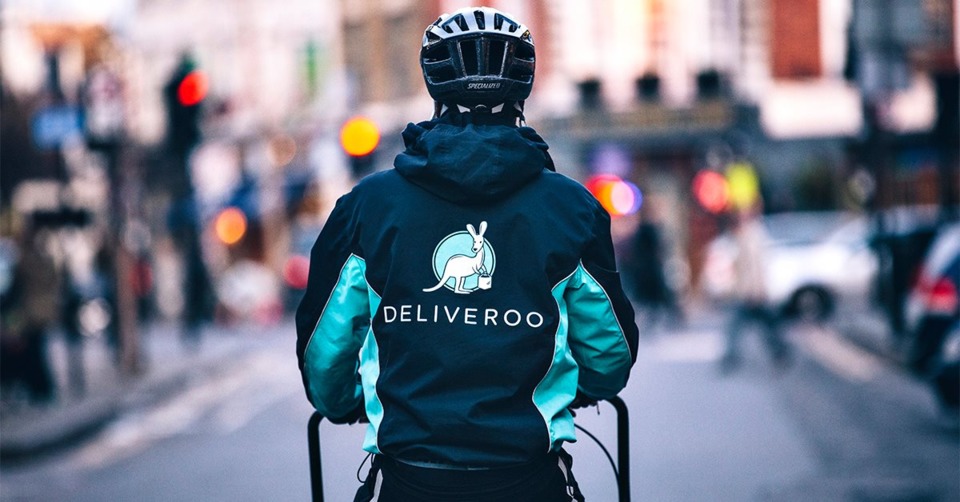
    Deliveroo today announced the launch of its new advertising platform, Deliveroo Media and Ecommerce, in Hong Kong. From now, brands will be able to advertise to Deliveroo customers with relevant offers across its app, on Deliveroo’s website and as part of social media, email and push notification campaigns.

    For the first time, advertising is planned for Deliveroo’s order tracker page, with new formats to launch over the coming months, alongside sponsored search listings.

    Currently Deliveroo partners are able to make use of Deliveroo’s advertising services, with sponsored positioning for restaurant or grocery partners for example. The new advertising platform means consumer FMCG brands will be able to advertise to millions of highly engaged Deliveroo customers.

    Deliveroo’s network of delivery-only ‘Editions’ kitchens and rapid grocery delivery ‘HOP’ stores are also part of Deliveroo’s new advertising proposition, enabling brands to get relevant content or samples into consumers’ hands as their meals and groceries are delivered to their door. 

    Nick Price, Interim General Manager of Deliveroo Hong Kong, said “Deliveroo has over seven million monthly active consumers globally, so we have an engaged and valuable audience for brands to connect with. Our new advertising platform will enable restaurant and grocery partners to tell their story emotionally and effectively whilst ensuring Deliveroo customers continue to receive a food-first experience. Done in the right way, both of our advertising activities can improve the customer experience by helping consumers to discover content they want in an engaging way, as well as helping merchants to drive incremental demand.”

    Advertising on Deliveroo will include partnerships with restaurant partners as well as FMCG companies. This will be done in a way that is mindful of the consumer experience, which is Deliveroo’s priority. Consumers will continue to receive a food-first experience in-app and Deliveroo intends to provide more space to enable restaurant and grocery partners to tell their story emotionally and effectively to Deliveroo consumers via the platform. The advertising solutions will sit within this context.

    With a food delivery marketplace in 10 markets, and with over 162,000 restaurants and 20,000 grocers on the platform, Deliveroo Media and Ecommerce is well positioned to connect brands with over seven million monthly active consumers.

    Deliveroo Media and Ecommerce was launched in the UK last Summer and has made an encouraging start, with advertising revenue reaching an annualised run-rate of £55 million or 0.8% of GTV in Q2 2023, reflecting that this is an effective way for merchants to drive incremental demand. Some of the popular brands that successfully utilised the advertising platform in the UK include Coca-Cola, Unilever, Reckitt and PepsiCo.

    Deliveroo is working with Criteo, the Commerce Media company, who will supply the advertising technology and media sales services.

  • Google adds “Send photos faster” option for RCS messaging

    Google adds “Send photos faster” option for RCS messaging

    The feature description says, “Resolution is reduced for faster sending.” By toggling on this option, you are giving up your higher-resolution photo sharing via Rich Communication Services (RCS) in exchange for a quicker delivery of a lower-res image. Since SMS already shares low-res images, the toggle should apply to RCS users only in areas with slow data speeds.
    RCS is Google’s version of iMessage that allows two Android users running the platform for messaging to share messages with larger character limits and end-to-end encryption. Higher-resolution pictures and videos can be sent and features like read receipts and typing indicators appear. But should an iOS user dare to get into a group chat, all of these lovely features go away. Sound familiar?
    Remember that all RCS features won’t be found if an Android user isn’t using the Google Messages app. Some U.S. carriers offer their own messaging apps for Android but if you want the best messaging experience on the platform, you need to install Google Messages and stop using the carrier-branded messaging apps.
    The “Send photos faster” option would come into play in areas where mobile data speeds are slower. In these situations, if the feature is enabled, sending a lower-res image would allow a photo to be delivered faster than it might otherwise.

    The feature has not been pushed out to all Google Messages users yet. To see if the “Send photos faster” option is available on your phone, open the Google Messages app and tap the profile picture on the right side of the search field at the top of the screen. Press on Messages settings and the fifth item down from the top should be the “Send photos faster option.” The feature is toggled on by default.

  • Gambling ads, adult content make Facebook ‘toxic’

    Gambling ads, adult content make Facebook ‘toxic’

    Facebook frequently displays ads soliciting gambling, which is illegal in Vietnam except at licensed casinos, and adult content even in accounts whose owners never search for them.

    Hoang Quan, an office clerk in Da Nang’s Thanh Khe District, says ads with scantily dressed women and gambling games often appear when he surfs the message board or watches Reels on Facebook.

    “The ads are suggested by Facebook and displayed at specific times: After 4 p.m. it is gambling; in the evening it is sexy and suggestive content,” he said.

    Tuan Phuong of Ho Chi Minh City, another Facebook user, sees similar ads pop up constantly.

    “Toxic content appears next to posts. Every time I scroll through a few posts of my friends, the News Feed inserts a gambling ad,” he says.

    He says he is flustered when he sees Facebook live streams with inappropriate content while sitting with his child in the evenings.

    In a survey this month 96% of participants said they had seen gambling and other offensive ads on Facebook, with 81% saying they are frequent.

    The situation seems to have worsened in March, with members on some technology forums suggesting Facebook’s censorship filter could be faulty.

    The contentious ads are usually in the form of a live stream and direct users to gambling websites. As soon as the live stream ends the video is removed from the platform by Facebook fan pages, leaving no trace.

    According to online marketing expert Mai Thanh Phu, the Facebook censorship system only looks at the beginning of a live stream and not the whole of it.

    “In the beginning, the live stream will not have any objectionable content. After Facebook approves the live stream and starts charging for the advertising, the fan page will become a gambling ad.”

    He says buying a fanpage to livestream or Facebook ads is simple and costs just a few million dong (VND23,600=US$1).

    Users can turn them off and report violations though there is no guarantee the same content will not appear again, he warns.

    The Facebook representative in Vietnam has not commented on the above issue.

    According to Ha Hai of the Ho Chi Minh City Bar Association, it is illegal for Facebook to allow gambling ads according under the Law on Advertising.

    “Facebook must actively control, block and remove illegal content, and not wait for users to report or authorities’ instructions.”

    In the past Facebook users have reported seeing ads for cannabis seeds and poppy though Vietnam has stringent drug laws.

    Last November Minister of Information and Communications Nguyen Manh Hung said the ministry plans to start inspecting advertising on cross-border platforms.

  • Timex goes after Apple Watch with hypocritical billboard

    Timex goes after Apple Watch with hypocritical billboard

    Surely no one in the wristwatch industry expected the Apple Watch to have an amazing success that it has experienced so far. First released in April 2015, Apple’s original plan was to promote the timepiece as fashionable jewelry. But it quickly became apparent to Apple that the wearable was selling as part of the Apple eco-system and as a tech device in its own right. Apple pulled the device out of high-end jewelry stores and focused on carrier and department store sales.
    Eventually, the wearable became known for its health-related features that no doubt helped to drive sales. Now, the Apple Watch is the most popular watch on the planet. That’s right, the Apple Watch outsells every other watch on Earth and that includes your famous luxury brands like Rolex, other more downscale brands like Seiko, affordable brands like Casio, and of course, mid-to-low-end brands like Timex.
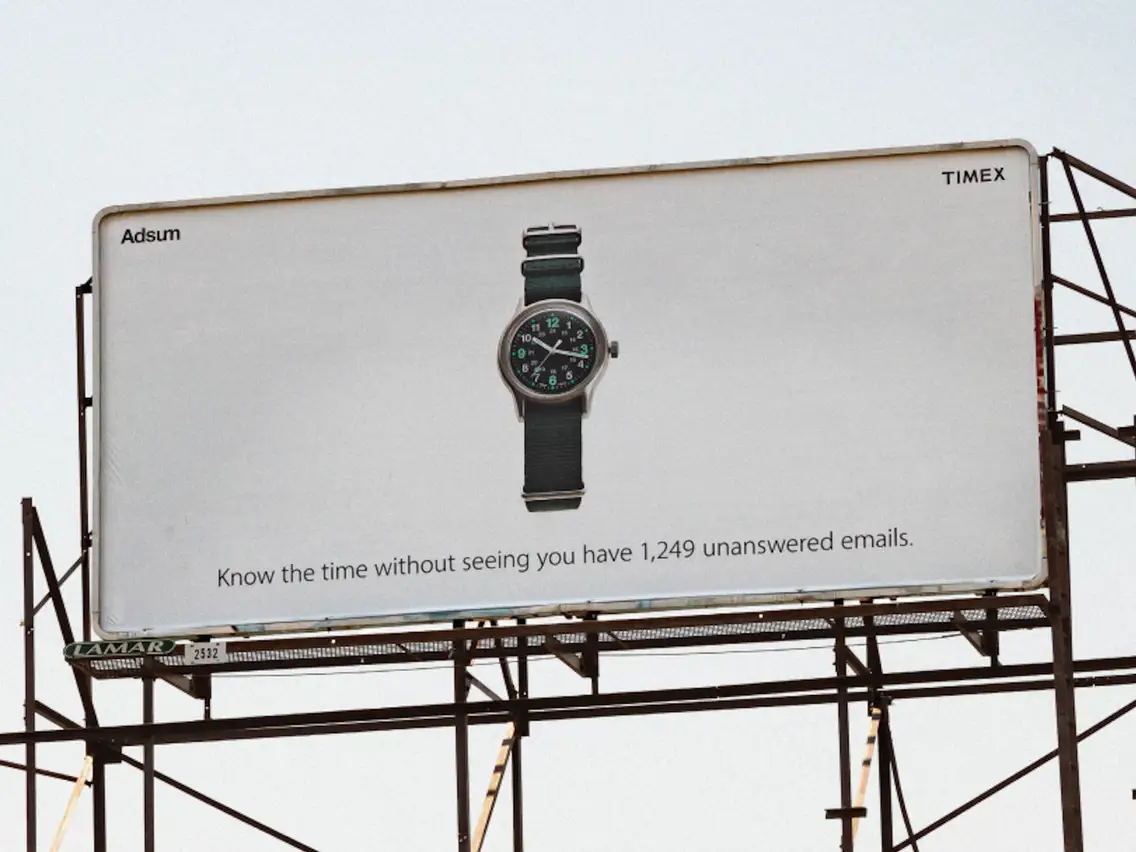
    Timex has been around since 1854 and has thus seen plenty of trends in the wristwatch market over the last 168 years. But we’d venture to guess that nothing has impacted the company more than the smartwatch, especially the Apple Watch. Timex decided to take on Apple and its timepiece on a billboard in New York City (yes, the “Big Apple”) that promotes its new $140 analog watch which was developed in partnership with a Brooklyn clothing company called Adsum.
    Even though this watch is sold out, Timex continues to have its billboard passing along the message that it wants Apple Watch users to read. “Know the time without seeing you have 1,249 unanswered emails,” the copy says on the sign. That refers to the Apple Watch’s ability to pass along notifications about your emails.
    Yeah, there is some hypocrisy involved with the billboard. Timex does have its own line of smartwatches and guess what? They pass along notifications. In fact, the Timex website notes that its smartwatch “Plays nice with your phone” and adds that “Over a hundred years of watchmaking has taught us that your watch becomes part of your soul. With notifications and fitness sensors, that bond is even stronger.”
    And the iConnect by Timex smartwatch, which is out of stock on the Timex website but is available from online retailers, will show email notifications. In fact, one retailer states, “Stay connected wherever you are. You can receive texts, Facebook, WhatsApp and email notifications on the touchscreen display of your iConnect by Timex smartwatch.”
  • Apple will ‘soon’ inundate the App Store with more ads

    Apple will ‘soon’ inundate the App Store with more ads

    While Apple froze third-party advertising cookies on its platform, resulting in the first revenue dip of Facebook since its inception, the App Store application shop has been showing ads in its search results as well as the respective tab for a while now.
    Brace yourselves, because these ads are now coming throughout the App Store, starting with the Today homepage tab, but they could also appear on each individual app page in the You Might Also Like section. The advertisement will allow developers to be promoting their own apps and Apple its own stuff as it sees fit according to its own privacy ground rules.
    The visible ads will be denoted as such and Apple won’t be targeting users below eighteen for personalized advertising, plus it won’t employ granular targeting by using your sensitive data like the other two ad behemoths Facebook and Google. That’s all part of Apple’s privacy and transparency policy, as it said in a dedicated statement:

    App Store developers are also happy with the ad development, as Ron Schneidermann of the app AllTrails states that “Apple Search Ads helped us attract new, more engaged customers across markets. We rely on Apple Search Ads for cost-effective customer acquisition – it’s a critical component of our growth strategy. As they become available, we plan to invest in new placements to reach even more customers on the App Store and continue to drive our business growth.”

    As for when will the new App Store advertising spree happen in earnest, Apple only said that the ad locations are now in their alpha state and it will “soon” start rolling out the testing phase, so don’t be surprised if ads appear on your iPhone application store in tabs where there were none of those pesky little nuggets were present before Apple’s move.
  • Netflix partners with Microsoft for upcoming ad-supported plan

    Netflix partners with Microsoft for upcoming ad-supported plan

    After it teased the upcoming launch of an ad-supported subscription plan, Netflix has now revealed that it picked Microsoft to help make that happen. Under the agreement, all ads served on Netflix will be exclusively available through the Microsoft platform.

    “It’s very early days and we have much to work through. But our long-term goal is clear. More choice for consumers and a premium, better-than-linear TV brand experience for advertisers. We’re excited to work with Microsoft as we bring this new service to life,” said Netflix COO Greg Peters.

    Netflix has been making headlines lately with announcement involving layoffs, after the streaming giant reported losses in the previous quarter. Early this year, Netflix reported a loss of 200,000 subscribers, but that feels extremely negligible compared to the service’s subscriber base of over 221 million.

    The recent subscriber base decline doesn’t really justify so many layoffs, but perhaps Netflix is afraid that will become a trend. That said, the launch of a new ad-supported plan will certainly increase its customer base.

    However, it remains to be seen if the company will manage to turn those casual consumers into paying customers following the launch of the ad-supported plan later this year.

  • Facebook to charge 5 pct tax on Vietnam ads

    Facebook to charge 5 pct tax on Vietnam ads

    Facebook parent Meta will charge a 5 percent value added tax on all Vietnamese advertisements starting June 1 after assuring the government it will fulfill its tax obligations.

    Meta executives last week told Prime Minister Pham Minh Chinh that the company would register and pay tax as a foreign contractor doing business in Vietnam.

    Authorities have been calling for properly taxing tech giants like Meta and Google, pointing out they account for around 70 percent of the online advertisement market but use various means to evade tax.

    They taxed cross-border platforms a total of VND5 trillion ($218.5 million) between 2018 and last year.

  • Meta seals partnership for 3D ads in step toward the metaverse

    Meta seals partnership for 3D ads in step toward the metaverse

    Meta Platforms will make it easier for brands to run three-dimensional ads on its Facebook and Instagram social media platforms through a new partnership with an eCommerce technology firm.

    The integration with VNTANA will allow brands to upload the 3D models of their products to Facebook and Instagram and easily convert them into ads, VNTANA said on Thursday in a press release.

    The move is a stepping stone into advertising in the metaverse, said VNTANA Chief Executive Ashley Crowder, referring to the futuristic idea of a collection of virtual worlds that can be accessed through devices such as headsets.

    Meta has staked its future on contributing to the building of the metaverse, which it has said could take up to a decade to be realized.

    Meta previously partnered with augmented reality (AR) companies Modiface and PerfectCorp to help beauty and cosmetic brands more easily run 3D and AR advertising.

    “The metaverse is basically the spatial internet,” Crowder said. “It is a whole world of possibility that starts with having the right 3D models of your products.”

    Facebook and Instagram users who see a 3D ad while browsing on their desktop or phone can interact with an image of a handbag, for instance, and move it around to view the item from all angles.

    “In a way, this offers a glimpse of what you might expect on future devices like AR glasses,” said Chris Barbour, director of augmented reality partnerships at Meta’s Reality Labs unit.

    Before VNTANA’s integration with Meta, advertisers would need to reformat 3D files to be compatible with Meta’s ad systems. Now, brands can use VNTANA to easily upload and convert the files into ads without technical expertise in working with 3D images, Crowder said.

  • Ads on Facebook are starting to recover from Apple’s App Tracking Transparency effect

    Ads on Facebook are starting to recover from Apple’s App Tracking Transparency effect

    Recently, Facebook has been struggling with its market share as it predicted a $10 billion loss in revenue due to Apple’s App Tracking Transparency. However, the company might be starting to recover its ad revenue.

    For those of you who don’t know, with iOS 14.5, Apple introduced a feature dubbed App Tracking Transparency (ATT), which allowed iPhone and iPad users to opt-out of tracking of their activity for targeted ads. Before this change, apps could track you across websites in order to offer you relevant ads, but Apple’s feature prevented that. And, as you can imagine, a vast majority of iOS users decided they didn’t want to be tracked.

    Facebook was among the companies that vocally disagreed with ATT, accusing Apple of harming small businesses with the move. And, as we could see later, Facebook ended up suffering quite a lot from ATT, and its ad revenue dropped significantly.

    As nothing is without consequence in this world, Facebook’s share value then plummeted because investors started selling their Facebook stock.

    However, things seem to be starting to improve, at least according to some small businesses owners on Facebook or Instagram. Many small businesses are claiming that their ads are performing better than usual. The reason for this change is… surprise, surprise – unknown at the moment.

    Earlier, Meta stated that it is working on adapting its advertisement systems to the new situation, so they can maximize the performance of ads. At the same time, many advertisers are reportedly still skeptical, but Meta seems to be working hard to maintain the improvement.

  • Vietnamese tired of advertisements popping up online

    Vietnamese tired of advertisements popping up online

    Vietnamese Internet users find online advertisements tiresome and do not want to watch them, a survey by YouGov has found. In a poll of 2,429 digital users, last December the British online market research and data analytics firm found that 47 percent of respondents always skip or want to skip online ads and 43 percent find the ads “annoying.”

    Only 25 percent said they are “interesting.”

    Thue Quist Thomasen, CEO of YouGov Vietnam, said: “Our survey also shows that even though most people remember seeing online ads, they are significantly less likely to recall clicking on ads or buying products after seeing ads.

    “In my view, the online marketing industry in Vietnam is largely, and fairly, preoccupied with tracking ad frauds and viewability. But marketers often pay insufficient attention to the metrics that truly matter, such as impact and quality, which are the key elements that drive advertising success.”

    Soames Hines, CEO of Ogilvy Vietnam, one of Vietnam’s largest creative agencies, said:”The survey’s results confirm what I have been thinking about digital advertising in Vietnam: There are so many ads nowadays that it’s hard for scattered branded banners to be effective across different websites.

    “What brands want are great campaigns that win the hearts and minds of consumers. Tiny banners and seemingly haphazard five-second videos just won’t be enough for brands to get what they want.”

    With 21.5 percent average annual growth in 2020-25 digital advertising in Vietnam is a booming business, according to the ‘Vietnam Digital Marketing Trends’ report released last year by digital marketing firm Novaon Ads.

    Advertisers are expected to spend $934 million on digital advertising in 2022, according to Statista, a German company specializing in market and consumer data.

    Vietnam has among the highest number of Internet users in the Asia Pacific. According to Statista, as of January 2021 the country of 96 million had around69 million Internet users.

    “Advertisers are often too focused on delivering ads as efficiently as possible while forgetting about the creative aspect of digital advertising,” Carl Söderblom, vice president of operations & business development at Swedish company Adnami, said.

    “This, in turn, results in low impact, ineffective ads. With high-impact ads, advertisers can … ensure they… are effective at driving results as well.”

  • Digital and data central as French retailer Carrefour speeds up turnaround

    Digital and data central as French retailer Carrefour speeds up turnaround

    French supermarket group Carrefour on Tuesday, € 3 billion (3.47 million) between 2022 and 2026 to strengthen digital commerce expansion and increase profits in line with Boss Alexandre Bomper’s future strategic plans. I promised to spend $ 10,000).

    E-commerce is the main driver of online push, as Europe’s largest food retailers aim to stay ahead of Amazon in grocery delivery and speed up ongoing turnarounds. -Boosted by Express Delivery and Innovative Services-Lamp-Upsizing Data and Retail Media, and Digitizing Financial Services.

    “Digital will be at the heart of our next strategic plan by 2026. This is a great opportunity for Carrefour,” Bompard Chairman and CEO told investors on Group’s Digital Day.

    By 1442 GMT, Carrefour shares were up 2.2% at € 15.70. However, when Bompard acquired it in July 2017, its shares were 30% below that level. He secured another three-year term in May.

    Carrefour has spent € 2 billion on technology and digital expansion in the first stages of its turnaround plan since 2018, trebling food e-commerce activity in the process.

    As a result of the new digital push, Carrefour has raised its total annual investment target to around € 1.7 billion. This is the € 1.5-1.7 billion cap given in early 2021.

    “Now that the first successful transformation plan is nearing its end, we’re bringing Carrefour, a traditional e-commerce retailer, a digital retailer that puts digital and data at the heart of all its operations and value creation. I want to transform into a model. “

    “Today, it’s very difficult for them to enter the food market, especially fresh food, and we have to find a model that they can’t replicate,” Bompard commented on the competition with Amazon.

    Carrefour said the additional investment could triple the total value of e-commerce products (the total value of products sold) from 2026 to € 10 billion.

    Digital forecasts an additional € 600 million in recurring operating profit in 2026 compared to 2021. “This will be minimal,” added Matthieu Malige, Chief Financial Officer.

    Carrefour, in the later stages of its five-year turnaround plan, which began in January 2018, has two planned partnerships. This year did not fail-one in Canada One with Couche-Tard and Auchan from France.

    Past digital initiatives ranged from strategic partnerships with Google to rapid grocery delivery service transactions with Uber Technologies.

    Carrefour announced on Tuesday that it would set up a dedicated venture capital fund to allow it to acquire minority shares in companies involved in innovation and emerging technologies.

  • Telegram will soon launch subscription service to disable ads

    Telegram will soon launch subscription service to disable ads

    Telegram is one of the services that gained a lot of customers due to the Facebook/WhatsApp outage, but it remains to be seen how many will become loyal users or will return to their “first love.”

    The messaging service has been adding many new features in the last few weeks and we’re certain more will be coming soon. Over the weekend, Telegram’s CEO Pavel Durov made a few announcements concerning the ads that appear on large channels with more than 1000 users.

    If you’re following one or more of these channels and you’re seeing ads, you’ll be pleased to know that Telegram will launch a companion subscription service meant to disable these ads. Of course, if you don’t want to pay for such a service, then you’ll continue to see those ads, but it’s nice to know that the option is there.

    We have already started work on this new feature and look forward to launching it this month. It can be issued in the form of an inexpensive subscription, which will allow any user to directly financially support the development of Telegram and never see official advertisements in the channels.
    Additionally, Telegram’s CEO revealed that those who own big channels will be able to turn off official ads in their channels of all users. For the time being, the company is assessing the “economic conditions” for this to happen. It’s unclear how that would work, but here is what Telegram says: “advertisers will soon be able to place an ‘invisible’ ad on any channel that – assuming there is sufficient cost per impression – will result in no ads on that channel.”

    No subscription price has been announced yet since Telegram is still working on bringing this feature to users, but we’ll learn more once it’s ready for implementation.

  • Samsung starts removing advertisements from its first-party apps

    Samsung starts removing advertisements from its first-party apps

    Samsung has started removing ads from its first-party apps. The company held a ‘town hall meeting’ back in August at which time we quoted Samsung’s mobile chief TM Roh who said, “We decided to delete ads from basic apps such as Weather, Samsung Pay, and Samsung Themes.” Samsung eventually released an official statement confirming the removal of the ads.

    The new versions of these apps sans advertisements were first spotted by Samsung customers in South Korea who posted the news in the company’s Community Forum. A comment from a Samsung executive announced that the ads were removed from the Health app on October 1st. The executive said, “This is the Samsung Health Operation Manager. Please note that the banner at the top of the Samsung Health app will not be provided from October 1.

    Even though Samsung has only confirmed that it was removing ads from the aforementioned first-party apps in its home country of South Korea, U.S. users have also seen ads disappear from these apps as well. Banner ads have been removed from Samsung Pay, the previously mentioned Health app (which used to show advertisements for Samsung’s line of smartwatches along with workout tips), and the Weather and Theme apps. For example, the Weather app has replaced the banner ads it used to show at the top of the screen with the temperature and forecast.

    It should be pointed out that while the banner ads are no longer seen on the Samsung Pay app, there is still a “Featured section” that includes offers. But that is in line with the app’s use as a mobile payment system. If the ads do not disappear from the first-party apps on your Samsung handset, you might need to “force stop” them to remove them from these apps.

    To force stop the app on your Samsung device, go to Settings > Apps and scroll to find the name of the app that you want to stop. Tap on the name of the app and tap on “Force stop” located in the bottom right corner. A pop-up menu will appear stating that if you stop the app, errors could occur. Tap on “OK.” Reopen the app and the ads should be gone.

    Samsung is not the only smartphone manufacture to include ads. Xiaomi and Oppo are two such companies to include them with their UI. But Samsung was hearing from customers who didn’t want to shell out $1,800 for a premium phone like the Galaxy Z Fold 3 only to feel that Samsung was trying to convince them to spend more money on their products. The removal of the ads is taking place via a server-side update which means you should not expect a new update to be sent your way OTA.

    While Samsung offers other first-party apps, the firm has yet to announce that ads will be dropped from these titles as well. Still, it would be a good look for Samsung if it were to finish the job and offer all of its own apps without ads on a global basis. Some Samsung customers also noted how cluttered first-party apps look with the ads included.

    At the time Samsung announced back in August its plan to drop the ads from the four basic first-party apps, the company said, “Our priority is to deliver innovative mobile experiences for our consumers based on their needs and wants. We value feedback from our users and continue our commitment to provide them with the best possible experience from our Galaxy products and services.”