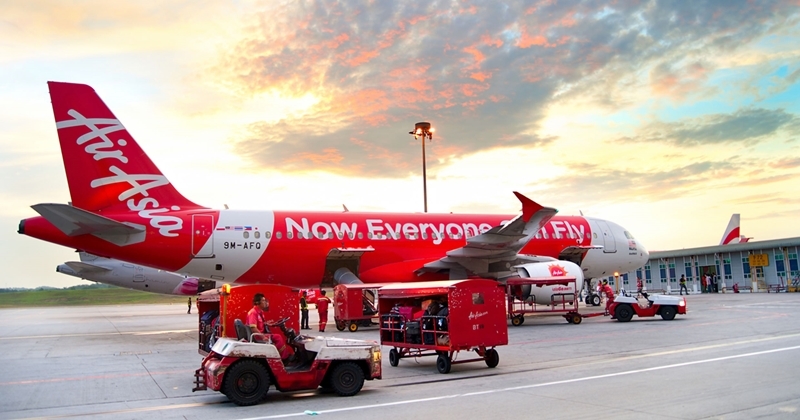
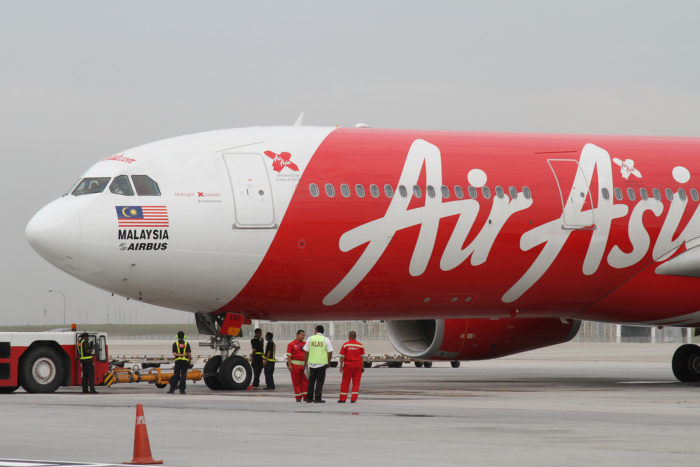
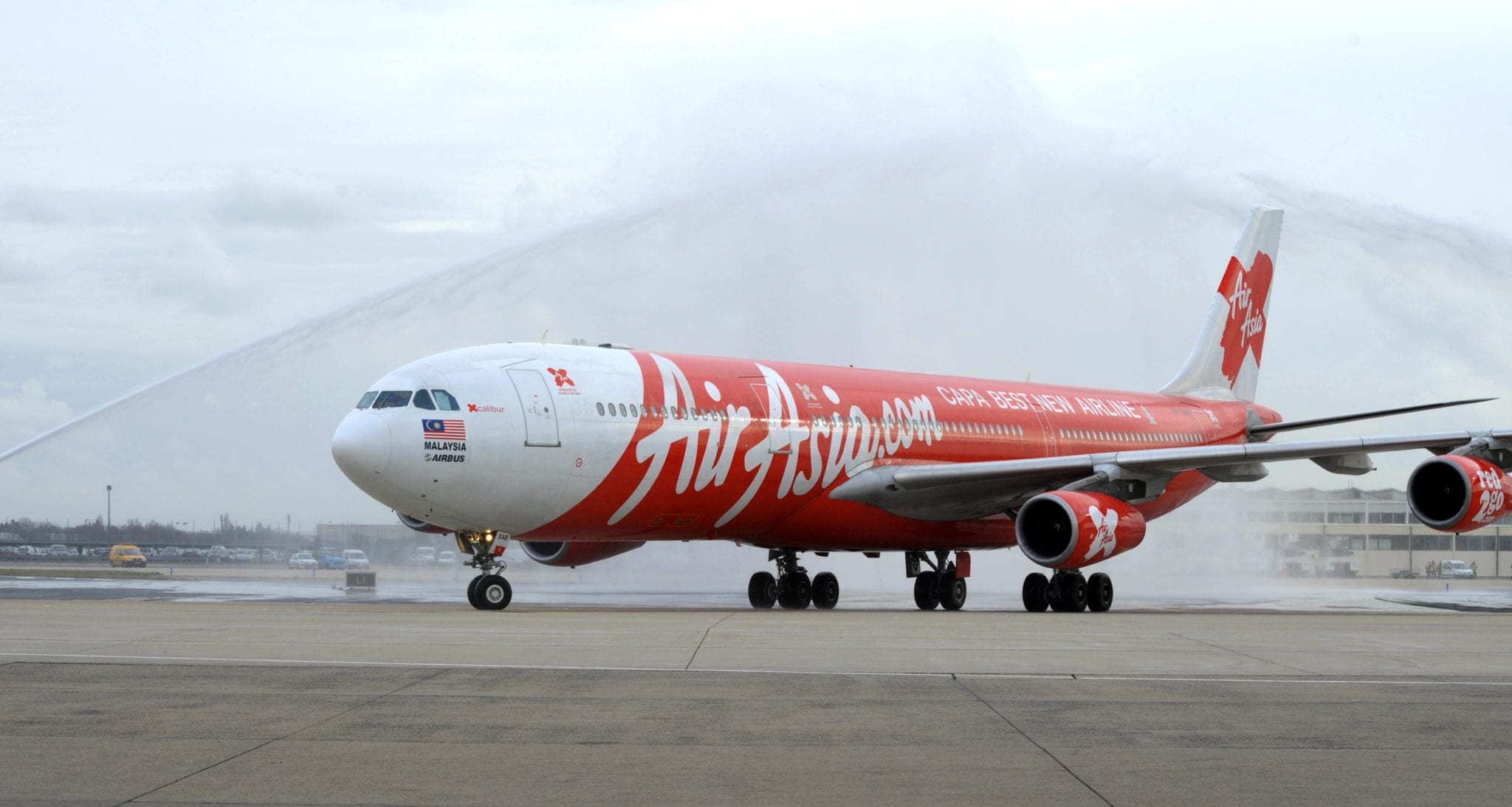
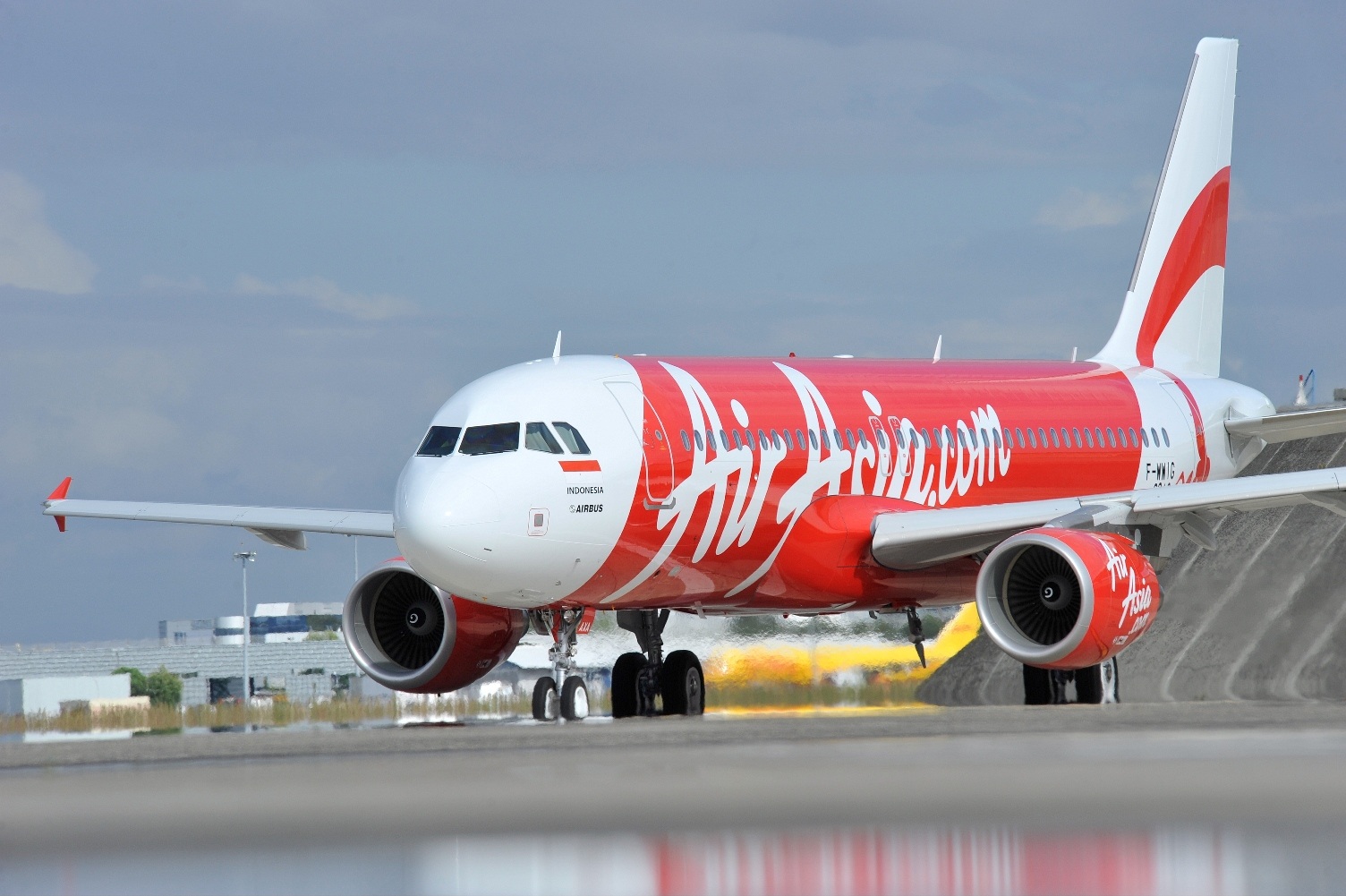
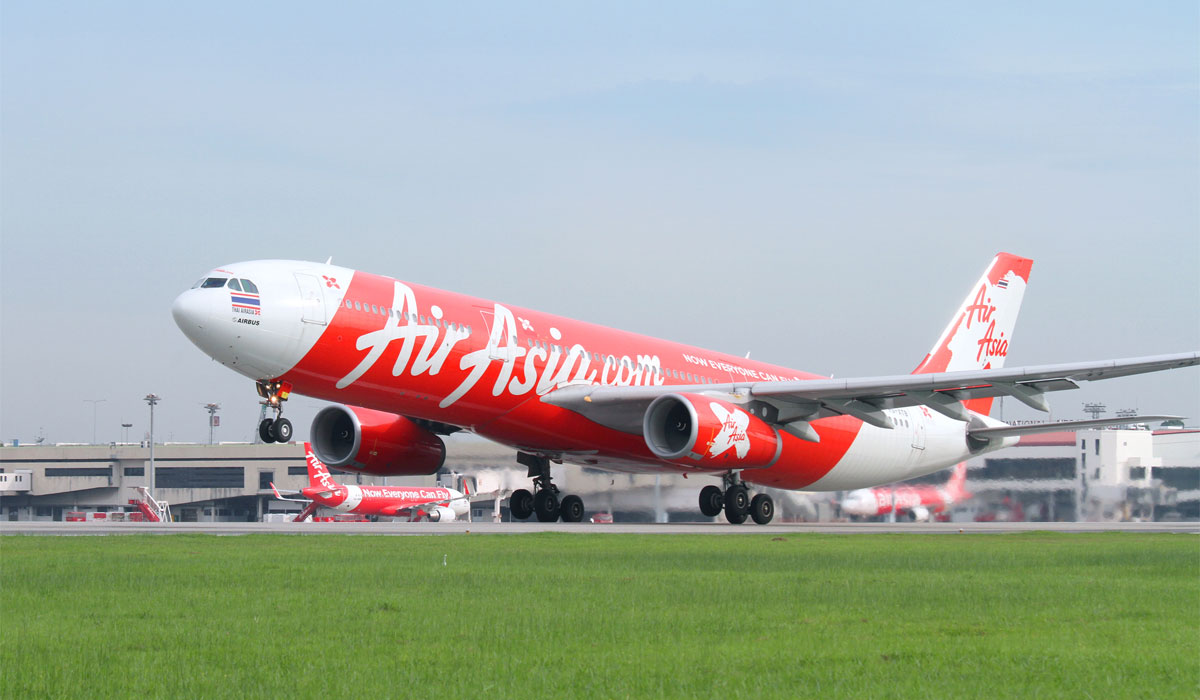
AirAsia announced it will be installing an innovative aircraft software modification known as Descent Profile Optimiser (DPO) on its A320ceo aircraft commencing from June in conjunction with the World Environment Day. This upgrade will help to generate fuel savings and significantly reduce carbon dioxide (CO₂) emissions. The enhancement to the aircraft’s onboard Flight Management System (FMS) performance database allows the aircraft to optimise the descent phase of the flight which subsequently minimises the amount of time spent at an inefficient level off.
The new initiative is set to reduce fuel consumption and improve the fuel efficiency by up to 0.75 percent of fuel burn which is equivalent to saving 101 kgs of CO₂ emissions per flight. This could reduce CO₂ emissions by over 221 tonnes per aircraft per year, representing a considerable contribution to more sustainable Flight Operations. Once installed initially on 17 aircraft, it would save 3,764 tonnes of CO₂ per year or the equivalent of 62,700 urban trees planted based on the US EPA’s Greenhouse Gas Equivalencies Calculator.
Bo Lingam, Group CEO of AirAsia Aviation Group Limited (AAAGL) said: “As the travel industry begins to recover and we expect to get back to pre-pandemic levels by the end of this year, it is important that we review our climate strategy and put in place new mechanisms and processes that will help to minimise the environmental impact of our flight operations. Installing the new flight operations optimisation solution for our current A320ceo aircraft allows us to reduce our carbon footprint for the short and medium-term as we continue to gradually upgrade our fleet to the higher capacity and more fuel-efficient A321neo in the longer term. Given the reality of climate change and the airline industry’s contribution to emissions, reducing our carbon footprint is currently one of our top sustainability priorities and we look forward to further reducing an additional 221 tonnes of CO₂ emissions per aircraft each year with the DPO system we are implementing. We remain committed to ensuring not only that we build a sustainable airline but also align with the aviation industry’s sustainability goal to reach net-zero by 2050.”
Besides the DPO, AirAsia has implemented several other key efficiency initiatives to reduce fuel consumption and carbon emissions such as One Engine Taxi (procedure to operate one engine during the taxi phase of flight instead of both engines), Idle Reverse Landing (a procedure that uses idle engine thrust upon landing instead of powered thrust to reduce noise and fuel burn) and the Required Navigation Performance-Authorisation Required (RNP-AR) approach (a procedure that uses the aircraft’s advanced navigation capabilities instead of conventional ground-based equipment for the shortest landing approach). In 2021, these measures enabled AirAsia to avoid emitting 11,175 tonnes of carbon dioxide, which is equivalent to planting 186,250 urban trees.
Malaysia’s AirAsia is facing a wave of complaints from customers who say they have still not been refunded for flights that were cancelled or rescheduled during the pandemic.
AirAsia and its subsidiary AirAsia X (AAX), both owned by Capital A Berhad, grounded thousands of flights in 2020 and 2021 after the Malaysian government shut state and international borders to curb the spread of COVID-19.
But months after the low-cost carrier resumed flights following the lifting of interstate and international border restrictions for Malaysians in October, hundreds of customers have taken to social media to complain of poor customer service and long waits for refunds.
Rohana Betak, 60, said she requested a refund of 4,000 Malaysian ringgit ($911) after the airline cancelled her flights between Senai and Kota Kinabalu, the capital of Sabah state, following the introduction of a nationwide lockdown in March 2020.
Betak, who planned to visit the area around Mount Kinabalu, Southeast Asia’s highest peak, with her family in October 2021, said the airline’s automated online customer service only offered her the option of travelling on different dates. Betak decided against accepting the offer due to uncertainty over when restrictions would be lifted and concerns about catching COVID-19. Two years later, she says she is still waiting for her money back.
“In my request, I said it was fine to refund me credits for the booking but instead I was reminded in June 2020 that I must board the flight to Sabah on a different date and there would be no refunds,” Betak told Al Jazeera.
“It was not helpful because instead of offering me at least credit in refunds, it told me I had no other choice but to travel on different dates.”
Rohana Betak, pictured in a pink hat in the back row, says she has been waiting two years for a refund from AirAsia [Courtesy of Rohana Betak]
Travel to Sabah before October 2021 was strictly limited to certain categories of travellers, including those travelling for work and those born in the state. Rohana and her family did not fall under any exempted category.
“When it demanded I get on another flight, I asked if they wanted to send me and my family to our deaths?” Betak said. “It’s so frustrating and I am so tired of trying to get my money back so I’ve accepted that I might not get my money back at all.”
Many of the complaints have been directed towards AVA, AirAsia’s online chatbot, which is the only line of communication between customers and the airline for issues involving bookings or flights.
In particular, some have questioned why it is so difficult to reach customer service to request a refund, even for flights booked since the lifting of pandemic restrictions.
Customer Aulia Chaerisa Salleh said she is waiting for a refund for a flight between Batam and Jakarta that was booked earlier this month after she was informed no seat was available.
“I paid for my ticket and it did not register in the system so I tried to get my refund for my tickets. I tried the AVA live chat but it is not helpful at all. It has been days, I haven’t heard from them,” she said.
Under AirAsia’s current refund policy, the airline offers customers a refund, credit or a new travel date whenever a flight is cancelled or postponed.
AirAsia told Al Jazeera the airline is engaged in ongoing dialogue with consumer regulators across the region to ensure compliance with all local regulations.
“AirAsia Group’s policies are in line with many low-cost operators in the travel industry worldwide and are fully compliant with all regulatory requirements and as a customer-centric airline, we have focused on resolving all customer queries during the pandemic as soon as possible,” a spokesperson said.
The airline group said it has resolved more than 90 percent of refund requests and is committed to resolving a small number of outstanding claims as soon as possible.
“In Malaysia for example, our current refund progress is only left with 0.03 percent of the refund requests we received and we are looking forward to completing the refunds exercise for all outstanding queries within the next few months,” the spokesperson said, adding that the past two years had been the most challenging in the history of commercial aviation.
The spokesperson added that “our passengers remain our number one priority” and the airline will “continue to enhance our services to deliver the very best in terms of safe, affordable and reliable air travel”.
Tan Kok Liang, president of the Malaysian Association of Tour and Travel Agents (MATTA), said the refunds backlog is a short-term issue and its 3,100 members will continue to book with AirAsia as long as requested by customers.
“The problem child is AAX and while air connectivity is crucial for tourism recovery, based on media reports, AirAsia should be held more accountable to all stakeholders,” Tan told Al Jazeera.
The hefty compensation paid out to airline co-founders Tony Fernandez and Kamarudin Maranun, who took home close to 30 million ringgit ($6.8m) combined last year, has also raised eyebrows.
Following the release of Capital A’s Annual Report 2021 last month, some social media users vented their frustrations on Fernandez’s personal Instagram accounts, with one comment slamming AirAsia as “the one and only airline that does not have a customer service phone number.”
Despite the generous executive compensation, AAX, the group’s long-haul carrier, was last year forced to undergo debt restructuring to save itself from liquidation after racking up huge debts during the pandemic.
In March, AAX announced it had completed its debt restructuring after creditors earlier agreed to a deal under which the airline would pay just 0.5 percent of outstanding debt and terminate existing contracts to restructureRM33.65 billion(US$8.1 billion) of liabilities.
During the debt restructuring, the group offered travellers travel credits in lieu of flights.
The Malaysian Aviation Commission (MAVCOM), however, urged the airline to reimburse customers for tickets purchased while threatening to exercise its powers under the Malaysian Aviation Commission Act 2015.
Capital A posted revenue of 1.7 billion ringgit ($387m) in the 2021 financial year, down 47 percent from the previous year, as capacity sank to just 36 percent of 2020 levels.
AirAsia has resumed flights between Kuala Lumpur and Siem Reap, Cambodia. The airline will operate the route with two flights per week on Mondays and Fridays. Flight AK540 is scheduled to depart from Kuala Lumpur International Airport 2 (klia2) at 13:05, arriving in Siem Reap at 14.20. The return flight, AK541, is timed to leave Siem Reap at 14:55, arriving back in Kuala Lumpur at 18:10.
Cambodia was one of the first countries in the region to relax its entry requirements for foreign travel, reopening the Kingdom to fully vaccinated international travellers without the need for quarantine or COVID19 testing at all international gateways and checkpoints in November 2021.
HE Thong Khon, Minister of Tourism, Cambodia, said, “Cambodia is now truly open for all vaccinated tourists and we welcome AirAsia guests back to our great country with open arms. Tourism is a significant driver of our economy and social development, we thank AirAsia for their continued support to stimulate and grow air travel to our key leisure destinations. Cambodia, the Kingdom of Wonder, invites travellers from all walks of life to feel its warmth, safely and hygienically.”
The Siem Reap flights follow AirAsia’s resumption of flights between Kuala Lumpur and Phnom Penh, the Kingdom’s capital city, in January.
“Prior to COVID19, Siem Reap was one of the most popular destinations in ASEAN as a key tourist hub for globetrotters from all over the world,” said Riad Asmat, CEO AirAsia Malaysia. “AirAsia started the route in 2018 and flew close to 170,000 passengers in 2019. We are confident that these new services will continue to be very popular in the future. In response to strong demand, we are also planning more flights and destinations in Cambodia with services to Sihanoukville scheduled to take flight on 2 June. AirAsia welcomes the initiatives taken by the Cambodian government to ease travel restrictions to allow more seamless travel to Cambodia. We look forward to flying more leisure seekers from near and far to the country soon.”
For entry into Malaysia, all international tourists and travellers are required to take a pre-departure COVID19 test within 2 days of departure and purchase COVID19 travel insurance (for short-term foreign visitors). Unvaccinated or partially vaccinated travellers are required to spend 5 days in quarantine.
For entry into Cambodia, there are no pre-departure, post-arrival COVID19 tests or quarantine requirements for fully vaccinated travellers. Travellers are only required to show proof of being fully vaccinated. Fully vaccinated travellers from Malaysia who wish to travel to Cambodia must meet the requirements set by the Cambodian Government prior to purchasing their flights and upon arrival.
AirAsia announced that it is resuming flights from India to Malaysia and Thailand with flights now available from April and May 2022 onward. Six new routes from India to Malaysia include Bengaluru to Kuala Lumpur (KL) and Chennai to Kuala Lumpur, Tiruchirappalli to KL from 5 April, Kochi – KL commencing 18 April, Kolkata – KL commencing 23 April and Hyderabad – KL commencing from 1 May, 2022.
Five new routes launching India to Thailand will include Bengaluru-Bangkok (Don Mueang) commencing on 4 May, Chennai-Bangkok (Don Mueang) on 4 May, Kolkata-Bangkok (Don Mueang) commencing on 2 May , Kochi-Bangkok (Don Mueang) commencing on 1 May , and Jaipur-Bangkok (Don Mueang) on 1 May.
Manoj Dharmani, AirAsia’s Regional Commercial Head for India, Sri Lanka & Bangladesh, acknowledged that “AirAsia’s resumption of international flights has been highly anticipated by both the airline and its guests. With Malaysia and Thailand reopening and travel restrictions being lifted, AirAsia will be continually re-introducing international services, starting from April 2022. In this regard, India, Malaysia, and Thailand are countries with significant potential in terms of stimulating tourism and reigniting the economy. We believe that our flight resumption will bring great opportunity and support to the countries’ economic recovery.”
AirAsia X launching new services to South Korea and India
Following the resumption of passenger services to Sydney, Australia in February, AirAsia X (AAX) is expanding its flight network from Kuala Lumpur with new services to Incheon (Seoul), South Korea and New Delhi, India commencing from 20 April 2022. Flights to Incheon (Seoul) will initially be operated weekly on Wednesdays and returning on Thursdays. Flights to New Delhi will resume twice weekly on Wednesdays and Sundays returning on the same days. Both services are on sale now for travel between 20 April 2022 to 30 June 2022, with additional services to be added in the near future. Guests with outstanding bookings or unused credit during the pandemic, will be able to use these for future bookings, by updating their original flight booking for future travel or by utilising their credit account to book the flights.
CEO of AirAsia X Benyamin Ismail said: “After two long years, we are thrilled to return to the skies once again with the best value airfares for medium haul travel. Now that the world is finally opening up, we are gradually resuming flights to our key markets, starting with Sydney recently and now also to South Korea and India, with more popular destinations to be announced soon. We are confident our return to these markets will be well received, particularly for those longing to visit friends and family again or for much anticipated leisure travel. With Malaysia’s international border reopening last week on 1 April, and quarantine free travel both ways on our new services, it is also the perfect time to welcome back international tourists, providing a significant boost to the nation’s tourism sector and the economy, as we did pre-pandemic.”
AirAsia has unveiled a five-year strategic collaboration with Google Cloud to advance Super App capabilities through cloud-based co-innovation across Southeast Asia.
Central to such efforts will be the combination of core competencies to nurture technology talent, the co-creation of software tools for “open innovation” and the delivery of data-driven intelligence targeting micro-, small- and medium-sized enterprises (MSMEs) on the platform. This is in addition to improved accessibility for diverse users in cities and rural areas.
Operating as a, forming part of Capital A’s digital pillar alongside AirAsia as a multinational airline.
The platform offers flight and hotel bookings, e-commerce, food and parcel delivery, ride-hailing, financial and health services and on-demand education among others, supported by an integrated rewards program and mobile wallet.
Since launching in 2020, Super App has become one of three unicorns headquartered in Malaysia, according to Credit Suisse, and currently houses 51 million users across ASEAN.
“Five years ago, when I decided to move our digital journey to its next stage, I was looking for a partner to help us reach that nirvana, much like how Airbus and General Electric helped us grow from a little two-plane operation to become the fourth-largest airline in Asia,” said Tony Fernandes, CEO of Capital A.
“I went around the US looking for that partner, met Diane Greene from Google Cloud, and the journey started. With Thomas and his team, we are now on the road to disrupting the digital platform arena in the same vein as we did airlines.”
Despite acknowledging that Capital A is “late in the game” from a digital perspective, Fernandes said Super App now operates at the “centre of our ecosystem” of e-commerce, logistics and fintech.
“We are determined to give all 700 million people in ASEAN inclusivity, accessibility and value,” he added. “With Google’s help, our ecosystem will not only be transactional, but be about building community, and enriching that community – not just the customers but partners like restaurants, airlines, hotels, and drivers. What we are doing is not evolutionary, but revolutionary. I’m going to enjoy the ride with Google.”
To help create an “agile culture and co-innovation talent engine”, Super App and Google Cloud will establish a Cloud Centre of Excellence (CCoE) consisting of AirAsia Allstars and Google Cloud technologists.
The move is designed to “embed an agile culture” across all Super App business units to “accelerate product development velocity” and up-skill talent, supported by access to Google Cloud’s Site Reliability Engineering (SRE) and MLOps best practices.
“To benefit everyone across Southeast Asia’s heterogeneous communities, the Super App must be simple and easy-to-use while underpinned by inclusive design, interoperability and personalisation,” outlined Amanda Woo, CEO, Super App.
“It’s therefore crucial that we leverage Google’s rich experience in building global platforms and ecosystems to equip and engage more talent, entrepreneurs a
AirAsia is expecting an increase of more than 70 international flight volumes per week for the first week of border reopening starting on April 1.
AirAsia Malaysia chief executive officer Riad Asmat said the international flight number is expected to reach 250 weekly by the end of April.
“AirAsia welcomes the announcement by the Malaysian government to fully open international borders on April 1, we are ready.
“I believe the seamlessness of travel will happen sooner than later,” he told reporters in a media briefing on the airline’s preparation for border reopening here today.
He said since resuming its operations with travel bubbles and a focus on domestic services, the gradual resumption of international flying is already well underway in tandem with borders gradually reopening around the world.
With the continued easing of travel restrictions, the airline group has increased its domestic flight capacity by 156 percent since October 2021 kickstarted with the Langkawi travel bubble, and by 50 percent for international flights since the announcement of borders reopening in April is made by the government on March 8, 2022.
A total of 75 aircraft are operating currently group-wide, he said. This is also supported by the reopening of other countries like Thailand, the Philippines, Indonesia, Cambodia, Singapore and Vietnam, said Riad.
While the airline currently has a number of international services already operating, the announcement of the nation’s reopening will provide a welcome boost to support additional capacity in many of its core international markets in line with significant pent-up demand.
Meanwhile, AirAsia Aviation Group Ltd chief executive officer Bo Lingam said the airlines earnings is expected to go back to pre-Covid level presumably by the end of the year with the hope that the fuel price goes down by then.
“AirAsia applauds the governments around the region for their decision to reopen borders and remove travel restriction with minimal testing requirements.
“We are thrilled to be resuming more flights in all of our core markets in Malaysia, Thailand, the international destinations including Bali, Manila, Bangkok, Ho Chi Minh City, Phuket, and more, starting in April.
Domestic flying also continues to soar across the group with four new domestic routes launched in Malaysia, from Kuching to Langkawi, Penang to Sibu, Johor Bahru to Bintulu, and Kota Kinabalu to Kuala Terengganu this year, he said.
“Regionally, we have seen similarly encouraging developments for domestic and international services in Thailand, the Philippines and Indonesia. We will continue to review our network which evolves based on a number of factors including demand,” he said.
He added that new services will be announced in due course as the world continues to gradually reopen.
“While our domestic services across the group have grown by 156 per cent in recent months due to significant consumer demand, and by 50 per cent for international, we expect to return to 100 percent or more of pre-COVID domestic and international flying by the end of this year,” he said.
AirAsia gears up for the nation’s reopening by adding more international routes to cater for significant pent-up demand ahead of Malaysia reopening borders to international travel 1 April.
With the continued easing of travel restrictions, the airline group increased domestic flight capacity in Malaysia by 156% since October 2021, when it kickstarted the Langkawi travel bubble scheme.
It has also increased international flights by 50% since the Malaysian government’s 8 March announcement confirming the reopening of borders on 1 April.
Currently, the airline has 75 aircraft operating flights across the group serving Thailand, the Philippines, Indonesia, Cambodia, Singapore and Vietnam.
AirAsia Aviation Group CEO Bo Lingam said: We’re thrilled to be resuming more flights in all of our core markets in Malaysia, Thailand, the Philippines and Indonesia and to be adding additional services to some of AirAsia’s most popular international destinations, including Bali, Manila, Bangkok, Ho Chi Minh City, Phuket and more, starting in April. Domestic flying also continues to soar across the group. We have recently launched four new domestic routes in Malaysia from Kuching to Langkawi, Penang to Sibu, Johor Bahru to Bintulu and Kota Kinabalu to Kuala Terengganu this year.
“While our domestic services across the group have grown by 156% in recent months due to significant consumer demand, and by 50% for international, we expect to return to 100% or more of pre-Covid domestic and international flying by the end of this year.”
To spur travel demand and bookings to destinations such as Singapore, Vietnam, the Philippines, India, Thailand, Indonesia, the Maldives, Brunei, Cambodia, Sri Lanka, Laos, Bangladesh, the airline group is pegging fares as low as MYRM89 one-way, while domestic routes are on sale from just MYR39 one-way.
Travelers can book cheap fares through the ‘Flights’ option in the AirAsia Super App from now until 27 March 2022 for travel between 1 April and 25 March 2023.
Beginning April 1, AirAsia Philippines is adding more weekly flights to the country’s top tourist destinations, including Boracay, Puerto Princesa and Cebu, after seeing a recent surge in bookings.
The low-cost airline, in a statement on Friday, said that it will increase by at least ten times the weekly flight frequencies to Kalibo, Boracay, Iloilo, Tacloban, Panglao, Puerto Princesa, Bacolod, Davao and Cebu next month in anticipation of foreign arrivals amid the easing of mobility restrictions.
“The influx of foreign tourists into the country will definitely signify the strong recovery of the Philippine aviation industry. Our guests’ eagerness to travel has already manifested with the increase in AirAsia’s forward booking from 30 to 60 days,” AirAsia Philippines spokesperson Steve Dailisan said.
As of March 18, Dailisan said they are “seeing a 97-percent increase in seats sold for travel in the month of April alone, with Boracay, Bohol, Cebu, Kalibo and Puerto Princesa on the top spots of the most booked destinations.”
For fully vaccinated foreign visitors, the airline said that vaccination cards are the only entry requirement.
By April 8, AirAsia will add Dumaguete City, which is the gateway to Negros Oriental, every Monday, Wednesday, Friday and Sunday in its route network.
Manila-Roxas flights, meanwhile, will be available beginning June 16.
The airline also offers an add-on comprehensive travel insurance plan for as low as P230 for foreign and local travelers as an “added layer of safety and protection.”
AirAsia Philippines is ramping up its vaccination efforts with 85 percent of its workforce having received COVID-19 booster shots.
AirAsia Malaysia will be reintroducing fuel surcharge beginning March 8 for all its domestic and international flights.
The reintroduction of the fuel surcharge by AirAsia is to offset the escalating jet fuel prices, which has exceeded US$120 per barrel. AirAsia has not been charging fuel surcharge since it was abolished in 2015. The airline said it has been absorbing the oil price increase over the years.
The fuel surcharge will be applicable for new flight bookings made on and after March 8. All bookings made before March 8 will not be affected.
The fuel surcharge rates for all domestic routes within Malaysia is RM10 while rates for international routes within one to two hours is RM25.
The rates for international routes for two to three hours, three to four hours and more than four hours are RM35, RM50 and RM60, respectively.
AirAsia Malaysia Chief Executive Officer Riad Asmat said airlines the world over are affected by the rising oil prices and the continuous upward spiral caused by the situation in Eastern Europe and other external factors have made it imperative for the airlines to reintroduce the fuel surcharge, despite the low-cost operator’s best efforts to resist it for as long as it could.
“Since we last abolished fuel surcharges in 2015 when the global fuel price was as low as US$48 a barrel, we have faced numerous occasions when the fluctuations have caused other airlines to start imposing surcharges.
“However, at AirAsia, we have been absorbing past increases in oil prices to continue to provide the best value to our guests. Unfortunately, the current situation where the oil price has shot up more than 160 per cent than what it was in 2015 has made it no longer sustainable,” he said in a statement today.
Riad hoped that the fuel surcharge will only be a temporary measure.
He said AirAsia will continue to ensure its fares remain as low as possible despite the fuel surcharge.
Even when faced with the devastating Covid-19 pandemic, AirAsia still managed to deflect the rising operational costs and continued to offer low fares to the people, he explained.
“We will continue to monitor the situation and at the same time capitalise on technological and digital innovations as ways to keep costs at bay and make air travel affordable for everyone.”
AirAsia removed its fuel surcharge twice in the past. It first introduced a fuel surcharge in 2005 and abolished it in 2008, and later reintroduced it in 2011.
In 2015, the jet fuel price was at its high of US$78 per barrel but AirAsia removed the fuel surcharge as soon as the price went down to around US$48 per barrel that year.
The Court of Appeal of Malaysia has dismissed attempts from AirAsia (AK, Kuala Lumpur Int’l) and AirAsia X (D7, Kuala Lumpur Int’l) to set aside a High Court ruling in favour summarily – without a full trial – of Malaysia Airports Holdings over outstanding passenger service charge (PSC) payments, Malaysia’s Daily Express and The Edge Markets reported.
A three-member bench unanimously confirmed on March 3 that the High Court was correct in granting the state-run airport operator a summary judgement for a total of MYR41.55 million ringgit (USD9.95 million) against the two low-cost carriers, comprising the outstanding charges, late payment fees, and costs.
The airlines had lodged three appeals each in an effort to strike out the rulings, and so the appeals court ordered them to pay additional costs of MYR10,000 (USD2,400) per appeal, totalling MYR60,000 (USD14,400).
Malaysia Airports’ claim against AirAsia and its long-haul affiliate is for alleged unpaid passenger service facilities charges at the rate the Malaysian Aviation Commission (Mavcom) regulator set in 2016 and amended in 2017 and 2018.
According to the plaintiff, the defendants had signed a contract on these fees and other conditions for the use of Kuala Lumpur Int’l Airport, rules that were also revised in 2017. The two carriers deny having accepted the terms of the contracts, however, claiming they had raised objections to the plaintiff but had been ignored.
The Capital A (formerly AirAsia Group) airlines have argued that the rate for the charges in the current regulations is a ceiling rate, not a fixed rate, and that the amount payable was to have been negotiated between the parties.
“We are of the opinion, and we agree with the findings of the learned High Court judge, that AirAsia’s actual dispute is not one between two aviation service providers but between AirAsia and [Mavcom] itself, because it is the commission that had prescribed the applicable PSC rate, and [Malaysia Airports] collects the same. Specifically, AirAsia’s actual dispute is against the decision of the commission to equalise the PSC rates” between Kuala Lumpur Int’l terminals one and two, the appeals court ruling said. “Accordingly, AirAsia should have addressed its PSC dispute by judicial review against the commission’s statutory decision to increase the rate.”
AirAsia X has also been the target of a Malaysia Airports Holdings lawsuit initiated in October 2020 to demand payment of MYR78.16 million (USD18.7 million) in alleged lapsed charges related to the long-haul low-cost carrier’s debt restructuring scheme. Malaysia Airports is a secured creditor of AirAsia X, it has argued, so it should have been excluded from the carrier’s debt reshuffle. Nevertheless, the airline obtained court approval in December 2021 to restructure the debt.
AirAsia has signed a non-binding memorandum of understanding to lease a minimum of 100 VX4 eVTOL aircraft from Avolon. The eVTOL aircraft is expected to enable AirAsia to further revolutionize air travel by providing advanced air mobility to a whole new range of passengers.
In addition to the eVTOL aircraft, Avolon, through its investment and innovation affiliate Avolon-e, will partner with AirAsia to commercialize zero-emissions eVTOL aircraft and develop an industry-leading urban air mobility (UAM) platform in Southeast Asia. Avolon and AirAsia will form a working group to pursue local certification, research potential market opportunities and infrastructure requirements for UAM. AirAsia will also leverage its successful travel and lifestyle mobile app, the AirAsia Super App, to help support and build an eVTOL ride-sharing platform with Avolon.
Tony Fernandes, CEO, Capital A, formerly AirAsia Group, commented: “Innovation has always been in our DNA and using technology to look at more efficient and sustainable ways of doing things is a core focus across Capital A (formerly AirAsia Group). We are now much more than just an airline with over 20 products and services on our super app leveraging off each other including flights, hotels, food, retail, delivery, ride-hailing and more. I am truly excited about this partnership between Avolon and AirAsia and the potential for zero-emissions ultra-short-haul air travel in Southeast Asia. The digital era is now. In the VX4, we have identified what we believe will be the eVTOL aircraft of choice and we are thrilled to be the launch airline for the aircraft in Southeast Asia. We are also delighted to extend our long-standing relationship with Avolon, which has a proven track record of delivering for its customers and is in sync with our goal to become the leading one-stop travel and delivery platform in Asean.”
Dómhnal Slattery, CEO, Avolon, added: “Tony Fernandes is an aviation pioneer who has built AirAsia into one of the leading airlines in the world and has now also created Southeast Asia’s fastest-growing Super App anchored on travel. We are delighted to partner with AirAsia and share our vision of revolutionizing the future of air travel. We look forward to working with Tony, and the AirAsia team, on their eVTOL journey. Together we will develop a ride-sharing platform and bring the zero-emissions VX4 aircraft into service, positioning AirAsia as the operator of choice for sustainable air travel in the region.”
In June 2021, Avolon ordered 500 VX4 eVTOL aircraft from Vertical Aerospace, valued at US $2 billion. Since announcing that order, Avolon placed 250 VX4 aircraft with Gol and Grupo Comporte in Brazil, up to 100 aircraft with Japan Airlines in Japan, and a minimum of 100 aircraft with AirAsia. As a result, Avolon has now placed up to 90% of its initial order book, underlining the demand for VX4 aircraft from the world’s leading airlines.
AirAsia India has unveiled its new ancillary service, ‘FlyAhead’. With the ‘FlyAhead’ service, guests wishing to take an earlier flight will be able to seamlessly opt for this facility.
The ‘FlyAhead’ service has been launched for a nominal fee of INR 1,500 for guests booked on standard fares and INR 500 for guests booked on Corporate and SME fares. Guests who reach the airport six hours or more prior to their scheduled flight departure can opt for the FlyAhead service at the AirAsia Airport Counter.
Change fees, which are typically INR 3,000 would be waived for all guests opting for the AirAsia FlyAhead service and fare differences typically charged by airlines would also not be applicable.
Speaking about the initiative, Dr. Ankur Garg, Chief Commercial Officer, AirAsia India, said: “AirAsia India has consistently developed innovative, future-proof solutions prioritizing the ease and comfort of our guests. Led by our core value of being ‘Guest Obsessed,’ our latest offering ‘FlyAhead’ is a new ancillary service which provides guests a flexible and convenient option to reach their destination ahead of schedule.”
AirAsia aims to spur intra-Asean travel with new regional routes, while Thai AirAsia hopes the Red War football match in July will drive demand from neighbors to Thailand.
The company is working on new destinations in Thailand, Indonesia, and Malaysia to replace the Chinese market, said Tony Fernandes, chief executive of Capital A, formerly AirAsia Group, which also owns Thai AirAsia via the AirAsia Aviation Group.
He said he already discussed with Thailand’s ministers regarding new international routes besides well-known destinations, such as Jakarta to Hua-Hin.
However, the implementation in Thailand will largely depend on Covid-19 tests and other travel regulations which remain the most critical obstacle for the industry.
Tassapon Bijleveld, executive chairman of Asia Aviation, the majority shareholder of Thai AirAsia (TAA), said the airline is preparing bundle packages for Manchester United and Liverpool football tournaments which combine match tickets and airline tickets.
The game will attract a number of sports fans, particularly from neighboring countries as the viral situation should have subsided by July.
He said every country in Southeast Asia has to cooperate to ensure seamless tourism which can help offset the lack of travelers from China, Japan, and South Korea who might resume international travel in the second half.
TAA plans to operate international flights to Singapore, Malaysia, and Vietnam next month with a target of 70-80% load factor in order to avoid losses.
He said travel regulations are the main concern for the airline as travel demand could not strongly rebound despite the reopening, so mandatory RT-PCR tests must be removed by the first half.
“We have to get back to the real world. The government must be brave because the current viral situation is not that severe compared to the previous waves as more Thais are already inoculated,” Mr Tassapon said.
Capital A also focuses on the growth of airasia Super App, its travel and lifestyle platform, which officially launched in Thailand on Monday.
Varut Vutipongsatorn, country head of airasia Super App (Thailand), said it has built the foundation for the platform over the past year. This year it will expand business throughout the country, starting with the Northeast.
The goals in Thailand are to add 1-2 new services each year, increasing air travel bookings as well as bundle packages between air tickets and hotels by 20 times and 40 times, respectively, within 2026.
This year, food delivery will expand its service nationwide, while door-to-door delivery within each province under airasia Xpress and a ride-hailing taxi service will start from March.
The announcement came just days after Capital A revealed plans to reorganize the airline division and diversify in an online press conference. During the conference, Capital A’s chief executive Tony Fernandes said that for the foreseeable short-term future, the focus of AirAsia Aviation Group will be on short-term travel within the Southeast Asian region.
The Teleport deal comes as AirAsia X tries to boost its cargo revenue to make up for the lack of revenue on the passenger side as a result of the COVID-19 pandemic.
On January 26, 2022, AirAsia X announced that it had partnered with French transport, logistics, and supply chain GEODIS to increase cargo capacity in Asia Pacific.
AirAsia X CEO Benyamin Ismail said that the company is in talks with other “major global clients that have air cargo requirements”.
“We are also in discussions with several other major global clients that have air cargo requirements, particularly to where we have established bases and flying rights. It’s just two months post our restructuring and the appetite for expansion of our cargo operations is significant. This dovetails neatly into one of the core pillars of our combination carrier strategy. For the foreseeable future, cargo revenue will underpin our route strategy and passenger revenue for the first time, will be ancillary,” Ismail said in a statement.
COO Captain Suresh Kumar Bangah said that the airline will only fly when it’s profitable and that AirAsia X hopes to bring back more aircraft over the course of the year.
“We will only fly if it’s profitable to fly. With our restructured low-cost base, we can fly profitably where other airlines may not be able to and this is a significant advantage to us. We intend to add a further one plane a month to full service from now and we hope to have our full fleet operational by the end of the third quarter. As more aircraft are brought back into service, we are able to recall back pilots and crew who have been through a tough period during this pandemic,” Bangah said.
Passengers on an AirAsia flight had their trip rerouted after spotting an uninvited passenger on the plane.
In a video shared on TikTok by user @edal8808, what appears to be a long snake can be seen slithering through an overhead light fixture. In the caption, the user wrote that the flight, which was headed from the Malaysian capital city of Kuala Lumpur to Tawau, had to instead make an emergency landing in Kuching, according to a translation of the text.
AirAsia did not immediately respond to a request for comment from NPR. However, the airline’s chief security officer Liong Tien Ling confirmed the incident in a statement to CNN.
“AirAsia is aware of the incident that occurred on the flight from Kuala Lumpur to Tawau on Thursday. As soon as the captain was notified, the plane was diverted to Kuching to be disinfected,” he said.
He went on to state that neither passengers nor guests were in danger, according to the outlet.
Passengers were able to continue their journey to Tawau that same day, multinational news network CNA reports.
Still, travelers with upcoming flights have no need to worry that their vacations may turn into a real-life version of Snakes on a Plane. In a statement obtained by CNA, Ling noted that what happened on Thursday’s place is not a common occurrence.
“This is a very rare incident which can occur on any aircraft from time to time,” he explained.
The video has been viewed more than 2 million times since being posted on Thursday, and footage of the unexpected discovery has since spread to other social media platforms like Twitter. However, it is unclear if the TikTok user who initially shared the video was the one to record it and they did not respond to a request for comment from NPR.
It’s not the first time snakes have found their way onto passenger flights. In 2019, a woman traveling home to Scotland from Australia encountered a nasty surprise when she went to unpack and found a snake curled up in her luggage. There was even an occasion where a pilot had to conduct an emergency landing after finding a snake in the cockpit.