Tag: asia

  • Sunway Velocity Mall opens doors

    Sunway Velocity Mall opens doors

    Sunway Velocity Mall has opened in Cheras, with a catchment of 1.72 million residents including the nearby areas of Ampang and Kuala Lumpur.

    With a neo-futuristic appearance, the sphere-shaped shopping centre, known as the “KL Orb”, is set to be a landmark on the city’s skyline, especially with its LED light display.

    Its opening is also a milestone for the Sunway Group’s retail division. The group’s fifth mall, it integrates shopping, entertainment and gastronomy in an integrated development.

    “Sunway Velocity Mall was built and designed with one key purpose – to enrich the life experiences of its surrounding community,” says Sunway Shopping Malls & Theme Parks CEO HC Chan.

    The centre has four precincts: Vanity Hall, Marketplace, Food Street, and Commune @ Sunway Velocity. The seven-storey mall offers the first-ever Aeon MaxValu Prime in Malaysia – the third such outlet in the world following Japan and Hong Kong.

    The other two main anchors are Parkson and TGV Cinemas, which has the largest Imax screen in Malaysia. Other tenants include Chi Fitness, Grand Imperial, Harvey Norman, JD Sports, Padini Concept Store, Popular Bookstore, Toys‘R’Us and Uniqlo.

    Chan says the mall is part of the “golden triangle of retail spaces” comprising the new Ikea Cheras, Aeon Maluri Shopping Centre, MyTown Shopping Centre and the Tun Razak Exchange (TRX) Lifestyle Quarter development.

    Sunway Velocity Mall has been “dressed” for the festive season with decorations including a 30ft (9m) Christmas tree surrounded by giant presents in the main atrium. There is also a Christmas spend-and-win campaign, Santa City, which runs until February 12. Prizes include a Volvo V40 car, a Celistar diamond ring by SK Jewellery, a Hero bed frame, and a Nature’s Finest Himalaya mattress from Harvey Norman.

    There are also free weekend Christmas workshops for children.
  • Why retailers need to consider setting up an online shop

    2 in 3 Singaporeans prefer retailers with e-commerce and mobile app.

    There are only a few days before Christmas and Singaporeans are surely busy shopping around, finding the perfect gift. But what do retailers need to do to keep up with the shopping hype this festive season?

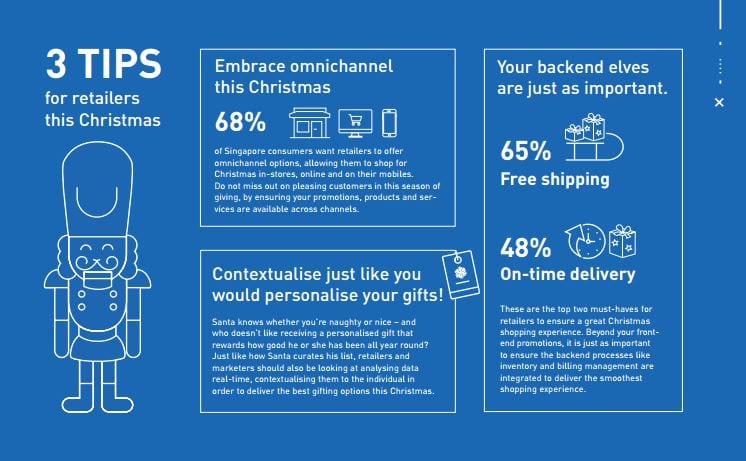
    According to the latest survey by SAP Hybris, Singapore shoppers want cross-channel options more than new-age services like digital wallets and augmented reality store experiences. Over 2 in 3 shoppers (68%) prefer retailers with a physical store coupled with both e-commerce and mobile app while more than half of consumers want retailers which offer self-pickup services as physical stores.

    “With high Internet and mobile penetration rates, it is of little wonder that Christmas online shopping is picking up among Singaporeans. The e-commerce market in Singapore is expected to be worth US$5.4 billion (S$7.46 billion) by 2025, according to a report by Temasek and Google released earlier in May this year, and is expected to make up 6.7% of all retail sales by 2025,” SAP Hybris global vice president of fast growth markets Nicholas Kontopoulos explained.

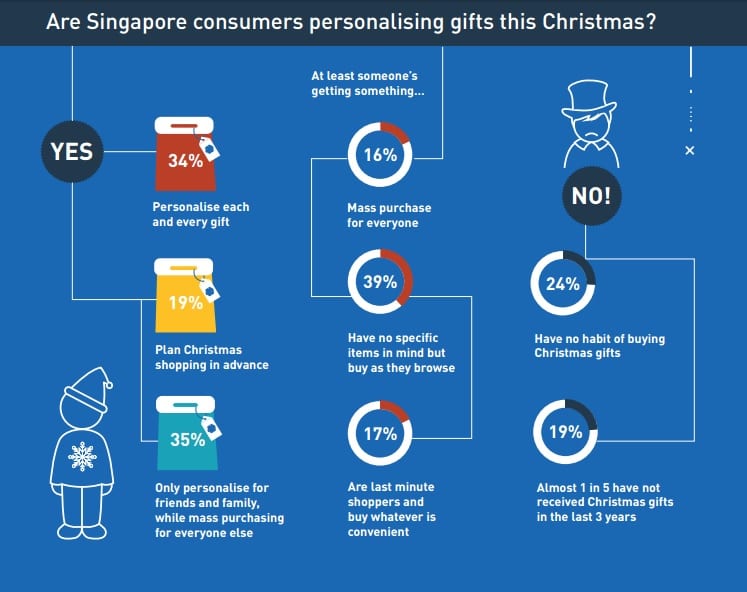
    More so, 65% of the shoppers stated that retailers can improve their Christmas shopping experience by offering free shipping. Around 48% see on-time delivery as a benefit while 41% noted that gift customization would signal yet another improvement.

    “Singaporeans are amongst the most tech-savvy spenders in Asia, and no strangers to e-commerce. Despite that and reports of Singapore’s continuously challenging retail landscape, the brick and mortar stores are definitely not dead,” Kontopoulos noted.

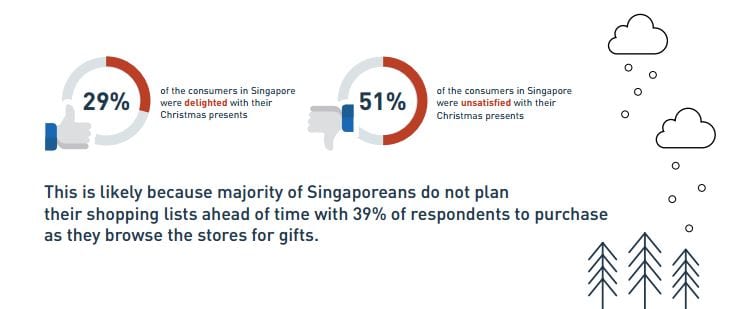
    He furthered, “In fact, the SAP Hybris survey found that 39 per cent of Singaporeans still enjoy browsing through stores. This reinforces what we have been telling retailers for some time: Singapore is a truly multi-channel market, where most consumers are using a combination of devices in their online and offline shopping. The findings also point us to a future where offline and online shopping are no longer two separate business models. Singaporeans are demanding a seamless omnichannel shopping experience.”

  • C-Store Private-Label Brands Thrive in South Korea

    C-Store Private-Label Brands Thrive in South Korea

    South Korean convenience stores have long been a part of the country’s quick, fast-changing lifestyle, and are going a step further by producing their own private brands, as reported.

    “The private brand business here will continue to grow across all industries, centered on firms with strong distribution channels. South Korea has a relatively low private brand penetration rate compared to other OECD (Organization for Economic Cooperation and Development) countries,” Suh Yong-gu, a professor of marketing at Sookmyung Women’s University, told the new source.

    Private-label brands also benefit from a lower price tag, Suh added. 7-Eleven Korea’s introduction of private coffee brand Seven Café is an example of an affordable product that competes with existing brands. The news source notes that Seven Cafe ranked No. 1 in terms of the number of products sold at the chain’s locations this year between July 1 and November 16, which marks the first time a private brand product outperformed established brands sold at 7-Eleven stores. Seven Café began with just 20 vendors in January 2015 and has expanded to more than 4,000 vendors as of November.

    Convenience stores are also collaborating with consumer goods manufacturers for added value, notes the news source. For example, South Korean c-store chain CU this year worked with dairy company Seoul Milk to release CU Big Yogurt. Since launching in April, more than 1 million bottles have been sold every month, and the product topped the list of yogurt beverages sold at CU locations, according to the company. CU has about 1,000 different private brand goods on display, which account for about 25% of all products sold at CU stores.

    C-store chain GS 25, operated by GS Retail, and instant noodle maker Paldo recently rolled out Omori Kimchi stew ramen, reports the news source, noting that about 9 million units of the Omori Kimchi stew ramen were sold within a year of its release, surpassing sales of Nongshim’s Shin Ramyun.

    In South Korea, c-store chains aren’t shy about experimenting with private brand products, even when they’re not food or beverage related. For example, in October 2015, CU teamed with local toy maker Oxford Block to introduce three limited edition toys. At 26,000 won ($22), the toys were sold out within five days of release.

    “The rise of private brand products suggests a rosy outlook for convenience retail brands. On the downside, it has cast a cloud over manufacturers of products such as beverages which have to allocate more budget for advertisements and promotions next year,” Kim Tae-hyun, an analyst at IBK Securities, told the news source.

    Industry experts look no further than Japan to gauge the future private brands in convenience stores.

    “Over the past 10 years, Japan has seen a power shift from manufacturing companies to convenience retail businesses on the back of the latter’s distribution channels. For example, Seven & I Holdings, the operator of 7-Eleven Japan, gains 50% of its net sales from private brand products,” said Han Kook-hee, an analyst at NH Investment and Securities, in a report. “Most leading Japanese manufacturing firms are keen to produce private brand products for convenience store brands.”

  • Samsung Maintains its Market Dominance followed by OPPO and ASUS in Indonesia

    Samsung Maintains its Market Dominance followed by OPPO and ASUS in Indonesia

    According to International Data Corporation’s (IDC) latest Quarterly Mobile Phone Tracker, total smartphone shipment in Indonesia in 2016Q3 recorded a slight Quarter-On-Quarter (QoQ) drop of 7% but still showed a moderate increase of 4% over the same period last year. “After the peak season of Lebaran ended, a stretch of quiet business begun in 2016Q3 which forced smartphone vendors to lower their shipment and focus more on improving the sales performance as well as laying the groundwork in anticipation of the peak shopping season in 2016Q4.” Says Reza Haryo, Senior Market Analyst, Client Devices, IDC Indonesia.

    Key highlights in the Indonesian smartphone market in 2016Q3 include: 

    US$250<US$300 price band segment grew significantly, which was contributed by the traction of OPPO’s F1s and Samsung’s Galaxy J7. However, when considering the Indonesian market as a whole, the US$100<US$200 segment remained the sweet spot, thanks to the demand for entry level 4G phones which usually offers the combination of 2GB ram and 16 GB internal storage.

    The share of 4G phones have also increased from 58% in 2016Q2 to 68% in 2016Q3 and had 8% sequential growth. This is largely due to the fact that telco service providers have been competing to expand their market share in a bid to capitalize on the growing number of smartphone users in the country through data bundling packages. In line with this expansion, the portion of smartphones sold in telco channel has also increased 22% YoY.

    “Indonesians use smartphones for entertainment purposes such as social messaging, video streaming, gaming, as well as browsing. Hence, there is a demand for the larger screen sized phones and the share of phablets have increased from 11% in 2015Q3 to 16% in 2016Q3. Most of the volumes came from major vendors such Samsung, OPPO and Asus. Samsung’s Galaxy J7, OPPO’s F1s and ASUS’ Zenfone Selfie were among the most popular models.” Adds Haryo.

    Top Five Vendor Highlights in 2016Q3 

    Samsung’s consistent marketing campaigns in retail shops enabled the vendor to increase shipments despite having a slower demand. This also extended the gap between the market leader and its competitors. The fallout from the Note 7 incident had relatively little impact on its brand perception in Indonesia.

    OPPO decreased sequentially relative to the non-peak period but still maintained its aggressive online and offline marketing activities. OPPO’s direct to retail strategy with various marketing supports continued to allow OPPO to increase its retail presence.

    Asus continued to rely heavily on the affordable Zenfone Go but the lack of marketing efforts throughout the quarter brought about its decline in the market.

    Advan introduced 8 low-cost 4G models in 2016Q3 alone. 4G models have been quick to pick up, partly thanks to the local vendor’s marketing activities heavily focusing on retail channels.

    Smartfren. As a local vendor that also operates as a telco provider, Smartfren tried to book more revenue from data services and recorded a 17% sequential decline for its smartphone shipment. Aside from bundling programs with leading smartphones such as the Samsung J Series, Smartfren have been consistent in promoting their Mifi product with attractive bundling program.

    Lenovo decreased sequentially relative to the non-peak period choosing to focus on sell-out instead. A6000, A1000 and A2010a were their top 3 models shipped in 2016Q3 in terms of units.

    Overall Positive Outlook for Indonesia

    IDC maintains the forecast for 2016 as the market is expected to expand significantly in Q4 and high demand during the festive season will allow vendors to increase shipment volume to reach targets. In addition, the continuous economic improvement from heavy infrastructure investment will continue to boost the Indonesia economy.

    The Local Content regulation (TKDN) is getting more accepted in a sense of clearer approach. A number of vendors including Xiaomi, LG, and Blackberry have now showed commitment to comply with this regulation. In the short term, it is expected that the industry will be focusing on local assembly but the challenge remains from the inadequate component supply chain ecosystem. But in the longer term, depending on the effectiveness of incentives provided by the government, more component manufacturers could move to Indonesia. This means that vendors would need to be prepared to have end-to-end manufacturing in Indonesia instead of just assembly. Hence, we expect that the future outlook will remain positive for 2017 onwards,” ends, Haryo.

    Channel dynamics

    With the intense competition and relatively low demand in 2016Q3, it caused vendors to put their utmost focus on liquidating stocks through improvement to their channels. The Direct to retail approach by cutting down the intermediaries has proven to help the sell-out of OPPO. IDC believes smartphone vendors will try to replicate this distribution strategy soon but this will require a strong retail relationship which only the larger vendors will be able to execute given the large volumes that they have and that they are more established in the market.

    Telco collaboration

    “Telco providers need to challenge the status quo and find ways to innovate as their core business continues to be pressured by over the top players which could be significant threats in revenue loss even as mobile data traffic grows exponentially. With an advanced network infrastructure and strategic partnership between telco providers, over the top players and hardware vendors, IDC believes that Telco providers and smartphone vendors can leverage the increasing demand for over the top players to drive up ARPU as well as brand exposure,” ends, Haryo.

  • Toshiba ropes in RPTech as a service partner

    Toshiba ropes in RPTech as a service partner

    Toshiba Electronics Asia (Singapore) Tuesday roped in RPTech Care Center, a service division of Rashi Peripherals a its service partner for India.

    RPTech Care Center will be managing Toshiba India Private Limited (TIPL) service needs and this alliance is aligned with Toshiba’s commitment to serve the customers by offering superior after-sales service, the two companies in a joint statement said.

    RPTech has more than 50 service centers spread across large cities in the country.

    “Being an international legendary brand that is committed to people, we believe in offering world-class quality and inventive products to our customers,” Polad Garda, country head, Toshiba India said.

    Further with our alliance with the RPTech Care Center, we are keen to offer our customers an excellent after sales service experience and satisfaction, Garda said, adding that it was a driving step to allow our customers with numerous alternatives and reduced turnaround time.

    “RPTech Care Center has well-built and dedicated service capabilities and post sales service systems,” Rajesh Goenka, Vice President, Rashi Peripherals said.

  • Digital video software market to exceed $9b by 2021

    Digital video software market to exceed $9b by 2021

    The video software market is expected to exceed $9 billion in revenue by 2021, according to a new report recently released by IHS Markit.

    The atomization of media distribution and the switch from hardware-based technology solutions to cloud implementations are key drivers for the $3 billion in revenue growth over the next five years, according to the new Video Software, Security, and Analytics Intelligence Service report from IHS Technology.

    “Taken together, these two forces have created a market where value is shifting towards the frontend,” said Cecilia Zhu, analyst at IHS Technology. “A superior user-experience has become fundamental to securing increased consumer spend.”

    Globally, content security accounts for 32% of the digital video software market. While demand for robust security solutions is unlikely to deteriorate,  particularly in the presence of high-value UHD and HDR content,  the segment is effectively saturated.

    North America is the key region for the video software market, and generates roughly $2.9 billion. The region’s value relates primarily to confluence of three factors — the presence of large media companies, their outright scale, and their sheer number.

    The region’s economic dominance should not, however, overshadow the existence of cutting-edge video services in Europe, Asia, and the Middle East, and the technology demand that these services generate.

    Cisco has a 15% share of the video software segment, the largest globally. The company has proven adept at transitioning into the video space, and in using its longstanding presence in core, metro, and access-network infrastructure to cross and upsell video-specific software.

  • Tencent China streams reality show thru LiveU

    Tencent China streams reality show thru LiveU

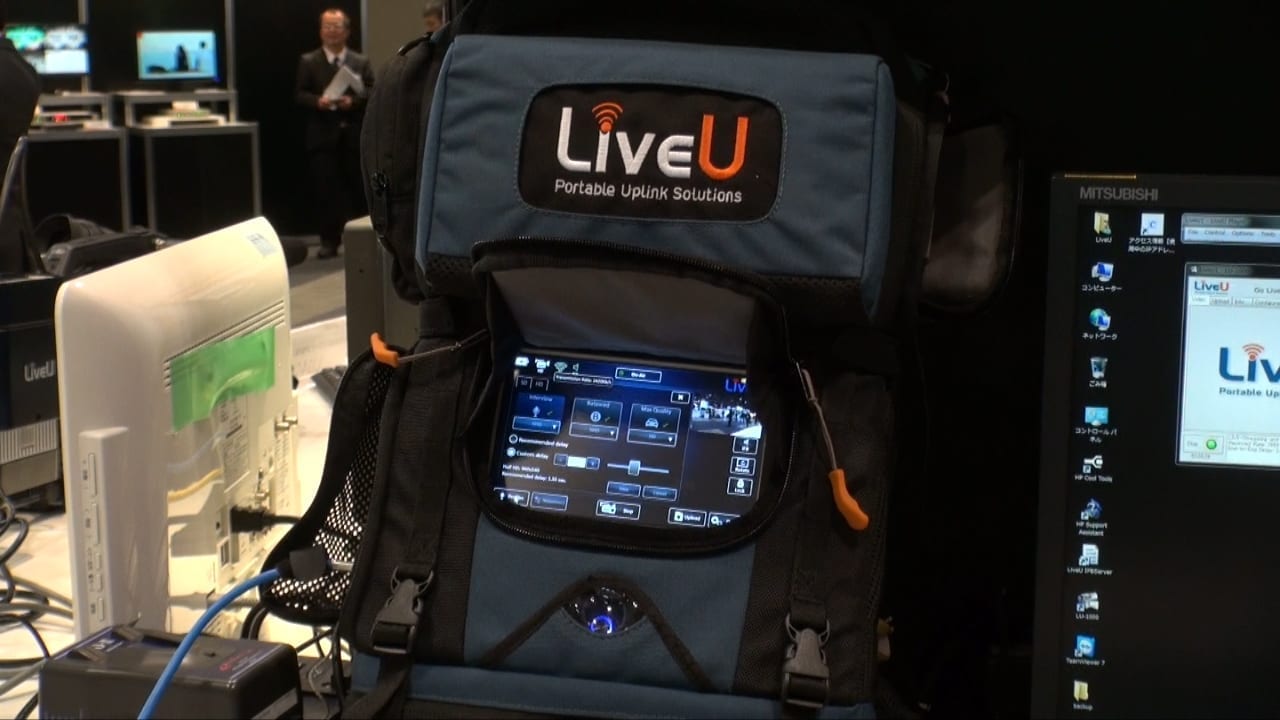
    Tencent is using LiveU’s portable transmission technology to stream live its new reality series called “See where you are going.”

    The live online program follows Olympic champions, movie stars and random guests in six cities around China (Suzhou, Hangzhou, Beijing, Tianjin, Qingdao and Shenzhen) as they perform various tasks.

    Tencent has deployed 10 LU200s, LiveU’s ultra-small transmission units, for the live production. Separate camera crews live stream the different stars in the different locations and viewers can choose one of six different video rooms to watch the video live on any device. At the end of each program, Tencent posts an edited version combining all the different clips online.

    The LiveU units and support are provided by LiveU’s local partner Guanhua Glory with additional support provided by Oneband Systems, an additional LiveU partner.

    Zhao Dongwei, Tencent transmission technology head, said that with the multi-camera chasing of stars, and multi-screen viewing, the show represents a new type of program in China.

    “Involving 6-10 hours per day of live streaming, it was important for us to choose a small, lightweight unit, which could deliver high quality and reliable live video over a long time in multiple locations,” said Zhao. “The LU200 surpassed our expectations, offering a highly cost-effective live transmission solution.”

  • Eros Now teams with Paytm on mobile payment, platform

    Eros Now teams with Paytm on mobile payment, platform

    Eros Now has entered into a strategic partnership in India with Paytm to enable its subscribers to make easy and hassle free payments using the e-wallet service.

    “Post demonetization in India, there has been a high surge in mobile and digital payments as we move towards a digital economy along with a rise in internet penetration and smartphone usage,” said Rishika Lulla Singh, CEO of Eros Digital.

    Through Paytm, owned by One97 Communications, users can make convenient payments to subscribe to Eros Now to access its rapidly growing repository of premium Bollywood and regional content including movies, music, television shows and originals.

    Eros Now said the platform currently has over two million paid subscribers worldwide through significant deals in place with all major telecom players in India, including as Reliance Jio, Airtel, IDEA Cellular Network and more recently Vodafone.

    Between the four platforms that offer Eros Now integrated as part of their video service, there is a potential reach of 686 million subscribers which is almost 60% of India’s total mobile user base of more than one billion.

    “Our strategy remains to distribute Eros Now, a world class OTT platform, to consumers across telecoms and OEMs with compelling content and product features,” said Singh. “We view the recent demonetization move in India as a great opportunity for the OTT business as more consumers are signing up for online and mobile pay systems.”

  • China’s Wanxiang gets approval to produce Karma electric cars

    China’s Wanxiang gets approval to produce Karma electric cars

    Wanxiang Group, a major Chinese auto parts supplier which almost three years ago bought the assets of defunct California-based plug-in hybrid carmaker Fisker Automotive, has received approval from local regulators to produce electric vehicles in China.

    According to a notice on Friday on the website of the National Development and Reform Commission (NDRC), China’s top economic and industrial planner, Wanxiang has the green light to build a factory with capacity to produce 50,000 electric cars a year.

    The move means the former Fisker Automotive, which was founded in part with a U.S. government loan and ceased production of its $100,000 plug-in electric hybrid sports cars in 2012 after a series of technical glitches and cost overruns, continues to survive under Chinese ownership after Wanxiang gave it a second life.

    Wanxiang later changed Fisker’s name to Karma Automotive.

    Wanxiang, a Hangzhou-based company which in 2012 also acquired U.S. lithium-ion battery maker A123, became the sixth company to be allowed to produce new-energy vehicles in China.

    More companies are currently being encouraged to enter the automotive industry in China but only if they are willing to produce so-called new-energy cars, mostly all-electric battery cars and heavily electrified plug-in hybrids.

    China has been making a push for electrically-propelled cars by offering incentives to buyers, forcing global automakers to share their technology, and opening its market to tech firms and others to produce electric vehicles.

    Beijing wants such vehicles to serve the mass market, and hopes the technology will help its auto industry close a competitive gap with global rivals which have a century’s head-start in traditional combustion engines.

    Aside from Wanxiang, NDRC has approved five companies to produce new-energy vehicles, including Ch-Auto’s Qiantu Motor, and Changjiang Auto. More companies such as WM Motor, Future Mobility, Singulato Motors are seeking approval.

  • Singapore IMDA appoints new CEO

    Singapore IMDA appoints new CEO

    Singapore has appointed Tan Kiat How as chief executive of the Infocomm Media Development Authority (IMDA) from January 1, 2017.

    Tan, currently deputy secretary (cyber and technology) at the Ministry of Communications and Information (MCI), succeeds Gabriel Lim, who will continue to serve as second permanent secretary (communications and information), said MCI in a media release.

    Prior to his stint at MCI,  Tan served at the former Infocomm Development Authority of Singapore (IDA), the Ministry of Finance and the Pioneer Generation Office (PGO).

    Tan’s previous contributions include helping to develop the Intelligent Nation 2015 plan and implement the Next Generation Nationwide Broadband Network at the then-IDA. He was also involved in refining the national cybersecurity strategy with the Cyber Security Agency (CSA) in his time at MCI.

    Lim was appointed co-managing director of IDA in May, in preparation for the formation of IMDA on October 1. He oversaw the establishment of the TechSkills Accelerator, a new hub for skills development and job placement, and preparations for Singapore’s fourth mobile network operator.

    Prior to that, Lim was appointed CEO of the former Media Development Authority of Singapore on December 8, 2014.

  • Bob Bakish takes helm at Viacom

    Bob Bakish takes helm at Viacom

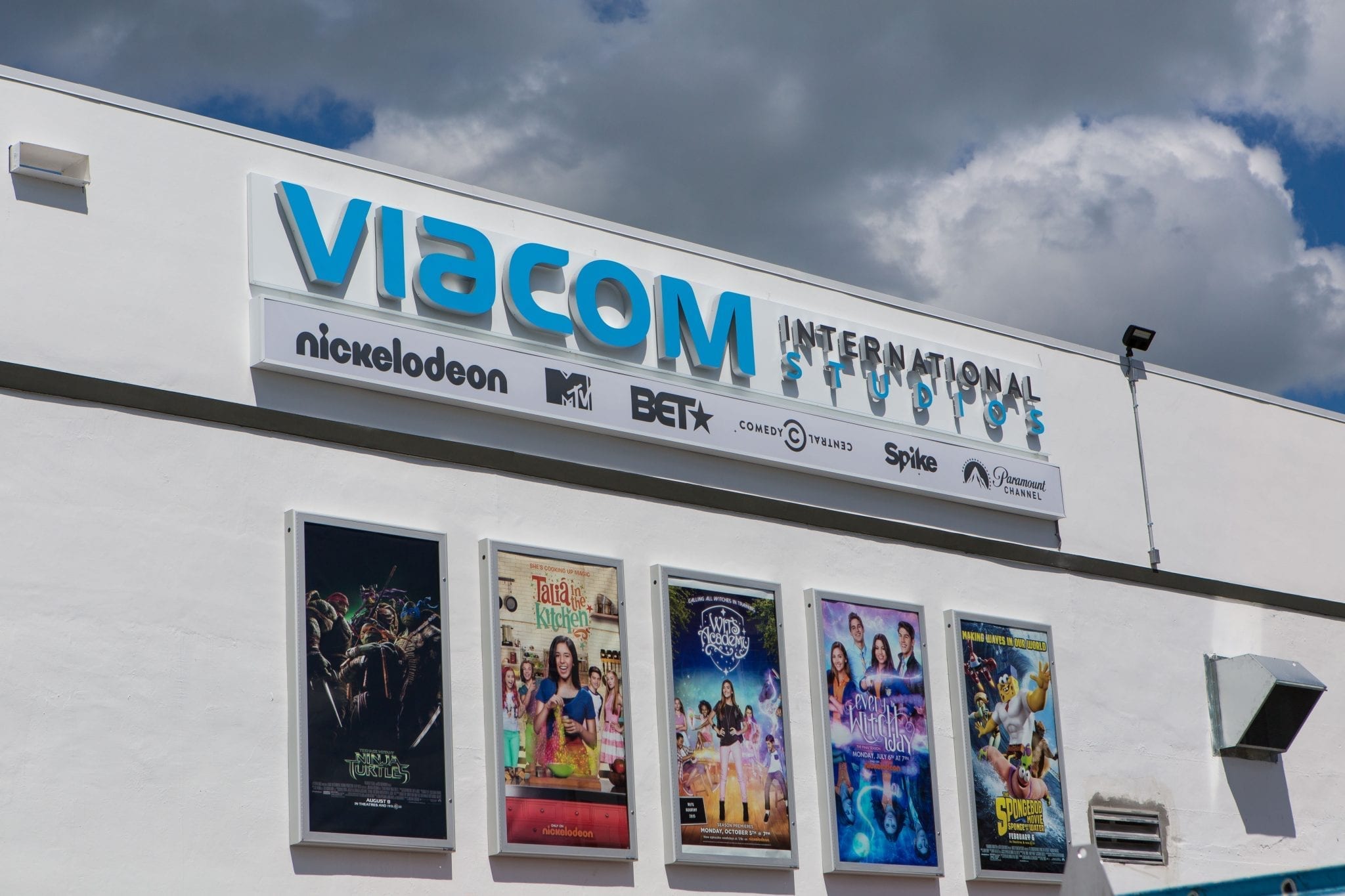
    Viacom has discontinued the exploration of a potential combination with CBS and has appointed Bob Bakish as president and CEO, and as a member of the board.

    Bakish has held leadership positions throughout the company since joining in 1997, most recently serving as president and CEO of Viacom International Media Networks prior his acting CEO role.

    “We’ve been working very quickly to mobilize the organization, reenergize our culture and address our areas of greatest need,” said Bakish.

    Also, Fox Networks Group Asia has appointed Italo Zanzi as EVP and managing director for its Sports network. The veteran sports executive leads the management of the Fox Sports business and team across Asia-Pacific and the Middle East.

    Zanzi joins Fox from Italian Serie A football club A.S. Roma where he was CEO for three and a half years, overseeing all aspects of the club’s operations and business.

    At Eutelsat Communications, Sandrine Téran will assume office as group CFO and member of the executive committee on January 9.

    Téran was formerly managing director of Louis Dreyfus Holding (based in the Netherlands) and has occupied other key executive positions in the Louis Dreyfus Group during the past eight years, notably global head of tax and corporate secretary, and subsequently global CFO of Louis Dreyfus Company.

    Téran succeeds Antoine Castarède who will be an advisor to the CEO over the coming months before leaving Eutelsat to pursue other interests.

  • DHL adding drones and ‘copters to its courier workforce as e-commerce operation expands

    DHL adding drones and ‘copters to its courier workforce as e-commerce operation expands

    DHL, the world’s largest logistics company, is poised for a major expansion of its delivery channels, including the wider use of shops where customers can collect parcels, drone deliveries, and what the company is calling “Parcel-copters”, says the chief executive of its rapidly growing e-commerce division.

    Speaking in Hong Kong, Charles Brewer suggested the routine procedure of having a uniformed courier delivering to your doorstep is rapidly becoming less popular, simply because customers these days are less willing to sit at home and wait for arrivals.

    So the company is now in the rapid process of introducing “alternative methods”, which Brewer – who’s been with the German deliveries titan since 1984 – is tipping to see the fastest growth.

    “We are going to have a big, big expansion in the choice of deliveries in some places,” he told on Thursday.

    Courier and delivery market leaders such as DHL, UPS and FedEx are having to adapt fast to ever-changing customer demands, with the emphasis very much now on faster, more convenient, internet-based methods.

    Brewer said his and other firms are increasingly facing what the industry likes to call the “parcel conundrum” – instances when shoppers enjoy the comfort and ease of picking their favourite items and placing their orders online, but are disappointed by the delivery efficiency that follows.

    “Their experience quickly begins to sour as the delivery process starts to take over,” Brewer said, citing a recent DHL survey result that showed more than 80 per cent of consumers are either dissatisfied or very dissatisfied with their online delivery experience.

    Many logistics firms, he added, only made deliveries to people’s homes within a time-banding, of say between 8am and 6pm, when typically people are at work.

    “Nobody wants to stay at home, waiting and waiting,” Brewer added.

    Brewer noted that customers are increasingly asking for what he calls “parcel lockers” and parcel shops, where they can easily collect their deliveries.

    We are going to have a big, big expansion in the choice of deliveries in some places

    A tie-up with intelligent locker makers will allow customers to retrieve parcels from lockers using a secure pin.

    “The fastest growing delivery channel is alternative,” said Brewer, outlining the future emphasis of his e-commerce offshoot.

    Since last year DHL has been running schemes in Germany to have packages actually delivered to the boots of people’s cars – in partnership with Daimler and Audi, the carmakers.

    The company is also partnering with Deutsche Telekom to launch a joint research into applications of unmanned aircraft for the safe and rapid delivery of parcels in urban areas.

    The first application is going to be the DHL Parcel-copter, which has been trialling since 2013.

    In September, it concluded a test of shipping products including urgently needed medicines via unmanned aircraft called “Parcel-copters,” in a Bavarian village of Germany.

    The planes were equipped with a mobile communications module allowing them to be located through GPS data.

    “One thing that will be very popular in Asia are parcel shops,” Brewer said.

    Already logistics companies such as Chinese company S.F. Express have been scrambled to join hands with bricks-and-mortar retailers such as 7-Eleven, to arrange convenient parcel pickup points.

    These alternative delivery methods are still in their infancy, accounting for just six per cent of total market share, while in mature e-commerce markets such as Germany and the Nordic countries, they already represent 10 to 15 per cent, Brewer said.

    “But that’s where we will end up in the rest of the world in the coming years.” he noted.

  • Ladies Market fake products seizure largest for three years

    Ladies Market fake products seizure largest for three years

    Hong Kong Customs has arrested 10 people and seized HK$10 million (US$1.2 million) worth of fake products, smashing a counterfeit syndicate at the Ladies Market.

    It was the largest syndicate caught in three raids by the Customs and Excise Department this year on Tung Choi Street in Mong Kok. In January and August, officers nabbed 12 people and seized HK$7.5 million in fake goods.
    Following those busts, the syndicate just nabbed had chosen potential customers more carefully to avoid detection, says Customs official Guy Fong Wing-kai.

    “The gang served only tourists from Europe and America,” he says. “They did not approach locals or Asian tourists in case they were undercover customs officers.”

    The syndicate sold their goods at 5 to 20 per cent of the genuine products’ price, he says.
    An investigation revealed the syndicate sold counterfeit goods at four hawker stalls in the market, using electronic tablets to show clients photos of the products.

    “Some clients were taken to its upstairs showroom nearby, which was packed with about 600 counterfeit products,” says Fong. Four nearby flats were used as warehouses, and a female ringleader went to the mainland regularly to buy the fake products.

    After a month-long investigation, about 90 Customs officers raided the four hawker stalls, the secret showroom and the four warehouses. Seven men and three women were rounded up and more than 10,000 fake products seized including watches, handbags and leather goods.

    Fong says it was Customs’ largest seizure of fake products in a single operation in the past three years.

    Aged between 24 and 38 years, the 10 Hongkongers are being held for questioning. None have yet been charged.

    Fong says the department will enhance its enforcement activities against counterfeiting during the holiday season. He says that selling counterfeit goods is regarded as a serious crime, carrying a maximum penalty of a HK$500,000 fine and five years in jail.

  • Cebu Pacific boosts capacity for festive season

    Cebu Pacific boosts capacity for festive season

    Cebu Pacific has taken delivery of a new Airbus A330-300 aircraft in time for the festive peak season.

    The new twin-aisle jet was delivered on 14 December and has now entered service on the airline’s route between Manila and Hong Kong. This deployment has led to a 22% increase in terms of seat capacity on the popular route.

    As a low-cost carrier, Cebu Pacific equips its A330s with 436 seats in an all-economy class layout. This gives it a greater capacity than some airlines’ A380s.

    Cebu Pacific is the largest Philippine carrier operating in Hong Kong, offering flights to Cebu, Clark and Iloilo, as well as Manila.

  • Ooyala launches applications for collaborative asset management

    Ooyala launches applications for collaborative asset management

    Ooyala has launched new versions of its MAM (media asset management) application and Reviewer application for its media logistics platform, Ooyala Flex.

    The new solutions make it easier for broadcasters, publishers and media companies to manage, review and approve video assets while automating steps in the workflow and capturing the associated data in the management phase of video production.

    Both applications are highly configurable, taking advantage of the workflow capabilities of Ooyala Flex. With a modular approach, the applications can be used separately or together.

    When deployed together, customers benefit from enhanced collaboration and efficiencies not found in traditional offerings on the market, allowing creative teams to focus only on the tasks that add value and creativity to productions.

    The HTML-5 based MAM application can be tailored to match each customer’s unique production workflow. Non-technical users are able to easily upload and organize video and image assets, search for and update metadata, perform rough-cut edits and review assets with internal teammates.

    The Reviewer application for Ooyala Flex lets individuals that are either inside or outside of the organization securely review, approve and submit time-coded comments on selected content from anywhere in the world, anytime-including real-time collaboration and annotation for images.