Tag: bank

  • DBS Triples Vacancies at Female-Focused Job Fair

    DBS Triples Vacancies at Female-Focused Job Fair

    The second edition of the bank’s virtual career fair sees vacancies for women technologists almost treble to 140.

    The bank is focusing its outreach efforts on filling five engineering roles: Engineering Lead; Solution Architect; ReactJS Developer; Full Stack Developer; and Software Development Engineering in Test, at its Women in Tech» career fair, which is returning in June 2021.

    We believe that by driving diversity in our engineering roles we will be able to incorporate a multiplicity of views and perspectives upstream so as to deliver outstanding digital experiences for our customers, Soh Siew Choo, DBS head of big data/AI and consumer banking technology, said in an announcement on Tuesday.

    Candidates must complete an online assessment by June 8, and shortlisted applicants will be invited to an online hiring day on 12 June 2021.

    According to DBS. there is a strong pipeline for of women for technology roles. The bank received more than 500 applications for 50 job opportunities at its inaugural virtual career fair, held amid the pandemic in October 2020.

    Among the new hires from last year’s edition was Lo Man Ling, vice president of consumer banking digital platform, who joined the bank after more than nine years in the public sector.

    DBS said the share of applications from women rose to over 30 percent, as compared to 5 percent in previous years, and the number of offers made to women also increased about five times, as a result of its efforts to reach out to women.

  • HSBC to Fund New Climate Solutions

    HSBC to Fund New Climate Solutions

    The bank is collaborating with the World Resources Institute (WRI) and WWF to unlock access to finance to help new climate-based projects create real-world impact. HSBC said it would put in $100 million of funding – half of which will be deployed in Asia – over the next five years to build towards a net-zero economy, according to a statement on Thursday.

    Keeping global temperature rises within safe limits requires new thinking and new technology. Asia is particularly vulnerable to climate change, but it is also where solutions are emerging fast, Peter Wong, HSBC deputy chairman and CEO said in the statement.

    The partnership covers 14 markets in Asia Pacific, including Australia, India, Indonesia, Hong Kong, Japan, mainland China, South Korea and Vietnam, across three funding streams: energy transition, nature-based solutions, and business innovation.

    The bank cited several projects as examples: improving industry access to renewables and green technologies in China, working with partners in Thailand to restore parts of Chiangmai’s degraded forests and advance sustainable agriculture, and supporting Hong Kong start-ups focused on climate innovations.

    Ignoring the human impact on climate will delay reducing inequality and achieving sustainable long-term growth in the region, the bank said.

    The Climate Solutions Partnership is part of the bank’s previously announced ambitious plans to combat climate change, under which it is setting aside $1 trillion in green financing to support customers in the transition to net-zero.

    Climate activists have criticized the bank for its support for the fossil fuel industry, alleging that it has invested some $80 billion in fossil fuels since the Paris Agreement in 2015.

    In March, the bank committed to phasing out support for the coal industry by 2030 in the developed world and by 2040 in the developing world, following pressure from activist investors.

  • UBS Cuts 700 Jobs

    UBS Cuts 700 Jobs

    Swiss bankers are the first to go in the Swiss bank’s current round of cuts. UBS has started cutting jobs as part of its current round of cost-savings measures, with around 700 employees in Switzerland affected.

    Most of the cuts will be in the corporate center although 200 jobs will go in wealth management and UBS Switzerland. These are in addition to the roughly 125 jobs UBS was going to get rid of before the Covid-19 pandemic put those plans on ice

    UBS CEO Ralph Hamers announced a $1 billion cost-savings target during first-quarter results last month. UBS’s cuts are aimed at the jobs expected to become redundant as a result of its ongoing digitalization processes. finews.com reported on the plans in April. They are expected to be wide-ranging and take out 3,000 jobs in total.

    UBS has not confirmed the figure but it is realistic in view of the savings targets and the bank’s cost structures. It also announced that restructuring costs would total $300 million in the second quarter, most of which were in the scope of the cuts originally announced last year.

    According to Bloomberg, around a dozen managing directors as well as more junior bankers in the advisory and trading business were recently let go. In wealth management, about five managing directors and several executive directors were impacted. In the investment bank, most of those cuts were those responsible for wealth management clients.

    CEO Hamers said his current efforts are aimed at implementing and executing the transformation and digitalization strategy, which is expected to take about three years.

  • Citi Names Head of Private Bank for South Asia

    Citi Names Head of Private Bank for South Asia

    The Singapore-based Citi veteran will oversee the bank’s global market managers in South Asia and will have direct responsibility for the Singapore and Malaysia markets.

    Citi has named Lee Lung Nien as head of its private banking business in South Asia, in addition to his existing role as chairman of Citi Private Bank for South Asia, according to an announcement on Monday.

    Lee joined Citi 30 years ago and was CEO of Citi Malaysia from 2014 to 2020. He previously held various other senior roles including co-head of corporate sales and structuring for markets and securities services, chief operating officer for Singapore, and AML (anti-money laundering) business head of Asia Pacific. In his new role, he will report to Steven Lo, Asia Pacific head of Citi Private Bank and Amol Gupte, Asean head and Citi country officer for Singapore.

    According to the bank, the South Asia region, which includes Singapore and Malaysia, is a «key growth area» for its private banking business and is critical to the success of the Citi Global Wealth initiative.

    The South Asia region possesses outstanding potential due to a fresh wave of entrepreneurship, developing capital markets and an increasingly welcoming environment for family offices, Gupte said.

    The South Asia head role was previously held by Jyrki Rauhio, who left in 2020 after 20 years at the bank and later joined HSBC Private Banking as its regional head of credit advisory.

  • DBS Launches Crypto Trust Offering

    DBS Launches Crypto Trust Offering

    DBS enlarges its cryptocurrency offering with a trust solution from its private banking arm amid growing demand for the asset class even within wealth succession plans. DBS Private Bank launches its cryptocurrency trust solution via wholly-owned DBS Trustee, according to a statement.

    The new trust offering is limited to cryptocurrencies currently supported by the bank’s digital asset exchange – DBS Digital Exchange (DDEX) – which includes Bitcoin, Ether, Bitcoin Cash, and XRP.

    According to the bank, the solution will ensure that critical information like access instructions or wallet backups will be kept confidential when passing on wealth in succession plans due to the additional protection afforded to trusts and their exclusion from the probate process.

    Confidentiality, peace of mind and taxation often emerge as top-of-mind concerns in our conversations with clients, and we would advise them to set up trust structures rather than wills, which are subject to the probate process, said DBS Private Bank’s regional head of family office, wealth planning and insurance solutions Lee Woon Shiu.

    This is especially so considering that international regulations and protocols are still nascent in the digital asset space, which could give rise to complications or unnecessary confusion if proper measures are not in place to prevent them.

    DBS expands its crypto offering amid growing demand for the digital asset class with DDEX registering S$80 million ($59.9 million) in assets under custody and a 10-fold increase of trading volumes since launch to S$30-40 million.

    The exchange currently has 120 clients with more awaiting onboarding.

    In recent years, more clients have expressed interest or are already invested in digital assets, and we expect this trend to accelerate as cryptocurrencies turn more mainstream, said group head of DBS Private Bank Joseph Poon. «Our trust structure allows clients to conveniently hold these assets, with a peace of mind that they will be safely managed and passed on to their intended beneficiaries.»

  • UOB’s Chan Kok Seong on Risk Culture and Hybrid Work

    UOB’s Chan Kok Seong on Risk Culture and Hybrid Work

    The protracted COVID-19 pandemic is no longer just a disruption to the way we work but has transformed permanently the world of work, Chan Kok Seong, UOB’s group chief risk officer, says in an interview.

    The future of work is shaping into a hybrid model that optimizes employee flexibility, autonomy and performance across locations. While much attention has been focused on enabling virtual teams through technology, it is important to balance the risks of remote working with productivity and agility.

    paper recently released by the Monetary Authority of Singapore and the Association of Banks in Singapore identified two key categories of risks for financial institutions: operational risks and people and culture risks, which all companies across sectors should note as they digitalize their businesses.

    How might companies better manage these emerging risks as they grapple with the embrace of remote working in the digital age

    Organizations will need to confront the technological, operational, legal and compliance risks which arise from a hybrid work model. A change in an organization’s control environment – such as when the majority of its employees perform their roles remotely – can introduce additional information security threat factors.

    For example, virtual workplaces include can be at risk of increased cyberattacks on an external network, potential leakage or misuse of confidential information, identity theft and employees circumventing work processes and controls against compliance guidelines.

    In a virtual work setting, enabling employees’ remote access to internal systems is a requisite. Companies must find a balanced and measured approach to cybersecurity safeguards that works for their operations and which do not compromise their risk controls or business productivity and agility.

  • OCBC Posts Record High Quarterly Net Profit

    OCBC Posts Record High Quarterly Net Profit

    The quarter’s earnings were driven by broad-based income growth and lower allowances. OCBC Bank recorded a net profit of S$1.5 billion ($1.13 billion) for the January-March period, a jump of 115 percent from the same period last year (S$698 million), and 33 percent higher than the preceding quarter (S$1.13 billion), according to financial results posted on Friday.

    The bank said the record quarterly profit was driven by broad-based income growth and lower allowances. OCBC hit a new high in fee income (S$585 million), while making a far smaller allowance compared with the year-ago period (S$161 million vs. $657 million). Performance was also boosted by its insurance arm Great Eastern, which reported a twelvefold increase in profits this quarter.

    Income from wealth management, comprising insurance, premier and private banking, asset management, and stockbroking, rose 40 percent to S$1.21 billion – 41 percent of the group’s total income.

    Assets under management at Bank of Singapore, its private banking arm, rose 1 percent from the previous quarter to reach $123 billion as of 31 March 2021.

    OCBC highlighted growing momentum from renewed market optimism across its businesses, as well as improved quarterly earnings from its overseas banking subsidiaries.

    While we remain watchful of the prevailing risks in the operating environment, our strong balance sheet and capital position will enable us to capitalize on opportunities arising from improved economic conditions, particularly in ASEAN and Greater China,» OCBC chief Helen Wong said.

    Earnings at Singapore’s «big three» local banks all beat analyst estimates (DBS: S$1.44 billion, OCBC: S$1.13 billion, UOB: S$891.4 million, according to Refinitiv).

    DBS, which announced its first-quarter results last week, also experienced a strong quarter, doubling its income from the quarter before to reach S$2.01 billion and posting record wealth management fees.

    UOB’s earnings grew to S$1 billion for the same period – up 46 percent on the back of strong fees, trading, and investment income.

  • UOB Mulls Citi Asset Hunt in Asia

    UOB Mulls Citi Asset Hunt in Asia

    UOB is the latest bank to express interest in potentially acquiring Citi’s retail assets in the Asia Pacific region.

    UOB chief executive Wee Ee Cheong said that the Singapore lender would provide more clarity on acquisition plans after Citi release more details later this month.

    As long as it’s a strategic fit, is at the right price and makes sense for the long term, we will look at it.

    Numerous banks – both global and local – have reportedly expressed interest in potentially acquiring assets from Citi’s 13-market consumer banking exit in Australia, Bahrain, Indonesia, South Korea, Malaysia, the Philippines, Poland, Russia, Taiwan, Thailand, Vietnam, India, and China.

    DBS, Standard Chartered, Kotak Mahindra Bank and Axis Bank are reportedly eyeing the opportunities in India.

    And Citi’s retail assets in Australia reportedly drew interest from ANZ, ING Bank, Macquarie, Bank of Queensland, and local insurer Suncorp.

    Other banks that are also reportedly in the APAC hunt include Singapore’s OCBC and Japan’s Mitsubishi UFJ Financial Group.

  • DBS has Strong Interest in Cryptocurrencies

    DBS has Strong Interest in Cryptocurrencies

    The bank is seeing more traction for its crypto assets business, which provides cryptocurrency trading and digital custody for accredited investors.

    Daily trading value on DBS’ digital exchange has grown tenfold since its launch to reach $30-40 million, with an investor base of 120 accredited investors and some S$80 million in digital assets under custody, DBS chief Piyush Gupta said at a media briefing last week as it announced its first-quarter results.

    I do think given the amount of interest in all the four cryptos that we trade now, that interest is quite high. And therefore, I do think it will pick up. But whether it picks up to tens of millions, or hundreds of millions of income over the next few years, it’s hard to say. So my thinking is, we should get in there, figure it out and grow and then we’ll get a better sense for how big this could be in time,» Gupta said, adding that the bank has a pipeline of hundreds of customers.

    The DBS Digital Exchange offers exchange services between SGD, USD, HKD, JPY, and four of the most established cryptocurrencies: bitcoin, ether, bitcoin cash, and XRP. Gupta said the bank would be scaling the business in subsequent quarters by issuing security tokens and extending the exchange’s trading hours, which currently works during Asian trading hours, to round-the-clock.

    Earlier this month, the bank also announced the development of Partior – an open industry platform with Temasek and J.P. Morgan that aims to reimagine and accelerate value movements for payments, trade, and foreign exchange settlement.

  • Vietnam stock market daily trading value closes in on Singapore

    Vietnam stock market daily trading value closes in on Singapore

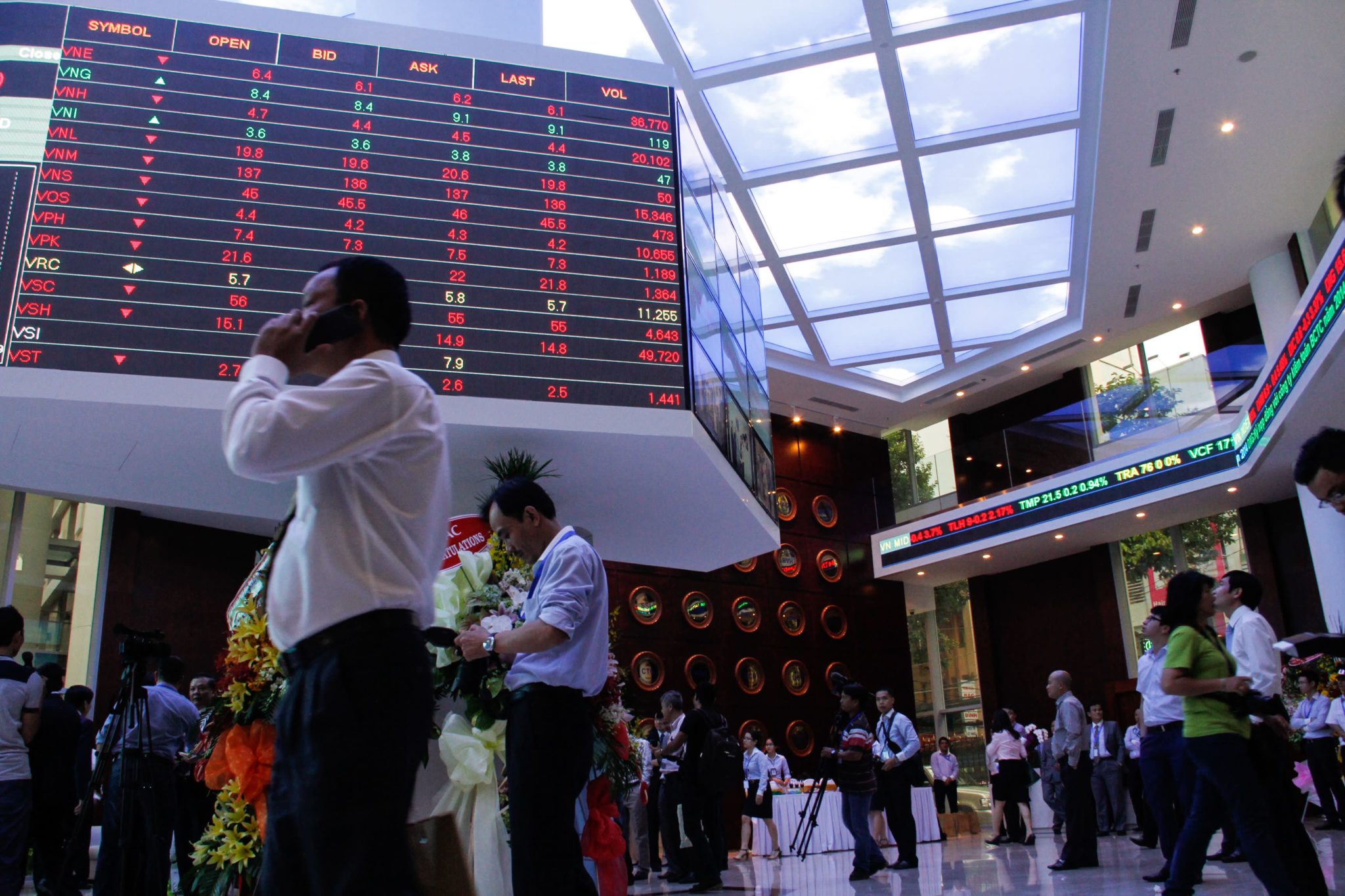
    The average daily securities trading value surged 5.6 times year-on-year in April to $725 million, nearly equivalent to that of Singapore, according to HSBC.

    The lender said in a recent report that the figure, which far exceeds those of Malaysia and Indonesia, was due to the increase in new investors and recovery of the economy.

    In March, the number of new trading accounts hit a record 113,900, taking the total to over 3.02 million.

    The economic recovery is underpinned by strong FDI flows, improvements in the manufacturing segment, and increased consumption, the report said.

    The benchmark VN-Index has risen 12.9 percent in the year-to-date compared to 4.2 percent for Asia ex-Japan.

    The index has repeatedly scaled new peaks this year after surpassing the psychological barrier of 1,204 points first reached in 2018.

    HSBC expected the market to continue to rise in the absence of alternative asset classes and bank deposit rates in decline.

    Though foreign investors have been pulling out of the stock market, HSBC said they would not be able to ignore Vietnam for much longer since it has proved to be one of the most resilient growth economies and 24 out of the 30 blue chips have still not reached the foreign cap.

    Besides, despite rising to record levels, the VN-Index remains 5 percent lower than its five-year average level with a price-to-earnings ratio of 15.1.

  • Net Profits Rebound at UOB

    Net Profits Rebound at UOB

    The bank’s quarterly earnings surged on the back of strong fees, trading, and investment income as business momentum improved.

    UOB’s earnings grew to S$1 billion ($750 million) in the first quarter of 2021 – up 46 percent from the previous quarter’s S$688 million and up 18 percent from the same period last year, according to financial results posted on Thursday.

    Income grew 11 percent to reach pre-Covid levels at S$2.5 billion, while fee income reached a new high to reach S$638 million (+22 percent), led by wealth management fees from investments and bancassurance. The bank also saw stronger activity in loans and investment banking, as well as treasury income. Its wealth management assets grew 10 percent to S$136 billion, of which 60 percent was from customers abroad.

    The bank highlighted growth across its key markets in Singapore, North Asia, and its Asean franchise. It expressed optimism as sentiment and business activities pick up and trade flows resume between Asean and Greater China.

    Across our key markets, we are seeing robust credit demand from our large corporate and institutional clients, Wee Ee Cheong, UOB deputy chairman, and CEO, said.

    Sustainability was a key theme for UOB, as total sustainable financing reached $12 billion during the quarter. During this period, the bank also issued Singapore’s first sustainability bond and global first dual-tranche sustainability bond.

    The bank’s AUM in ESG-focused investments also reached S$2.2 billion at the end of the quarter.

    DBS, which announced its first-quarter results last week, also experienced a strong quarter, doubling its income from the quarter before to reach S$2.01 billion and posting record wealth management fees.

    OCBC is due to release its quarterly results tomorrow, but its insurance arm Great Eastern has already reported a twelvefold increase in profits this quarter.

  • HSBC AM Names Asia Head of Credit Research

    HSBC AM Names Asia Head of Credit Research

    HSBC’s asset management arm appoints a new head of credit research in Asia amid an ongoing expansion across its product range and distribution capabilities in the region.

    HSBC Asset Management appoints Seok Poh Yeoh as head of credit research for Asia, according to a statement, effective immediately.

    In her Hong Kong-based role, Yeoh reports locally to head of Asian fixed income Elizabeth Allen as well as Paris-based global head of credit research Tina Radovic.

    Yeoh has 16 years of industry experience and was most recently a financial and corporate credit research analyst at Credit Suisse. She rejoins HSBC Asset Management after first joining in 2012 as a financial analyst.

    The latest hire follows announced ambitions by HSBC Asset Management to enhance its platform in mainland China, India, and Southeast Asia, most notably for the high net worth product range across alternatives, sustainability, and thematic equities.

    According to the bank, HSBC Asset Management has Asian fixed income assets under management totaling nearly $73 billion as of March 31 this year.

  • HSBC AM Names Asia Head of Credit Research

    HSBC AM Names Asia Head of Credit Research

    HSBC’s asset management arm appoints a new head of credit research in Asia amid an ongoing expansion across its product range and distribution capabilities in the region.

    HSBC Asset Management appoints Seok Poh Yeoh as head of credit research for Asia, according to a statement, effective immediately.

    In her Hong Kong-based role, Yeoh reports locally to head of Asian fixed income Elizabeth Allen as well as Paris-based global head of credit research Tina Radovic.

    Yeoh has 16 years of industry experience and was most recently a financial and corporate credit research analyst at Credit Suisse. She rejoins HSBC Asset Management after first joining in 2012 as a financial analyst.

    The latest hire follows announced ambitions by HSBC Asset Management to enhance its platform in mainland China, India, and Southeast Asia, most notably for the high net worth product range across alternatives, sustainability, and thematic equities.

    According to the bank, HSBC Asset Management has Asian fixed income assets under management totaling nearly $73 billion as of March 31 this year.

  • Citi Registers Stellar Growth in Asia

    Citi Registers Stellar Growth in Asia

    Citigroup CEO Jane Fraser’s first-quarter debut featured strong earnings worldwide and in Asia where the American lender is eyeing growth opportunities, particularly from private wealth in the region.

    Citi’s consumer banking unit in Asia saw $5.2 billion in net new money in the first quarter of 2021 – a 13 percent year-on-year increase – according to a memo seen.

    Investment sales, investment revenue and invested assets all saw decent growth at 48 percent, 22 percent and 29 percent, respectively.

    Citi’s private banking arm delivered its best quarter ever with a 2 percent increase, driven in part by growth in managed investments.

    Citi also posted strong growth from its investment banking business in Asia which saw an 84 percent increase in revenues from continued momentum in equity capital markets.

    Looking ahead, we have excellent momentum, a crisp strategy and tremendous opportunity across our region, said Citi’s APAC chief executive Peter Babej in the memo. The coming months and years will be defining for Citi.

    Overall, the bank posted $4.1 billion of revenue and $1.3 billion of net income in the region which contributed to 21 percent of global revenues, according to its latest published results.

  • Singapore and Thailand Link National Payment Infrastructures

    Singapore and Thailand Link National Payment Infrastructures

    In a world-first, the two countries have established a link between Singapore’s PayNow and Thailand’s equivalent PromptPay.

    Customers in Singapore with DBS, OCBC, and UOB accounts, and customers of Bangkok Bank, Kasikorn Bank, Krung Thai Bank, and Siam Commercial Bank in Thailand will be able to securely perform cross-border peer-to-peer transactions of up to S$1,000 or THB25,000 using just their mobile numbers.

    The transactions will take place at the near real-time speed at a fee that is competitive to remittance services. Over time, participating banks and use cases will be scaled up and expanded, the Association of Banks in Singapore said in an announcement on Thursday.

    Monetary Authority of Singapore (MAS) and the Bank of Thailand first mooted the possibility of a link between their respective countries’ networks in 2017.  The announcement said the two sides spent the past few years working to align their target operating model, business rules, technical connectivity as well as legal framework.

    Wee Ee Cheong, ABS chairman, deputy chairman and CEO of UOB, said the initiative is also «an important step to connecting payment systems across ASEAN at scale in the future.

    MAS managing director Ravi Menon previously said MAS is keen to help other central banks in the region to expand the linkage, so that more people across Southeast Asia can benefit.