Tag: bank

  • ABBank seeks to hike capital through rights issuances of shares

    ABBank seeks to hike capital through rights issuances of shares

    ABBank plans to increase its charter capital by 65 percent to VND9.4 trillion ($407 million) through rights issuances of shares to existing shareholders.

    There will be two issuances, one each in the second and third quarters of this year, the Hanoi-based lender said in a plan it outlined to shareholders.

    The bank, established in 1993, plans to use the money raised for expansion and ensuring capital adequacy.

    It targets increasing pre-tax profits by 44 percent this year to VND1.97 trillion. It achieved 10 percent profit growth last year.

  • StanChart Names Global Head of Private Banking

    StanChart Names Global Head of Private Banking

    Standard Chartered has hired a former UBS executive to oversee its private and affluent banking business worldwide.

    Raymond Ang has been named global head of private and priority banking at the Asia-focused British lender, according to a statement, pending regulatory approval.

    In the Singapore-based role, Ang reports to consumer, private, and business banking chief executive Judy Hsu.

    Ang has 25 years of experience across consumer and private banking and lived in Hong Kong, Taiwan, Thailand, and Singapore. Ang was most recently with UBS where he spent nine years, last as its sector head for Indonesia, Greater China, and offshore Japan. Previously, he also worked for Carlyle, DBS, and Citi.

  • UOB Names Sustainability Chief

    UOB Names Sustainability Chief

    UOB appoints a chief sustainability officer in yet another industrywide move towards expanding the green finance market.

    Eric Lim has been named as the Singapore bank’s CSO, according to a statement, as an extension to his existing role as head of group finance.

    Lim also joins UOB’s management committee and reports directly to deputy chairman and CEO Wee Eee Cheong.

    Lim’s new responsibilities include ensuring «synergies» between the bank’s sustainability strategy and financial performance management.

    He is also the chairperson of UOB’s group environmental, social and governance (ESG) committee which is tasked with

  • Standard Chartered Grows Digital Payments Proposition

    Standard Chartered Grows Digital Payments Proposition

    The bank is doubling down on its commitment to the payments industry with its investment in a global cross-border payments platform. SC Ventures, the innovation, ventures and fintech investments unit of Standard Chartered bank, has made a strategic investment in Ireland-based CurrencyFair, it announced in a statement.

    As a result of the investment, CurrencyFair will merge with Assembly Payments, an Australia-based platform that automates complex payment workflows, which is invested into in 2020. The combined entity will offer the full range of payment services, providing retail and corporate clients access to fast, high-volume domestic and cross-border payments, the announcement said.

    The announcement highlighted a $2 trillion revenue market for payments, citing figures by McKinsey & Company, as well as an increasingly complex global cross-border business payments market.

    Paul Byrne, CEO of CurrencyFair, will lead the merged business, which will focus on payments, global payment accounts, partner ecosystem, lending and settlement, and services.

  • Techcombank expects profit growth

    Techcombank expects profit growth

    Vietnam’s largest private lender Techcombank targets an increase of 25 percent in this year’s pre-tax profits to a record VND19.8 trillion ($858 million).

    It expects credit to grow by 12 percent. Profits rose by 23 percent last year to VND15.8 trillion.

    It has undistributed profits of VND26.7 trillion, which it plans to use to fund operations. It has not paid dividends for the last 10 years.

    In a year when businesses struggled to repay loans due to the impact of the Covid-19 outbreak, the lender saw provisions for bad debts triple to VND2.66 trillion.

    Meanwhile, the bank’s board is seeking shareholders’ permission to make Ho Anh Ngoc, a brother of chairman Ho Hung Anh, a director.

    Ngoc, 39, has a doctorate in economics from Macquarie University in Australia. He has held several positions in the bank since 2017 and is currently chairman of the bank’s southern representative board.

  • UOB CEO Takes Pay Cut

    UOB CEO Takes Pay Cut

    His compensation in 2020 included an unchanged base salary of S$1.2 million, S$8.568 million bonuses, and S$37,000 in-kind benefits.

    Wee Ee Cheong, UOB’s deputy chairman, and CEO, received a total of S$9.805 million in 2020, down 8.8 percent from S$10.75 million in 2019, according to the bank’s annual report, published Wednesday.

    Some 60 percent of the variable pay will be deferred and vest over three years. Of the deferred portion, 40 percent will be in cash and the remaining 60 percent will be on the form of share-linked units, the report said.

    The bank posted earnings of S$2.92 billion ($2.21 billion) for the full year 2020 – 33 percent lower than 2019’s record earnings.

    Earlier this month DBS also said it would be cutting the payout of chief executive Piyush Gupta by 24 percent to S$9.18 million ($6.82 million) in 2020.

  • Vietnam stock market reaches new historic peak

    Vietnam stock market reaches new historic peak

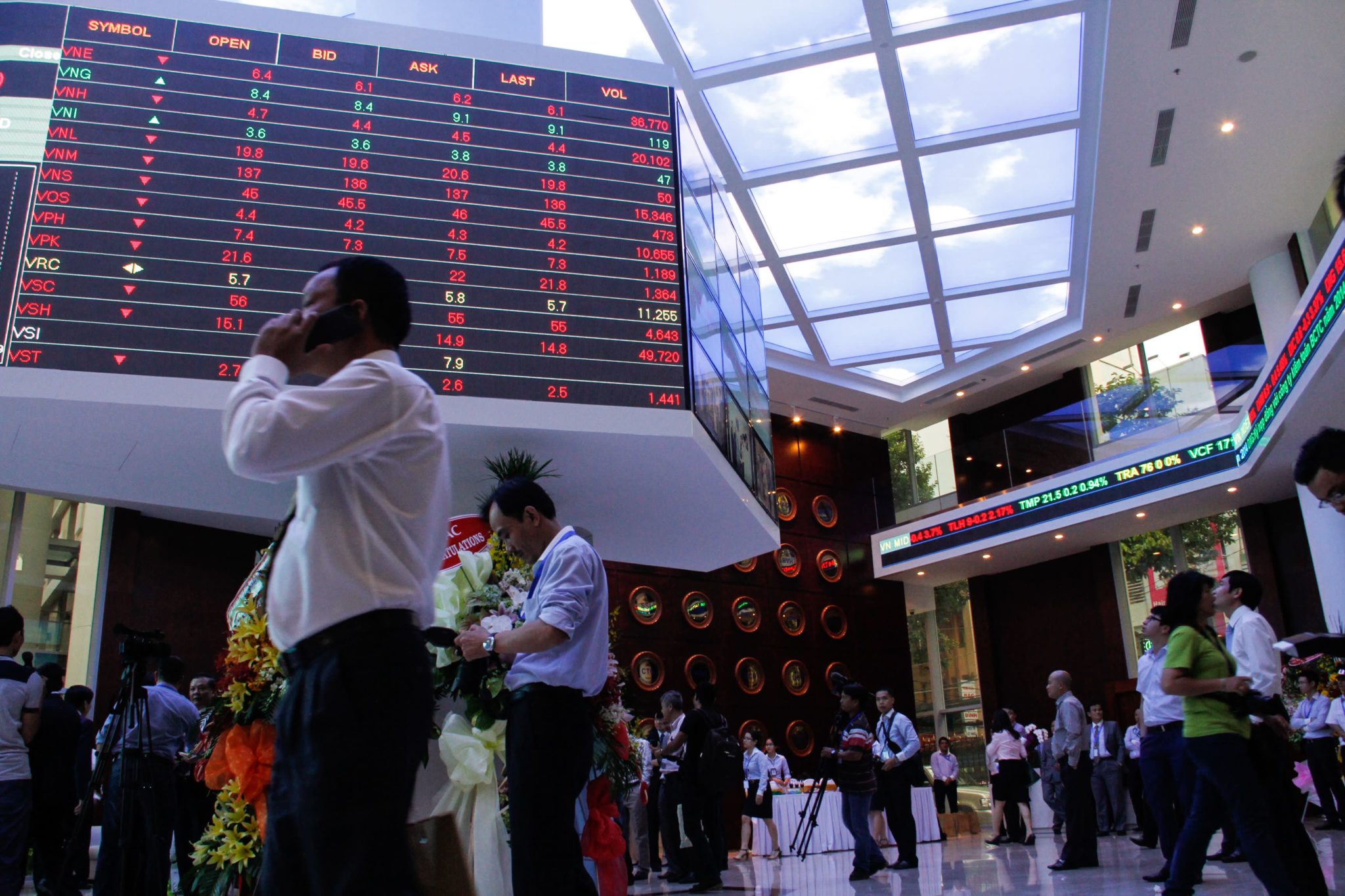
    Vietnam’s benchmark VN-Index surged 2.07 percent to a new historic peak of 1,216.10 points Thursday, driven by Vingroup and Vietcombank tickers.

    The index rose throughout the day after breaking the 2018 peak of 1,204 points in the morning. It continued to surge in the afternoon and ended with a near 25-point gain.

    This is its biggest daily gain in six weeks. The index has ended in the green four sessions in a row.

    Trading value on the Ho Chi Minh Stock Exchange (HoSE), on which the index is based, surged 16 percent to VND16.94 trillion ($735 million). The bourse saw 334 stocks gain and 106 lose.

    VIC of the biggest conglomerate Vingroup contributed most to the VN-Index gain with 4.6 points. The ticker rose 4.3 percent, its seventh gaining session in a row, up by a total 15 percent since March 23.

    VCB of state-owned lender Vietcombank pulled the index up by 2.1 points with volume tripling from Wednesday to rise 2.2 percent.

    Other major contributors included HPG of steelmaker Hoa Phat Group, VHM of real estate giant Vinhomes and VNM of dairy giant Vinamilk, together pushing the index up by 4.4 points.

    The strongest blue-chip gainer was SSI of leading brokerage SSI Securities Corporation with a ceiling increase of 6.9 percent, followed by TCH of real estate company Hoang Huy Investment Financial Services JSC with a 5.9 percent gain.

    Foreign investors broke off four consecutive net selling sessions with a net buying value of VND45 billion. They focused on VIC, HPG and STB of Ho Chi Minh City-based lender Sacombank, which surged 17 percent in the last six sessions.

    The HNX-Index for stocks on the Hanoi Stock Exchange, home to mid and small caps, surged 2 percent, while the UPCoM-Index for the Unlisted Public Companies Market added 0.37 percent.

  • DBS Outlines China Strategy

    DBS Outlines China Strategy

    DBS will seek to further its expansion in mainland China with a focus on three areas: its securities joint venture, consumer finance and Greater Bay Area opportunities. DBS chief executive Piyush Gupta unveiled details about its China plan during the latest annual general meeting held virtually yesterday.

    We are convinced that China’s opening-up in the capital account is going to present tremendous opportunities, Gupta told shareholders.

    We’re already seeing some benefits of that, as institutional investors from China come out and international investors go into China. So that’s hopefully a big area of growth for us. According to Gupta, the bank’s new securities joint venture in China, announced last September, is expected to go to market in the coming few weeks.

    On consumer finance, the bank will also launch a wholly-owned business in China, in addition to its existing 15 percent ownership in a consumer finance joint venture with Postal Savings Bank of China.

    And on Greater bay Area, Gupta said DBS’ Hong Kong presence is expected to support deeper integration into the area with «good momentum» observed last year, especially from its supply chain solutions.

    Gupta also commented on DBS’ takeover of Lakshmi Vilas Bank (LVB) last November and stressed that the deal was not a forced marriage.

    People have asked whether this was a forced marriage or if we were forced to do this deal,» he said, noting that the bank long had an interest in organic and inorganic expansion. This the last thing from a forced marriage.

    DBS highlighted an opportunity through the LVB takeover to accelerated its digital push in South India with an eye on two segments with huge opportunities: retail and small-to-medium-sized enterprise clients.

    Post-acquisition, the bank has added 125,000 corporate and 2 million retail customers with the latter figure boosting its retail share of deposits from 23 percent to 48 percent. Gupta also said that he expects no more incremental cost of credit from the LVB portfolio and expects the merged entity to become profitable in the next 12 to 24 months.

  • Archegos Collapse Hits Japan’s Largest Bank

    Archegos Collapse Hits Japan’s Largest Bank

    More losses from the downfall of Bill Hwang’s Archegos Capital Management have been unveiled, this time from Japan’s largest bank. Mitsubishi UFJ Group’s (MUFG) securities arm faces losses of up to $300 million related to an unnamed U.S. client, according to a statement, through its European subsidiary.

    Losses could change depending on market prices and the unwinding of the transactions, though it isn’t expected to have a material impact on MUFG’s business capability or financial soundness.

    MUFG is taking all necessary steps to manage the risk and any effect on earnings will be reflected in the fiscal year starting April 1.

    The statement is widely believed to refer to the collapse of Bill Hwang’s family office Archegos and the latest hit to MUFG brings total global bank losses to as high as $6.3 billion.

    Nomura recently warned of around $2 billion in losses reportedly also believed to be linked to Archegos. Credit Suisse was also significantly impacted with estimated losses of $1 billion to $4 billion.

    Other banks involved, such as Goldman Sachs, Morgan Stanley and Deutsche Bank, have claimed to see little to no impact. Wells Fargo was the latest to unveil its prime brokerage relationship with Archego but said it did not experience any related losses as the bank was well collateralized at the time and no longer has any exposure.

  • PGBank pulls plug on merger plans after 2nd debacle

    PGBank pulls plug on merger plans after 2nd debacle

    After calling off its merger with HDBank, lender PGBank does not plan to look for other partners and will remain independent, its chairman, Nguyen Quang Dinh, has said.

    “In the last six years, PGBank planned to merge with VietinBank and HDBank, but both deals were unsuccessful, which has been affecting the bank’s business.”

    “So the board of directors now aims to develop the bank as an independent entity,” he said at the lender’s annual general meeting on March 30.

    Shareholders approved rescindment of the merger plan, which never received approval from the State Bank of Vietnam.

    PGBank’s proposal to merge with state-owned VietinBank collapsed in 2014 after two years of negotiations.

    The bank targets a 46 percent rise in pre-tax profits this year to VND310 billion ($13.4 million).

    First-quarter profit was up 5 percent year-on-year to VND80 billion, according to its CEO, Nguyen Phi Hung.

  • AXA IM Nabs Ex-Picet Asset Management Exec

    AXA IM Nabs Ex-Picet Asset Management Exec

    AXA Investment Managers hires a former executive from Pictet Asset Management as its Asia head of institutional sales. AXA IM has hired Carmen Lai as its head of institutional sales for Asia, according to a statement, reporting to APAC head of client group core Terence Lam in the Hong Kong-based role.

    Lai will oversee the development of AXA IM’s institutional business and client relationships in Asia, tasked initially to build a dedicated sales team for the North and Southeast Asia markets.

    Lai is a veteran in the asset management industry in the region, joining from Pictet Asset Management where she spent a decade, last as its Asia ex-Japan head of institutional sales. Previously, she also worked for Blackrock.

    In addition, AXA IM also appointed Kyle Wang as Asia head of sovereign and supranational Entities (SSE). Wang will report to Lam and work closely with Lai.

    Institutional clients remain a key focus for AXA IM’s Asian growth strategy, where we continue to see robust momentum, said Matt Lovatt, global head of client croup core and member of AXA IM’s management board.

    The enhanced team will reinforce the business coverage of AXA IM Core across the region, as we uphold our pledge to uncover global investment opportunities and offer active, long-term, and responsible investment solutions for our valued clients.

  • UBS Singed by Archegos

    UBS Singed by Archegos

    Switzerland’s largest bank didn’t escape the Archegos wreckage unscathed. UBS’ singing is however far from the burn that rival Credit Suisse is nursing. Zurich-based UBS, the sixth-largest prime broker according to data provider Preqin, also catered to troubled hedge fund Archegos. Yet the Swiss bank was mum as its crosstown rival Credit Suisse warned of a major hit against its first-quarter results.

    The damage unleashed at Credit Suisse by the hedge fund now reportedly tallies at as much as $5 billion. How did UBS, which ranks directly behind Credit Suisse in catering to hedge funds, escape a similar fate?

    The answer is that the Swiss wealth management giant didn’t entirely, according to a person familiar with the matter. UBS, silent this week as Credit Suisse issued its profit warning, is reportedly still unwinding a series of complicated instruments when it called margin on the hedge fund.

    Though estimates vary, the bank believes it will be left nursing losses of not more than low-three-digit millions from business with Archegos, the person said. The damage isn’t such that it will neither torpedo UBS’ quarterly profits nor trigger a warning, the person noted. A spokeswoman for UBS declined to comment.

    Analysts expect a quarterly profit of $1.44 billion from UBS when it reports on April 27, according to a consensus compiled by the bank itself. Executives at both banks scrambled late last week to evaluate the Archegos debris, with Swiss regulator Finma intervening early on.

    UBS’ top investment banker Rob Karoskfy, risk chief Christian Bluhm, and finance overseer Kirt Gardner were among the top executives involves. The Swiss bank apparently feels confident enough it can extricate itself from the wreckage without wiping out the quarterly progress.

    This puts UBS squarely in the camp of Goldman Sachs and Morgan Stanley, which were both able to offload their Archegos holdings quickly. By contrast, Credit Suisse and Japan’s Nomura, which on Monday flagged a $2 billion hit, weren’t as fast.

    The episode illustrates that UBS’ risk limits held in this case, while raising manifold questions about Credit Suisse’s limits. The latter’s shares slumped more than 16 percent since the bank disclosed the Archegos hit on Monday; investors sent UBS’ shares just three percent lower over the same period.

  • Citi Launches Hiring Spree in Hong Kong

    Citi Launches Hiring Spree in Hong Kong

    Citi will hire up to 1,700 for its Hong Kong unit, partly in anticipation of the upcoming Greater Bay Area opportunities.

    Citi will add 1,500 to 1,700 in Hong Kong, according to a report citing Hong Kong and Macau chief executive Angel Ng Yin-yee.

    The expansion follows a 44 percent surge from net new money in Hong Kong and revenue increases across business units, in contrast with the bank’s global financial performance.

    According to Ng, the majority of the new hires will be focused on frontline staff. In addition, Citi will also hire for middle and back-office roles in areas like product development, digital channel development and compliance.

    The bank plans to fill most of the positions this year and also boost tech spending by 28 percent.

    One of the major Greater Bay Area opportunities in the making is the ‘Wealth Management Connect’ scheme – a cross-border channel that will allow mainland residents of the 11-city cluster to invest in Hong Kong and Macau-based wealth management products.

    The scheme is currently being delayed due to the pandemic and Hong Kong officials have said the launch will wait until travel bans are lifted.

    According to Ng, she doesn’t expect the scheme to start with a «big bang» but instead grow gradually to reach multiples of the Hong Kong market.

  • CIMB Restructuring Sees Lay-Offs in Singapore

    CIMB Restructuring Sees Lay-Offs in Singapore

    The Malaysian lender is revising its strategy to emphasise sustainable growth, in line with the group’s vision to be a «leading focused Asean bank.»

    CIMB Singapore is laying off staff and will close its Orchard Road branch as part of a restructuring exercise, which will see it optimise its functional set-up and leverage its group strengths through regionalization.

    These will make us more resilient, more productive and better positioned for growth going forward,» CIMB Singapore chief executive Victor Lee said in an internal memo.

    CIMB Singapore will be positioned as an Asean banking hub for the group, with a focus on wealth management, SME (small and medium-sized enterprises) banking, regional corporates and treasury and markets. According to the report, the bank had 1,200 staff in Singapore. Only its Raffles Place branch will remain following the exercise.

    Singapore is a core and important market to the CIMB Group, and we will continue to invest in our key growth areas, CIMB Singapore said in a statement.

    The bank let go of three of its business heads in Singapore in November 2020, following a review of its operations that cited the poor performance brought about by the pandemic.

  • DBS Offloads Hong Kong Office Space

    DBS Offloads Hong Kong Office Space

    DBS is reportedly the latest to join the wave of global banks and multinationals that are cutting down office occupancy in Hong Kong.

    DBS will surrender a quarter of the eight floors it occupies in one of its Hoang Kong offices – One Island East Tower – according to a report citing unnamed sources.

    The office is located outside of Hong Kong’s central business district in Quarry Bay.

    DBS joins other global banks, like Standard Chartered and BNP Paribas, in shedding Hong Kong office stock.

    In fact, multinationals accounted for 75 percent of surrendered office space in the city last year, according to Cushman & Wakefield, amid the growing adoption of flexible work arrangements.

    In November last year, DBS said it would allow its employees to work remotely for as much as 40 percent of the time due to the pandemic.