Tag: blockchain

  • UBS and Ant International Pioneer Real-Time Global Payments: Unveiling Next-Gen Blockchain Solutions for Cross-Border Settlements

    UBS and Ant International Pioneer Real-Time Global Payments: Unveiling Next-Gen Blockchain Solutions for Cross-Border Settlements

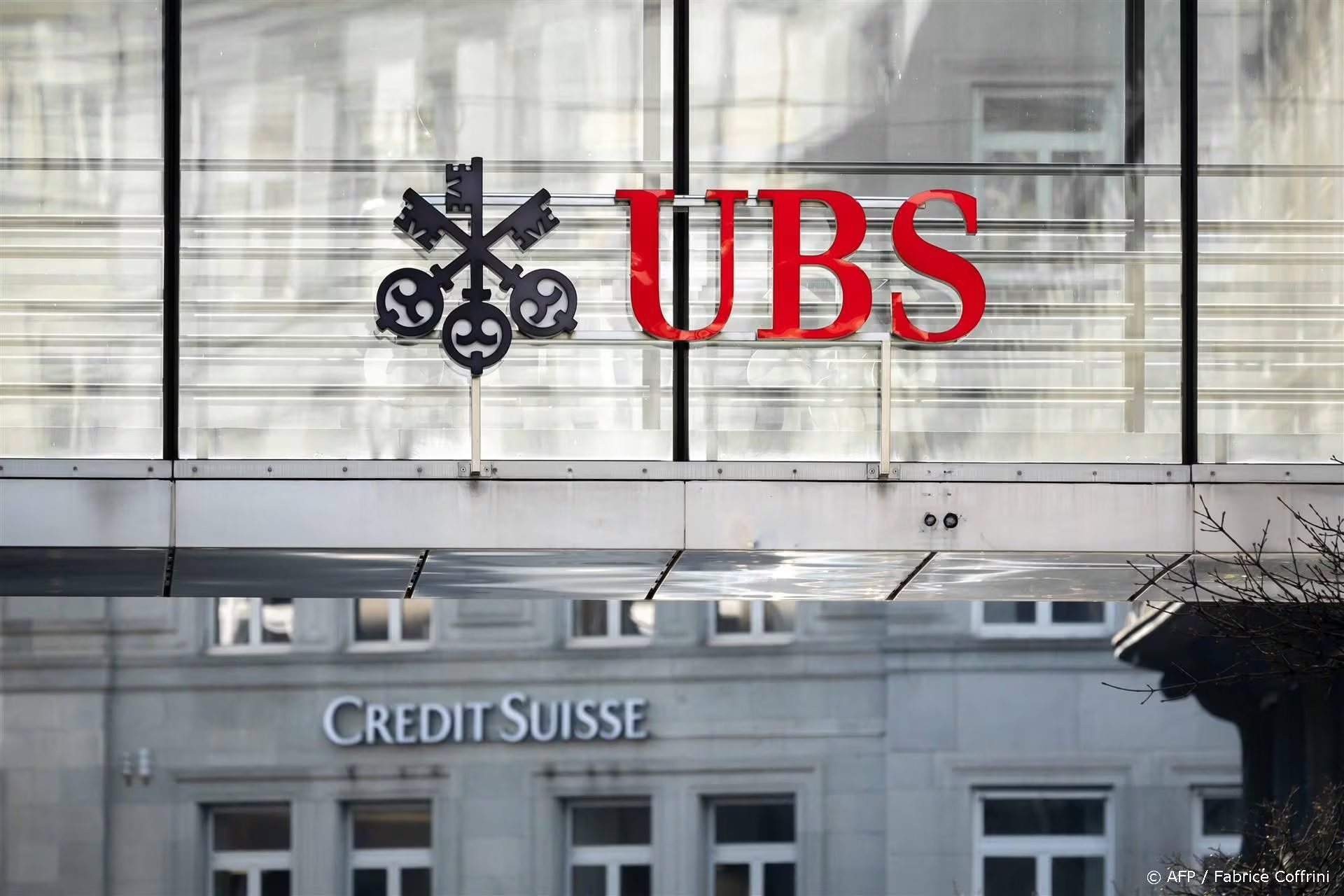
    Swiss institution UBS has announced a strategic partnership with Singaporean fintech firm Ant International. The collaboration aims to build blockchain-based tokenised deposits to facilitate real-time global payments. This alliance marks a significant milestone in the rapidly transforming digital finance sector in Asia.

    Exploring Blockchain Solutions

    At UBS’ Singapore head office, both companies signed a Memorandum of Understanding to delve into blockchain solutions. These solutions aim to upgrade cross-border settlements and liquidity management for Ant International’s global treasury functions.

    As per the details released on Monday, Ant International plans to utilize UBS Digital Cash, a blockchain payment platform launched in 2024. The platform is designed to expedite, streamline and secure settlement procedures across multiple markets.

    Tokenised Deposits: A Central Element

    A primary focus of this partnership is the examination of tokenised deposits, which will link UBS Digital Cash with Ant International’s proprietary Whale platform. The Whale platform is a next-generation blockchain-based treasury management system.

    This combined infrastructure is designed to facilitate real-time cash flows across Ant’s worldwide entities, bypassing traditional cut-off restrictions and enhancing liquidity visibility across various currencies.

    Pioneering Digital Asset Innovation

    Young Jin Yee, co-head of UBS Global Wealth Management Asia Pacific and country head UBS Singapore, stated that the alliance with Ant International builds upon the momentum of UBS Digital Cash’s pilot launch from the previous year. The combined expertise in digital assets and Ant’s progressive blockchain technology would deliver a real-time, multi-currency payment solution that is both transparent and efficient.

    The partnership also underscores UBS’s commitment to augmenting client access to global markets via digital innovation.

    A Strategic Alliance

    Kelvin Li, general manager of platform tech at Ant International, expressed excitement about the partnership with UBS, a global bank with a solid reputation for blockchain innovation. Li highlighted the shared belief in the transformative potential of these technologies for cross-border payments, and the anticipation of creating a larger impact together.

    This alliance showcases the growing interest in programmable money, tokenised deposits, and real-time settlement infrastructure – areas financial institutions deem critical for the future of cross-border payments.

    Unlocking Capital Efficiency

    For banks, businesses, and wealth managers, the opportunity to instantly move liquidity across markets can unveil new heights of capital efficiency, risk management, and treasury automation.

    As Asia becomes a global hub for digital-asset experimentation, the UBS-Ant partnership epitomizes the region’s increasing influence.

    Questions & Answers

    What is the main goal of the partnership between UBS and Ant International?
    The alliance aims to develop blockchain-based tokenised deposits to facilitate real-time global payments.

    What is the role of Ant International’s proprietary Whale platform in this partnership?
    The Whale platform, a next-generation blockchain-based treasury management system, will be linked with UBS Digital Cash to facilitate real-time cash flows across worldwide entities.

    What potential benefits can banks, businesses, and wealth managers expect from this partnership?
    They can anticipate new heights of capital efficiency, risk management, and treasury automation, thanks to the ability to instantly move liquidity across markets.
  • HSBC and Standard Chartered Predict Blockchain and AI Boom in Hong Kong’s Fintech Future

    HSBC and Standard Chartered Predict Blockchain and AI Boom in Hong Kong’s Fintech Future

    During the 10th annual Hong Kong FinTech Week in 2025, HSBC CEO Georges Elhedery and Standard Chartered CEO Bill Winters discussed the city’s significant role as an international finance hub. Both CEOs shared a bullish outlook about the future of digital assets, blockchain, artificial intelligence (AI), and other tech-related advancements.

    The Future of Blockchain Settlements

    Standard Chartered CEO, Bill Winters, shared his vision for the future of money and settlements, anticipating a shift away from traditional methods. He expressed a mutual belief with Hong Kong’s leadership that, in due course, all transactions will be settled on blockchains and all money will become digital. “This implies a complete transformation of the financial system, although the specifics remain uncertain,” he stated.

    AI: Emphasizing Efficiency and Adoption

    HSBC CEO, Georges Elhedery, highlighted the distinctive approach to AI in Asia, particularly in mainland China and Hong Kong. This contrasts with the cutting-edge innovation focus in the US and the emphasis on safety through regulations in Europe. Elhedery pointed out the efficiency and speedy delivery showcased by AI, as well as the mass adoption of such emerging technologies, using the DeepSeek moment as an example.

    “This has truly been enlightening,” Elhedery commented.

    Tech Milestones in Hong Kong

    Both HSBC and Standard Chartered have been proactive in introducing new fintech innovations in Hong Kong, particularly in relation to digital assets. HSBC made several commendable strides, including being the first to complete a local blockchain-based settlement and the initial launch of tokenized gold. Standard Chartered has also shown leadership in crypto custody and the pioneering of tokenized money market funds.

    Elhedery reaffirmed their commitment to Hong Kong, stating, “HSBC announced on October 9th an investment exceeding HK$100 billion ($13 billion) for acquiring minority shares of Hang Seng Bank in Hong Kong. This demonstrates our strong confidence and belief in Hong Kong’s future outlook.”

    Questions & Answers

    What future predictions were made for blockchain settlements?
    Standard Chartered’s CEO, Bill Winters, predicted that all future transactions will be settled on blockchains and all money will be digital, implying a total transformation of the current financial system.

    What is the Asian approach to AI, according to HSBC’s CEO?
    HSBC’s CEO, Georges Elhedery, stated that Asia, particularly mainland China and Hong Kong, has embraced AI by showcasing efficiency, speed of delivery, and promoting mass adoption of such technologies.

    How is Hong Kong’s role as an international finance hub being reinforced?
    HSBC and Standard Chartered have been active in introducing new fintech innovations in Hong Kong, particularly in the area of digital assets. HSBC’s recent investment of more than HK$100 billion ($13 billion) in Hang Seng Bank also indicates confidence in Hong Kong’s future financial outlook.

  • 1inch Exchange Aims to Revolutionize Retail Crypto with Bold New Market Strategy

    1inch Exchange Aims to Revolutionize Retail Crypto with Bold New Market Strategy

    Launched in 2019, 1inch has been on a mission to revolutionize the decentralized finance (DeFi) landscape by aggregating liquidity from various decentralized exchanges (DEXs). This enables users to execute token swaps at the best prevailing prices—swiftly, efficiently, and completely decentralized.

    Redefining Its Brand for a Broader Audience

    In a bold move, the innovative platform has unveiled a rebranding initiative at Token2049, showcasing a new visual and messaging identity along with a revamped web address: 1inch.com. This rebranding effort underscores the project’s significant growth ambitions, particularly its aspiration to bridge the gap between DeFi and traditional finance (TradFi), fostering greater integration with established financial systems.

    The new look comes with what the company describes as a “radically simplified design,” featuring clearer interfaces and streamlined products. By prioritizing user-friendliness, 1inch is aiming to make DeFi more approachable for both everyday users and institutional players. Their fresh slogan, “We move forward as 1,” encapsulates this direction.

    At the summit, which attracted 24,000 Web3 enthusiasts from all corners of the globe, co-founder Sergej Kunz (who prefers to forgo the traditional CEO title) expressed that “soon, DeFi will be indistinguishable from traditional finance—but that doesn’t imply centralization. It means traditional systems and users are coming on-chain. 1inch’s rebrand signals maturity—not a shift in our mission.”

    Channeling Bruce Lee’s Philosophy

    The expansion of 1inch’s software-as-a-service (SaaS) model has led to its non-custodial technology being integrated widely across the industry. Established platforms such as Binance, Coinbase, Ledger, MetaMask, and Trust Wallet now leverage 1inch’s technology to enhance their swap functionalities.

    Interestingly, the name “1inch” draws inspiration from Bruce Lee‘s iconic “one-inch punch,” embodying a philosophy centered on precision, coordination, and effectiveness. This foundational idea mirrors 1inch’s early vision: to connect fragmented liquidity sources with unparalleled efficiency, thereby offering users the most advantageous swap rates.

    A Showcase of Innovation at Token2049

    Token2049 in Singapore was not solely about rebranding; it also served as a platform for several groundbreaking product announcements over the two-day event. For instance, Hypersurface, a new DeFi venture, launched its protocol on HyperEVM, introducing covered calls—one of the most popular yield strategies from traditional finance—into the crypto realm. While covered calls represent a multi-billion dollar monthly volume in traditional markets, they’ve stayed largely out of reach for most crypto investors until now. Hypersurface is determined to change that, enabling users to earn higher yields on Ethereum, Bitcoin, HYPE, and other tokens.

    Additionally, the launch of XAUt0 on Celo marks the first instance of tokenized gold being made available on the platform. This omnichain variant of Tether Gold complements Celo’s existing USDT offerings, which are already utilized by millions. Consumers in over 150 countries can now easily access this ancient store of value directly on an Ethereum Layer 2 network.

    Furthermore, the Celo Foundation rolled out Nightfall, an open-source zero-knowledge privacy solution developed by EY. Operating as a Layer 3 on the Celo network, Nightfall offers low-cost, private, and auditable transactions across multiple token standards. This innovation represents the first application of the technology in a payments-centric blockchain context, poised to expand Celo’s functionalities into the B2B sector—an area projected to exceed $180 trillion in global cross-border flows. Talk about a financial jab that packs a punch!

    Questions & Answers

    What is the main purpose of 1inch?
    1inch aims to aggregate liquidity from multiple decentralized exchanges to provide users with the best available prices for token swaps, enhancing the efficiency and accessibility of DeFi.

    How does 1inch’s rebranding reflect its growth?
    The rebranding to 1inch.com and its simplified design signify a strategic shift towards integrating DeFi with traditional finance, aiming to attract both everyday users and institutional partners.

    What are some of the new products announced at Token2049?
    Key announcements included Hypersurface introducing covered calls to the crypto space, the launch of tokenized gold on Celo, and the Celo Foundation unveiling Nightfall for privacy-focused transactions.

  • Vietnam Unveils NDAChain: A Pioneering Step Towards a Secure Digital Future

    Vietnam Unveils NDAChain: A Pioneering Step Towards a Secure Digital Future

    In a significant step towards enhancing the security and transparency of its digital landscape, Vietnam has officially launched NDAChain, its national blockchain platform. Developed by the National Data Association and overseen by the Data Innovation and Exploitation Center under the Ministry of Public Security, NDAChain serves as a vital backbone for data verification within both government and private sectors.

    Navigating the Digital Frontier

    NDAChain addresses the critical vulnerabilities of centralized data models, such as the risks of cyberattacks and limited scalability. By offering a decentralized layer of trust, the platform supports essential national systems, including e-government initiatives, finance, healthcare, logistics, and education. “Vietnam has chosen a hybrid data architecture that merges centralized and decentralized elements. NDAChain acts as a protective layer for our live data, crucial for our digital society and economy,” explained Mr. Nguyen Huy, Head of Technology at the National Data Association.

    The Rationale Behind a National Blockchain

    With a population of over 100 million rapidly embracing digital transformation, Vietnam generates data at an unprecedented scale. In response, the National Data Center is being established to serve as the primary repository for citizen and national information. Safeguarding this sensitive data from breaches and misuse necessitates an advanced verification system. Blockchain technology, known for its immutable records and transparency, offers a robust solution for tracking and validating data sources, especially during critical, multi-sector exchanges.

    Unpacking How NDAChain Functions

    NDAChain is a Layer-1 permissioned blockchain, backed by a consortium of 49 validator nodes that includes both public institutions and private enterprises. Key players encompass the National Data Center, Ministry of Public Security, and notable corporations like SunGroup, Zalo, and Masan. Each validator node keeps a distributed ledger, ensuring transparent transaction logging and incorporating smart contracts to optimize processes. Additionally, it features identity verification tools that tie into Vietnam’s VNeID and national identity databases.

    Utilizing a proof-of-authority (PoA) consensus mechanism empowered by zero-knowledge proofs (ZKP), NDAChain enhances security and privacy. The platform boasts the capacity to handle 3,600 transactions per second, resulting in low latency and high scalability for nationwide adoption. Who knew that a combination of high-tech wizardry and a strong Vietnamese spirit could tackle data challenges so elegantly?

    Empowering Digital Identities and Product Traceability

    NDAChain not only underpins e-government solutions but also fosters NDA DID, a decentralized identity system that allows individuals to verify identities in real-time during transactions, service access, or digital agreement signings. With the NDAKey app, users can authenticate identities in just seconds, drastically diminishing the risk of fraud.

    The platform also powers NDATrace, Vietnam’s system for product identification, authentication, and traceability. Each product is assigned a unique identifier (UID) that complies with GS1 standards, ensuring compatibility with the EU’s EBSI framework. This interoperability enables Vietnamese businesses to seamlessly integrate into global supply chains while enhancing consumer confidence in product authenticity.

    A Vision Beyond 2025

    By the close of 2025, NDAChain aims for full integration with the National Data Center, extending its reach to local government entities and educational institutions by 2026. This next phase will concentrate on talent development, fostering international collaboration, and launching Layer-2 applications tailored to specific industries.

    Thanks to its open and integrative design, NDAChain promises to be a catalyst for innovation, paving the way for startups and tech companies to create solutions like identity wallets and anti-counterfeiting tools.

    Aiming for Global Recognition

    More than 50 countries, including China, the EU, and South Korea, have rolled out national blockchain platforms. Vietnam distinguishes itself with a strategic focus on public-private partnerships, adherence to global standards, and deep integration with its national data ecosystems. NDAChain embodies Vietnam’s dedication to establishing resilient digital infrastructure and cultivating a dynamic digital economy.

    Questions & Answers

    What is NDAChain, and who developed it?
    NDAChain is Vietnam’s national blockchain platform developed by the National Data Association and managed by the Data Innovation and Exploitation Center under the Ministry of Public Security.

    How does NDAChain enhance data security and transparency?
    NDAChain provides a decentralized layer of trust that addresses the vulnerabilities of centralized data models, safeguarding essential national systems against cyber threats while ensuring transparency in data verification.

    What are the future plans for NDAChain?
    By the end of 2025, NDAChain is set to integrate fully with the National Data Center, expanding further to local government and educational institutions by 2026, with an emphasis on talent development and international cooperation.

  • Vietnam’s Largest Blockchain and AI Week Set to Ignite Innovation in June

    Vietnam’s Largest Blockchain and AI Week Set to Ignite Innovation in June

    Da Nang Set to Host Pioneering Technology Event

    On April 23, Orochi Network Co., Ltd., FPT Online Services Joint Stock Company, and the Da Nang Center for Research, Training, and Design of Microchips and Artificial Intelligence (DSAC) unveiled ‘Super Vietnam 2025,’ a transformative technology event dedicated to fostering the blockchain and AI landscape. Sponsored by VnExpress, this initiative aims to spotlight cutting-edge tech, enhance domestic and international collaboration, and leverage government policies to bolster a thriving innovation ecosystem.

    Building a Sustainable Blockchain Future

    Tran Thi Kieu Diem, CEO and co-founder of Orochi Network, emphasized the importance of a robust technological foundation coupled with clear legal frameworks for sustainable blockchain development. She stated, “For blockchain technology to thrive, a solid technological foundation and a clear legal corridor are essential,” underscoring the objectives of Super Vietnam 2025.

    Supportive Local Policies to Drive Innovation

    Le Hoang Phuc, Director of DSAC, reinforced Da Nang’s commitment to nurturing high-tech sectors with supportive policies. These include a three-year personal income tax exemption for skilled personnel and free operating space for startups in AI, semiconductor, and blockchain fields. “We are dedicated to taking concrete actions to cultivate high-quality human resources for the future,” Phuc affirmed.

    Engaging Conferences and Thematic Sessions

    The event will kick off with a plenary opening conference on June 4, themed “Emerging Tech – Creative Synergy, Future Orientation,” bringing together experts, policymakers, and industry leaders to discuss pivotal technology trends. Following this, specialized sessions on “Application of blockchain and AI in enterprises” and “Future investment vision” will feature technology corporations, investment funds, and startups.

    A Dynamic Expo and Competition

    In conjunction with the conference, the Super Vietnam Expo will run from June 4 to June 5, showcasing nearly 50 booths focused on sectors such as data, fintech, AI, and gaming. This expo serves as a critical networking opportunity for businesses and global investors alike.

    Moreover, the Super Vietnam PitchFest, launching on April 25, offers blockchain and AI startups a chance to secure funding and receive mentorship, culminating in an exciting awards ceremony during the event week.

    Additional Opportunities for Collaboration

    Attendees can also look forward to side events including deal-making sessions, a job fair, a technology tour, and a talent incubation signing ceremony, all aimed at creating a collaborative atmosphere for innovation. Organizers anticipate that Super Vietnam 2025 will serve as a flagship event, igniting Vietnam’s innovation ecosystem and advancing the nation’s blockchain and AI initiatives.

    In conclusion, as Super Vietnam 2025 prepares to gather over 5,000 attendees and 100+ industry leaders in Da Nang, it promises to be a significant catalyst for growth in the retail sector and a strong indicator of evolving consumer trends toward technology-driven solutions.

  • Sygnum Capitalizes on Blockchain Growth in Lugano’s Retail Landscape

    Sygnum Capitalizes on Blockchain Growth in Lugano’s Retail Landscape

    Swiss digital asset banking group Sygnum has launched its latest office in Lugano, aiming to strengthen collaborations within the burgeoning Bitcoin and digital asset ecosystem of Ticino. This move coincides with the city’s ambitious Plan ₿ initiative, which promotes broad blockchain adoption.

    Driving Digital Innovation in Ticino

    With the opening of its Lugano office, Sygnum takes another significant step in its growth journey. “Lugano is emerging as a crucial innovation hub, bolstered by robust support for digital assets, institutional adoption, and increasingly clear regulatory frameworks,” explained Mathias Imbach, Sygnum’s co-founder and Group CEO, during the launch event.

    A Progressive Stance on Digital Assets

    In recent years, Lugano has established itself as a leader in digital asset acceptance. Residents now have the convenience of settling municipal taxes in Bitcoin and can use various digital currencies for purchases at numerous local businesses, reflecting a growing consumer trend towards cryptocurrency.

    The Ambitions of Plan ₿

    Plan ₿ is not just about fostering a crypto-friendly environment; it seeks to revolutionize the city’s financial infrastructure using Bitcoin technology. The initiative encompasses groundbreaking projects, including Bitcoin investment pools, sustainable mining efforts, specialized education programs, and notable events like the Plan ₿ Forum.

    “It’s inspiring to witness institutions like Sygnum leverage the opportunities Lugano presents in the fields of digital and financial transformation. Innovation is relentless, and the financial sector is no exception,” added Michele Foletti, Mayor of Lugano and President of the Plan ₿ Foundation.

    Implications for the Retail Sector

    Sygnum’s expansion in Lugano highlights the intersection of finance and retail as consumer demand for digital asset options continues to rise. This move could reshape how companies engage with customers and accept payments, paving the way for more widespread adoption of cryptocurrency in everyday transactions. As brands expand their presence in the digital finance space, the retail landscape is poised for significant transformation.

  • Vietnam blockchain development center launched in Hanoi

    Vietnam blockchain development center launched in Hanoi

    DTS Group and GMO have established a blockchain technology application and development center with the goal of promoting blockchain technology in Vietnam.

    The Mira Blockchain Center in Hanoi aims to bring blockchain technology to life through integrated technology-based physical products and high technology projects.

    The unit will research, apply, deploy, and transfer blockchain technology in artificial intelligence-related technology and other sectors.

    Through research, Mira will create and utilize blockchain technology for ground-breaking technological solutions. The hands-on human resources training center will provide consultation services and technology deployment training for both local and international businesses.

    The Mira Blockchain Center’s services include blockchain application services for asset management, finance, and supply chains, technology consulting services for businesses or organizations, and blockchain testing services for testing and evaluating blockchain performance in businesses.

    At first, Mira will focus on supporting Vietnamese businesses by carrying out technology research and development activities, increasing technology capacity of enterprises.

    The center will later develop blockchain solutions and applications for international markets.

    Leon Truong (Truong Gia Bao), Chairman of DTS Group, said: “Mira will execute continuous testing to perfect our technical process for new projects, providing in-depth knowledge about blockchain.”

    Ngo Van Tau, General Director of GMO, said the center will provide well-trained, practical engineers for domestic and foreign enterprises.

    “I believe the center will help improve Vietnam’s position on the world technology map,” Van Tau said.

    DTS Group, founded by Truong Gia Bao, is a private corporation operating in the fields of media, finance and technology investment. DTS Group has collaborated with associates in its network to promote technology innovation, particularly in the blockchain sector.

    GMO is as a software manufacturer, providing IT solutions and services in Japan, Vietnam, and several English-speaking markets.

    Mira blockchain center

    Address: 6th floor, Ocean Park Building, No. 1 Dao Duy Anh, Dong Da, Hanoi

    258 Ton Dan, Ward 8 District 4, Ho Chi Minh City

  • Switzerland as a Sustainability, Blockchain and Fintech Hub

    Switzerland as a Sustainability, Blockchain and Fintech Hub

    It seems rather paradoxical that Switzerland is both a hub for sustainability and an energy-gobbling blockchain hub.

    The latest data from Switzerland’s Department of Finance underscores the growing importance of blockchain and fintech for the country’s financial sector. At the same time, sustainable investments are high on the agenda in Switzerland, the two seemingly at odds with each other.

    The financial industry continues to be one of the most important sectors in Switzerland, even as other areas of the economy have grown more strongly, a report compiled by the State Secretariat for International Financial (SIF) showed.

    The contribution to the Swiss economy from financial and insurance services increased slightly to CHF 66.9 billion in 2021 compared with CHF 64.4 billion a decade ago. At the same time, Switzerland’s GDP expanded more rapidly.

    Employment figures show this as well. Most recently, around 212,000 people worked in the sector, compared with around 216,000 ten years ago. Only outside the core financial sector did employment grow in the last decade, from around 50,000 to 63,000.

    According to the data, sustainable investments showed steep growth, their volume growing by 31 percent last year to over 1.5 trillion Swiss francs, according to a market survey conducted by Swiss Sustainable Finance (SSF).

    Switzerland has developed into a hub for startups in blockchain technology and fintech. The number of companies has grown to 1,128 in 2021 from 960 in the previous year, employing 6,002 people compared to 5,184 in 2020.

    According to a study, the number of fintech companies stagnated in 2021, but the volume of business nevertheless increased.

  • Startups pin high hopes on blockchain, NFT technologies

    Startups pin high hopes on blockchain, NFT technologies

    Vietnamese startups have great expectations of the blockchain technology, envisaging practical e-commerce and entertainment impacts as the country pursues digital transformation.

    “We dream of becoming a billion-dollar company,” said Nguyen Tuan Quynh, chairman of book distributor Saigon Books, as he talked about a new project which uses blockchain in podcast and audiobook production.

    He said he wanted to create a blockchain-based platform for users, including celebrities, to produce audio content and make money. The audios will be distributed as non-fungible tokens (NFT), which are digital assets that represent objects like art, music, in-game items and videos, and have unique identifying codes. They are bought and sold online, frequently with cryptocurrency.

    “It will be a long run but we have taken the first steps. We also aim to have foreign-language to take this platform overseas,” Quynh said.

    Nguyen Tran Phi Yen, communications director of online event hosting platform Fan8.Club, is working on a project in collaboration with a hospitality partner that will create one million booking NFTs at premium hotels in Vietnam.

    “Blockchain is no longer something of the future. It has real products now.”

    Vietnamese startups have made headlines since last year with their use of the blockchain technology. Blockchain games like Axie Infinity and finance apps like Coin98 Finance have raised millions of dollars.

    Vietnam’s blockchain market is set to enjoy double-digit growth in the 2023-2027 period as 5G development across the country facilitates the formation of smart cities, according to a report by TechSci Research.

    Nguyen Thanh Nam, chairman of blockchain solutions provider OneBlock Labs, said that the technology could be used to trace origins of agriculture products, develop web browsers with better privacy protection and facilitate e-governance.

    “The government has made many efforts to create a national database using technology. With blockchain, more potentials can be reached,” he said.

    In 2020, the Vietnamese government listed blockchain a top tech research priority for application in the Fourth Industrial Revolution era.

    The Ministry of Science and Technology plans to let some blockchain companies to use the technology to try out some of their ideas for social benefits this year. Startups say they are aware of the challenges in developing the blockchain technology, high programmer salaries being one of them.

    “Hiring programmers to build a blockchain app costs four to five times that of a normal app,” said Quynh of Saigon Books said.

    Finding a team of experienced blockchain techies who understand the market is very difficult, said Nam of OneBlock Labs.

    “It is therefore crucial to start developing blockchain human resources.”

    Yen of Fan8.Club said that the world will soon have pre-established blockchain platforms for businesses to use and create their own products, and Vietnamese firms can take advantage of these instead of building everything from scratch.

    Some industry insiders have also warned about the potential to misuse blockchain.

    Pham Phuoc Nguyen, digital operations head at Coin98 Finance, said: “Not everything needs blockchain. Some can be done the traditional way.”

  • Binance Invests in Media To Educate on Blockchain

    Binance Invests in Media To Educate on Blockchain

    Cryptocurrency player Binance is going old school, making a $200 million investment in media brand Forbes via a SPAC investment.

    Forbes is set to go public by the end of the first quarter via an acquisition by Magnum Opus Acquisition Ltd., which is a special purpose acquisition company (SPAC) already listed on the New York Stock Exchange.

    Binance is investing in the deal via a $200 million commitment to the total $400 million private investment in public equity, or PIPE, Forbes said in a press release Friday. PIPEs are common in SPAC deals as the SPAC entity may not have raised enough equity initially to complete its planned business combinations.

    The deal’s PIPE size will remain at $400 million, with Binance taking over existing subscription agreements, the statement said.

    Under the deal, Binance is expected to advise Forbes on its digital assets and Web3 strategy, the statement said. Web3 is a conceptual new iteration of the world wide web-based on blockchain technology, but it has not yet been implemented.

    Forbes is committed to demystifying the complexities and providing helpful information about blockchain technologies and all emerging digital assets, said Mike Federle, CEO of Forbes, in the statement. With Binance’s investment in Forbes, we now have the experience, network, and resources of the world’s leading crypto exchange and one of the world’s most successful blockchain innovators.

    Changpeng CZ Zhao, founder and CEO of Binance, added that media is an essential element for building widespread consumer understanding of blockchain technologies.

    We look forward to bolstering Forbes’ digital initiatives, as they evolve into a next-level investment insights platform, Zhao said in the statement.

    As part of the deal, Patrick Hillmann, chief communications officer for Binance, and Bill Chin, head of Binance Labs, which is Binance’s venture capital arm and incubator, will join Forbes’ board of directors, the statement said.

    The overall acquisition of Forbes values the combined company at an implied pro forma enterprise value of $630 million, Forbes has said previously.

  • Blockchain game development booms as Vietnamese gamers make their play

    Blockchain game development booms as Vietnamese gamers make their play

    Vietnamese companies are racing to develop blockchain games and mobilize millions of dollars from foreign investors as they seek to make their place in the new industry.

    After the monster-combat game Axie Infinity became the most valuable non-fungible token (NFT) game in the world this year, at least six more games developed by Vietnamese companies have been launched.

    Sipher, a multiplayer online battle arena game, recently raised $6.8 million from investors in the U.S. and South Korea.

    Faraland, a multiplayer role-playing game, had earlier received $2.4 million from investors, while another game, HeroVerse, got $1.7 million.

    Other notable projects include My Defit Pet, MeebMaster and Theta Arena.

    Vietnamese have gained prominence in the blockchain game industry with Axie Infinity, followed by many other projects that have raised millions of dollars, said Phan Tung, co-founder of Faraland.

    Thao Trang, chief marketing officer at Project SEED, a game platform powered by blockchain technology, said global industry insiders see Vietnam as a blockchain ecosystem, not just separate projects.

    The country has a large number of smartphone game players with 57 percent of 68 million smartphone users spending an average of 3.9 hours a day gaming, according to market research company App Annie.

    It is also ranked second in Southeast Asia in mobile game downloads with 22 percent of market, behind Indonesia at 38 percent.

    “Blockchain has opened the door for new business and revenue for game companies. They should take this advantage of this to expand globally,” said Lynn Hoang, national director of cryptocurrency exchange Binance Vietnam.

    However, blockchain game developers in the country face many challenges, especially in recruiting people with adequate skills. There is a shortage of suitable candidates, companies say.

    Trang said that her company usually found people who are either good at blockchain or game technology and had to train them to acquire other skillsets.

    “Conflicts between the two groups are common. Blockchain changes every day and developers have to on their toes all the time, ready to respond to market reactions.”

    Another difficulty is market pressure, which pushes developers to launch their products early, compromising quality.

    Nguyen Thanh Trung, one of the founders of Axie Infinity, said that blockchain game has moved beyond the stage of discovering whether making something possible or not, to how good a creation can be.

    Pham Anh Tuan, a game developer with 10 years in the industry, said that blockchain games could remain popular for at least another 10-20 years.

    The blockchain industry is set to see the entrance of many traditional game giants, he said.

    Technologies like virtual reality and augmented reality will be utilized to create a metaverse, he added.

  • StanChart Exec Joins Blockchain Startup

    StanChart Exec Joins Blockchain Startup

    Taipei-headquartered XREX has named a managing director in Singapore as it sets its sights on expanding its platform in the region.

    Taipei-headquartered XREX has appointed Christopher Chye as managing director of XREX Singapore and director of product. In this dual role, he will oversee XREX’s businesses and operations in Singapore and play an instrumental role in bringing new value propositions to XREX’s clients, the startup announced on Tuesday.

    Chye joins from Standard Chartered Bank, where he held roles in commercial banking, consumer banking, wealth management and financial crime compliance. He was also a pioneer of Standard Chartered’s digital bank venture in Singapore, where he led the bancassurance, rewards and loyalty, and brand and marketing pillars, and was executive director at its regional CEO office. He was previously a  management consultant with KPMG.

    In a separate announcement, XREX said it raised $17 million in pre-Series A funding led by CDIB Capital Group. The funds will be used to apply for financial licenses in Singapore, Hong Kong and South Africa, and partner with banks and financial institutions, like payment gateways.

    Many of our team members are from or have lived in the markets where we serve. We keenly understand the struggles faced by many cross-border merchants who lack safe access to US dollar liquidity, XREX CEO and cofounder Wayne Huang, said in the announcement.

    XREX was launched in 2018 to drive financial inclusion in emerging markets by leveraging blockchain technology.

    The company uses blockchain technology to solve dollar liquidity shortage issues in emerging markets, and has products like a payment escrow service and crypto-fiat exchange platform.

  • StanChart Exec Joins Blockchain Startup

    StanChart Exec Joins Blockchain Startup

    Taipei-headquartered XREX has named a managing director in Singapore as it sets its sights on expanding its platform in the region.

    Taipei-headquartered XREX has appointed Christopher Chye as managing director of XREX Singapore and director of product. In this dual role, he will oversee XREX’s businesses and operations in Singapore and play an instrumental role in bringing new value propositions to XREX’s clients, the startup said on Tuesday.

    Chye joins from Standard Chartered Bank, where he held roles in commercial banking, consumer banking, wealth management, and financial crime compliance. He was also a pioneer of Standard Chartered’s digital bank venture in Singapore, where he led the bancassurance, rewards, and loyalty, and brand and marketing pillars, and was executive director at its regional CEO office. He was previously a  management consultant with KPMG.

    In a separate announcement, XREX said it raised $17 million in pre-Series A funding led by CDIB Capital Group. The funds will be used to apply for financial licenses in Singapore, Hong Kong, and South Africa, and partner with banks and financial institutions, like payment gateways.

    Many of our team members are from or have lived in the markets where we serve. We keenly understand the struggles faced by many cross-border merchants who lack safe access to US dollar liquidity,» XREX CEO and cofounder Wayne Huang, said.

    XREX was launched in 2018 to drive financial inclusion in emerging markets by leveraging blockchain technology.

    The company uses blockchain technology to solve dollar liquidity shortage issues in emerging markets and has products like a payment escrow service and crypto-fiat exchange platform.

  • Korean Internet Giant Opens Blockchain Units in Singapore

    Korean Internet Giant Opens Blockchain Units in Singapore

    Kakao Group will pursue the globalization of its public blockchain project, Klaytn, from the city-state.

    South Korea’s Kakao Group has established two new blockchain entities in Singapore – nonprofit Klaytn Foundation and global accelerator unit Krust, it announced in a statement.

    Kakao Foundation said in a statement that it would work proactively and systematically to expand the Klaytn network, while Krust, led by Dean Song, will work with the foundation to help accelerate its mission.

    We will actively invest our human as well as financial resources in developers and businesses of the blockchain world to accelerate the growth of our ecosystem and the development of our technology, the foundation said. Founded in 2010, Kakao Group operates messenger app KakaoTalk and internet bank KakaoBank. Kakao also recently won a bid to pilot South Korea’s central bank digital currency (CBDC) project.

    The Singapore development is funded by a $300 million blockchain development war chest that also includes an improvement reserve fund used for service maintenance purposes.

  • Vietnamese studio bags $1 mln funding for new blockchain game

    Vietnamese studio bags $1 mln funding for new blockchain game

    Vietnamese game studio Topebox and its blockchain partner KardiaChain have raised $1 million for an upcoming blockchain game called My DeFi Pet.

    The investors include Shanghai-based venture capital firms Axia8 Ventures, OKEx Blockdream Ventures, and the venture capital fund of cryptocurrency exchange OKEx in Hong Kong. Vietnam-based venture capitalist Megala Ventures and Chinese game developer Animoca Brands have also pitched in.

    Based in HCMC, Topebox is the developer of hit games like Pocket Army, Sky Dancer: Free Falling, and King Rivals. It had bagged $1 million in the seed funding round from Singapore’s mobile game publisher Habby in April last year.

    My DeFi Pet is its first blockchain gaming project, which is set to launch globally in mid-May. The game will include decentralized finance (DeFi) and non-fungible token (NFT) features. NFT is a unit of data stored on blockchain that certifies a digital asset to be unique and therefore not interchangeable.

    Accordingly, players can earn tokens while playing the game, get rewards by participating in the game’s events and make profit from selling in-game characters.

    The Topebox developer team includes experienced game producers from Vietnam’s gaming giant VNG and leading global mobile video games developer Gameloft.

    It aims to have it business appraised and valued at $150 million in the next 3-5 years.

    Before My DeFi Pet, Vietnam had developed another blockchain game called Axie Infinity, released in 2018. It was developed by Vietnamese game developer Sky Marvis and was the first blockchain game developed in Southeast Asia.