Tag: burger king

  • Burger King slammed for ‘racist’ ad promoting Vietnamese burger

    Burger King slammed for ‘racist’ ad promoting Vietnamese burger

    The clip shows several people tying and failing to eat a burger with large, red chopsticks. A caption accompanying the video read “Take your taste buds all the way to Ho Chi Minh City with our Vietnamese Sweet Chilli Tendercrisp.”

    The video, shared by Maria Mo via the account @mariahmocarey, has received more than 2.7 million views. Mo told that she shared the clip as she was tired of large corporations portraying Asians in an offensive manner.

    “I could not believe that such a concept was approved for such a big, well-known company. It says a lot about what kind of demographics they must employ across the board for their ads.”

    Other social media users were quick to slam the fast foot retailer for making fun of a utensil that has been used across Asia for thousands of years.

    Viet Thanh Nguyen, the Pulitzer Prize-winning Vietnamese-American novelist, shared the clip with the comment “What’s worse, this ad or using chopsticks in your hair?”

    The advertisement was later removed from all of Burger King NZ’s social media platforms.

    Respond to the controversy, Burger King released a statement, saying: “The ad in question is insensitive and does not reflect our brand values regarding diversity and inclusion. We have asked our franchisee in New Zealand to remove the ad immediately.”

    Burger King New Zealand’s Chief Marketing Officer James Woodbridge expressed regret.

    “We are truly sorry that the ad has appeared insensitive to our community. We have removed and it certainly does not reflect our brand values around diversity and inclusion.”

    Burger King entered the Vietnamese market in 2011 but has struggled to win over local consumers. The firm hoped to have 60 outlets in the country by 2016, but as of 2018 had only 11.

  • Burger King cancelled IPO plan

    Burger King cancelled IPO plan

    TFI TAB Food Investments, the exclusive operator of Burger King in the Turkish and Chinese markets, has withdrawn its expected US$220 million IPO in the US. Citing market volatility, TFI TAB withdrew the filing nine months after postponing the Burger King IPO following instabilities in Wall Street trading. The filing had already been scaled back from an initial ask of $400 million, offering 22 million shares for between $9–11. Plans were to use raised funds to pay off debts and for general business purposes.

    The Istanbul-based firm is the world’s largest Burger King franchise, operating 1822 locations – of which 766 are within China.

    According to the firm, “moving into China was bold. We entered this huge and vastly different market later than our competitors. We and our partners invested significant upfront capital as we signed on as the exclusive master franchisee and developer for Burger King in China.”

    In a  statement on the withdrawal the company said it would continue to evaluate the timing for a  Burger king IPO “as market conditions develop”.

  • Burger King eyes expansion in Africa

    Burger King eyes expansion in Africa

    Burger King, the world’s second-biggest burger chain, is set to launch a string of restaurants in sub-Saharan Africa, including Nigeria, according to a senior executive.

    Daniel Schwartz, chief executive of Burger King’s parent company, Restaurant Brands International, told that the region was seen as a “huge opportunity”.

    Africa has mouth-watering demographics for any fast-food chain, with the United Nations forecasting that it will have ten of the world’s fastest-growing cities between now and 2035.

    And the continent’s population is young, with a median age of just 19. The population is expected to top two billion by 2050, doubling again by the end of the century.

    Burger King is currently undergoing rapid expansion internationally, adding two or three restaurants each day to its global network. But with 17,000 outlets worldwide, it remains far behind rival McDonald’s which claims more than 37,000.

    Asia and Europe are the main focus for Burger King, but, said Schwartz, the brand is “significantly under-penetrated” in Africa.

    “We are so under-penetrated around the world relative to our peers – and ourselves in the US,” he added. “We’re just scratching the surface.”

    José Cil, president of Burger King, told the FT that fast-food restaurants “aren’t really well penetrated yet” in sub-Saharan Africa. “We think Nigeria is an amazing opportunity, we think East Africa as well.”

    Besides Nigeria, Africa’s largest economy, Burger King is reported to be eyeing Kenya and Ivory Coast among other countries in the region.

    But, said Cil, Burger King had “a lot of work to do” in Nigeria “in terms of infrastructure and supply chain”.

    “We want to do it right — and we want to do it in a big way,” he said. “We want to scale quickly. So, we’re excited about the potential.”

    News of Burger King’s latest expansion comes as Nigeria inches its way out of a recession caused by the dramatic fall in oil prices. With a population of 194 million, the country is the continent’s most populous.

  • Everstone puts on the block a piece of Burger King India

    Everstone puts on the block a piece of Burger King India

    Five years after setting up the franchise for Burger King in India, homegrown PE firm Everstone Capital is set to offload a minority stake in the quick service restaurant (QSR) chain. Everstone, which holds about 88% of Burger King India, will offload 20%, valuing the chain at $300-350 million, according to two people aware of the development.

    As per the proposed transaction, about 30-35% of Burger King India will be sold through secondary and primary offerings. Parent Burger King Worldwide holds 12% of Burger King India.

    Advisory firm EY has been mandated to run the sale process, which is expected to be launched in a few weeks, said one of the persons cited above. Everstone will remain the controlling stakeholder after the transaction.

    F&B Asia Ventures, a pan-Asian food and beverage business platform controlled by Everstone Capital, owns and operates Burger King’s branded restaurants in India and Indonesia. Everstone joined hands with US fast-food chain Burger King Worldwide in 2013 to set up the franchise for the two countries.

    Burger King India grew 68% to post sales of Rs 237 crore in FY17 from Rs 141 crore in FY16. In FY17, the company generated average sales of Rs 2.7 crore from each of its 88 outlets opened till March 2017, while rival Westlife Development, which runs McDonald’s in the south and west, posted average sales of Rs 3.6 crore from each outlet. Burger King, however, notched up higher numbers than Jubilant FoodWorksNSE -0.78 %, where average sales per outlet were at Rs 2.1 crore from both its brands, Dominos, Dunkin’ Donuts, ET reported last year.

    Since its first outlet was opened in November 2014, Burger King India has grown into 140 outlets in more than 30 cities in India and is expected to cross 200 by FY19. The chain is present in Amritsar, Ahmedabad, Bengaluru, Chandigarh, Chennai, Hyderabad, Kochi, Ludhiana, Mumbai, Delhi-National Capital Region and Pune.

    If the deal materialises, it will be Everstone’s second part exit from the food and beverages (F&B) portfolio in the past year. In December, Everstone sold a stake in Massive Restaurants, owned by Jiggs Kalra and son Zorawar Kalra, to PE firm Gaja Capital.

    Brands on its F&B Asia platform include Harry’s, Domino’s (Indonesia), Burger King, Pind Balluchi and Duck & Rice. The fund has invested over `1,200 crore in the sector so far. Besides F&B Asia, Everstone also owns Pan India Foods Solutions, a platform with brands such as Spaghetti Kitchen, Copper Chimney, Gelato Italiano, The Coffee Bean & Tea Leaf, Bombay Blue and Noodle Bar.

    “Investor interest in Indian QSR is driven by the same trends that are driving consumption theme across categories such as demographics, urbanisation and eating out,” said Harminder Sahni, managing director of retail consultancy firm, Wazir Advisors. Multinationals have the advantage of global brand equity and experience. Indian brands are too young to compete as of now and have to tackle issues such as product development, supply chain, store expansion and consumer connect, Sahni added.

  • Big expansion plan for Burger King Thailand

    Big expansion plan for Burger King Thailand

    Fast food chain Burger King is preparing to open 16 new stores by the end of this year in Thailand.

    Prapat Siangjan, Burger King Thailand GM, said the company also plans to open 15 stores annually in 2019 and 2020, taking the network to 131. The stores will be opened near tourist spots and petrol stations, where higher than average spending is considered likely.

    “Customers at petrol stations spend one-and-a-half-times more than at original stores,” said Siangjan, “because we can stay open from breakfast until late at night, and not only at lunch and dinner time as is the case with retail complexes.”

    Other areas of the Burger King Thailand business continue to expand, with last year’s newly introduced delivery channel showing monthly sales figures that indicate double growth year on year.

    This year’s expansion will cost the company THB375 million (US$11.3 million).

  • Burger King Thailand sees space for expansion in the forecourt segment

    Burger King Thailand sees space for expansion in the forecourt segment

    Burger King Thailand is set to open around 15 stores per year over the next three years with gas stations a major focus.

    Of the 16 stores to be opened in the second half of 2018, ten locations with be drive-thrus at gas stations, with the company identifying this segment as a bigger spending market for customers in Thailand.

    “Customers at petrol stations spend one-and-a-half-times more than at original stores because we can stay open from breakfast until late at night, and not only at lunch and dinner time as is the case with retail complexes,” explained General manager Prapat Siangjan, according to Pulse News.

    The company plans to spend 375 million baht ($11.3mn) on new store openings this year.

    With 15 new more stores expected to open in 2019 and 2020, Burger King will expand its Thai network to 131 over the next three years.

  • Japan’s fast food rivalry heating up

    Japan’s fast food rivalry heating up

    McDonald’s Japan plans to open more stores this year, its first expansion in a decade.

    At the same time, rival Burger King is working on tripling its Japanese locations to 300 by 2022 at a cost of ¥5 billion (US$45.5 million).

    With a 4.5-fold increase in group net profit last year, McDonald’s Holdings logged a record ¥24 billion. It aims to open 150 to 200 locations in the next three years. With closures taken into account, it expects a net increase of about 100.

    “Over the past several years we were focusing on optimising our store portfolio,” says president Sarah Casanova. “Now it is time to look to opportunities to grow with new restaurants.”

    Following a peak in 2002, the number of McDonald’s locations in Japan has been declining. The chain now has 2900 outlets, a drop of about 1000.

    The turnaround for the burger market is mainly because of record numbers of tourists in Japan, 28.6 million last year.

    Burger King Japan plans to open most of its 200 new restaurants in cities like Tokyo, Osaka and Nagoya. Target locations include shopping-centre food courts and suburban sites with room for a drive-through. A home-delivery service will be offered to counter the move last year by McDonald’s Japan to partner with Uber Eats.

    After a slump, Burger King left Japan in 2001, returning in 2007. Its current expansion drive follows a Hong Kong investment fund acquiring the Japan rights from Burger King. It is also revamping its product lineup.

  • Burger King AsiaPac to invade Taiwan market

    Burger King AsiaPac to invade Taiwan market

    Burger King AsiaPac has signed a master franchise agreement with Nexus Point Management to further develop the fast-food brand in Taiwan.

    Terms of the transaction have not been disclosed.

    Burger King president Jose Cil says Taiwan is one of the largest quick-service restaurant markets in Asia Pacific.

    Nexus Point managing partner Kuo Chuan Kung says it will accelerate the expansion of Burger King restaurants in the market and make further investments in technology and infrastructure.

    The burger chain also has outlets in China, India, South Korea and Vietnam. Founded in 1954, i has more than 16,000 locations in more than 100 countries. It is owned by Restaurant Brands International.

    Nexus Point is an Asian private equity fund with a focus on greater China.

  • Burger King sales grow even as industry stagnates

    Burger King sales grow even as industry stagnates

    American fast-food chain Burger King, in the second year of its India operations, grew 69% to post sales of Rs 237 crore during FY17 when most quick-service restaurants were struggling with stagnant sales. In the 2016-17 fiscal, the company generated average sales of Rs 2.7 crore from each of its 88 outlets opened till March, while its rival Westlife Development, that runs McDonald’s in the south and west, posted average sales of Rs 3.6 crore from each outlet. Burger King, however, notched up higher numbers than Jubilant FoodWorksBSE, where average sales per outlet were at Rs 2.1 crore from both brands, Domino’s Pizza and Dunkin’ Donuts.

    Burger King’s losses rose to Rs 62 crore during last fiscal, compared with Rs 38 crore a year ago, as the company doubled its store count. Burger King, that now runs more than 100 stores in India, claims it is now profitable at both the store and company level. “Our restaurant EBIDTA (earnings before interest, taxes, depreciation and amortisation) has been positive since last July,” said Rajeev Varman, CEO, Burger King India. “Sales grew mainly due to three reasons — all our burgers are grilled similar to an Indian-stye tandoor which is healthy, our focus on entrylevel pricing, and we offer the largest vegetarian menu within QSR.”

    Burger King, that is popular for its Whopper burger, entered India in November 2014 when most quick-service restaurants were struggling with falling sales. There was a slight revival last fiscal but the overall market continued to face challenges, compounded further by demonetisation announced in November last year which saw consumers reduce discretionary spending. The 65-year-old burger chain partnered Everstone Capital in India, which holds a majority stake in the company through subsidiary F&B Asia Ventures.

    It has lined up $100 million for expansion over the next few years and expects to open at least 40-45 restaurants in India in the next few years. “There’s a significant room to grow as the potential in each of the 28 cities where we are present remains high,” said Varman. Leading quick-service restaurants have seen low same-store sales growth (SSG) since the past two years with consumers cutting back on discretionary spending.

  • Lalamove Adds Delivery Toppings to Burger King Online Orders

    Lalamove Adds Delivery Toppings to Burger King Online Orders

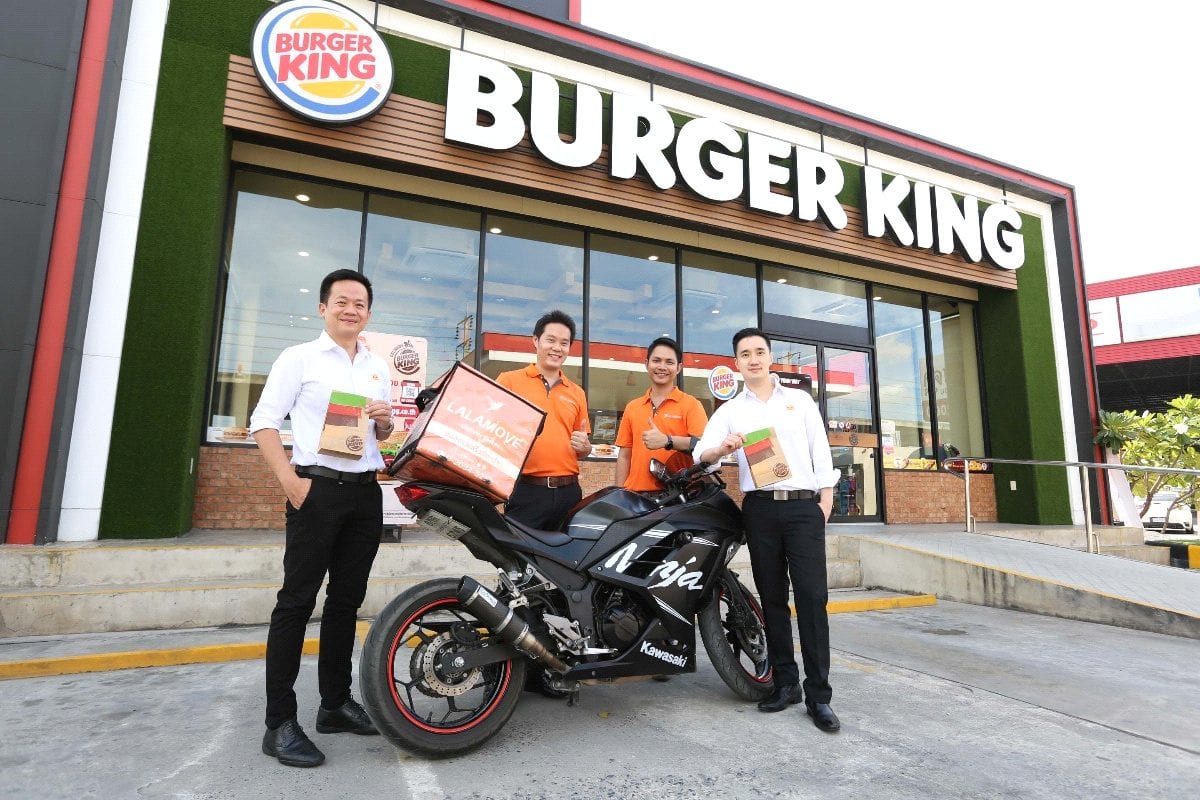
    US global fast-food chain BURGER KING has teamed up with Hong Kong-based on-demand delivery app and Thailand’s top food delivery platform, Lalamove, to launch its new partnership in November 2017 that will ensure better delivery of perfectly flame-grilled burgers to online customers all over Thailand.

    Burger King is the first fast-food burger restaurant chain to be added to the Lalamove delivery service and according to Chanon Klahan, Managing Director of Lalamove Thailand, this represents the delivery app’s reputation and focus on expansion. “To be chosen to join forces with such a successful household name as Burger King is a true sign of confidence in what we can deliver business-wise and of course burger-wise! It also shows Lalamove’s focus on building

    strong partnerships as we grow. With our food-delivery network of drivers, we can definitely help stimulate demand as Burger King continues to expand into new delivery locations.”

    In October 2017, Lalamove announced its own plans for global expansion too, by setting its sights on a presence in more than 100 cities across Asia after securing USD100M Series C funding.

    Prapat ‘Patrick’ Siangjan, General Manager at Burger (Thailand) Limited says, “Burger King has seen an opportunity to grow its customer base substantially. With the addition of an online food ordering channel, which is very popular today, Burger King can greatly expand its delivery zones.”

    “Thanks to Lalamove, which is Thailand’s leading same-day delivery and logistics provider, this collaboration will enable us to meet the needs of our customers better than ever before. By steadily launching new menu items to satisfy the appetites of our increasingly sophisticated customers, Burger King has seen the burger market continuously grow and receive consumer good response, especially in Q1 and Q3 of this year.”

    “In 2018, we plan to increase the number of branches by another 15-20 more new outlets, each with an average investment of 25 million Baht, in Greater Bangkok and strategic provinces nationwide. BURGER KING’s strong selling points will continue to be its focus on sourcing fresh, quality ingredients and creating unique menu offerings that will tantalize consumer taste buds, alongside our famous flame-grilled Australian beef for great-tasting deals at unbeatable prices.”

    With 16 branches already opened this year which brings the company to 89 outlets in total, (84 in Thailand and another 5 overseas), the Burger King brand is firmly established in this country. Consistently rolling out new restaurants in high potential locations enhances the brand and enables Burger King to extend its online delivery service zones to better meet growing consumer demand throughout Thailand. This is why Burger King chose to partner with the new Lalamove online delivery service as a part of its ongoing process to improve its online business as a whole.

    To celebrate this new partnership with Lalamove, Burger King is currently running a promotion offering free delivery with orders of 500 Baht or more from December 1st – 29th  2017.

  • Lotte sells Burger King Japan to Affinity Equity

    Lotte sells Burger King Japan to Affinity Equity

    Affinity Equity Partners of Hong Kong has bought Burger King’s Japanese business from South Korea’s Lotte Group for an undisclosed sum.

    A new entity set up by Affinity, Burger King Japan Holdings, is expected to take over the roughly 100 fast-food outlets next month, reports Nikkei Asian Review.

    The US burger chain had pulled out of Japan in 2001 following poor earnings, but re-entered the market in 2007 when Lotte and Japan-based Revamp bought the franchise and ran it as Burger King Japan. Three years later the business was transferred to Lotte subsidiary Lotteria.

    Meanwhile, rival McDonald’s has maintained leadership in the market despite a slowdown and store closures in the past few years, pushing Burger King to seek a new approach.

    Affinity bought the Burger King South Korean franchise last year from VIG Partners for US$170 million. Meanwhile, Affinity is raising $5 billion for its fifth fund, which exceeds its $3.8 billion fund in 2013.

  • Burger King Landside Opens at Airport

    Burger King Landside Opens at Airport

    American global fast food chain, Burger King has opened its third local outlet at the Nadi International Airport yesterday.

    The new outlet known as the “landside” restaurant will be accessible to all customers who visit the airport.

    Burger King initially started its Fiji operations at the Nadi International Airport on November 16, 2015 with the opening of its first outlet which is only accessible to customers departing our shores via the international departures lounge.

    The second outlet was opened at Martintar, Nadi in February last year.

    Burger King Fiji General Manager, Akash Narsey said they’ve worked very closely with Airports Fiji Limited to make sure the new site was delivered on time and the handover was as smooth as possible.

    “Today has been the first day of operation, it has been very positive. We haven’t really advertised to say this is where we are but the number of guests that have come in since we opened at 5.30am this morning, it’s very positive, a lot of locals and those that work around here as well,” Mr. Narsey said.

    With interior designs designed by a New Zealand based company, natural copper brick walls, and furnishing pieces shipped from China and Thailand and world-class standard kitchen fit outs, Mr. Narsey said the construction of the outlet costs about $1million including labour.

    He said the features of the restaurants are mostly similar to the already existing outlets with minor differences which includes the selling of draught beer at the new restaurant.

    The restaurant is open from 5.30am to 10pm daily.

    “It’s not open 24  hours, at the moment it is tied with the flight departures, we will most definitely change those times depending on what our customer demands are,” Mr. Narsey said.

  • Foreign fast food chains show underwhelming performance in Vietnam

    Foreign fast food chains show underwhelming performance in Vietnam

    Experts say there are several challenges: intense competition from the increasing number of domestic and foreign food companies, high prices (a burger goes for “four times a bowl of Pho”), and the fact that hamburgers and French fries are just not for Vietnamese people.

    Below are some major chains and their progress in Vietnam compared to other markets in Asia.

    Burger King

    Burger King has closed five restaurants in Ho Chi Minh City, Hanoi, and Danang in recent years, citing sub-optimal location, according to news reports, despite an ambitious $40-million investment plan upon its entry in 2012.

    At the time, Burger King expected to open 60 restaurants nationwide, as consumers were excited to try the famous hamburger from the west. However, five years later, the fast food chain has only reached a quarter of this target with 15 restaurants: seven in Hanoi and eight in Ho Chi Minh City.

    The reasons Burger King missed its original goal, according to experts, could be tough competition, high operating costs, and a misunderstanding of Vietnamese taste buds.

    “In the short term, hamburgers cannot become a popular choice for Vietnamese consumers,” said Nguyen Manh Tu, business development director of Blue Kite Food and Beverage Services Company Limited, which has the franchise rights to Burger King in Vietnam, in an exchange with the broadcaster VTV.

    Such an initial drawback would require fast food chains to adjust their menus or strategies. In the case of Burger King, after re-negotiating the franchising terms to reduce the projected store count to 15 and refining its menu, its sales has increased by 50 per cent each year for the last two years, according to VTV. Good customer service and the quality of ingredients, with beef imported from Australia, will continue to be Burger King’s advantage in the eyes of Vietnamese customers.

    Tu added that the future of Burger King will depend largely on the restructuring of Restaurant Brands International, the multinational company that owns several fast food brands, including Burger King.

    Other markets in Southeast Asia have welcomed Burger King long before Vietnam. It entered Malaysia in 1997 and now has more than 50 Burger King restaurants in the country. In the Philippines, Burger King was acquired by local fast food giant Jollibee Foods Corporation, which in 2011 bought a 54-per cent stake in BK Titans Inc., the holder of franchise rights to Burger King in the Philippines.

    McDonald’s

    Originally from the United States, the golden arch logo of McDonald’s is now recognisable everywhere in the world.

    In 1992, McDonald’s opened its largest restaurant in the world at the time in Beijing, and 40,000 customers came to taste a bite of American culture on the first day of business, according to James Watson’s book “Golden Arches East: McDonald’s in East Asia.”

    Four years later, by the end of 1996, McDonald’s had 29 outlets in Beijing, according to Associated Press. Generally perceived by Chinese consumers as a symbol of status and western modernity, McDonald’s grew rapidly in China, a country where its well-trained staff and clean restaurants were a novelty in the 1990s.

    Ten years on, in 2006, McDonald’s had 784 restaurants in China, opening 75 new restaurants a year on average, according to company data. The company also had more than 150 restaurants in Hong Kong during this period, and at one point served half a million fast food fans per day, according to BBC News. (Hong Kong’s population was 7.3 million in 2015.)

    Fast forward five years to 2011, and the fast-food chain had 1,464 outlets in China, meaning it opened 136 new outlets each year during the five-year period.

    Today, there are more than 2,400 restaurants in mainland China, according to the New York Times. However, McDonald’s will sell 80 per cent of its businesses in China and Hong Kong to the state-owned conglomerate Citic and private equity firm Carlyle Group, granting these firms franchise rights. This is part of McDonald’s newfound plan to turn 95 per cent of its restaurants into franchises, thereby saving money and passing the hefty cost of modernising the stores on to franchisees, analysts said.

    Last year, McDonald’s also sold the franchise rights to its restaurants in Malaysia and Singapore to Saudi Arabian Lionhorn Private Limited.

    With a network of 262 restaurants, McDonald’s recorded a year-on-year revenue growth of 16 per cent in 2016 in Malaysia and is looking to repeat this with a double digit growth in revenue and profit this year, according to the company website.

    Meanwhile, almost four decades after entering Singapore in 1979, McDonald’s 120 restaurants claims to serve 1.2 million customers each week. (The island had a population of 5.5 million as of 2015.)

    Another country in the region where McDonald’s has a long history is the Philippines. The first McDonald’s restaurant opened in 1981 in central Manila. More than 36 years later, the Philippines is one of its biggest markets in Asia in terms of store count, only behind China, Japan, and Taiwan, according to company data. The company has always reported double-digit annual growth in revenue in the past 10 years, and in 2016 sales increased by 14 per cent. It opened 45 new outlets last year and is targeting 45 more this year.

    In Vietnam, McDonald’s is seen to be growing slowly. Three years ago, as customers queued up to try the first Vietnamese restaurant in Ho Chi Minh City, McDonald’s planned to open 100 restaurants within the decade (average 10 new restaurants each year). However, the chain now has only 15 restaurants, falling rather short of the target.

    Jollibee

    Jollibee is the Philippines’s home-grown fast-food chain. Filipino-Chinese founder Tony Tan Caktiong started Jollibee selling ice cream in 1978, but eventually shifted to hamburgers to meet market demand. After many years of competing with McDonald’s, Jollibee’s more than 2,000 restaurants controlled 18 per cent of the Metro Manila market, compared to the 10 per cent of McDonald’s, according to Forbes Asia’s 2013 data.

    In a few sentences, Tan explained this feat to Forbes Asia, saying “We found that they excelled over us in all aspects—except taste. It suited Americans, but not really Filipinos. Ours (food) tends to be sweeter, spicier, and more salty. We were lucky as it was not easy for them to change their product because of their global image.”

    Jollibee also wanted to become a global player, as there are large Filipino diasporas in many countries longing for the familiar taste of their hometown food. The company entered the US in the 1980s and Saudi Arabia, Qatar, and the United Arab Emirates in 2008, according to Forbes Asia. New locations were planned in countries, such as Britain, Italy, and Canada.

    In addition to developing its own brand, the company also bought already-popular brands and works to improve them. For example, in China, Jollibee bought the noodle and rice chain Yonghe King in 2014, the congee brand Hong Zhuang Yuan back in 2008, and the beef noodle chain San Pin Wang in 2012.

    Jollibee bought Burger King’s 23 restaurants in the Philippines in 2011. More recently, it also purchased 40 per cent of American burger chain Smashburger and made plans to open at least 1,400 Dunkin’ Donuts locations in China in the next 20 years.

    Jollibee Foods is now the biggest restaurant chain in Asia, boasting about 3,290 outlets worldwide under various brands.

    In Vietnam, Jollibee opened its first restaurant in 1996 and now boasts 80 outlets nationwide. Jollibee is successful among foreign brands on the Vietnamese fast food market. It has been growing rapidly in recent years, with two thirds of its restaurants having been opened in the last five years, according to numbers from dantri.com.vn. The company began granting franchise rights in late 2015.

    At the end of 2016, Jollibee Foods went into a joint venture with Viet Thai International to create SuperFoods Group, thereby gaining ownership of several other brands, such as Highlands Coffee, Pho 24, and Hard Rock Café.

    Jollibee is expected to take the company public via an Initial Public Offering in 2019, an indication of Jollibee’s success as well as ambition to imitate its success in other countries: buying and growing major local brands.

    Thanks to this strategy, Highlands Coffee doubled the number of coffee shops from 60 in 2014 to 130 in 2016, according to news site Soha.

    Subway

    Claiming to be a healthier alternative, Subway is a little bit different. Entering Vietnam six years ago, the world’s biggest fast food brand has set a goal of 50 restaurants in Vietnam by 2015. However, at present, there are only six of them in Ho Chi Minh City, as previously reported by VIR.

    “Like other fast food brands, Subway entered Vietnam late. Initially, we had to adjust our strategies to fit the culture as well as market trends. It takes time for us to adapt to the differences in the Vietnamese market to get the desired foothold here,” Mark Mason McGrath, general director of Subway Vietnam, explained to VIR in February.

    In Southeast Asia, Subway has opened 200 restaurants in Singapore, 100 in Thailand, and 40 in the Philippines. However, Subway has not reached its expected goals in Vietnam.

    Pressure to conform

    In conclusion, most fast food brands entered Vietnam with big promises, probably due to their success in other markets, such as the Philippines, Malaysia or China. However, several brands, such as McDonald’s, Burger King or Subway, set foot in Vietnam much later than other markets, which seemed to be a big disadvantage, while chains that opened long before, such as Jollibee, Lotteria, and KFC, seem to be doing better.

    News reports and expert opinion seem to agree that foreign fast food chains have not been able to win the heart of Vietnamese consumers because they lack that local taste that could entice them to return time and again. There are signs of change, such as rice being added to the menu (the rice and fried chicken combination is unheard of in the west) or Jollibee beginning to use traditional Vietnamese fish sauce to marinate its fried chicken, as the company announced recently.

    According to Jollibee’s data, 90 per cent of customers liked the fried chicken seasoned with fish sauce and would eat it again. Such an adjustment is something other fast food chains should take notice of.

  • Burger King GM talks Myanmar expansion plans

    Burger King GM talks Myanmar expansion plans

    Biting into a Burger King in Myanmar for now requires a passport, with the country’s only restaurant located past customs at Yangon International Airport. But franchise operator Minor Food Group is hoping local appetite will merit many more outlets.

    Thai firm Minor Food Group (MFG) opened Myanmar’s first Burger King in Terminal 1 on July 1 – with very little fanfare. There was no press release, no ceremony.

    By comparison, rival fast-food giant KFC opened its first Myanmar branch almost exactly a year earlier, inviting a host of local media and offering free food. Local KFC franchise holder Yoma Strategic also started its operations with a clear plan to open several outlets, first in Yangon and then across Myanmar. The group says it is on track to have 12 KFC restaurants open by March next year.

    MFG, however, only sought approval from the US Burger King company for a single outlet in Yangon International Airport, Prapat Siangjan, the firm’s general manager for Burger King Thailand, said.

    The firm has specialised in running Burger Kings in airports – it started its Thai operations with restaurants at Suvarnabhumi Airport, and its first expansion outside of Thailand was into airports in the Maldives, he said.

    Myanmar’s new international airport Terminal 1 and anticipated tourist growth prompted MFG’s decision to make the country its second overseas location, he added.

    The lack of publicity was down to two factors. Firstly, when the outlet opened in July not all Terminal 1 operations were online, said Mr Siangjan. Only two carriers were using the new space, although more have since moved in. MFG is also entering a new market and wants to make sure its operations are running smoothly and service standards are up to scratch before the official launch, he added.

    A PR announcement and opening in expected due course, he said.

    Mr Siangjan hopes MFG will be able to open many more outlets outside of the airport. But expansion will depend partly on how well the initial branch does, which will help MFG gauge demand. It is likely to be at least a year before the firm decides to expand, he added.

    One issue with the initial location is that many of the customers are likely to be departing tourists, which Mr Siangjan admitted could make it hard to assess local appetite. The prices at the airport outlet – which are denominated in dollars – have also raised eyebrows, with a standard value whopper meal going for US$8.50.

    One potential plan is to open a second Burger King at the domestic terminal next door, which would have prices in kyat and cater more to locals, but negotiations for a second outlet are at a very early stage, he said.

    Applying for permission for the first airport outlet was relatively smooth, he said. MFG applied towards the end of 2015, and received the green light early this year. The Thai firm runs the Yangon airport Burger King without a local joint venture partner, he added.

    Mr Siangjan could not comment on whether the approvals process would be any different for opening an outlet outside of an airport.

    Keeping an eye on the new Myanmar operations should be straightforward, as Yangon is closer to MFG’s head office than some of the outlets it operates in Thai provinces, he said.

    But MFG is not guaranteed to remain the only franchisee authorised to operate Burger King in Myanmar, and Mr Siangjan said MFG has to keep in close contact with Burger King headquarters to make sure they know if a competitor arrives.

  • Burger King hands Lowe Lintas creative brief for the Whopper

    Burger King hands Lowe Lintas creative brief for the Whopper

    International fast food franchise Burger King has appointed Lowe Lintas Mumbai to launch a new campaign for its iconic sandwich ‘the Whopper’.

    The campaign brief is be mainly targeted at India’s millennial generation and will focus on strengthening brand awareness within this demographic.

    Describing Lowe Lintas’ team as a “talented bunch”, Burger King India’s chief marketing officer Kapil Grover said: “Creative agencies are like an extended marketing team. It’s important to have partners who understand the brand and share the same passion.”

    Lowe Lintas’ leadership recently underwent a reshuffle with the appointment of Arun Iyer to the dual role of agency chairman and chief creative officer.

    President and Mumbai office head Raj Gupta was also named chief executive officer.