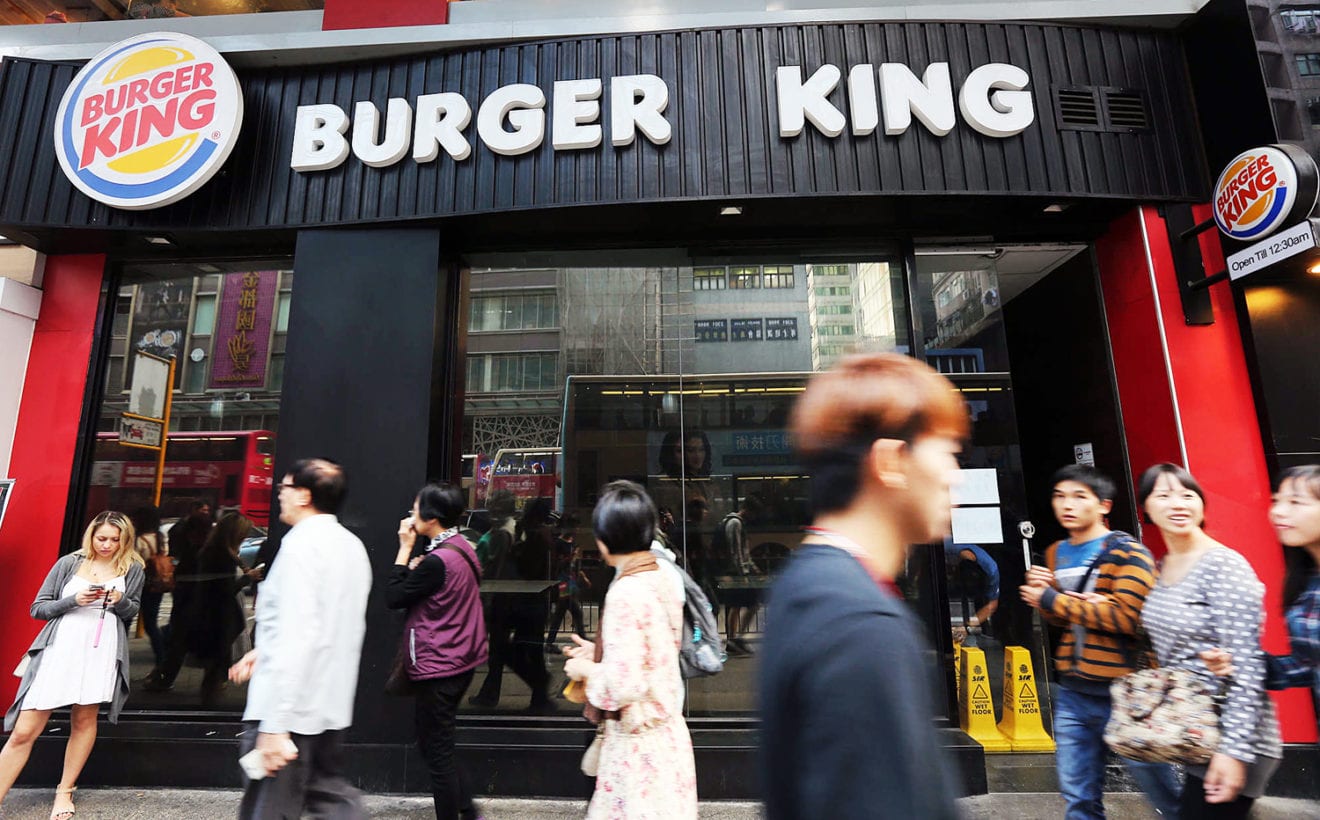
The closure of five of seven Burger King fast food restaurants in Hong Kong heralds more shutdowns amid a retail and tourism downturn, retailers warn.
The franchisee of the five restaurants, Perfect Combo, was taken to court several times this year over unpaid rental payments and other fees involving several outlets. Two of them – in Tsim Sha Tsui and Yau Ma Tei – were located in tourist hot spots.
“Conducting business in Hong Kong is not easy these days” said a manager of a medicine shop on Nathan Road, just 10 metres from the shuttered Yau Ma Tei Burger King outlet.
Nathan Road, known for its numerous jewellery and medicine shops, has been one of the favourite shopping spots for mainland tourists.
However, eight shops on a 500-metre stretch from Yau Ma Tei to Mong Kok are currently closed or vacant. The shops used to sell jewellery, watches, handbags, medicine and beef jerky, according to staff of nearby shops, and three closed just last month.
Mr Hui, the manager of a medicine shop on Nathan Road, said his boss might close the shop next year if his rent is not cut enough.
“This shop hasn’t made a cent in profit since it opened two years ago”, he said, “ Mainland tourists used to buy more health care products. Now they go for ordinary milk powder.” The shop makes more money from health care products.
“Custom has dropped one-third after the protests against parallel trading earlier this year” Hui said.
With Hong Kong’s GDP growth expected to slow to about 2.4 per cent this year, local consumers also tend to be more conservative in spending their hard-earned money.
“It’s not just mainland tourists. Local consumers have also been buying less this year,” said Mr Ng, a salesman in a sports shoe shop on Nathan Road. Ng said the shop had been offering heavier discounts this year – with prices 10 to 15 per cent lower than in the same period last year.
Other than shutting down stores completely, some retailers chose to cut the size of their shops to save rental costs. Zhongxing Watch, a Hong Kong luxury watch chain, cut the size of its Nathan Road store by one-third this year, said an employee of a nearby jewellery store. No one rents the vacant area.
Hong Kong retail sales dropped 3 per cent in October year on year despite the National Day Golden Week holiday. In the first 10 months of this year, retail sales shrank 2.7 per cent from the same period last year.
Breaking with their traditional role as mutual fund managers or short-term profit seekers, homegrown PEFs have now transformed into strategic investors to spearhead the recent boom of mega-sized M&As. And leading the pack is Seoul-based MBK Partners Ltd.
Beating global big-name PEFs like KKR & Co. and Affinity Equity Partners, MBK Partners clinched a 7.2 trillion won (US$6.37 billion) deal last month to acquire U.K. retail giant Tesco Plc’s Korean unit Homeplus, South Korea’s second-largest supermarket chain with 8.6 trillion won in sales last year. It is the country’s largest takeover deal in size.
Last year, Hahn & Co., the second-largest PEF based in South Korea, bought a controlling 70 percent stake in Hanon Systems, formerly Halla Visteon Climate Control Corp., a leading automotive thermal management solutions provider, for about 4 trillion won.
Taihan Electric Wire Co., South Korea’s second-largest electrical materials manufacturers, was sold to No. 3 IMM Private Equity last month for 300 billion won.
Local PEFs’ aggressive investments have spiced up the long-slumped local M&A market as they have registered huge returns from leveraged company buyout deals amid a low interest rate trend.
Many well known brands are owned by PEFs, ranging from Burger King and KFC to NEPA Co., an outdoor apparel manufacturer, and Coway Co., a leading water purifier firm.
PEF managers offer a series of distinct private equity funds to make investments in various equity securities after raising capital from cash-rich individuals and institutional investors such as public pension plans, insurance companies and foundations.
South Korea opened the PEF market in 2004 to encourage corporate takeovers and investment to provide capital to venture start-ups.
According to data compiled by the Financial Supervisory Service (FSS), a total of 51.2 trillion won in assets were under management by 277 PEFs at the end of 2014, compared with 400 billion won tallied in 2004 when two PEFs were floated for the first time in the country.
They have attracted more than 5 trillion won every year since 2008 and collected 9.8 trillion won in investment last year alone.
PEFs have started to draw attention from institutional investors, including the National Pension Service, as the South Korean economy has seemingly entered a low-growth cycle and the benchmark KOSPI has moved in a narrow box range since the 2008 global financial crisis.
Recently, the South Korean government relaxed regulations in a bid to fuel the M&A market by luring PEFs. It has loosened the so-called double reviewing process by the state anti-trust agency and stakeholder filing requirements.
MBK Partners is in the forefront to explore the PEF-led M&A market.
Founded by former Carlyle managers in 2005, MBK Partners has grown into one of the biggest Asian buyout funds with about 14 trillion won in assets under management, with a focus on South Korea and other Asian regions.
It has invested in 23 companies including Coway, cable TV operator C&M Co., NEPA Co. and Homeplus. Its total assets amount to that of Dongbu Group, the 20th largest conglomerate, with 14.6 trillion won.
Hahn & Co. has assets of 3.3 trillion won with 12 businesses including Hanon Systems, Daehan Cement and Woongjin Foods Co. under management. No. 3 IMM Private Equity operates 100 firms worth 2.8 trillion won in total assets, followed by Mirae Asset Global Investments Co. with 2.2 trillion won and Vogo Investment with 1.9 trillion won.
“In the beginning, most PEFs were founded by retired government officials and fund managers with a career in global PEFs. They were financial investors, who bought stakes and sold them to lock in profits,” said Kim Kyung-young from the Asset Management Supervision Office at the FSS.
“Now they are changing into strategic investors, or buyout investors, playing a major role in acquiring large companies and carrying out corporate restructuring.”
Although such PEFs have successfully made their presence felt in the local M&A market, South Korean investors are wary of such buyout funds as many PEFs have still disappeared from the market due to worse-than-expected profitability in a takeover deal.
“PEF-led M&As are not always successful,” said Koo Kyung-hoe, a senior analyst at Hyundai Securities Research Center. “About 66 percent of PEFs reach target profit rates, but we have to bear in mind that the rest, 34 percent, end up in vain.”
For example, MBK Partners, regarded as having the Midas touch in the financial market, took over C&M in 2008 for about 2 trillion won, but its plan to resell the company has been stalled due to a long slump in the cable TV industry.
He said they have to expand the range of investors as nearly all local PEF clients are institutions like pension funds and financial firms.
“In advanced countries, PEFs collect money from universities, foundations and even cash-rich individuals,” said Koo. “They need to draw up plans to lure them as they can serve as an effective, appropriate alternative investment tool in the future.”
Experts also noted that local PEFs have to overcome the negative public perception in South Korea that they clash with labor unions over restructuring after a takeover.
U.S. Lone Star Funds’ purchase and resale of Korea Exchange Bank has deepened such negative perceptions toward PEFs among South Koreans, according to experts. Lone Star bought KEB in 2003 for 1.38 trillion won and then sold it to Hana Financial Group Inc. in 2012, pocketing a profit of 4.5 trillion won.
Burger King Malaysia and Singapore has a new owner after previous franchisor Ekuinas sold out for US$18 million.
Ekuiti Nasional Bhd (Ekuinas) has sold the operation to Newscape Capital (Newscape) with the agreement of BK Asiapac Pte Ltd, the master franchisor of the Burger King brand in the Asia Pacific region.
Newscape is an investment company run by experienced retail operators Chua Tia Guan and Lee Thiam Wah. It successfully acquired the rights to Burger King in the two markets after a previous bid by Brahim’s Holdings Bhd was rejected by BK Asiapac in February.
Abdul Rahman Ahmad, Ekuinas CEO, said the sale would place the Burger King brand with a franchisee with the financial strength and operational expertise to expand the brand’s operations.
“This exercise has also enabled Ekuinas to successfully complete the restructuring of its F&B portfolio involving our exit from the Quick Service Restaurant (QSR) segment to fully focus and expand on the core Casual Dining and Beverage segments with brands such as Tony Roma’s, Manhattan Fish Market, New York Steak Shack, Coolblog and San Francisco Coffee,” he said in a statement.
BK Asiapac president David Shear commended Ekuinas’ four year partnership and said the company looked forward to the opportunities working with Newscape.
US fast food company Burger King has posted its best quarterly sales increase in nearly a decade.
The company says the sales boost is the result of a promotional ‘two for $5’ campaign, the introduction of the new spicy BLT Whopper and a boost in breakfast sales – no single “silver bullet”.
Burger King’s same store sales rose 6.9 per cent in the US and Canada, according to parent Restaurant Brands International, but it declined to say if it was the result of increased customer traffic or a high per customer spend. Given the low cost promotional offer, it’s likely to have come at the cost of margins.
Burger King’s performance is all the more significant due to its coincidence with a 2.6 per cent fall in sales by its larger rival McDonald’s.
Global same store sales rose 4.6 per cent at Burger King.