Tag: Business

  • The largest jewellery marketplace in the world opens in Hong Kong

    The largest jewellery marketplace in the world opens in Hong Kong

    Two major jewellery shows organised by the Hong Kong Trade Development Council (HKTDC) will open next week. The sixth HKTDC Hong Kong International Diamond, Gem & Pearl Show, which showcases jewellery raw materials, will take place at AsiaWorld-Expo from 26 Feb to 2 March, while the 36th HKTDC Hong Kong International Jewellery Show, which specialises in finished fine jewellery, will be held at the Hong Kong Convention and Exhibition Centre (HKCEC) in Wan Chai from 28 Feb to 4 March.

    This year, the two shows will feature a record of more than 4,600 exhibitors from 48 countries and regions, once again forming the world’s largest jewellery marketplace.

    Jewellery exports grow 13.3% in 2018, but challenging year ahead
    HKTDC Acting Executive Director Benjamin Chau said: “Though the Sino-US trade conflict has been looming large over all sectors and industries, Hong Kong exports of fine jewellery showed healthy growth of 13.3% year on year to reach HK$57 billion in 2018. Exports to the United States, Hong Kong’s largest jewellery export market, were particularly robust, growing by 18.1%.” However, Mr Chau pointed out that the single-month figure for December showed the total value of fine jewellery exports falling 12% year on year, indicating that the impact of the Sino-US trade conflict on exports is beginning to be felt. Compounded by other unfavourable factors such as escalating geopolitical conflicts, Mr Chau reminded businesses to be ready for a potential slowdown in global economic growth in 2019.

    Buying missions organised to help address economic uncertainty

    Mr Chau added that economic uncertainties led to the total value of Hong Kong’s exports of jewellery raw materials, including pearls, gems and semi-gems, declining by 17.6% in 2018, although there was still satisfactory growth in some major markets, including Mainland China (+8%), Belgium (+19.2%) and Israel (+24.4%). “To help the industry grasp more business opportunities, the HKTDC will organise 120 buying missions, comprising more than 8,200 companies from 75 countries and regions, to visit the shows this year,” Mr Chau explained. “These companies will consist of department stores, speciality shops, chain stores and online stores, with 700 coming from the US and 5,700 companies visiting from emerging markets. This will help the industry expand into emerging markets to deal with the unstable global economy.”

    Worldwide support from industry bodies and jewellery associations

    The two shows continue to receive support from industry organisations and jewellery associations from around the world. A total of 38 pavilions, including those from Australia, Mainland China, France, Germany, Italy, Myanmar, India and the US, will set up group pavilions at the shows. Various jewellery organisations will continue to set up their own pavilions, including ACODES from Colombia, the Antwerp World Diamond Centre, International Coloured Gems Association, Israel Diamond Institute, New York Diamond Dealers Club, Tanzanite Foundation and the Gem & Jewellery Trade Association of Thailand, among others.

    The Avenue of Jewellery Creators will be set up at the Jewellery Show by the Asia Pacific Creator Association for the first time, introducing jewellery designs created by Hong Kong and mainland designers. Also new at the Jewellery Show are pavilions from Mexico and Indonesia, while groups from Donghai in Jiangsu province and Dongguan in Guangdong province will debut as exhibitors. The Diamond, Gem & Pearl Show will welcome the participation of the Australian Opal Association and the Beihai Bureau of Commerce from the mainland for the first time, broadening the show’s international outlook.

    Japan as first-time partner country to showcase rare pearls

    With support from the Japan External Trade Organisation and the Consulate-General of Japan in Hong Kong, the HKTDC is collaborating with the Japan Pearl Exporters’ Association and the Japan Pearl Promotion Society to invite Japan as this year’s partner country for the first time. A Japan Pearl Jewellery Pavilion and a Japan Pearl Pavilion will be set up at the Jewellery Show and the Diamond, Gem & Pearl Show respectively, featuring some 130 exhibitors. The two major Japanese pearl organisations will also host a media event on the first day of the Jewellery Show (28 Feb) to introduce exquisite pearl jewellery from Japan.

    Diamond, Gem & Pearl Show runs from 26 February to 2 March

    This is the sixth straight year that the HKTDC has run the two shows in parallel in separate venues. The Diamond, Gem & Pearl Show, which specialises in the raw materials used in the jewellery industry, will be held at AsiaWorld-Expo. The show is organised into different themed zones, including the Hall of Fine Diamonds, which showcases prime quality diamonds of different shapes, cuts, grades and rare colours. The Treasures of Nature zone displays various glittering precious gemstones, semi-precious gems and other natural raw materials, while the Treasures of Ocean zone houses the highest quality pearls from Tahiti, the South Seas and other pearl-producing areas around the world.

    Among the impressively large number of special exhibits on display are:

    Hong Kong company Novel Collection Ltd (Booth No: AWE 2-Q01) will feature a pear-shaped, pink-coloured 5.01-carat diamond with unique cutting valued at HK$46.8 million.

    Swiss exhibitor Theilkas GmbH (Booth No: AWE 1-A05) will present pearls from Caribbean queen conches. Characterised by a unique flame effect, pink conch pearls are one of the world’s most precious pearl types.

    Shaun Gems International (Booth No: AWE 1-A16) from the United States will display a matched pair of natural sapphires of vivid blue colour, weighing a total of 27.76 carats and valued at more than HK$3 million.

    Jewellery Show runs from 28 Feb to 4 March

    The Jewellery Show, which opens on Thursday (28 Feb), will feature a wide array of finished jewellery and exquisite craftsmanship. A total of 38 renowned jewellery brands will converge at the Hall of Fame to showcase their collections. Returning brand names include Lao Feng Xiang from the mainland, Japan’s Kuwayama and Italy’s Giorgio Visconti, while new exhibitors include Hong Kong’s Asia Star, Japan’s Kawamura, Russia’s Kabarovsky and the UK’s JT Jewellery Theatre.

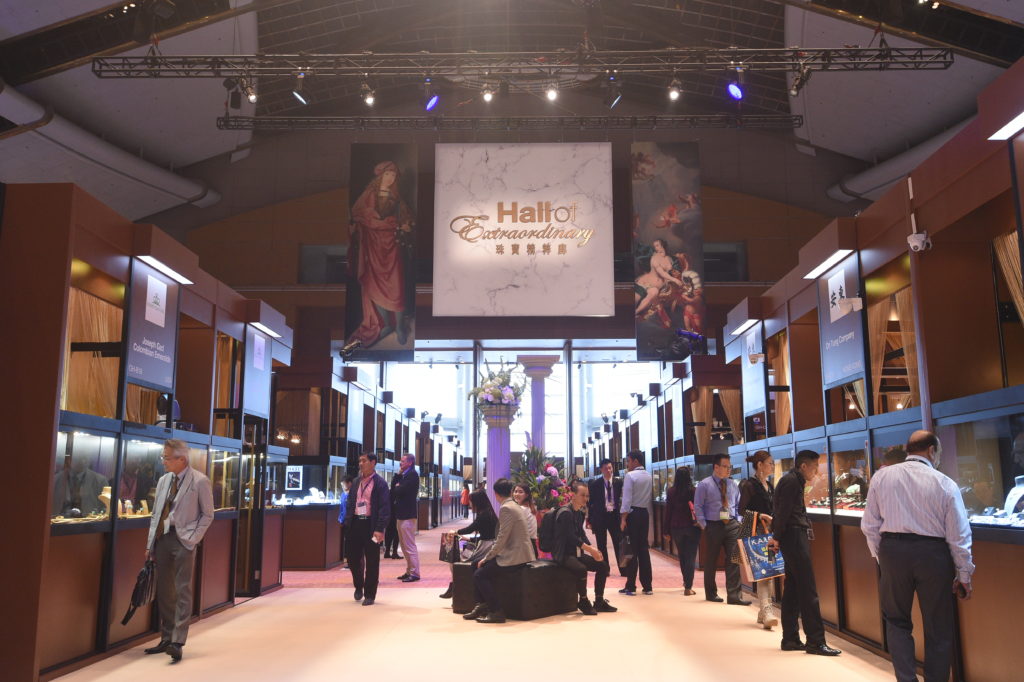
    The Hall of Extraordinary will display skillfully crafted, valuable and unique jewellery pieces from some 100 companies, including:

    Hong Kong’s Jadmily Jewelery (Booth No: CEC GH-B05) will feature a jade necklace valued at HK$64 million. The oval centre stone of the necklace is a jadeite cabochon extracted from a top-tier ancient mine in Myanmar. The warm, smooth touch of elegance is illuminated with dazzling diamonds. The centre stone weighs 51.48g.

    Foo Hang Jewellery of Hong Kong (Booth No: CEC GH-D16) will showcase a diamond jewellery set worth more than HK$13 million. The centrepiece of the set is a marquise shaped diamond of 10.04 carats valued at over HK$8 million. The rare marquise cut is testament to the superb craftsmanship that makes the diamond even more dazzling.

    One of the exhibits of Hong Kong company Belford Jewellery (Booth No: CEC CH-L01) is its “Lava Collection”. One of the jewellery pieces in this collection is an orange-red Mexican fire opal that is uniquely set against a number of coloured diamonds to imitate flowing lava. The piece is valued at HK$345,000.

    Another Hong Kong company, Famous Group Ltd (Booth No: CEC GH-G05), will display a sapphire diamond set valued at over HK$10 million. The sapphire stones, with a total weight of more than 180 carats, are adorned with 128 carats of diamonds to bring out the elegance.

    The IT Solutions for Jewellery zone that debuted last year will return to help buyers boost their competitiveness by tapping into the latest technologies for use in the designing, manufacturing, quality monitoring and selling of jewellery. The new Amber Jewellery zone is introduced to address the growing market demand, while other themed zones include Antique & Vintage Jewellery Galleria, Designer Galleria, Hall of Jade Jewellery, Treasures of Craftsmanship, Hall of Time, Wedding Bijoux and World of Glamour. In the Hall 3E entrance of the Jewellery Show, supported by Chow Tai Fook Jewellery Group, the “ARTRIUM” will showcase the company’s unique collection of precious jewellery.

    Networking activities to facilitate business exchange

    A host of activities and events, including jewellery parades, networking sessions, buyer/exhibitor forums and seminars, will be held during the shows to facilitate business exchange. One key event is the cocktail reception and Jewellery Gala Dinner held on the first day of the Jewellery Show (28 Feb). The theme for the gala dinner will be “Dionysus”, after the Greek god of wine, with a menu personally prepared by Edward Voon, Executive Chef of French restaurant LE PAN. The dinner will be attended by actresses Carat Cheung and Toby Chan. The award presentation ceremony for the biennial International Jewellery Design Excellence Award − often referred to as the “Oscars of the jewellery industry” − will be held during the cocktail reception, with the “Champion of the Champions” being announced.

    During the show period, the HKTDC will stage demonstrations of jewellery craftsmanship and themed seminars to update industry players on the latest market trends, production technologies and product styles. For example, experts from the Gemological Institute of America (GIA) will conduct a seminar on “Fancy-coloured Melee Diamonds and their Identification” (26 Feb). The HKTDC will also hold a jewellery industry forum on 1 March covering topics such as the forecasting of jewellery trends, how jewellery design software will revolutionise the design of jewellery products, and insights into the impact of 4K 3D printing technologies and mobile commerce, with a representative from Tencent explaining how artificial intelligence and big data can be used to increase sales. Other seminar topics include the latest developments in the internationalisation of the Fei Cui standard (2 March), observations on sapphires from Mogok, Myanmar (3 March), and gemology studies and market analysis of Myanmar rubies (3 March). Details can be found on the show websites.

    In addition, to identify design talents for the industry and demonstrate the high calibre of Hong Kong jewellery designers to international buyers, the HKTDC has joined hands with four local jewellery industry bodies to organise the 20th Hong Kong Jewellery Design Competition. The theme of the competition this year is “Be Connected, Be United”, attracting around 200 quality entries. The finalists’ designs will be on display in the Hall 1D lobby of the HKCEC during the show period.

    To make it convenient for buyers to visit both shows, a complimentary shuttle bus service will be provided by the HKTDC between AsiaWorld-Expo and downtown (including the HKCEC in Wan Chai). Please visit the show websites for details.

  • CaratLane: 10 years of transforming jewellery in India

    CaratLane: 10 years of transforming jewellery in India

    When Mithun Sacheti founded CaratLane 10 years ago, e-commerce was at its infancy in India and no one could have imagined that Indian consumers would be ready to buy jewellery online. CaratLane was founded with a mission to democratise jewellery – to make beautiful jewellery accessible and affordable and with designs that are modern and wearable. A refreshing and courageous objective at the time, especially since the avenues for an online business weren’t as wide open then as they are today.

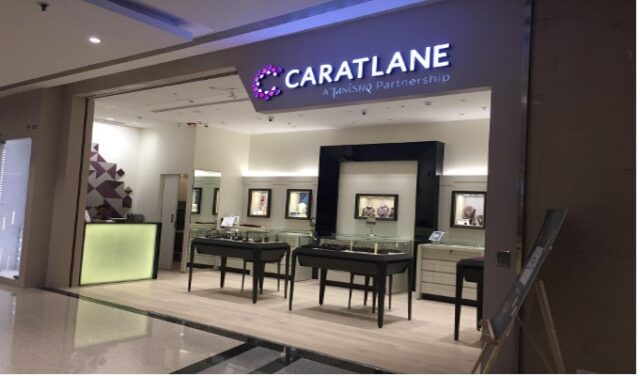
    CaratLane hasn’t looked back since then. It has grown from being one of India’s first online jewellery brands to being one of India’s largest new age jewellery brands now with 50 stores across the country.

    On the special occasion of CaratLane’s 10th birthday, Mithun said “The world has indeed changed in the past ten years. And while e-commerce has now become widely accepted in India, it has taken steady and sustained focus to democratise jewellery-buying online. From a website for easy shopping to allowing women to explore jewellery through apps to discovering interactive mirrors and providing a no-barrier access to precious jewellery in stores, CaratLane has transformed jewellery-buying in India.”

    “Our strong online footprint is now complemented by our growing store presence. With 50 stores across the country, we are now perhaps the world’s first truly omni-channel jewellery brand. It wouldn’t have been possible without our extremely valuable and loyal customers and an extremely dedicated team who would stop at nothing,” he added.

    As a part of the celebrations, CaratLane has added limited edition jewellery to three of its bestselling collections – Butterfly, Aaranya and Gold Lace. It has also launched its biggest sale ever with flat 20 percent off on all diamond jewellery but that’s not all, there are many more exciting offers for CaratLane customers.

    CaratLane, has also launched an upbeat film to create buzz around its 10th birthday celebrations. The campaign rolled out nationally with a combination of TV, digital and CaratLane’s social media channels. The film is targeted towards creating FOMO (fear of missing out) on its celebrations, among its audience.

    Talking about the campaign Atul Sinha, Senior Vice President Marketing, CaratLane said, “We’ve come a long way since our inception and we wanted to celebrate this milestone with the people who made it all possible – Our customers. The ‘10th birthday’ campaign film beautifully captures our excitement as well as the cheerful emotion that we’re trying to build around the occasion through our biggest sale ever.”

  • Nintendo makes comeback in Korea with Switch

    Nintendo makes comeback in Korea with Switch

    Nintendo, the Kyoto-based game company, returned to Korea. After almost disappearing over the past decade in the storm of mobile and online games, it is returning to the market with Switch, a retro console that marries the latest technology with old favorites, like Pokemon. A 41-year-old surnamed Kim, a father of three, recently found his new favorite hobby: playing Switch. His two favorite games are Diablo 3 and Legend of Zelda: Breath of the Wild, both of which he used to enjoy years ago at attending university.

    He now plays the latest versions.

    “To advance to a higher level on smartphone games, I have to spend a lot of time and money, so I lost interest,” said Kim. “As for Switch, it’s like the games I played when I was younger. Just like arcade games, I can save the game and can continue playing it where it ended whenever I want. Also, the game itself is not too difficult.”

    Plenty of people seem to agree with Kim.

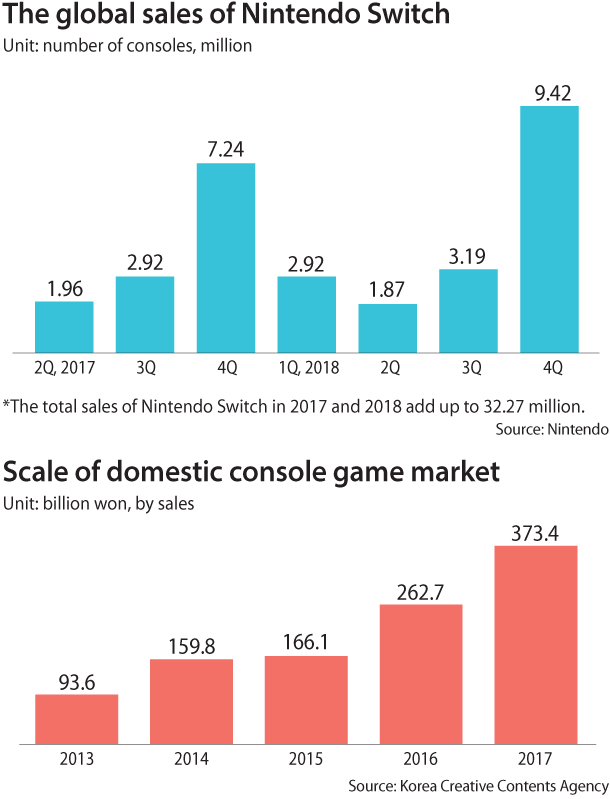
    Global sales of Switch from its introduction in March 2017 through late 2018 totaled 32.27 million units, according to a report from Nintendo. On average, 33.5 Switch consoles have been sold per minute. A total of 163.61 million Switch titles were bought during the same period.

    The Switch ended 2018 as the year’s best-selling hardware platform both in unit and in dollar sales terms, according to a report from NPD Group, a U.S.-based market-research company. Both in units and dollars, the Switch was the best-selling game since Sony PlayStation 4 in 2015.

    The Switch boom is evident in Korea, where consoles are not generally very popular. The product has been generating 51 percent of game sales at Emart, the main marketing channel for Switch.

    According to a report from Korea Creative Content Agency (Kocca), the size of the console game market in Korea grew by 42.2 percent from 2016 to 2017. Sales of Switch – which totaled more than 110,000 units in the first month of its release in Korea in December 2017 – and the rise of the related software sales were major contributors to the game market expansion, the report argues.

    Revival of Retro

    Nintendo, which was founded in 1889 as a playing-card company, most recently became an icon of innovation around year 2000 when it introduced Nintendo DS and Wii. Each sold more than 100 million units, and the strong sales in Korea led to the development of similar games locally.

    The success was short lived. The market began to change around 2010 as smartphone games started to develop and lead the market. In 2011, Nintendo experienced its first annual earnings loss since it was listed on the stock exchange in 1983.

    The company sought a rebound the following year with the Wii U, but only 13 million units were sold.

    Nintendo suffered losses for three years, and its presence in the console game market gradually waned with the dominance of the Sony PlayStation 4 and Microsoft’s Xbox. Nintendo’s share price dipped to as low as 8,060 yen ($73) from its November 2007 peak of 70,500 yen. The company’s weak performance continued until 2016, when Nintendo shook the game world with Pokemon Go, its wildly popular augmented-reality smartphone game.

    The comeback was confirmed with the release of Switch the following year.

    Popular with young and old

    Nintendo’s timing couldn’t have been better. It released Switch just as the newtro trend was gaining ground. Newtro, a portmanteau of new and retro, is reviving many long-dormant styles and products.

    The most popular titles in the early days of Switch – Super Mario Odyssey, Legend of Zelda and Pokemon: Let’s Go, Pikachu! – are the latest versions of classic games that people now in 30s and 40s used to enjoy when younger.

    “Switch looks very similar to the portable arcade games that people now in 30s and 40s first used in their childhood,” said researcher Jang Min-ji from Kocca. “As the generation that grew up with these games now has purchasing power, similar games are bought by people in that generation.”

    “Even younger people – those in their teens and 20s – who have never experienced these games, are finding Switch refreshing in that unlike smartphone and traditional console games, users can carry it around and play it while in bed, not to mention connect the games to television. Such charms of Switch have captivated people across age groups,” Jang said.

    The global newtro trend was evident at Consumer Electronics Show (CES), held in Las Vegas in early January. Though many people gathered to experience Sony’s state-of-the-art games with virtual reality and augmented reality, bigger crowds gathered at booths for classic games, like Street Fighter II and Double Dragon.

    “It has become a new trend for people in their 30s and 40s to reminisce about their past, while the younger generation fulfills their fascination for the newtro style,” said Kim Gyeong-geun, a merchandiser at a local toy seller, Toy Friends.

    Growing tired of mobile games

    Another key contributor to the growing demand for classic games is the gradual loss of interest in mobile games, which dominated the local market over the past several years. Players are growing tired of the free-to-play model, which is employed by the majority of mobile massively multiplayer online role-playing games (Mmorpg).

    With free-to-play mobile games, players can download the game either for free or at a low price, but they are compelled to spend more to improve the gaming experience.

    In a report on the success of Switch, Lee Taek-su from KB Research wrote, “In the past, most people did not agree with the idea of spending money on console game software that costs between 50,000 won [$44.40] and 60,000 won, since they could easily play mobile games for free or for around 1,000 won to 2,000 won. But as a growing number of players start to have the experience of spending much more cash on mobile games, their perceptions have started to change.”

    The diversity of games that could be interesting to people of different ages and gender, and the fact that these games can be enjoyed by multiple people at once through the connection of hardware, are few reasons Switch is gaining popularity.

  • Fosun Fashion Group launches company to help brands launch in China

    Fosun Fashion Group launches company to help brands launch in China

    Hong Kong-listed Chinese trading group Fosun has launched Fosun Fashion Brand Management Company (FFBM) to serve brands with ambitions to expand in the Greater China market. The new firm is offering full brand management services, covering retail and wholesale operations, merchandising, marketing and communications management, human resources and complete back office support. With an average of more than 15 years of operational experience in China, the FFBM team has successfully grown a number of fashion brands in China over the past two decades.

    “We are excited about FFBM. This is a major milestone for us at this critical stage in FFG’s development as we continue to expand our in-house operating capabilities,” said Joann Cheng, Fosun Fashion Group’s chairman. “The FFBM team brings a comprehensive set of operational experience spanning retail and digital in fashion, which will be invaluable as we enter this new phase of execution. This new platform provides FFG with a wider scope of competencies, and allow us to maximise control over brands’ performance in our own backyard enabling us to create incremental value for brands outside of their home markets.”

    FFBM’s CEO James Chen said that in recent years, China has become one of the core markets for many brands, and it will continue to thrive to become one of world’s top consumer markets.

    “Having lived and worked in China for the last 20 plus years, I am excited, now more than ever for the vision of Fosun Fashion Group as well as the fashion landscape in China.”

    The news comes less than a week after Fosun’s announcement of a takeover bid for German-listed fashion retailer Tom Tailor.

  • Foreign e-tailers must have registered entity in India: Draft policy

    Foreign e-tailers must have registered entity in India: Draft policy

    E-commerce sites or apps available for download in India must have a registered business entity in the country, according to latest draft e-commerce policy, which also proposes regulation of cross-border flow of data collected by sector players in India.

    According to analysts, the move to make it mandatory for foreign online retailers to register entities in India follows the relatively recent spread and expansion in the country of Chinese e-commerce platforms which do not have an Indian presence.

    These include Chinese portals such as Shein, Romwe and AliExpress and the proposed registration norms come after complaints made to the government by traders’ bodies like the All India Online Vendor Association about Chinese online operators shipping cheaper products to Indian customers as gifts in order to avoid customs duty.

    As per the proposed norms, all foreign e-commerce sites must have a registered business entity in India as the importer on record or as the entity through which all sales in India are transacted.

    The draft policy has also proposed a ban on all parcels designated as gifts, with the exception of life-saving drugs.

    Moreover, as per the draft policy, all data collected by e-tailers in India and stored abroad should not be made available to other business entities outside the country, for any purpose, even with customer consent.

    However, the government will have the right to access the data of Indian consumers stored abroad.

    Restrictions on cross-border flows of data would not apply to data which is not collected in India, business-to-business (B2B) data sent to India as part of a commercial contract between a business entity located outside India and an Indian business entity.

    Software and cloud computing services involving technology-related data flows, which have no personal or community implications and multi-national companies, moving data across borders, which is largely internal to the company and its ecosystem, would not have to follow the regulations.

    New foreign direct investment (FDI) norms, which prohibit the e-tailers from selling products of companies in which they have stakes, came into effect on February 1 despite both Amazon and Walmart seeking a six-month delay in their implementation.

    The second e-commerce draft policy has been welcomed by sector players like Snapdeal and trader associations such as the Confederation of All India Traders (CAIT).

    Snapdeal said the draft policy’s rejection of inventory based e-commerce must be followed by effective implementation of FDI norms to ensure marketplaces do not own or control inventory, directly or indirectly.

    “The recognition of data as a strategic national asset is well-timed and will lead to the development of required regulation in this regard,” a Snapdeal spokesperson said.

    US giants Amazon and Walmart, which recently acquired a 77 percent majority stake in the Indian e-retail major Flipkart, said they are reviewing the draft e-commerce policy and will share their inputs on the proposals in course of time.

    Amazon has been forced to remove an array of products from its India website in order to comply with the new FDI regulations in e-commerce.

  • Retail report says holiday sales were disappointing

    Retail report says holiday sales were disappointing

    Shoppers did not spend as much as expected this past holiday season. Holiday sales were up just 2.9 percent in 2018, the National Retail Federation said, on the heels of the Commerce Department announcing retail sales for December fell 1.2 percent, the largest decline since September of 2009. NRF, the retail industry’s trade organization, had been calling for 2018 holiday sales, those from Nov. 1 through Dec. 31, to rise between 4.3 and 4.8 percent.

    “It appears that worries over the trade war and turmoil in the stock markets impacted consumer behavior more than we expected,” NRF President and CEO Matt Shay said in a statement. “There’s also a question of whether the government shutdown and resulting delay in collecting data might have made the results less reliable.”

    NRF said online and other nonstore sales were up 11.5 percent this past holiday season, while the group had been calling for growth of between 11 and 15 percent.

    It said sales, both in stores and online, were down 1.5 percent in November year over year, and in December were up just 0.9 percent. It added that October sales were up 5.7 percent year over year, but spending during that month isn’t included in NRF’s holiday sales tally.

    NRF chief economist Jack Kleinhenz said the sales results were “truly a surprise” and “in contradiction to the consumer spending trends” NRF had been monitoring.

    The fresh retail sales data from the Commerce Department has, meanwhile, raised new concerns about a recession. But economists also say the biggest drop in nine years clashes with other data and may be suspect.

    NRF is still calling for retail sales, excluding automobile dealers, gasoline stations and restaurants, to climb between 3.8 and 4.4 percent this year, amounting to as much as $3.84 trillion.

  • Where Chinese tourists go for shopping

    Where Chinese tourists go for shopping

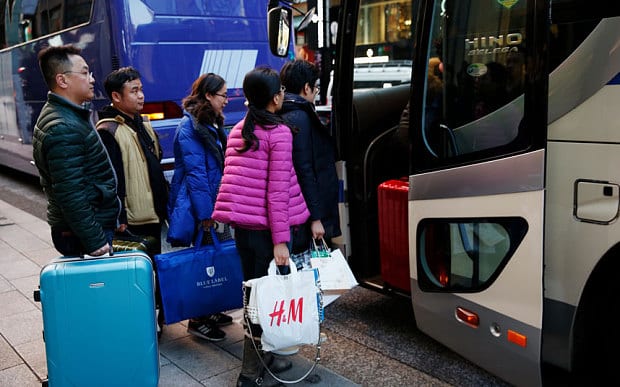
    Hong Kong, Tokyo, Seoul and Singapore were among the hottest shopping destinations for Chinese tourists last year, according to Ctrip. In the latest big-data report from the Chinese travel-services provider, Edinburgh, Singapore and San Francisco were also among the top 10. Last year, nearly 150 million overseas trips were made by Chinese tourists, who collectively spent US$120 billion.

    London was the city that saw the highest per-capita spending by Chinese tourists – more than US$4428 – followed by Paris, Macau, Dubai, Okinawa, Kyoto, Osaka, Nagoya, Hong Kong, Singapore and Fukuoka.

    Europe is still a hot destination for Chinese luxury goods buyers because prices there are much lower than the global average, and a tax-refund system also facilitates sales.

    Despite the recovery of the British pound last year, the UK remained a popular destination for Chinese tourists, said Ctrip.

    Experts noted that Chinese consumers would still be a focus of competition between shopping destinations this year, and many retailers internationally have upgraded their shopping facilities to lure Chinese tourists.

  • AirAsia unveils plans to begin international flights to Vietnam city

    AirAsia unveils plans to begin international flights to Vietnam city

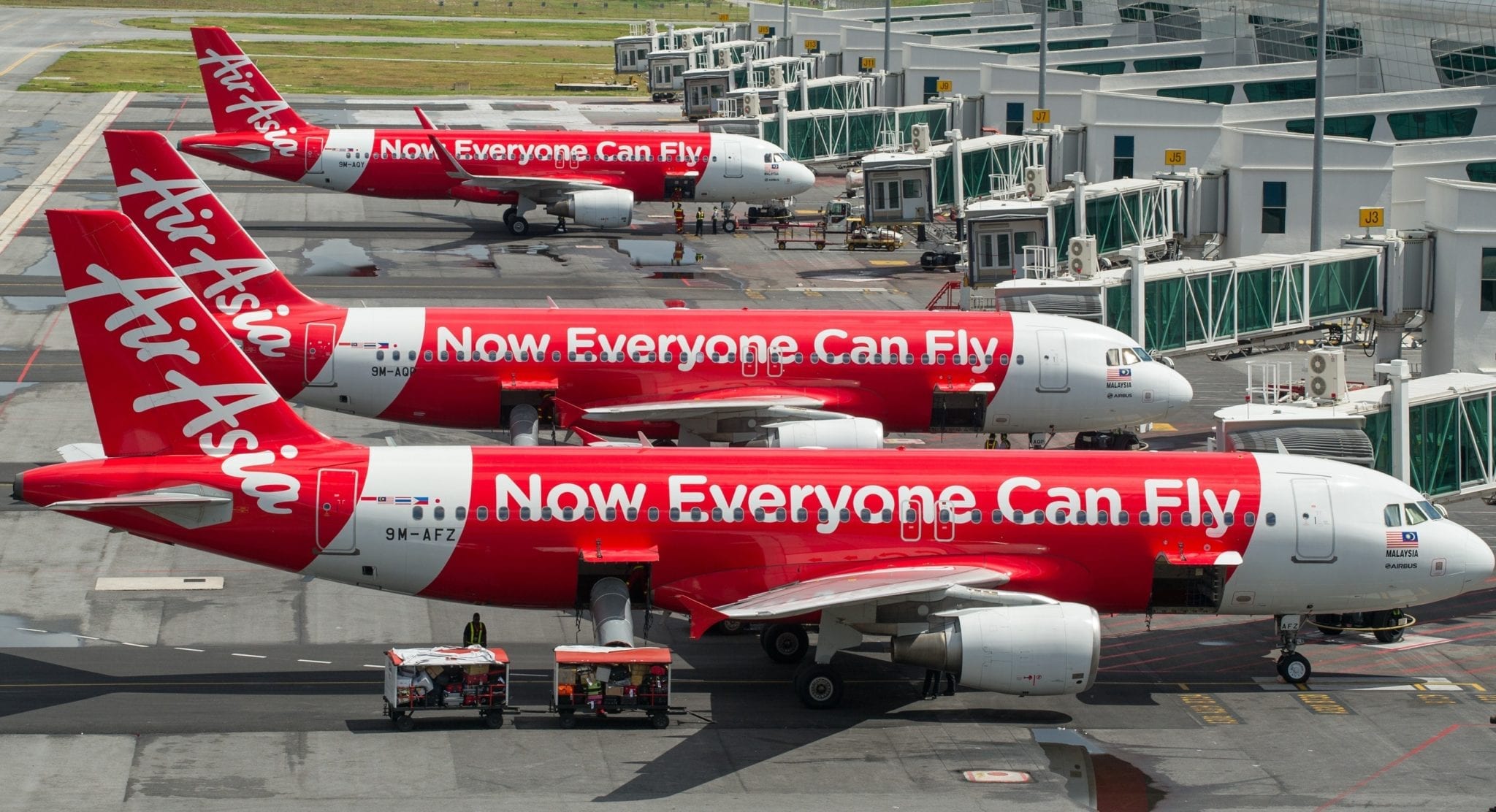
    AirAsia will start flying from Kuala Lumpur and Bangkok to Can Tho in Vietnam’s Mekong Delta in the next few months. The budget carrier has announced it will begin the Kuala Lumpur – Can Tho service on April 8 with four flights a week and the Bangkok – Can Tho service from May 2 with three flights, AirAsia said in a recent statement. Tran Viet Phuong, director of the city’s Department of Culture, Sports and Tourism, told local media that the services would help increase the number of foreign tourists visiting the Mekong Delta.

    He added that visitors from not only Southeast Asia but also from India and Australia would find it easier to reach the city given AirAsia’s network.

    AirAsia Malaysia CEO Riad Asmat said: “We foresee the new route not only contributing to the socio-economic development of the city, but also providing new opportunities for the people in Mekong Delta to connect with ASEAN and beyond through our wide network.”

    According to the Can Tho Tourism Association, 8.48 million tourists visited the city in 2018, a 12.5 percent increase from the previous year.

  • Zen Corporation Thailand completes IPO

    Zen Corporation Thailand completes IPO

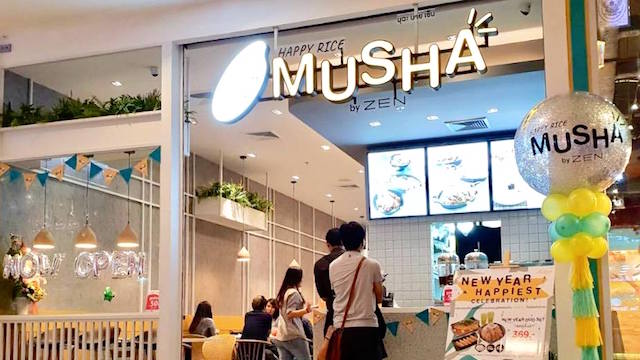
    Thai restaurant operator Zen Corporation secured THB975 million (US$31.35 million) via an IPO issued last Wednesday. The firm sold all 75 million shares on offer, representing 25 per cent of its registered capital, at THB13 each. Its stock price grew 17.69 per cent over the course of its trading debut, as strong demand pushed the value per share up to THB15.30 on the first day.

    Zen Corporation is known for its various restaurant chains, including its eponymous brand as well as Musha by Zen, Sushi Cyu Carnival Yakiniku, AKA, On the Table Tokyo Cafe, Tetsu and de Tummour.

    The firm also operates food delivery, catering, restaurant management and consultancy services, as well as food retail operations.

  • Jollibee Malaysia plans 100 Stores

    Jollibee Malaysia plans 100 Stores

    Philippine restaurant chain Jollibee has announced plans to launch more than 100 Jollibee stores in Malaysia within the next 10 years. According to a report, the openings will include 50 stores in Sabah and Sarawak. President and head of JFC International Business for Europe, the Middle East, Asia and Australia Dennis Flores said that Jollibee would be a “welcome addition to the diversity of the food scene in Kota Kinabalu,” the Sabah state capital.

    “We believe that we can appeal to the diversity as we have seen in other countries where Jollibee has been successful, such as Vietnam, Brunei, Hong Kong and Singapore,” he said at the official inauguration of the Jollibee Malaysia grand store (which has been trading since last year) at Centre Point Sabah this week.

    Chairman and founder of JFC Tony Tan Caktiong said the company was happy with the enthusiastic welcome to the store’s opening from local customers.

    “This has given us an encouragement to reach more Malaysians with our delicious menu and friendly service,” he said.

    Jollibee operates 14 brands in 21 countries with more than 4500 stores worldwide.

  • Allianz Malaysia earnings up 15.3% to RM100m in fourth quarter

    Allianz Malaysia earnings up 15.3% to RM100m in fourth quarter

    Allianz Malaysia Bhd’s earnings increased by 15.3% in the fourth quarter ended Dec 31, 2018 (Q4) to RM100.04 million, from RM86.78 million in the previous corresponding quarter mainly due to higher underwriting profit from motor business arising from lower claims and management expenses. For the quarter under review, the general insurance segment recorded a profit before tax of RM78 million, an increase of 15.7% as compared to the preceding year quarter.

    Meanwhile, the life insurance segment recorded a profit before tax of RM50.3 million, a decrease of 15.5% due mainly to higher group claims.

    Allianz reported a 7.63% increase in revenue to RM1.3 billion in Q4 from RM1.21 billion, driven by higher gross earned premiums and investment income.

    For the full year, its net profit grew 30.9% to RM377.02 million from RM287.96 million a year ago, while revenue was up 7.9% to RM5.18 billion from RM4.8 billion previously.

    The general insurance industry reported a marginal growth of 1.5% in gross written premium for the year ended Dec 31, 2018.

    Allianz said the group anticipates similar trend in the medium-term given the economic uncertainty and subdued consumer sentiments.

    However, it said the general insurance segment will continue to offer innovative products and services in anticipation of a fully liberalised insurance market while further expanding its multi-distribution model to maintain market leadership.

    For the life insurance segment, Allianz will continue to leverage on the strength of its multi-distribution channels and increase productivity across distribution channels to generate growth.

    The group will also continue to focus on optimising the performance of its insurance businesses and expect to maintain satisfactory results in 2019, it added.

  • CLUSE opens its very first monobrand store in Taiwan

    CLUSE opens its very first monobrand store in Taiwan

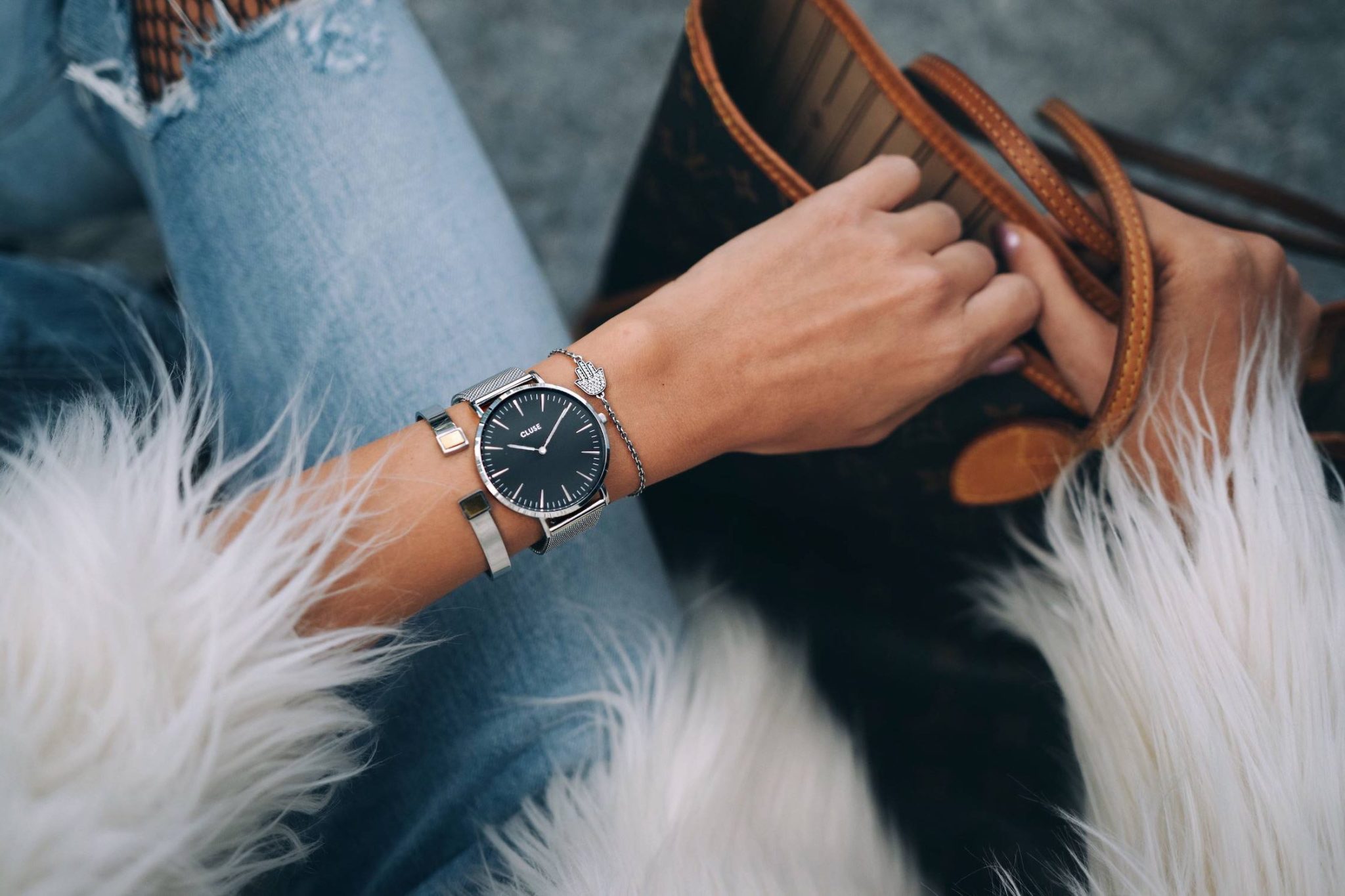
    The Amsterdam-based watch brand renowned for its timeless sophistication and strong focus on materials, quality, and style has just opened its first monobrand store in Taiwan in partnership with Bluebell. This CLUSE monobrand POS is a rotating pop-up in partnership with Eslite, which aims to attract visitors from different cities in Taiwan. This month the pop-up stops at the Eslite Taichung Parklane by CMP Store, 1F.

    CLUSE, created in Amsterdam in 2013 by a team of young and ambitious individuals, is a fast-growing watch brand for the modern and fashionable woman.

    Named after “Cluses”, one of the oldest watchmaking towns in France, CLUSE is able to combine a modern, minimalistic, and elegant design yet remaining faithful to its heritage by crafting authentic, quality analogue timepieces.

    CLUSE was discovered at an early stage by the fashion-loving crowd on social media, and among others, it has acquired worldwide fame on Instagram and Facebook, being recognized as a successful Facebook story for its effective digital marketing strategies.

    Thanks to the profound in-house knowledge of Social Media marketing, a data-driven approach and a clear customer profile based on campaign data, CLUSE has managed to grow to a staggering 1.6 million Facebook fans and 700K Instagram followers within 3 years.

    This success is boosted by CLUSE’s brand ambassadors who are recognized among the most influential kol worldwide like @sincerelyjules and @retroflame who live their life with the same philosophy of the brand.

    Drawing inspiration from minimalist fashion and subtle colours, CLUSE represents the mentality of simplicity of being grounded, empowered, sophisticated and true to oneself.

    CLUSE is designed not only to indicate time, but also to define the best moments in life.

    CLUSE is designed for dynamic and versatile women. One CLUSE watch allows infinite possibilities thanks to the mix&match easily interchangeable straps.

    CLUSE has soon become the most popular lifestyle watch brand in Europe and invested into a high-end network of distributors.

    After expanding in Europe, CLUSE has quickly conquered millennials in different countries, and it led to simultaneously launch in wholesale in Japan, Korea, Malaysia, and wholesale and mono-brand stores in Hong Kong, Singapore, and now Taiwan.

    The latest collection is La Tétragone (this new classic square shape design launched in SS18), and Triomphe (also launched in SS18).

    Following the success of CLUSE timepieces, the brand has started a new adventure into jewelry. Three collections have been created Essentielle, Idylle, and Amourette to translated unique personalities into unique pieces.

    CLUSE is definitely a brand to keep an eye on, strong brand identity,  effective digital marketing strategy, and an army of influencers boosting its brand image.

  • Hong Kong’s Link REIT Buys Shenzhen Mall for RMB 6.6B

    Hong Kong’s Link REIT Buys Shenzhen Mall for RMB 6.6B

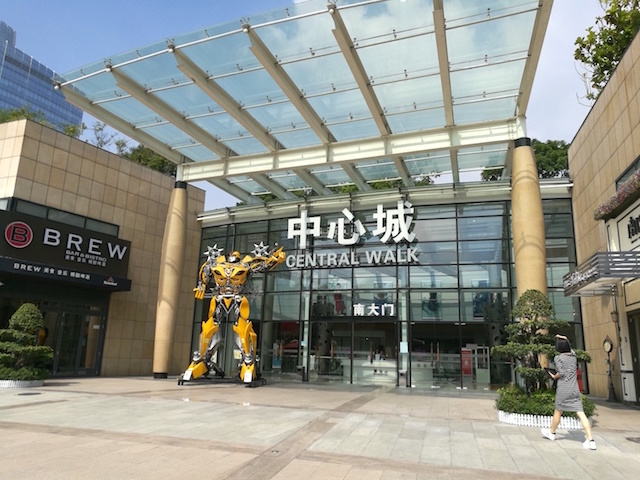
    Link Asset Management has bought the Centralwalk shopping mall in Shenzhen’s CBD via its real estate investment trust. The RMB6.6 billion (US$981.9 million) transaction marks Link REIT’s first acquisition in Shenzhen, the second in the Greater Bay Area and its fifth in Mainland China, all in tier-one cities. Centralwalk is a five-storey retail centre in Shenzhen’s Futian District, home to the South China head offices of Fortune 500 companies, multinational corporations and leading domestic firms. The property sits atop two subway lines, providing a 14-minute link to Hong Kong and less than an hour to most parts of the Pearl River Delta region.

    “The acquisition marks another milestone in our expansion in China,” said Link CEO George Hongchoy.

    “Centralwalk is seated in the heart of the city’s booming commercial hub. It is strategically located at the juncture of two popular subway lines in Shenzhen and within a five-minute walk from the Futian high speed rail station. We see enormous upside potential in this asset as we will apply our expertise in asset enhancement and placemaking to attract footfall to this mall, unleashing its potential as a leisure and entertainment landmark in Shenzhen.”

    Upon settlement of the transaction next month, Link REIT will control approximately 5 million sqft of retail and office space in four tier-one cities on the Mainland: Beijing, Shanghai, Guangzhou and Shenzhen, with Mainland Chinese assets representing about 13.1 per cent of Link’s total asset value.

    “The acquisition will enable us to capture the exponential growth spurred by the high speed rail link and the Greater Bay Area development,” Hongchoy added. “With diversification of markets, we continue to play to our strengths to offer investors steady income and long-term growth opportunities.”

    Centralwalk has a retail floor area of about 903,100sqft, and its retail occupancy currently stands at around 100 per cent. It has a gross monthly passing income of RMB 23.8 million as at December last year.

    The property houses a wide variety of familiar brands and a dynamic mix of retailers, covering food and beverage, fashion, accessories, education, lifestyle, health and beauty, a supermarket and a cinema.

    Link is anticipating the opportunity to enhance the property’s rental reversion and performance through trade-mix and tenant-mix upgrade, given that retail tenancies expiring in 2019, 2020 and 2021 represent approximately 25.5 per cent, 24.8 per cent and 18.0 per cent respectively.

  • Asia markets rally as Trump delays China tariffs

    Asia markets rally as Trump delays China tariffs

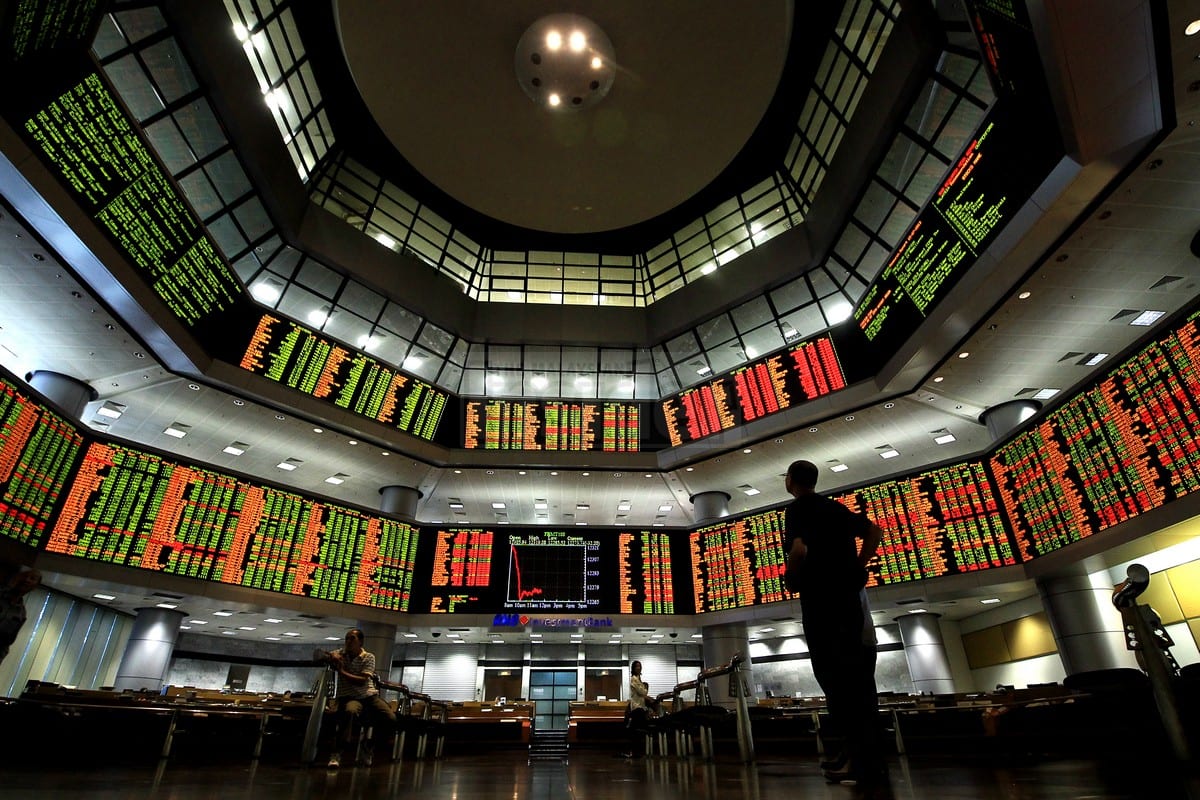
    Shanghai led a rally across Asian markets Monday after Donald Trump said he would delay a hike in tariffs on Chinese goods citing “substantial progress” in trade talks and fuelling hopes of an end to their long-running stand-off. Optimism over the negotiations had already provided support to global equities, spurring a rally in January and February, but the president’s comments gave extra ammunition to investors to ramp up the buying.

    The news also fired currency markets with the yuan extending gains to a seven-month high, while other high-yielding, riskier units were also up against the dollar.

    Trump said on Twitter that the US “has made substantial progress in our trade talks with China on important structural issues including intellectual property protection, technology transfer, agriculture, services, currency, and many other issues”.

    He added: “As a result of these very productive talks, I will be delaying the US increase in tariffs now scheduled for March 1.”

    The president also said he planned to hold a summit with his Chinese counterpart Xi Jinping at his Mar-a-Lago estate in Florida to sign a deal.

    China’s Xinhua news agency added that the two sides had “made substantial progress on specific issues” including on transfer of technology, intellectual property and agriculture.

    ‘Sigh of relief’

    In morning trade, Shanghai jumped 2.8% and Hong Kong added 0.4% while Tokyo ended the morning 0.7% higher.

    Sydney and Singapore each put on 0.1%, while Seoul was flat, Taipei added 0.4% and Jakarta rose 0.3%.

    The gains in Asia followed another positive lead from Wall Street, where the Dow enjoyed its ninth straight weekly gain – the longest streak since May 1995.

    “This is a sigh of relief,“ said Ben Emons, managing director for global macro strategy at Medley Global Advisors. “Markets will still keep a level of caution, but this news is encouraging,“ he said.

    The upbeat sentiment lifted high-risk currencies, with the yuan hitting its highest level against the dollar since July, while South Korea’s won, the Australian dollar and the Indonesia rupiah were also well up.

    Forex traders will be closely watching speeches this week from top Federal Reserve officials – including chairman Jerome Powell’s appearance in front of lawmakers – hoping for clues about the bank’s monetary policy plans.

    Wall Street “will be looking for soothing comments about the future size of the balance sheet – the bigger the better – and insights into future rate hikes”, said Jeffrey Halley, senior market analyst at OANDA.

  • Vietnamese airlines continue to be plagued by pilot shortage

    Vietnamese airlines continue to be plagued by pilot shortage

    With increasing demand for pilots as they expand, Vietnamese airlines have had to raise salaries, spend more on training and hire foreign pilots. Figures from the Civil Aviation Authority of Vietnam show that by 2020 Vietnam will need a total of 2,680 pilots for commercial flights, 1,320 more than now. Vietnam Airlines, the country’s flag carrier, needs to hire 193 more pilots to increase the number on its payroll to 1,293 pilots to meet demand in 2019, according to the carrier’s recent assessment report.

    The assessment forecast the demand to keep rising increasing to 1,340 by 2020 and 1,570 by 2025. This is a challenging number given the increasing shortage of pilots globally, according to industry insiders.

    According to a recent report from Boeing, the global aviation industry will need 790,000 new pilots by 2037, or double the current number, driven by an anticipated doubling of the commercial airplane fleet, record travel demand and tightening labor supply.

    Pilot training has always been extremely expensive, with stringent health and technical knowledge requirements, meaning that the number of pilots qualifying is always limited, according to industry insiders.

    A former Vietnam Airlines pilot revealed that because of the shortage, soon after he gave notice of termination he received many offers from airlines both domestic and foreign.

    He said many other pilots at Vietnam Airlines also constantly offered 15-25 percent higher salaries by head hunters.

    As a result the carrier has been focusing on hiring trainees. Duong Tri Thanh, its general director, said given the global shortage of pilots and carry out its expansion plans in time, Vietnam Airlines has been training internally and recruiting foreign pilots despite high costs.

    Similarly, Jetstar Pacific or Vietjet Air are facing difficulties filling their vacancies with pilots when trying to rapidly expand in South Korea, Japan, and other countries in Southeast Asia. Currently, the number of pilots at these firms is largely foreign due to limited domestic supply. Typically, at Jetstar Pacific, foreign pilots account for 80 percent of their fleet.

    However, foreign pilots can be hard to come by since many other companies in Asia can offer them better remuneration and working conditions.

    An aviation expert said airlines need to combat the pilot shortage by investing in training facilities and recruitment programs and subsidizing training for pilot trainees.

    Vietnam’s aviation industry has been growing rapidly in recent years. There were 12.5 million air passengers last year, up 14.4 percent from 2017.

    The number of flights in the country grew by 16 percent on average between 2010 and 2017, according to official data.

    Vienam’s five airlines are Vietnam Airlines, its low-cost carrier Jetstar Pacific, budget airline Vietjet Aviation, Bamboo Airways and Vietnam Air Services Co.