Tag: Business

  • T-Hub, Uber launch T-Bridge startup platform

    T-Hub, Uber launch T-Bridge startup platform

    Indian startup incubator T-Hub has joined hands with ride sharing pioneer Uber and TiE Silicon Valley to launch a program that will connect Indian startups with global market opportunities and help bring global new-age companies to the country.

    A press release issued by the startup incubator T-Bridge said that the program will enable startup communities in India and globally to cross-pollinate ideas, innovate and create channels for knowledge transfer. It will also create a network of mentors, VCs, incubators and accelerators that will support the Indian startup ecosystem.

    K T Rama Rao, Telangana Minister for IT on Saturday inaugurated T-Bridge at Uber’s headquarters in San Francisco.

    T-Bridge will provide a platform for such fast-track tech companies looking to tap into India’s huge consumer market for technology and help startups access UberExchange-Uber’s flagship startup mentorship program and TiE Silicon Valley’s mentor network.

    “We have a strong vision to make Hyderabad one of the top 10 startup cities in the world. T-Bridge is one such move towards opening a channel of investment from the world to the state of Telangana. I am proud to open our first outpost in the US in association with Uber and TiE Silicon Valley and believe that this association will forge new partnerships and spur investment and innovation between the two countries,” Rama Rao said at the launch.

    Rachel Whetstone, Uber’s senior vice president for policy and communications, said, Telangana is one of the most progressive states in India; and it has set up a culture of ‘regulatory incubation’ – allowing new ideas and business models to thrive.

    “Today more and more people around the world want to build something themselves. Through initiatives like UberExchange, our mentorship program for Indian startups, we hope to spur entrepreneurship. Creative partnerships like T-Bridge will continue to strengthen ties between India and the global startup scene,” Whetstone said.

  • Government Proposes Business Travel Card for Indian Ocean Countries

    Government Proposes Business Travel Card for Indian Ocean Countries

    The Chairman of the Indian Ocean Rim Business Forum (IORBF), who is also the Deputy Head of Maritime Affairs and Fisheries Division at the Indonesian Chamber of Commerce, Yugi Prayanto, has proposed to introduce a business travel card for all members of the Indian Ocean Rim Association (IORA).

    “The IORBF needs to come up with a concrete initiative to improve economic cooperation and business in the Indian Ocean region,” Yugi said here on Friday.

    He pointed out that the IORBF meeting, led by Indonesia and South Africa, aims to improve interaction and cooperation among IORAs businessmen and its dialogue partners in order to develop cooperation in economy, trade and investment in the Indian Ocean region.

    “The IORBF agrees that economic cooperation opportunities need to be explored further and these include the IORA Comprehensive Economic Partnership Agreement (IORA-CEPA ) and IORA Business Travel Card (IBTC),” Yugi noted.

    These initiatives are supported by IORA member countries, among others, South Africa, Australia, India, Indonesia, Kenya and Mauritius.

    According to him, the forum agrees that the establishment of IORA-CEPA is very important to improve economic cooperation, trade and investment in the Indian Ocean region.

    The IORA-CEPA, Yugi pointed out, is expected to become an umbrella for IORA economic cooperation in order to increase trade and investment, open market access, develop industry as well as strengthen regional value chain and structural reforms.

    Meanwhile, the IBTC, he underlined, is expected to ensure mobility of entrepreneurs and facilitate business interaction among the IORA member states.

    “The IBTC in time will strengthen people-to-people contact, including business-to-business links among IORA member nations,” Yugi stressed, adding that the IORBF really hopes these two initiatives will be discussed at the 20th Anniversary Commemorative Summit of IORA meeting in March 2017.

    He added that the agreements reached at this meeting will be reported to the Committee of Senior Officials on October 25-26, 2016 and to the Council of Ministers on October 27, 2016.

    Forty businessmen from various IORA member countries are participating in this 22nd IORBF meeting.The IORA focuses on economic, trade and investment cooperation. It comprises 21 countries, namely, South Africa, Australia, Bangladesh, India, Indonesia, Iran, Kenya, Madagascar, Malaysia, Mauritius, Mozambique, Oman, the United Arab Emirates, Singapore, Seychelles, Somalia, Sri Lanka, Tanzania, Thailand, Comoros and Yemen.Australia passed on the chairmanship of IORA to Indonesia in 2015. Indonesia is the IORA Chairman for 2015-2017.

  • New MoU Promotes Hong Kong-India Business Links

    New MoU Promotes Hong Kong-India Business Links

    The Hong Kong Trade Development Council (HKTDC) today signed a Memorandum of Understanding (MoU) with its counterpart in India, the India Trade Promotion Organisation (ITPO) to strengthen economic partnership between Hong Kong and India and increase bilateral commercial activity, especially for small and medium-sized enterprises from both places.

    Win-win for Hong Kong and India

    “This MoU reflects the growing desire for deeper business links between India and Hong Kong, with our city serving as the gateway to the Chinese mainland and Asia for Indian companies. At the same time, Hong Kong enterprises see huge opportunities in India,” said Margaret Fong, Executive Director, HKTDC. “Closer cooperation between the HKTDC and ITPO will produce a win-win result for our business communities.”

    Ms Fong and LC Goyal, Chairman and Managing Director, ITPO, signed the MoU in Hong Kong. The agreement fosters cooperation in areas of mutual interest, including providing each other with information related to trade promotion activities, encouraging businesses to join events organised by the HKTDC and ITPO and identifying potential products and markets.

    “Both organisations reaffirmed their resolve to identify and promote key sectors under the ambitious ‘Make In India’ flagship initiative of the Government of India,” said Mr Goyal. “The partnership will also open new areas of growth for trade with ASEAN countries.”

    Long and strong business links

    Hong Kong and India enjoy close and strong bilateral ties formed over more than 150 years of business and cultural links. In 2015, India was Hong Kong’s fourth-largest export market with total exports to India expanding 8.1 per cent year-on-year to US$13.1 billion. On the other hand, India was Hong Kong’s ninth-largest source of imports in 2015, amounting to US$10.6 billion. India is Hong Kong’s seventh-largest trading partner globally with bilateral trade of US$23.7 billion last year.

    HKTDC & ITPO: a mutual mission to promote trade

    Established in 1966, the HKTDC is a statutory body in Hong Kong dedicated to promoting Hong Kong’s trade in goods and services. The HKTDC organises more than 30 major international trade fairs in Hong Kong each year. ITPO is the trade promotion agency of the Ministry of Commerce and Industry of India. ITPO provides a wide spectrum of services to trade and industry and acts as a catalyst for growth of India’s trade.

  • Singapore’s services industry business receipts edge up 0.4% in Q2

    Singapore’s services industry business receipts edge up 0.4% in Q2

    Singapore’s services sector saw a mixed performance in the second quarter with overall revenue edging up 0.4 per cent year on year.

    This is according to the latest business receipts index, released on Friday (Aug 26) by the Department of Statistics Singapore, which excludes wholesale & retail trade and accommodation & food services.

    The health & social services industry reported the largest revenue growth of 7.7 per cent in April-June quarter from the same period a year ago.

    Other industries with higher business receipts included education services (5.0 per cent) and information & communications services (1.4 per cent).

    Industries that saw lower turnover included transport & storage services (-2.2 per cent) and recreation & personal services (-1.6 per cent).

  • Hogan Lovells launches mobile app for doing business in Indonesia

    Hogan Lovells launches mobile app for doing business in Indonesia

    Hogan Lovells (in association with Dewi Negara Fachri & Partners) has launched an innovative new app called “How To Indo” to help businesses navigate the legal landscape when doing business in Indonesia.

    The app will change the way that anyone doing, or considering doing, business in Indonesia can access relevant legal guidance.

    Anyone with an Apple or Android device will be able to access key guides on what you need to know about doing business in Indonesia. From M&A and infrastructure transactions to Hogan Lovellsfinancing arrangements, from restructuring and insolvency to managing a dispute, these guides cover the key legal issues in doing business in Indonesia.

    Mark Cooper, Corporate Partner, Singapore said:

    “We hope that this innovative product leads the way in helping clients to navigate the regulatory landscape in Indonesia and makes it easier for them to take informed business decisions.”

    The app is available to download today:

    Click here to download the Apple version.

    Click here to download the Android version.

  • Myanmar businesses want policies

    Myanmar businesses want policies

    There are concerns the new government, which took office in April, has not yet revealed its economic policies. Businesses are also concerned that if the policies further open up the economy, some companies would not be ready for potentially intense foreign competition.

    At a panel discussion of the Economist Events’ Myanmar Summit 2016, Sai Sam Htun, executive chairman of Loi Hein Co, the No 1 beverage firm in Myanmar and the producers of Alpine drinking water, said local business were showered with optimism and challenges.

    “Currently, local business people are worried,” he said. “We expect the government to come up with the road map, model and vision for the country. We expect that as soon as possible. Otherwise, we are in the dark and do not know where to go, what to do and what will happen in the future.”

    He welcomed the national agenda to achieve reconciliation, but that should not be the single priority.

    “The new government brings us to the road to democracy, but that doesn’t guarantee that everything will be smooth,” he said. “We are expecting our leader Daw Aung San Suu Kyi to say something about the future economy of Myanmar.”

    Kyaw Win, planning and finance minister and chairman of the Myanmar Investment Commission, said the policies should be revealed by the end of this month.

    Win Win Tint, chief executive officer of City Mart Holdings, the nation’s largest retail chain, noted that Myanmar needed to consider whether foreign investment should be allowed in trading, the services industry and retailing.

    Currently, Myanmar’s retail industry is fragmented. Modern trade accounts for only 10 per cent of the retail industry, compared to 45 per cent in Thailand and 25 per cent in Vietnam.

    There is a huge growth potential, but poor infrastructure and low consumption may hold back the potential growth. Suppliers are still unable to support retailers, pushing the ratio of imported products to 80 per cent.

    “One thing we always tell our policy-makers is that local businesses are not on a level-playing field,” Win Win Tint said. “If the MIC allows foreign players in these industries, they will enjoy tax incentives and access to overseas financing.”

    She added that the old foreign investment law did not take local business interests into consideration.

    Sai Sam Htun, however, is not afraid of foreign players. He recalled the situation a few years ago when all businesses fretted about the entry of foreign players.

    “I was quite scared that I would be out of business. But I aggressively worked on the branding aggressively,” he said. “If you are in the market, you just have to be consistent. Then you can compete with any competitor and face any challenge.”

    He noted that foreign and local businesses could have win-win strategies. Foreign companies like Coca-Cola, PepsiCo and multinational beer companies have successfully forged partnership with local players.

    Loi Hein has formed four joint ventures with foreign companies – two each with Japanese and Thai counterparts.

  • Chow Tai Fook casino interests expand

    Chow Tai Fook casino interests expand

    Hong Kong jewellery retailer Chow Tai Fook Enterprises is diversifying into gaming, and is lead partner in a three-way joint venture developing Vietnam’s second integrated resort casino.

    After a prolonged delay, work has started on the $4 billion project’s first phase, in the UNESCO heritage city of Hoi An in Quan Nam province.

    Also involved in the Nam Hoi An Casino Resort are Vietnamese investment banking firm VinaCapital and Macau junket company SunCity Group. Chow Tai Fook acquired VinaCapital’s majority holding last September, although VinaCapital has announced it will boost its stake from 22.5 to 32 per cent, and also has a major stake in SunCity.

    Chow Tai Fook casino interests in Vietnam, through its New World Development unit, already include two large hotels in Ho Chi Minh City, the New World and the Renaissance Riverside. Three hotels will be included in the Hoi An development.

    Including resorts, an amusement park, golf course, premium villas and apartments, the first phase of the Hoi An project will cost about $500 million and should be completed early 2019. It covers 160ha. The only other integrated resort in Vietnam offering high-end gaming for international tourists is the larger Ho Tram Strip resort near Vung Tau, a beach settlement near Ho Chi Minh City.

    While the Nam Hoi An resort was licensed in 2010, VinaCapital’s original JV partner Genting Malaysia dropped out of the project two years later after deciding that the government’s demand for a minimum US$4 billion investment threshold was too steep considering the property’s gaming options would not be available to local residents.

    Chow Tai Fook, meanwhile, has been aggressively seeking out diversification via casino projects. The company has a stake in The Star Entertainment Group’s $3 billion resort casino project in Brisbane, and in November the Korea Herald reported that Chow Tai Fook had signed a letter of intent to invest $1.6 billion in creating a casino resort at Incheon, near Seoul.

    Chow Tai Fook is a privately held conglomerate controlled by the family of Hong Kong businessman Cheng Yu Tung, Hong Kong’s fourth-richest person who is a longstanding business partner of Stanley Ho Hung Sun, a founder of Macau casino investor SJM Holdings. For the Vietnam project, Chow Tai Fook is working through its entity Gold Yield Enterprises.

    Reuters has quoted industry analysts as saying that Vietnam is within easy reach of wealthy Chinese who provide the lion’s share of gaming revenue in Asia.

  • Indonesia eyes US$9 billion in fruit, flower business

    Indonesia eyes US$9 billion in fruit, flower business

    The Agriculture Ministry is aiming to increase the value of Indonesian flower and fruit farming by Rp 120 trillion ( US$9 billion ) by pushing promotion, revitalizing plantations and boosting local fruit consumption.

    Indonesian fruit exports reached $37 million in 2015, a 30 percent increase from $28.9 million in 2014, said Agriculture Minister Amran Sulaiman.

    Indonesia’s main export crops are bananas, oranges, mangoes, papaya and pineapples, with the US, the United Arab Emirates, Singapore, China, Hong Kong, Spain and the Netherlands as the main destination countries.

    “Our fruit exports continue to increase on top of meeting our local demand,” Amran said at his office in South Jakarta, during the soft launch of the ‘Fruits and Flowers International Festival’ scheduled to run from November 17 to November 20 in Bogor, West Java.

    Meanwhile, Indonesia’s main export flower varieties are orchids, roses, jasmines, chrysanthemum and tuberoses.

    To increase fruit production, the government will provide 400,000 hectares of land in Sumatra, Java, Kalimantan and Sulawesi. The program has started with 100,000 hectares in cooperation with state-owned companies.

    Rector of Bogor Agriculture Institute ( IPB ) Herry Suhardiyanto said Indonesia must step up its fruit production to the plantation scale, focusing on 12 fruit commodities, including durian, orange, papaya and pineapple.

    “Fruits can be an instrument for food diversification that will make Indonesia the largest tropical fruits producer in the world by 2045,” he said, adding that the upcoming international festival could help achieve this objective.

    The four-day festival will feature 500 international trade visitors including importers, distributors and wholesalers from Asia, the United Arab Emirates, Australia, New Zealand, Europe and the US.

    It will also display seeds, fruits, flowers, flower and fruit products, agriculture equipment. It is expected to attract 10,000 visitors.

    In addition, there will be activities such as business matching, conference, export business coaching, a carnival and fruit and floriculture contests.

  • Tips on starting a business

    Tips on starting a business

    The fun really begins now, as there is so much to learn about starting a new business. There is a lot of preparation and risk involved in starting out in a new venture. There are a lot of options available for you to look into, as you start your venture as an entrepreneur. I must admit it takes a lot of courage and want, to succeed and to create a viable business. There is no point in creating a business if you are not prepared to give it your all. The risks involved are far too high, to take a step into a new business venture light heartedly. I’m not trying to scare you but merely emphasize, what to expect if you decide to take on the challenge.

    Create a Business Plan

    It is imperative that you create a business plan before you start your venture. A business plan is like a road map to your success. You will find that there are many different areas that you should have a firm understanding of. A few examples of this include a Marketing plan, Equipment list, suppliers list and a list of processes for your daily operations. These are just a few areas you should be looking into and there is a lot more preparation required for a successful business. There is a number of ways you can set out your business plan there issoftware and templates available. The main thing is that you have one!

    Don’t Over Capitalize

    The best way to start a business is to start out small and dip your toe in so to speak. The advantages to testing your market will ensure you do not end up in a hole, with nothing to show. There is a lot of successful businesses. Which have started out with a very minimal investment a great product and a great business strategy.

    Understand the Nature of What you are Selling

    It is a good idea to enter an area of business where you have experience. The obvious upside to entering a business that you know a lot about is the rate of failure will be lower. Imagine for a second that you have a great idea started investing your time and hard earned savings, to find that you had no idea what you were doing . You may not be able to sustain the business based on your turnover. A lot of your learning would be now coming from on the job learning, which can be quite costly.

    If you had experience already around certain areas of the business you were starting, you would eliminate a large part of the risk. So in basic terms the more you know in advance to your commencement, obviously the less risk involved. Business is all about eliminating the levels of risk associated with it. There will always be risk but you must manage it efficiently to succeed.

    Market your Business Effectively

    Your business obviously must be marketed to your audience. Now there is no point marketing to an audience that is not receptive to your product. For instances if your selling men’s business shoes, you want to market to business men. The chances of selling those men’s business shoes to truck drivers, will be quite minimal. I hope you understand the point I am trying to outline.

    Once you have indentified your market, then it’s time to test different ways of marketing. Most of the best entrepreneurs try small efforts, in different areas tweaking to maximize results. Marketing is a complete topic on its own and needs to be looked at very thoroughly if you are to succeed. In saying this there are some very cost effective ways, available to start marketing your business.

    Read as Much Literature as you Can

    If you are dedicated to your success and follow your dreams then you will succeed. We are in the information age and can access a great wealth of information from basically anywhere. The best part is a lot of this information is FREE. We must constantly learn from investing time, in advancing our knowledge to succeed. Remember that Rome wasn’t built in a day and that you don’t need to go it alone. Many people have already made the mistakes, you just need to learn from them and tailor it to your own situation.

  • Filipino Business Community in Indonesia Launches Business Club

    Filipino Business Community in Indonesia Launches Business Club

    The Filipino business community in Indonesia has launched the Philippine Business Club Indonesia (PBCI), a business association representing private sector interests to promote and strengthen business, economic, and socio-cultural ties between the Philippines and Indonesia.

    “I am very optimistic about the potential of this business association, and we look forward to the activities and projects that the PBCI will undertake this year and in the coming years to ensure that its members can take advantage of new avenues for trade, investment, and economic cooperation between the Philippines and Indonesia,” Deputy Chief of Mission of the Philippine Embassy in Jakarta Robert Manalo stated at the launch here recently.

    The initiative signals the Filipino communitys greater commitment to building a stronger and strategic relationship with Indonesia.

    “Indonesia is the largest market in the ASEAN, representing almost half of its population. With the implementation of the ASEAN Economic Community, we are facing a historic opportunity to support a vital and growing Philippine private sector, one whose expanding interests show a more global outlook amid the economic integration in the region,” remarked Antonio Capati, chairman of the PBCI.

    The PBCI will endeavor to promote, strengthen, and foster cooperation and collaboration among its members in pursuing the commercial and social interactions of companies, individuals, and organizations dedicated to the development of trade, investments, and people-to-people cooperation between the Philippines and Indonesia.

    The PBCI will work closely with the Philippine Embassy and the Philippine Trade and Investment Center in Jakarta, business chambers, respective public and private sectors, and other key stakeholders in the Philippines and Indonesia to realize its objectives. The club will host seminars, conferences, trade & investment briefings, trade missions, matchmaking, and networking events.

    Additionally, the club will undertake special projects to contribute to business and social development in the Philippines and the ASEAN.

  • Vodafone India aims to double SME base in Bangalore

    Vodafone India aims to double SME base in Bangalore

    Vodafone India has outlined a strategy aimed at doubling its SME customer base in Bangalore, known as the Silicon Valley of India.

    Vodafone Business Services announced a three-pronged plan to increase its SME coverage in the state of Karnataka – particularly capital Bangalore (Bengaluru) – and across India.

    The three spokes of the strategy are coverage, intelligence and automation. Coverage involves widening the company’s ecosystem of channel partners and advanced resellers.

    Automation will involve making it easier for SMEs to do business with Vodafone through initiatives involving opening a system access partner portal. Intelligence will involve launching six new services tailored for specific industry verticals, to complement the six already launched.

    In addition Vodafone will use the newly launched VBS cloud platform to provide SaaS to Indian SMEs. The operator has also introduced Ready Business 2.0 – an integrated suite of Vodafone communications services designed to help SMEs find answers to business problems.

    “Vodafone Business Services will help growing businesses become ready for their next phase of growth. Our newly launched cloud platform will act as a one-stop shop for SMEs for all their ICT related business needs,” VBS national head for SMEs Ajay Sehgal said.

    “With our Ready Business 2.0 proposition, our fixed, mobile and cloud solutions can empower SMEs in scaling up faster, enhancing operational efficiencies and building a more connected and productive workforce, thus making their business more responsive to customers.”

  • Korean investors to venture in sea transport business in Indonesia

    Korean investors to venture in sea transport business in Indonesia

    An investor from South Korea wants to invest US$80 million in shipping business in Indonesia, the Capital Investment Coordinating Board (BKPM) said.

    The unnamed investor is especially interested in operating liquefied natural gas (LNG) tankers, BKPM chief Franky Sibarani said.

    The Korean investor hoped to operate two LNG tankers in the country, Franky, who visited South Korea recently, said here on Saturday.

    The Korean investor also opened the possibility of building terminal for gas storage, he said.

    He said the prospective investor plans to visit the county to look for local partner to operate the business.

    “We are not only interested in the size of investment but more important is the added value created by the investment,” he said.

    The investor also indicated interest in President Joko Widodos vision of developing sea toll, he said.

    “The program is seen as positive in contribution to the countrys development in general,” he added.

    He said South Korea is one of the countries actively increasing investment in Indonesia.

    South Korean investment implemented in 2015 alone reached Rp15.1 trillion in 2,329 projects. From 2010 to 2015, Korean investment in the country totaled Rp79.6 trillion.

    “In the past five years, South Korea has continued to rank among five largest investors in the country,” her added.

    Korean investment commitments were worth US$4.6 billion in 2015 or an increase of 86 percent from 2014.

  • 2016 Chinese business gets off to a roaring start in Korea

    2016 Chinese business gets off to a roaring start in Korea

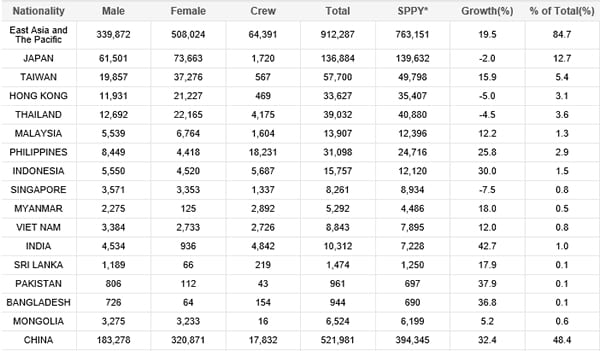
    The Chinese tourism and travel retail business began with a bang in January with arrivals up by +32.4% year-on-year to 521,981, according to Korea Tourism Organization.

    The growth is all the more impressive for coming off a strong base. January 2015 saw a similarly robust +32.9% rise to 394,345.

    Departures by Koreans also rose strongly, up +15.1% in January to 2,112,337, following an impressive +20.1% increase in 2015.

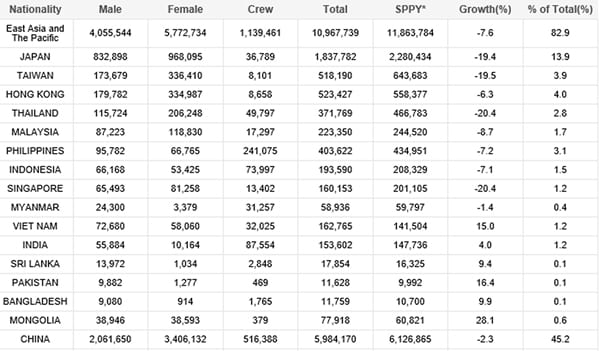
    The January figures will be much welcomed by Korean travel retailers after a difficult 2015 caused by the mid-year MERS crisis. Chinese arrivals dipped by -2.3% last year, a fall driven entirely by the catastrophic slump in tourism from June through August.

    Japanese visitor arrivals remained soft in January, falling -2.0% to 136,884, following a -19.4% fall in 2015.

    For 2015, Chinese visitors accounted for 45.2% of all arrivals, with the once dominant Japanese representing a mere 13.9% share.

    Visitor arrivals by gender for January; Source: Korea Tourism Organization
    Visitor arrivals by purpose and nationality for January; Source: Korea Tourism Organization
    Outbound departures of Korean nationals by gender for January; Source: Korea Tourism Organization
    Visitor arrivals by gender for 2015; Source: Korea Tourism Organization
  • Pertamina Woos Myanmar Retail Fuel Business

    Pertamina Woos Myanmar Retail Fuel Business

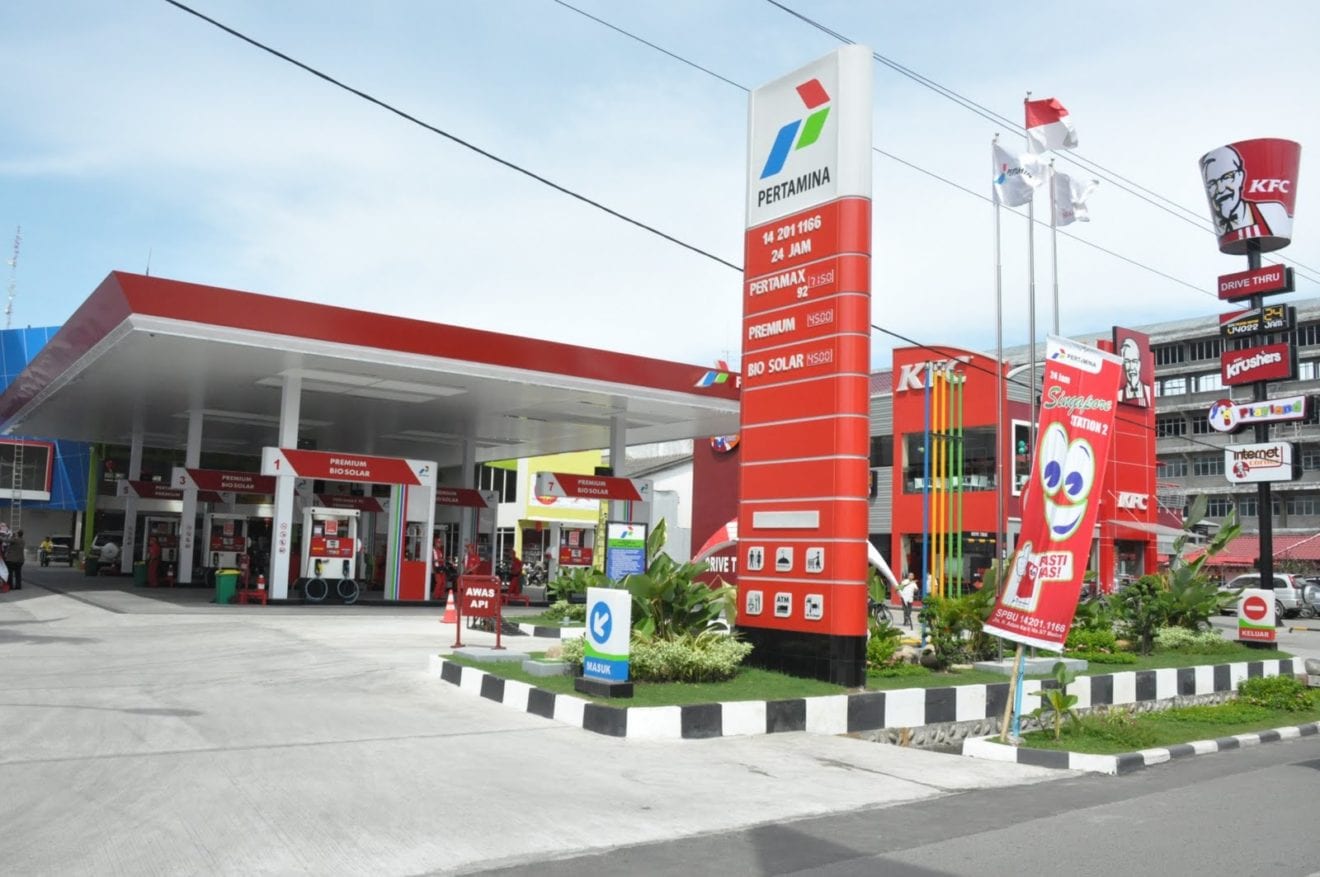
    Under the bidding proposal, Pertamina and MPPE would establish a joint venture to sell co-branded oil fuels.

    Pertamina would operate 18 fuel depots and 12 fuel stations across the Mekong country through the joint venture, Ahmad said.

    “We would invest $33 million for the project,” he said, adding that the deal would also open an opportunity for Pertamina to sell fuel to other independent fuel stations across Myanmar.

    Pertamina is also considering an offer from a Cambodia firm to sell fuel in the country. In Cambodia, Pertamina could sell its fuel under Pertamina brands and operate its own fuel station, but it could not have a fuel depot, Ahmad said.

    The state energy company have been trying to expand its downstream business abroad, in particular in the Southeast Asian countries.

    “Our targets is the developing countries because it’s easier to secure permits there compared to the more developed countries,” Ahmad said.

    Rini Soemarno, the State-Owned Enterprise Minister, said earlier that she targeted Pertamina to branch out to at least one of the Mekong countries by 2018.

    Pertamina has Pertamina International Timor, a joint venture with 4-Consortio Timor Progresso, to sell oil fuel, lubricants and liquefied petroleum gas in Timor Leste.

    The state energy company virtually controls Indonesia’s retail oil fuel market, thanks to its vast distribution network across the archipelago. That despite the government has opened the sector to foreign firms like Dutch’s Shell, Malaysia’s Petronas and French’s Total for more than a decade.

  • Peruri expands operation to digital security business area

    Peruri expands operation to digital security business area

    The Indonesia state-owned money printing company Peruri has expanded operation to digital security business area in preparation to enter the era of integrated smart security to be competitive and able to keep pace with the modernization.

    “In order to have greater competitiveness in digital era we are expanding our wings to digital security that we could provide an integrated smart security service,” President Director of Peruri, Prasetio, said here, Thursday.

    The expansion is prompted by the rapid advancing technology that necessitated change in the world economic system that forces Peruri to continue to expand from service to business model, he said.

    “We are not only strengthening our core business of money printing , but we are also expanding operation to digital security business area through our subsidiary Peruri Digital Security by providing solution such as Certificate Authentication and Smart Card,” he said.

    Peruri also has a strategy in entering the era of integrated smart security, which is centered in transformation of company including transformation of human resources, business , structure and system as well as culture, according to him.

    “With the transformation we hope Peruri could continue to chalk up positive growth in the coming years,” he said.

    In a bid to achieve the positive growth, this year Peruri will be focused on market expansion, promoting reputation and strengthening competitiveness, he added.

    The strategic steps include reorientation of market from formerly focused only on domestic market to global market, and restructuring parent and subsidiaries to be more effective in marketing, he said.

    “Another strategic step is reorganization to be in line with the 2016 company budget working plan and long term business road map,” Prasetio said.

    With the strategic steps and preparation made ahead of the era of integrated smart security, the company is set to contribute significantly to the countrys economic development, he said.

    Peruri chalked up around Rp3.051 trillion in income in 2015 or more than doubling income of Rp1.39 trillion in the previous year.

    Its net profit rose to Rp284 billion or an increase of more than ten times from Rp23.49 billion in 2014.

    The company signed a memorandum of understanding to improve synergy with a number of state construction companies including construction companies — Adhi Karya, Amarta Karya, Brantas Abipraya, Hutama Karya, Istaka Karya, Pembangunan Perumahan, Nindya Karya, Perum Perumnas, Waskita Karya and Wijaya Karya.

    It also signed MoU with state-owned telecommunication company to develop digital business.