Tag: Coles

  • Coles targets health-conscious Aussies with private label

    Coles targets health-conscious Aussies with private label

    Supermarket giant Coles is targeting the 40 percent of Australians seeking healthier food choices with the launch of a new private label health food range.

    Wellness Road aims to provide customers with  “uncomplicated, nutritionally balanced” options to make meals more nutritious.

    The new range comprises 28 products including organic foods, seeds, flour, grains, noodles, and oil.

    “Industry stats suggest that the health food aisle is growing twice as fast as retail food sales overall,” a Coles spokesperson said.

    “Wellness Road is about our strategy at Coles of lowering the cost of living for Australians and how we give them better quality foods at lower prices.”

    Coles has designed Wellness Road to make healthier eating more accessible and affordable to customers of all ages.

    “From teenagers through to those in their 60s and 70s our customers are telling us that they want to eat less processed foods and cut back on sugar and salt,” the spokesperson added.

    The supermarket giant has been making waves this week that Coles is taking a two-pronged approach to gain market share and grow sales, with some stores to be reformatted towards convenience, with a bigger range of ready-to-eat meals, and some stores to be reformatted towards value. Managing director Steven Cain is expected to unveil the strategy next month.

  • Coles reshaping 200 stores around convenience

    Coles reshaping 200 stores around convenience

    Coles is ramping up its convenience strategy, with a plan to grow sales on the back of “food-for-now” and “food-for-later” products. As part of this strategy, the brand will convert around 200 Coles supermarkets to a more premium, convenience-focused format, as shift 200 lower-volume stores to a more value-centric format, while adding around 75 new product lines to its existing range for ready-to-eat meals – such as breakfast foods, curries, soups, roast vegetables and stir-fry kits.

    According to the report, Coles chief executive Stephen Cain sees an opportunity through this strategy to grow another billion dollars in sales over the next five years.

    “It’s high growth and it mainly happens outside supermarkets at the moment,” Cain told.

    “Some of it will come from other players in the convenience market, but because it’s value-added it’s also growing the market as well.”

    Cain previously told analysts that the brand was changing rapidly in the space, but was still lagging behind the competition.

    “We are growing our baskets, and we are growing our transactions. We believe that we can do a better job with the convenience customers, and we’re setting up the business to do that going forward,” Cain said.

    Coles’ focus on convenience is not surprising, given the number of partnerships it has forged with third parties, since splitting from former-parent company Wesfarmers in late 2018, to ensure customers can get its products how they want when they want.

    Deals with online marketplace eBay and meal-delivery service Uber Eats are other incentives for Coles to improve its food-for-now and food-for-later offerings by allowing several pillars of the business to utilize the expanded range.

    “Making life easier for our customers means enabling our customers to fulfill their shopping needs ‘anytime, anywhere’,” a Coles spokesperson said.

    “We know our customers’ needs are changing rapidly and we are evolving our offer accordingly.”

    The convenience market is growing rapidly in Asia Pacific, with the region having been named the “largest and fastest-growing” convenience market in the world in a report by GlobalData.

    According to GlobalData retail analyst Honor Strachen, the changes being seen in the region’s convenience offers, such as those outlined by Coles, have been improving store sales and profitability at a time that retail space is becoming more expensive, and margins are increasingly under pressure from inflation and discounting.

  • Coles launches reusable container for at Home

    Coles launches reusable container for at Home

    Coles is encouraging customers to reduce food and plastic waste at home with its latest promotion, which is this time aimed at adults.

    The Coles Fresh Food Container Program, offers ‘container credits’ when customers spend $20 or more using flybuys online or in-store.

    The credits can be redeemed for a range of five reusable containers from 600mL to 1.5 litres, as well as a specially-designed vacuum pump. The containers are made from durable polypropylene and can ultimately be recycled in a kerbside bin at the end of their life.

    “We know our customers want to reduce food waste for environmental and family budget reasons, and these reusable containers are a great way to keep food fresh in the fridge or pantry without the need for more single-use plastic,” Coles chief operating officer Greg Davis said in a statement.

    The supermarket giant has removed 1.2 billion single-use plastic bags from circulation since they were phased out last year and has diverted more than 542 million pieces of flexible plastic from landfill since 2011 through its recycling partnership with REDcycle.

    “This is a great initiative by Coles to reduce food and plastic waste. When food waste ends up in landfills it produces methane – a powerful greenhouse gas that contributes to climate change. By shopping wisely and storing food in air tight reusable containers we can all do our bit to help the environment and save money, ” Paul Klymenko, CEO of environmental organisation Planet Ark, said.

    The promotion is available in-store running between April 24 and July 2.

  • Coles scores exclusive deal with the world leader

    Coles scores exclusive deal with the world leader

    Supermarket giant Coles has entered into an exclusive services agreement with the world’s leading online grocery platform, Ocado, to double its home delivery capacity in Australia by the end of the 2023 financial year.

    Over the next four years, the supermarket will spend $130 million to $150 million on the construction and development of the project, which will give the retailer access to Ocado’s online grocery website, automated single-pick fulfilment technology and home delivery solution.

    As part of the deal Ocado will install and maintain equipment for Coles in new automated customer fulfilment centres outside Sydney and Melbourne, which are expected to be operational by the 2023 financial year.

    Each centre has an estimated sales capacity of between approximately $500 million and $750 million per annum.

    The new deal is expected to offer customers a seamless digital customer experience, greater range, improved product availability and freshness, as well as more regular delivery windows. The partnership means increased network capacity at a lower cost to serve and is expected to double Coles’ current home delivery capacity.

    “Ocado is singularly focused on online grocery shopping, and as a result, has become the leading solution provider in the world. We are delighted to be partnering with them to make life easier for Coles’ customers here in Australia. Ocado’s ongoing investment and retail partnerships around the world will help us continue to improve our offer into the future,” Coles CEO Steven Cain said.

    Customers outside of metropolitan Melbourne and Sydney will have access to Ocado’s website, whereby orders will continue to be fulfilled by the existing store-based network, which will continue to evolve over the coming years.

    “We are delighted to partner with Coles,” Luke Jensen, CEO of Ocado Solutions, said. “Already a leading player in online grocery retailing in Australia, we are proud that they have chosen the Ocado Smart Platform to take them to the next level. Our flexible, scalable and modular solution will help them bring new levels of convenience, choice and value to Australian consumers. The Australian market is changing as consumer needs evolve and our platform will enable Coles to lead this transformation in a profitable and sustainable way.”

    Ocado CEO Tim Steiner said he is delighted to be working with Coles “to reshape the food retail landscape in Australia”.

    Ocado has over 15 years’ experience in grocery market innovation and recently signed a deal with British retailer Marks and Spencer to boost its online grocery experience.

  • Coles starts selling food on eBay

    Coles starts selling food on eBay

    Coles on Wednesday started selling a range of ‘everyday essentials’ on eBay, in a bid to reach some of the marketplace’s 11 million unique monthly visitors. The offering includes perishable and non-perishable items in Coles’ everyday essentials range across several categories, including select pre-packaged fresh food, pantry, personal care and household items. The items at launch are available to eBay shoppers in metro Sydney, Melbourne and Brisbane. Shoppers will initially have just one delivery option, though more will be added throughout the year, according to a statement from eBay and Coles. 

    Alister Jordan, chief executive of Coles Online, described the partnership as being all about convenience.

    “By partnering with eBay, we are providing our customers another convenient way to access our products and have them delivered straight to their door,” he said in a statement.

    The idea is that consumers who are already buying fashion, homewares and electronics on eBay can also complete their food shopping on the online marketplace, rather than having to make a second – virtual – trip to Coles’ e-commerce site.

    “It really comes down to convenience and being able to choose from a great range of groceries as well as those bigger ticket items you can’t get from a supermarket,” Julie Nestor, eBay’s CMO told.

    “Think about planning for a dinner party and being able to purchase everything from the table setting to the meal ingredients on the one site – it’s a more convenient, seamless way to shop online.”

    There is also the fact that more and more brands stocked on supermarket shelves are increasing their direct-to-consumer sales through their own websites or marketplaces like Amazon, which expanded into the pantry category last October, though it doesn’t yet offer fresh food in Australia. For eBay, the partnership seems to be about growing its eBay Plus membership program, which it launched in May 2018 in what many saw as a response to Amazon Prime. The program, which costs $49 a year, includes unlimited delivery and returns on new items bought on eBay, discounts on the Stan streaming service and opportunities to earn points through Coles’ flybuys loyalty program.

    Nestor confirmed that launching Coles’ food offering on eBay has been in the works for some time.

    “After we successfully launched our partnership with flybuys last year, this is a natural extension of our relationship with Coles,” she said.

    Nestor declined to say how many members are currently signed up to the eBay Plus program, but she described the uptake so far as “really positive” and said the company expects it to continue to grow with the launch of Coles on eBay. EBay Plus members get free delivery on orders that are $49 and over, and they earn double the number of flybuys points on all orders.

  • FWC gives new Coles deal a tick

    FWC gives new Coles deal a tick

    The Fair Work Commission has signed off on Coles’ new enterprise agreement, bringing an end to a three-year fight over the pay and conditions of more than 80,000 workers.

    FWC deputy president Val Gostencnik yesterday approved the contentious agreement after workers voted in favor of the deal in February.

    Coles was forced to draft a new enterprise agreement after its 2014 deal with the SDA was found by the full bench of the FWC to have failed the Better Off Overall Test (BOOT).

    SDA national secretary Gerard Dwyer said the new agreement was an “excellent outcome for Coles workers” that would deliver a pay rise for all workers and improved penalty rates.

    “With wage growth at historic lows across Australia, we’re pleased this new agreement has been approved and will deliver a July increase to Coles workers and pay rises for all over the life of the agreement,” he said.

    The agreement delivers higher wage rates than the Award and locks in conditions such as voluntary work on public holidays and flexible rostering provisions.

    Casual employees will also have the right to request to convert to full or part time work if they have worked a pattern of hours over a twelve-month period, subject to conditions.

    Retail and Fast Food Workers Union  (RAFFWU) John Cullinan had opposed the agreement, arguing that it traded away too many conditions, but nevertheless said its approval was a step in the right direction for Coles workers.

    “It’s taken three years but now we’re there … a landmark new agreement, the first major agreement in retail that restores penalty rates, shift rates, casual loadings and other conditions,” Cullinan said.

    “We fought every step of the way, even over the last few weeks we were still fighting to get the best deal.”

    RAFFWU said that the new deal will deliver many workers with a 20 per cent increase in pay.

  • Coles catching up to Woolies on price

    Coles catching up to Woolies on price

    Coles has stepped up its price investment in a bid to catch up with Woolworths’ renewed momentum amid a warning that promotional fatigue may be setting in among shoppers as the supermarket wars rage on.

    UBS analyst Ben Gilbert’s latest report, citing a survey of 1.5 million prices, has found that Coles’ prices from January to August have decreased faster than Woolworths quarter-on-quarter.

    Coles’ prices have dropped 1 per cent in Q317, 2 per cent in Q417 and 2 per cent in the first quarter of FY18, while Woolworths has made little-to-no change over the same period.

    Gilbert said that industry feedback suggests Coles is investing to catch-up with Woolworths rather than simply accelerating its investment, reaffirming his assessment that the market is still rational.

    “We continue to believe the market is rational, with a step-up in sequential investment at Coles more so the result of ‘catch up’ to Woolworths vs. a step-up in discounting,” Gilbert said.

    “That said, the market remains competitive, with share of basket on promotion high, Aldi cutting prices across fresh and new competition coming [Kaufland & Amazon],” he continued.

    Gilbert warned that increasing promotional intensity in both cold grocery and fresh categories is leading to promotional fatigue among customers, and that there remains an opportunity for the big-two in reducing the breadth of their high-low offerings.

    Since committing circa $1 billion into prices and service last year, Woolworths has gained the upper-hand over its rival Coles with IBISWorld data released on Wednesday morning finding that the giant increased its market share in 2016-17 for the first time in several years.

    IBIS reckons Woolies will continue to gain share over 2017-18, moving to 36.8 per cent of the total market compared to Coles’ 30.9 per cent and Aldi’s 8.6 per cent.

    “[Coles] is likely to invest strongly in prices in 2017-18, which should see its market share remain relatively stable,’ IBISWorld’s senior industry analyst Nathan Cloutman said.

    But Coles is moving fast in other areas, according to Gilbert, who noted that the Wesfarmers-owned chain is aggressively rationalising its range through a simplification of its supply chain.

    “Range rationalisation remains a major cost-out opportunity for both retailers through simplification of supply chain. We believe Coles is further advanced, albeit needs to be careful not to cut too far, and provide an opportunity for Woolworths to establish a competitive advantage around range,” Gilbert said.

    IBIS reckons ranging changes will likely be dominated by a shift to private label over the next twelve months, with Woolworths’ recent decision not to stock Coke’s new no-sugar product providing evidence that the big-two are cracking down on excessive SKUs. The research firm’s data says private-label products account for approximately 25 per cent of total sales in the supermarkets and grocery stores industry.

    Fresh challenge

    According to IBIS, the imminent entry of AmazonFresh is making online sales increasingly important in the supermarkets and grocery stores industry. IBISWorld anticipates revenue in the online grocery sales industry will grow at an annualised 12.4 per cent over the next five years.

    “Woolworths and Coles are constantly improving their online sales channels by expanding their click and collect options and investing in consumer data analytics,” said Cloutman.

    “Despite this, Australians spend significantly less time and money on online grocery shopping than in comparable countries, such as the United Kingdom and the United States.”

    Costco is also accelerating its move towards online sales, with the company currently trialling an online delivery service for businesses based in Melbourne. IBISWorld found that despite growing strongly, online grocery sales are expected to still represent a small share of total grocery sales at 2.0 per cent in 2017-18.

  • Wesfarmers says independent, specialty retailers will lose more market share

    Wesfarmers says independent, specialty retailers will lose more market share

    “For some but not all, lower interest costs, and then, in Sydney and Melbourne particularly, there’s the wealth effect of higher house prices. And [share]markets have generally been OK so people’s superannuation balances are probably looking OK.”

    Mr Goyder said the main threat to the resurgence in sentiment was unemployment.

    “The thing that we always worry about is unemployment because we think that’s the thing that can knock consumer confidence. That’s the one thing I’d be watchful of,” he said.

    “But at the moment, you know, I think these numbers in some way belie a sense of negativity on the Australian economy.”

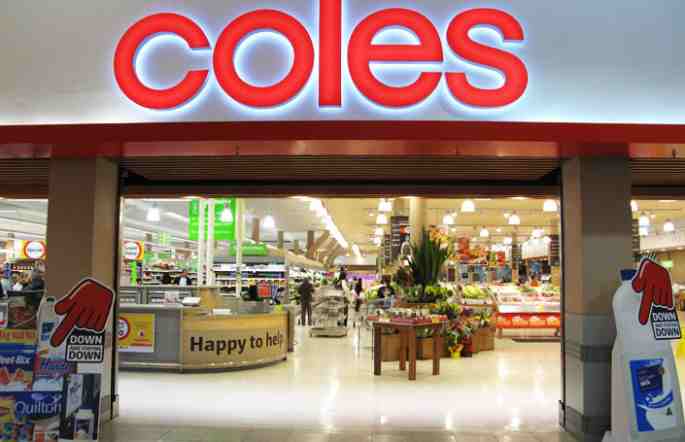
    Excluding new store openings, Wesfarmers on Wednesday posted 3.8 per cent growth in Coles  food and liquor sales in the three months to March 31, 2015. This was its weakest growth rate for a year, as deflation took a toll across its 775 supermarkets, with food and liquor prices falling 1 per cent.

    Including new stores, total food and liquor sales posted 5.4 per cent year-on-year quarterly growth to $7.1 billion.

    Wesfarmers says its “strongest set of numbers for some time” demonstrate the health of the Australian economy, but unemployment remains the biggest risk to consumer confidence.

    Wesfarmers, Australia’s largest private sector employer, on Wednesday reported a 3.3 per cent increase in retail sales to $13.12 billion for the March quarter compared with the same quarter last year.

    The result was boosted by stellar sales at its Bunnings hardware chain and market-share gains by supermarket chain Coles, but dampened by weakness in liquor and at its discount department store Target.

    “I think consumers right now have got the benefit of lower fuel prices, probably lower energy prices,” managing director  Richard Goyder said.

    Meanwhile, Bunnings exceeded expectations with quarterly same-store growth of 9.4 per cent, and discount department stores Kmart and Target reported disparate results: Target same-store fell by 1.9 per cent, while Kmart’s rose by 6.3 per cent.

    Bruce Smith, portfolio manager at Alphinity Investment Management, said the results were pretty much in line with expectations. “Bunnings is a brilliant business and going strongly, the Kmart recovery continues and Target’s still pretty ordinary,” he said.

    Deutsche Bank analyst Michael Simotas said the third-quarter results were solid, with all divisions stronger than expected except Target. “We expect this result to be well received by the market but it is too early to judge the impact of Woolworths’ planned price investment,” he said, referring to supermarket rival Woolworths’ announcement in February that it would spend at least $500 million on cutting its prices and improving its stores.

    Mr Goyder said Wesfarmers “changed nothing based on what any competitor has done in the past few months”.

    And finance director Terry Bowen said Coles had plenty of opportunity to steal market share in fresh food, such as meat, from independent and specialty retailers. “In broad terms, independents have lost market share [over the past five years] and if you look … more holistically at the market, Aldi and Costco … have gained market share and Coles and Woolworths have basically maintained and moved their market share around a bit.

    “But the big movements have been Aldi and Costco growing – bearing in mind they are the largest retailers in the world, multinationals. And the independents have lost market share.”

    Wesfarmers estimated Coles had about 25 per cent of the Australian food market, about 20 per cent of liquor and less than 20 per cent of the home improvement and office supply markets.

    Shares in Wesfarmers defied a 1.85 per cent fall in the broader market to close down 15¢, to $43.

  • Woolworths ads not so cheap, but Coles ads down, down

    Woolworths ads not so cheap, but Coles ads down, down

    The supermarket wars have pushed two of Australia’s big advertisers in different directions, with No. 1 supermarket Woolworths revving up its spending while Coles winds its down.

    Woolworths is estimated to have spent $18.8 million on traditional advertising from January to March this year. This was an 8 per cent increase on its $17.4 million supermarket spending in the first three months of last year.

    By contrast, Coles is estimated to have slashed its ad spend to $13.7 million from January to March. This is down 17 per cent from $16.5 million in the same period last year.

    The Nielsen advertising expenditure estimates cover the bulk of the supermarkets’ ad spend, across television, radio, print, outdoor, cinema and some online. It doesn’t cover advertising booked through exchanges, specialist press and social media.

    Credit Suisse analyst Grant Saligari said Woolworths had “increased advertising frequency [on TV] and has been running more promotions in the third quarter [from January 5] than in prior periods.”

    Woolworths and Coles declined to comment.

    Coles’s long-running “Down, Down” campaign, featuring rockers Status Quo, has been widely described as successful but annoying. Woolworths responded last year with a less lauded campaign featuring a “Cheap, Cheap” slogan, animated birds and singer Samantha Jade. Its ‘BrandZAC’ campaign for Anzac Day last month was widely panned.

    Sources have suggested Coles’s lower ad figures this year could be because it was working out its response to Woolworths’ campaign, or because its existing campaign was successful.

    Ben Willee of Spinach Advertising said: “Just because you spend more doesn’t necessarily mean your campaign is more effective. The hardest part is getting your creative right.”

    Woolworths – owner of major retailers including alcohol business Dan Murphy’s and discount department store Big W – and Wesfarmers – owner of Coles and hardware chain Bunnings – are two of Australia’s biggest advertisers.

    Responding to disappointing grocery sales and an improving Coles, Woolworths in February said it would spend at least $500 million on cutting its prices and improving its stores.

    Coles this week reported a marginal increase in market share in the third quarter and tipped independent and specialty retailers would continue to lose market share at the hands of foreign supermarkets Aldi and Costco. Coles has about 25 per cent of the Australian food market, Wesfarmers said.

    Excluding new store openings, Coles food and liquor sales grew by 3.8 per cent in the three months to March 31. Including new stores, Coles food and liquor grew by 5.4 per cent, to $7.1 billion.

    Woolworths is set to hold a strategy briefing day and store visits next week, and is tipped to post third-quarter sales growth of about 0.9 per cent.

  • Aldi Australia vows to maintain pressure on rivals

    Aldi Australia vows to maintain pressure on rivals

    Discount retailer Aldi Australia has vowed to maintain pricing pressure on rivals in the AUD85 billion (USD69.58b) grocery market, after increasing sales by 13 percent in 2014, outpacing food and liquor sales growth at Coles and Woolworths almost three-fold.

    Aldi Australia’s sales reached AUD6 billion in the 12 months ending December 2014, compared with AUD5.3 billion in 2013. The growth was underpinned by strong same-store sales growth and 25 new stores.

    In comparison, Woolworths’ Australian food and liquor sales grew 4.7 percent to AUD41.7 billion in fiscal 2014 and Coles’ food and liquor sales rose 4.6 percent to AUD29.2 billion.