Tag: E-Commerce

  • China e-commerce huge opportunity for British merchants

    China e-commerce huge opportunity for British merchants

    New research says almost half of the UK’s top online retailers are failing to capitalize on China’s burgeoning e-commerce market. E-commerce service provider Global-e reports that British companies are significantly missing out on a marketplace that’ll be worth $1.5 trillion within four years.

    Chinese shoppers love doing it online. Buying big brands from around the world, It’s global, China’s Centre for Economic Exchange anticipates online retail will account for 30 to 40 per cent of world trade in less than a decade. E-commerce entrepreneur Amir Schlachet says most firms see that as a huge opportunity.

    “Most of them actually do realize that China is an important market. It’s close to a trillion shoppers online. Very open to the world. It’s already around half of the online population actually buying cross border.” said  Schlachet.

    Recent research by market research company Emarketer backs him up, claiming nearly 45% of people in China shop on overseas websites. And the internet shopping giant Alibaba offered further evidence with figures for 2015 indicating a revenue rise of more than 30 percent. However, while many UK retailers have seen the online potential, to others claims Schlachet are failing to take advantage.

    But global’s also local and the trick to getting into the Chinese online market baffles some. Shoppers in China want websites in Mandarin; prices in Renminbi the local currency and payment using local systems such as Tenpay.Union Pay and Alipay. So, while shops in Britain go out of their way to welcome Chinese shoppers, researchers at Global-e found traders needed help online.

    It’s all a barometer of how globalization is changing the way we go shopping, but at the same time it’s a real indicator of how new businesses can start up to take advantage of that.

  • Apple Pay to go live in China on February 18

    Apple Pay to go live in China on February 18

    Apple Inc’s Apple Pay mobile payment system will be available in China from February 18 for Industrial and Commercial Bank of China Ltd (ICBC) customers, bank representatives said in social media posts on Tuesday.

    The technology giant had previously said the system would launch in China in early 2016, making it Apple Pay’s fifth country as it accelerates development of a planned new revenue stream. ICBC is China’s biggest lender by assets.

    An Apple spokeswoman declined to comment on ICBC’s posts on the projected launch. The lender is set to be joined by a raft of peers: Apple’s China website lists 19 Chinese lenders as official Apple Pay partners, and state media reported two other lenders will also go live with the service from February 18.

    Greater China is Apple’s second-largest market by revenue, but the company faces an uphill battle to match that prowess quickly in mobile payments.

    Apple Pay’s beginnings have been less than auspicious in other markets, including scepticism from retailers in its home market. But in China, Apple Pay’s issue will be how to compete with dominant and entrenched players, serving shoppers well used to paying for goods and services with their handsets.

    China is the world’s biggest smartphone market. By the end of 2015, 358 million people, more than the population of the United States, had already taken to paying by mobile phone, according to the China Internet Network Information Center.

    Dominating those payments are China’s two biggest Internet companies: social networking and gaming firm Tencent Holdings Ltd and e-commerce company Alibaba Group Holding Ltd , through its Internet finance affiliate Ant Financial Services Group.

    Tencent operates WeChat Payment, while Ant Financial runs Alipay.

    Apple Pay has also struggled to gain traction with banks in some countries. In Australia, the four main banks are holding out against the new entrant. The company in Britain faced resistance from big banks over fees before relenting.

    Earlier on Tuesday, China’s state radio reported on its website that China Guangfa Bank Co Ltd and China Construction Bank Corp said on social media they would also launch Apple Pay on Feb. 18.

    A China Construction Bank spokesman declined to comment, while Guangfa could not be reached for comment.

  • e-money transactions reach Rp5.2 trillion

    e-money transactions reach Rp5.2 trillion

    Electronic money (e-money) transactions conducted in the country in 2015 reached Rp5.2 trillion in value, up from Rp4.3 trillion in 2014, Governor of Bank Indonesia(BI) Agus Martowardojo said.

    “In 2009, electronic money transactions were valued at about Rp520 billion only, and now they have reached Rp5.2 trillion,” the central bank governor said while opening the National Non-Cash Movement (GNNT) in Kupang, the provincial capital of East Nusa Tanggara (NTT) here on Saturday.

    Agus said the non-cash transaction system, either using prepaid cards, credit cards or electronic money, is very useful because it makes the financial system more efficient.

    With non-cash transactions, the state could reduce the use of banknotes and coins, making transactions more efficient and saving money on printing currency.

    “We are convinced that the non-cash system would be safer, more practical and more efficient,” Agus said.

    After all, the non-cash payment system can be used widely, such as while purchasing cellular phone minutes, shopping at malls or paying electricity and tap water bills.

    He said the e-commerce and non-cash transactions are predicted to continue to increase.

    “Non-cash payments could also be for online-transactions, resulting in efficient usage of time and economizing,” he added.

  • Thai fashion e-commerce goes from rags to riches

    Thai fashion e-commerce goes from rags to riches

    WearYouWant’s site has 500 fashion merchants offering some 14,000 products. The company plans to release a native mobile app next month as 50% of its website traffic comes from mobile phones.

    The online fashion sector in Thailand is drawing massive interest from global players eager to cash in on one of the fastest-growing markets.

    Competition in the interactive fashion stores is expected to be more intense this year, says Thai fashion marketplace WearYouWant.

    But it will be increasingly difficult for newcomers to find a place in the Thai market because existing players have established a strong foothold here, said Julien Chalte, co-founder and co-chief executive of WearYouWant, a four-year-old website.

    E-commerce accounts for about 1% of retail sales in Thailand but the market is expected to see steeper growth this year.

    Mr Chalte said e-commerce was an immensely motivating sector because of its versatility.

    Thai consumers are very conscious of shopping behaviour both offline and online, so it is essential to provide the best and widest selection of products, good prices and efficient delivery, he said.

    WearYouWant’s site has 500 fashion merchants including boutiques, distributors and brands that offer 14,000 products.

    Online merchants can sell directly to consumers but delivery is handled by the site, which earns revenue through commission on purchased products.

    WearYouWant secured Series B investment funding of US$3.5 billion last September, led by the leading fashion e-commerce player in Japan, Start Today, which operates Japan’s largest fashion e-commerce portal Zozotown.

    Mr Chalte said Bangkokians were no longer driving the growth of online fashion shopping.

    “The fastest-growing provinces are Nonthaburi and Chon Buri, and the trend seems to be continuing into 2016,” he said.

    WearYouWant plans to release a native mobile app by March because 50% of its website traffic comes from mobile phones.

    The company will also introduce new feature apps including an image recognition engine that allows user to take a photograph of an item in a store and instantly be presented with a good offer on the same or similar product.

    The trend this year will move towards more mobile payment options, but cash on delivery will remain the preference.

    Mr Chalte said the average age of the company’s customers was 32. They mainly live in Bangkok, with 65% of customers female.

    Customers spend an average of 3,000 baht on the website. Beauty products remain the best-selling product, with clothing, shoes and accessories experiencing significant growth.

    In 2015, WearYouWant’s annual revenue rose 200% from 2014, with a 150% hike in turnover generated by mobile devices.

  • E-commerce expansion primed for Indonesian market

    E-commerce expansion primed for Indonesian market

    As smartphones become more commonplace in Indonesia, apps are enjoying a surge in popularity, suggesting that e-commerce – for both goods and services – is filling market voids and strengthening its economic foothold.

    Online trading and transport apps in particular are generating interest, offering a solid foundation for other start-ups, and attracting international players and financiers to the country.

    However, technology companies will be looking to further improvements in related services, such as logistics, and changes to foreign investment regulations to support continued expansion.

    The era of the app

    Since launching its mobile app in early 2015, Go-Jek, the Indonesian two-wheeled motorbike taxi service, has seen its market value rise as high as $400m and the number of registered drivers jump from 500 to 200,000.

    Also seeing the opportunity in the market, in May Malaysia’s Grab expanded into Jakarta, launching its GrabBike service, before introducing a car-based service several months later. The company is now active in at least five cities around the country, with plans to expand further in the coming year.

    The scale of the popularity of e-services was evidenced by the major backlash that Ignasius Jonan, minister of transport, faced last December when he attempted to ban transport apps like Go-Jek. Amid a public outcry and #SaveGojek trending on Twitter, the government quickly reversed its decision.

    Voicing his support for ride-hailing apps, President Joko Widodo told local media, “Innovation among the younger generation should not be stifled. Applications such as Go-Jek exist because they are in demand.”

    The growing use of ride-hailing apps signals a wider expansion under way across the country in e-commerce and mobile transactions.

    According to the Indonesian eCommerce Association, the country’s online market is projected to triple between 2014 and 2016 to reach Rp283trn ($20.8bn).

    While online sales represented around 1% of all retail sales in Indonesia in 2015, research firm eMarketer expects this share to grow to 4.4% by 2019, with e-commerce spending forecast to rise from $3.2bn to $10.9bn over the period.

    Major players moving in

    With a population of around 250m, Indonesia’s e-commerce potential has captured the attention of global technology and investment giants.

    In late January US-based e-commerce platform eBay confirmed plans to open an office in Indonesia, following in the footsteps of Twitter, which has had a base in the country since March. The move will see eBay build on its local partnership with state-owned telco Telkom, through which it operates the online shopping portal Blanja.

    For its part, the Chinese internet search company Baidu announced plans to boost investment in Indonesia, where it operates the MoboMarket app store with more than 500,000 products available for download.

    Major new domestic players are also entering the e-commerce scene. MatahariMall.com launched its operations in early September with $500m in backing from Indonesian real estate developer Lippo Group. Describing itself as the Alibaba of Indonesia, the firm said it hopes to become a driving force for e-commerce in the country.

    Hadi Wenas, the company’s CEO, suggested the site was created to mimic a brick-and-mortar shopping experience.

    “Just like an offline supermall, you enter, walk around and shop by floor. Each floor focuses on different categories,” he told media at the launch.

    Leading start-ups in Indonesia are also benefitting from international venture capital interest. Go-Jek, for example, attracted $6m in seed funding in mid-2014, with another $15m raised from US-based Sequoia Capital in April of last year.

    Further investment in the industry is likely to be spurred by the easing of foreign ownership limits in the e-commerce segment. Previously included on the country’s negative investment list, the government recently ruled to allow up to 33% foreign ownership of e-commerce ventures.

    More to be done

    However, some obstacles to sector growth remain. While internet connectivity is rapidly growing, it is coming from a smaller base than other countries in the region.

    The number of internet users in Indonesia reached 73m in 2015, or approximately 29% of the population, according to the Ministry of Communications and IT, significantly less than Malaysia (67.5%), Thailand (55.9%) or the Philippines (43%).

    A fragmented logistics landscape and underdeveloped payment infrastructure also present hurdles to expansion, with just 6% of Indonesians holding credit cards, according to a 2014 report by UBS.

    App developers will need to keep the characteristics of the market in mind when planning expansion. For example, a targeted approach is likely needed to attract Indonesia’s traditionally risk-averse and brand-loyal shoppers. A survey by McKinsey last year found that 63% of Indonesian consumers only buy products from brands they already know, suggesting word of mouth may be an important tool for growing local market share.

    E-commerce solutions are increasingly being used to bridge gaps in Indonesia’s infrastructure, with some start-ups helping firms extend their reach to rural areas.

    Start-ups looking for innovative ways of reaching rural customers are also employing a tactic known as assisted e-commerce, which uses technology to connect local stores with product distributors, helping to minimise geographic challenges and overcome low penetration of credit cards.

    Kudo, for example, which was founded in early 2014, offers online shopping through physical point-of-sale kiosks in public places.

  • China’s cross-border e-commerce boom is a boon for small retailers abroad

    China’s cross-border e-commerce boom is a boon for small retailers abroad

    After years of tepid growth, sales at several Australian vitamins, minerals, and supplements companies suddenly shot up by 20, 30, or even 40% in 2015. For those who know what happened that in China in late 2014 the source of this growth probably isn’t a big mystery: Regulators expanded a tax exemption to cross-border e-commerce.

    The resulting growth in trade has been dramatic, and for firms who have long eyed the big Chinese market but are too small to invest in finding a distribution partner or building a physical presence on their own, the boom of 2015 has delivered a revelation: They, too, can access the mainland market.

    E-commerce has of course been big in China for years, and in 2014 online retail sales totaled nearly US$430 billion, accounting for roughly 10% of all retail sales.  (The same figures for the United States were US$300 billion and 6.4%, respectively.)  Until recently, however, this activity was nearly all domestic – i.e., goods produced in or already shipped to China being sold to Chinese consumers.

    That makes perfect sense in light of the retail explosion of recent years:  China has more than 300,000 pharmacies, more than 2,000 mid-to-high end department stores, and supermarket catchment areas in urban areas are even smaller compared with the United States because of smaller formats and the lack of parking (and, until recently, widespread car ownership). Within this rapidly-developing retail landscape, however, some factors are driving consumers to prefer foreign products, whether bought once in China or ordered from abroad.

    Driving demand

    Food scandals are well-known and heavily publicized, from the baby-killing melamine-laced formula scandal of 2008 to the discovery this year of decades-old “vampire” meat.  In September, fake rice made from tiny pieces of rolled-up paper was even uncovered in Guangdong.  In light of such underhanded tactics, it is understandable that consumers might perceive foreign brands as safer and of higher quality.

    Price pressures pushing up consumer prices is another key issue.  Commercial rents, especially in first-tier cities such as Shanghai and Beijing, rival those in developed nations.  At the end of 2014, rents in Beijing’s Wangfujing averaged $480 per square foot per year vs. $360 for Singapore’s Orchard Road.  Wages, while still lower compared to western economies, are also rising quickly.

    Finally, Chinese consumers are becoming more sophisticated and better able to differentiate between local brands trying to pass themselves off as foreign and the real thing.  With travel increasing and the transparency in commerce that the internet can bring, tastes in products are becoming more global.

    Historic developments

    By as early as 2005, a Chinese consumer could order an album on Amazon and wait a few weeks for it to arrive—though naturally taxes and shipping often added to the price of the CD itself. But it wasn’t until the fourth quarter of 2014 that cross-border e-commerce really exploded.  The impetus was the application of a previously obscure piece of the tax code to cross-border e-commerce, implemented in a number of pilot cities.

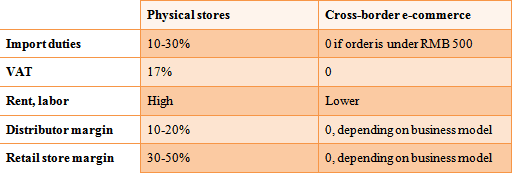
    The personal effects tax originally targeted Chinese travelers who had emigrated abroad and were bringing back gifts – such as small appliances – for relatives.  Small items were exempt, but the tax was set at 10% for nearly everything else.  In late 2014, though, the government proclaimed that this personal effects tax also applied to cross-border e-commerce in certain pilot areas.  The effect was dramatic, as can be seen in the price differentials illustrated below.

    Obviously some costs, such as freight and insurance, are incurred whether selling through physical stores or cross-border e-commerce.  However, the price differential can be observed in following key areas, demonstrated with VMS products as an example:

    The nuts and bolts

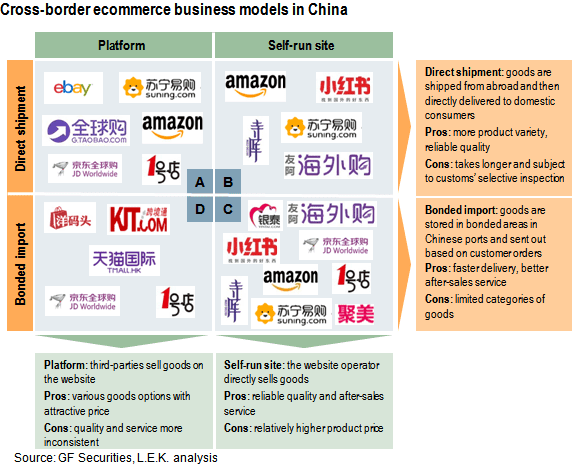
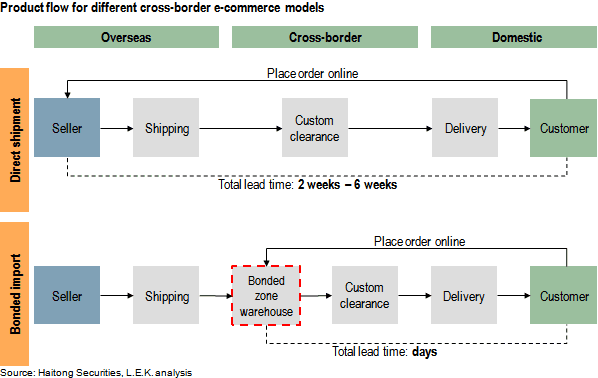
    Business models for cross-border e-commerce can be viewed across two main dimensions: Whether the site serves as a platform that aggregates multiple sellers or sells its own products, and whether delivery to the consumer is made from the source country or from a bonded warehouse.

    Each model has its own quirks (see graphic below), and it is not yet clear whether there is an obvious winner.  It is likely that multiple models will co-exist –for example, a self-run, bonded import model could work for goods with the highest turnover (such as diapers and infant formula), while direct shipment models might better suit the long tail of less-frequently ordered items.

    In terms of product flow, though, the bonded import model has the clear advantage in terms of speed.  Consumers can receive product within days – sometimes only one or two – rather than weeks.

    With both models the seller can choose how much to take on internally, and how much to either outsource or hand over to a partner.  Hundreds of cross-border e-commerce companies have already sprung up in China, providing services that run the gamut from simple customs clearance all the way to a full consignment model.

    Local interests

    While e-commerce, including the cross-border variety, is here to stay, the advantages that it has over traditional imports may not last forever, depending on the product category.  In June of 2015, for example, China’s government lowered import duties on skin care products, which harmonized online and offline prices to an extent.  In 2016, import duties on additional products including handbags and suitcases are also slated to be slashed.

    Regulatory vacuums will likely be filled step-by-step as well.  For example, vitamin potency levels are regulated for products registered and sold in China, but currently these rules are not applied for cross-border e-commerce imports.  Local players are crying foul, and regulators will no doubt feel pressured to act.

    For now, though, cross-border e-commerce is helping to level the playing field by allowing smaller-scale companies to profitably access the vast China market while providing a huge boon in the form of savings and product diversity to Chinese consumers as well. Chalk one up for the little guys on both sides of the border.

  • Mobile e-commerce to fuel Chinese retail

    Mobile e-commerce to fuel Chinese retail

    Despite the slowdown in China’s GDP growth, the Alibaba Group believes the country’s consumer economy will weather the storm and grow handsomely, largely fuelled by mobile e-commerce.

    According to a recent report titled The New China Playbook by he Boston Consulting Group (BCG) in association with the with AliResearch, Alibaba Group’s research arm, even if China’s GDP growth slows to 5.5 per cent, which is a full point below the 6.5 per cent government target, the country’s consumer economy will expand by more than half to $6.5 trillion in 2020 from $4.2 trillion in 2015.

    According to the report, e-commerce is expected to play a major role in the development of China as a consuming nation, a transition that is being accelerated by the growth of shopping via smartphones and other mobile devices.

    “One of the most revolutionary changes in the Chinese consumer economy has been the astounding growth of e-commerce,” the BCG said. In 2010, online transactions made up only 3 per cent of total private consumption in China; online channels today account for 15 per cent of the total, a share that BCG projects will rise to 24 per cent in 2020 (in contrast, online shopping currently accounts for about 7.5 per cent of private consumption in the US).

    The BCG does not foresee a marked slowdown in the growth of e-commerce. Over the next five years, private online consumption is expected to surge at a compound annual growth rate of 20 per cent, compared with 6 per cent annual growth in offline retail sales. Chinese consumption will grow by more than half to $6.5 trillion over the next five years from $4.2 trillion in 2015. E-commerce on the whole will account for 42 per cent of that growth.

    BCG identified three distinct “megatrends.” First, rising incomes are fueling greater spending, and in new areas not seen before. Then there’s the growing prominence of China’s “young generation.” And finally, the shift from bricks-and-mortar retail to e-commerce will continue to play an ever-bigger role in China’s economy.

    Overall, an incremental $2.3 trillion in annual consumer spending that China is expected to add over the next five years is almost like adding another Japanese consumer market onto the global economy, the report said.

  • Indonesia to ease foreign ownership rules in e-commerce, retail & power but with curbs

    Indonesia to ease foreign ownership rules in e-commerce, retail & power but with curbs

    In a bid to enhance investments, Indonesia is planning to relax ownership rules in the retail sector even though foreign players will still not be allowed to hold majority stakes.

    According to the head of Indonesia investment board (BKPM) Franky Sibarani, the government will also allow foreign investors to fully own e-commerce businesses provided their investment value is beyond Rp 10 billion ($726,745). Investments below Rp 10 billion in startups or SMEs (small-medium enterprises) is prohibited.

    “The purpose of this policy is to protect our SMEs,” Sibarani said.

    The caps placed on minimum investments could limit inflows of foreign venture capital firms, who typically invest seed stage funding in the sub-million dollar stage in startups.

    Even in retail, the government is keen to open up only the large retail operations, especially outlets with land size above 2,000 sq metres. Foreign ownership in retail, that operate in the below 2,000 square meters (sqm) area, remain closed.

    The proposed rules will be included in the upcoming foreign negative investment list (DNI), scheduled to be issued in March this year.

    Tackling another sector requiring huge capital, Indonesia will allow full foreign ownership in geothermal power plants of more than 10 megawatt (MW), and 67 per cent for smaller power plants.

    Sibarani said, the government plans to partly open foreign direct investment in electricity transmission business, an area which was previously closed.

    Foreign ownership in companies developing high-voltage (HV) and ultra-high voltage (UHV) grid will be partly opened up to 49 per cent from zero per cent foreign investment, while low to medium voltage grid remains closed for foreign investment.

    Investment commitment in January

    Investment commitment in Indonesia reached Rp206 trillion ($15.04 billion), up 119 per cent in January compared to the same month last year.

    “This shows that investors’ confidence remains high and investment climate is still conducive despite slowdown in the world economy,” BKPM Chairman Franky Sibarani said at a press conference. Given the positive trend, he expects this year’s realized investment target of Rp545.4 trillion will be achievable.

    Majority of the direct investment commitments came from foreign investors (FDI), amounting to Rp168 trillion, while the remaining Rp38 trillion were domestic investments, representing an increase of 261 per cent and 101 per cent respectively.

    The largest investment commitment came from Singapore amounting to $7.5 billion, followed by China $2.8 billion, South Korea $280 million, Japan $132 million and Malaysia $105 million.

  • Mobile shopping soar 42% as retail sales hit record high in Dec.

    Mobile shopping soar 42% as retail sales hit record high in Dec.

    Retail sales in South Korea hit a record high in December aided by brisk demand for furniture, food and beverages, and cosmetics, a government report showed Tuesday.

    Retail sales amounted to 33.19 trillion won ($27.6 billion) in December, up 2.7 percent from the 32.3 trillion won tallied the previous year, according to the report by Statistics Korea. It also marks a 2.8 percent gain from November’s 32.3 trillion won.

    The December figure marked the highest monthly amount since January 2010 when the state statistical bureau started to compile related data.

    Sales of furniture jumped 6.4 percent on-year to 423 billion won in December, with food and beverage sales rising 4.1 percent to 6.8 trillion won. Demand for cosmetics grew 3 percent to 1.5 trillion won over the cited period.

    However, sales of home appliance goods, computers and mobile phones dropped 2.2 percent on-year to 3.2 trillion won, while sales of clothing fell 3.7 percent to 5.2 trillion won.

    Department stores saw their sales fall 2.7 percent on-year in December, while large discount outlets and supermarkets basked in a 3.1 percent and 1.1 percent rise, respectively.

    Convenience stores saw their sales jump 21.5 percent from a year earlier, the data showed.

    Online shopping sales, which have been growing swiftly in recent years, jumped 15.3 percent on-year to reach a record 5.33 trillion won in December on the back of the strong sales of food products, cosmetics and clothes.

    Online shopping accounted for 16.1 percent of all retail sales in December, up from 15.3 percent the previous month.

    Purchases made through mobile devices, meanwhile, soared 41.73 percent on-year to 2.65 trillion won, accounting for 49.6 percent of all online sales in the period, according to the report.

    For the whole of 2015, Statistics Korea said the amount of retail sales reached 366.5 trillion won, up 1.9 percent from a year earlier.

  • E-commerce in Asia grows 32%

    E-commerce in Asia grows 32%

    E-commerce grew to $835 billion in Asia in 2015, the kind of expansion that beckons web retailers around the world. But moving into cross-border e-commerce means mastering the different market conditions from country to country, according to Internet Retailer’s new 2016 Asia 500.

    The lure of Asia, and particularly China, for international merchants is strong and growing stronger: Chinese consumers alone purchased $589.61 billion worth of goods online in 2015, an increase of 33.3% over the same period a year earlier, according to the National Bureau of Statistics in China. By comparison, online retail sales in the U.S. grew by 15.5% per year from 2011 to 2014 and were up by nearly 15% in the first three quarters of 2015, according to the U.S. Commerce Department.

    The largest domestic e-commerce players are driving the bulk of the sales and growth in China. The 266 China-based merchants ranked in the new Internet Retailer 2016 Asia 500—the largest online retailers in Asia as measured by their annual online sales—grew 65.7% in 2015 to $173.69 billion from $104.82 billion, representing 79% of total Asia 500 sales of $220.00 billion and 89% of the growth. By comparison, the 30 United States-based retailers ranked in the Asia 500 grew online sales 24.2% to $21.91 billion last year—the bulk of that for most of them coming from Chinese customers.

    Indicative of e-commerce growth in Asia overall, total 2016 Asia 500 online sales were up 54.5% in 2015 to $220.00 billion from $142.42 billion in 2014.

    When factoring in the roughly $411 billion transacted through the seven largest online marketplaces, including those owned by Rakuten Inc. and Alibaba Inc., Internet Retailer estimates the Asia-Pacific e-commerce market is worth $834.71 billion, up 32.1% from $631.81 billion in 2014.

    E-retail growth in Asia and China remains far ahead of that in the U.S., one reason many U.S. brands and retailers are looking to expand into these markets. For the first nine months of 2015, adjusted U.S. e-commerce sales totaled $251.98 billion or 7.2% of total retail sales (excluding foodservice) of $3.51 trillion, according to U.S. Commerce Department data.

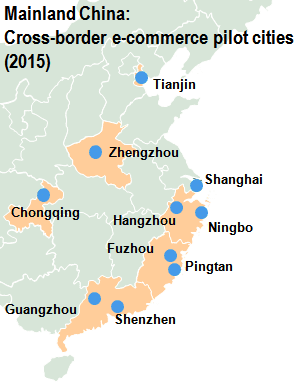
    Such heady online growth isn’t lost on merchants based outside Asia, particularly those targeting Chinese consumers that crave foreign goods. As added incentive for buyers and sellers, the Chinese government in recent years has made it easier for consumers to buy overseas goods via the web. That includes setting up free trade zones in 10 cities where China’s customs service provides fast clearance of small orders from Chinese consumers. Foreign companies can ship the orders from abroad or store goods in these areas without them clearing customs, and then, as orders are received, send them through the streamlined customs process.

    One way U.S. retailers are reaching shoppers in Asia is through marketplaces. For example, when BCBG Max Azria Group LLC wanted to step up its presence online in China, the U.S. women’s apparel manufacturer and retailer decided the best place to start was Tmall Global, Alibaba’s marketplace for imported goods. BCBG previously shipped online orders to China, letting international e-commerce fulfillment specialist Borderfree handle orders. But growing sales justified a bigger investment in China, says Michelle Magallon, senior vice president of digital commerce and omnichannel.

    In November 2015 BCBG signed a deal with VoyageOne to manage its website on Tmall Global, including marketing and fulfillment, Magallon says. BCBG is in the early stages of putting together a multichannel distribution strategy in China, which includes two stores in Singapore. The company also has five stores in Taiwan.

    BCBG isn’t alone among merchants in the U.S. and other countries looking to sell to the growing number of Asian online shoppers, notably the 375 million Chinese consumers who buy online. But those retailers aiming to enter or expand their online sales in Asian countries all face similar challenges, regardless of home country. To succeed online in Asia, retailers in the U.S. and other nations first are assessing the challenges of marketing, logistics, culture and regulations—and associated costs—for conducting e-commerce in each country.

    For companies like BCBG, which is not yet ranked in the Asia 500 but is No. 424 in the Internet Retailer 2015 Top 500 Guide with online sales of $37.9 million in 2014, the key to connecting with online shoppers in Asian countries is understanding what shoppers want and then evaluating the local vendors who can provide the services needed in each market, Magallon says.

  • Indonesia’s Elevenia marketplace gets $50 million from existing investors

    Indonesia’s Elevenia marketplace gets $50 million from existing investors

    Elevenia just raised another $50 million from its existing investors. The ecommerce marketplace is a joint venture of South Korean company SK Planet and Indonesian telco XL Axiata.

    Elevenia launched in Indonesia in early 2014 with an initial capital of $18.3 million from each partner. It has since received multiple capital injections from its parents, bringing Elevenia’s total funds – including the latest round – to about $110 million.
    The company claims to have clocked $95 million in revenue in 2015. It also says it has about 20,000 daily transactions and four million products listed from 30,000 sellers, with 40 million visitors.

    That’s double the figures it released around its first anniversary in early 2015. At that time, Elevenia announced 20 million visitors a month, 18,000 sellers, and two million product listings. It did not release revenue figures for 2014.

    Elevenia has been a steady yet somewhat quiet presence in Indonesia’s crowded ecommerce landscape. It competes alongside companies like Lazada, Bukalapak, Tokopedia, Qoo10, Rakuten, Blanja, Blibli and MatahariMall.

    With fresh funds at hand, it plans to grow its team, increase its marketing efforts, improve its product and services, and move to a new office, the company said in a statement.

  • Hong Kong Indian entrepreneur out to build ‘the next Alibaba’ in Mumbai

    Hong Kong Indian entrepreneur out to build ‘the next Alibaba’ in Mumbai

    Akanksha Hazari’s parents were relieved when she announced in 2013 that she was moving to Mumbai on her own.

    “After Palestine, India was fine,” says her mother, Anjali. “Akanksha wanted to go to Africa originally, but her father and I managed to convince her that it was probably not a good idea.”

    Home for the 32-year-old former Middle East strategist turned star technology entrepreneur is Hong Kong, the city she moved to with her Indian parents when she was eight. She attended West Island School,and became so good at squash she was selected to play for Hong Kong in her teens.

    “For me, Hong Kong is very much home … I am an Indian-Hong Kong girl,” she says.

    Hazari is the founder of m.Paani, a phone-based customer loyalty platform that helps to bring together small retailers andconsumers in emerging markets.

    It may sound esoteric, but as she explains in her parents’ Mount Davis flat, this is just the first step in building a global business that can help the world’s underserved “offline” population access important services from which they have been excluded. In short, she wants m.Paani to be the next Alibaba.

    Her ambition is matched by an iron will that has seen her take on a large American charity co-founded by Hollywood star Matt Damon, and win.

    In 2010, Hazari was studying for an MBA at Cambridge University and formed a team to enter an annual competition for business students run by the Hult Prize Foundation. That year, participants were asked to submit business plans that could help address water scarcity issues, and Damon’s Water.org was brought in as an adviser. Hazari’s team came up with m.Paani (paani means water in Hindi), a mobile phone-based customer loyalty programme that encourages the supply of clean water to low-income families in India. When they won, Hazari – the only team member who wanted to launch the start-up for real – asked for the US$1 million prize money she believed they had been promised. Water.org, however, was under the impression that the US$1 million was going to its own projects.

    Our goal was to support Hult in its efforts to teach about the urgency of this issue among students and the need for innovation,” writes Rosemary Gudelj, the charity’s senior manager, global advocacy and office of the CEO, in an email. “However, we also knew that these students only had two months to develop ideas. While we were hopeful that the winning case or other cases would be actionable by Water.org, we clearly were not comfortable committing to implementing the winning idea.

    “When [Hazari’s] team won, we offered to have her and her team work with Water.org on looking into and developing the group’s idea to probe further, and see how this concept could be applied to local needs and circumstances. However, her request was to receive the full US$1 million grant to fund the organisation she launched.”

    In the end, Water.org kept the US$1 million and the Hult family gave Hazari a separate grant of US$300,000 that allowed her to widen m.Paani’s business.

    “At the time, Hult Prize thought it a better strategy to partner with a non-government organisation to help the winners manage and deploy the prize capital, rather than to directly give the money to a young student team. But once the US$1 million was transferred to Water.org, they kept it. That’s why I couldn’t start m.Paani straight away. It took me two years to get the money, which Philip Hult privately gave me,” says Hazari.

    That tenacity helped her secure most of the funding she needed to set up the business in Mumbai around 18 months ago. Today, the loyalty point network has around 200 merchants and 10,000 customers.

    “Think of it as something like air miles or credit card points. You earn points when you buy your groceries at your neighbourhood m.Paani corner shop. The shopkeeper taps in your mobile phone number – that’s your m.Paani account number – and your point balance is updated in real time,” says Hazari. The points can be used to pay for items or to redeem practical gifts from the m.Paani gift shop: water filters, English language textbooks or small appliances, for example.

    While m.Paani has a social agenda – to leverage the often-neglected purchasing power of lower-income households and to boost the competitiveness of small, independent retailers that make up about 70 per cent of India’s US$600 billion a year retail market – it is very much a for-profit business.

    It makes money by charging shop owners a commission for each transaction recorded. In return, previously offline mom-and-pop shops get a customised website, mobile app and digital transaction histories, and a consumer database.

    The latter is key to Hazari’s ultimate goal: for m.Paani to become a “big data” player. The idea of data collection may be anathema to many internet users concerned with privacy, but she says those who do not have any data to offer get left behind.

    “These shopkeepers tend to write everything down in a notebook. They can’t get insured, or apply for a bank loan, because there is no data about their business,” she says.

    The same goes for the customers. Without any credit history, they are not likely to get bank loans or access other financial services. From this year, m.Paani will start scoring individuals and businesses on their creditworthiness, a first step in utilising their shopping records.

    Hazari says small retailers with no online presence will struggle to compete against the growing presence of international chains such as Wal-Mart and Tesco as India gradually liberalises its retail sector. Online giants such as Amazon are also expanding aggressively in India. Issuing loyalty points helps rope in their customers.

    The next step for m.Paani is to go national, and eventually spread to Africa and Southeast Asia.

    “I want to build an Indian company that’s international,” she says. “For me there’s a lot of pride in that. Why can’t the next Google come out of India? That’s why Alibaba is such an exciting company. It’s the first company to do that out of our market.”

    After earning a degree in politics and Middle Eastern studies from Princeton, Hazari worked for the Aspen Institute, encouraging Israeli and Palestinian joint business ventures as a way to promote peace. It meant living in Jerusalem and crossing the border every day to manage operations such as a hospital and a power plant in Gaza.

    “Her time in the Middle East meant months of sleeplessness for me,” says her mother. “But I’m very proud of her.”

    After two years,Hazari decided that business had a lot of power to change people’s lives and immersed herself in the corporate world, becoming a consultant in clean energy at Booz & Co. in the US and Dubai. That was followed by a year of designing environmentally sustainable services and information technology applications to help rural Indian families, and then the MBA in Cambridge.

    Hazari’s parents had settled in Hong Kong so that their children could have access to better education, and a better quality of life (dad Ajay is a director in a shipping company, and mum Anjali teaches at an international school). But for her, the opportunities lie in India and beyond.

    I think we have a desire to be a part of that story, of building our country and taking it forward.

    Akanksha Hazari

    “For my parents, or people like them in India and mainland China, the dream was to get their kids to go out. That’s not the case for us any more. These countries are no longer the same. We see so much opportunity to do something bigger than just go the West and get a job. If we come home we can actually build something of our own. And also, I think we have a desire to be a part of that story, of building our country and taking it forward. We are shaping the future of that country, and that’s a huge opportunity,” says Hazari.

    The start-up in India has yet to make her a billionaire (“We’ve been surviving by bootstrapping, she says). But it has already earned her valuable international recognition. On March 9, she is receiving an award from the Vital Voices Global Partnership, the NGO set up by Hillary Clinton and former secretary of state Madeleine Albright, at a gala celebrating women leaders around the world.

    Investors are also beginning to see m.Paani’s potential. “We’ve just closed series A [funding]. Our user numbers are growing 20-40 per cent month-on-month and investors are starting to see this as a proper business,” Hazari says. Their backers include an Indian venture capital firm and a select group of Indian angel investors.

    She is not surprised that Hong Kong – once known as a breeding ground for entrepreneurship – has failed to produce many start-ups that grab the world’s attention.

    “There’s a lot of pushback here for those who want to set up their own business. You have to be a very strong personality to do it anyway. I didn’t take any money from my parents. I knew the decision I was making meant I would not have a great lifestyle but I was OK with that. You need to be ready to deal with the negative pushbacks… and work a lot harder to prove your point and make sacrifices,” she says.

    Besides, Hong Kong is fundamentally a very small economy and very focused on financial services, which means that young people who want to pursue big ideas tend to have to go abroad, or to China. And she expects more people will.

    “Our generation is more purpose-driven than it is pay-cheque driven. The time is right – we are very educated and have the luxury of thinking about what values we want in life and not just how much money we want to make. I think it’s a fundamental shift,” she says.

  • Reliance retail business thrives

    Reliance retail business thrives

    Indian retailer Reliance Industries has reported a 50 per cent growth in sales in its consumer electronics category for the quarter to December 31.

    Reliance Retail also consolidated its leadership in the grocery category, optimising its network to enhance profitability. Several private-label products were launched in the grocery and general merchandise categories during the quarter. The contribution of private-label sales to overall sales increased to 14.6 per cent from 8.6 per cent in the same period the previous year.

    There are now more than 2 million registered members across 37 countries for Reliance Mart stores. These 1537 outlets specialise in consumer electronics. Strong year-on-year growth in this category was helped by Digital Express Mini rapidly scaling up during the quarter to reach more than 1250 outlets across the country in a short time since launch.

    Also delivering a strong performance, the fashion and lifestyle category was 16 stores opened byReliance Trends during the quarter.

    A Reliance Retail joint venture with Marks & Spencer continued to grow with new store openings, whileReliance Brands launched Dutch lingerie brand Hunkemöller, and also opened the first airport store in India for UK games and toys retailer Hamleys, in Delhi.

    Initiatives encompassing fashion and lifestyle e-commerce are also proceeding through beta testing. The development of a marketplace platform and distribution ecosystem for 4G devices are on track and being rolled out. It will be the largest distribution reach for devices in India, says the company.

    Meanwhile, the company is training 4G sales specialists while integrating supply chain and service centres. Reliance Retail also launched its own brand of 4G LTE smartphones, under the brand LYF, during the quarter.

  • DHL eCommerce Eyes Thailand’s Fast-Growing Online Retail Sector

    DHL eCommerce Eyes Thailand’s Fast-Growing Online Retail Sector

    DHL eCommerce, a division of the world’s leading logistics company, Deutsche Post DHL Group, has expanded its operations into Thailand and is offering end-to-end domestic delivery service for Thai e-commerce merchants. With its new service, DHL eCommerce is offering a range of unique service options that caters to Thailand’s burgeoning e-commerce market.

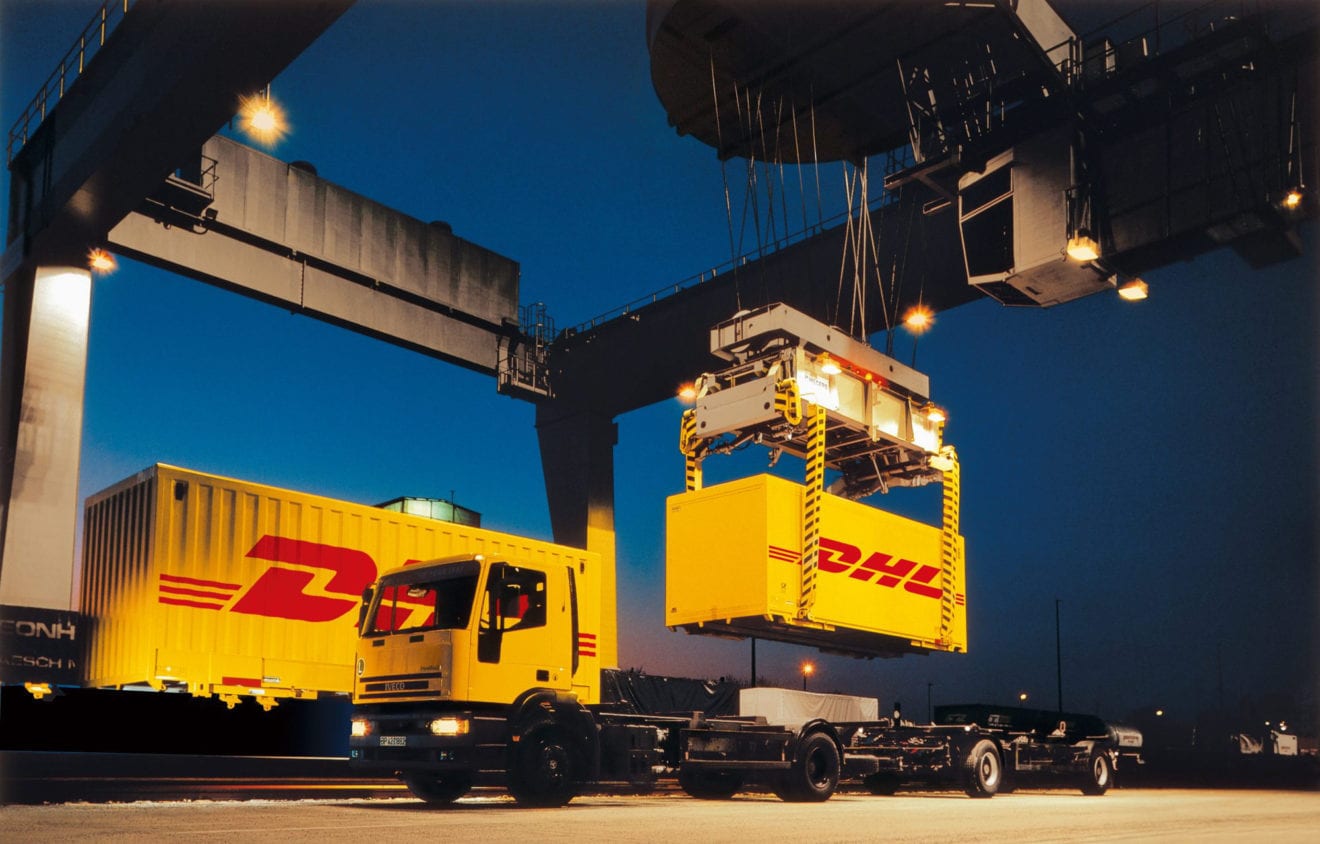
    Understanding that a strong backbone for e-commerce growth lies in a good logistics system, DHL eCommerce aims to enable a better e-commerce experience for both consumers and merchants through efficient logistics and a seamless online shopping experience. Major additions will be made to DHL’s delivery infrastructure in the country, including a 3,000 sqm central distribution center in Bangkok and a network of over 20 depots located throughout Thailand ensuring full coverage across the entire country. To meet increasing business demands, DHL plans to more than double the number of depots in Thailand by 2017 and expand its fleet primarily in two-wheel vehicles that can operate more efficiently in the traffic situations in Thailand’s major cities.

    As part of its service offerings, DHL eCommerce’s fleet of two- and four-wheel vehicles will provide next-day delivery to all urban areas, and a 2-3 day delivery to all other locations. All merchants have access to Cash on Delivery (COD) with daily remittance and access to a multilingual call center.

    DHL eCommerce launches in Thailand

    The launch of DHL eCommerce in Thailand is a great showcase for Strategy 2020, the corporate strategy of Deutsche Post DHL Group, which has seen a rename of its Mail division to “Post – eCommerce – Parcel” to better reflect the focus on products and services offered for the high-growth e-commerce market. DHL has been operating in Thailand since 1973, through its other business units – DHL Express, DHL Global Forwarding and DHL Supply Chain.

    “Thailand, with its tremendous growth potential, fast e-commerce adoption and high smartphone penetration rates, has been identified as the first Southeast Asian country to launch DHL eCommerce’s domestic delivery service in line with our group’s Strategy 2020,” said Thomas Kipp, CEO, DHL eCommerce. “The Thai e-commerce market is expected to more than triple in size to EUR 3.6 billion between now and 2020[1] and with this investment, we are well positioned to support the growth of e-commerce businesses in Thailand.” 

    “We see major strategic opportunities for e-commerce growth in Thailand, particularly with the Asean Economic Community which is expected to increase the movement of goods within the region. Despite e-commerce already being a billion-dollar sector with extremely rapid adoption, Thailand’s e-commerce share of the retail market is still relatively low compared to other high-growth economies. Only 1.7% of total sales in Thailand are obtained from e-commerce, compared to more than 10% in China,” said Malcolm Monteiro, CEO, Asia Pacific, DHL eCommerce. “Thailand is ranked as one of our top priority markets in Southeast Asia: its expected annual market growth of more than 20% (from 2014 to 2020) is likely to be largely driven by significant numbers of SMEs beginning to extend their business models into online marketplaces.”[2]

    “In order to fulfill Thai consumers’ expectations of seamless and simple e-commerce, businesses need logistics services that keep up with extremely rapid changes in consumers’ expectations while providing high operational excellence,” said Kiattichai Pitpreecha, Managing Director, DHL eCommerce Thailand. “This makes the need for a tailored e-commerce delivery service greater than ever before – so that merchants, especially SMEs, can focus on their core business and grow faster based on a high performing logistical backbone.”

    “Our successful offerings in India and China have proven that exceptional customer service bolstered by robust and scalable end-to-end delivery networks are the two essential ingredients needed to win e-commerce market share. That applies to all players, from small businesses to multinational retail conglomerates,” added Malcolm Monteiro, CEO, Asia Pacific, DHL eCommerce. “As Thai consumers continue to come online and join the region’s appetite for e-commerce, we are confident that our services will give customers both a first-mover advantage and a unique competitive edge.”

  • E-commerce will boost smaller South Korean brands

    E-commerce will boost smaller South Korean brands

    As growth indicators such as commodities and oil test their lowest price levels for more than 10 years, the fear of deflation that gripped Japan for many decades is quickly becoming a global phenomenon. Even in the U.S., where economic growth is relatively strong, there is a noticeable lack of wage inflation in the face of strong employment reports over the past 12 months.

    While we can blame part of this problem on the aftermath of the global financial crisis of 2008, I place at least some of the blame on the rapid proliferation of Internet technology. A clear example is the loss of traditional retail jobs to ballooning online sales.

    South Korea is a good leading indicator on this issue because of its heavy Internet penetration and dense population, making it a good market sample for other economies to track. South Korea’s retail industry is also an interesting case of being both a victim and beneficiary of the creative destruction of traditional retail channels caused by the onset of e-commerce.

    South Korean retail businesses are dominated by large corporations, often part of one of the country’s huge conglomerates known as chaebols. The scale these corporations enjoy at the group level gives them a huge cost advantage over small to medium sized enterprises, which need to build from the ground up. Right now, e-commerce is killing retail businesses through intense price competition that is driving down margins.

    In South Korea, traditional retailers are hurt not just by domestic online sales but also overseas Internet purchases. In 2014, the value of purchases from overseas websites delivered to South Korean homes reached more than $1.5 billion, from $274 million five years earlier. This figure slipped slightly in 2015 because of government restrictions on purchases, but will continue to rise in the coming years at the expense of traditional retailers and their workers.

    For decades, chaebols operating in domestic retail and consumption industries enjoyed outsized margins due to protectionism against imported goods. In the last decade, however, the South Korean government has forged trade agreements with 52 nations far and wide, including one with China just last year.

    The combination of e-commerce and trade deals has driven the rapid rise of overseas online purchases, especially from the U.S., where a much broader selection of products is available, often at huge discounts to local prices. South Korean shoppers have become so successful at arbitraging this pricing gap that the South Korean government has placed an unofficial limit on cross-border online transactions that qualify for exemption from customs duties.

    Viable competitor

    Another driver of online imports is cheap and efficient delivery, made possible by a growing logistics industry. Strong growth in e-commerce has allowed for rising efficiency in deliveries, which now makes it a viable competitor to offline retailers.

    Overseas online purchases hurt all South Korean retail and consumer brands, but they hurt the large corporations most. For two decades, the chaebols have enjoyed government support through import protection and distribution networks built over many decades of lobbying and cooperating with myriad regulatory hurdles.

    South Korean SMEs never benefited from this because they were usually niche players in crowded markets. As a result, the flood of foreign brands coming into South Korea through online purchases threatens the profitability of large corporations more than the SMEs. A good example is Samsung Electronics’ 60 inch LED TVs, which South Korean shoppers have been buying from U.S. e-commerce shopping sites. Even after delivery and customs duties, prices are up to 20% cheaper than in South Korea.

    But these developments are not all bad news for South Korean retailers. The advent of technology will also allow South Korean SMEs to penetrate a much bigger market: China.

    Historically, when South Korean companies wanted to expand overseas, they would spend years investing in distribution channels and learning how to deal with customs and local regulations. As a result, expansion outside South Korea was a high-risk strategy that yielded patchy results for smaller companies. But the rapid development of e-commerce in China is making the expensive and time-intensive task of establishing distribution channels as quick as the click of a mouse. Already we are seeing companies that have rocketing China revenues, driven by online sales that would previously have taken years of investment and experience to achieve.

    The speed at which China’s online giants are making e-commerce accessible to outsiders will help companies from South Korea that have a good following at home but lack the scale to expand overseas. As South Korea continues to attract millions of mainland tourists annually, recognition of domestic-oriented brands will spread through China and create follow up demand.

    Right now, investors seeking to benefit from Chinese interest in South Korea are focusing on duty free stores. But the next phase of investor attention will be consumer brands that attract attention from Chinese customers seeking to buy outside duty-free channels. E-commerce and information distribution via the Internet will accelerate that process.

    As China tries to promote domestic consumption to compensate for the declining economic growth coming from falling investments, the tax incentives that duty free stores attract will have to decline. That will put brand owners in pole position in the China market rather than traditional retailers such as department stores, hypermarkets and duty free channels.

    Peter S. Kim