Tag: E-tailing

  • Super Delivery concept launches in Japan

    Super Delivery concept launches in Japan

    An eCommerce venture relaunched in Japan this week claims to be the world’s largest wholesale website.

    Super Delivery, launched domestically by Raccoon Co back in 2002, offers apparel and general merchandise produced or developed in Japan for supply to 134 countries. This week it opened to the world.

    It has launched with some 400 manufacturers displaying more than 100,000 items for sale on the website. More than 930 shops and companies are  registered with the eCommerce marketplace as buyers.

    Among products being sold on the portal are numerous traditional Japanese handicrafts. Echizen Shikki Kyodo Kumiai (Echizen lacquerware cooperative association) in Sabae, Fukui Prefecture, which deals with lacquerware products that have a history of more than 1500 years, will sell  over 1000 items, mainly bowls and dishes.

    Those who use the Super Delivery service can confirm the wholesale prices of products after they register themselves with the website as members, and can pay for products they buy by credit card or electronic money transfer.

  • ‘Trust us’ urges Alibaba.com

    ‘Trust us’ urges Alibaba.com

    Chinese internet giant Alibaba.com has enhanced its vetting of suppliers to boost confidence with its online customers.

    The company says it is adding new features to service designed to reassure buyers – many of them retailers in North America and Europe – that they can trust the sellers offering merchandise on Alibaba.com.

    The Alibaba Trade Assurance program, introduced in January, has been limited to transactions completed via bank transfers, but will soon also cover purchases made with credit cards, Sunny Chhabra, a US-based global marketing and business development executive with Alibaba.com, told delegates to a conference in Las Vegas.

    In addition, the program, which until now will only covered Chinese suppliers selling on the business-to-business Alibaba.com platform, will be extended to other manufacturers and distributors in other countries. India will be the next country added, he said.

    Already 54,000 Chinese suppliers, or about half the number that offer to fill bulk orders on the Alibaba site, participate in Alibaba’s Trade Assurance program. An Alibaba subsidiary called OneTouch vets companies that wish to participate. If a buyer purchases from a participating supplier Alibaba will refund the buyer’s deposit, up to a specified amount, if the goods are not delivered on time or are not of the quality specified.

    “If the supplier is at fault, the buyer gets their money back, Chhabra said. “You’ll be covered by Alibaba. We’ll go after the supplier to recoup our losses.”

    To receive compensation for poor quality, he noted, the buyer will have to engage a service that inspects the goods, either at the factory or at the buyer’s warehouse.

    Buyers now can filter suppliers at Alibaba.com by those participating in Trade Assurance. When a prospective buyer hovers over a participating supplier the amount Alibaba will guarantee appears. That amount varies based on feedback from buyers. If a supplier gets good reports from customers then Alibaba gradually increases the amount it will guarantee.

    When a retailer or other buyer purchases from a participating supplier, the two parties sign a contract on Alibaba.com and the purchase is completed on the site. That’s a departure for Alibaba.com, which, since its introduction in 2003, has served as a way for retailers, wholesalers and other bulk buyers to find mainly Chinese suppliers, but has never been a transactional site. One of the advantages for Alibaba is that now that transactions are completed on the site the Chinese eCommerce giant for the first time gets accurate information about what products companies are buying and how much they are paying, Chhabra said.

    Alibaba executives also said the company has begun allowing some foreign suppliers to sell on 1688.com, a site that until now has enabled Chinese retailers and other companies to buy from Chinese suppliers.

    Alibaba reported that its revenue from international wholesale transactions, mainly Alibaba.com, totaled $201 million, six per cent of revenue and a 12 per cent year on year increase. Revenue from domestic wholesale, mainly 1688.com, was $161 million, five per cent of revenue and a 41 per cent increase over the same period a year ago.

    The bulk of Alibaba’s revenue, more than $2.5 billion, came from its huge online marketplaces in China, primarily Taobao, where some 8.5 million sellers offer products in a wide-open online bazaar, and the more brand-friendly Tmall, which features products from such major Western companies as Nike, Apple, Burberry and Juicy Couture.

    Those Chinese marketplaces, which together account for roughly 80 per cent of online retail sales in China, accounted for 78 per cent of Alibaba’s revenue in the quarter.

  • Jumei sales double

    Jumei sales double

    Jumei, the Chinese online retailer, says its sales rose 99.5 per cent in the second quarter to June 30.

    The e-tailer achieved net revenues of US$308.1 million and its GMV rose by 30 per cent to $376 million as its customer base grew 28 per cent and orders by 58.2 per cent.

    But its gross profit as a percentage of net revenues decreased to 30 per cent from 46.3 per cent in the same period of 2014 reflecting the company’s shift in strategy from beauty product marketplace sales to general merchandise sales that started last September – along with promotional activities associated with baby and maternity products.

    Leo Chen, Jumei’s founder and CEO, said the company was “thrilled” with its quarter.

    “This very strong growth was driven by Jumei Global during what is typically a seasonally light quarter. We continue to strengthen our position as a leading import cross-border eCommerce platform in China – a milestone we achieved last quarter. We are pleased to see both active customers and number of orders grow rapidly while maintaining a high repeat purchase rate.”

    Chen said since transitioning into cross-border eCommerce during the third quarter of 2014, the frequency of customer purchases has grown significantly, increasing 34 per cent from the third quarter of 2014 to the second quarter of 2015, due primarily to Jumei’s diverse global product offerings and expansion into other women’s categories such as baby and maternity and health and wellness.

    “We are confident that our continued investment in category expansion will enhance the customer experience, increase user stickiness and strengthen loyalty to our platform,” said Chen.

    “We recently announced a strategic investment in BabyTree, the largest online parenting community in China and the largest globally as ranked by traffic volume, with daily active users (“DAU”) exceeding 10 million. By integrating Jumei’s supply chain and logistics expertise in cross border ecommerce with BabyTree’s large and growing user base, we believe we will be able to leverage the significant cross-selling opportunities across all Jumei categories to become the dominant female-focused ecommerce platform in China.”

  • Rakuten launches express delivery

    Rakuten launches express delivery

    Japan’s leading eCommerce portal Rakuten has launched Rakubin – a new rapid delivery service which promises goods in as little as 20 minutes – 2 hours a day.

    The new service has made its debut in the Tokyo suburbs of Shibuya, Setagaya, Minato and Meguro. It applies to a limited range of 450 items – largely convenience or drug-store core lines, such as noodles, cafe products, confectionery and coffee; detergent, toilet paper and diapers.

    In the Rakubin app, users can check the estimated time of delivery before placing their order.

    After the order has been completed, a delivery interval of 15 minutes will be displayed, allowing users to effectively make use of the time before the arrival of the order. The delivery cost for one order is 390 yen (including tax) when users receive the goods beside the delivery vehicle at the specified location, and 770 yen (including tax) when the goods are delivered directly to users by a member of the delivery staff.

    Fulfilment is undertaken by a fleet of delivery vans which carry stock of the items and circle the areas, awaiting despatch to delivery addresses.

    Rakuten says it will expand the service to include a longer list of products, and a broader geographical area once the concept is bedded down and refined.

  • Teabox has the World’s first tea subscription service

    Teabox has the World’s first tea subscription service

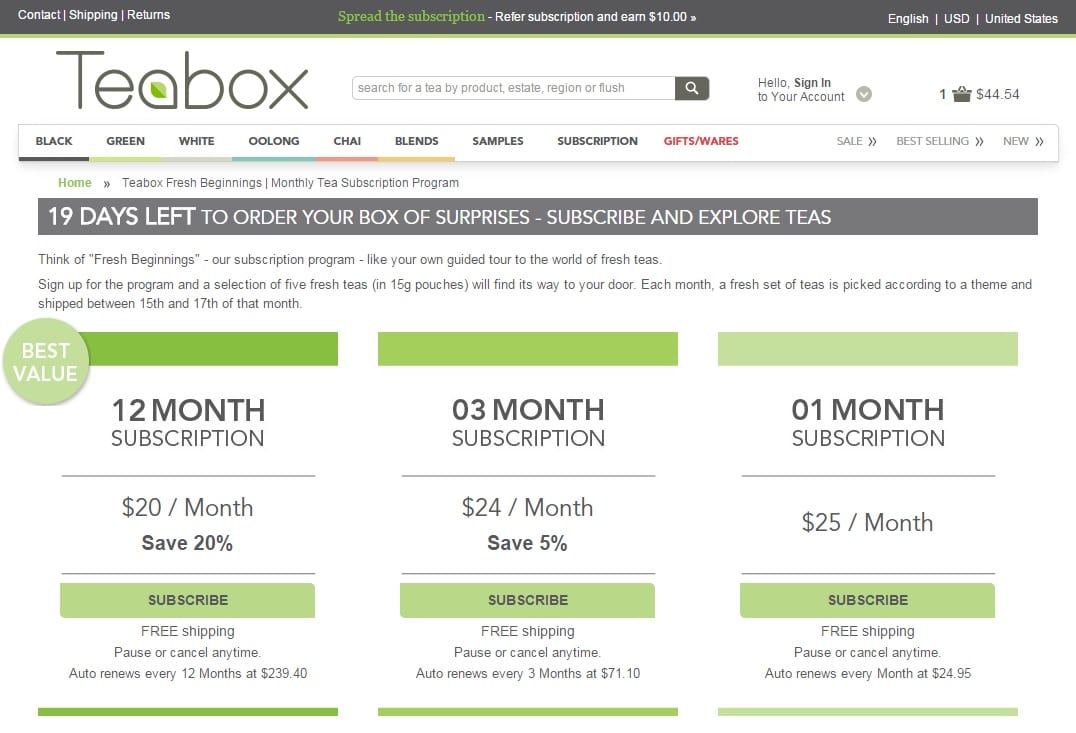
    Indian online tea retailer Teabox the global eCommerce tea company, has launched the world’s first ‘Personalized Tea Subscription Service’.

    The program is powered by Teabox’s patent-pending ‘machine-learning technology’ that it says personalises and matches every individual’s tastes to a selection of teas.

    The Teabox subscription program allows tea drinkers to choose the kinds of tea they would enjoy by breaking down their ‘perfect cup’ into 75 different attributes, such as aroma, astringency,

    strength and body, into objective components which are matched to user preferences, habits and taste characteristics.

    When consumers sign up to the plan, Teabox has them take a quick five-question quiz online, the results of which are analysed by Teabox’s ‘prediction engine’ software.

    “Each user is assigned a ‘signature’ tea based on their responses. The machine ­learning algorithms look for patterns to identify a selection of teas best suited to go with this signature profile,” the company says.

    “And as the users repeat and share their experiences with our prediction engine, it improves its discerning capabilities thereby improving its understanding of a user’s choices and matches our teas to them better. This feedback loop enables a reinforced learning behavior of the system allowing it to fine tune itself to specific taste profiles as we go further,” said Teabox founder and CEO, Kaushal Dugar.

    “When it comes to taste preferences, there are no universals. One’s taste preferences are unique and theirs alone,” he said. “But the descriptions of teas, like wines, can be subjective. We understand this, and that’s why our prediction engine has been developed to break down subjective words like “floral,” “sweet” and “astringent” into over 75 quantifiable attributes.

    “This, coupled with the habits and preferences of our customers enables us to pick out teas perfectly suited to their palate – making our subscription program the most personalised tea experience out there.”

    Teabox ships a package of tea based on the user’s habits and preferences each month. The teas come from the company’s broad selection of tea gardens and suppliers and the company promises fresh teas.

    Teas are delivered within five days of ordering and subscription packages are priced from US$9.99 to $39.99 a month.

    Founded in 2012, Teabox sources fresh teas from 200 growers in Darjeeling, Assam and Nilgiri to the entire world. In two years, Teabox has delivered over 30 million cups’ worth of tea to customers in 80 countries.

    The company is backed by Jafco Asia, Accel Partners, Keystone Group and Dragonee Investment Group.

  • Malaysian online shopping habits evolve

    Malaysian online shopping habits evolve

    More men are shopping online in Malaysia than ever before. And nearly half of the nation’s online shoppers are doing so on mobile devices.

    Those are two of the key findings of online marketplace 11street’s Online Shopping Index for 2015.

    The split between men and women in the nation’s online shopping community is now 48:52, according to the study based on the four week  Ramadhan and Raya period from June 22 to July 19.

    11street said gross merchandise value (GMV) more than doubled during the Ramadhan and Raya period and in just a few months, 11street has achieved various milestones including a rank of 40 on Alexa

    Hoseok Kim, 11street CEO, says Malaysia is one of the top leading countries in the world when it comes to smartphone Internet access with the number of connected devices per person used by Malaysians which stood at 1.2 devices.

    “As online shopping becomes part of the Malaysian lifestyle, smartphones will play a vital role in enabling shoppers to grab good products and offers online at anytime, anywhere,” said Kim.

    The 11street Online Shopping Index shows that contrary to the popular belief that fashion and electronics are the most sought after categories, Malaysians shop in diverse categories including health & beauty, kids & baby, home & living, grocery, services such as e-vouchers and more. Also, popular items that customers mostly searched during Ramadhan include baby car seats, Tupperware, Bluetooth earphones, and skincare.

    The index found that customers bought from either two or more product categories within a single transaction and that is expected to increase over the next few years.

    By gender, women mostly purchased mobile, tablets, beauty, health and personal products as well as baby and kids items. Men shopped for electronics, sports and leisure items – and kids & baby, especially gear such as baby car seats.

    11street currently carries more than 700,000 products making it one of the largest online marketplaces in Malaysia.

  • Chinese shoppers feel safer online

    Consumers across Southeast Asia and Greater China feel safer paying in a brick and mortar environment as opposed to online; sole exception is China

    According to the inaugural MasterCard Safety and Security Index, consumers across Southeast Asia and Greater China cited identity theft and ATM-related fraud as the top two security concerns when it comes to electronic payments.

    Some 42 per cent of consumers in Southeast Asia (Indonesia, Malaysia, Philippines, Singapore Thailand, and Vietnam) were most concerned with ATM-related fraud such as a stolen card, card cloning or skimming. In the Greater China markets (China, Hong Kong and Taiwan), this figure was 31 per cent.

    But the biggest surprise was in confidence in shopping online. The Index showed that in general, consumers across Southeast Asia, and the markets of Taiwan and Hong Kong still feel safer paying in a bricks and mortar environment than buying online. China differed, being the only market where consumers felt paying online was safer than in a physical store; even more so than in Singapore.

    Almost every consumer polled in the Greater China markets had made an online payment in the past year. Consumers in China (62 per cent) particularly favored the use of digital wallets in online electronic payments over those in Hong Kong (14 per cent) and Taiwan (29 per cent).

    Consumers across Southeast Asia (35 per cent) and Greater China (32 per cent) were almost as equally concerned about identity theft in relation to data breaches. This includes personal data such as bank details, personal IDs, addresses, and signatures that are stolen or compromised through websites. In both regions however, it appears that these concerns do not directly stem from consumers’ own personal experiences but rather, as a result of the perceived severity of fraud based on what was reported in the media.

    MasterCard chart1

    Meanwhile, the Index also reinforced that banks continue to play a critical role in ensuring payment safety and security for consumers in Southeast Asia. This is both, because of the high levels of trust consumers place in banks as well as the reliance that consumers have on banks to help them resolve issues that crop up in this area.  Banks are often the first line of defense and recourse for the affected consumer – nearly half of all consumers in Southeast Asia who experienced ATM fraud first approached their card-issuing banks for advice.

    “The fact that most cardholders have a primary relationship with their banks, has an obvious and deep-rooted correlation to their sentiment, around who they trust most when it comes to ensuring the safety and security of electronic payments,” said Ari Sarker, oo-president, Asia/Pacific, with MasterCard.

    “This was emphatically reflected in the feedback from all the markets in Southeast Asia and Greater China. However, in Singapore in particular, in addition to banks, consumers also placed significant trust in the government, which is a natural outcome given the country’s strong regulatory environment and overall reputation around safety and security.”

    None of the respondents surveyed in Southeast Asia placed any trust in local websites, suggesting that there is still a lot of work to be done by local eCommerce merchants to ensure that they meet global security standards for payments and build consumer confidence on this front.

    In Greater China, aside from banks and governments, merchants were also seen to have a growing responsibility in ensuring payment safety and security, with 28 per cent of consumers in these markets going to merchants as their first recourse in seeking resolution for payment safety and security issues. Furthermore, merchants in these markets were instrumental in solving 40 per cent of all online electronic payment disputes.

    These and other key findings of the MasterCard Safety and Security Index will be discussed at the MasterCard Global Risk Leadership conference in Singapore on August 26 – 27. The 20th edition of this conference will gather global payment risk leaders to share best practices in fighting fraud together, as an industry. The conference demonstrates MasterCard’s commitment in helping partners and customers fight fraud using the latest tools, processes, and technologies so there is no one weak link in the payments ecosystem.

    The survey was carried out across in six markets in Southeast Asia (Indonesia, Malaysia, Philippines, Singapore, Thailand, and Vietnam) as well as three markets in Greater China (China, Hong Kong, and Taiwan). A total of 6600 consumers and 100 merchants were polled online and face-to-face between January and May 2015 on questions relating to the payments security landscape, payments in brick and mortar and online, safety and security payment concerns and experience with payment fraud, among others.

  • RedMart Singapore raises $26.7m

    RedMart Singapore raises $26.7m

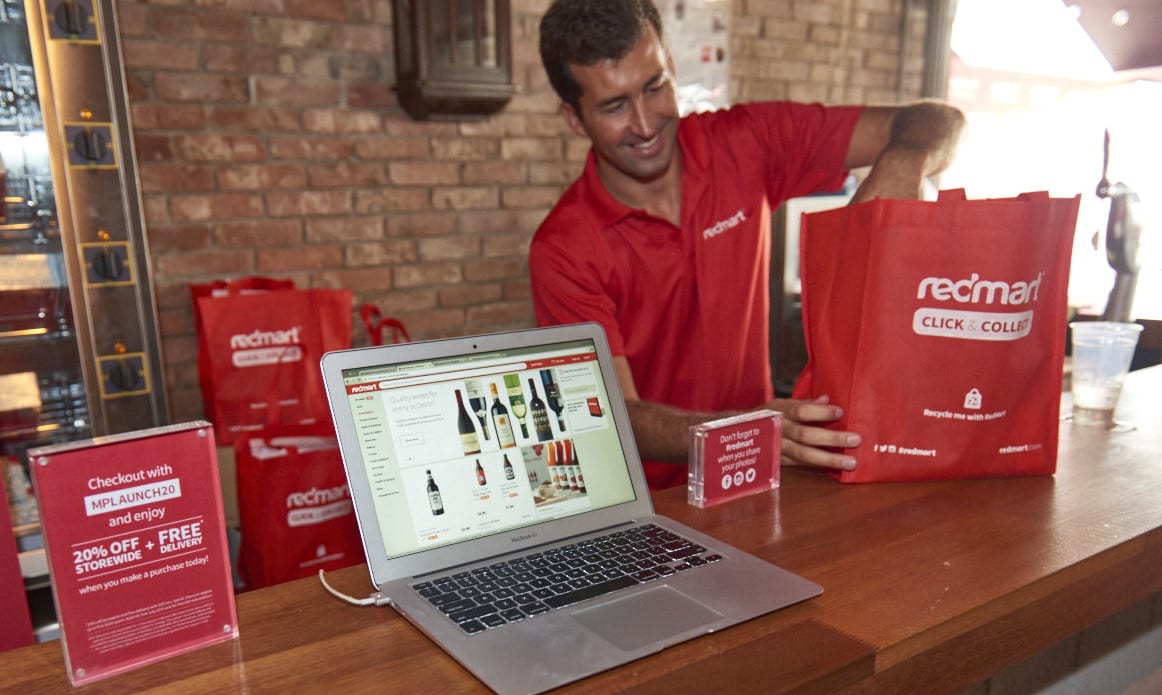
    Singapore online grocer RedMart has raised more capital and appointed a former Amazon executive to drive regional expansion.

    RedMart Singapore has previously indicated an interest in expanding into Vietnam, Thailand, Manila, Hong Kong, Indonesia, Malaysia and Taiwan – but it has not disclosed which markets it sees as a priority with its newly secured funds.

    RedMart has secured US$26.7 million in a round of funding tapping existing shareholders Garena, Softbank Ventures Korea, Visionnaire Ventures and Facebook co-founder Eduardo Saverin. It has also attracted a new investor – Far East Ventures, part of Singapore property developer Far East Organization which is diversifying its investment portfolio eyeing startups and tech ventures.

    The funds will be used to expand into regional markets outside Singapore, a move to be led by new recruit Colin Bryar, a former VP of US eCommerce giant Amazon.

    RedMart Singapore increased sales to US$9.43 million in 2014, but massive investment in infrastructure saw its losses balloon to $29.4 million – a not uncommon scenario of eCommerce startups.

    Bryan will oversee engineering, marketing and operations, taken over from co-founder Vikram Rupani, who takes on the title of President of RedMart.

  • Lotte.com launches China app

    Lotte.com launches China app

    South Korea’s Lotte.com has launched a Chinese mobile shopping mall service known as ‘china.lotte.com’ to meet demands of consumers chasing the ‘Korean Wave’.

    Growing numbers of Chinese are buying goods online from offshore sources – a practice referred to as ‘Haitao’ locally. And Korean goods – especially in the beauty and fashion categories – are enormously popular among the younger demographic.

    China.lotte.com, launched Wednesday (August 19) is’ exclusively focused on customers from Greater China. After global.lotte.com launched in February last year, Lotte spent a whole year preparing for the Chinese version of the site.

    More than 10,000 lines have been selected for China.lotte.com and another 5000 local Chinese lines are being added progressively.

    Chinese customers can shop using regular payment services including Alipay, UnionPay, Tenpay, PayPal and local Chinese credit cards.

    Lotte.com’s global business team manager Hwang Hyun Jung says China.lotte.com considered even minute details to meet the expectations of the rapidly growing Chinese overseas shopping market.

    “Through meticulous translations and user tests via Chinese supporters, this service is mainly composed of local-friendly user interface,” she said.

    Lotte.com has attracted “hundreds of thousands followers and supporters” via Weibo during the last six months in preparation for the launch.

    The company is also promising to work with Korean small businesses to help expose their brands and products to Chinese consumers via the portal.

  • China’s Jollychic.com branches into homewares

    China’s Jollychic.com branches into homewares

    Chinese eCommerce company Jollychic.com, an online global fashion destination, has unveiled a new line of homeware products called J.Home.

    “Increasing demand and lower prices have made Jollychic’s promotional furniture products a viable alternative for clients all around the world, according to Siwei Ma, furniture manager at JollyChic.com.

    “The growing public awareness about global eCommerce and other major advantages of the internet enables our customers to shop for more than 6000 products from different categories, including home decor, bed & bath, dining and pet care.”

    Jollychic.com is a global fashion destination, selling fast fashion and publishing a wide variety of fashion-related content, positioning the website as a growing fashion community. We sell over 50,000 branded and own-brand products through localized mobile and web experiences, delivering from our fulfillment centers in China to almost every country in the world. It runs sites in nine languages: English, French, Spanish, Arabic, Polish and Chinese.

    With the expansion into homewares, shoppers can take advantage of a free interior design consultation with dedicated customer service. An expanded customer loyalty program has been expanded to include a free gift offer that includes mugs and more.

  • Global Brands in talks with Alibaba, JD.com

    Global Brands in talks with Alibaba, JD.com

    Global Brands Group is discussing a possible “strategic alliance” with Chinese eCommerce companies Alibaba and JD.com.

    The two e-tailers are declining to comment on the matter, but based on comments by Global Brands CEO Bruce Rockowitz, Bloomberg reports the alliance “could involve online sales of brand-name children’s wear, among other products, through Alibaba’s Tmall and JD.com, and co-operation offline”.

    Rockowitz said a formal announcement is likely later this year.

    “We are working with JD and Alibaba on a strategic alliance, joint venture,” he said. “It’s a relationship or joint venture together that can create a solution online, offline and mobile that none of us can do by ourselves.

    “Both of them want to do something. They don’t have the content, just platforms, but they want to go to the next level.”

    The comments came in the wake of Global Brands’ first full year results announcement earlier this week when it reported stronger margins as it continues to shed non-performing brands in favour of higher end products.

    Last December, Global Brands announced a joint venture with David Beckham and his business partner Simon Fuller. The joint venture, Seven Global, focuses on the continued development of the brand around David Beckham as well as on creating large scale brands in partnership with a select number of high‐profile sports and entertainment icons. The venture will cover all major consumer product categories.

  • UnionPay partners with Latitude19

    UnionPay partners with Latitude19

    Latitude19 Technology says its internet payment gateway is now registered with UnionPay Online Payment, a service for eCommerce transactions that enables UnionPay cards to be accepted over the internet with real-time transaction authorisation.

    The service brings the convenience of transacting over the internet to all Issuers, Acquirers, Merchants, and UnionPay cardholders in a simple and secure way, opening the way for holders of more than 5 billion UnionPay cards to shop online.

    Latitude 19 Technology CEO & founder, Timothy Moore said UnionPay registration is an important milestone in the company’s strategy to become the leading global offshore payment gateway.

    The deal makes Latitude19 the first provider for UnionPay in the Caribbean and Latin America.

    “Our partnership with the world’s largest card association, will fast track our growth and provide valuable solutions for our clients.”

    Latitude19 Technology’s UnionPay International credit card issuing program is based on a globally recognised platform that has been designed to rapidly launch and deploy new programs or expand existing programs in real-time versus taking months with other legacy platforms. It supports debit, credit, or emerging payment programs in plastic, virtual, or mobile form.

    Latitude19 Technology is a Cayman Islands-based secure, international, online payment gateway that offers competitively priced, custom credit card payment solutions for eCommerce merchants.

  • Ron Johnson wins $50m for Enjoy concept

    Ron Johnson wins $50m for Enjoy concept

    Former Apple retail chief Ron Johnson’s new project has attracted a $50 million capital investment.

    His new venture, Enjoy Technology, is an online eCommerce start-up which sells a selected range of quality consumer electronics online only – then sends them to the purchaser’s home along with an expert in setting the equipment up. The concept merges service and customer focus with the convenience of shopping online.

    The $50 million was raised in series B funding led by Highland Capital. It comes on top of the initial $30 million and will be used to expand the concept outside its test markets of New York City and San Francisco Bay.

    “Since launching in May, we have been thrilled with the high-quality experiences we’ve been able to deliver for our customers, partners and employees,” said Johnson in a statement.

  • China Jo-Jo Drugstores Announces First Quarter Financial Results for Fiscal Year 2016

    China Jo-Jo Drugstores Announces First Quarter Financial Results for Fiscal Year 2016

    China Jo-Jo Drugstores, Inc., a leading China-based retail and wholesale distributor of pharmaceutical and health care products through its own online and retail pharmacies, today announced financial results for the first quarter ended June 30, 2015.

    FY 2016 First Quarter Highlights:

    Revenue increase during the first quarter ended June 30, 2015 was mainly due to the expansion of the Company’s retail drugstores and online pharmacy business. Retail drugstores sales, which accounted for approximately 57.0% of total revenue, increased by $1,575,129, of which an 8.2% increase in same-store sales contributed $827,593 while new stores sales contributed approximately $617,453.

    Online pharmacy sales reached $5,965,768, an increase of 131.9% over the same period last year, as we have been actively exploring new ways to grow our online sales. We have expanded cooperation with business-to-consumer online vendors, including Alibaba Group’s Taobao affiliate, JD.com and Amazon, by posting our products on their online platforms. In addition to launching an online payment service (“Alipay Service”) based on a service agreement with Alipay (China) Internet Technology Ltd. (“Alipay”), we launched stores on Tencent’s WeChat platform, China’s dominant mobile messaging app and social network with over 500 million active users.

    Starting from January 2015, we have strengthened our cooperation with certain large insurance companies in China such as the People’s Insurance Company (Group) Of China Limited, to sell online products to their customers who have purchased health insurance through them. In May 2015, we have set up a joint venture, with a leading Pharmacy Benefit Management (“PBM”) provider in China, which owns and operates Yikatong (the “E-Pharmacy-Card”), a popular pharmacy and health insurance benefit program with over 180,000 current users. The joint venture agreement requires the PBM provider to direct the majority of its online E-Pharmacy-Card transactions to our official online pharmacy site. In June 2015, we have organized an operation team to direct the sales from commercial insurance to our own website. We expect that this cooperation will boost our online sales and profit margin in the future.

    Mr. Lei Liu, Chairman and CEO of the Company stated, “We are excited to see a steady growth on our online and retail sales from last year. Revenue of our online pharmacy, www.dada360.com, is about five times the revenue of the same period last year thanks to our strategic partnership with China’s leading Pharmacy Benefit Management (PBM) provider and insurance companies. We are dedicated to further expand our efforts on our online pharmacy, which proves to be a popular business area supported by National Internet Plus Strategy in China. We will continue to devote resources to grow our online pharmacy business with the goal of becoming a national leader in pharmaceutical e-commerce business. Our retail pharmacies have also maintained robust growth both in sales and profitability. The management will strive to capitalize on the growth of health insurance and online sales in China.”

  • Macy’s coming to China via Alibaba

    Macy’s coming to China via Alibaba

    One of America’s most iconic fashion retailers is coming to China.

    A new joint venture agreement between Macy’s Inc. and Hong Kong-based Fung Retailing Limited was signed on Tuesday in Hangzhou to form Macy’s China Limited.

    The new company will launch an exclusive online flagship store on Alibaba’s Tmall Global in late 2015., providing authentic, high-quality Macy’s merchandise to shoppers in China. It will be the first US department store to join Alibaba’s Tmall Global.

    Tmall Global, on the other hand, will be the first and only third-party e-commerce platform in China providing apparel, fashion accessories and home products directly from Macy’s to consumers across China.

    “Millions of Chinese tourists have come to know and love Macy’s when they travel to New York, San Francisco, Chicago and other American destinations,” said Terry J. Lundgren, chairman and chief executive officer of Macy’s Inc. “By making Macy’s accessible in China through Alibaba’s Tmall Global, we have an opportunity to deepen our relationship with international customers and to grow sales.”

    Fung Retailing’s chairman, Dr. Victor K. Fung, said that with its affiliates, including LF Logistics, the company will fully support the activities of the Macy’s-Fung Retailing joint venture.