Tag: ecommerce

  • Time for travel agents to embrace “true retail”

    Time for travel agents to embrace “true retail”

    A recent report by eMarketer predicts that by 2021, Asia Pacific consumers will spend $3.001 trillion online, and ecommerce will make up 25.4% of total retail sales. Whilst this hasn’t been the death knell for bricks and mortar, it has forced retailers to re-think how to use their physical stores.

    Apple was one of the first to pioneer using their real estate as a way to drive brand ‘experience’ as much as sales.

    With their open-plan design, army of knowledgeable staff and regular, in-store seminars, Apple’s stores inspire and educate customers, helping the company achieve long-term loyalty.

    The fashion sector has been quick to follow suit too, adopting a range of technologies to transform how their stores are used by customers – recent innovations include ‘live’ mirrors that suggest matching items as the customer enters the dressing room and geo-targeted apps that alert shoppers to discounts and in-store promotions when they walk past.

    By comparison, APAC’s travel agents have been slower to spruce up their bricks and mortar models.

    However, with mobile travel sales accounting for 50% of online travel sales, and the number of online travel sales is only set to rise as more digital natives reach adulthood, now is the time for them to start.

    Rather than being a burden, when done right this is an opportunity for travel retailers to diversify; improve their success in cross- and up-selling; and engage the next generation of travelers who want very different things from the booking experience than their parents and grandparents.

    A good example is global travel group, TUI Travel.

    With a third of their sales still taking place in their physical stores, the company noticed that their customers’ purchase journey was becoming increasingly non-linear and multi-channel.

    In response, they piloted the use of in-store touch screens in the UK to enhance their customers’ store experience and invested in integrating their physical and digital channels for seamless shopping.

    By doing so, they were able to optimize interaction at every touchpoint, resulting in an overall increase in sales and average spend tripling in the stores that introduced interactive technologies.

    On the back of this success, they have since rolled these changes out in a number of their other physical stores too.

    Welcome to ‘true retail’

    ‘True retail’ is the notion of taking a 360-degree view of the customer, thinking beyond just the point of sale to consider all other brand touchpoints – from early inspiration to aftercare – and channels, whether they are in-store, on mobile, online or, as is increasingly the case, a combination of all three.

    ‘Inspiration’ is one of the biggest, and as yet largely untapped, opportunities for travel retailers to differentiate themselves by setting up their physical stores differently.

    Following the Apple model, store design is a good place to start – iPads loaded with relevant travel content, interactive displays and AI technologies can all be used to create a fun environment where customers can browse without sales pressure.

    The key is for travel agents to focus on the customer experience first and foremost – to create a space where people actively want to visit as part of their holiday planning.

    Automate the predictable to invest in the exceptional

    Another big, in-store asset for ‘inspiration’ is a travel agent’s staff.

    The more time that they can spend talking to customers, and the more knowledgeable and passionate they are about travel, the better.

    Historically in-store staff at travel agents were stuck behind their screens due to cumbersome systems and back-end processes.

    However, with the right technology, a lot of this can now be automated, giving staff the information they need at the touch of a button and in turn freeing up their time to walk the floor and focus entirely on customer service.

    Make it multi-channel

    Embracing ‘true retail’ also means acknowledging that there is no longer a single, linear purchase journey for travel bookings.

    Just as some customers will come into store to make a purchase having already done a lot of research online, others may prefer to get in-store inspiration then buy at a later date, through another channel.

    Retail travel agents need to ensure that they don’t lose this second group of shoppers to their competitors by continuing to follow-up with highly-tailored content, to whatever channels the customer prefers, after they’ve left the store.

    ‘Personalization’ and ‘relevance’ are essential to doing this successfully, so travel agents should use data capture across all of their touchpoints to build up a detailed, single-customer-view that is drawn from real behavioral insights rather than demographic assumptions.

    Applied in the right way, this intelligence can also be used to inform more tailored cross- and up-selling, with a much higher chance of conversion.

    Aftercare

    Finally, taking a truly 360 view of customer needs means keeping channels of communication open long after the sale itself.

    Successful fashion retailers do this well through convenient returns processes on online orders and hyper-relevant ‘you might also be interested in…’ content, designed to inspire the next purchase.

    This is an equally important opportunity that travel retailers shouldn’t ignore.

    In short, travel agents should have a post-purchase strategy for every customer, the more tailored the better.

    For best results, this should go way beyond the immediate post-sale window and should incorporate practical on- and even post-trip value-add services too, such as delay notifications, visa information, and discounts on services at the destination.

    Ultimately, traveler expectations are changing, which means retail travel agents today need to think beyond the booking.

    This will require a significant mindset shift for some, but also promises big rewards, and future-proofed customer loyalty, for those that get it right.

  • JD.com to provide more imported product to China

    JD.com to provide more imported product to China

    JD.com, China’s largest retailer, will purchase nearly RMB 100 billion worth of products from overseas brands. As disposable incomes in China rise, consumers increasingly demand high-quality products, especially imported products.

    E-commerce has rapidly emerged as one of China’s most preferred channels for buying overseas brands. Last year, the number of users purchasing products from overseas brands grew by 37.1% compared to 2016.

    The volume of imported goods in 2018 to date has already skyrocketed 150% as compared with two years ago.

    JD’ “Retail as a Service” strategy has proved enormously appealing to household
    names from all over the world.

    Indeed, the growing family of leading international brands partnering with JD to facilitate their e-commerce strategy now includes the likes of Saint Laurent, Alexander McQueen, Dell, Nestle, Avène and many more.

    As China’s e-commerce transformation continues to unfold, consumers have gravitated especially towards premium, smart, and green products.

    According to JD’s data, the highest performing categories among its customers this year have been mobile phones, computer and office suppliers, home appliances, maternal and childcare, and digital products.

    Advanced economies such as the U.S., Japan, South Korea, Germany, and the Netherlands remain the most popular sources of imported goods.

    Chinese consumers buying online are mostly younger (26-45 years old), white-collar workers with middle-to-high incomes.

    China’s most developed regions, particularly the coastal cities, account for the largest uptake of imported goods.

    The growth rate for purchases of overseas brands, however, is now highest in fourth- and third-tier cities, where these brands are often not available in brick and mortar stores.

  • China’s LightInTheBox to acquire Singapore ecommerce Ezbuy

    China’s LightInTheBox to acquire Singapore ecommerce Ezbuy

    Chinese online retailer LightInTheBox will acquire Singaporean e-commerce platform Ezbuy for approximately US$86 million, subject to some closing conditions. Ezbuy, which has more than 3 million customers in Southeast Asia and Pakistan, has grown from a middleman service linking international consumers and Chinese e-retailers to become a more traditional online retailer in its own right. It secured US$17.6 million earlier this year, predominantly from Chinese investors.

    LightInTheBox CEO Zhiping Qi said: “This transaction is part of our larger plan to build our business-to-consumer cross-border ecommerce out to scale globally,” citing Ezbuy’s supply chain management as potentially supporting the firm’s emerging markets strategy.

  • Snapdeal trims losses for FY18, exudes confidence on hitting profits

    Snapdeal trims losses for FY18, exudes confidence on hitting profits

    E-commerce firm Snapdeal has narrowed its consolidated losses substantially to Rs 613 crore for FY2017-18, as per regulatory documents. According to a report: The company, which competes with larger rivals like Amazon and Flipkart, had posted a consolidated loss of Rs 4,647.1 crore in FY2016-17, documents filed with the Corporate Affairs Ministry showed.

    The consolidated revenue from operations declined to Rs 436.1 crore for 2017-18 as against Rs 903.8 crore in the previous financial year.

    On standalone basis too, Snapdeal trimmed its losses to Rs 440.7 crore in 2017-18 from Rs 4,638.9 crore in the year-ago period. Total revenue was at Rs 514.6 crore in FY18 as against Rs 1,105.7 crore in the previous fiscal.

    Snapdeal, in its filing said, the company had embarked on its journey towards profitability last year.

    “This year, we continued on this path and focused on building a leaner and more capital efficient business. We substantially reduced our costs, both variable and fixed overheads,” it added.

    The company said it reduced its business promotion expense by 88 percent year-on-year, whereas fulfilment expenses were lower by 67 percent y-o-y.

    “We optimised the team structure and leveraged technology more efficiently, which was critical in trimming our employee expenses by 68 per cent y-o-y. While all of this has come at the expense of lower top line, your company is extremely proud of its achievements over the year and is absolutely confident that it is heading in the right direction to achieve profitability,” it said.

    When contacted, a Snapdeal spokesperson said, “Our prime focus last year was to maximize the operating efficiency of the marketplace ahead of implementing our planned growth initiatives. We are extremely pleased to see the incredible results from our disciplined execution with losses reducing by 88 percent”.

    In addition, parts of the revenue, which were disproportionately loss-making, were identified and curtailed during the year in order to realign the business for growth with healthy margins, the spokesperson added.

    Snapdeal, which had seen its business being impacted severely by the intense competition in the e-commerce segment, had last year dumped the US$ 950-million takeover offer from rival, Flipkart.

    It was then that Snapdeal Co-founders, Kunal Bahl and Rohit Bansal had said the company will pursue a fresh strategy in the Indian market.

  • Chinese Singles’ Day courts Vietnamese consumers

    Chinese Singles’ Day courts Vietnamese consumers

    Promoted by Alibaba in China for more than 10 years, Singles’ Day is now courting Vietnam with great fervor. More than a week before “Singles’ Day’ which falls on Nov. 11, major shopping firms in Vietnam had begun to update their mobile applications with a range of games designed to ‘hype up’ consumers.

    These included shaking the phone to earn coins (shopping vouchers), discount lotteries and ‘easter eggs’ giving specific discounts, and many more.

    Few retailers explain why Nov. 11 was chosen as the date for this promotional event, which some hail as “the biggest discount of the year.”

    Consumers and online businesses both acknowledge, however, that the marketing race building up to the day has been very fierce.

    The most boisterous claims came from Singapore based e-commerce group Lazada, which announced that it will gift 110,000 vouchers worth $10 million.

    General manager of Lazada Vietnam, Zhang YiXing, said he had spent the last three months fine-tuning Lazada’s app and working with vendors for the Nov. 11 event.

    Although they have no reason or specific connection with Alibaba, other e-commerce sites are not missing the opportunity to profit from Singles’ Day. Industry insiders remark that with competition so fierce, the ‘big players’ are implementing emulation strategies to grab whatever advantage they can get at.

    In particular, businesses do not want to stand idle during an event which increases the traffic and revenue of its rivals. So they’ve all jumped on the Singles’ Day bandwagon and made it spread further.

    “E-commerce is the most developed industry in Vietnam and also the most competitive,” said Tran Ngoc Thai Son, founder and CEO of e-commerce company Tiki.

    On the Tiki website, the company hails Nov. 11 as the “legendary sales season”, introducing a lottery to win laptops, phones and shopping vouchers with a total value of up to VND10 billion ($431,980).

    Meanwhile, Shopee, a consumer Internet platform provider based in Singapore, has called this day the “Super Sale.” The company has also launched a game consumers can play to earn rewards and has been promoting a different product line each day to attract attention before the official event.

    Lotte.vn has also jumped into the fray in dramatic fashion, calling the event the “Nov. 11 shopping war”, while Adayroi, run by Vietnam’s biggest private conglomerate Vingroup, has launched a full week of promotions from Nov. 1-11 with its “Sale Season”.

    Experts say that in addition to price, this years’ competing retailers have also focused more on branded goods and after-sales service.

    “Technology is no longer a challenge for Vietnam’s e-commerce sector but consumer confidence. Now choosing products and discounts from a trusted retailer is also important, not just price,” said Le Hai Binh, vice president of the Vietnam E-commerce Association.

    “Delivery and after-sales services are competitive advantages that cannot be ignored in this race.”

    Lucrative day

    Although not as fierce as this year, last Nov. 11 had made ‘a killing’ for retailers, encouraging them to step up promotions this year.

    According to data released by France-based commerce marketing company Criteo, retail sales of online shopping sites in Vietnam during the last Single’s Day campaign increased 245 percent, compared with ordinary days in the year, and marked a 70 percent increase in traffic.

    Last Nov. 11, traffic increased the most in the evening, from about 9 p.m. onwards. Shopping time “peaked” at 11 p.m., which is one hour before promotions end, so consumers were rushing to finish their shopping.

    The two most popular items last year were home appliances and electronics, with sales soaring by over 276 percent and 266 percent respectively compared to ordinary days.

    Silvia Siow, Criteo’s chief customer strategy manager for Southeast Asia, Hong Kong and Taiwan, said that these two categories were best sellers because of their high value. People tended to wait for promotions to cash in on significant discounts in absolute terms. Siow also said that Nov. 11 was playing a growing role in Southeast Asia, not just Vietnam.

    He said the real gains from Nov. 11 were not in sales but an expanded customer base and increased market share.

    “Sales are important, but traffic is more important. Increased traffic may represent newcomers who arrive and discover or rediscover products. “

    The heat of the Nov. 11 race in Vietnam is expected to last many years as it is the second most dynamic e-commerce market in Southeast Asia, behind Indonesia.

    Economist Simon Baptis, CEO of Asia region for the Economist Intelligence Unit (Economist Group) said: “Vietnam will be one of the fastest growing economies in the region with real growth constant at a high level between 2019 and 2023.

    “Reinforcing consumer confidence in e-commerce and electronic payment systems is also a need of the period.”

  • ShopBack: More people aware of 11.11 this year

    ShopBack: More people aware of 11.11 this year

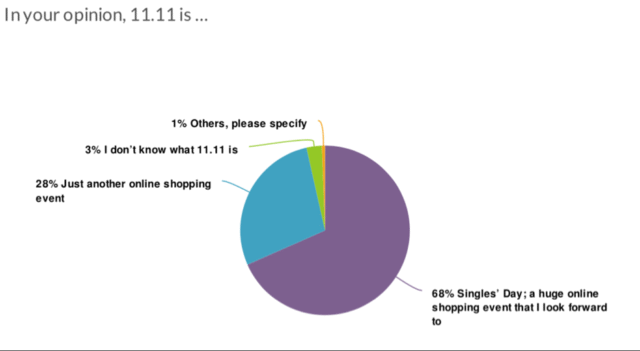
    Leading Cashback platform ShopBack conducted a survey recently and found the awareness level towards 11.11 Singles’ Day among Malaysian online shoppers has grown to 96% this year, from 69% in 2016. “In a 2016 survey to 2,000 Malaysian online shoppers, 69% answered they know what Singles’ Day is and 31% said they don’t. This year, 96% answered it is a huge online event (68%) or just another online shopping event (28%); only 3% from 2,000 respondents said they don’t know what 11.11 is, and 1% indicated that day has other meanings to them. This is an approximately 40% increase compared to 2016,” Alvin Gill, Country General Manager of ShopBack Malaysia says.

    According to Alvin, Alibaba’s investment in Lazada and massive promotions rolled out via multiple online and offline channels, as well as education efforts done by reward partners throughout the years likely contributed to the awareness growth. “Alibaba’s Taobao and Tmall have been collaborating with ShopBack on a regional level to boost market performance via cash rewards and multimedia educational efforts since 2014, of which include multi-lingual contents, digital and on-ground marketing exposures, as well as customer service support to encourage purchases through either Taobao, Tmall or Lazada’s Taobao collection, whichever suits their needs,” he adds.

    “While it is encouraging that a majority of them are looking forward to 11.11, online sellers should also target those who feel 11.11 is ‘just another shopping event’ via better product and promotional strategy. 98% of respondents said they are willing to make more purchases if the products they need are available with greater offers online. The top three offers that would encourage them to spend are high product discounts, free shipping/delivery, and promo codes/coupon,” Alvin points out.

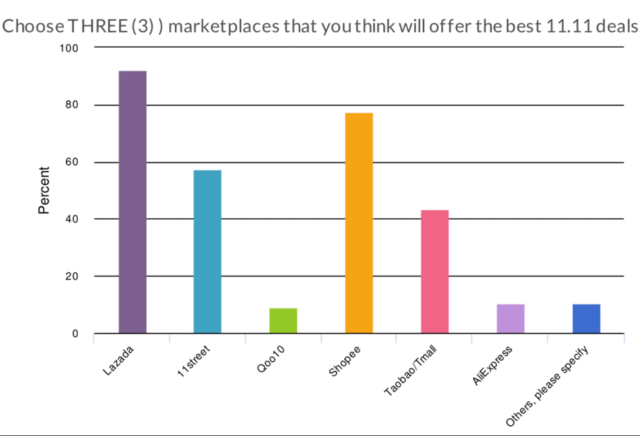
    When asked to choose three online marketplaces that they feel would provide the best 11.11 deals this year, Lazada emerged as the top choice, followed by Shopee and 11street.

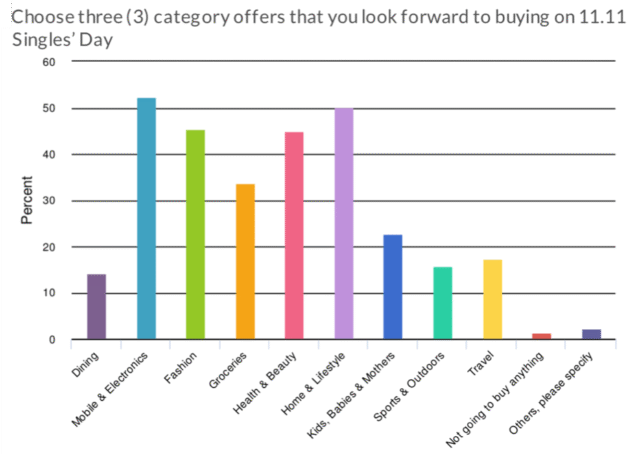
    The survey also reveals that online shoppers prefer their shopping to be affordable, fast and safe. “Mobile & Electronics emerges as the most popular category for 11.11 without surprise; the second is Home & Lifestyle which suggests shoppers could be looking for items to make over their living spaces before the New Year, followed by Fashion as well as Health & Beauty.”

    The 2018 ShopBack 11.11 online shopping survey covered views from 2,000 of ShopBack’s active online shoppers, of which 98.7% are aged 21 years old and above and around 85% have RM2,000 monthly income and above. 68.1% of the survey respondents use credit/debit card to make online payments while 25.4% select online banking as the preferred method, followed by cash on delivery 3.3%, Paypal 2.8%, and others 1.3%.

    “We witnessed 10 times more than usual web traffic directed to our partner’s sites on 11.11 in 2017, more than RM6 million worth of transactions were made through our platform and over RM200,000 cashback saved by using ShopBack. Together with our partner merchants, ShopBack Malaysia has tailor-made the 2018’s 11.11 campaign according to shopper’s needs and we aim to break the record by doubling our performance as well as cashback number this year,” Alvin says.

    Currently, more than 1 million Malaysians are using ShopBack for their daily purchases. The company works with online sites like Lazada, 11street, Taobao, Tmall, Booking.com, Expedia, Traveloka, ZALORA, Hermo, etc to give up to 30% cashback as a loyalty reward to online shoppers. Besides Malaysia, ShopBack also operates in Singapore, Indonesia, Philippines, Thailand, Taiwan and Australia. Over RM25 million worth of cashback has been given to its Malaysian users thus far. The cashback savings can be transferred out to a user’s bank account upon validation.

  • What is Singles’ Day like in the Philippines?

    What is Singles’ Day like in the Philippines?

    It all started with a few students from Nanjing University who decided to break away from the monotony of being single for one day. They chose 11.11 because of the solitary implications of the number 1 which symbolize being single. However, this simple celebration turned into one of the largest shopping days in the world.

    It turns out that this event gained great interest also in Southeast Asia.

    According to Google, in Philippines the popularity of Singles’ Day has increased more than four times in the last five years.

    Who’s taking part in Singles’ Day? What are the behaviours of consumers on that day? 

    Shopping therapy for the young and lonely

    Who shops on Singles' Day

    So, who exactly takes part in Singles’ Day?

    57% are actually women.

    In accordance with the event’s name, three out of four consumers are single.

    Of course, not only singles went on a shopping spree.

    An increase in interest, although not as significant as among singles, can also be noted in the group of people in relationships.

    The interest in Singles’ Day is especially apparent among young Filipinos.

    Compared to a regular day, the number of transactions on Singles’ Day among people aged 18-24 grew by 1022%.

    However, getting great discounts is not restricted to younger people as there is a noticeable interest in this shopping festival among all age groups.

    The day for singles to indulge themselves

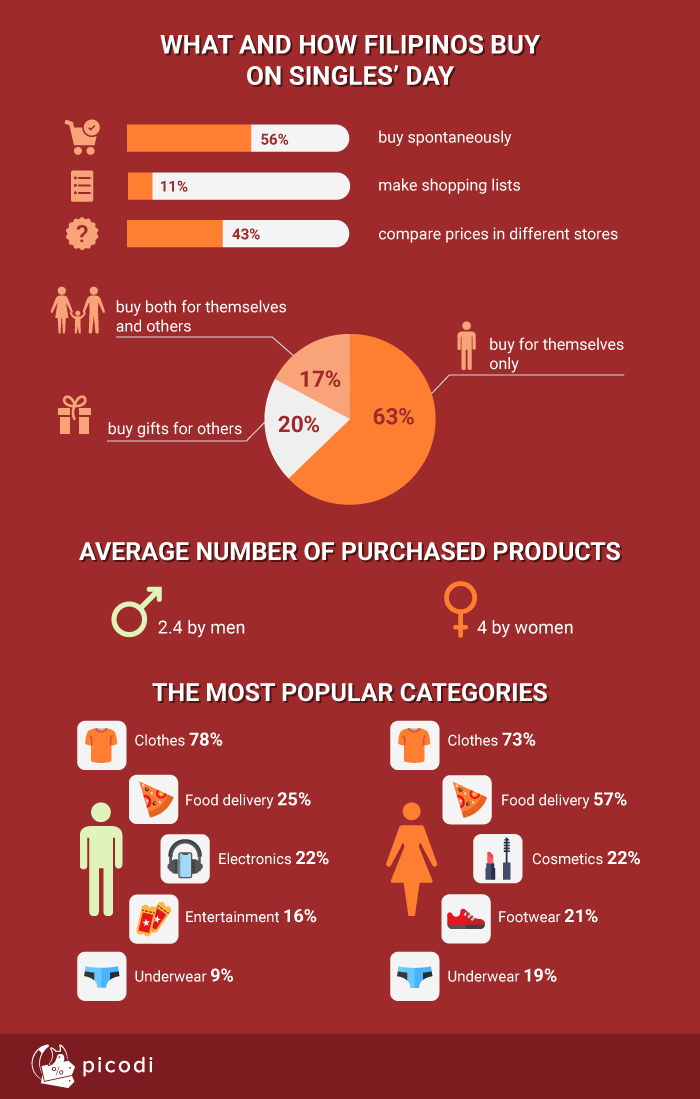
    What and how Filipinos buy on 11.11

    More than half of Filipinos do not prepare for the Singles’ Day shopping craze but buy impulsively on that day.

    43% compare the prices in different stores while 11% make lists before shopping.

    It looks like most people treat 11.11 as an occasion to meet their desires rather than an opportunity to execute a well-thought-out shopping plan.

    On top of that, more than 60% of consumers buy things just for themselves and only one-third buy gifts for other people on that day.

    An average man buys less than an average woman—2.4 and 4 products respectively.

    The most desirable items among men are clothes, delivery food and electronics. Similarly, women buy mostly clothes, delivery food and cosmetics.

    Shopping fever in the middle of the day

    Shopping behaviours on Singles' Day

    It’s not surprising that Filipinos buy more than usual on Singles’ Day.

    The number of online transactions increased significantly with 970% more purchases compared to a regular day.

    On average, a Filipino is willing to spend 3050 PHP on a Singles’ Day shopping spree and sales reached a peak right in the middle of the day, at 1 PM.

    Mobile users far behind

    Singles' Day: Devices types and brands

    70% of consumers use desktops when doing their shopping on Singles’ Day.

    Only 26% of Filipinos make their purchases on mobile phones.

    Most of the transactions are made on Apple devices, followed by Samsung, OPPO, Asus and Huawei appliances.

  • ‘Physical and online retail will co-exist in the future in India’

    ‘Physical and online retail will co-exist in the future in India’

    The retail sector in India has been evolving at a swift pace. Rapid urbanisation and digitisation, rising disposable incomes and lifestyle changes – of particularly the middle-class – are major contributors to the revolution of the retail industry.

    In a freewheeling chat, Anuj Puri, Chairman – ANAROCK Property Consultants talks about what canbe expected from the Indian retail industry going ahead. Excerpts:

    How do you see retail industry shaping up in India?

    Retail is back with a big push. A lot of foreign brands are looking to enter India, a number of Indian brands are expanding rapidly, a number of new Indian brands are opening up retail stores. Equally, I see a huge amount of promptness within the Indian retail real estate on the bounce back of organised retail in India. Modern retail is growing fast. 10 years ago, the contribution of modern retail format was only 2 percent and today it is getting into the double digits.

    Which retail format will come out clear-cut winner in future?

    There will be newer formats that will be very important to get into the retail real estate spaces. F&B and new formats in entertainment will continue to do very well.

    Anything which is experiential and cannot be bought online and has an ability to touch, feel, taste, hear and smell, those formats in the physical space will continue to do well.

    With e-commerce expanding at a rapid pace, what is future of malls in India?

    Expanding e-commerce in India has a positive impact on the physical retail real estate. E-commerce space cannot divulge into physical space. Both of them are integrating with each other like Walmart has recently bought Flipkart, Amazon in setting up its physical stores, there are number of e-commerce players which are planning to set up their retail stores and many e-retailers are also investing/ buying existing physical stores. We can say it is an integration of e-commerce and physical space.

    What is the future of malls a few years from now?

    Going ahead, technology is going to play a big role for both retailers and mall developers. The taste of the consumer coming in, the ability to drive the footfalls to the right stores, to understand the demographics of the people who are coming into mall are all going to be important learnings which the mall developer will pass on to his partners – the retail brands.

    In future, technology will integrate the experience, partners and will help in driving the sales, deriving right retail formats in the malls. Just like in the more mature markets, where technology plays a huge role in the mall operation, similarly it will be replicated in India as well.

    How can the malls stay relevant to the consumers for years?

    It is true that a mall has to continue to change its skin. It is necessary to bring something new to attract different retailers. Change is a perennial process. Malls must continue to attract footfalls by adapting to change.

    What is your outlook on retail spaces in Tier II cities and beyond?

    Big retailers are occupying a huge space in Tier II cities as the profit margins are very high and the rentals are low. Also, since consumers coming to these stores have more time to spend, they have an ability to experience on the entertainment, leisure, retail and food. We are not only bullish on Tier II cities but Tier III cities as well. Retailers are often seen complaining about lack of good retail real estate spaces in India.

    How do you see this changing in the future?

    At this point of time, we are starved for good quality retail spaces. It is absolutely true that there are more retailers who want to get into the malls which are successful. We are hopeful that over the next 2-3 years there will be a better equilibrium because there are number of malls that are under-construction and it is expected that these malls will be able to cater to the increasing requirement of retailers.

    I also think that these mall developers who are building up the malls have also learnt that how to build, operate good quality malls and how to attract right kind of retailers within those malls.

  • Fung Retailing, Alibaba to collaborate bringing lifestyle brands into China

    Fung Retailing, Alibaba to collaborate bringing lifestyle brands into China

    Fung Retailing and Alibaba have formed a strategic partnership to launch more international lifestyle brands in Mainland China. The partnership will bring closer Alibaba’s 600-million user base and Fung Retailing’s 3000+ network of stores across Greater China, UK, France, South Korea, Singapore, Malaysia, Thailand and the Philippines. Its partly- or majority-owned businesses include Circle K and Zoff (under Convenience Retail Asia), Trinity, Toys R Us, Suhyang Networks, the UCCAL Fashion Group and Branded Lifestyle Holdings.

    The Fung Retailing and Alibaba collaboration aims to meet the increasing demand of Chinese consumers, building on the strengths of both parties in online and offline retailing, the two companies said in a statement. At the same time, it will better serve global brands by leveraging Fung Retailing’s global portfolio of brands, offline retail channels and marketing know-how, as well as Alibaba’s ecosystem, digital retail leadership, technology, and consumer insights.

    “That will help global brands tailor their product development and marketing strategies to meet the ever-changing needs of Chinese consumers,” the statement said. “The brands can also draw on Alibaba’s new retail channels, including Tmall and Intime, as well as Fung Retailing’s offline stores, thereby reducing costs, risks, and the time traditionally associated with entering the China market.”

    Photo: At the Fung Retailing and Alibaba MOU signing ceremony this week, from left: Sabrina Fung, group MD of Fung Retailing, Dr Victor Fung, group chairman of the Fung Group; Daniel Zhang, CEO of Alibaba Group; and Toby Xu, VP of Alibaba Group.

    Under a memorandum of understanding signed this week, both companies will join forces in global brand recruitment and offer brands merchandising, marketing and omnichannel distribution services. This collaboration will focus on the mainland China market as a first step, and potentially expand to other regions riding on Alibaba’s platforms.

    Speaking during the signing ceremony in Shanghai, Alibaba CEO Daniel Zhang said Alibaba wants to help global brands expand their foothold in China by fully integrating its New Retail capabilities, big data and technology with Fung Retailing’s “unparalleled advantages in brand and supply chain resources”.

    “We believe this partnership represents the beginning of a new chapter for New Retail.”

    Fung Retailing’s group MD Sabrina Fung said retail is changing exponentially, so it’s important to stay ahead of the curve, which this agreement allows the company to do.

    “Through this exciting strategic partnership with Alibaba, we will help customers navigate the full Chinese retail economy and reach China’s 1.4 billion consumers more easily. In this evolving retail landscape, and faced with changing consumer behavior and disruptive retail technologies, we are focused on developing new ways to do business,” she said.


  • HK’s Goxip secures funding for massive expansion plan

    HK’s Goxip secures funding for massive expansion plan

    Hong Kong fashion e-commerce business Goxip has secured US$1.4 million from financial services firm Convoy Global Holdings. The investment will fund Goxip’s planned expansion in Southeast Asia and allow the establishment of new payment services, including installment loans to online shoppers. The initiatives are expected to make the firm’s products more affordable to a broader audience in the region.

    Goxip has already set up in Malaysia and Thailand.

    Goxip raised $5 million early this year from Chinese imaging/video app developer Meitu and Nan Fung Group along with input from three individual investors. Meitu, which is also bringing its 456 million active users into play, also invested in this round of funding.

    Goxip’s CEO Juliette Gimenez said: “With Meitu’s help, we’ve been growing faster than expected, especially with our Thailand launch ahead of schedule. Bringing Convoy on board will allow us to keep our momentum while also adding an important fintech component to our play, especially as we enter emerging markets across Southeast Asia where spending power still lags behind Hong Kong and Singapore.”

  • Flipkart, Amazon see bumper in India festive sale

    Flipkart, Amazon see bumper in India festive sale

    With festive sales drawing to a close, e-tailing giants Amazon and Flipkart have claimed bumper sale on their platforms, and that they were ahead of the competition, as they received orders from customers from over 99 percent of the pin codes in the country.

    According to a report: Citing a survey by Kantar IMRB and other reports, Amazon India Senior Vice President and Country Head Amit Agarwal said Amazon emerged as “the most visited and transacted shopping destination in India this festive season” (October 10-15, October 24-28 and November 2-5).

    “With 99.3 percent of pin codes placing at least one order, 89 percent of new customers coming from smaller towns, almost 70,000 small and medium businesses getting at least one order and new Prime memberships growing by nearly 2X, we are humbled that India trusts us to find, discover and buy anything online,” he said in a release.

    Asked about another report stating that Flipkart cornering 51 percent share of the festive sale between October 9-14, Agarwal said, “we don’t comment on reports that are based on non-scientific methodologies”.

    The said industry report had stated that Amazon.in had a 32 per share in the first leg of the festive sale before Dusshera.

    Both Walmart-backed Flipkart and Amazon have claimed record-breaking sales numbers across categories like smartphones, large appliances and fashion during their festive sales.

    “The current sale (November 1-5) is already more than 2X of our Big Billion Days sale this year. We were the clear leaders in the fashion category… we had all brands (of smartphones) except one…competition is no where close to that,” Smrithi Ravichandran, Head of Growth, Flipkart said.

    She added that customers on an average spent Rs 7,500 on various purchases during this festive sale and that its gross merchandise value (GMV) was up 90 percent over last year.

  • Alibaba promises US$200 billion global sourcing plan

    Alibaba promises US$200 billion global sourcing plan

    Alibaba has committed to help import US$200 billion worth of goods from more than 120 countries over the next five years. The company says the move underscores its long-term commitment to globalisation and boosting its efforts to meet the rising demand of Chinese consumers for high-quality international products.

    However, it could also be construed as a move to shore up alternative supply chains in the wake of growing trade tensions between the US Trump administration and China.

    “Globalisation is one of Alibaba’s most critical long-term growth strategies,” said Alibaba CEO Daniel Zhang in a statement. “We are building the future infrastructure of commerce to realize a globalised digital economy where trade is possible for every country around the world.”

    He said using Alibaba’s innovative technology and robust ecosystem, the company is positioned to make global trade more inclusive and fulfil its mission “to make it easy to do business anywhere in the digital era.”

    Zhang outlined Alibaba’s plan at its Global Import Leadership Summit held at the first-ever China International Import Expo in Shanghai. Between 2019 and 2023, Alibaba forecasts it will help import international goods from businesses of all sizes in top countries such as Germany, Japan, Australia, the US, South Korea and Singapore. Several top global brands including P&G, Nestle, JBS, and Refa, have confirmed their holistic partnership with the Alibaba ecosystem.

    By collaborating with various Alibaba businesses units, these brands have been able to effectively engage with China’s massive middle class, a primary engine powering China’s consumption growth.

    Alvin Liu, GM of Tmall import and export, said China’s middle class is booming. “As incomes are rising in China, consumers want faster access to and a wider variety of high-quality products from around the world. Tmall is uniquely positioned to help international brands tap into the growing China market as consumers seek to upgrade their lifestyle.”

    According to a joint report by Deloitte China, the China Chamber of International Commerce, and AliResearch, China’s robust economic growth in recent years has increased the number of middle-to-high income Chinese consumers, who are fuelling the demand for imported, quality goods.

    The report notes that China’s cross-border e-commerce market has grown remarkably, with the proportion of imports to total e-commerce sales growing from 1.6 per cent in 2014 to 10.2 per cent last year. The report also highlights that, between 2014 and 2017, the number of shoppers on Alibaba’s dedicated platform for cross-border shopping, Tmall Global, has grown 10-fold.

  • Tmall, Swire Properties launch New Retail initiative

    Tmall, Swire Properties launch New Retail initiative

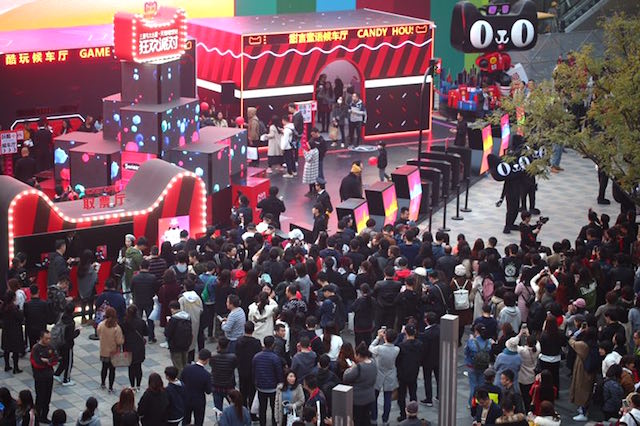
    Alibaba Group’s Tmall and Swire Properties are launching a New Retail initiative creating tailored retail experiences at Swire Properties’ five shopping malls in Mainland China. The partnership will bring benefits to customers in time for Alibaba’s 11.11 Global Shopping Festival on Sunday with Taikoo Li Sanlitun in Beijing the first brick-and-mortar shopping mall in Mainland China to experience this year’s 11.11 “red packet rain” this week.

    Swire Properties will introduce Tmall’s New Retail technologies at five of its developments: Taikoo Li Sanlitun and Indigo in Beijing; HKRI Taikoo Hui in Shanghai; Taikoo Hui in Guangzhou and Sino-Ocean Taikoo Li in Chengdu. The five New Retail initiatives include Tmall Smart Stores, a Tmall Pop-Up Store, Interactive Idol Engagement Photo Booths, Smart Nursery Rooms and a Smart Parking Service.

    Tmall Smart Stores: Shoppers will enjoy a seamless online and offline shopping experience from order to delivery (for participating physical stores). By signing up as members of selected brands, customers can instantly receive details on the latest promotions, and enjoy a return service by simply using their digital devices.

    Tmall Pop-Up Store: Tmall will open an interactive pop-up store featuring cutting-edge technology at Taikoo Li Sanlitun. This nine-day promotion during the Festival will offer shoppers in-depth and enhanced experiences.

    Interactive Idol Engagement Photo Booth: Fans will have a chance to ‘virtually interact with’ and snap a photo with their idol. This is the first-of-its-kind check-in hot spot in Mainland China.

    Smart Nursery Rooms: These offer mothers a relaxing and private space where they can nurse their babies at shopping malls. Vending machines will also offer essential nursing necessities.

    Smart Parking Service: By linking Alipay with their car license plates, drivers can pay parking fees with ease. This service will save drivers 80 per cent of the time usually spent on paying the parking charge and exiting the car park.

    “At Swire Properties, we are always looking for new ways to innovate and integrate the latest technologies into our business, so that we can bring unique experiences to our customers,” said Han Zhi, director, retail at Swire Properties. “Our collaboration with Tmall is a powerful example of digitisation. By harnessing rapidly developing online technologies and big data, our goal is to define the New Retail shopping experience.

    “This year marks the 10th anniversary of Taikoo Li Sanlitun and Alibaba’s 11.11 Global Shopping Festival, both of which have grown in leaps and bounds the past decade. We’re confident that our partnership, which also celebrates this milestone, will set a new benchmark in our respective industries and in the digital space.”

  • High Suning profit increase reported

    High Suning profit increase reported

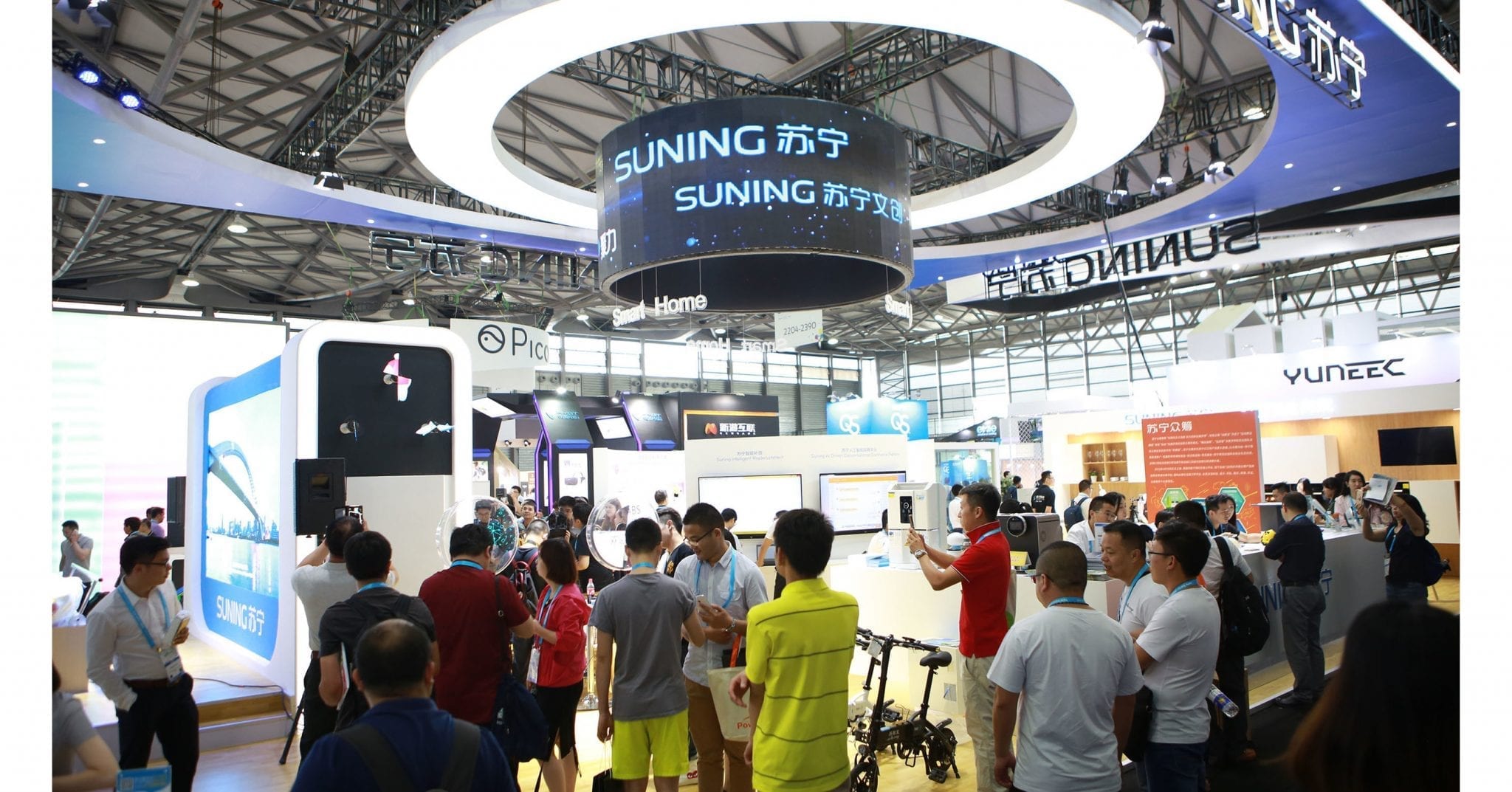
    Chinese O2O retailer Suning has posted RMB172.97 billion (US$24.79 billion) in operating revenue in its third quarter performance report. The result shows a 31.15 per cent year-on-year increase on the reported figure during the first three quarters this year. The company also generated a net profit of RMB6.127 billion ($878 million), an increase of 812.11 per cent over the same period last year.

    The company credits the result to the strength of Suning’s fast-growing online sales comparative to other e-commerce platforms.

    Suning currently has more than 382 million registered users. It operates 6292 direct-sale physical stores and 1453 Suning retail cloud franchise stores.

    Suning says it will provide free delivery in the days approaching the holiday the 11.11 Singles Day shopping spree and will not raise its delivery fees on the day.

  • Alibaba’s second-quarter revenue jumps high

    Alibaba’s second-quarter revenue jumps high

    Alibaba’s second-quarter revenue grew 54 per cent year on year, reaching RMB 85.1 billion ($US12.3 billion). Net income attributable to shareholders was RMB 20 billion ($2.9 billion), a 13 per cent year-on-year increase. “Alibaba had another strong quarter of rapid growth,” said Alibaba Group CEO Daniel Zhang.

    “Annual active customers increased by 25 million to reach 601 million in the year ended September 30.”

    “Annual active customers increased by 25 million to reach 601 million in the year ended September 30.”

    Alibaba’s cloud-computing arm saw 90 per cent year-on-year growth to RMB 5.6 billion, launching more than 600 products and features during the quarter ranging from big data analytics, AI application innovation, security and internet-of-things enhancements.

    The business’s online Tmall operations saw a 30 per cent increase in gross merchandise value, driven by improved conversion rates and increased traffic in the fast-moving consumer goods, home furnishings and apparel categories.

    Alibaba’s New Retail strategy has continued to pay off across its Hema supermarkets network, with stores that have been in operation for at least 1.5 years seeing online sales account for 60 per cent of turnover for the September quarter. By the end of the quarter, 77 Hema stores had been opened in China.

    The group has dropped its forecast revenue guidance for the full year by 4 to 6 per cent to between RMB 375 billion and RMB 383 billion. As it stands, the group expects revenue to grow by 54 to 56 per cent.