Tag: Finance

  • KBank appoints Ms. Voranuch Dejakaisaya as Executive Chairman-KBTG

    KBank appoints Ms. Voranuch Dejakaisaya as Executive Chairman-KBTG

    KBank recently announced the appointment of Ms. Voranuch Dejakaisaya as Executive Chairman–KASIKORN Business–Technology Group (KBTG) to supervise the IT systems of KBTG and KBank, and help steer the organizations’ transformation plans and regional expansion.

    Ms. Voranuch Dejakaisaya, currently aged 62, graduated with a Bachelor of Science, Statistics, Chulalongkorn University, and a Master of Business Administration (M.B.A), Chulalongkorn University. She has extensive work experience with a number of organizations, including GE Capital (Thailand) as Chief Information Officer SEA/IT Regional Head, Bank of Ayudhya PCL as Chief Information, and Siam Commercial Bank PCL as Chief Information & Operations Officer. Prior to her retirement, she was Chief Technology Officer at SCBX PCL. She then joined KBank as Executive Chairman-KBTG in May 2022.

    Ms. Voranuch Dejakaisaya received the “CIO50 ASEAN 2019” award (Ranked #1) from the International Data Group (IDG) – a world-class IT consulting company, and the “Chief Information and Technology of the Year 2019” award from The Asian Banker. Additionally, she was Chairman of the Thai Bankers’ Association’s CIO Club from 2019 to 2020.

  • Government rejects airlines’ demand for further tax cuts

    Government rejects airlines’ demand for further tax cuts

    The Ministry of Finance has turned down airlines’ requests for further tax breaks, saying they have received enough support from the government.

    In response to several airlines’ request to reduce value-added tax from 8 percent to 5 percent and fuel import tax from 7 percent to zero, the ministry said in a statement Friday that only the National Assembly can decide on VAT cuts.

    The current 8 percent VAT is already a reduction from the normal 10 percent, and aviation companies are also eligible for the lower rate, it said.

    It also pointed out that the aviation industry has already benefited from a lot of support in terms of taxes and fees since the pandemic began.

    Environment tax on jet fuel has been reduced by half to VND1,500 per liter until the end of this year.

    It is important to ensure a balance between the benefits companies and the government get, the ministry said.

    Vietnamese carriers served 14.5 million passengers in the first four months of this year, up 26.3 percent year-on-year, according to the General Statistics Office.

    Airlines resumed regular international services in March after a two-year hiatus due to Covid-19.

  • Google Joins Swiss Open Banking Initiative

    Google Joins Swiss Open Banking Initiative

    Switzerland’s Openwealth initiative gains momentum as one of the world’s largest cloud providers becomes a member.

    Google Cloud becomes the latest addition to the Openwealth Association, joining as an API service provider, the organization announced on Thursday.

    The application programming interface (API) allows third-party providers to dock with IT platforms, in this case, banks and wealth managers. As a leading cloud provider, Google Cloud will allow Openwealth to disseminate the API standard globally.

    Apigee, Google’s API management platform, is one of the most widely used open API publishing software solutions in the world, used by many OpenWealth members, it said.

    The Swiss industry initiative aims to standardize the interfaces of a wide range of institutions and simplify data exchange between custodian banks and portfolio management system providers and custodian banks themselves.

    Google joins UBS, Credit Suisse, Julius Baer, ZKB, and SIX, among others, in the industry initiative.

  • UBS Weathers First Quarter Headwinds

    UBS Weathers First Quarter Headwinds

    Switzerland’s largest bank UBS has weathered multiple first-quarter headwinds, turning its best first-quarter net profit in over a decade. UBS reported Tuesday a net profit of $2.1 billion in the first quarter, exceeding expectations, showing the bank was able to steer a course through several challenges in the first quarter and posted its best first-quarter results since 2007.

    The result improved on the $1.3 billion reported for the fourth quarter of last year and was better than the $1.8 billion booked during the first three months of 2021.

    Switzerland’s largest bank accomplished this in the face of the Ukraine war, inflation showing no signs of abating anytime soon, and central banks that are tightening the loose-money spigots. «Our strong results today speak to our ability to accomplish our objectives regardless of the backdrop,» said UBS CEO Ralph Hamers.

    UBS said it reduced its Russia exposure early and actively and had a direct country exposure of $400 million as of March 31 of 2022. It expects a firm-wide P&L negative impact of $100 million.

    The bank said it is not conducting any new business in Russia or with Russia-domiciled clients. However, it will continue to monitor settlement risk on certain transactions with Russian bank and non-bank counter parties, which might result in unexpected increases in exposures.

    Pre-tax profit was $2.7 billion, improving by one billion dollars from the fourth quarter result of $1.7 and bettering the comparative year-ago quarter of $2.3 billion.

    Earnings per share were $0.61 in the first quarter, up from $0.38 in the fourth quarter of last year and higher than the $0.49 reported during the first quarter of 2021, the results showed.

    Global wealth management (GWM) booked a pre-tax profit of $1.3 billion, with the unit reporting net new fee-generating assets of $19 billion in the first quarter compared to 36.2 billion in the same year-ago quarter. Total fee-generating assets were $3.1 trillion As of the first quarter of last year, the GWM unit no longer reports net new money every quarter, and will only disclose the figure in its annual report.

    Earlier this month, finews.com reported that 2021 was a bumper year for Swiss banks attracting new money inflows. But this year, wealth and asset managers are facing geopolitical and economic uncertainty resulting from the ongoing war in Ukraine and inflation showing no sign of abating anytime soon. Add to the mix central banks that are starting to close the taps of easy money flowing into financial markets.

    The investment bank’s division’s 126 percent pre-tax profit growth from the comparative quarter was mainly attributable to Archegos-related losses in the same quarter last year. Excluding that loss, revenues increased by 4 percent, or just over $100 million, primarily from increased revenues in equity derivatives, rates, and foreign exchange.

    While the path of economic growth has become much more uncertain, UBS expects growth in economic activity to continue, but increased uncertainty could continue to affect client activity levels and asset prices. However, even as central banks are tightening policy to arrest rising inflation, the banks said that rising interest rates, notably the US dollar, are expected to lead to higher net interest income.

  • UBS Currently Sees Little Hope for Credit Suisse

    UBS Currently Sees Little Hope for Credit Suisse

    Switzerland’s two major banks are usually cautious about rating each other’s shares. But right now, UBS sees little potential in its rival. Credit Suisse’s share continued to lose value and they are now trading just above 7 Swiss francs ($7.3) after it made a warning earlier this week that it would report a first-quarter loss. There is little to suggest that the stock will recover in the foreseeable future, especially after CEO Thomas Gottstein spoke of 2022 as a transition year. Now, many bank analysts seem to be chiming in with the same view.

    British investment bank Barclays lowered its price target for Credit Suisse shares from 7.50 francs to 7.00 francs on Thursday, with their banking specialist, Amit Goel, rating the stock as underweight, which ultimately can be interpreted as a recommendation to sell.

    UBS banking analyst Daniele Brupbacher was a little less harsh on his employers’ rival, giving Credit Suisse shares a twelve-month price target of CHF 7.40 and rating the stock as neutral earlier this week. So while not advising to sell, he is advising against buying it even at such a low price.

    When the two major Swiss banks rate each other, they usually do so rather cautiously. Although they are ultimately competitors, they also play a decisive role in shaping the Swiss financial center. And no one is interested in having just one big bank in the future.

    In an interview earlier this year, UBS CEO Ralph Hamers said that it’s never a good thing when a competitor has problems because the reputation of all banks suffers as a result.

    For decades, the business models of UBS and CS were quite similar, but have diverged over the past decade or so. UBS saw no need to repaint, merely touching up its success model, as former UBS Chairman Axel Weber liked to say. Credit Suisse has been laboring for years to make a new start without success, and scandal after scandal has beleaguered the bank.

    This is reflected in the performance of Credit Suisse’s share price and the corresponding ratings of UBS. The last time UBS banking analyst Brupbacher gave his rival shares a buy rating was in April of last year. At that time, the stock was trading at 9.73 francs, and UBS had formulated a price target of 10.80 francs.

    In December 2021, UBS downgraded Credit Suisse shares to neutral, mainly due to the ongoing turbulence surrounding the Greensill funds and the Archegos hedge fund, but also because then Chairman António Horta-Osório had not succeeded in giving the bank a new, credible strategy. UBS’s target price for Credit Suisse’s shares was 9.30 Swiss francs, cut again in February to 8.50 francs and now to 7.50.

    It is quite clear. From now on, there will definitely be one financial center – two business models – and the two competitors will open up a new capital in Swiss banking history. While UBS pulls away, Credit Suisse will be hard-pressed to avoid announcing personnel changes when it presents its quarterly figures next Wednesday. That is the only real way it can credibly hold out the prospect of a new start.

  • TPBank eyes 36-percent hike in profits

    TPBank eyes 36-percent hike in profits

    Private lender TPBank expects its pre-tax profits to top VND8.2 trillion ($358 million) this year, up 36 percent from 2021.

    It also targets a 20 percent increase in assets to VND350 trillion.

    The bank plans a rights issue of 527 million shares this year to raise VND5.3 trillion and increase its charter capital to VND21 trillion.

    VnDirect Securities has forecast 25 percent growth for TPBank this year, higher than the 20 percent expected for the sector.

    BaoViet Securities has forecast its compounded annual growth rate to top 31.4 percent in 2020-22 and return on average equity (ROAE) in the period of 24.8 percent.

  • Stocks plunge to 11-week low

    Stocks plunge to 11-week low

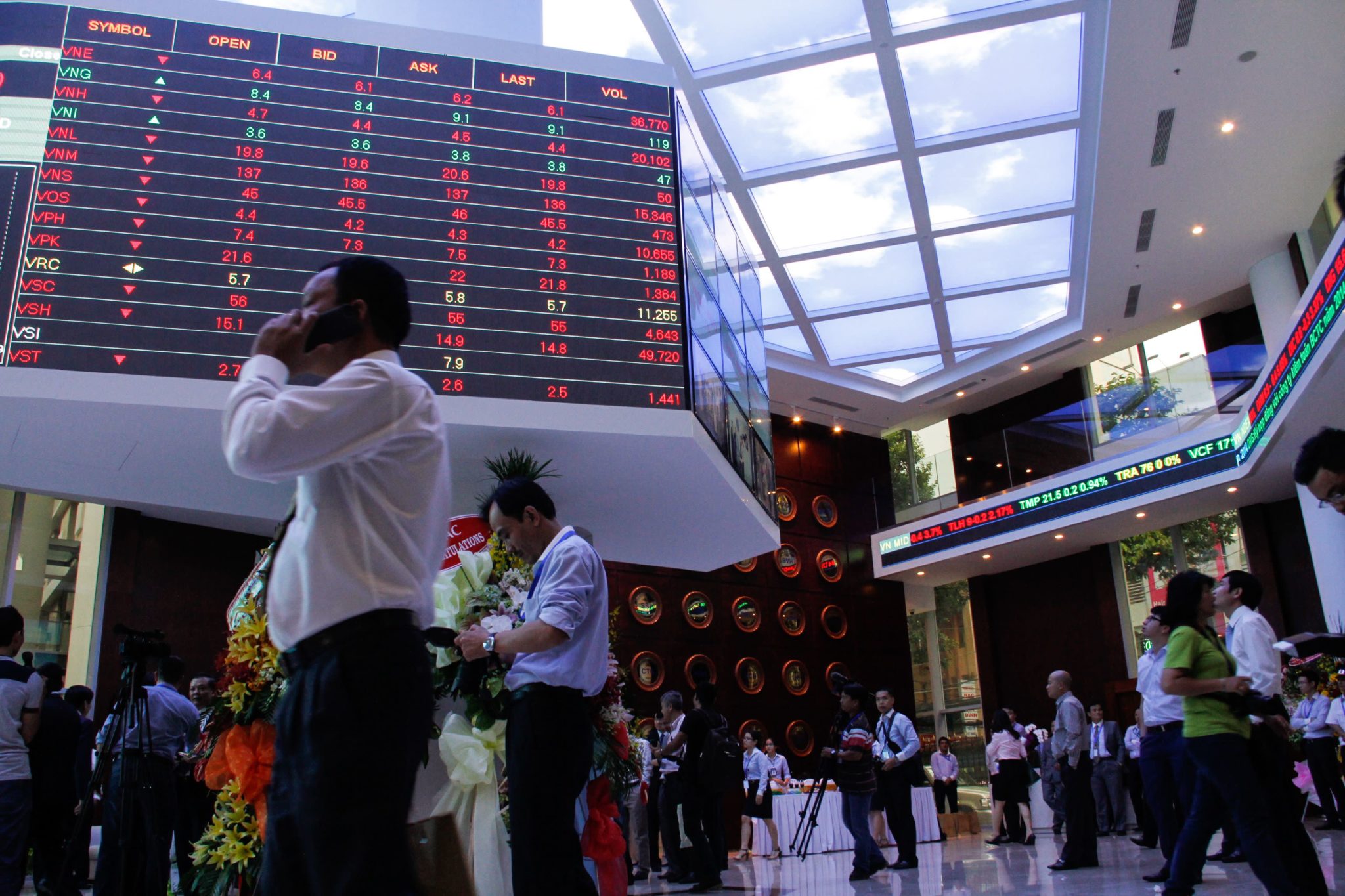
    Vietnam’s benchmark VN-Index started off the week in the red with a 1.25 percent drop to 1,440.23 points Monday morning, the lowest in 11 weeks.

    The index fell by 17 points as of 11:06 a.m. after ending in the red in four out of the last six sessions.

    The main bourse Ho Chi Minh Stock Exchange (HoSE) saw 361 tickers in the red and 107 in the green.

    Brokerages have forecast earlier that the market would drop in the short term.

    The VN30 basket, comprising the 30 largest capped stocks, saw 15 tickers in the red, with SSI of leading brokerage SSI Securities Corporation falling 4.5 percent to the lowest since August last year.

    VHM of real estate giant Vinhomes dropped 3.4 percent, the lowest in over a year.

    Other losers included CTG of state-owned lender VietinBank, down 3.5 percent, MBB of lender MB, down 2.7 percent, and VIC of biggest private conglomerate Vingroup, down 2.9 percent. Fourteen blue chips bucked the trend, with PNJ of Phu Nhuan Jewelry rising 3.2 percent and FPT of IT giant FPT Corporation gaining 2.2 percent. Both were at new peaks.

    They were followed by SAB of brewer Sabeco, up 2 percent, and TPB of private TPBank, up 1.6 percent.

    Foreign investors are buying the dips with a VND88 billion net purchase, focusing on DPM of Petrovietnam Fertilizer & Chemicals Corporation and NLG of real estate developer Nam Long Investment Corp.

    The HNX-Index for stocks on the Hanoi Stock Exchange, home to mid and small caps, was losing 2.51 percent, while the UPCoM-Index for the Unlisted Public Companies Market was losing 1.5 percent.

  • Standard Chartered sees Vietnam inflation higher than central bank forecast

    Standard Chartered sees Vietnam inflation higher than central bank forecast

    Standard Chartered Bank expects inflation of 4.2 percent this year, slightly higher than the central bank forecast, driven by the geopolitical situation and higher commodity prices.

    “Over the medium term, demand-push inflationary factors are likely to kick in as the economy recovers,” the lender said in a note, adding that supply-side factors pose upside risks to inflation, particularly given the ongoing geopolitical situation.

    It forecasts a further increase in the rate next year to 5.5 percent.

    The State Bank of Vietnam targets inflation of not more than 4 percent this year.

    Prices rose by 1.8 percent last year, the lowest rate in six years.

    The Asian Development Bank this month forecast Vietnam’s inflation to hit 3.8 percent this year and 4 percent next year, pointing to the instability in global oil prices.

    Standard Chartered was confident about Vietnam’s growth potential, forecasting GDP growth of 6.7 percent this year (2.6 percent last year), saying the recent bounce in economic indicators have become more broad-based.

    Tim Leelahaphan, the bank’s economist for Thailand and Vietnam, said: “The government lifted its quarantine requirement for international arrivals in mid-March. We think the reopening of tourism, which accounts for close to 10 percent of GDP, is the key development to watch in the second quarter after a two-year closure.”

    Vietnam remains a manufacturing hub and a key link in the global supply chain despite geopolitical and pandemic-related challenges, the bank said.

    FDI started recovering this year after contracting last year, and the bank expects this to continue, particularly in sectors such as manufacturing, electricity and gas,.

    Several major global tech companies have shifted (or plan to shift) production to Vietnam from China in recent years to diversify their supply chains, Leelahaphan added.

  • Game Your Way to a Job at Julius Baer

    Game Your Way to a Job at Julius Baer

    The Swiss bank is launching its own video game to attract future tech talent. In an effort to attract future tech talent, Swiss bank Julius Baer is offering its own game on the video game platform Roblox where candidates can take the Be Baer Challenge in the metaverse, the bank announced Monday.

    How many times must children have heard their parents admonish get off of the computer and go play outside, or do your homework and stop playing games?

    Now they can play and look for a job.

    The Julius Baer Challenge was launched on April 11 and requires the users to employ logical and analytical thinking, creativity, and speed in a gaming environment. Players can create their own avatar which can roam around the bank’s virtual headquarters in Zurich in 3D. The challenge has four different levels where prizes can be won, and a showroom that informs players about jobs and benefits at the bank.

    We are thrilled to have been able to implement this unconventional approach to attract tech talent. We wanted to bring a ‘Super Mario’ aspect to the banking world. Gaming requires curiosity, agility, and a drive to advance to the next level. These skills are highly sought after in a banking environment said Guido Ruoss, global head of human resources at the bank.

    The Be Baer Challenge was designed in partnership with E-Sports and gaming experts aimed at creating an inspiring location in the Roblox metaverse. Founded in 2004, Roblox is a global gaming platform with 55 million daily active users with video games are available on PCs, Xbox, and cell phones. There are currently 9.6 million developers on the platform.

    Maybe now, kids will be hearing from their parents «what are you doing outside? Come in and get on the computer and look for a job!»

  • UBS Sets Up Diversity Focused Investment Team

    UBS Sets Up Diversity Focused Investment Team

    UBS has created a new unit dedicated to diversity and inclusion. Switzerland’s largest bank has created a new wealth management unit aimed at mobilizing client funds to offer investments that promote equality and expand outcomes for underrepresented or marginalized groups, according to a report.

    Karen Sunderam will lead the group from New York. According to her LinkedIn profile, she has been with UBS for nearly five years and has been the head of inclusive investing solutions since May last year.

    By responding to client requests for investment options that reflect personal values and are aimed at social good, UBS will offer clients opportunities to channel their money to firms at least partly owned by minorities. This also includes products led by portfolio managers who self-identify as racial or ethnic minorities, women, veterans, disabled and LGBTQ, «Bloomberg» reported.

    Under CEO Ralph Hamers, UBS has dedicated itself to the «purpose» of reinventing investing and connecting people for a better world. Head of sustainability Michael Baldinger was tasked in May 2021 with weaving these threads across the group and advancing diversity.

  • New UBS Chair Under Pressure to Deliver

    New UBS Chair Under Pressure to Deliver

    Shareholders of UBS voted incoming chairman Colm Kelleher into office with overwhelming support. Now he must meet their expectations.

    With UBS’s record results last year it is no surprise there was no shareholder rebellion at today’s annual general meeting and that shareholders voted overwhelmingly in support of new and existing board members. Incoming chairman Irishman Colm Kelleher garnered 97.7 percent of the votes in favor, the bank said at today’s annual general meeting (AGM).

    Kelleher worked for Morgan Stanley for three decades, last serving as president of the investment bank from which he retired in 2019. He was somewhat of a surprise selection to take over from Axel Weber who is stepping aside because of a 10-year term limit.

    UBS’s new chairman won the post over candidates such as Roche’s overseer Christoph Franz, Swiss ex-central banker Philipp Hildebrand, and ex-Unicredit boss Jean-Pierre Mustier.

    Perhaps because Kelleher is not Swiss, the candidate for the vice-chair was Lukas Gaehwiler, elected today with an approval rating of 96.9 percent, thus adding «Swissness» to the board. Gaehwiler is the chairman of UBS Switzerland since 2017 and was a member of the UBS Group Executive Board from 2010 to 2016. Before that, he was at rival Credit Suisse for 20 years. part of Gaehwiler’s job will be to represent UBS in Switzerland’s powerful industry associations and the corridors of political power.

    The following were elected to an additional one-year term:

    • Jeremy Anderson (98.46%)
    • Claudia Boeckstiegel (98.70%)
    • William C. Dudley (99.10%)
    • Patrick Firmenich (99.11%)
    • Fred Hu (95.83%)
    • Mark Hughes (99.12%)
    • Nathalie Rachou (99.12%)
    • Julie G. Richardson (97.79%)
    • Dieter Wemmer (98.59%)
    • Jeanette Wong (98.40%)

    The shareholders approved the discharge of the members of the board of directors and the group executive board from legal matters for the 2021 financial year by 93.15 percent, but that excludes all issues related to a cross-border tax dispute with France.

  • Raiffeisen Planning Digital Services Expansion

    Raiffeisen Planning Digital Services Expansion

    The Swiss cooperative bank plans to spend a significant portion of its 500 million Swiss franc strategy budget on digitization by 2025.

    Over the past several years, Raiffeisen Switzerland was replacing outdated banking systems which had taken up numerous resources. With that project now completed, the bank can proceed with its digitalization plans.

    Raiffeisen has attached great strategic importance to digitalization even before the group strategy. Our digital channels, especially our e-banking, have enormous significance. However, we want to position our digital solutions more broadly and continue to drive digitization as a complement to our physical branches, interim CIO Robert Schleich said in an interview with inside-it.ch

    With the foundation now in place for implementing digital products, Raiffeisen has reached a comfortable starting position from which digital services can be expanded, Schleich said.

    But the bank is not starting completely from scratch. Its mobile e-banking app has over one million users and, according to Schleich, is gaining ground among competitors. He admitted the bank was lagging behind competitors, but now that the core banking system has been renewed it can be built upon.

    Process efficiency is also an important element, Schleich said. For the core mortgage lending business, it’s not just about digitizing the existing process, but also improving it. That means the ability to conveniently apply for mortgages online and to be able to check the application more quickly.

    We’re spending 500 million francs on the entire group strategy by 2025. There’s more to it than digitization. For example, new customer business or the diversification of income. However, a significant portion of the overall budget is reserved for digitization itself, Schleich said.

    Schleich will be handing the CIO reins to Niklaus Mannhart in September 2022 at the latest, but cannot discuss issues with him since he is still under contract at his current employer.

    For now «I’m concentrating fully on the interim management of IT at Raiffeisen Switzerland. We are currently discussing what will happen after that. There are more than enough exciting tasks at Raiffeisen,» he said.

  • UBS Named as Bank for Shell Company of Roger Ng’s Wife

    UBS Named as Bank for Shell Company of Roger Ng’s Wife

    In the latest of Roger Ng’s 1MDB trial, an FBI agent claims that his wife played a major role in creating a shell company to open an account with Swiss financial giant UBS.

    Roger Ng’s wife, Hwee Bin Lim, played a central and crucial role» in helping her husband launder illicit payments from the 1MDB bond deals.

    Prosecutors claim that Low and his associates siphoned at least $500 million from the first $1.75 billion bond transactions called «Project Magnolia» with ex-Goldman colleague Tim Leissner testifying that he had received more than $60 million from Low into accounts controlled by his then-wife Judy Chan Leissner before using those accounts to send $35.1 million to Ng through an entity set up by Lim.

    In the latest development, FBI special agent Sean Fern took the stand and testified about Lim’s role in setting the shell entity using a raft of emails as proof.

    According to Fern, Lim inquired about creating a shell entity one day before the first 1DMB bond deal closed. The shell company – first named «Silken Waters» before later being renamed «Victoria Square» – was opened along with a bank account at UBS.

    Although Lim’s mother, Tan Kim Chin, was listed as the beneficial owner, Fern said he traced emails showing that bankers communicated directly with Lim about Victoria Square and the UBS account.

    Ng has argued that the money sent from Leissner’s wife to Lim, who has not been charged, was for an unrelated business transaction.

  • UBS Exiting Mitsubishi Venture in Japan

    UBS Exiting Mitsubishi Venture in Japan

    Switzerland’s largest bank is selling its joint real estate venture with Mitsubishi to an investment firm.

    UBS announced it is exiting a 20-year joint real estate venture in Japan, agreeing with its partner Mitsubishi to sell its Mitsubishi Corp.-UBS Realty Inc. (MC-USBR) to investment firm KKR, UBS said in a statement released Thursday.

    UBS said it expects to book a gain in asset management and a CET1 capital increase of $900 million upon finalization of the transaction which is expected to be in April of this year.

    The joint venture between Mitsubishi and UBS Asset Management Real Estate & Private Markets was formed in 2000 and has since grown into one of the largest real estate asset management companies in Japan.

    MC-UBSR manages two Tokyo Stock Exchange-listed J-REITs, the Japan Metropolitan Fund Investment Corporation (JMF) and the Industrial & Infrastructure Fund Investment Corporation (IIF), with assets under management of around $15 billion.

    The sale does not mean that UBS is exiting the Japanese real estate market, UBS Asset Management President Suni Harford said.

    The Japanese market remains a cornerstone of our Real Estate & Private Markets business in Asia Pacific, and we remain focused on serving the needs of our clients and capturing growth opportunities in this strategically important region. Through our rapidly growing real estate investment unit, UBS Japan Advisors, we will continue to advise our clients on Japanese property investments, Harford said.

    UBS’s  said that its asset and wealth management divisions along investment banking businesses operating in Japan are not affected by the sale

  • Former Wirecard Bosses Indicted

    Former Wirecard Bosses Indicted

    Three ex-Wirecard bosses could face ten years in prison after prosecutors issue indictments, while one former executive is still on the run.

    In June 2020, German fintech Wirecard was forced to admit that there was a 1.9 billion euros ($2.2 billion) hole in its balance sheet, leading to bankruptcy proceedings. Now, three former heads of the firm have been indicted, according to a story in Germany’s Handelsblatt.

    Prosecutors in Munich accuse former Wirecard CEO Markus Braun of professional fraud, misappropriation of company assets, balance sheet falsification, and manipulation of the company’s stock price, according to the 480-page indictment obtained by the German newspaper.

    Oliver Bellenhaus, who managed Wirecard’s Dubai office, and Stephan von Erffa, responsible for accounting, were charged along with Braun, and could face up to ten years in prison. Bellenhaus, alleged to have embezzled millions, has confessed and is the key witness for the prosecution. Testimony he provided so far has led to the imprisonment of Braun and von Erffa.

    Left out of the indictment is Jan Marsalek, the former Wirecard COO, who is a wanted fugitive, and could currently be in Russia, the paper said.

    Investigators say that Braun and his co-defendants were cooking Wirecard’s books as early as 2015, with fake bookings and revenues with partner companies. As a result, it is very likely the former managers will have to stand trial, Handelsblatt said. They are presumed innocent.

    Wirecards auditors, EY, have been dragged into the proceedings, with insolvency administrator Michael Jaffé exploring claims for damages against the auditor. If it can be established that EY made intentional errors when auditing Wirecard’s books, they would be subject to unlimited liability.

    A report last year from Germany’s Institute of Public Auditors known as the «Wambach Report,» didn’t paint a very flattering picture of EY’s auditing of Wirecards books,  another Handelsblatt report said.