Retail News CRM

Tag: gaming

  • First Sony Lounge opens in Malaysia

    First Sony Lounge opens in Malaysia

    Sony has opened its first Play Everything Lounge by PlayStation in Southeast Asia at Sunway Pyramid. The lounge, operated by Sony Interactive Entertainment’s local office, will be open until February 17. Sunway Malls and Theme Parks CEO HC Chan said he was honoured the mall has remained a mall-of-choice for experiences. “The partnership with Sony Interactive Entertainment signifies a true collaborative curation by two of the leading names of the industry. It is our privilege to work with a world-renowned gaming giant to bring another dimension of experiences for our shoppers. It is important for malls to go beyond conventions to stay relevant.”

    Sony’s regional head Hidetoshi Takigawa noted the strong performance of the PlayStation business in Malaysia, and said the Sunway Pyramid store is a means for the brand to engage with its local fans.

    Southeast Asia’s first PlayStation Experience was held in Kuala Lumpur last year.

    Gaming tournaments, community engagement activities and unreleased game trials are expected to be held in the space. A virtual reality area allows visitors to try Sony’s PlayStation VR gaming system for PlayStation 4.

    View the image of the lounge below (6 pictures) :

  • Tencent finished Q3 with strong result despite regulation

    Tencent finished Q3 with strong result despite regulation

    Gaming and chat specialist Tencent has reported a strong third-quarter profit despite ongoing issues with Mainland China regulatory authorities over its gaming software. Tencent’s share price has fallen by about one third this year, shedding US$165 billion off its value, although last year its share price doubled. In September the company announced a restructuring program aimed at lessening its reliance on games and expanding its interests into areas such as cloud and industrial services in the transport, fintech and healthcare sectors.

    Tencent profit in the September quarter rose 30 per cent to RMB23.3 billion (US$3.36 billion) which exceeded analysts’ forecasts. This was partly due to fair-value gains from the IPO of food delivery service Meituan Dianping.

    Growth in its gaming division was ahead of expectation, but the company was unable to update shareholders on the status of its negotiations with mainland government officials over a regulatory block which has frozen new game approvals. The government has yet to decide on whether or not to allow Tencent to begin charging for features of its popular PUBG Mobile game. Chinese authorities are concerned that many Chinese are becoming addicted to mobile games.

    Those roadblocks were cited as the reason Tencent’s growth rate – a respectable 24 per cent, nonetheless, to US$11.6 billion – was its slowest quarter in more than three years.

    Sales of smartphone games grew 7 per cent year on year and 11 per cent quarter on quarter, while advertising sales, the company’s single largest revenue source, rose 47 per cent

    Revenue from cloud and payment services (WeChat Pay) helped fuel a 69 per cent increase in Tencent’s “other” revenue category.

  • Vietnam’s gaming firm profits fall 52 pct in 9 months

    Vietnam’s gaming firm profits fall 52 pct in 9 months

    Vietnamese online gaming giant VNG has reported Jan-Sept 2018 profits of VND152 billion ($6.5 million), a 52 percent year-on-year slump. The company has said in its third-quarter financial statement that higher expenditures have eaten into its profits.

    Selling and administrative expenses of VND853 billion ($36.7 million) and VND382 billion ($16.44 million) respectively in the nine-month period marked a 72 percent and 27 percent year-on-year surge.

    At its recent annual meeting, the company’s management board had predicted a sharp drop in profits compared to previous year as the company wanted to focus resources on investment in strategic products and diversify operations.

    The company focuses in four main areas: e-wallet, mobile product development, ecosystem building, and e-commerce.

    VNG has set a revenue target of over VND5 trillion (more than $215 million) for this year, 17 percent higher than in 2017.

    However, after-tax profit is expected to only reach VND549 billion ($23.62 million) compared to VND938 billion ($40.36 million) in 2017.

    VNG, which used to be known as VinaGame, also owns major news site Zing, popular music site Zing MP3, instant messaging app Zalo, and e-commerce site Tiki.

    Tiki, VNG’s largest investment in e-commerce, continues to suffer increasing losses. In the first half of this year, Tiki’s losses of VND102 billion (nearly $4.39 million) were more than double the same period last year.

    The cumulative loss of this e-commerce site has reached nearly VND600 billion (about $25.82 million) after seven years of operation, beginning in 2010.

  • Razer aims to take over MOL

    Razer aims to take over MOL

    Gaming company Razer aims to take over Southeast Asian virtual gaming credits and e-payment platform MOL Global at a valuation of US$100 million.

    Razer already holds a nearly 35 per cent stake in the platform.

    Razer co-founder/chief Tan Min-Liang says the acquisition will enable Razer to take over one of Southeast Asia’s largest e-payment networks, deepen its presence in the “under-served” region, and create one of the world’s largest virtual-credit platforms for gamers.

    In August, Tan took up Singapore Prime Minister Lee Hsien Loong’s Twitter challenge for an e-payment proposal to turn the state into a cashless society. The following month, Razer proposed to develop and deploy an e-payment system, RazerPay, for which it would commit S$10 million in seed funding.

    Tan this week said the system would also enable cashless capabilities in Southeast Asia as well. It would be complementary and accretive to Razer’s gaming business.

    Razer, which is dual-headquartered in Singapore and San Francisco and listed on the Hong Kong Stock Exchange, says it will pay about US$61 million to acquire 65.1 per cent of MOL’s issued share capital.

    The acquisition will be by way of a statutory merger, upon which MOL will become a wholly owned subsidiary of Razer.

  • DHL, FC Bayern expands cooperation in gaming market

    DHL, FC Bayern expands cooperation in gaming market

    DHL and Germany’s FC Bayern Munich yesterday announced the expansion of their cooperation with innovative activations within the video gaming market, specifically in the FIFA 18 game set to launch in September 2017.

    This is DHL’s bid to tap on the massive potential of the computer games market, which analysts predict will grow its revenue from US$493m in 2016 to US$1.1b in 2019.

    In 2015, DHL helped the club to launch its online flagship store on Tmall Global. As the team’s official logistics partner and e-commerce full service provider, DHL plays a key role in delivering official merchandise to FC Bayern fans in China.

    During the team’s 2017 Audi Summer Tour to Shanghai, Shenzhen and Singapore, the Bavarian club confirmed its desire to further engage with its fan base in China, providing fans with the latest club merchandise, such as jerseys and other FC Bayern products.

    FC Bayern is one of the world’s biggest football club with over 280,000 members and one of the most successful, having won five UEFA Champions League titles, three Club World Cup trophies as well as 27 German national league championships.

  • Gaming firm Razer opens first store in Hong Kong and sets its sights firmly on mobile industry

    Gaming firm Razer opens first store in Hong Kong and sets its sights firmly on mobile industry

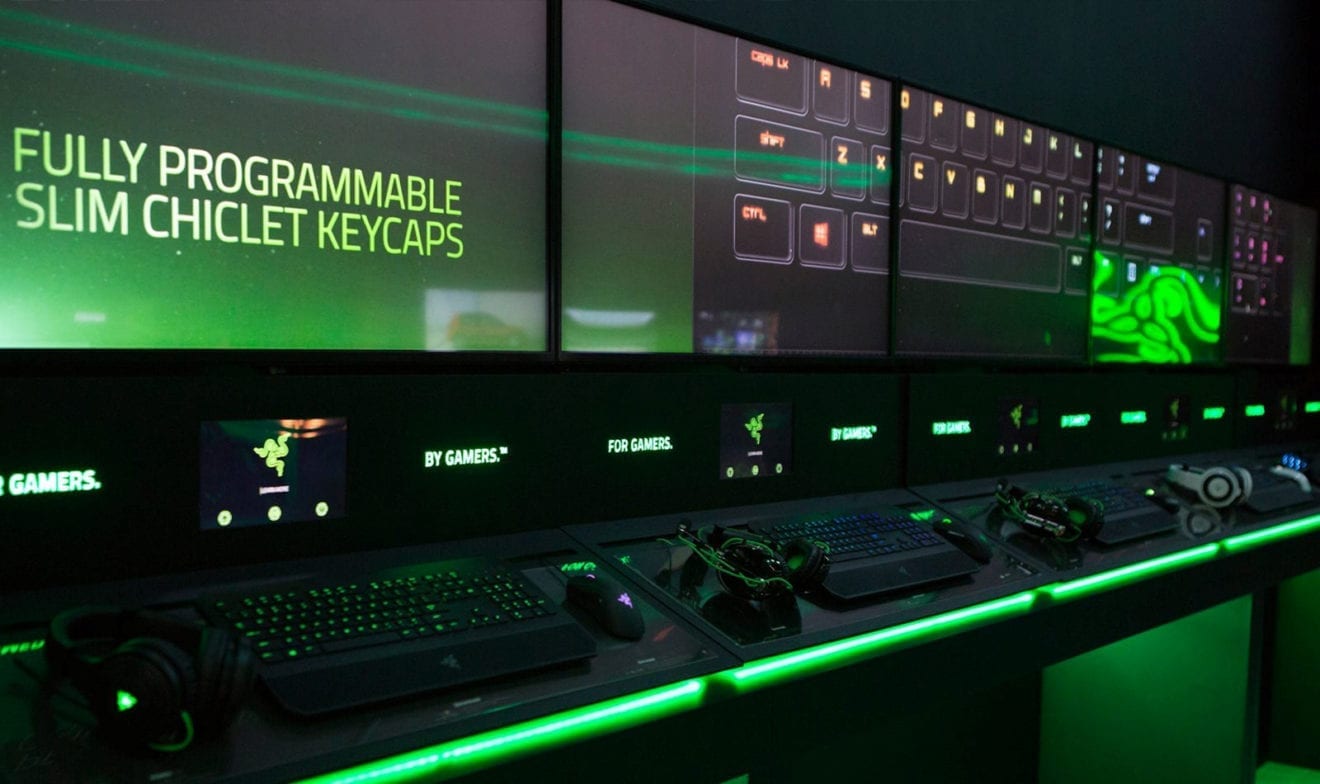
    Razer, the popular US gaming peripherals brand which opened its first concept store in Hong Kong on Saturday, is now hoping to take on the mobile gaming industry after successfully disrupting the PC gaming scene with devices such as its powerful gaming laptops and mice, its chief executive has told us.

    Razer, which is in partnership with Three Group – the mobile telecommunications arm of Li Ka-shing’s CK Hutchison on the development of the Hong Kong outlet – has its sights on taking on the mobile gaming landscape, too, which chief executive Tan Min-liang said “is going to be a huge part of our business”.

    “There is so much potential for Razer – we’re still growing exponentially through the PC market … we’ve shipped over US$1 billion in hardware over the last three years, and we haven’t even gotten started on the mobile gaming market yet,” said Tan, who splits his time between San Francisco, where the company is based, Singapore and Taiwan, where Razer has its design centres.

    The company on Saturday opened the doors to its sixth RazerStore worldwide, on Cannon Street in Hong Kong’s bustling Causeway Bay shopping district. Razer’s other shops are in Shanghai, Taipei, Bangkok, Manila and San Francisco in California.

    An alliance was formed last month where Razer and Three will work together to offer specific tariff plans, services and devices to electronic games players around the world.

    Tan also said Razer and Three will work together on “future mobile devices”, although he declined to elaborate on further details.

    While Razer’s current product offerings are largely PC-focused, with its array of mice, keyboards and sleek gaming laptops, the company has yet to offer any peripheral devices for mobile gaming, although Tan believes is an industry that is ripe for disruption.

    “When Razer first looked at gaming laptops, there were no products or services that really worked well for gamers. Similarly, right now I don’t see any mobile device or software platform that really fulfils the needs of the [mobile] gamer … there is a huge opportunity to disrupt the mobile market,” Tan told SCMP.

    Razer is yet to reveal its plans in the mobile space, but it has made several acquisitions in the past couple of years to suggest it is moving towards eventually developing its own mobile devices or gaming platform for the growing number of users who play games on their smartphones or mobile devices.

    In July 2015, it acquired Android gaming company Ouya for its Android TV games and online retail platform to bolster the game offerings for its Forge TV console product.

    And in January this year, it bought Nextbit, the startup headed by several ex-Google employees who worked on Android and who produced the Robin smartphone, which amassed over US$1.3 million in pledges on crowd-funding platform Kickstarter.

    “We’ve put together some of the best talent in mobile design,” Tan said.

    “With Nextbit, we now have the top tech leads of Android from Google with us, and the former lead designer for HTC who has helped design HTC phones for [years].

    “We’re bringing together the best possible talent at Razer to work on next generation devices,” he added.

    Razer already has a large following in China and Hong Kong with its gaming peripherals consistently coming top in the category on e-commerce platforms such as Tmall and JD.com, Tan said.

    A third of Razer’s business comes from Asia, a large part of which comes from China, he added, declining to provide specific numbers.

  • Vietnam’s online gaming firm VNG eyes IPO in US

    Vietnam’s online gaming firm VNG eyes IPO in US

    It is now in a race with budget carrier VietJet to become the first Vietnamese company to list abroad. Vietnamese online gaming and messaging firm VNG Corp said Tuesday that it has signed a preliminary agreement with U.S. bourse operator Nasdaq Inc to explore an initial public offering, a move that could make it the first Southeast Asian firm to be listed overseas.

    The agreement, which could see Nasdaq help VNG prepare for the listing, was signed on the sidelines of Vietnam Prime Minister Nguyen Xuan Phuc’s visit to the U.S.

    Founded in 2004, VNG provides online games, music streaming and messaging applications. Its statement did not disclose details about the IPO plans.

    The company was not immediately available for comment.

    In his Tuesday meeting with Robert H. McCooey Jr, vice president of Nasdaq, PM Phuc hailed the agreement between Nasdag and VNG. According to a government report, he said that Vietnam’s government always encourages the cooperation between local firms and U.S. partners.

    In a report on Sunday, VietJet Aviation Joint Stock, which controls almost half of Vietnam’s domestic airline market, is in talks to become the first company in the Southeast Asian nation to list its shares in an overseas stock exchange.

    “We’ve been approached by some foreign stock exchanges including London, Hong Kong and Singapore, which expressed their interest in our stock,” Nguyen Thi Phuong Thao, VietJet’s founder and chief executive officer, was quoted as saying. She added that she will meet exchange officials in New York later this week.

    VietJet reportedly received shareholder approval in April to boost its foreign ownership limit to 49 percent from 30 percent. The increase will need to be approved by the government because foreign ownership in the industry is currently capped at 30 percent.

    “We don’t want to hide our hope to become the first Vietnamese company to list shares overseas,” Thao reportedly said.

  • Lenovo Set To Open Retail Stores In Asia Pacific, Gaming Brand Push

    Lenovo Set To Open Retail Stores In Asia Pacific, Gaming Brand Push

    Lenovo has said that they are looking to establish over 100 Lenovo gaming stores in the Asia Pacific region, it’s not known if or when any Australian stores will be established.

    Currently JB Hi Fi has an exclusive deal with Harvey Norman who are not seen as a destination for hard core gamers. The decision to go exclusive with the mass retailer was made by Brandan Lau the Director of Consumer PC’s at Lenovo Australia.

    Initially JB Hi Fi was going to range Lenovo gaming products but dropped the Chinese brand in favour of staying with the Alienware brand from Dell, which has been highly successful for the retailer.

    According to Lenovo sources in Hong Kong, the new Asia Pacific stores will sell a range of gaming products including workstations, notebooks, accessories including mouse and keyboards as well as gaming bags.

    We also understand that the Company who are successful direct sell operators in Australia, are also looking to sell their B2B PC range which includes Think Pads and 2 in 1 products via the new stores.

    Currently Lau is banking on heavy discounting to drive consumer PC sales while at the same time investing in extensive direct sell marketing in mass newspapers and online, for Lenovo PC products a move that has not gone unnoticed by Lenovo consumer PC retail partners.

    The Company are also major partners with Amazon.

    Combined Lenovo’s consumer and enterprise product lines each contributes 50% of Lenovo’s PC sales in Asia Pacific with the Chinese Company set to shortly market a 25th anniversary range of ‘Think’ enterprise products to lift awareness of their enterprise offering.

    What Lenovo are looking to achieve with their direct sell retail format, according to sources, is uptake for a new gaming brand called Legion. All their new gaming products including a new range that will be released at IFA in Germany in September will be branded Legion.

    Ivan Cheung Asia Pacific President at Lenovo said recently that excluding Japan and China that gaming products made up 75% of the Asia Pacific’s overall consumer PC sales, Retail News understands that this is not the case in Australia due in part to Lau’s decision to consolidate his gaming sales primarily via Harvey Norman.

  • Indonesian game developers wake a sleeping giant

    Indonesian game developers wake a sleeping giant

    Avid gamer Alwin Daniel, 24, likes to drift off into his cell phone during his tight daily schedule.

    The Jakarta-based business analyst is intrigued, for example, by the meme-worthy Tahu Bulat, a locally made mobile game.

    “What got me hooked on the game is the fact that the more you play it, the more you can get upgrades and the more money you can collect. It’s an addictive cycle,” Alwin told.

    Tahu Bulat, literally “round tofu”, is the invention of Bandungbased game developer Own Games. Soon after its launch, it leaped onto Google Play Store’s “hit games” list in May last year, even beating Android’s top game Clash of Clans with more than 1 million downloads.

    Without Tahu Bulat’s popularity, not many people would realize what is going on in the local gaming industry, something that could be described as a sleeping giant.

    With little policy support or infrastructure, a number of skillful developers have so far managed to drive up the industry’s impact on the domestic economy through continuous creation and surging credibility.

    Indonesia has about 400 developers who have produced over 1,000 games, according to research by game engine company Unity3D.

    The country had the world’s fastest growing number of mobile game players as of August 2015.

    Indonesia is also the country with the largest amount of mobile game downloads in the world. Some 96 percent of mobile internet users play these games.

    Revenues from the local gaming industry jumped significantly by 77 percent to US$321 million in 2016.

    The skill and the potential of Indonesian game developers has transcended borders as more collaborations with foreign developers are now taking place.

    One such example is the collaboration between Indonesian developer True Digital Plus Indonesia (TDPI), a local unit of Bangkok-based PC and mobile games developer True Digital Plus (TDP) and South Korean developer Supreme Games, which created a mobile strategy game called Triumph Over Pain.

    “Through this game, TDP and Supreme Games will continue to be active in developing the local creative industry by providing the proper benchmark for how local mobile games should be and how skilled our local developers are,” said TDPI’s country director Sofian Martineau, claiming that Triumph Over Pain was the first Action-Based Role Playing Game (RPG) to be released on a mobile platform in Indonesia.

    Several globally well-known action RPG titles include The Elder Scrolls series, the Diablo series and the Dark Souls series, but these titles have yet to make the crossover to the mobile platform.

    Despite its tremendous potential, the gaming industry, which is a subsector of Indonesia’s creative economy, is still largely ignored by the government, a reality acknowledged by the Communications and Information Ministry’s informatics application director general Semuel Abrijani Pangerapan.

    “Right now, local game developers only control 10 percent of the local market share. This could even shrink to 3 percent if the government doesn’t realize the industry’s potential to contribute to economic growth,” he recently said.

    With help from the government, local developers might be able to control 50 percent of the local market by 2020, Semuel said.

    Being a country with the fifth largest number of smartphone users in the world, Indonesia has an immense cell phone user base, and therefore the potential for developing a prominent mobile games industry was significant, he added.

    At present, regulations affecting the gaming industry are minimal and among the few is a decree from the communications and information minister on the Indonesian game rating system (IGRS), which divides games into five different age categories, namely all ages, 3 years and above, 7 years and above, 13 years and above and 18 years and above.

  • Playphone Game Store Expands into Asia With GASH Prepaid Game Cards at 114000 Retail Outlets

    Playphone Game Store Expands into Asia With GASH Prepaid Game Cards at 114000 Retail Outlets

    Playphone®, Inc., a global leader in mobile social gaming and recently acquired by premier game developer GungHo, announced today a partnership with Gamania Digital Entertainment Co., Ltd. (GASH), a leading Asian online game publisher based in New Taipei City, Taiwan. Playphone and GASH are partnering to offer Asian gamers a revolutionary new social gaming experience with the world’s most popular games, a unique set of advanced social features, and GASH prepaid game cards − the preferred local payment method for the region.

    Playphone develops and operates social game stores worldwide, offering mobile gamers a single engaging app to discover, download, play and share thousands of their favorite games with friends. Playphone Game Stores are deeply integrated with social features throughout the gaming experience, easily connecting gamers with friends to recommend games, challenge or invite to play, brag leaderboard ranks, and more. Playphone’s gaming platform, with games from over 3,000 global developers, is rapidly expanding distribution in emerging markets.

    GASH is the largest online game publisher and digital entertainment platform in Taiwan, and its prepaid card platform is the most widely used game payment system in the region. GASH prepaid cards facilitate mobile purchases of paid games or in-game items without the need of a credit card. Gamers purchase GASH prepaid game cards in varying denominations at over 114,000 retail outlets in Asia. The GASH digital entertainment platform supports over 10 million active users, and current GASH users can now use their prepaid GASH cards to purchase paid games and in-game items from the Playphone Game Store.

    “Our partnership with GASH perfectly aligns with Playphone’s vision of providing the best social gaming experience in Asia, where gamers are hesitant to input credit card information into their mobile apps,” said Ron Czerny, CEO and Founder of Playphone. “As a gaming leader in the region, GASH has provided an invaluable contribution to our efforts to tailor our gaming experience to local Asian gamers.”

    “We are very excited to partner with Playphone to offer GASH gamers a technically-advanced, personalized gaming experience,” said Simon Lu, Chief Operating Officer of GASH. “And our partnership is a huge win for game developers, who simply upload games to the Playphone Developer Portal for instant access to Asian distribution and the GASH payment solution.”

    Game developers add games to the Playphone Game Store simply by uploading their existing Android game file (APK) to Playphone’s Developer Portal (developer.playphone.com). Playphone’s technology automatically integrates the game into the Playphone platform, providing the game with instant access to Playphone’s global distribution channel, preferred local payment solutions including GASH prepaid game cards, and world-class social features.


  • Razer Taiwan opens gaming retailer idea

    Razer Taiwan opens gaming retailer idea

    US-based digital video games big Razer has opened a singular flagship retailer in Taiwan’s capital metropolis, Taipei.

    Razer was created by CEO and Min-Liang Tan, a Singaporean, and specialises in merchandise marketed particularly to players. The Razer model is presently being marketed underneath Razer US.

    Within the new Taipei retailer, which opened final Friday, players can attempt the corporate’s distinctive units together with excessive finish pc mice designed for on-line video games, keyboards and different equipment.

    Centrestage are the Razer Edge pill, a handheld pc operating Home windows eight optimised to game-playing – and a purpose-built PC unveiled finally yr’s Shopper Electronics Present in Las Vegas.

    The opening was celebrated on-line with a minisite – #TWRazerStore (in Chinese language language) and weblog and social media postings in English. Most of the firm’s US administration flew to Taiwan for the opening.