Tag: grab

  • Grab to invest US$250m in Indonesian startups over next three years

    Grab to invest US$250m in Indonesian startups over next three years

    Grab will invest US$250 million (RM1.025 billion) in Indonesian startups over the next three years through its newly launched innovation arm, as the ride-hailing firm aggressively pushes to cement its position in the Southeast Asia’s largest economy.

    The Singapore-based firm has raised US$2 billion in funding in recent months and also launched the Grab Ventures arm to develop technology start-ups in sectors beyond ride-hailing as it locks horns with Indonesia’s Go-Jek for regional dominance.

    “We are looking at startups in both series A and B, which we could integrate into our ecosystem,” Ridzki Kramadibrata, managing director for Indonesia said.

    The company, which counts Chinese ride-hailing firm Didi Chuxing and Japan’s SoftBank Group Corp among its backers, has already starting looking at startups and will start funding rounds later this year, he added.

    Grab is interested in healthcare and food-and-grocery delivery startups as well as those that facilitate digital payments and automated processes, he added.

    Grab’s rival Go-Jek has already evolved from a ride-hailing service to a one-stop app allowing Indonesian clients to make online payments and order everything from food, groceries to massages. It is now looking to expand in Southeast Asia, to Vietnam, Thailand, the Philippines and Singapore.

    Kramadibrata said Grab is currently the top ride-hailing player in Indonesia and that he was confident the firm would be able to maintain the lead. The firm is valued at around US$11 billion, according to sources.

    “We hold 65% of (Indonesia’s) ride-hailing market, as based on total rides and transactions,” said Kramadibrata. “And it won’t stop there, our market share is increasing.”

    He reckons Grab holds majority market share in 137 cities in Indonesia, compared with Go-Jek’s roughly 50. Kramadibrata said he based his estimates on internal and third-party data that he declined to reveal.

    Its CEO, Nadiem Makarim, said that this month that the company’s app was a market leader in Indonesia, processing more than 100 million transactions for 20-25 million monthly users.

    He did not specify how many of those transactions were only for ride hailing.

    Ride hailing services in Southeast Asia are expected to
    surge to US$20.1 billion in gross merchandise value by 2025 from US$5.1 billion in 2017, according to a Google-Temasek report.
  • Behind dispute between traditional taxi and ride-hailing company in Hanoi

    Behind dispute between traditional taxi and ride-hailing company in Hanoi

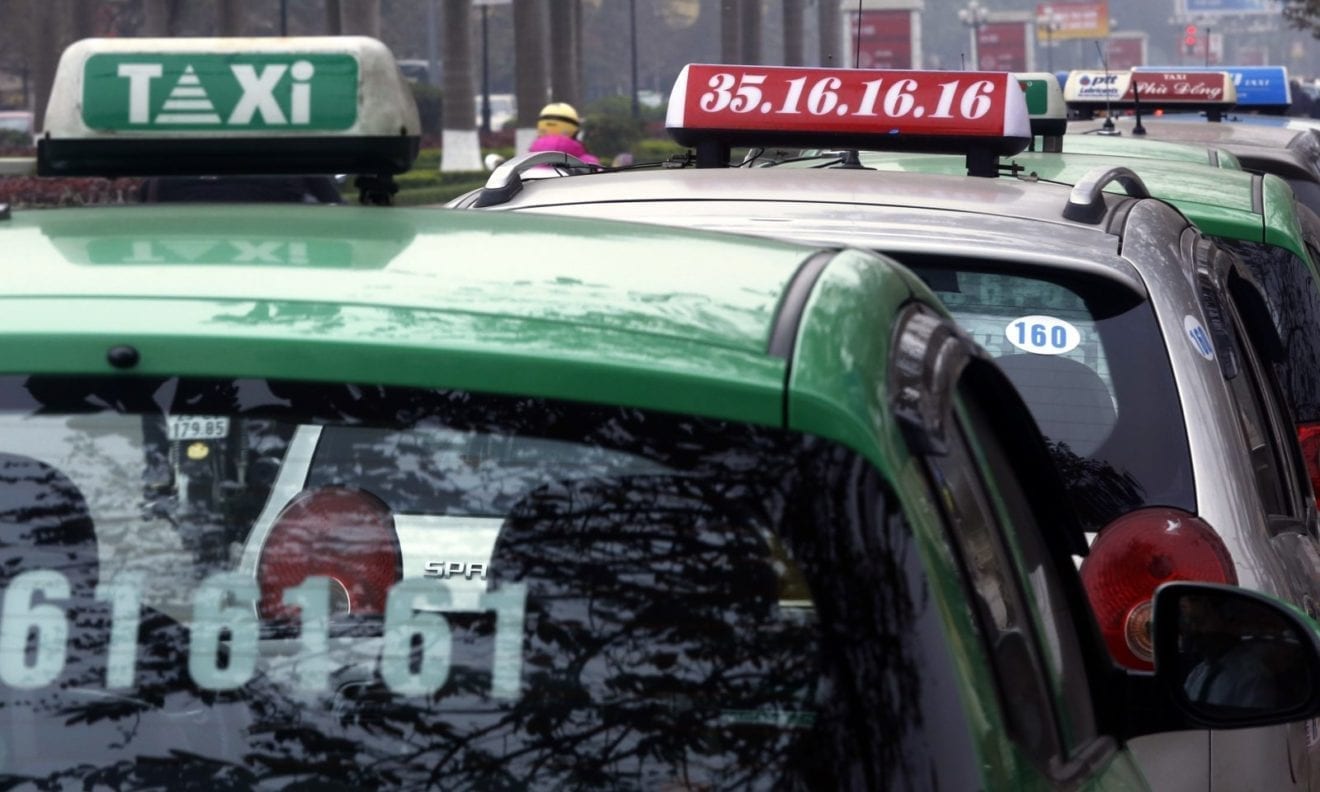
    Three major taxi firms in Hanoi have recently joined forces to have their 3,000 vehicles operating under a single brand starting in October.

    Thanh Cong, Ba Sao and Sao Ha Noi are set to become G7 Taxi in a bid to take on ride-hailing behemoth Grab.

    In April representatives of top traditional taxi firms had sat down to discuss the idea of building one common ride-hailing app for all of them.

    Nguyen Cong Hung, chairman of the Hanoi Taxi Association, said: “Traditional taxis, each with their own app, are now trying to compete with Grab. But we are divided, therefore we need to unite.”

    The meeting came after logistics firm Phuong Trang announced it had invested $100 million in ride-hailing app Vato and leading taxi firm Mai Linh started offering benefits to attract drivers.

    In March southern taxi firms ComfortDelgro Savico and Vinataxi had merged to take on Grab.

    Vinataxi, the third largest taxi firm in HCMC, was confident the merger would increase its growth sixfold this year.

    But Grab is also busy.

    While the acquisition of Uber’s Southeast Asian business last March has allowed Grab to become the dominant player in the ride-hailing business in Vietnam, it is working to improve its strategies to compete with local taxi firms.

    The company introduced Grab for Business in Vietnam earlier this month, a service that helps a company track the trips its employees make to limit unnecessary trips and control expenses.

    Following the recent entry of Indonesia’s Go-Jek as Go-Viet, Grab is deploying various strategies to attract drivers by offering bonuses and opening stops with free wifi and coffee.

    ‘Huge unfairness’

    The Hanoi Taxi Association earlier this month wrote to Prime Minister Nguyen Xuan Phuc saying Grab’s operation has created a “huge unfairness in terms of business conditions which demolish traditional taxi businesses and cause instability in society.”

    It wanted GrabCar to be considered “electronic” to guarantee fairness and all GrabCar vehicles to carry the label “electronic taxi.”

    The Ministry of Transport has labeled GrabCar as “electronic taxi” in then newest version of its bill on transport regulations, but does not require its vehicles to carry the legend.

    In a report related to the bill, which is expected to be discussed at the next session of the National Assembly in October, the Central Institute for Economic Management says lawmakers should not use old standards to new business models.

    “It is a grave mistake to force Grab to operate as a traditional taxi,” Nguyen Dinh Cung, chairman of the institute said.

  • Don’t treat ride-hailing firms as taxis, Vietnam government advised

    Don’t treat ride-hailing firms as taxis, Vietnam government advised

    Forcing ride-hailing cars to work like traditional taxis is a serious mistake revealing a non-innovative mindset, a leading economist says.

    Nguyen Dinh Cung, director of the Central Institute of Economic Management (CIEM), criticized state agencies for a “managing mindset” that “is not yet innovated”.

    Cung was referring to the latest draft decree on transportation management, which asks ride-hailing firms like Grab, Fastgo and Vietgo to comply with many conditions that are applied to normal transportation businesses like taxi companies.

    He said firms that primarily used software cannot be called a transportation business and said the new move was not consistent with the country’s stated aim of removing at least 50 percent of current business conditions.

    Cung told VnExpress that the state managers must also think in terms of the market from the perspective of facilitating new technologies and business models instead of using administrative procedures to intervene in their business.

    While the latest draft has cut many conditions for the ride-hailing business, such as logos, paint colors, board signs, an operating center, communication equipment and uniforms for drivers, Cung said there were still several negative conditions.

    For instance, the draft decree requires ride-hailing firms to send their transport contract information to the Transport Department before providing their service.

    It also requires that ride-hailing firms have a team to manage and monitor traffic safety issues.

    Cung said such conditions were meant to give authorities more room to intervene in the operations of the ride-hailing firms.

    He has recommended to the Government Office that the draft is not approved and instead, the state tries to encourage new investment forms or business models with an open and fair environment in keeping with Industry 4.0 trends.

    Even if they don’t want to encourage the new technology-based business yet, the laws should not do away with such business models with irrelevant, old conditions, he told VnExpress.

    Prepared by the Ministry of Transport to replace the Decree 86/2014 on managing automobile transportation businesses, the fifth edition of the draft has been released for public feedback.

    The tussle between ride-hailing cars and traditional taxis has not cooled after the exit of Uber from the Southeast Asian market in March. Taxi firms have continued to complain about the unfair competition they are facing.

    They have also joined hands to fight the market onslaught of ride-hailing firms.

    The ride-hailing market has seen new entrants after Uber’s departure, including Aber, Fastgo and GoViet, which is an affiliate of Indonesia’s Gojek.

    Current market dominator Grab has expanded its service to include GrabFood and GrabCar Business, the latter targeting the corporate sector. These moves pose further challenges for long-standing taxi firms like Mai Linh, Taxi Group and Vinasun.

  • Go-Jek Close to Profit in All Segments, Except Transportation

    Go-Jek Close to Profit in All Segments, Except Transportation

    Go-Jek, Indonesia’s first billion-dollar startup, is “extremely close” to achieving profitability in all its segments, except transportation, its founder and chief executive, Nadiem Makarim said.

    Launched in Jakarta in 2011, Go-Jek – a play on the local word for motorbike taxis – has evolved from a ride-hailing service to a one-stop app allowing clients in Southeast Asia’s largest economy to make online payments and order everything from food, groceries to massages.

    “We’re seeing enormous online-to-offline traction for all of our businesses and are close to being profitable, outside of transportation,” the 34-year old chief executive said.

    The startup is expected to be fully profitable “probably” within the next few years, Nadiem added.

    Already a market leader in Indonesia, where it processes more than 100 million transactions for its 20-25 million monthly users, Go-Jek is now looking to expand in Southeast Asia.

    Ride-hailing services in Southeast Asia are expected to surge to $20.1 billion in gross merchandise value by 2025 from $5.1 billion in 2017, according to a Google-Temasek report.
    Go-Jek said in May that it would invest $500 million to enter Vietnam, Singapore, Thailand and the Philippines after Uber struck a deal to sell its Southeast Asian operations to Grab – the bigger player in the region.

    Go-Jek is seeing strong funding interest from its backers as it targets an aggressive expansion, Nadiem said.

    “Since its Aug. 1 launch, the app has already grabbed 15 percent of market share in Ho Chi Minh,” Nadiem said. The firm this week opened recruitment for motorcycle drivers in Thailand.

    The startup expects anti-monopoly concerns swirling around the Grab-Uber deal, which Singapore said had substantially hurt competition, to help clear a path for its expansion.

    “We’re bringing back choice. The Singapore government is particularly eager to bring back competition,” Nadiem said, adding that the order of overseas rollouts had not been set.

    Overseas Push

    Go-Jek’s offshore push comes at a time when Singapore-based Grab is stepping up funding to expand in Indonesia and transform itself into a consumer technology company, starting with a partnership with online grocer HappyFresh.

    “Mimicking Go-Jek’s strategy is the highest form of flattery,” Nadiem laughed.

    “The super app strategy has been around for a while now and no Southeast Asian player can claim to have pioneered it,” Grab said in a statement. The company also said Grab has not lost market share in Ho Chi Minh City since August, but declined to provide market share data.

    Nadiem believes Go-Jek’s understanding of food merchants will give it an edge over Grab, which counts investors such as Chinese ride-hailing firm Didi Chuxing and Japan’s SoftBank Group among its backers.

    Nadiem, who sees food delivery as Go-Jek’s core business, said he was not concerned about funding, without giving details.

    Go-Jek was reported in June as being in talks to raise $1.5 billion in a new funding round and was valued at about $5 billion in a prior fundraising, sources said. The firm had said in March it was considering a domestic initial public offering.

    Nadiem noted Go-Jek’s backers were sharing both capital and expertise. The company is collaborating with Google on platform mobility, Tencent on payments strategy, JD.com on logistics operations and Meituan Dianping on merchant transactions and deliveries.

    Go-Jek has set up a venture capital arm, Go-Ventures, to invest in startups in Southeast Asia “with strategic importance to our business,” the chief executive said.

  • Grab Raises $1b to Expand in Indonesia, Eyes More Funds

    Grab Raises $1b to Expand in Indonesia, Eyes More Funds

    Singapore-based Grab said on Thursday (02/08) that it has secured $1 billion in fresh funding and will consider raising further cash, as the ride-hailing firm aggressively expands in Indonesia, Southeast Asia’s biggest economy.

    The latest fundraising comes less than two months after it secured $1 billion from Toyota Motor Corp and values the six-year-old startup at around $11 billion, a source close to the company said.

    The firm was valued at around $6 billion earlier this year when it bought Uber Technologies’ regional operations.

    “We will continue opening the financing for certain investors that we think will add value,” Grab president Ming Maa said on Thursday, declining to give any funding target.

    He added that Grab was seeing significant demand from investors globally, both financial and strategic.

    The latest funding in Grab came from global asset manager OppenheimerFunds, China’s Ping An Capital, Microsoft Corp co-founder Paul Allen’s Vulcan Capital, Macquarie Capital and Lightspeed Venture Partners, among others.

    Grab already counts deep-pocketed investors such as Chinese ride-hailing firm Didi Chuxing and Japan’s SoftBank Group Corp among its backers.

    It plans to use the new funds to expand its online-to-offline services, and invest a major portion of the proceeds in Indonesia, as competition heats up with Indonesian rival Go-Jek that is plotting an expansion to Singapore, Vietnam and Thailand.

    Grab said it had earmarked Indonesia, an emerging battleground for technology firms looking to serve a population of over 250 million people, as a priority market.

    The ride-hailing firm is also seeking to transform itself into a consumer technology group, offering services such as digital payments and food delivery.

    Maa said parts of Grab’s business, including transportation, were already profitable in some markets, and an initial public offering was not a focus for the company in the short term.

    Ride hailing services in Southeast Asia are expected to surge to $20.1 billion in gross merchandise value by 2025 from $5.1 billion in 2017, according to a Google-Temasek report.

  • Grab Aims to Dominate Indonesian Market With Open Platform Strategy

    Grab Aims to Dominate Indonesian Market With Open Platform Strategy

    Ride-hailing company Grab has launched GrabPlatform and GrabFresh to tap further into the Indonesian market, its representatives said on Tuesday (10/07).

    Grab is going to upgrade its app to focus on people’s daily needs and make it become an everyday superapp.

    For this purpose it just launched GrabPlatform, a new interface which provides transportation, news, e-commerce and food delivery services. The food feature, GrabFresh, is operated by HappyFresh, Southeast Asia’s leading online grocery shopping company.

    Now the company is testing the news feed feature, which is intended to engage users more while they are using the company’s ride-hailing services.

    “Partnering strategy, or we call it open platform strategy, has been favored by us to offer more to customers. It has been proved very effective in boosting our business” said Grab co-founder and chief executive Anthony Tan said on Tuesday.

    In 2017, Grab acquired Kudo, Indonesia’s leading online-to-offline payment service, which according to Tan has been very helpful for the company’s expansion.

    “After partnering with Kudo, we’ve grown tremendously across cities in Indonesia. And then with OVO, who is the country’s leading e-wallet. We recognize that we can’t be the best in everything, so we find the best partners. Kudo was the best agent network, OVO is the best e-wallet and TPI [ride-hailing service Teknologi Pengangkutan Indonesia] is one of the best rental partners,” he said.

    “If it wasn’t for Kudo, we could not have grown in Indonesia that fast. We went operational from 20 cities to over 100 cities in Indonesia, because of Kudo.”

    The region’s leading ride-hailing app is facing rivalry from local competitor Go-Jek, which in May announced expansion to Singapore, the Philippines, Thailand and Vietnam.

    According to App Annie, Go-Jek was leading in Indonesia, recording 15 million active users every week last year, much better than Grab with 2.5 million users.

    In March, Grab merged with ride-hailing giant Uber for the latter’s Southeast Asian operations.

  • Grab launches grocery delivery service

    Grab launches grocery delivery service

    It will kick off in Indonesia in July, followed by Thailand and Malaysia by late 2018.

    Grab teamed up with Indonesian start up HappyFresh to launch its grocery delivery services, an announcement revealed. The move is part of Grab’s open platform strategy as it eyes to become Southeast Asia’s first everyday superapp.

    Through GrabFresh, consumers can pick grocery products which will be delivered by GrabExpress drivers and other delivery partners within an hour or at a pre-arranged time.

    “We’ve gone from offering our tech as a booking platform for taxi operators, to providing a fleet of delivery drivers for e-commerce companies,” Grab CEO and co-founder Anthony Tan said.

    Available through the main Grab app, the on-demand grocery delivery platform will kick off as a beta service in Jakarta from July. Thailand and Malaysia can access it by late 2018.

    “Grocery delivery is a huge opportunity in Southeast Asia,” HappyFresh CEO Guillem Segarra said. “From our research, 70% of grocery delivery app users shop at least once per week, and they like to shop from the stores that they are familiar with.”

    The platform includes a selection of about 100,000 grocery products from over 50 large supermarket chains and specialty grocery chains as well as trained personal shoppers who could help pick items for customers.

  • Grab now has more rivals than ever before

    Grab now has more rivals than ever before

    From an e-hailing app, Grab has made great steps forward, providing many different services. Most recently, it started the payment service GrabPay and lending service Grab Financial.

    The consumer lending market in South East Asia is very large. As estimated by the World Bank, about 2 billion people in the world cannot access bank services, and most of them are in Asia Pacific.

    The non-cash payment market, according to Grab, is worth $500 billion in South East Asia.

    An analyst commented that Grab is wise taking a ‘roundabout’ approach to consumer lending (it conquered the transport market first before aiming for the consumer credit market).

    Consumer lending is a fertile business field for Chinese e-commerce firms. The firms offer online payment apps to users to ‘learn’ about their financial capability.

    Grab, as an app, quickly attracted users, especially investors. Just within six years, Grab became an unicorn company, i.e. an unlisted technology firm with valuation of $1 billion and higher, in South East Asia. Analysts estimate that Grab is valued at $6 billion.

    The total number of Grab downloads has reached 95 million all over South East Asia. This could serve as the launch pad for it to conquer the consumer lending market.

    The challenges 

    “GrabPay e-wallet will be used for both transport and food delivery services, two of the most used services in South East Asia,” said Jerry Lim, director of Grab Vietnam.

    However, the analyst said, by expanding its business, Grab would have to compete with more rivals who are ‘powers’ in their fields. In online payment, for example, it will have to compete not only with AirPay (Sea) and Alipay (Alibaba Group), but also with local firms such as ZaloPay (VNG) and MoMo.

    In Indonesia, Grab bought an e-commerce platform, Kudo, in April 2017. Grab believes that this is the factor which can help expand GrabPay. However, in Vietnam, Grab’s two big rivals – Sea and Alibaba — both have strong support from two popular e-commerce floors – Shopee Vietnam and Lazada Vietnam.

    Similarly, GrabFood has rivals in the food delivery sector, where Sea’s Now, which inherited the large custom from Foody, is the leader.

  • Vietnam slams brakes on GrabTaxi plan to expand operations

    Vietnam slams brakes on GrabTaxi plan to expand operations

    The Transport Ministry has shot down a GrabTaxi plan to extend its services to provinces like Ninh Thuan, Dong Thap and Gia Lai.

    The ride-hailing firm now is allowed to operate in the five cities and provinces of Hanoi, Ho Chi Minh, Da Nang, Khanh Hoa and Quang Ninh.

    However, the firm said its GrabTaxi service is quite different from the GrabCar, so GrabTaxi should be allowed to operate nationwide.

    Both GrabTaxi and GrabCar operate under the same Grab application, but GrabTaxi offers a run-of-the mill taxi service, while GrabCar is a service which connects customers with private cars for ride-hailing purposes.

    In January, a GrabTaxi representative said: “The firm always abides the law and we do not allow GrabCar to operate outside the Ministry of Transport’s designated cities and provinces.”

    Grab is currently under an investigation by Vietnamese authorities after its acquisition of Uber’s Southeast Asia operations shows signs of breaching local antitrust laws.

    The investigation, which began on May 18, is estimated to take 180 days and can be extended by another 120 days, said the Vietnam Competition Authority (VCA) under the Ministry of Industry and Trade.

    Prior to the statement, a VCA investigation had found that Grab’s market share in Vietnam had exceeded 50 percent since its ride-hailing rival Uber left the Southeast Asian market in April.

    Vietnam’s 2004 Competition Law requires that all mergers and acquisitions (M&As) that result in a company gaining over 30 percent of market share must be reported to competition authorities.

    M&As that result in a company gaining over 50 percent of market share are restricted.

  • Grabbing Grab’s share a tough question in Vietnam

    Grabbing Grab’s share a tough question in Vietnam

    Local ride-hailing firms lack deep pockets needed to out-incentivize market leader Grab. After Uber Technologies Inc sold its ride and food-delivery businesses in Southeast Asia to bigger regional rival Grab last March, Vietnamese firms have tried to chip away at Grab’s dominance.

    A number of ride-hailing apps have been introduced recently, like Aber, which was developed by a group of Vietnamese students studying in Europe; FastGo, an affiliate of NextTech Group; and MVLchain – a Singapore-based transportation startup; VATO; Didi; and MaiLinhBike.

    Besides competing in the bike- and car-hailing businesses with dominant player Grab, the new entrants also plan to offer good delivery, car rentals and long-haul ride services.

    But, for the moment, none of them have shown the ability to fill the gap left by Uber or to threaten Grab’s supremacy, because they have not differentiated themselves from the competition.

    Newcomers did look for some “killer features” that are absent from previous apps to lure customers. For instance, VATO allows users to bargain with the driver for the most competitive price and Mai Linh Bike says it will collect lower commissions from its drivers and will not increase ride prices during peak hours.

    But such measures are not enough because ride-hailing is a cash burn business and only those with strong financial resources can endure, experts say.

    EasyTaxi has probably learned how tough this fight is. The Brazil-based company came to Vietnam at the end of 2013, six months before Grab and Uber’s presence in this market. Despite being the first comer, it withdrew from the market just two years later. Money, or the lack of it, was the reason, industry insiders say.

    Cash burn strategy

    Even big players like Grab and Uber have reported heavy losses in Vietnam. According to the General Department of Taxation, Grab, with a total registered capital of only VND20 billion ($881,057), has incurred losses of nearly VND1 trillion in three years of operating in Vietnam.

    But this cash burn strategy is how Grab and Uber are eating up traditional taxi firms’ market share. In 2014-2015, they launched intense promotional programs including free rides and discounts to lure customers. They also expanded their driver networks by providing them with subsidies and big rewards based on performance.

    Limited funding limits the budding competitors’ ability to offer incentives the way the big players can, so the former are always playing catch up. They can’t offer discounts, and can’t expand their network of drivers in order to offer faster, better rides.

    In a price-driven market, customers are always looking to choose the cheapest possible ride. And they have complained that it is not easy to book a ride with the new apps even in downtown areas.

    Duc Huy, a senior student at the Academy of Journalism and Communication in Hanoi, told VnExpress that he found it difficult to get a ride on MaiLinhBike as there are not many drivers around North Tu Liem District where he lives.

    “I have to wait for 10 minutes to get on a MaiLinhBike ride because the river is 2-3 km away,” he said.

    Drivers too see Vietnamese ride-hailing platforms as backup options. They are not ready to switch despite Grab cutting back on drivers’ incentives.

    Taxi driver Duy Ngoc said he operates on both Grab and VATO apps, but gets just two or three rides booked on the VATO platform a day.

    “So, I mainly drive on the Grab platform to ensure my income,” he said.

    “New apps do not have a large customer base. Drivers just sign up to get incentives, so their main driving service remains the previous one (Grab),” said 25-year-old Grab motorcycle driver Quoc Anh.

    Market niches

    With Go-Jek about to set foot in Vietnam with its Go Viet app, competition is only get tougher for local firms. The Indonesian ride-hailing firm is a heavyweight competitor to Grab in the Southeast Asian region. Will local apps stand a chance? The answer is, unlikely, in a head-to-head fight.

    “Capital shortfall is a disadvantage for Vietnamese ride-hailing apps, so they should not enter the cash burn race,” said Dr Nguyen Duc Thanh, head of the Vietnam Institute for Economic and Policy Research.

    He said going head-to-head with bigger rivals is not the right path to follow. There are other ways to succeed, he added.

    “They can enter niche markets like good delivery, car rentals or long-distance ride services. Instead of trying to divide market share in the beginning, newcomers should think of a long-term strategy to build a solid foundation,” Thanh added.

    It was not a fluke that even a well funded Uber lost to a more localized opponent, he said.

  • Toyota Pumps $1b in Grab in Auto Industry’s Biggest Ride-Hailing Bet

    Toyota Pumps $1b in Grab in Auto Industry’s Biggest Ride-Hailing Bet

    Toyota Motor has agreed to buy a $1 billion stake in Grab in the biggest investment by a carmaker into a ride-hailing firm, at a time when traditional automakers are racing to team up with disruptive tech companies.

    The value of six-year-old Grab will be just over $10 billion after the investment, said a person familiar with the matter.

    The deal comes as the auto industry faces a spike in the need for technological prowess with the advent of features such as autonomous driving, while app makers offer passengers the option to forgo car purchases by connecting them with drivers.

    Some automakers have responded by partnering with makers of ride-hailing apps, which dominate the fast-growing field of mobility services, in anticipation of a future of reduced car ownership.

    General Motors has invested in US ride services firm Lyft, whose rival Uber Technologies is also backed by Toyota. Meanwhile Japan’s SoftBank Group – also an investor in Grab and Uber – last month said it would invest $2.25 billion in GM’s autonomous vehicle unit Cruise.

    Toyota’s trading arm invested an undisclosed sum in Grab last year. This time, the automaker is lead investor in a financing round launched after Grab acquired Uber’s operations in Southeast Asia, a region of 640 million people.

    Grab called it the largest-ever investment globally by an automotive manufacturer in the ride-hailing sector.

    The Singapore-headquartered firm did not disclose how much fresh capital it aims to raise. It raised $2.5 billion in its last round in July, resulting in a reported value of $6 billion.

    Grab said it logs six million rides a day via apps downloaded onto over 100 million mobile devices. The firm also offers online to offline services, such as food delivery and digital payments, which it aims to expand deeper into the region using funds from its latest financing round.

    “We will work with partners like Toyota to continue to transform transportation in Southeast Asia,” Grab said in an email. “We want to be the one-stop mobility platform for users.”

    It also said Toyota will appoint an executive to Grab’s board of directors while a dedicated Toyota team member will be seconded to Grab as an executive officer.

    Toyota said it aimed to offer financing, insurance and maintenance services to drivers based on data collected through recorder devices already installed in some Grab vehicles.

    “Going forward, together with Grab, we will develop services that are more attractive, safe and secure for our customers in Southeast Asia,” Toyota executive Shigeki Tomoyama said in a statement.

    The data could also help Toyota develop its own next-generation mobility services, including a self-driving electric vehicle aimed at companies for use in tasks such as ride hailing, package delivery and mobile shops.

    Other Grab investors include Japan’s Honda Motor, South Korea’s Hyundai Motor and Chinese ride-hailing firm Didi Chuxing. Uber acquired 27.5 percent of Grab in exchange for the US firm’s Southeast Asian business earlier this year.

    Grab’s main rival is now Indonesia’s Go-Jek, which last month said it would invest $500 million to begin expanding abroad.

  • Grab Malaysia partners Maybank for mobile wallet launch

    Grab Malaysia partners Maybank for mobile wallet launch

    Grab announced a strategic partnership with Maybank to drive the acceptance and usage of Grab’s new cashless payment method, the GrabPay mobile wallet.

    The announcement comes as Grab, which received its e-money license from Bank Negara Malaysia in December 2017, is set to launch its GrabPay mobile wallet in beta in the coming weeks.

    With the partnership and support of Maybank, Grab consumers will not only be able to use GrabPay mobile wallet at GrabPay merchants, but will also be able to eventually use their mobile wallet at Maybank’s key merchants thereby making GrabPay accepted at a wider network of merchants.

    Similarly, Maybank customers will also eventually have the option of paying via Maybank QRPay at GrabPay merchants.

    Through the partnership, consumers will soon also have the added convenience of directly topping-up cash to their mobile wallet via Maybank2U.

    Maybank group president and CEO Datuk Abdul Farid Alias said that the collaboration with Grab is part of Maybank’s ongoing efforts to provide customers with even more digital conveniences that would not only enrich their online experience but also enhance their lifestyles.

  • Vietnam starts antitrust investigation into Uber-Grab deal

    Vietnam starts antitrust investigation into Uber-Grab deal

    Vietnamese authorities have launched an investigation into Grab’s acquisition of Uber’s Southeast Asia operations, which has shown signs of breaching local antitrust laws.

    The investigation is estimated to take 180 days, starting Friday and can be extended by another 120 days, Vietnam Competition Authority under the Ministry of Industry and Trade said in a statement.

    Earlier the same week, the competition authority’s investigation found that Grab’s market share in Vietnam has gone up to above 50 percent since its ride-hailing rival Uber left the Southeast Asian market last month.

    Vietnam’s Competition Law from 2004 requires that all mergers and acquisitions (M&As) that result in a company gaining over 30 percent of market share must be reported to competition authorities. M&As that result in a company gaining over 50 percent of market share are restricted and can only be completed with permission from authorities.

    Previously, Grab claimed that its combined market share with Uber in Vietnam is less than 30 percent, so it doesn’t have to “inform to the competition authority before proceeding and completing this transaction in the country.”

    However, the ride-hailing app company was unable to submit evidence to prove that it did not violate the law.

    In late March, Grab announced its acquisition of Uber in Southeast Asia, which saw Uber taking a 27.5 percent stake in Singapore-based Grab, and Uber CEO Dara Khosrowshahi joining Grab’s board.

    Grab was last valued in July last year at an estimated $6 billion.

  • GrabFood deliveries kicks off in Vietnam

    GrabFood deliveries kicks off in Vietnam

    Grab Vietnam is the first ride-hailing service in Southeast Asia to expand to GrabFood deliveries.

    Starting today in Ho Chi Minh City, the service enables consumers to order food from nearby restaurants that have signed up to the new app. Merchant partners have an online storefront, and there is no minimum order requirement. The app also features promotions and recommendations.

    The roll-out follows in such cities as Hanoi, Danang, Ha Long and Nha Trang.

    “Food delivery is a natural extension of our transport offerings,” says Grab Vietnam country head Jerry Lim. “Each day, millions of people in Southeast Asia rely on ride-hailing services, while food-delivery services save them time.”

    Meanwhile, in Indonesia and Singapore, the company will also add UberEats, which runs until end of this month, to its business.

    GrabFood was launched in Jakarta in 2016, with Bangkok having a beta test last year. It is also currently in beta phase within the Singapore CBD.

  • Grab refuses to release details of Uber buy-out

    Grab refuses to release details of Uber buy-out

    The deal has left tax payments unresolved and questions remaining about a potential market monopoly. Tax authorities in Ho Chi Minh City have once again sent a request to Grab in Vietnam asking the company to provide details concerning its recent acquisition of rival Uber’s Southeast Asia business.

    The reason for the request is due to the fact that Grab is legally obliged to pay tax on the transfer of capital and business market share following the deal.

    Vietnam’s tax law states that all income generated by foreign companies operating in the country should be subject to tax, regardless of where they are based.

    Organizations and individuals that receive capital from foreign organizations are required to declare and pay tax on behalf of those foreign organization, tax authorities cited the law as saying.

    With details of the Uber- Grab deal remaining undisclosed, authorities are still unsure how to calculate how much the latter owes in tax.

    Uber also allegedly still owes Vietnam’s government $2.3 million in taxes required, but claims that according to Vietnam’s agreement on double taxation avoidance with the Netherlands, that figure is inflated.

    Grab has previously said that the $2.3 million is down to Uber, and has refused to pay the firm’s outstanding debt.

    Grab’s decision violates Vietnamese law and international practices, said lawyer Doan Van Hau, chairman of the Vietnam Lawyers’ Commercial Arbitration Center.

    Quoting Vietnamese law, Hau said that Grab was responsible for paying all of Uber’s back taxes.

    Ho Chi Minh’s tax department previously asked five local commercial banks to help it collect the outstanding sum from Uber, but failed to do so as the company did not have a bank account in Vietnam.

    Uber has since filed two lawsuits against Ho Chi Minh’s tax department.

    Grab is also under investigation by Vietnam’s Ministry of Industry and Trade for violating the Competition Law in its acquisition of Uber.

    Malaysia, the Philippines and Singapore are all requesting details of the acquisition.