Tag: #internet

  • Could Samsung Internet actually be killing Chrome on mobile?

    Could Samsung Internet actually be killing Chrome on mobile?

    Chrome is the most popular Internet browser in the world. It’s cross-platform, it syncs effortlessly across devices, it’s fast and capable, and it comes with every Android handset, ready to rock. It’s so widely preferred by users that Android manufacturers kind of gave up on developing their own browsers and just release their phones with nothing but Chrome.

    Well, most of them.

    Through the years, Samsung has persisted and kept developing its Samsung Internet browser — an app that was once a laggy mess — and has managed to make a fast, powerful browser that supports a lot of useful plugins and works in unison with other elements across the One UI interface.

    We thought we’d ask you — do you prefer Samsung Internet over Chrome? And it turns out the result is almost 50/50! Not only that, some people report that they are on another Android phone, but make it a point to go to the Play Store and download the Samsung Internet browser.


  • Cloud fueled data center spending growth to $150b in 2018

    Cloud fueled data center spending growth to $150b in 2018

    Synergy Research Group (SRG) says a 30% spike in public cloud spending the data center hardware and software market grow to $150 billion in 2018. In addition, the requirement for ever-richer server configurations also drove up enterprise server average selling prices.

    Spending on enterprise data center infrastructure grew by 13% in part driven by the 23% growth in private cloud or cloud-enabled infrastructure, which helped to offset a marginal decline in traditional, non-cloud infrastructure.

    In terms of market share, ODMs in aggregate account for the largest portion of the public cloud market, with Dell EMC being the leading individual vendor, followed by Cisco, HPE and Huawei. The 2018 market leader in private cloud was Dell EMC, followed by Microsoft, HPE and Cisco.

    Private cloud or cloud-enabled infrastructure accounted for a little over a third of the total. Servers, OS, storage, networking and virtualization software combined accounted for 96% of the data center infrastructure market, with the balance comprising network security and management software.

    “Cloud service revenues continue to grow by almost 50% per year, enterprise SaaS revenues are growing by 30%, search/social networking revenues are growing by almost 25%, and e-commerce revenues are growing by over 30%, all of which are helping to drive big increases in spending on public cloud infrastructure,” said John Dinsdale, chief analyst at Synergy Research Group.

    “We are also now seeing some reasonably strong growth in enterprise data center infrastructure spending, with the main catalysts being more complex workloads, hybrid cloud requirements, increased server functionality and higher component costs,” added Dinsdale.

  • Indonesia’s FiberStar extends collaboration with Huawei

    Indonesia’s FiberStar extends collaboration with Huawei

    Indonesia’s FiberStar has signed an agreement with Huawei to jointly expand high-speed fiber network services in the market.

    FiberStar recently partnered with Huawei to build a 1Tbps backbone DWDM network linking Jakarta with Surabaya. The network consists of submarine and terrestrial cables that form a ring network with a total length of more than 3000 kilometers.

    Building on this cooperation, the companies signed a memorandum of understanding at the Huawei ISP Summit Asia Pacific 2019 in Bali to strengthen collaboration in the field of fixed networks and data centers.

    FiberStar co-founder and director Thomas Dragono said Huawei shares the company’s vision for the digital transformation of Indonesia.

    “Being the pioneer of Indonesia’s neutral infrastructure service, and considering Huawei’s advancement in the optical communications field, we have both decided to explore a deeper and stronger partnership,” he said.

    “The consensus on the advantages of optical network technologies and evolution trends are the basis of cooperation between both parties. We will leverage the advanced DWDM and MPLS technology to expand the coverage of networks in Indonesia, and further facilitate the growth of the digital economy in Indonesia.”

    FiberStar was established in 2014 as a subsidiary of Indonesia’s biggest conglomerate the Salim Group.

    The company is Indonesia’s biggest carrier-neutral infrastructure provider, offering coverage to 92 Indonesian cities across the nation’s main islands including Sumatra, Java, Bali, Kalimantan, and Sulawesi.

  • Carriers to account for 20% of digital content sales

    Carriers to account for 20% of digital content sales

    The proportion of worldwide digital content paid for via carrier billing is expected to nearly double over the next 5 years, said Juniper Research.

    The study, Direct Carrier Billing: Forecasts, Player Strategies & Emerging Opportunities 2019-2024, revealed that with most leading app stores and content providers now seeking to enable carrier billing as an option, consumer spend via the mechanism is expected to rise from $28 billion last year to nearly $90 billion by 2024.

    It claimed that carrier billing deployments would benefit both operators and content publishers; allowing the former to generate a revenue stream from content while enabling the latter to gain subscribers by using carrier marketing channels.

    Juniper claimed that the convenience and growing availability of carrier billing would see it increasingly used for content subscriptions as well as impulse purchases.

  • Global fixed broadband subs to reach 1b by year-end

    Global fixed broadband subs to reach 1b by year-end

    The global fixed broadband market is on track to reach 1 billion subscribers by the end of 2019, driven by unprecedented growth of fiber connections in Asia Pacific, particularly China, according to Kagan.

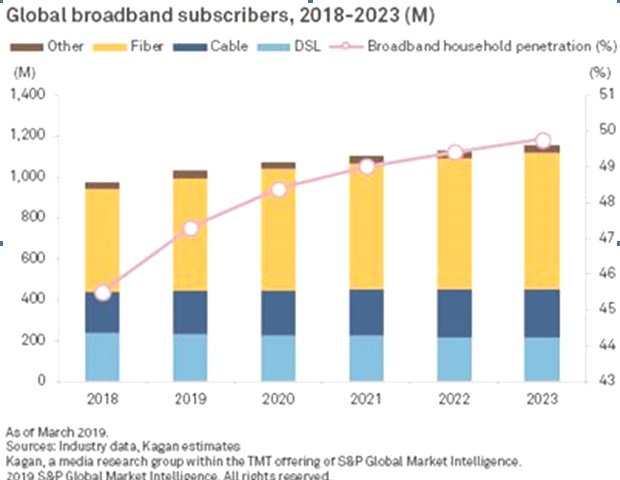
    At the end of 2018, broadband subscriptions reached 974.7 million while broadband household penetration reached 45.5%, up from 43.2% in 2017. However, household penetration is projected to remain under 50% until 2025, the S&P Global Market Intelligence research unit said.

    Kagan: Global broadband subscirbers 2018-2023

    Source: Kagan

    China and US remain by far the largest fixed-broadband markets, together accounting for half (50.7%) of the global total in 2018. China alone claims 40.1% of the global total and 74.4% of Asian broadband subs due to large-scale fiber deployments as part of the country’s national Broadband China project.

    Singapore maintains the highest fixed-broadband household penetration in the world, at over 100%.

    In terms of access technology, 51.4% of the global fixed broadband subscribers are using fiber-to-the-premises (FTTP), which overtook DSL in 2016 to become the largest fixed-broadband platform on a global scale.

    FTTP remains the fastest-growing fixed-broadband platform, growing by 13.8% year over year in 2018.

    According to Kagan, fiber subscriptions have overtaken DSL in Asia and Eastern Europe, with China, Japan, Russia, South Korea and US being the five largest fiber-optic markets in the world.

    Western Europe, the Middle East and Africa are still in favor of using DSL, making it the dominant multichannel platform in these continents, while cable leads in North America and Latin America.

  • Telin Singapore secures OSPAR certification

    Telin Singapore secures OSPAR certification

    Indonesia’s PT Telkom has announced that its subsidiary in Singapore has secured certification that will allow it to serve a wider range of clients in the financial sector.

    Telin Singapore has completed an Outsourced Service Provider Audit Review (OSPAR) report signifying its compliance with the Association of Banks In Singapore (ABS) guidelines.

    The certification will allow the company to increase its client base in the financial sector, as local financial sector companies require technology service providers to be in compliance with ABS guidelines.

    An independent audit is a part of this certification process, and OSPAR meets this requirement.

    In addition, Telin Singapore has achieved Payment Card Industry Data Security Standard Compliance (PCI DSS) for companies that handle branded credit cards from the major providers.

    “The OSPAR proves that our controls and processes are secure and robust. Through obtaining OSPAR, our financial services clients could rest assured that their data is securely stored according to the highest security standards in our data centers,” Telin Singapore CEO Andreuw Th.A.F said.

    “A loss or breach of customer confidential data and disruption to banking services will result in reputational and financial damage to the financial institutions.”

  • Shanghai launches 5G trial district

    Shanghai launches 5G trial district

    The City of Shanghai has launched 5G trials in the Hongkou district, which also has the distinction of having a gigabit broadband network.

    The 5G trial, backed by China Mobile, involves providing full coverage of the district.

    During a commencement ceremony for the trial, a 5G video call was placed using the Huawei Mate X foldable 5G smartphone.

    The city plans to deploy over 10,000 5G base stations by the end of the year, and over 30,000 by 2021.

    As part of the trials, the city also plans to provide support for over 100 companies developing 5G-related application scenarios.

    The wide-scale trial follows Huawei’s deployment of trial 5G services at Shanghai’s Hongqiao Railway Station in February.

    Other Chinese cities are also investing in taking an early lead with 5G deployments, including Chengdu in the Sichuan province and Wuhan in Central China.

    The latter city has deployed a trial 5G network encompassing over 100 5G base stations to explore developments in autonomous vehicles, drones and satellite-based positioning, the report states.

  • Philippines taps UNDP to accelerate free Wi-Fi rollout

    Philippines taps UNDP to accelerate free Wi-Fi rollout

    The Philippines’ Department of ICT (DICT) has signed a partnership agreement with the United Nations Development Program (UNDP) aimed at fast-tracking the deployment of free Wi-Fi access in public places.

    Under the agreement, the UNDP will provide support for the government’s Pipol Konek – Free Wi-Fi Internet Access in Public Places Project.

    The UNDP will conduct area-based network analysis of target sites, oversee monitoring of project impact, and continue to provide technical training to stakeholders involved in the rollout.

    The UNDP and the DICT will meanwhile jointly take charge of project oversight. The project participants plan to hold workshops and consultative meetings to address the challenges with the rollout and investigate potential solutions.

    The DICT sought the assistance of the UNDP in September last year to expedite the project and aid in the capacity-building initiatives of the companies involved in the rollout. A formal signing ceremony was held last week during the first project board meeting.

    “Today as we set to seal this meeting of minds, the Department is optimistic that our goals of providing free Internet access and promoting knowledge-building among our citizens will soon be realized,” DICT acting secretary Eliseo M Rio Jr said at the signing ceremony.

  • How to open links in external browser with Facebook Messenger

    How to open links in external browser with Facebook Messenger

    For a while now, both the Facebook and Messenger app have been opening links in their own, internal browser — a simple webview window, which doesn’t support multiple tabs and is there to allow you to quickly interact with something on the web, and even allow said item to communicate back to your Facebook app instantly.

    That said, a lot of people find the internal browser annoying. Why? Well, sometimes you just tap on a YouTube video only to be greeted by a webview window, which opens a desktop version of the YouTube site that you are not even logged into. Lame. Sometimes, you want to open a web page in your Chrome or Safari browser so that it can stay there as an open tab. Other times, you get so into the information you are reading about that you want to quickly open a few more tabs on it and do a deeper research… oops, you can’t — you are not in your browser of choice, you are in Facebook’s webview.

    Needless to say, many users out there would prefer it if their links simply open in a default app of choice — if it’s a YouTube link, just have it open the video in the YouTube app; if it’s a web link, just launch it in Chrome or Safari.

    Well, there’s a solution for that problem… if you are on Android. That’s right, for some odd reason, Facebook does not allow iPhone users to opt out of using its internal browser. If you are on iOS, you are forced to manually swap apps, though it’s not as slow or painful as it may sound.

  • Broadband access equipment revenue hits $3.4b in Q4

    Broadband access equipment revenue hits $3.4b in Q4

    The market was bullish in last year’s fourth quarter for broadband access equipment revenue, according to a report, but Converged Cable Access Platform (CCAP) spending declined.

    Dell’Oro Group announced on Monday that broadband access equipment revenue hit $3.4 billion, growing 8% year over year in last year’s fourth quarter compared to the same quarter in 2017.

    Increased shipments of GPON optical line terminals (OLTs) and DOCSIS 3.1 customer premises equipment (CPE) counteracted a decline in CCAP spending.

    “FTTH deployments globally continue to show strength,” said Dell’Oro’s Jeff Heynen, research director, broadband access and home networking, in a prepared statement.  “Both 2.5 Gbps GPON and 10 Gbps EPON equipment marked year over year increases, particularly in China. The gains on the telco side helped to offset surprising weakness in cable CCAP spending, as MSOs delay new capacity purchases while they determine how to move forward with distributed access architectures (DAA).”

    Among other capabilities, DAA will give the cable industry a better starting point for virtualized networks and software-defined networking. At last year’s SCTE Cable-Tec Expo, SCTE President and CEO Mark Dzuban said during a panel discussion that the cable industry needed to do a better job of defining DAA in order to launch it at scale.

    Total cable access concentrator revenue was down 18% year over year, mainly due to a slowdown in CCAP license purchases in North America. Cisco, Arris, Casa Systems and Harmonic are among the leading CCAP vendors.

    The total number of DSL port shipments grew 16% year over year with VDSL ports increasing 13% and G.fast ports increasing by a whopping 232%, according to Dell’Oro.

    PON OTL shipments grew 6% over the same timeframe, driven by strong demand for 2.5 Gbps GPON units in China and across the entire Asia-Pacific region.

    Overall, Dell’Oro’s fourth-quarter 2018 Broadband Access Quarterly report said that 2.5 Gbps GPON, 10 Gbps EPON and Gfast equipment all saw increased spending in the quarter.

  • Firefox latest update makes it a much better browser for iPad users

    Firefox latest update makes it a much better browser for iPad users

    If you’re using Firefox on your iPad, you’ll be pleased to know that Mozilla is now making your life much easier. Since the iPad offers a bigger display than the iPhone, which means you can use it differently like for example watch a video and browse the Internet.

    In order for that to work, your browser must support split screen, a feature that allows you to have two apps side-by-side making it easy for you to share links or take notes without having to switch back and forth between apps. The latest Firefox update enables iPad users to divide the screen between the browser and another app like Google Maps or Slack.

    Besides split screen support, Mozilla also included some quality of life improvements, such as better tab management, easier to access Private Browsing, and keyboard shortcuts.

    After the update, you’ll notice that Firefox will display tabs like tiles, which makes it easier to see them. Also, whenever you try to get to a private page on an iOS device, you usually have to go through a couple of steps, but the latest version puts Private Browsing in the lower left corner of the browser window so that you can access it with just one click.

    Now, if you’re using an external keyboard with your iPad, you’ll be happy to learn that you can hold down the command key on your tablet to show keyboard shortcuts. Mozilla has implemented some shortcuts exactly as they are on the Mac, so you might be familiar with many of them. There’s also another feature introduced which will allow you to send tabs between devices without having to leave the browser, but you will need a Firefox account for that.

    Last but not least, a much-requested feature is now being implemented in Firefox, but only to some extent. Since iOS doesn’t allow Mozilla to enable users to set Firefox as the default browser, the developers have found a way to allow them to set it as default browser when they open email links from Microsoft Outlook.

  • China Mobile reports $17.6b profit for 2018

    China Mobile reports $17.6b profit for 2018

    China Mobile has reported a 3.1% increase in net profit for 2018 to 117.78 billion yuan ($17.58 billion) as the company focused on reducing costs and increasing operational efficiency.

    Operating revenue declined 0.5% in reported terms to 736.82 billion yuan, but grew 1.7% after 2017’s results were recalculated using the new IFRS revenue standard..

    Telecommunications service revenue fell a reported 0.4% but grew 3.7% in comparable terms to 670.9 billion yuan.

    The operator’s net profit was also aided by the listing of the company’s tower division China Tower in August last year.

    China Mobile reported a 4.3% increase in its total customer base for the year to 925 million, of which 713 million are 4G customers – a 9.7% increase from 2017. But mobile ARPU fell 8% to 53.1 yuan as a result of strong competition.

    Meanwhile total wireline broadband subscribers increased by 39% to 157 million, of which 147 million were household broadband customers. Household broadband blended ARPU grew 3.2% to 34.4 yuan.

    “2018 was a challenging year for telecommunications operators. Competition amongst peers changed in characteristics as products and services have become homogenized while cross-sector challenges have intensified. The value of traditional telecommunications business rapidly diminished, coupled with multiple challenges from a complex and rapidly-changing policy environment,” China Mobile chairman Yang Jie said.

    “In order to counter market competition, overcome the major obstacles in the ongoing reforms and enhance management, we continued to encourage everyone across the Company to take the ‘Big Connectivity’ strategy even further and implement the integrated development of the “four growth engines”.”

  • Australia to spend $114m to fill more mobile black spots

    Australia to spend $114m to fill more mobile black spots

    The Australian government has allocated A$160 million ($114.1 million) towards extending the national Mobile Black Spot Program for a further two rounds.

    The funding for rounds five and six of the program, which aims to fill gaps in mobile coverage in regional and remote communities, will be used primarily to help improve coverage at public interest premises such as medical facilities, schools and economic centers.

    The additional commitment brings the current government’s funding in the program to A$380 million. So far 1,047 new base stations will be delivered under the program at a total cost of A$760 million. Of these, 682 have been switched on nationally.

    Additional funding is being provided by local and state governments, mobile operators, businesses and community organizations.

    Applications from operators, businesses and local communities for round four of the program recently closed. This round will see 180 new base stations constructed, including 73 which will specifically target public interest premises.

    “Fast and reliable connectivity is essential to ensure regional areas remain competitive with access to the same business and study opportunities as the rest of Australia. We’re ensuring our regions are not left behind,” Australian minister for regional services and deputy leader senator Bridget McKenzie said.

    “All stakeholders are strongly encouraged to submit an application when we open the tender process and take advantage of the additional rounds under this fantastic program.”

  • Konnectivity to buy out remaining shares of M1

    Konnectivity to buy out remaining shares of M1

    Konnectivity, the joint venture buying out Singapore’s M1, has revealed plans to embark on a multi-year transformation of the operator to enhance its competitiveness in the market. The venture revealed it will compulsorily acquire the remaining shares in M1 after securing a 94.55% stake.

    Konnectivity, which is jointly owned by Keppel Corporation and Singapore Press Holdings, announced it will exercise its rights to acquire all remaining M1 shares at the offer price of S$2.06 ($1.52) per share, and then take the company private.

    After the compulsory acquisition, Konnectivity will own 80.69% in M1, while Keppel Corp subsidiary Keppel Telecommunications and Transportation will own the remainder.

    After the acquisition closes, Keppel Corporation and SPH plan to work with M1 on a transformation strategy focused on the three prongs of innovation, technology adoption, and digitalization to help Singapore’s smallest operator better compete with larger rivals Singtel and StarHub.

    “As a member of the Keppel Group, M1 looks forward to working closely with the Keppel Group and with SPH to accelerate the changes needed to deliver even more innovative and compelling products and services, to stay ahead of the competition,” M1 CEO Manjot Singh Mann said.

    “M1 shall endeavour to transform to be at the heart of convergence of various digital services and technologies that present day consumers and enterprises demand. Keppel and SPH bring with them their organisational strengths and stability, which will help us chart our growth plans aggressively, while seeking significant opportunities of synergy with them.”

  • India has world’s cheapest mobile data

    India has world’s cheapest mobile data

    India is the cheapest country in the world for mobile data, while 10 of the top 20 cheapest countries are in continental Asia, according to analysis from broadband price comparison site cable.co.uk.

    Analysis of mobile data plans in the 230 countries with mobile broadband availability found that Indian operators offer an average price per 1GB of data of $0.26 – well below the global average of $8.53.

    The analysis also shows that Asian countries made up half of the top 20 cheapest markets in the world, with the average price of 1GB of data being well over $1 in Sri Lanka, Mongolia, Myanmar and Bangladesh.

    Malaysia ($1.18 per 1GB), Indonesia ($1.21), Bhutan ($1.25), Iran ($1.28) and Vietnam ($1.31) also made the top 20 list, and only three Asian countries are more expensive than the global average – Taiwan ($9.49), China ($9.89), and South Korea ($15.12).

    The analysis did not include countries in the Oceania/Pacific region. Australia is by far the cheapest country in the region with average prices of $2.47 per 1GB. The most expensive market in the region is Samoa at $30.09.

    “Many of the cheapest countries in which to buy mobile data fall roughly into one of two categories,” Cable.co.uk consumer telecoms analyst Dan Howdle said.

    “Some have excellent mobile and fixed broadband infrastructure and so providers are able to offer large amounts of data, which brings down the price per gigabyte. Others with less advanced broadband networks are heavily reliant on mobile data and the economy dictates that prices must be low, as that’s what people can afford.”