Tag: Investment

  • Singapore government to spend $2b on ICT this fiscal

    Singapore government to spend $2b on ICT this fiscal

    Singapore’s soon-to-be-formed Government Technology Agency (GovTech) will continue to partner the ICT industry and invest in technologies such as data analytics, ICT infrastructure, and platform-as-a-service to develop citizen-centric services.

    GovTech, which will be established at the end of this year, will replace the Infocomm Development Agency of Singapore (IDA) and aim to lead technological transformation in government.

    The agency is expected to continue to partner the industry to co-create such digital solutions and will be calling for a projected S$2.82 billion ($2.04 billion) of ICT tenders across fiscal year 2016.

    These ICT tenders will comprise mainly infrastructure and ICT security bulk contracts due to some multi-year contracts ending in FY16, as well as contracts relating to agency-specific systems. Last year, SMEs accounted for more than half of the total contracted value of ICT tenders.

    One key focus for government procurement this year will be to enhance ICT infrastructure to better support the data and digital services needs of a Digital Government in a Smart Nation.

    For example, increased data center virtualization will allow the government to modernize its hosting of ICT applications and ensure faster time to production for new digital services.

    Wi-Fi will be extended to more areas within government schools to support smart learning. The government will also continue to invest in its cybersecurity efforts, with a bulk tender for IT security services to be called in this fiscal year.

    “We want to empower Singapore with possibilities through technology. To do that, investment in infrastructure is necessary so that innovative citizen-centric services can be built and enhanced on a strong foundation,” IDA managing director Jacqueline Poh said.

    “There will be opportunities abound for the government and industry to collaborate and build a smart nation together.”

  • Private Fixed Asset Investment In China Is Crashing

    Private Fixed Asset Investment In China Is Crashing

    We often think of liquidation events exclusively in terms of price, but in the real economy there is volume to consider. When financing dries up as financial agents run for cover lest they receive only further margin or collateral calls, it enacts a short run disruption in economic flow. At the margins, some firms are forced to delay activity while others can only give up altogether. It is difficult to figure how much in any liquidation is temporary and how much ends up as a permanent reduction.

    The dramatic events of January and February all across the globe undoubtedly created just this kind of mix. As it ended around February 11, there was going to be some bounce back in economic terms as funding began to flow again, allowing delayed projects and activity to restart. Because of that, it wasn’t surprising to see certain economic accounts and factors seemingly improve especially in March. That did not mean anything other than the end of the liquidation crunch, as the baseline decay remains in place and, as we are finding out again, was only amplified by further reduced capacity during the liquidations – those projects and activity that will never be restarted.

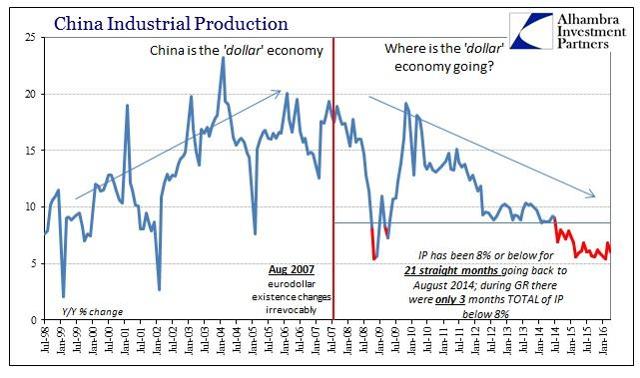
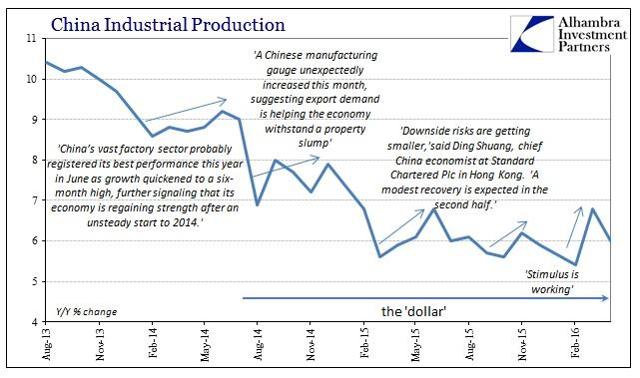
    As usual, this global process is most evident in China. Despite a burst of optimism especially in March statistics, the temporary part of the liquidation rebound is increasingly within view. Industrial production had jumped to 6.8% from a multi-year low of 5.4% in the January-February holiday combination and brought with it the usual “it’s all over” commentary. Instead, IP dropped back to just 6.0% in April which, like exports, suggests only what I propose above; a (very) brief respite only because the “dollar” hasn’t been as obviously stifling as it was to start 2016.

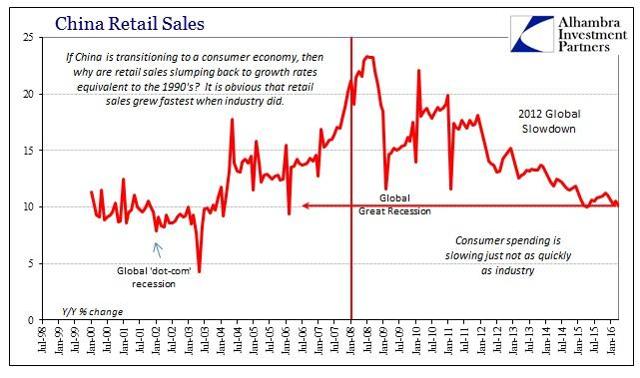
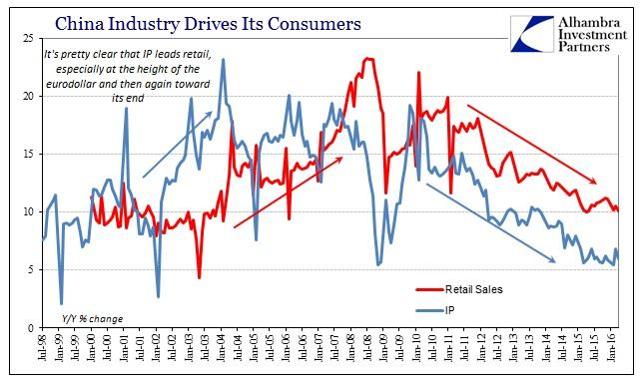
    The same trend was recorded in Chinese retail sales as well, which is perhaps a bigger blow to March’s hopeful sentiment. Even economists have started to admit China’s industrial “miracle” may never be resumed so they have turned in near desperation to the idea of a “consumer driven” economy, as if there is some plan being carried out to replace the manufacturing/export orientation of the rising eurodollar period. This wishful thinking gained traction only because retail sales have decelerated at a lag to industrial production.

    It is clear, however, through a wider perspective that China’s consumers are slowing just as China’s industry where “stimulus” can at best explain the delayed reaction. Even in 2016, the same pattern emerges as in manufacturing and export; retail sales were atrocious to start the year (Jan/Feb) at just 10.2%, nearly as bad as the worst of 2015, rebounding to 10.5% in March. The latest update for April is even worse than the Jan/Feb period, as Chinese retail sales slowed again to just 10.1%.

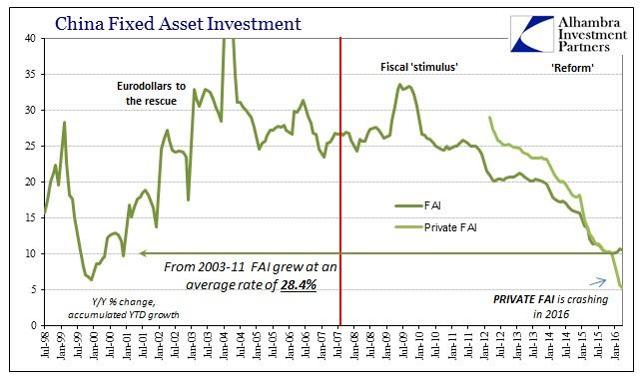
    As bad as those end results are for the direction of the Chinese economy, the real bad news is buried in productive capacity. Where industrial production and retail sales may have picked up the temporary portion of the economy disrupted by liquidation, fixed asset investment (FAI) suggests the reduction in baseline economic reality might be even worse than feared. Private FAI is crashing in China.


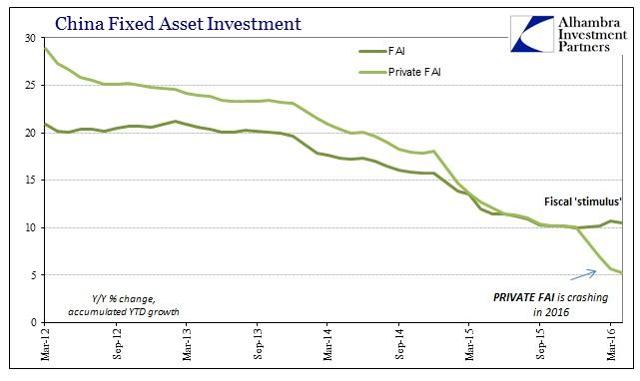
    Overall, total fixed asset grew 10.5% in April, down from 10.7% in March. Private FAI was just 5.2%, however, as it is clear the Chinese government is back to fiscal “stimulus” once again. The National Bureau of Statistics reports FAI in “accumulated” annual growth, which means the stated estimates for April include all months of the year through April. Since Private FAI was 6.9% to start the year but only 5.2% in April, actual growth in capex was less than that still. In other words, rather than rebound Private FAI has only slowed further into this year.


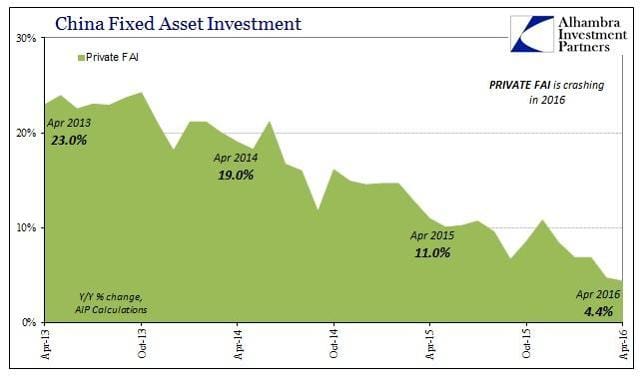
    By simple calculation we find that Private FAI for April alone was just 4.4% more than April 2015. That compares to 11.0% growth in April 2015 over April 2014. Before the “rising dollar”, private-driven capex in China was expanding at and above 20%, and had been nearly 30% when the NBS first broke out the private component in 2012. That would be a level more consistent with what China was expecting of the “recovery”, which can only suggest 4.4% (and the obvious trajectory to get to that level) really is crashing industrial investment.

    Unlike the remaining components in FAI, private sources of capital investment are the primary expressions of job growth and Chinese economic advance. Any “stimulus” that flows through the State-Owned Enterprises is largely inefficient and ineffective, the usual waste of spending for the sake of spending. Because China is still oriented toward manufacturing, private spending to increase that capacity accounts for about a third of all Chinese labor! Further, state-owned media has reported that Private FAI is responsible for 90% of new urban employment. China is in big trouble at 4.4% (with the arrow still pointing further down).


    This helps explain the lagged deceleration in retail sales and the Chinese economy overall, more so the persistent and stubborn slowing than the lag. Unlike temporary bursts of production levels, capex investment growth is determined by longer run projections and harder reality than the overflowing optimism that arrives with every minor, short-term uptick in monthly variation. In many ways, this descent in the Chinese baseline is incredibly simple and intuitive unlike the orthodox commentary that tries to deny it month after month:


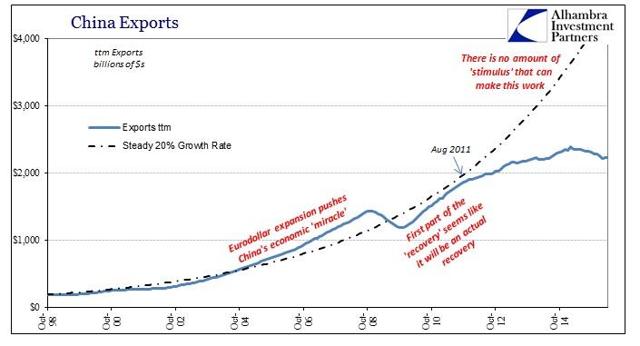
    The fact that Private FAI is now crashing in 2016 is related to the effects of the liquidation(s). The lack of financial flow in “dollars” convinces more and more firms that despite all the promises the global economy will never rebound while at the same time mothballing projects that will never be restarted and canceling many before they ever get that far. It is the brutal reality of this ongoing paradigm shift – the slowdown that will not stop slowing down. From this perspective, as noted on the chart above, it is easy to understand that there is no amount of “stimulus” (read: waste) that can make it work; without a eurodollar resurrection there is no path back to 2005. The manner of this decline is often uneven and lumpy, but it is uniform across China and the global economy. It will be undisturbed by anything except further liquidations to carry out the business end of the capacity reduction.

    That is the most important piece of the economic update for China in April. Industrial production and retail sales demonstrate that despite some optimism that March wasn’t January/February, the direction of the Chinese economy has not actually changed. The dramatic slowing in Private FAI suggests an even sharper incline in the already downward tilted baseline. (Jeffry P.)

  • South Korea’s Overseas Direct Investment Topped US$10 Billion in Q1

    South Korea’s Overseas Direct Investment Topped US$10 Billion in Q1

    The Ministry of Strategy & Finance announced on May 12 that South Korean enterprises’ and individuals’ overseas direct investment increased by 29.5% from a year ago to US$10.3 billion in the first quarter of this year, breaking the US$10 billion mark for the first time in four years.

    The amount has continued to increase since early last year. It rose by 32.8% from US$34.44 billion to US$45.74 billion between 2010 and 2011 and then fell 13.3% to US$39.65 billion and 10.1% to US$35.64 billion in 2012 and 2013, respectively. However, it rebounzded to US$40.23 billion last year after edging down by 1.8% to US$35 billion in 2014.

    The overseas direct investment by the banking and insurance sector increased by 96.3% year on year to US$4.02 billion in the first quarter of this year. During the same period, that by the manufacturing sector totaled US$2.76 billion with a year-on-year growth rate of 33.6%. Meanwhile, that by the mining sector fell 13.8% and that by wholesale and retail dropped by 42.3%.

    The amount of the investment in Asia soared by 64.3% to US$2.95 billion to take up 28.6% of the total. That in Latin America jumped by 75.4% to US$2.35 billion. In contrast, that in North America declined by 10.9% to US$2.73 billion while that in Oceania dropped by 30%. By country, those in China and Vietnam increased by 93% and 36.3%, respectively. On the contrary, those in the United States and Canada fell 8.2% and 60.9%.


  • Campaign encourages more Japanese SMEs to invest in the Philippines

    Campaign encourages more Japanese SMEs to invest in the Philippines

    Japanese SMEs are being enticed to invest in the Philippines, where labor cost is competitive and a majority of workers are English-speaking.

    Spearheading the campaign are Rizal Commercial Banking Corp. (RCBC) and Resona Bank, a bank for small and medium enterprises in Japan’s Kansai and Osaka areas. To date, 55 Japanese firms have established their facilities in the Philippines following the tie-up agreement they entered into in 2012.

    Japanese companies which have established their facilities in Philippines affirmed the advantage of the competitive cost of Philippine labor with the added benefit of Engish-speaking skills that enable easier training and work atmosphere.

    In their latest campaign, RCBC’s Japanese Business Relationship Office first senior vice president Yasuhiro Matsumoto recently accompanied Trade Secretary Adrian Cristobal Jr.  to a Philippine Investment Opportunities Forum in Osaka, Japan.

    Attended by 350 corporate clients, the forum was organized by the Resona Foundation for Asia and Oceania with co-organizers Osaka Prefecture Government, the Osaka Municipal Government, the Kansai Economic Federation, the Osaka Foundation for Trade and Industry, and the Osaka Chamber of Commerce Industry. This was also supported by JETRO, Resona Bank and the Kinki Osaka Bank.

    Matsumoto highlighted the success secrets of companies operating in the Philippines. As RCBC’s key senior officer focused on Japanese clients, Matsumoto had seen and supported the entry and growth of Japanese companies, specially in export processing zones.

    Matsumoto further cited the growing spending power of the Filipino consumer as shown by the surge in business by a range of consumer-focused companies in food, beverage, and middle-end retail outlets that are supplanting the formerly ubiquitous low-end sari-sari stores in the urban centers. With the second largest population in ASEAN, with a young average age, the Philippine potential for investments is huge, he said.


  • Digi to spend $217.6m on capex in 2016

    Digi to spend $217.6m on capex in 2016

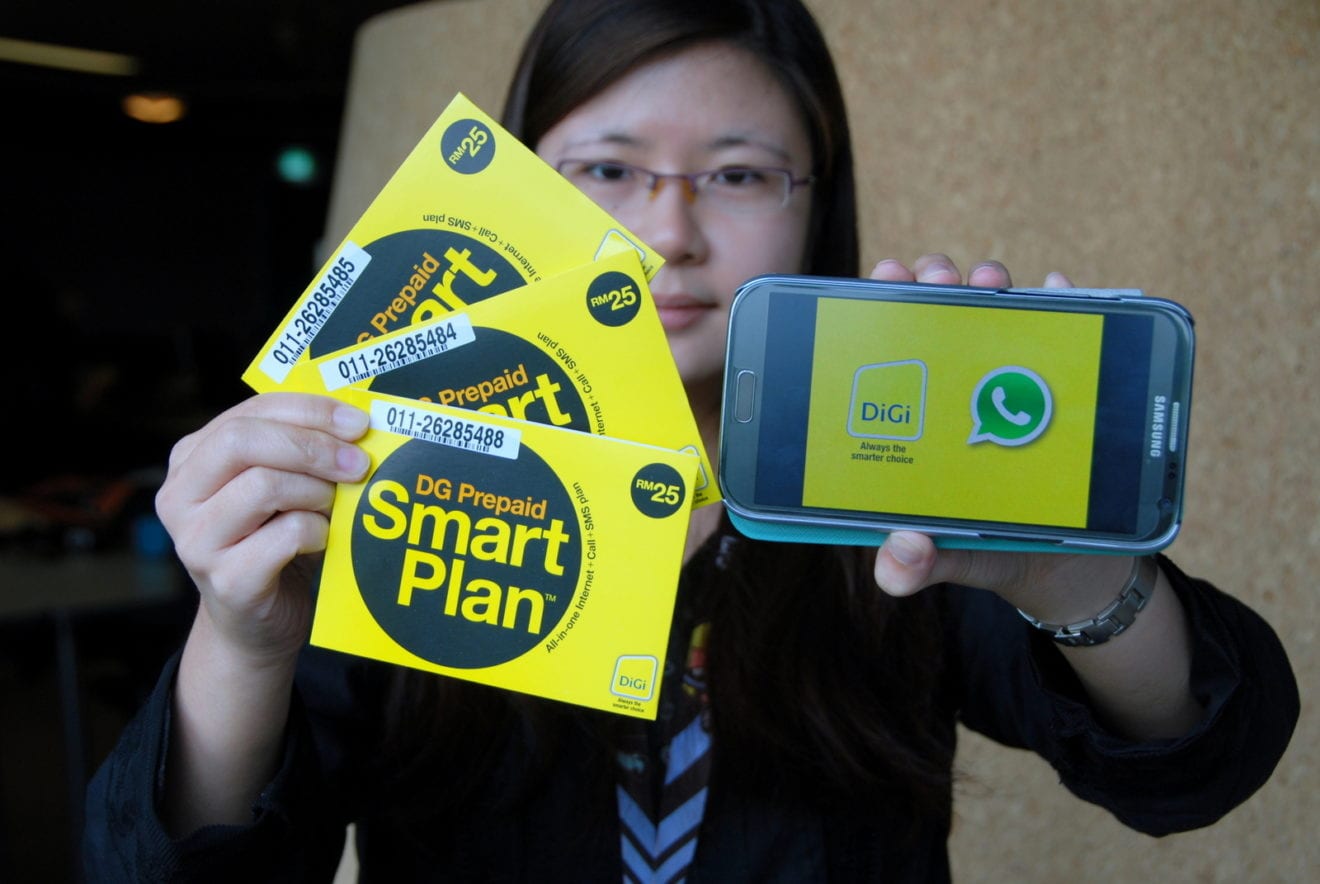
    Malaysia’s Digi Telecommunications has allocated 904 million ringgit ($217.6 million) in capex for 2016, to pursue expansion projects including the rollout of VoLTE and VoWiFi.

    The operator has roughly maintained its capex budget at the same size as 2015.

    Digi is currently testing voice over LTE and Wi-Fi technologies and anticipates a commercial launch this year, according to chief marketing officer Christian Thrane.

    He said the operator’s LTE network currently covers around 72% of Malaysia’s populated areas and 150 major cities and towns.

    In response to growing data demand, Digi recently launched a postpaid plan starting at 28 ringgit per month that offers higher internet quota than previous plans, as well as the ability to roll over unused data. The operator will offer promotional discounts on the new plans until June 30.

    Digi has also introduced data roaming plans for frequent and budget travellers starting at 10 ringgit per day.

  • Thai Robinson to invest $479 mln on new stores over 5 years

    Thai Robinson to invest $479 mln on new stores over 5 years

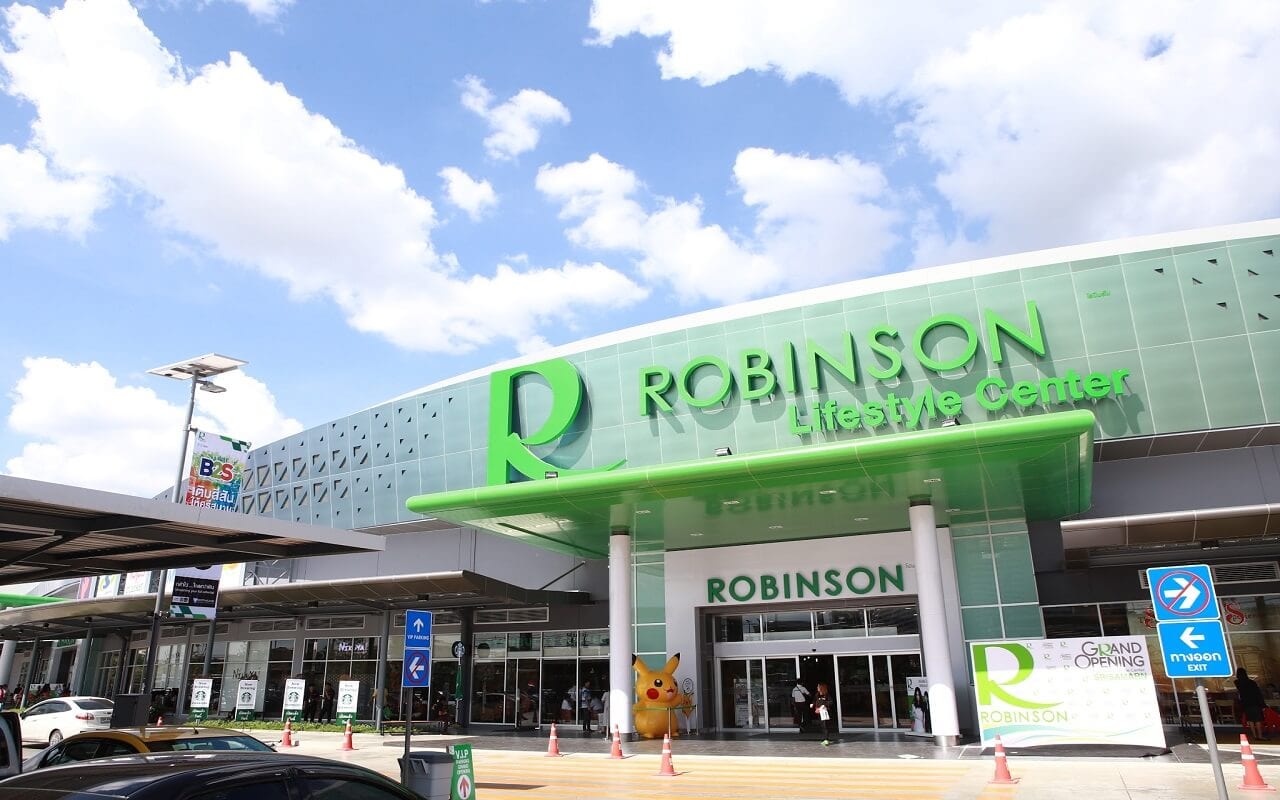
    Thailand’s Robinson Department Store PCL said on Tuesday it aimed to invest about 16.8 billion baht ($479 million) over the next five years on opening new stores in a move to boost average sales growth by 5-7 percent a year.

    Speaking at a news conference, President Alan Thomson said Robinson, majority-owned by Thailand’s largest retail conglomerate Central Group, planned to boost the number of stores to 56 by 2020 from 42 now, pinning its hopes on government economic stimulus measures stoking a pickup in the country’s now-depressed consumer spending.

    Growth at that pace would be equivalent to an average of 2.8 new stores a year. But Robinson’s rate of expansion has slowed recently, dropping to two new stores this year, versus four in 2015 and five two years earlier, a deceleration that reflects Thailand’s current economic weakness, Thomson said. This year, the company will spend 1.6 billion baht on opening two branches. It’s aiming for sales growth of 7 percent from 2015’s 25 billion baht, and expects sales to reach 35 billion baht by 2020, Thomson said.

    He also said Robinson planned to spend 2.5 billion baht to renovate 20 existing stores in an effort to respond to changing retail patterns and attract more customers despite the spread of online shopping.

    Robinson also operates two stores in Vietnam, and aims to double that by 2020, Thomson said. “We are trying to identify challenges before we expand in Vietnam,” he said, adding the company would likely invest more in Vietnam next year after a pause in 2016.

    After being hit in recent years by weak spending in the slowing economy, like other Thai retailers, Robinson has seen signs of improvement in demand, thanks to the government’s stimulus measures, Thomson said.

    The company’s same-store sales rose 3.1 percent in the fourth quarter of 2015, versus a drop of 2.1 percent for the
    full year, according to company data.


  • Thai investment in VN concentrated in processing, manufacturing

    Thai investment in VN concentrated in processing, manufacturing

    According to the agency, there are about 200 Thai projects in such industries, with combined investment of US$7 billion or 88 per cent of Thailand’s total investment in Vietnam.

    These sectors are followed by agriculture, forestry and seafood sectors, which have 31 projects worth $235 million. The rest are in retail and construction sectors.

    As the end of February this year, Thai businesses had invested in 428 projects in the country, with a total investment capital of $7.88 billion, ranking 11th among countries and territories that have invested the largest capital in Vietnam.

    A Thai project was worth $18.4 million on average, about $14 million more than the average value of a foreign investment project in the country.

    The southern Ba Ria – Vung Tau Province attracted the highest number of foreign direct investment projects from Thailand, worth $3.77 billion. It’s followed by the northern Vinh Phuc Province with projects worth $744 million and the southern Binh Duong Province with $513.4 million.

    The statistics also showed that Thai joint venture investments comprised 70 per cent of Thailand’s registered investment in Vietnam, worth $5.5 billion.

    Vietnam has become a favourite destination of many Thai billionaires in recent years, with many large projects and merger and acquisition transactions taking place in retail and consumption areas.

    These include Thai company Berli Jucker’s (BJC’s) purchase of Metro Cash & Carry Viet Nam for more than $870 million; and Power Buy, a subsidiary of the Central Group of Thai billionaire Chirathivat, also acquired a 49 per cent share in New Solution and Technology Development Company NKT, the owner of Viet Nam’s leading retailer Nguyen Kim Trading JSC.

  • SM Investments Corporation wins two Anvil Awards for its Annual and ESG Reports

    SM Investments Corporation wins two Anvil Awards for its Annual and ESG Reports

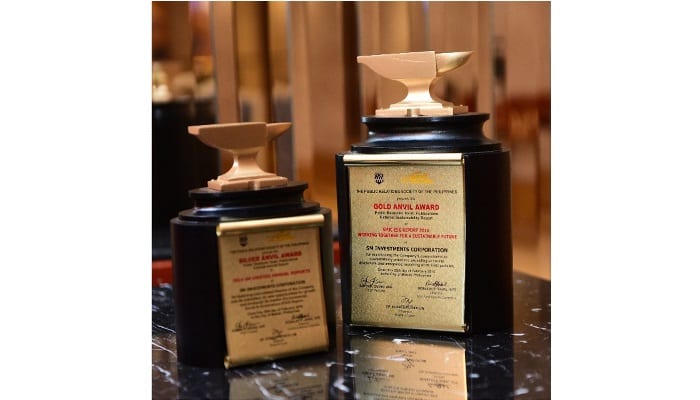
    SM’s first 2014 ESG report with the theme, “Working Together for a Sustainable Future”, earned a Gold Anvil Award for manifesting the company’s commitment to sustainability practices and for providing accurate disclosure and integrated reporting of its ESG policies. It is a group-wide report highlighting good governance, social development and environmental consciousness of SM companies such as SM Retail, SM Prime Holdings, and BDO Unibank. SM recognizes that adhering to ESG global best practices is a journey as global guidelines and the needs of SM’s stakeholders continue to evolve.

    The 2014 Unified Annual Reports bagged a Silver Anvil Award for featuring inter-related themes of the company and its subsidiary on new opportunities for growth.

    The 2014 Unified Annual Reports consist of the Annual Report of SM with the theme, “Pursuing New Opportunities for Growth” and that of SM Prime Holdings, Inc. that carried the theme, “Building New Opportunities for Growth”.

    Dubbed as the “Oscars” of the public relations industry in the Philippines, the Anvil is presented to the outstanding public relations tools and programs that have met the high standards set for each category.  PR practitioners, industry communications specialists, academicians and business persons attended the event.

  • 2016 China Fixed-Asset Investment Growth Target at Around 10.5%

    China’s economic planning agency said Saturday that it aims to realize around 10.5% growth in fixed-asset investment this year.

    Beijing had set a 15% growth target for fixed-asset investment in 2015, but actual growth came in slower at 10% as the world’s second-largest economy lost momentum.

    The National Development and Reform Commission also said it expected retail sales to increase by 11% in 2016, compared with a target of 13% in 2015. Last year, China’s retail sales rose 10.7% from a year earlier.

    China attracted $126.27 billion in foreign direct investment in 2015, up 6.4% from a year earlier, and it reported $ 118.02 billion overseas direct investment last year, up 14.7% year-over-year.

  • Fund expands Indonesia exposure, buys into retail

    Fund expands Indonesia exposure, buys into retail

    Singapore sovereign wealth fund GIC has increased its exposure to Indonesia’s growing middle class by investing 5.2 trillion rupiah ($385 million) in Trans Retail, the main retail arm of conglomerate CT Corp.

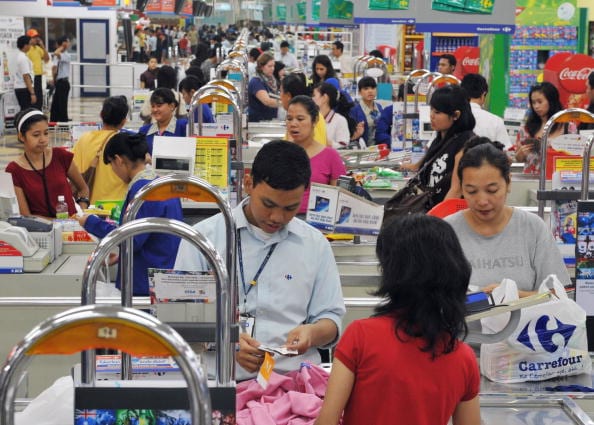
    CT Corp’s businesses span television and online media to retail, banking and amusement parks. Its retail arm Trans Retail, formerly a local unit of French retail group Carrefour, currently runs 86 hypermarkets and supermarkets in the country under the Carrefour and TRANSmart brands.

    GIC said in a press release on Wednesday that Trans Retail is taking advantage of the rapidly expanding consumer class as Indonesia’s retail scene shifts from traditional mom-and-pop stores to modern trade formats.

    “We are keen to build lasting partnerships with reputable local partners,” said Amit Kunal, GIC’s head of direct investments group for Southeast Asia.

    CT Corp’s owner Chairul Tanjung, Indonesia’s fifth richest businessman in 2015 according to U.S. magazine Forbes, is a rare breed of non-ethnic Chinese tycoons in the country who built his business from scratch. CT Corp gained full ownership of Trans Retail after it increased its stake to 100% in 2013 for 525 million euros ($578 million). The group also has a stake in Garuda Indonesia, the country’s flag carrier.

    GIC has been boosting investments in consumer sectors overseas, especially in emerging markets where the middle class population is growing. Its investments include retail, e-commerce, education and medical sectors.

    In 2014, the sovereign wealth fund participated in a round of investment for Indian e-commerce company Flipkart, which raised a total of $1 billion, and invested $104 million in Taiwanese music-streaming company KKBOX. The fund has also actively invested in various shopping malls overseas, including in the U.S., South Korea and Brazil.

    Nonetheless, uncertainties remain in the outlook for Indonesia’s retail scene. Trans Retail does not disclose its financial performance, but the earnings of Indonesian retailers have been under pressure amid a slowdown in consumer spending.

    Matahari Putra Prima, a listed hypermarket operator affiliated with the Lippo Group conglomerate, reported a 30% year-on-year decline in net profit for the nine months ended in September 2015. On Wednesday, supermarket operator Hero Supermarket said it would sell off its convenience store business.

  • How China’s Alibaba spends $18 billion investing in companies

    How China’s Alibaba spends $18 billion investing in companies

    The Chinese e-commerce giant acquired eight companies and invested in 15 overseas businesses in 2015.

    Alibaba Group Holding Ltd. is not just an e-commerce company that can create $14 billion in online sales in 24 hours. With near-constant investments, the Hangzhou-based company has evolved into a business empire, aiming to serve more consumers beyond its current 400 million active users.

    Alibaba spent about $18.3 billion to invest in 65 companies, including acquiring eight companies and investing in 15 overseas businesses, according to China-based market data company IT Orange.

    Alibaba’s major investment sectors are e-commerce, entertainment, finance, enterprise solution & technology, and online to offline, according to IT Orange. In China, O2O or online to offline, refers to a way for Internet companies to develop mobile apps that connect local services, such as a dry-cleaner, with online users.

    Alibaba continued to invest in the technology vendor sector, but total spending in this sector was still small, IT Orange says. Alibaba also reduced investments in healthcare and travel companies in 2015, compared with 2014.

    Alibaba in 2014 invested in 40 companies by spending more than $17 billion, including stakes in two healthcare companies and two travel companies, according to IT Orange.

    Those 65 companies—including Chinese ride-hailing app Kuaidi, travel site Wanzi.com, Hong Kong-based newspaper South China Morning Post, China-based shipping company YTO Express and Chinese film studio Bona Film Group—operate in various industries but could help Alibaba build a more diversified business to offer more services more efficiently.

    “Alibaba has been a giant online corporation with diversified businesses ranging from marketplaces, retail and payment to travel, entertainment, transportation and other businesses. Alibaba doesn’t need to focus (on one) as it knows all those industries from its home market,” Ralf Gladis, founder and CEO of payment firm Computop Inc., tells Internet Retailer.

    Take YTO as an example. YTO says its shipping network covers 2,300 Chinese cities and about 43% rural villages. The company says the partnership with Alibaba helps it improve efficiency and expand into rural areas and global market. The company says it delivered 3.3 billion parcels in 2015, compared to 2.1 billion in 2014. 70% parcels delivered by YTO were generated by e-commerce orders and about 70% of those e-commerce parcels came via Alibaba Group businesses.

    In 2015, YTO reduced delivery time by investing more in air transportation. The company purchased three Boeing B737-300 airplanes to further reduce some cross-province delivery times from three days to one day. YTO also worked with many regional shipping companies to build an international network that covers eight countries, including Japan, Korea and Germany.

    YTO says Alibaba’s support also includes data and information. Alibaba sends feedback from online shoppers to YTO so the shipper can find and fix the problem faster than before.

    In 2015, Alibaba increased its strategic investments in 20 large companies. Some investments have topped several hundred million dollars, including investing in The Postal Savings Bank of China; Suning Commerce Group, No.3 in the Internet Retailer 2015 China 500; and Chinese smartphone maker Meizu, No. 168.

    Alibaba also acquired eight companies, including the Chinese version of YouTube, Youku.com. Youku.com says videos played on its site have topped 600 million times per day in 2015. Alibaba bought Youku.com for $4.67 billion.
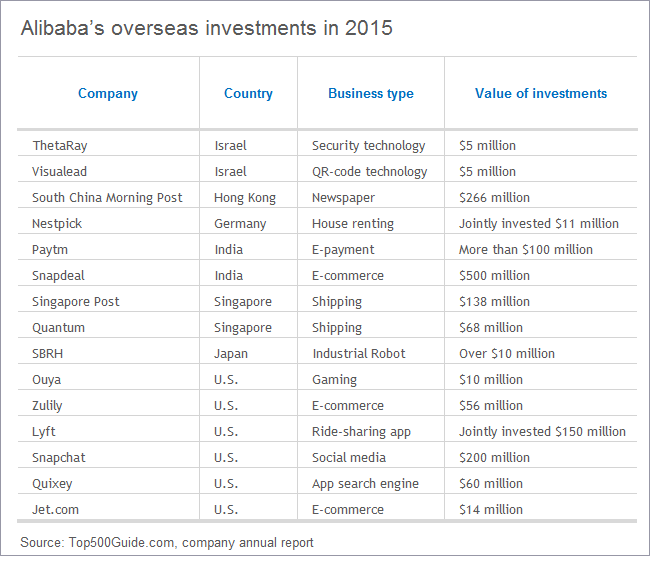
    Alibaba’s 15 overseas investments in 2015 mainly focus on e-commerce, entertainment and technology. IT Orange estimates Alibaba spent about $2.5 billion for stakes in those companies, including e-commerce companies Jet.com and Zulily.com.

    Alibaba declined to confirm the information from IT Orange but says the company may have invested in more than 65 companies in 2015 because it also invested in many small startups.

    Alibaba’s investment goal is to learn the best practices from others and then use them to improve its operations in China and global markets, according to Alibaba’s IPO filing document.

    “Alibaba is just trying to get insight into the next big thing with the goal of eventually importing the tech back home where they have the world’s largest Internet audience. They’re investing in U.S. companies because this is where tech innovation is happening,” Laura Swanson, senior consultant at omnichannel consulting firm FitForCommerce, tells Internet Retailer, “Essentially they’re giving themselves a front-row seat to watch these companies so that by the time certain products or services reach China, Alibaba will have the control.”

    Alibaba already leads in some areas. “Alibaba is not only bigger than Silicon Valley companies, it is also more innovative in many areas. Working with both PayPal and Alipay, we know by experience that Alipay is far ahead of PayPal when it comes to payment innovations. For instance, Alipay customers can use their (mobile) wallet in many bricks-and-mortar retail stores, and they get excellent services including hassle-free tax-return services when they shop abroad,” Gladis says.

    By investing in U.S. e-commerce companies like online marketplace Jet.com, Alibaba could understand consumer behavior on both ends of the world to help U.S. merchants selling to Chinese consumers as well as help Chinese merchants selling to U.S. consumers, Gladis says.

    For more Chinese e-commerce data, please click here for Internet Retailer 2015 China 500.
  • Toyota ready to invest Rp5.4 trillion in Indonesia

    Toyota ready to invest Rp5.4 trillion in Indonesia

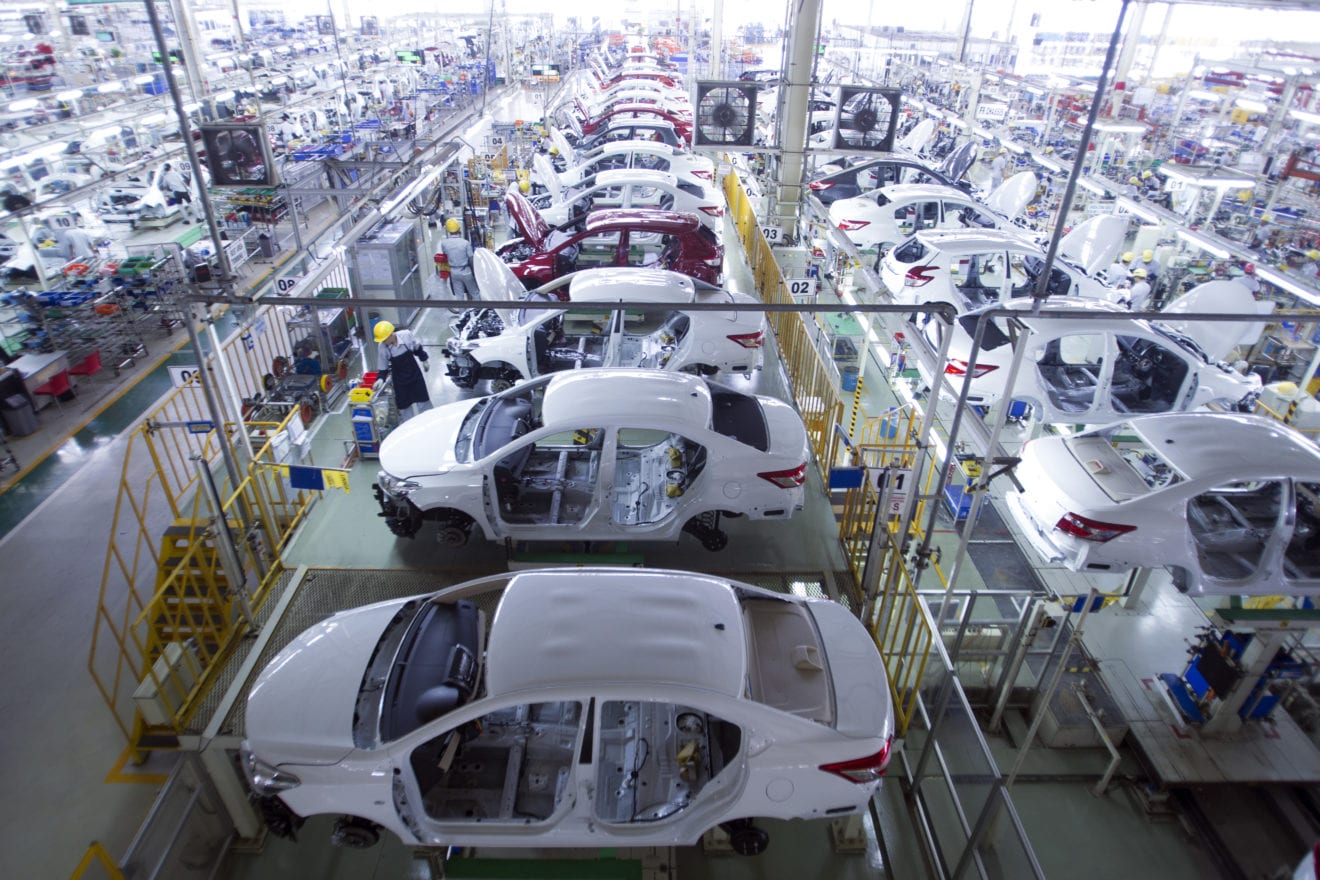
    The Toyota Motor Corporation (TMC) group is ready to invest Rp5.4 trillion in Indonesia this year, according to Industry Minister Saleh Husin.

    Husin received the pledge during a meeting with TMC Executive Vice President Seiichi Sudo in Nagoya, Japan, on Thursday.

    “Toyota is serious about doing business in Indonesia. This year, it will invest Rp5.4 trillion, following the Rp5 trillion worth of investment that the company made in 2015,” he noted in a press statement received here, Friday.

    This reflects that global investors still trust Indonesias investment climate and see prospects in the nations automotive industry, he noted.

    The minister has lauded Toyota for its trust and continued investment in Indonesia, after selecting the nation as one of its investment destinations and a Toyota car production base so far.

    He called on Toyota and its partners in Japan to increase investment in the automotive sector, particularly for the manufacturing of materials and spare parts.

    The minister also invited the company to conduct research and development activities in Indonesia to strengthen the structure of Japans existing automotive industry in Indonesia.

    Husin also urged Toyota to increase the production of cars in Indonesia, which has a population of over 250 million, including 74 million belonging to the middle class.

    The Toyota brand dominates around 31-32 percent of Indonesias domestic market.

    Within five years, from 2015 to 2019, Toyota has planned to invest a total of Rp20 trillion.

    Until 2014, Toyota had invested Rp40 trillion in Indonesia.

    Currently, the Japanese company is constructing an engine plant in Karawang, West Java.

  • Hong Kong entrepreneur Ricky Wong plans HK$100m ad campaign boost for online shopping

    Hong Kong entrepreneur Ricky Wong plans HK$100m ad campaign boost for online shopping

    Ricky Wong Wai-kay has ambitious plans to boost his online shopping venture with a HK$100 million ad campaign and staff expansion despite a grim economic outlook and still being a long way from breaking even.

    The HKTV boss said that a year after the official launch of his online shopping mall, it had recorded an average of 700,000 to 800,000 unique visitors per month and the number of customers had doubled in the last two months to tens of thousands.

    He said each customer placed orders ranging between HK$400 and HK$1,000.

    “We will broaden the range of goods available. We will soon offer fresh seafood, chicken and vegetables among some 99,000 items available in our online store.”

    Wong said the company had set aside a HK$80 million to HK$100 million advertising budget for e-commerce in the coming year.

    READ MORE: HKTV and boss Ricky Wong win HK$1.3m libel payout from ATV and ex-director James Shing

    He also planned to expand the logistics team from around 300 to 800 or 1,000.

    “The cost will still be much lower than operating a physical shop,” he said. “High rent is killing Hong Kong’s retail sector.”

    Wong cited a recent report from CBRE Research, which named Hong Kong as the world’s most expensive retail market.

    According to the report, rent for retail spaces in Hong Kong had reached US$4,334 per sq ft per year – 3.3 times more than in Paris, ranked at No 3, and 3.6 times more than in London.

    He said some Hong Kong retailers spent nearly 50 per cent of turnover on rent.

    “Tourists who come to Hong Kong won’t shop here. They would rather shop in London or Paris,” he said.

    But he admitted there was still a long way to go before breaking even.

    Wong initially intended to develop a TV business that operated alongside his e-commerce venture with HKTV. But HKTV did not get a free TV licence from the government and his internet TV business did not take off due to lack of advertising.

    But he has not given up his TV dreams completely. He said he was still negotiating with the government on mobile TV development, and a multimedia centre under construction in Tseung Kwan O was expected to be completed by the end of this year.

    However, Wong has no concrete plans to revive any TV productions.

  • Investors sought for top-yielding Oud production project in Laos

    Investors sought for top-yielding Oud production project in Laos

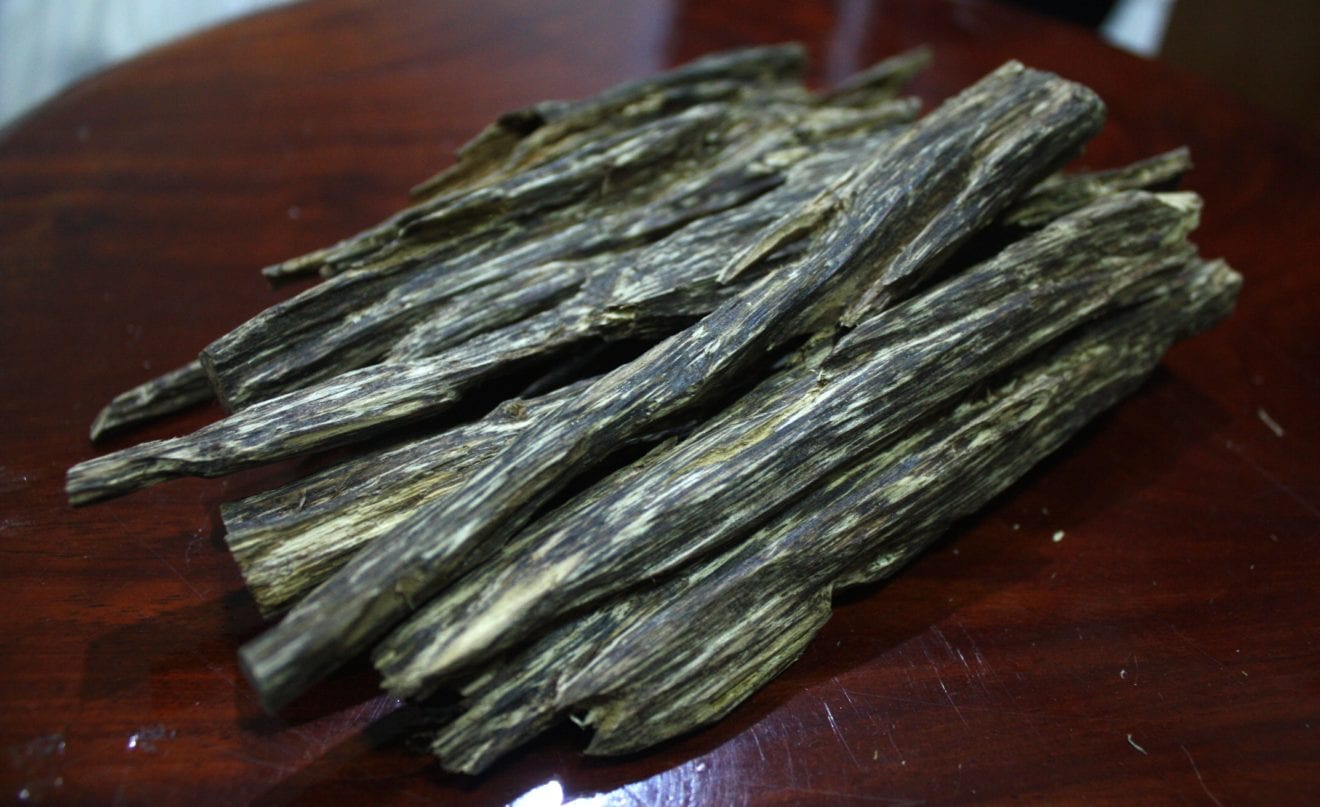
    Two companies from Malaysia are on the lookout for investors to set up a big agarwood tree plantation in Laos to produce Oud oil and other agarwood products for markets in Asia, the Middle East and Europe.

    Agricultural contractor Aseagate on January 6 signed an agreement valued 200mn with forestry management and agriculture technology firm Richwood Capital both companies are based in Kuala Lumpur to operate and run a 2,000-hectare agarwood tree plantation in the central Lao province of Bolikhamsai, one of the largest plantations projects in the landlocked Southeast Asian country so far.

    According to Richwood Capital’s CEO Kendrick Ho Qing Tyat, the project will be implemented in four phases. The initial investment in the first phase is about 18mn for the planting of 200,000 agarwood trees aged between 18 and 22 years at costs of 90 per tree, which should yield a return of 200mn in three years based on calculations that one liter of high-quality agarwood oil fetches at least 14,000 on the wholesale market.Over four phases in the coming six to eight years, with the planting of new trees and new investors on board, the venture’s business plan is to reach a total return of no less than 7.2bn, Tyat said at a press conference in Kuala Lumpur last week. The venture plans to set up its own production plant in Laos or to collaborate with a Lao partner. To produce the resin from which the Oud essence can be distilled, a special technique developed by a Singapore laboratory using a unique and effective enzyme will be deployed to multiply the resin output per tree.

    Main export markets will be the Middle East and China, and also Southeast Asia to tap the big potential that opened up with the recent launch of the ASEAN Economic Community. Top European perfume makers are also on the potential client list. The venture will also sell agarwood leaves, which can be made into tea, and explore ways of producing wood chips from the agarwood trees as well as offer “agriland banking” to investors to tap into the growing ptential of agarwood farming.

    Both companies hailed agarwood as a safe investment, as it was “more resilient to economic fluctuations as compared to stocks and bonds,” and insurance will be purchased to provide protection against possible natural calamities.

    Aseagate has been awarded the sole rights to the management of the agarwood plantation, while Richwood Capital will supply and plant the trees. The plantation concession has been exclusively awarded by the Lao government to the Singapore branch of non-governmental organisation Global Outstanding Chinese 100, or GOC100, an association of international Chinese industrialists, business people and entrepreneurs, which will cooperate with the two Malaysian firms in setting up the plantation and is working out profit-sharing and other details for the collaboration with the Lao government.

    GOC100 in August 2015 signed an exclusive agreement with the Lao Ministry of Agriculture and Forestry for the concession of the plantation which is located within a Lao military base and guarded by the army. Infrastructure-wise, the plantation will benefit from a new railway network linking Laos with China to be set up by 2020.

    Agarwood is increasingly becoming an investment commodity due to its valuable resin of which Oud oil is being distilled. Pure Oud is highly in demand as a natural fragrance throughout East and Southeast Asia, as well as in the Middle East and by global perfume manufacturers. It is a popular fragrance for both men and women in the Arab world, while it is also used in traditional Chinese medicine, by Ayurvedic and Tibetan physicians and as meditation incense by various religious groups. In some Arab cultures, it is also used as inhaled incense as a natural remedy against insomnia.

    What makes investment in an agarwood plantation particularly attractive is the fact that, due to its scarcity, the mature wood is pricier than gold with a retail price of between 5,600 and 10,000 per kilogramme, making it one of the most expensive natural raw materials in the world.

  • Learn to build winning portfolio with new investment series

    Learn to build winning portfolio with new investment series

    Here’s your chance to learn how to build a winning portfolio amid the uncertain market.

    Over the next 12 months, The Sunday Times will feature a new series that will showcase and track the simulated portfolios of three types of retail investors. The year-long Save and Invest Portfolio Series campaign aims to encourage and equip investors with the knowledge to save for the future.

    The initiative will involve the Singapore Exchange (SGX) collaborating with CFA Society Singapore and MoneySense, the national financial education programme.

    Starting next Sunday, the series will feature simulated portfolios of a young working adult, a married couple with two young children and a retiree.

    Their portfolios are guided by a panel of four CFA charterholders who are volunteers with CFA Society Singapore and have 77 years of experience collectively as investment professionals.

    SMART INVESTING

    We are excited about this initiative that showcases real-life investment portfolios of people at different life stages that the average investor can relate to. This series is an extension of SGX’s commitment to educating and engaging our retail investors, and to arm them with skills and confidence.

    MS LYNN GASPAR, head of retail investors at SGX.

    The series aims to guide retail investors in basic investment techniques and how to build a portfolio in accordance with their investment goals and risk tolerance.

    The portfolios will be tracked over 12 months. Different types of investment instruments and choices, including relatively new ones such as the Singapore Savings Bonds, will be introduced.

    Mr Lee Boon Ngiap, Monetary Authority of Singapore’s assistant managing director of capital markets, says it is essential to save and invest for the long term to grow our retirement nest egg.

    He says: “In investing, one should consider one’s goals, investment objectives, existing commitments and risk appetite.

    “We encourage the public to visit the MoneySense website and Facebook page which regularly feature informative guides and useful articles on investing.”

    He adds that the Save and Invest Portfolio Series will help enhance financial knowledge and complement MoneySense in empowering investors to make better-informed decisions.

    Ms Lynn Gaspar, head of retail investors at SGX, says: “We are excited about this initiative that showcases real-life investment portfolios of people at different life stages that the average investor can relate to. This series is an extension of SGX’s commitment to educating and engaging our retail investors, and to arm them with skills and confidence.”

    She adds: “We hope this will set the momentum for more investors to start or progress in their investing journey.”

    The SGX Academy and CFA Society Singapore will jointly host six public seminars that are aligned with themes featured in the series.

    These seminars will allow retail investors to meet SGX Academy trainers and CFA Society professionals.

    Ms Jan Richards, president of CFA Society Singapore, says one of the most fundamental and effective ways to protect investors is to equip them with the knowledge and tools to make informed decisions.

    “This has become ever more imperative as global markets remain uncertain and the investment environment challenging,” she adds.

    “We hope that the Save and Invest Portfolio Series can introduce The Sunday Times readers to a more disciplined way of investing, inspire them to learn more and eventually help them grow their hard-earned savings into a comfortable nest egg.”

    Business editor Lee Su Shyan believes readers will get an in-depth look into how different investing decisions play out in real life. She says: “We at Sunday Times Invest feel very strongly about financial literacy and this series will enhance retail investors’ understanding of investing.

    “Readers are welcome to write in with their views and suggestions to Invest editor Lorna Tan.”

    Watch this space.