Retail News CRM

Tag: iphone

  • iPhone sales on TikTok quadruples to $3.3M

    iPhone sales on TikTok quadruples to $3.3M

    iPhone sales on TikTok Shop in Vietnam quadrupled between April and May to VND84.8 billion (US$3.33 million) before Apple shut down the distribution channel without explanation.

    According to YouNet ECI, a Ho Chi Minh City-based e-commerce data provider, FPT Shop had led in sales on TikTok until the shutdown, followed by Viettel Store and Di Dong Viet.

    The three accounted for nearly 87% of all iPhone sales on the platform. FPT, Viettel and Di Dong Viet sold 1,922, 576 and 453.

    YouNet ECI head of market research analysis Nguyen Phuong Lam said many iPhones were sold through livestreaming, which has proven to be an effective sales method on TikTok.

    According to data provider Metric, revenues from Apple products on TikTok Shop reached VND203 billion in the first five months, up 955% year over year.

    But on May 31 many authorized Apple retailers in Vietnam removed their products from it.

    A Di Dong Viet spokesperson told VnExpress that Apple requested the retailers to go off TikTok without any explanation.

    Lam conjectured that Apple was concerned that sales on TikTok Shop could cause conflict with offline distribution channels.

    Metric analysts said the fact that iPhone was sold together with many other products and used to attract buyers has caused severe damage to the brand.

    On many livestream sessions iPhones were sold along with clothes, diapers and other products, many of unknown origin.
  • Apple’s iPhone production shift leaves ghost town in China

    Apple’s iPhone production shift leaves ghost town in China

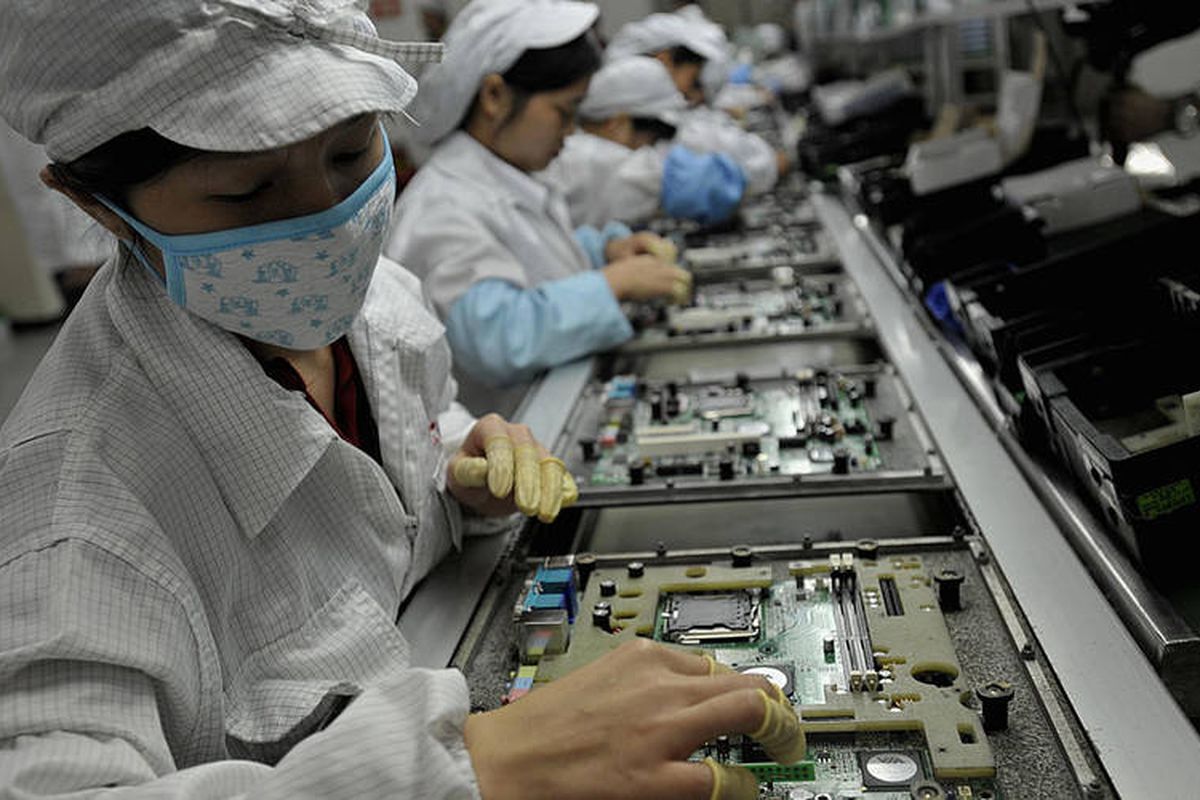
    Apple supplier Foxconn’s industrial park in Nanning, Guangxi, has been deserted, heavily impacting the local economy, as production of the iPhone is being moved away from China.

    The facility, once the centerpiece of Nanning’s economy, now stands empty, while its surrounding streets and residential buildings remain largely vacant, as depicted in a video shared by news channel China Observer last Friday.

    Although some nearby apartments are available for occupancy, they have struggled to attract buyers despite offering discounts, as the area has lost its appeal now that most of the facility’s employees having left.

    During its heyday a few years ago, the complex boasted a workforce of 50,000 and consumed vast resources to sustain them.

    However, with Apple’s strategic decision to shift production away from China, the Nanning complex was among the first to face downsizing as it was deemed under-utilized by Foxconn.

    Foxconn, Apple’s primary supplier, has been shifting its production lines to other Asian nations in recent years amid tensions between the U.S. and China.

    One of these destinations is India, whose iPhone production has doubled from 2022 to $14 billion last year, accounting for 14% of the Apple’s total iPhone output.

    Meanwhile, iPhone production in Zhengzhou, Henan, where the largest iPhone factory is located, plummeted by 60.1% year-on-year to 6.65 million units in the first quarter, citing data from Zhengzhou’s local customs authority.

  • Apple doubles down on China R&D amid iPhone sales slowdown

    Apple doubles down on China R&D amid iPhone sales slowdown

    As iPhone sales face a slowdown in the largest smartphone market globally, aka China, Apple is expanding its applied research operations in the country. With stiff competition from Huawei and other prominent domestic smartphone makers, Apple is doubling down on its research operations to stay ahead in the game.

    In a statement provided to the South China Morning Post, Apple revealed its intentions to bolster its research center in Shanghai, with a focus on supporting all its product lines.

    Additionally, the tech giant plans to open a new lab in Shenzhen by the latter half of 2024. This new facility will be dedicated to testing and research, focusing on key products such as the iPhone, iPad, and Vision Pro headset.

    The company underscored that the upcoming facility in Shenzhen will enhance its collaboration with local suppliers and provide support for local employees. Apple’s vice president and managing director of Greater China, Isabel Ge Mahe, expressed pride in fostering stronger connections in China and expanding the company’s footprint there. She remarked:

    We have already invested 1 billion yuan (US$139.2 million) into the existing applied research lab in China.

    These recent moves come on the heels of a commitment by Apple to ramp up capital spending in Greater China, the company’s third-largest market globally, following the Americas and Europe.

    This strategic shift follows a decline of 24 percent in iPhone sales in mainland China during the first six weeks of 2024. Apple faced formidable competition from a resurgent Huawei at the high end of the market, coupled with pricing pressures in the mid-range from Chinese smartphone heavyweights such as Oppo, Vivo, and Xiaomi.

    Recently, the Cupertino tech giant took action in response to sluggish sales and intensified competition from Huawei by offering discounts on the iPhone 15 line in China.

  • Apple has started designing 2nm chips for future iPhone models

    Apple has started designing 2nm chips for future iPhone models

    An Apple employee on Linked In  is supposedly the source of a new report that claims Apple has started designing chips that will be built using TSMC’s next-gen 2nm process node. Leaked slides published on the Korean website gamma0burst and posted via a tweet on “X” by leaker Revegnus the heavily redacted Apple slide refers to older 5nm chips such as the A15 Bionic, 3nm chips such as the A17 Pro, and a future 2nm chipset.

    As the process node used to build a chip “shrinks” in size, the features of the chip get smaller including the transistors allowing more of them to fit inside a chip. That is important because the higher a chip’s transistor count, the more powerful and/or energy-efficient that chip is. The iPhone 15 Pro and iPhone 15 Pro Max are currently the only smartphones powered by a 3nm chip.

    Later this year, Apple is expected to use 3nm application processors (AP) for all four iPhone 16 models. The iPhone 16 and iPhone 16 Plus could be powered by the 3nm A18 Bionic AP while the iPhone 16 Pro and iPhone 16 Pro Max will sport the more capable A18 Pro AP. Both components will be built using TSMC’s second-generation N3E 3nm node.

    SMC is supposedly planning to start production of 2nm chips during the second half of 2025 with the foundry churning out 1.4nm chips in 2027. Apple is expected to be the first company to obtain 2nm chips. The latter should deliver 10% to 15% performance upgrades at the same power or use 25% to 30% less power running at the same speed when compared to 3nm chips.

    Apple is TSMC’s top customer which is why it is usually able to be the first to receive chips made by TSMC using its latest process node. Apple will need to make some design changes in order to take advantage of TSMC’s 2nm node which will feature Gate-all-around (GAA) transistors instead of the currently used FinFET transistors.

    Using horizontal nanosheets placed vertically, GAA transistors allow the gate to surround the channel on all four sides reducing current leak and increasing the drive current. This results in stronger electrical signals between the transistors improving the performance of the chip. Back in December, TSMC showed off a prototype 2nm chip to both Apple and Nvidia.

  • iPhone users should expect to receive iOS 17.1.2 next week

    iPhone users should expect to receive iOS 17.1.2 next week

    Get ready iPhone users because iOS 17.1.2 is coming your way. MacRumors says that it has seen evidence of the update in its website’s analytics logs. Some of the higher profile bugs that still need to be exterminated include one that has prevented iPhone users running iOS 17.1 and later from wirelessly charging using the in-car charging pad of their General Motors vehicle. Apple had previously disseminated iOS 17.1.1 to eliminate a bug that broke NFC on iPhone 15 series handsets that charged using BMW’s in-vehicle charging system.

    Without NFC, the damaged iPhone units could not use Apple Pay and some received an error message saying that Apple Pay could not be set up on their devices even if the feature had already been used on these phones. Apple-certified techs were told to use Apple Service Toolkit 2 software in order to revive the NFC chip on damaged units, while some were told that their iPhones had to be opened up to repair or replace some of the hardware. While BMW warned iPhone 15 series users not to use the in-vehicle charger on new vehicles, Apple did push out iOS 17.1.1 to fix the issue at the beginning of this month.

    The iOS 17.1.2 update will probably be released next week since Apple traditionally stays away from releasing any new software builds during the week of Thanksgiving in the U.S. That’s because many of Apple’s employees are given the week off. Last year, a similar situation occurred with iOS 16.1.2 and the latter was finally released on November 30.

    As for iOS 17.2, Apple has been pushing out beta builds of the update with the final version expected in the middle of next month. The update will add support for spatial video recording for the iPhone 15 Pro models; these videos will be viewable with the Apple Vision Pro headset once it is launched. The iPhone’s new Journal feature will be available once iOS 17.2 is installed along with new Clock and Weather widgets, and an option that will allow iPhone 15 Pro series users to have the Translate app open when the Action button is long-pressed on the phone.

    But before iOS 17.2 arrives, iOS 17.1.2 will be released possibly to fix the GM wireless charging bug and any other annoying issues that iPhone users are currently dealing with.

  • iPhone 15 prices plunge 20% in three days

    iPhone 15 prices plunge 20% in three days

    An iPhone 15 Pro Max brought from overseas is now sold at around VND40 million (US$1,650) in Vietnam, down 20% in three days.

    Smartphone shops in Hanoi and Ho Chi Minh City on September 26 offered the VND40 million price for 256GB storage option. Higher storage options of 512GB and 1TB cost VND45 million and VND58 million, respectively.

    Traders queued up to buy the product at Apple stores in Singapore and Thailand and brought them to Vietnam unofficially.

    The first ones were available on Friday last week, one week before they are sold officially in Vietnam, at prices around VND70 million, or nearly 50% higher than official prices in Vietnam.

    Nguyen Hieu, owner of an unofficial Apple shop in Hanoi, said that he had anticipated the drop in prices this year as the iPhone is sold in Vietnam only one week later than Apple’s tier-1 markets, compared to several weeks in previous years.

    He only bought 20 iPhone 15s to sell in the last three days.

    Retail chains are reporting a shortage of the most expensive option, the iPhone 15 Pro Max, due to high demand from preorders.

    Customers will have to wait until the end of October for more supply, retailers said.

  • Apple announces the date for iPhone 15 ‘Wonderlust’ event

    Apple announces the date for iPhone 15 ‘Wonderlust’ event

    Apple has now confirmed that its next event for 2023, where it will apparently announce its new smartphone lineup, the iPhone 15, and new watches, will take place next month.

    The company’s website says that the event will take place on September 12 at Apple Park and will begin at 10 a.m. PT. It will be live-streamed on apple.com as well as the Apple TV app.

    The Pros will also likely feature a new 3nm chipset, which should make them faster and more power-efficient than the current models. The iPhone 15 Pro Max may feature a new periscope camera for a greater zooming range and this could make it the best camera phone of 2023.

    The iPhone 15 and 15 Plus will purportedly feature the Dynamic Island and a 48MP main camera.

    The entire lineup will likely have USB-C ports, slimmer bezels, softer corners, and bigger camera bumps. The standard models will probably stick to last year’s pricing but the premium variants could be up to $200 more expensive.

    The phones will reportedly hit the shelves on September 22.

    Coming to the watches, we will probably also get to see the Watch Series 9 and the second Watch Ultra during the Apple 2023 event. The new wearables are sounding like incremental upgrades and the most interesting new feature is seemingly a new chip.

  • Apple iPhone users can move Chrome’s URL address bar to the bottom of the screen

    Apple iPhone users can move Chrome’s URL address bar to the bottom of the screen

    Google is about to offer iPhone users the option to move the URL address bar (also known as the Omnibox) on Chrome to the bottom of the screen. Currently available only to iPhone users who enable a flag, a future update should allow all iOS users to move the bar on Chrome. By moving the URL address bar near the bottom of the display, users can more easily navigate the browser using one hand.
    If you want to move the Omnibox on the iOS version of Chrome to the bottom of the display, here is what you do. Open the Chrome app on your iPhone. From the URL field (AKA Omnibox) enter  chrome://flags. When the next page opens, in the rectangular search bar type in bottom-omnibox-steady-state. That should take you directly to the correct flag. Press the pill-shaped button that says “Default.”  Tap on “Enable,” close Chrome and re-open it.
    Once you’re back in Chrome, tap the three-line Hamburger icon in the lower right corner and then tap Settings (the gear icon) at the top of the screen. You’ll see a menu; scroll down to the listing Bottom Omnibox and toggle it on. And that is it. Your URL address bar, AKA your Omnibox, will now be on the bottom of the screen whenever you use Chrome on your iPhone.
    You might recall that when iOS 15 was in beta, Apple moved the URL address bar to the bottom of the screen on the Safari mobile browser. This created an uproar among iPhone fans who, while loyal, aren’t known for their flexibility. Those complaining said that moving the bar to the bottom of the screen made Reader Mode and the refresh button hard to find. So in iOS 15 Public Beta 4, Apple did away with the changes to Safari. However, Safari users on iPhone now have the choice between placing the mobile browser’s Unibox at the top or the bottom of the display.
    To make your selection, go to Settings > Safari and scroll down to the Tabs heading. You can choose between having the URL address bar/Omnibox at the top of the screen, or at the bottom. Remember, having it at the bottom might make it easier to use the browser one-handed.
  • Apple may sell iPhone 15 in Vietnam next month

    Apple may sell iPhone 15 in Vietnam next month

    Apple may sell its new iPhone 15 in Vietnam in September, a month earlier than last year as the company considers adjusting the country’s “priority level” from 3 to 2.

    According to a local electronics retail chain, Apple is considering adjusting the priority level of the Vietnamese market from three to two.

    Priority level two means Vietnam retailers could be authorized to sell the new iPhone 15 in its second phase of release.

    Last year, iPhone 14 was launched on September 7 and sold from September 16 in markets with Apple Store shops. The second phase started on September 23 in 20 countries and territories. The product was officially distributed in Vietnam from October 14, the release’s third phase.

    “The final decision has not been made, but it is a remarkable signal that Apple is more interested in Vietnam and iPhone 15 may be sold a few weeks earlier than previous years,” said the chain’s manager.

    The launch date of the iPhone 15 is likely to be announced on September 13 and the new model will be on sale from September 22. These timelines are about one week later than the iPhone 14’s schedule last year, but the sale to second-tier priority markets could still be as early as September.

    Some electronics retail chains said that although Apple wants to raise the Vietnamese market’s priority level, thin iPhone 15 supplies could push the release of the model past its expected date in early October.

    Vietnam does not have an Apple Store like neighboring countries Singapore and Thailand. However, in recent years, the growth of the iPhone’s presence in Vietnam has been significantly faster than in some international markets.

    Vietnam was the sixth country in Southeast Asia to open an Apple Store Online in May, and just two months later became the third country in the region to have Apple Pay.

    According to analysts, Vietnam, Thailand, Indonesia and India are becoming more important to Apple as growth in other key regions is slowing.

    “Apple is further consolidating its presence in emerging markets,” Chiew Le Xuan, an analyst at Singapore-based technology market analyst firm Canalys, said when Apple opened its online store in Vietnam on May 18.

    “In recent months, Apple has also increased their distribution and network of Apple authorized resellers (AARs) in Southeast Asia,” he said.

    During the coming September launch ceremony, in addition to the iPhone 15 series with four models, the Watch Series 9 and Watch Ultra 2 models are likely to be released. New operating system versions such as iOS 17 and PadOS17 will also be officially released.

  • Netflix turns your iPhone into a game controller

    Netflix turns your iPhone into a game controller

    A couple of years back, in 2021, Netflix rolled out games on its mobile app. At first, the mobile games collection was kinda tiny, but over time, it got bigger and loaded with loads of free mobile games for Netflix subscribers. Netflix is also getting ready to toss games onto the TV scene too, and it looks like it is getting closer to the launch day by introducing its new Netflix Game Controller app.

    The new app will allow you to play games on TV by using your phone as a controller. You will have to pair your phone with the TV to play the games when they become available on Netflix. The company says it will happen soon. The app is only available for iOS in the App Store.

    Using your iPhone or iPad as a controller sounds like a pretty cool idea because you wouldn’t need to purchase an extra controller to play on your TV.

    There are dozens of games you can play on the Netflix mobile app. The streaming service is adding 40 new mobile games this year and stating that 70 titles are currently in development with its partners. Some of the most popular games on the platform are based on hit shows like Stranger Things and Queen’s Gambit.

    Lately, Netflix has stopped offering its Basic plan in the US and UK, pushing users to opt for pricier options to keep using the service. Meanwhile, Netflix hasn’t raised its plan prices for over a year, likely in an effort to retain more paying subscribers following its password-sharing crackdown.

    As games make their way onto TV screens, we’ll find out whether the prices will remain unchanged or if this new feature will bring about a price hike.

  • iPhone 14 Pro Max price down 24%

    iPhone 14 Pro Max price down 24%

    After 10 months of being sold in Vietnam, iPhone 14 Pro Max has seen its selling price fall by 24% to VND25.7 million (US$1,089).

    In early August, some Apple authorized resellers (AARs) in Vietnam lowered the price of iPhone 14 Pro Max to less than VND26 million, the lowest since its launch in October 2022.

    Di Dong Viet is selling iPhone 14 Pro Max for VND25.7 million, Hoang Ha Mobile for VND25.9 million, CellphoneS and FPT Shop for VND26.4 million, and The Gioi Di Dong (Mobile World) for VND26.7 million.

    The current price of iPhone 14 Pro Max at AARs is some VND5 million lower than the smartphone sold at Apple Store Online Vietnam.

    Phung Phuong, a manager of Di Dong Viet, said the price decline stemmed from both Apple’s assistance given to AARs and their own efforts.

    Besides iPhone 14 Pro Max, other models of Apple have seen selling prices drop by VND300,000-500,000 per unit. The prices of iPhone 14, iPhone 14 Plus, and iPhone 14 Pro currently are at least VND18.5 million, VND21 million and VND23.6 million, respectively.

    The manager of a big AAR said the prices of iPhone 14 models have decreased the most drastically.

    After 10 months of being sold in Vietnam, the price of iPhone 13 Pro Max declined by 15.7% to VND26.9 million from VND31.9 million.

    The third quarter is always a quiet period for the market as users wait for a new model of iPhone, usually launched in September and sold in October in Vietnam.

    However, this year the price competition has become more intense, forcing AARs to offer big discounts to attract users.

    “This may be the bottom price of iPhone 14 Pro Max, and the price race is showing signs of ending,” a manager of Hoang Ha Mobile said.

    In addition to smartphones, AARs have lowered selling prices of other Apple products by VND0.5-1 million per unit to lure customers before the new school year starts in September.

    This year, AARs in Vietnam not only compete with each other but also with Apple when its online store is offering students many incentives and promotions.

  • iPhone imports cost Vietnam $1.6B

    iPhone imports cost Vietnam $1.6B

    iPhone imports cost Vietnam US$1.61 billion last year, equivalent to 46% of all phone imports.

    According to the Ministry of Industry and Trade, total imports were up 10.5% to $3.5 billion, with Samsung, Oppo, and Xiaomi accounting for most of the rest.

    Samsung imports cost $940 million, and that of Oppo, $442 million.

    Almost $18 worth of components were also imported, and South Korea and China accounted for 93% of phone and part imports.

    Many Apple distributors said the more expensive an iPhone model, the higher the demand.

    According to the ministry, some 210.5 million phones worth VND663.7 trillion were manufactured in Vietnam last year, down 9.1% in volume but up 15.1% in value.

    Exports fetched the country $33.32 billion, with Samsung alone accounting for $31.42 billion.

  • iPhone 14 prices to decline further

    iPhone 14 prices to decline further

    A guest holds the new iPhone 14 at an Apple event at their headquarters in Cupertino, California, U.S. September 7, 2022. Photo by Reuters

    The prices of iPhone 14 in Vietnam, which are already among the lowest in the world, will continue decreasing in the coming time, market observers said.

    “In April, Apple authorized resellers will have to import a new batch of iPhones according to their commitments to Apple. To lower inventory, slashing prices is the best way,” said a reseller.

    Officially launched in the country on Oct. 14, 2022, the iPhone 14 Pro Max version originally sold for VND34 million ($1,440).

    Only half a year later, the price dropped by more than VND7 million, the fastest rate of price decline since iPhone smartphones were first officially sold in Vietnam in 2014.

    Prices of some other iPhone 14 versions also decreased sharply.

    “The iPhone price war is always going on, but never as fierce as now. This is the first time the price of Apple’s latest phone model has dropped so steeply after only half a year,” said Phung Phuong, a manager of smartphone retail chain Di Dong Viet.

    According to a large electronics retailer, there are two reasons for the current price race.

    Firstly, Apple has not yet fixed a price range in Vietnam, so local dealers set their own selling prices according to actual needs and market situations.

    Large stores often sell Apple smartphones at prices VND1-2 million higher than smaller ones, but still attract customers due to their wide coverage, good reputation, and better after-sales services.

    Meanwhile, smaller stores must accept low profits, slashing prices to compete with bigger ones.

    Secondly, at the beginning of 2023, demand for smartphones started diving, but Apple authorized resellers still imported a large number of products to receive sales incentives from Apple.

    Inventory is now too high, forcing resellers to lower prices to make cash flows run smoothly.

    “Big retailers are slashing selling prices, so small and medium ones have to follow suit to keep their market shares,” said Nguyen Lac Huy, a manager at smartphone retail chain CellphoneS.

    The iPhone 14 was rolled out in Vietnam in October last year. While the Pro and Pro Max versions sold out within a few months, sales of the iPhone 14 and Plus versions have been sluggish.

    Retailers said the combined sales of the two models account for less than 5% of the total.

  • iPhone 14 prices in Vietnam cheapest in the world only after US

    iPhone 14 prices in Vietnam cheapest in the world only after US

    Low demand has driven iPhone 14 prices in Vietnam to the second lowest levels in the world after only the U.S. According to German data portal Statista, the price starts at US$799 in the U.S. while authorized Apple resellers in Vietnam sell it at VND19.7 million ($834.7).

    “The iPhone 14 is not popular, and so stores are selling them at close to import prices to recover capital,” said Thanh Son, the owner of a mobile phone showroom in HCMC’s District 1.

    But in other Asian markets, the prices are higher. They start at VND22.3 million in Singapore, VND20.7 million in Hong Kong, and VND23 million in Thailand.

    In Vietnam, the prices of two high-end models, 14 Pro, and 14 Pro Max, are only VND1 million lower than in the U.S.

    The iPhone 14 Pro Max costs VND28 million, down VND3.5 million within just one month. “This is an unexpected development because in previous years, it was not until June or July that iPhone prices fell steeply,” Nguyen Lac Huy, a manager at retail chain CellPhoneS, said.

    Unlike at the end of last year, the supply of iPhone 14s is now abundant, so people can choose colors and capacities.

    Nguyen Minh Khue, a manager at another retail chain, Viettel Store, said the prices of the entire iPhone 14 range were recently cut by up to VND2 million due to the falling demand and increasing supply.

    Some other Apple products are also among the cheapest in the world in Vietnam. An iPad 9 starts at VND7.5 million and a MacBook Air M1 at VND19.9 million, while in the second cheapest market, Hong Kong, the latter still sells at VND23.4 million.

  • Apple stock plunges the most since the financial crisis on iPhone production woes

    Apple stock plunges the most since the financial crisis on iPhone production woes

    While production lead times of the iPhone 14 Pro models have started to normalize after the pandemic lockdown scare that prevented Foxconn from assembling enough units to meet demand not long ago, the iPhone 14 series production schedule and sales as a whole are not where investors would want them to be.

    As a result, Apple’s stock took another nosedive and is now down 12.4% just in the month of December alone. Not only that, but juggernauts like Apple and Tesla are now sharing the unenviable position of experiencing some of their worst stock plunges ever. For Tesla, that’s the biggest drop on record, while for Apple’s stock this year will mark the biggest plunge since the 2008 financial crisis and the subsequent freefall in stock indexes.

    Apple is on the verge of closing below $130 a share, erasing all gains accumulated since mid-2021, while for the whole 2022 its stock has dropped a whopping 27%. The Federal Reserve’s interest rate rise push has something to do with it, of course, as it sent investors scouring for safe havens and out of riskier bets like tech stocks, resulting in a nearly 34% drop of the Nasdaq this year.

    Still, last quarter Apple grabbed the jaw-dropping 42% of the global phone revenue and while the last quarter of the year may be negatively affected by the COVID surge in China after the country’s reopening, its revenue may very well hit record again, riding on the higher average selling price of its iPhone 14 series which is heavily skewed in favor of the more expensive iPhone 14 Pro and iPhone 14 Pro Max models.