Tag: lg

  • LG profit plunges, missing forecasts by a mile

    LG profit plunges, missing forecasts by a mile

    LG Electronics’ operating profit fell nearly 80 percent in the fourth-quarter of 2018 year-on-year, according to preliminary figures disclosed in a Financial Supervisory Service regulatory filing Tuesday.  The smartphone and household appliances manufacturer estimated 75.3 billion won ($67.0 million) in operating profit for the final quarter of last year compared to 366.8 billion won in the same quarter in 2017.

    The estimate is far below the 398.1 billion won forecast by analysts surveyed by FnGuide, a data provider. The company anticipated 15.8 trillion won in revenue from October to December last year, a 7-percent decline from the same period a year earlier.

    Analysts pointed to the slowing global smartphone market as a factor weighing on the company.

    “With the smartphone market currently in a slump, [the company] is unable to find an opportunity to recover,” said Kim Ji-san, an analyst at Kiwoom Securities in a report Tuesday that predicted disappointing earnings prior to LG’s announcement. “Demand has slowed as smartphone replacement cycles have become longer in high-value markets such as Korea and the United States,” Kim added.

    Meanwhile, the company estimated annual operating profit for 2018 at 2.7 trillion won, a 9.5 percent rise from the previous year.

  • LG unveils TV that rolls up for storage

    LG unveils TV that rolls up for storage

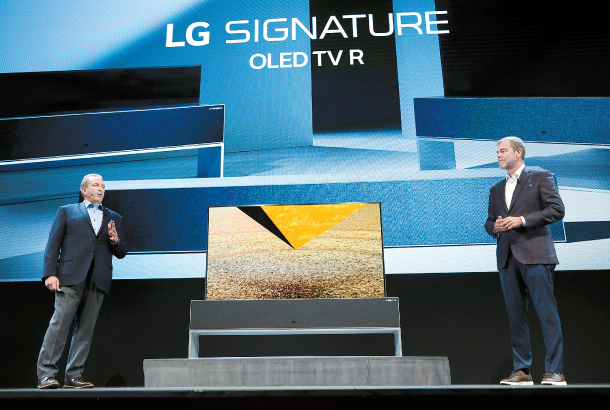
    LG Electronics unveiled the world’s first “rollable” television at the Consumer Electronics Show (CES) 2019 that launched in Las Vegas, United States, on Tuesday. Last year, its affiliate LG Display unveiled a prototype of a 65-inch rollable OLED display panel at the same event. Dubbed the LG Signature OLED TV R9, it uses the same technology, only it comes with an aluminium case at the screen’s bottom that looks like a long tissue box.

    A rolling OLED display was possible because unlike TV panels of the past, OLED screens don’t need backlight to show color, but have molecules that let out light on their own.

    The panel can roll itself up and down from the case so that the television set looks more like a long, rectangular table once the screen is completely inserted. LG boasts that the screen can maintain its color definition even as it rolls itself. R9 won the CES 2019 Innovation Awards in the video display sector.

    LG plans to launch global sales of R9 this year, starting from Korea. Its price was not disclosed, but it will be among LG’s premium television lineups. The advantage of the rollable TV set is that it can be placed in locations like the window side or in the middle of a room. For conventional TV screens, the popular choice was beside or on the walls as they take up space and block the view if installed elsewhere.

    The television set also comes with high-quality speakers and an artificial intelligence software that enhances the set’s performance to adjust definition and sound according to the film or video played. It also recognizes simple vocal commands.

    When the screens are rolled inside the case, R9 can work similarly to an audio set as it can play music via connection to smartphones or other portable devices. It also comes with various modes to use the screen apart from watching movies and TV shows.

    It can function like a huge electronic canvas that shows photos saved in your smartphone. For those who want to create a cozy atmosphere, it has a “Mood” mode that plays a video of a fireplace or displays mood-specific light on the screen.

    LG Display Vice Chairman Han Sang-beom expressed confidence in the panel in front of local reporters on Tuesday at the CES. According to Han, the rollable panel was rolled and unrolled more than 100,000 times during its development process.

    “We’re talking with other clients as well [apart from LG Electronics] for the rollable TV panels,” he said. “My plan is to target the premium market instead of aiming for sales volumes.”

  • Wavy waterfall by LG

    Wavy waterfall by LG

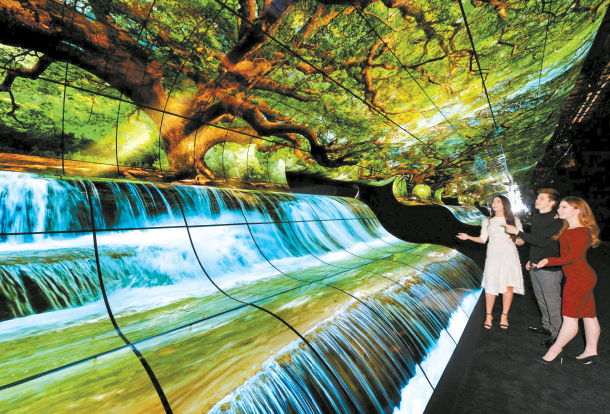
    Models showcase LG Electronics’ 260 flexible OLED signage displays put together to form a waterfall at the company’s Consumer Electronics Show 2019 exhibition entrance in Las Vegas on Monday. The annual event, which will host over 4,000 companies this year, began yesterday.

  • LG Household’s History of Whoo makes history

    LG Household’s History of Whoo makes history

    LG Household & Health Care’s skin care brand The History of Whoo generated 2 trillion won ($1.79 billion) in sales this year as of Thursday. This is the first time a Korean beauty brand has reached that threshold. The 2018 record is also a 40.8 percent increase from last year’s annual sales.

    “For us, the achievement is meaningful in that it’s a sign we’re nearly able to compete shoulder-to-shoulder with global beauty brands,” LG said in a statement.

    The 2 trillion won in sales figure is based on manufacturer price. Counting the consumer price tag, the figure jumps up to 3 trillion won. According to market research firm Euromonitor International, the top three global beauty brands – Lancome, Shiseido and Estee Lauder – generate between 4.4 trillion and 5.3 trillion won a year based on the same standard.

    The last time The History of Whoo set a record was in 2016, when the brand made 1 trillion won in annual sales, 14 years after its launch. Breaking the 2 trillion won threshold came just two years later.

    The rapid growth is notable in that Whoo successfully survived a widespread boycott of local brands in China last year, following the installment of the U.S.-led antimissile system Thaad. This is in contrast to a score of other beauty companies like local leader Amorepacific, which have suffered huge blows from the loss of Chinese customers and some have yet to recover to pre-Thaad revenue levels.

    A spokesman explained that the brand kept its positive image thanks to word-of-mouth marketing and repurchases from Chinese customers.

    In terms of strategy, LG believes Whoo’s positioning as a high-end beauty brand has proven effective. Among its wide brand portfolio, The History of Whoo is one of LG’s premium brands with a higher price tag.

    Its main concept is that the products are based on records from Korea’s past dynasties which use oriental medicine as main ingredients. The brand story is also reflected in its product packaging, which emphasizes gold and red, which industry watchers say fits well with Chinese consumers’ taste for glamor.

    “We also concentrated a lot of our marketing activities to target VIP customers that have buying power,” said an LG spokesman.

    For next year, the company plans to continue its drive to push premium brands. Another brand LG is hoping to develop in the price range is SU:M, which is less flashier than Whoo, but emphasizes the use of fermented plants. Although smaller than Whoo, SU:M is also expected to reach 440 billion won in sales this year, a 15.8 percent increase year-on-year. During this year’s third quarter, LG’s three luxury brands – Whoo, SU:M and O HUI – were responsible for more than 60 percent of its beauty revenue.

  • LG U+ says it can download things 10 times faster on 5G

    LG U+ says it can download things 10 times faster on 5G

    LG U+ said Wednesday that it has demonstrated 10 times faster download times compared to 4G LTE on its 5G network. While 4G LTE offers 133.43 megabits per second download speeds on average, according to data from the Ministry of Science and ICT, LG U+ said it realized 1.33 gigabits per second on its 5G network.

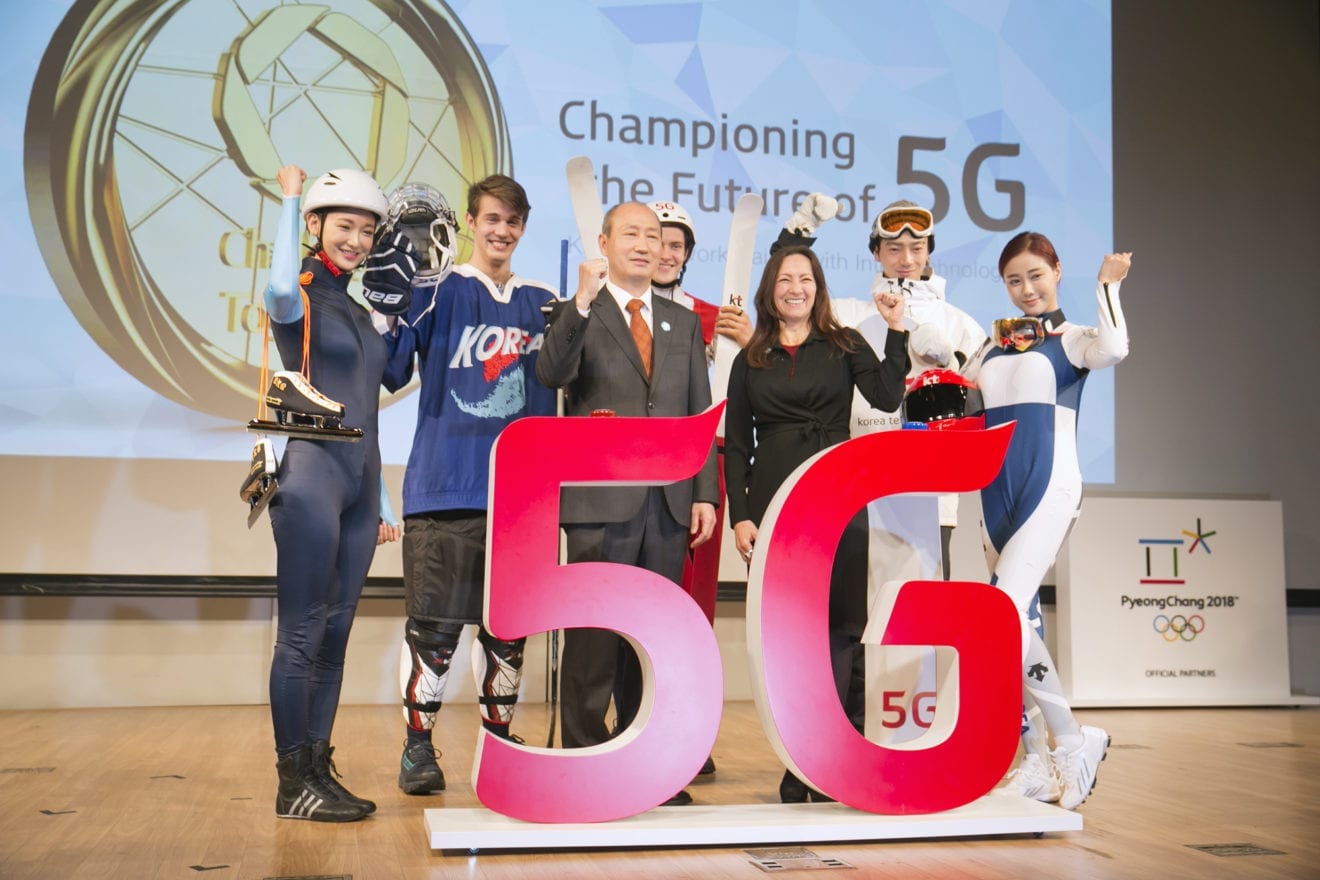
    LG U+ claims it is nearly the fastest speed consumers can practically experience on 5G. Next year, when 5G is commercialized for smartphones, the smallest carrier in the country projects data download speeds will increase to as fast as 2 gigabits per second when the 5G network will be coupled with the 4G LTE network.

    LG U+ believes 5G is its chance to move up the mobile carrier ranking, currently dominated by SK Telecom and KT.

  • LG sets up lab to conduct appliance technology research

    LG sets up lab to conduct appliance technology research

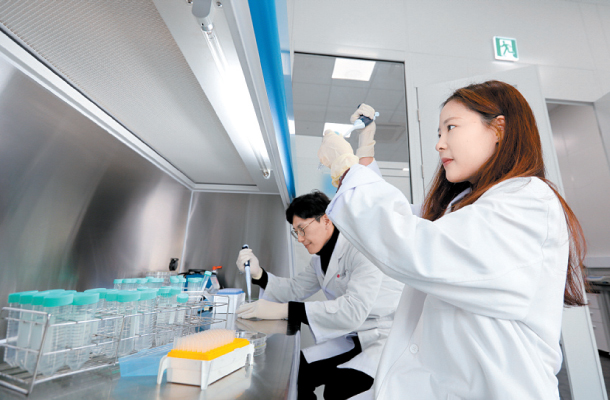
    LG has established a new research laboratory committed to advances in fridge, oven and other home-appliance technologies. LG Electronics opened the 6,760-square-foot Food Research Institute on Monday at Changwon, South Gyeongsang. At the center, researchers will develop technologies that can be applied to the company’s home appliances, such as refrigerators, kimchi and other specialty food fridges, ovens and electric stove tops.

    Food preservation, the fermentation of kimchi and food preparation will be some of the focuses.

    The company said researchers will work closely with academics from Seoul National University and Konkuk University, as well as experts from government and private agencies, such as the Rural Development Administration, the Korea Food Research Institute and the World Institute of Kimchi.

    LG Electronics often mentions advanced technologies in its marketing materials, using the technology to set itself apart from competitors.

    According to the company, LG refrigerators run on inverter linear compressors, which are 18 percent more energy efficient and create less noise than comparable gas compressors. Its kimchi refrigerators maintain temperatures of 6.5 degrees Celsius (43.7 degrees Fahrenheit), the optimal level for kimchi. At that temperature, the growth of a lactic-acid bacteria that creates a sour taste is suppressed. LG’s electric stove tops can cook food up to 2.3 times faster than gas ranges, the company boasts.

    The facility at Changwon is not the first research lab established by the company to further develop its home appliances. In February, LG Electronics opened a water research lab committed to the making of better water purifiers. In October, it opened a center dedicated to air science to advance its air purification technologies.

    “We will continue investing in research and development related to food, water and air technologies,” said Song Dae-hyun, head of LG Electronics’ Home Appliance & Air Solutions.

  • Huawei’s woes in U.S. give pause to Korea, too

    Huawei’s woes in U.S. give pause to Korea, too

    The arrest of Huawei’s Chief Financial Officer Meng Wanzhou in Canada has triggered alarms in the Korean telecommunications industry, especially after LG U+ moved onto a fifth-generation (5G) network this month that uses Huawei network devices.

    The Chinese telecommunications giant has maintained a sizeable influence since it first entered the Korean market in 2002. While it was originally focused on the cable infrastructure business, Huawei moved on to offering wireless telecommunications devices in 2007 as local telecommunications companies introduced third-generation wide-band code-division multiple access services.

    In 2013, Huawei received orders for fourth-generation 4G long-term evolution (LTE) wireless base stations from LG U+ for services in Seoul, Incheon, and areas in Gyeonggi and Gangwon.

    The 5G equipment market in Korea is estimated to be worth 10 trillion won ($8.89 billion).

    While Huawei is a leading supplier to the telecommunication industry, concerns about the security of its devices has held the company back. Only LG U+ decided to use Huawei equipment for 5G. Huawei has claimed that it had no such security problems in the 170 countries that it operates in and would follow inspection requests by the Korean government.

    LG U+ signed a deal with Huawei to introduce around 30,000 base stations in the Seoul, Incheon, and the Gyeonggi and Gangwon regions by next March. The deal is reportedly worth around 300 billion won, not including maintenance fees.

    The decision by Korea’s smallest telecommunications company made business sense as it used Huawei equipment for its 4G network.

    Huawei’s equipment, however, will not be installed in areas occupied by United States Forces Korea (USFK) such as in Pyeongtaek, Dongducheon, Yongin in Gyeonggi. The U.S. government has requested that Huawei equipment not be used out of concerns about a Chinese cyberattack. USFK has been suspicious about Huawei equipment. When LG U+ chose Huawei equipment for its 4G network, around 10,000 USFK soldiers switched carriers.

    The current situation has left LG U+ in a difficult position. Its deal with Huawei is already inked, and the 5G service works in sync with the existing 4G system, so it is impossible for the company to simply not use Huawei equipment.

    The recent banning of Huawei equipment by Britain, Australia, Canada, New Zealand and Japan, along with growing worries in Korea, places more pressure on the telecommunications unit.

    A senior LG U+ official expressed frustration at the current situation and the Korean government’s inaction.

    “Our government is just trying to not upset either China or the United States,” said the official. “Shouldn’t the government come forward and clear things up?”

    Meanwhile, the government maintains its stance that the selection of telecommunications equipment is an issue for companies to decide.

    “Inspecting security is the responsibility of the business operator. It is not appropriate for the government to take part in an area that a company should make a decision on,” said Park Jun-guk, an official at the Cyber Security Industry Bureau in the Ministry of Science and ICT.

    “[We] will, however, strengthen security inspections in the form of a technology advisory conference.”

    While 5G has stirred controversy, Huawei has an even stronger presence in the country with its cable and optical transmission equipment businesses. In the cable business, all three telecommunications companies, SK Telecom, KT and LG U+, are customers of Huawei.

    Huawei has also won orders from Koscom, a state-run financial IT solution company, and from electric utility Kepco.

    Last month, the Chinese company won an order with KT to connect the sales network of the National Agricultural Cooperative Federation and the National Livestock Cooperatives Federation worth around 120 billion won.

    According to market researcher IHS Markit, Huawei is the biggest global telecommunications equipment maker, with a market share of 22 percent. While Samsung Electronics holds a strong position in the Korean market, a 45 percent market share, it commands a paltry 4 percent share of the global market.

  • LG Electronics supports Ethiopian entrepreneurs

    LG Electronics supports Ethiopian entrepreneurs

    LG Electronics announced on Thursday that it has opened an entrepreneurship center for young people at an existing technical and vocational education center run jointly by LG and the Korea International Cooperation Agency (Koica) in Addis Ababa, Ethiopia.

    The existing job training center, the LG-Koica Hope TVET (Technical and Vocational Education and Training) College, was established in Addis Ababa in 2014 to help Ethiopia achieve economic growth by offering quality education to young Ethiopians and helping them acquire the foundations of financial independence.

    The new center has been named the LG Social Campus Business Incubator Center. It provides graduation candidates of LG-Koica Hope TVET with the opportunity to receive help building a business model and launching their own company. The center will offer office and co-working spaces, as well as training in law, marketing, leadership and business administration.

    “We hope that a socially-recognized company will be born in Ethiopia with the support of the LG Social Campus,” said Yoon Dae-sik, president of the government relations division at LG Electronics.

    “We will keep up with efforts to help Ethiopian youngsters step up their competitive edge and independence.”

    The Korea International Cooperation Agency is a state-run organization devoted to supporting socio-economic development in developing countries.

  • LG seeks AI, robotics, big data talent in Silicon Valley

    LG seeks AI, robotics, big data talent in Silicon Valley

    LG Electronics Vice Chairman Jo Seong-jin will be in Silicon Valley on Nov. 14 scouting employees with expertise in future technologies such as artificial intelligence, robotics, big data and the cloud. He will meet with job candidates – mostly those with doctoral degrees in the areas of interest – and introduce LG’s vision for growth and plans to staff up in research and development. He will then meet with academics focused on artificial intelligence, including professors at Stanford University, to discuss technological trends and future prospects in the field, according to LG.

    Jo will also visit San Diego, San Jose and Seattle to meet with corporate leaders in IT, finance and consumer goods to discuss the company’s blueprint for the future.

    “LG must hire global talent to become a leader in future businesses based on artificial intelligence, big data and the cloud,” Jo was quoted as saying by LG in a release.

    LG will continue investing in leading companies and cooperating with other businesses in related fields, he added.

    Inaugurated as chief executive of LG Electronics in 2016, Jo has been outspoken about the company’s future in artificial intelligence.

    Delivering a keynote speech at the opening of the IFA tech fair in Berlin in August, he said LG will be “pouring the company’s resources into artificial intelligence,” given that the technology will determine LG’s future.

    LG launched an artificial intelligence research center in June. It is led by the company’s chief technology officer and devoted to voice, video and bio recognition as well as deep-learning algorithms.

    Earlier this year, the country’s second-largest electronics appliance producer established another center connected to LG’s Silicon Valley lab. It is focused on deep learning and automobile technologies.

  • Korea’s KT skips Huawei for 5G

    Korea’s KT skips Huawei for 5G

    KT has chosen Samsung Electronics, Ericsson and Nokia as suppliers of 5G network equipment. As expected, Huawei was excluded from the list.  “In choosing 5G equipment providers, the company considered a wide range of factors: the level of technology, investment costs and management stability based on the compatibility with the existing LTE network,” KT said in a statement.

    The bid results, announced by the company Thursday, come a month after SK Telecom named Samsung Electronics, Ericsson and Nokia as its 5G equipment providers.

    This is the second time Huawei was left out despite having participated in internal tests along with the three selected.

    SKT and KT’s choices were anticipated because both had used equipment from Samsung, Ericsson and Nokia for their 4G LTE networks.

    Compatibility of equipment is an advantage for mobile carriers in terms of cost and maintenance, especially in the early stages when 5G equipment is not fully installed nationwide.

    LG U+ is the only one among Korea’s three mobile carriers that has not yet announced 5G equipment suppliers. The smallest mobile carrier is likely to include Huawei on its list. It partnered with the Chinese company for its 4G LTE network, along with Samsung, Ericsson and Nokia.

    An LG spokesman said Thursday that the company “does not have plans to openly disclose selected bidders for 5G network equipment at the moment,” as it is not mandatory.

    However, LG U+ Vice Chairman Ha Hyun-hwoi gave a strong hint at the parliamentary audit late last month when he gave a positive answer to a lawmaker’s question on whether it was “unavoidable” to use Huawei’s 5G equipment as its 4G equipment was from the same company.

    The biggest advantage of Huawei’s 5G equipment is cost efficiency. The Chinese company is known to charge prices that are 20 to 30 percent lower than other global competitors for high-quality 5G equipment. A factor that argues against Huawei is security concerns.

    Due to its ties to the Chinese government, there have been worries that the company’s equipment is being used for spying. In August, the U.S. and Australian governments banned Huawei from supplying equipment for their 5G wireless infrastructure citing security reasons. Britain said in July it “is less confident” about the integrity of Huawei products.

    The concern is shared by some local customers as well. Online petitions at the Blue House’s official website have been posted since June requesting a stop to LG’s adoption of Huawei’s 5G equipment. Huawei has been denying such allegations.

    In a press release last month, the Chinese tech company highlighted that, despite ongoing security concerns, there has been zero cases of actual information leakage in the past.

    “We have supplied LTE equipment for LG U+ since 2013, and until now, there were no cases of security accidents,” said the statement. “After multiple verifications by the government, it has been proved that there have been no problems.”

  • LG Electronics launches new design

    LG Electronics launches new design

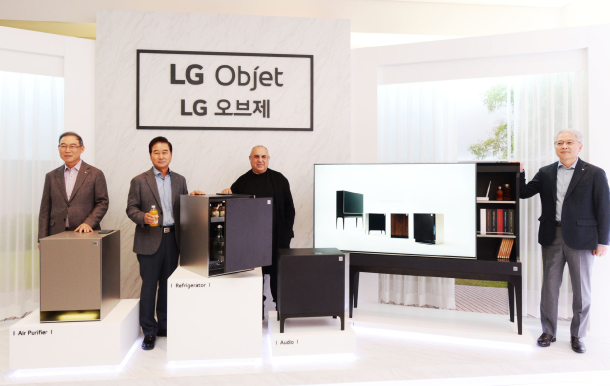
    LG Electronics has introduced a premium brand that combines furniture design with home electronics. The company rolled out four products under the LG Objet name at a press conference held Thursday in Gangnam District, southern Seoul: a mini refrigerator, an air purifier, a speaker and a television.

    “The thing about home electronics is that they are placed mostly in kitchens or living rooms but rarely inside bedrooms,” said Song Dae-hyun, LG’s president for home appliances. “Bedrooms, on the other hand, only have furniture, so in the last few years, we thought about ways to make home electronics coexist in that space.”

    All four items are covered with hard wood.

    Another way in which LG worked to make the appliances look more like furniture was to reduce the size of external features typical to electronic devices, like buttons or small screens. They are simplified or hidden in less visible areas of the product. An exception is the television, with its 65-inch screen, but LG added a furniture-like touch to it by placing a cabinet behind a sliding television screen.

    The fridge and the air purifier won Red Dot and iF design awards. Architect and industrial designer Stefano Giovannoni was involved in the development of the products.

    In terms of function, LG utilized technology to make the devices more appropriate for bedrooms.

    A compressor is a core component in a refrigerator, and it tends to be noisy. LG Objet’s refrigerator utilizes the type of cooling found in wine cellars to make the product quiet.

    For customers using the refrigerator or the air purifier as a bedside table, LG enabled a corner of the top surface to work as a wireless charger for portable devices.

    Song said during the press conference that he believes affluent customers in their 50s and 60s with strong purchasing power will be a source of demand as they look for ways to decorate their private spaces.

    The refrigerator and the air purifier are priced at 1.99 million won ($1,760); the speaker, 1.49 million won; and the television, 9.99 million won. The products were made available for sale at LG Best Shops starting Thursday.

    This is LG’s second high-end home appliances brand after the LG Signature series, introduced in 2016. Apart from sales, the other goal of LG’s premium product expansion is to maintain a leadership in the sector.

  • Fair to screen startup hosted by LG

    Fair to screen startup hosted by LG

    Technology-related subsidiaries of LG hosted a fair on Monday in which 20 local start-ups presented their cutting-edge developments in areas such as autopilot technologies, artificial intelligence and big data. The small firms are seeking partnerships with and support from the fourth-largest conglomerate in Korea.

    LG picked the start-ups jointly with the Korea International Trade Association (KITA), hoping to revitalize local start-up ecosystem.

    The conglomerate is providing a venue for the fledgling firms to mingle with their larger counterparts and find new business opportunities.

    LG subsidiaries participating in the event include LG Electronics, LG Display, LG Innotek, LG Chem, LG U+ and LG CNS.

    Executives and researchers from those companies as well as KITA CEO Kim Young-ju paid a visit to the start-up fair, which took place at the LG Science Park in Magok, western Seoul, and had a closer look at technologies and services featured.

    Funnel, for instance, has developed a voice-recognition system that automatically collects information from television broadcasts. The resulting database can be used for artificial-intelligence smart speakers and voice-command chat bots.

    Venta VR owns a technology that is able to tape high-resolution 3D videos and calibrate the video images afterwards in a way that enhances the level of immersion and minimizes visual fatigue.

    LG will offer some of the participating start-ups office and research space inside the LG Science Park as well as technology-related consulting and funds.

    Companies under the LG umbrella have been increasing support for start-ups.

    LG Electronics is backing four start-ups that are in the web operating system business, whereas LG CNS and LG Display have been running their own programs.

    LG-led tech fairs aimed at locating and supporting promising local start-ups have been held in the United States, Germany, Israel and Russia.

    With a German start-up discovered during a tech fair in Europe, LG developed a linear compressor technology for refrigerators.

    LG says it will apply the cooperation system it developed overseas to Korean start-ups and smaller companies.

    “Future cooperation with start-ups will propel their global outreach,” said an executive at the LG Science Park.

  • LG U+ adds Google Assistant to its IPTV

    LG U+ adds Google Assistant to its IPTV

    Unlike its telecom service competitors SK Telecom and KT, LG U+, the smallest of the three, is taking a two-track strategy when it comes to voice commands for its internet protocol TV (IPTV) service.

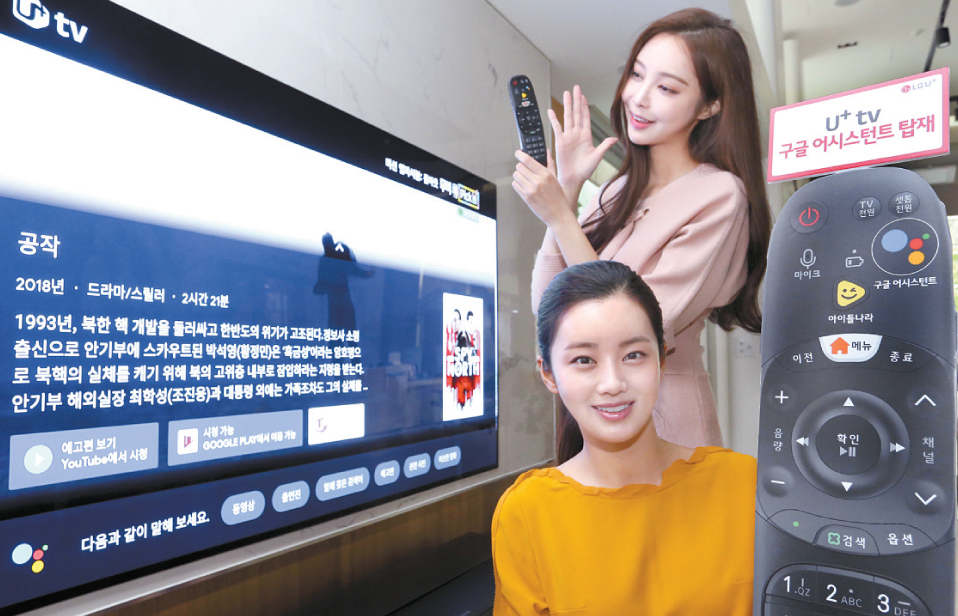
    LG U+ said on Wednesday that it will enable its customers to use Google Assistant for its IPTV set-top box. Subscribers to LG U+ IPTV service can use Google’s AI voice assistant to watch YouTube on TV, launch the Google Photos app as well as use translate and search features with a remote control specifically devoted to Google Assistant.

    Searching for videos on YouTube and viewing photos on smart TVs is hardly new for owners of the latest smart TVs, but using a remote control for real-time translation on a TV is a unique feature.

    “We plan to continue expanding the fields of cooperation with Google that began in 2012,” said Won Kang-hoon, leader of the IPTV partnership service team at LG U+.

    LG U+, an affiliate of LG Electronics, already joined forces with top domestic search engine and portal operator Naver last December to let its customers use Naver’s Clova AI platform for its cable TV service. The telecom operator even tied Clova Friends, an AI speaker, with its subscription services as part of a joint promotion.

    LG U+ IPTV subscribers, who total around 2 million, can use both Clova and Google Assistant. But the telecom has yet to decide whether to link the Google Home AI speaker with its IPTV service.

    SK Telecom and KT, the two largest telecom operators in Korea, have been building their own AI voice command platform. The former has Nugu and the latter has Giga Genie. Other tech firms, such as Samsung Electronics and Naver, have theirs as well. LG U+’s affiliate LG Electronics has its own ThinQ platform, but as of now it only works with home appliances and smartphones.

    LG U+ first released a set-top box equipped with the Google TV operating system in 2012. Four years later, it let subscribers watch some curated YouTube video content. Last August, LG U+ began offering YouTube Kids content to subscribers.

  • LG vows to invest more in Austrian affiliate ZKW

    LG vows to invest more in Austrian affiliate ZKW

    LG Electronics said Friday it will continue to invest more in Austrian automotive lighting system firm ZKW Group, which was purchased by the South Korean company earlier this year.

    In April, LG Electronics bought a 70 percent stake in ZKW, with the holding firm LG Corp. purchasing a 30 percent stake. The 1.4 trillion-won ($1.24 billion) deal marked the biggest merger project carried out by LG to date.

    The Korean tech giant said LG Vice Chairman and CEO Jo Seong-jin visited the headquarters of ZKW, located in Wieselburg, Austria, earlier this week, sharing the company’s vision with the new sister firm.

    Jo stressed ZKW will play a great role in LG’s future projects and promised to give leeway to the Austrian-based firm’s management based on trust.

    In April, LG said it will retain the current management at ZKW even after the acquisition and guarantee the employment of its Austria-based staff for the next five years. LG also vowed to continue making investments in ZKW.

    ZKW, meanwhile, announced its new logo to mark a new start after becoming a member of the LG family.

    The Austrian firm was established in 1938 and is specialized in the production of premium automobile lights.

    LG Electronics plans to increase investments in ZKW to bolster its automotive parts business.

  • Samsung, LG show off hottest gadgets at IFA

    Samsung, LG show off hottest gadgets at IFA

    The 2018 IFA, the biggest trade show in Europe for electronic appliances, kicked off Friday with a lot of buzz about connected homes, artificial intelligence (AI) and televisions with extraordinary resolution.

    IFA is a “place for many different industries – each with their expert knowledge – to share, discuss and develop their innovation and vision,” said Christian Goke, CEO of Messe Berlin, host of the annual tech fair, in a statement. “Nowadays, hardly any company can innovate without partners, alliances or open ecosystems. That brings a new mindset and heralds the Age of Co-innovation.”

    Korean tech giants Samsung Electronics and LG Electronics as well as dozens of smaller business operators have booths showing off their latest products.

    But Samsung and LG opted for different strategies for this IFA. Whereas Samsung highlighted its technological prowess by showing a few notable new products, LG was more ambitious in unveiling a flurry of new gadgets.

    Two top leaders from LG jointly delivered an opening keynote welcome.

    Jo Seong-jin, vice chairman and chief executive officer, and Park Il-pyung, president and chief technology officer, talked about what is next for the company as it looks to the future. They emphasized its signature ThinQ artificial intelligence platform, which has the slogan “Think wise, be free: Living freer with AI.”
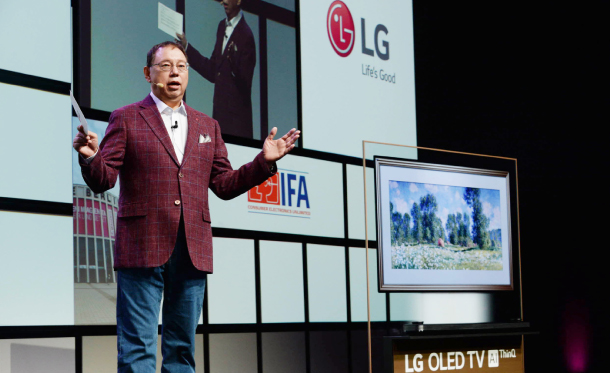
    It was the first time that an LG executive delivered a keynote speech at the IFA.

    Jo provided his insights into how LG’s AI strategy can change customers’ lives with its “open platform, open partnership and open connectivity” philosophy.

    “Combined with cutting-edge computing, big data and enhanced connectivity through 5G, AI will integrate life, space and time into one, and open new possibilities that allow people to pursue freer, more valuable lives,” Jo said.

    Park explained how LG’s AI technology is being used in refrigerators, televisions and washing machines and why an open AI strategy was designed with the consumer in mind.

    Other tech company leaders speaking at the trade show over the next several days include those from Huawei, Microsoft and Amazon.

    More than one third of LG’s exhibition space is dedicated to AI, with a range of LG ThinQ products displayed in three different lifestyle zones: ThinQ Travel, ThinQ Gourmet and ThinQ Style. Each zone has been designed to reflect the diverse lifestyles of modern consumers by incorporating AI-enabled products into futuristic home environments.

    The ThinQ Travel zone will demonstrate the process of searching for an optimal holiday destination using AI televisions and booking flights and accommodations using the LG G7ThinQ smartphone.

    In the Internet of Things (IoT) living room – designed in collaboration with Italian luxury furniture company Natuzzi – the XBOOM AI ThinQ smart speaker shows it can turn on a TV and alter the settings of connected sofas and lighting installations.

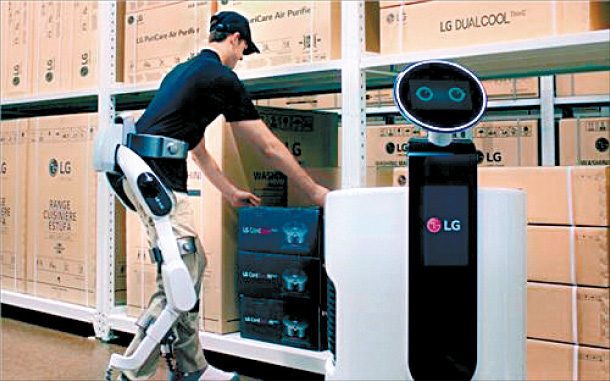
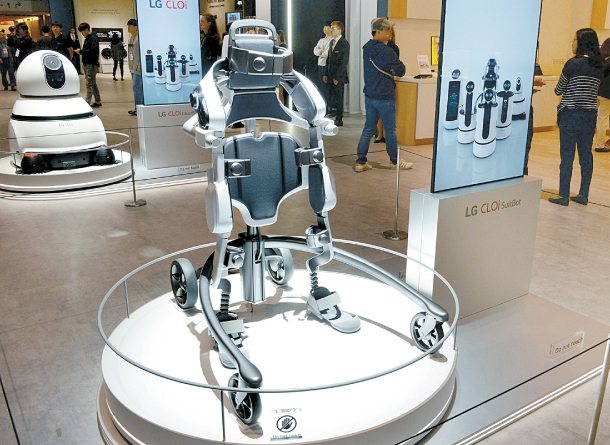
    The CLOi SuitBot, a wearable robot, is being shown for the first time at the IFA. It is meant to empower humans at work. The robot supports lower limbs and enhances a human worker’s power, helping him lift or move heavy things with ease. That makes it useful in manufacturing and construction. A person with weaker lower-body strength may also use it to more easily walk around.

    The robot is equipped with sandal-type shoes and automatically adjusts itself to fit the body.

    The core tech zone highlights innovative technology used in LG ThinQ products such as LG OLED TVs and LG SUPER UHD TVs. An 88-inch 8K OLED TV is debuting in the zone, boasting 7,680 by 4,320-pixel resolution and the ability to generate deep blacks and vivid colors while making wide-viewing angles possible.
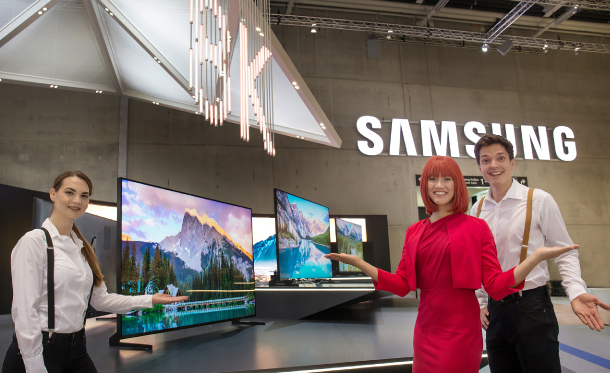
    Samsung took the wraps off an 8K QLED TV, which Kim Hyun-seok, president and CEO of the consumer electronics division, said would “revolutionize the visual display industry.”

    Available in four sizes – 65, 75, 82 and 85 inches – the extraordinarily high resolution televisions boast 16 times better resolution than currently available 4K and ultra high-definition televisions.

    He did not disclose the time of their launch or their prices but said Samsung may release them before 2020.

    “Samsung has been a leader in TVs for the past 12 years globally and 13 years in Europe,” said Kim at a press conference on Thursday. “We will keep up that status with 8K.”

    Currently, 4K televisions account for 70 percent of all televisions sold by Samsung, even though video content for such high-resolution televisions is not widely available. Samsung’s AI technology upgrades the original lower-resolution videos into a format matching the 4K television.

    The tech behemoth also showcased The Wall, a 146-inch MicroLED modular screen. It can transform into any size or shape according to a user’s needs. It also eliminates the need for color filters or backlighting.