Retail News CRM

Tag: nokia

  • Nokia and AIS Fibre Trial Fastest Broadband in Asia

    Nokia and AIS Fibre Trial Fastest Broadband in Asia

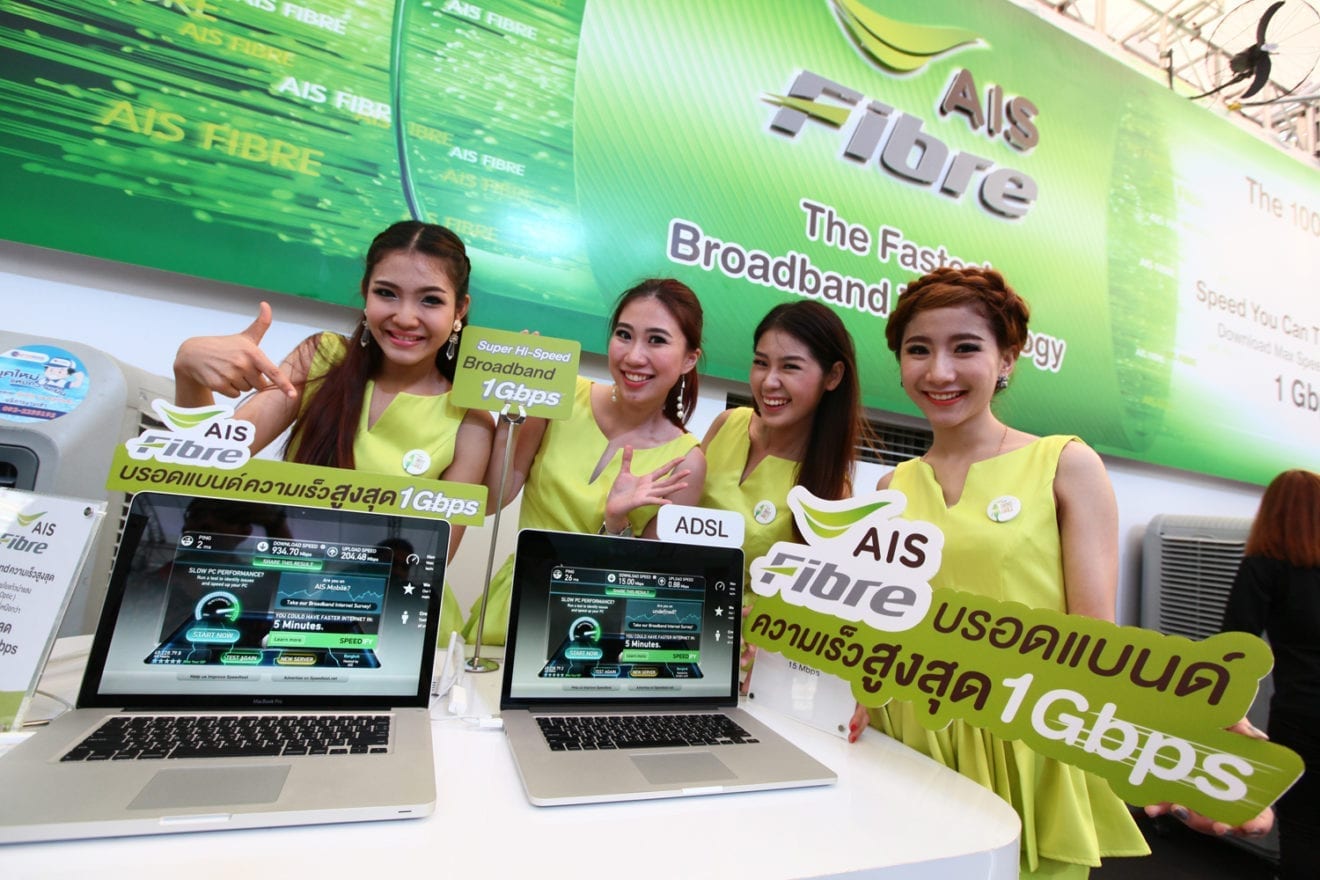
    Nokia and AIS Fibre announced the first trial of their 25G PON solution in Asia. AIS Fibre in Thailand trialed the technology using its existing optical line terminals (OLT), which have already been rolled out nationwide. The OLT was connected simultaneously to three end-user devices with a combined speed of 37.5 Gb/s using a 25G PON optical network terminal (ONT) at 25 Gb/s, an XGS-PON ONT at 10 Gb/s and a GPON ONT at 2.5 Gb/s. All services can be served with the same single fiber at the same time.

    AIS Fibre was the first operator to offer 100% optical fiber broadband services in Thailand. With this successful trial concluded, the company is set to realize its ambition to build the most future-proofed fiber optic home Internet network in the country.

    As new applications like virtual reality gaming and hologram calls enter the mainstream, AIS Fibre will be able to offer the services with super high speeds and low latency. Since AIS Fibre will be able to run GPON, XGS-PON and 25G PON services on the same fiber line, it can offer customers a full choice of speeds up to 25 Gb/s on the existing platform and without the need for intrusive excavation and laying of new fiber.

    25G PON also gives AIS Fibre the opportunity to offer enterprises a 10G + and lower latency replacement to Point to Point (P2P) connections which can be costly and are less scalable. The operator will also be able to use the technology for 5G backhaul, which will become increasingly important as it builds more cell sites required for higher frequency 5G.

    Thanit Chaiyaboonthanit, acting managing director of Fixed Broadband at AIS, said, “AIS Fibre prioritizes innovation that will provide the best services to our customers and gives us network technology which meets users’ future needs in terms of both speed and flexibility. This partnership with Nokia to trial 25G PON technology has yielded favourable results, inspiring us to believe that we can deploy it in the future.”

    Ajay Sharma, head of Thailand and Cambodia at Nokia, noted, “With enhanced speeds provided by 25G PON, fiber networks are evolving into being able to connect everything, everywhere. They play an important role in delivering any service to any endpoint, including residences, businesses and cell sites. We are proud to have been part of this important milestone.”
  • Nokia to power KDDI’s 5G networks with standalone core and monetization solutions

    Nokia to power KDDI’s 5G networks with standalone core and monetization solutions

    Nokia has announced that Japanese operator KDDI has selected Nokia’s 5G Core and Converged Charging software to support its transition to a fully automated, cloud-native 5G Core architecture.

    Nokia’s cloud-native 5G Core’s near zero-touch automation capabilities help operators drive greater scale and reliability. Following the evolution of KDDI’s networks to 5G standalone core, subscribers will experience lower latency, increased bandwidth and higher capacity.

    Nokia’s open 5G Core architecture gives KDDI the flexibility to be responsive to market demands while controlling costs by streamlining operations and unlocking crucial capabilities, such as network slicing. Developed around DevOps principles, Nokia’s 5G Core will automate the lifecycle management of KDDI’s networks, as well as enable continuous software delivery and integration.

    Nokia will also deploy 5G monetization and data management software solutions including cloud-native Converged Charging, Signaling, Policy Controller, Mediation and Registers to capture new 5G revenue opportunities, enhance business velocity and agility, and streamline the operator’s network operations.

    With Nokia’s monetization solutions, KDDI will be able to monetize new opportunities within the 5G economy. This includes 5G network slicing and network as a service offering, IoT and new business models for B2B2X services through a containerized, microservices-based solution that enables services-based integrations with new 5G network functions meeting standards requirements for 5G convergent charging systems.

    Other products in the deal include Nokia’s Digital Operations software, Cloud Operations Manager, NetAct network management system and Archive Cloud to automate the backup and storage of network data. Solutions will be deployed across Nokia cloud infrastructure, a cloud-native solution that integrates multi-vendor and multi-technology environments.

    Tatsuo Sato, Vice President and Managing Officer, Technology Planning, KDDI, said: “The deployment of Nokia’s solutions marks a key milestone in the evolution of our 5G architecture. The evolution of our 5G architecture will enable us to fully automate and provide better services to our customers. We are pleased to be continuing our strong relationship with Nokia.”

    John Lancaster-Lennox, Head of Market Unit Japan at Nokia, said: “We look forward to expanding our 25-year relationship with KDDI with the deployment of our standalone 5G Core solutions. With crucial monetization and operations functions, such as network slicing, KDDI will unlock key revenue opportunities and benefit from increased operational efficiencies as well.”

  • Nokia deploys 5G standalone core network for Taiwan Mobile

    Nokia deploys 5G standalone core network for Taiwan Mobile

    Nokia announced that it has deployed its 5G standalone core network for Taiwan Mobile Co. to enable the operator to provide the most advanced 5G applications for enterprises and businesses, and to strengthen its network services and performance.

    The timely deployment includes Nokia’s voice core, cloud packet core, subscriber data management, signaling, network exposure, policy controller, cloud infrastructure, and security management for radio transport. With a 5G standalone core network, Taiwan Mobile can readily provide the most advanced 5G services such as network slicing and smart city solutions that require ultra-low latency and reliability.

    Nokia and Taiwan Mobile are long-standing partners and Nokia, as the sole supplier of Taiwan Mobile’s 5G network, is supporting the operator’s ‘Super 5G strategy’ focused on sustainability and digital transformation.

    Nokia leads the market in core network deployments, with 25 of the top 40 communication service providers relying on its core network products.

    Tom Koh, Senior Vice President and Chief Technology Officer, Technology Group, Taiwan Mobile, said: “Introducing SA to unleash the full potential of 5G beyond high-speed to further realize innovative use cases enabled by ultra-low latency and massive IoT is our strategic mission in the 5G era. We are delighted to reach this milestone with Nokia to bring the first true 5G network into Taiwan. Owning the agility of network slicing to swiftly customize the network for accommodating different use cases, Taiwan Mobile will be able to accelerate time-to-market to provide a wide variety of services for everyone and everything and to free enterprises to embrace Industry 4.0. The SA technology is built from cloud architecture, infrastructure-agnostic by design, which paves a critical step to a full software agile virtualization network. It unlocks the use cases with distributed cloud for low latency service with local breakout needed. Taiwan Mobile’s true 5G network will become the innovative engine for consumers to experience as well as verticals to deploy applications without limits.”

    Susanna Patja, Head of Cloud & Network Services, Greater China, Nokia, said: “We are very pleased that the Nokia 5G Standalone Core network is now up and running, on schedule, for Taiwan Mobile. This provides Taiwan Mobile with exceptional capabilities in terms of machine-to-machine communication, extreme automation, and reliability that enables critical 5G uses for enterprises; and does so with the knowledge that this standalone network will continue to function seamlessly with non-standalone networks.”

  • Nokia partners Uniti Group for first commercial launch of WiFi Beacon in Australia

    Nokia partners Uniti Group for first commercial launch of WiFi Beacon in Australia

    Nokia and Uniti Group’s retail brands including FuzeNet, HarbourISP and UnitiBroadband, have announced the first commercial launch in Australia of Nokia’s WiFi Beacon.

    Utilizing mesh technology, Nokia’s Beacon 1.1 solution will allow Fuzenet and HarbourISP to provide residential customers with superfast and reliable Wi-Fi coverage throughout the home.

    Kurt Magner, Chief, Consumer & Small Business at Uniti Group, said: “As the digital revolution enters our living rooms, kitchens and offices, so must our Wi-Fi networks. Nokia’s WiFi solution ensures uninterrupted connectivity and high speeds into every corner of our subscribers’ homes, transforming them into true digital homes. We are thrilled to be the first service provider to offer a Nokia WiFi Beacon solution in the country.”

    Anna Wills, Managing Director of Australia and New Zealand at Nokia, said: “Service providers often have no visibility of poor in-home network issues. A sub-standard Wi-Fi experience inside the home negates the benefits of excellent broadband service promised by providers and is increasingly the leading cause of consumer complaints. Consumers who are seeking uniform in-home coverage with no disruptions. The Nokia solution, which is a combination of local and cloud-based Wi-Fi optimization, helps achieve the best overall Wi-Fi performance for residential customers.”

  • Nokia trials AI technology in Melbourne to keep streets clean and safe

    Nokia trials AI technology in Melbourne to keep streets clean and safe

    Nokia the City of Melbourne have conducted a trial using Nokia Scene Analytics artificial intelligence (AI) technology to develop a deeper understanding of waste disposal behaviour. This will allow the city to tackle the issue of waste dumping more efficiently keep laneways – the busy and narrow city streets and pedestrian areas – even more clean, safe and free of garbage.

    To decrease the frequency of waste contractor visits to busy areas, the City of Melbourne has offered local residents and businesses subscription-based access to the large-capacity compactor facilities. With the compactor in place, Council then wanted to understand how the service was being utilised and how to mitigate illegal waste dumping, which can quickly create safety and hygiene issues in the area.

    Under its ‘emerging technology testbed’ initiative, the City of Melbourne worked with Nokia to leverage an existing network of installed cameras as internet of things (IoT) sensors to monitor one of the compactors. The Nokia Scene Analytics solution employed an AI-powered algorithm to filter and collate data from the cameras, while also combining other data sources, such as operational data on the compactor itself, to create real-time alerts and produce reports. Initial trial results demonstrate that Scene Analytics can support the City’s objectives for better, safer citizen experiences while simultaneously lowering maintenance and down time costs for waste management services.

    This innovative use of Scene Analytics has been recognized on a national stage as the partnership between Nokia and the City of Melbourne was shortlisted for the Communications Alliance’s ACOMMS awards in the Artificial Intelligence category.

    Lord Mayor Sally Capp, City of Melbourne, said:“This is a great example of using new technology to help remove illegal waste more quickly, make our city cleaner and protect the environment. Our partnership with Nokia is another way we are gathering data to make Melbourne a safer, smarter and more sustainable city. This innovative project will help to avoid hazards and make our streets even cleaner by allowing our waste services to better understand behavior trends related to the illegal and dangerous dumping of waste.”

    Rob Mccabe, Head of Enterprise of Australia and New Zealand,Nokia,said: “The City of Melbourne is using robust AI technology to offer its citizens, visitors and businesses a greener and more liveable community. In helping the City of Melbourne monitor and enhance services with real-time driven actions, Nokia Scene Analytics is supporting the safety, security and operational continuity of this city in a proactive and automated way.”

  • Nokia secures first 5G contract in China

    Nokia secures first 5G contract in China

    Nokia secured a 5G RAN contract for China Mobile on Monday, making this the company’s first 5G contract in the country.

    Nokia was awarded a 10% share in one of three contracts tendered by China Mobile, while Ericsson obtained 9.6% of another contract. The total tender for all three contracts reached about $6 billion, with Nokia being awarded 4% of the overall tender. Comparatively, Ericsson was awarded 2%, dropping from about 11% last year.

    Together, Huawei and ZTE won the majority share in all three contracts to build 5G 700 MHz base stations for China Mobile and China Broadcasting Network. This is followed by a smaller local company Datang Corporation.

    China Telecom and China Unicom will also be disclosing awards of their respective 5G contracts.

    Currently, China is ahead of other countries in 5G deployments. According to data from the Ministry of Industry and Information Technology, China had deployed 820,000 5G base stations by the end of March.

  • Nokia secures first 5G contract in China

    Nokia secures first 5G contract in China

    Nokia secured a 5G RAN contract for China Mobile on Monday, making this the company’s first 5G contract in the country.

    Nokia was awarded a 10% share in one of three contracts tendered by China Mobile, while Ericsson obtained 9.6% of another contract. The total tender for all three contracts reached about $6 billion, with Nokia being awarded 4% of the overall tender. Comparatively, Ericsson was awarded 2%, dropping from about 11% last year.

    Together, Huawei and ZTE won the majority share in all three contracts to build 5G 700 MHz base stations for China Mobile and China Broadcasting Network. This is followed by a smaller local company Datang Corporation.

    China Telecom and China Unicom will also be disclosing awards of their respective 5G contracts.

    Currently, China is ahead of other countries in 5G deployments. According to data from the Ministry of Industry and Information Technology, China had deployed 820,000 5G base stations by the end of March.

  • Nokia suing Oppo over patent infringement in several countries

    Nokia suing Oppo over patent infringement in several countries

    Nokia, just like other big companies in the telecom industry, is very protective when it comes to its own patents. The Finnish company signed licensing agreements with many companies that use its patents and sued those that used them without permission.

    The most recent on the list of companies that have just got sued by Nokia is Oppo. Nokia has decided to file lawsuits against Oppo for patent infringement in four countries: England, France, Germany, and India.

    The reason behind Nokia’s action is that Oppo refused to renew the licensing agreement that allows the use of certain patents, which the Chinese company signed back in 2018. FOSS Patents reports that Nokia is using the same legal teams that won the previous company’s patent enforcement campaign against Lenovo and Daimler, so this might be a quick battle.

    According to a statement offered by Nokia, there have been negotiations between the two companies, but Oppo decided to go on its own and rejected all offers.

    We have been negotiating the renewal of our patent licensing agreement with Oppo but unfortunately, they have rejected our fair and reasonable offers. Litigation is always our last resort and we have offered to enter into independent and neutral arbitration to amicably resolve the matter. We still believe this would be the most constructive way forward.

    This can probably end only two ways: either Nokia wins and Oppo pays, or Oppo agrees to sign another multi-year licensing agreement. Without dismissing Oppo’s chances to win the case, Nokia’s expertise in defending its patent portfolio recommends it as the sure winner, but surprises can happen.

  • Nokia and Optus deploys Australia’s first integrated antenna

    Nokia and Optus deploys Australia’s first integrated antenna

    Nokia announced the deployment of Australia’s first Interleaved Passive Active Antenna (IPAA) in collaboration with Optus. Together, Nokia and Optus deployed the first IPAA in Yeerongpilly, Brisbane. The solution helps ease site-related challenges which accelerate the introduction of 5G services across the country.

    As operators look to rollout 5G, finding space on existing towers and rooftops for new massive MIMO active antenna equipment poses a significant deployment challenge for operators. Long delays in acquiring permission for site upgrades; the potential strengthening of the supporting structures and potentially higher rental payments to landlords, can in combination seriously delay operators, such as Optus, in getting 5G services to their customers.

    Nokia’s IPAA solution was developed in collaboration with CommScope. It will allow Optus and other operators to upgrade existing sites to 5G by simply replacing their existing antennas with a similar-sized unit that supports all legacy technologies as well as 5G massive MIMO active antenna, all in a single compact solution. By utilizing this solution, Optus can overcome many deployment challenges that can typically hinder the introduction of 5G.

    Lambo Kanagaratnam, Managing Director of Networks at Optus, said: “We’re committed to keeping our customers connected and at the forefront of 5G. By partnering with global technology leaders like Nokia, we continue to bring the best global innovations to our customers. The introduction of the IPAA into our network infrastructure will help us speed up the deployment of our 5G network by addressing space and structural capacity constraints.”

    Rob Joyce, Chief Technology Officer of Australia and New Zealand at Nokia, said: “We’re delighted to be partnering with Optus to bring our unique IPAA solution into play in the Australian market. The IPAA is an advanced technical solution to tackle the problems of finding space on towers and rooftops for 5G upgrades. Operators can now simply replace an existing antenna with Nokia’s IPAA solution to upgrade the site and at the same time, introduce 5G; it couldn’t be simpler.”

  • Nokia chosen by Allo for gigabit fiber network in Malaysia

    Nokia chosen by Allo for gigabit fiber network in Malaysia

    Nokia announced that it has been chosen by Allo, an Information and Communications Technology service provider in Malaysia, to deploy a gigabit fiber network in the states of Melaka, Johor, Negeri Sembilan, and East Coast of Malaysia.

    The deployment, which includes Nokia’s Gigabit Passive Optical Network (GPON) solution and Access Management System, will be completed by end of Q2 2021 covering nearly 150,000 home passes. When completed, the end-users will be able to enjoy a high-speed broadband network and applications that require high capacity. The future-ready fiber network will enable Allo to increase its revenue as it will be able to support new use cases like smart cities, smart poles, edge automation, 5G backhaul, and enterprise services.

    Nokia’s solution will enable Allo to better manage bandwidth in line with the requirement for different services. The fiber network will support the convergence of more services and users on the same infrastructure, allowing Allo to bring down operating expenses and enhance revenue.

    With the new network, Allo will be able to acquire relevant insights into network utilization as the network grows and new technology enablers are added. Nokia’s solution will also help Allo benefit from network simplification and easier management of the network.

    Rodzi Ahmad, Chief Executive Officer at Allo, said: “We are pleased to partner with Nokia to bring the next generation of fiber services to our enterprise and residential users. By utilizing Nokia’s expertise, we will be able to accelerate the rollout of fiber services over the next two years. This enables us to offer high-speed broadband to a greater number of people in keeping with the vision of Malaysia’s fiberization initiative. Together Allo and Nokia will continue working towards the ultimate goal of improving broadband connectivity in Malaysia.”

    Stuart Hendry, Head of Enterprise for Asia Pacific and Japan at Nokia, said: “We are excited to work with Allo on this crucial initiative for the rollout of the next-generation fiber services. Our field-proven solutions will help Allo support the growing demand for bandwidth and provide network flexibility. Nokia’s solution will enable Allo to bring down costs and offer new and exciting services to its customers. The initiative will help build a future-ready network capable of meeting the ever-growing data demand.”

    In addition to the GPON roll-out, Allo is also conducting field trials with Nokia’s next-generation XGS-PON products which could be deployed where the network requires even greater bandwidth, up to 10Gbps symmetrical.

  • Nokia chosen by Chunghwa Telecom to expand 5G network in Taiwan

    Nokia chosen by Chunghwa Telecom to expand 5G network in Taiwan

    Nokia has announced that it has been chosen by Chunghwa Telecom (CHT) to expand the operator’s 5G network in Taiwan. The deal aims to support CHT’s objective of achieving 80 percent population coverage as well as boost 5G subscriptions to over 20 percent of its current subscriber base. The expansion will leverage products from Nokia’s AirScale portfolio to deliver enhanced connectivity for people and businesses in the southern and central areas of the country.

  • Nokia demonstrates record Optus’ 5G mmWave capabilities

    Nokia demonstrates record Optus’ 5G mmWave capabilities

    Nokia and Optus announced that they achieved a record-breaking aggregate site throughput of 10 Gbps during a downlink speed demonstration using 800 MHz of millimeter Wave (mmWave) spectrum at a live 5G site in Brisbane. Powered by Nokia AirScale Radio, the site demonstrates the huge potential of 5G as it is introduced across future spectrum bands. Once deployed, the speed and a capacity boost from the 5G mmWave layer will unleash lightning-fast speeds for consumers and enterprises alike to support a range of new low-latency, high-bandwidth services.

    The recent demonstration showcased the capabilities of Nokia’s 5G mmWave technology and the benefits of adding it on top of an existing 5G/4G site. The demonstration showed how Nokia’s 5G mmWave technology delivers on the promise of super-fast data rates by boosting the site capacity to 10 Gbps and beyond.

    Nokia’s 5G mmWave technology will allow Optus to focus on scalability, automation, and performance by supporting services that utilize the full capability of 5G. Leveraging Nokia’s solutions, Optus can also harness 5G mmWave to serve the enterprise market and explore new use cases in healthcare, mining, port operations, and smart manufacturing, among other industries.

    The decision to select this mixed commercial and industrial area of Brisbane was made keeping these new use cases in mind as they sought to showcase the many real-world benefits of mmWave to the enterprise; thereby gaining early insights into this new exciting technology before wider rollout in the future.

    This achievement further strengthens the long-standing and collaborative partnership between Nokia and Optus. In early 2019, Optus became the first operator globally to deploy Nokia’s FastMile 5G indoor gateway in a live 5G network. Recently, the two companies also successfully launched 5G services at the Optus Stadium in Perth, Australia.

    Lambo Kanagaratnam, Managing Director of Networks at Optus, said: “We’re committed to keeping Australia connected and at the forefront of 5G. By partnering with global technology leaders like Nokia, we’ve taken an exciting step towards unlocking the massive potential that 5G mmWave will bring to the consumers, enterprises and industries in Australia. Reaching 10 Gbps per site is a crucial step in our 5G development and validates the progress we’ve made with the technology together with Nokia.”

    Anna Wills, Head of Oceania at Nokia, said: “This is another milestone in the development of 5G services and demonstrates the confidence operators have in our 5G solutions. Today’s achievement with Optus shows the potential of mmWave deployments, particularly at a time when connectivity and capacity are so crucial. We’re proud of our long-standing relationship with Optus and the great strides we continue to make together in this new era of connectivity.”

  • Nokia debuts innovative public cloud charging for CSPs on AWS

    Nokia debuts innovative public cloud charging for CSPs on AWS

    Nokia has today announced the deployment of its cloud-native convergent charging solution on Amazon Web Services (AWS) to accelerate communications service providers (CSPs) migration of business-critical, high-frequency charging applications to the public cloud, and to deliver the benefits of the cloud for 5G.

    This announcement, which builds on an existing relationship with AWS, enables CSPs to efficiently run workloads on AWS and pioneer new monetization schemas as part of their journey towards deploying business support systems (BSS) in the public cloud.

    As a containerized network function (CNF) on AWS, Nokia Converged Charging (NCC) provides true continuous availability, supporting the high frequency, low latency demands of an always-on, real-time convergent charging system built for the needs of the 5G economy. This enables CSPs to tap new revenue streams from 5G capabilities, including differentiated pricing, network slicing, and flexible product offerings, such as IoT and B2B2X.

    According to Analysys Mason, “SaaS and public cloud will make inroads into the market for monetization platforms by growing more than 6.5X from 2019 to 2025 and increase its share to over 14% of the total spend.” NCC’s architecture can support CSPs at every step of their public cloud journey, from the deployment of greenfield sub-brands as a first step towards hosting testing environments to full production workloads of the main brand on the public cloud.

    Fabio Cerone, EMEA Telco Managing Director at AWS, said: “We are pleased that Nokia is expanding its relationship with AWS by offering its cloud-native convergent charging system on AWS and connecting it to various services, such as with analytics to pioneer new monetization schemas. As the world becomes increasingly cloud-centric, it’s important that our customers can leverage cloud-native solutions to unleash the potential benefits of the cloud and 5G.”

  • Nokia deploys first 5G standalone RAN in Southeast Asia to M1-Starhub JV in Singapore

    Nokia deploys first 5G standalone RAN in Southeast Asia to M1-Starhub JV in Singapore

    Nokia announced the first 5G standalone (“SA”) Radio Access Network (“RAN”) Sharing network in South East Asia. The company has been selected by Antina Pte. Ltd. (“Antina”), a joint venture formed by mobile network operators M1 and StarHub, following a competitive tender process, to deploy 5G SA networks across Singapore. The commercial deployment of a 5G SA network will introduce compelling new use cases and cater for the growing data demand in the country, putting Singapore at the forefront of 5G standalone technology in the region.

    The partnership will enable Antina’s customers – M1, StarHub and other mobile service providers on wholesale arrangements – to benefit from a game-changing ultra-high speed, low-latency and highly secure 5G SA network that will reduce complexity and increase cost efficiencies. It will also enable new use cases across entertainment, cloud gaming, transportation, education and healthcare.

    Nokia will provide equipment from its comprehensive AirScale portfolio and CloudRAN solution to build the Radio Access Network (RAN) for the 5G SA infrastructure, utilizing the 3.5GHz spectrum band. Nokia will supply 5G base stations and its small cells solution for indoor coverage, as well as other radio access products. Nokia’s 5G SA technology will provide Singaporean enterprises with the opportunity to explore multiple new use cases due to the network’s higher bandwidth, higher uplink speeds and lower-latency.

    Nokia CloudRAN solution is designed to enable Antina to build a more agile business, meet new traffic demands, make better use of spectrum as well as optimize performance and mitigate costs. Nokia’s CloudRAN technology is expected to provide Antina with the flexibility to meet customer demands in the evolving 5G era. Nokia’s NetAct network management, CloudBand Application Manager and CloudBand Infrastructure Software will streamline operations and securely manage Antina’s networks.

    The commercial launch of this 5G SA network in Singapore will underpin the infrastructure for a vibrant 5G ecosystem.

    Tommi Uitto, President of Mobile Networks, Nokia, said: “This is an important win for Nokia that demonstrates our leadership in commercial-grade Cloud RAN as well as mobile operators’ trust in our capabilities for rapidly transitioning to 5G standalone networks. We look forward to supporting Antina in the deployment of a successful rollout of the 5G SA network in Singapore which aligns with the country’s vision of creating a world-class 5G infrastructure. We hope other global markets considering making the move to 5G SA will take note of Antina’s success.”

  • Nokia and LG Uplus to test 5G B2B digital platform in South Korea

    Nokia and LG Uplus to test 5G B2B digital platform in South Korea

    Nokia has today announced that it will conduct a 5G Business-to-Business (B2B) digital platform trial for LG Uplus. Once deployed, the platform will allow LG Uplus to reduce time-to-market for launching 5G-powered services to its enterprise and business vertical customers. The platform will also enable LG Uplus to address new business segments, including Industry 4.0, and smart factory. After deployment, the solution will promote the use of 5G by enterprises and verticals to grow their business, aligning with the Korean Government’s Digital New Deal initiative.

    The proof-of-concept test of the 5G B2B digital platform will be completed in two phases starting in February. While the first phase involves a demonstration in the Nokia Lab, the second phase with a field trial is planned in the LG Uplus Regional Operation Center in KyungNam.

    Nokia’s solution is based on multi-domain technology and ensures full automation and near real-time delivery of services. The solution includes a service platform powered by Nokia’s Digital Operations software, Cloud Operations Manager, Network Exposure Function, Registers, Cloud Packet Core, Software Defined Networking, and gNB (5G version of eNodeB), across Nokia’s cloud platform.

    LG Uplus will use the platform to cost-efficiently automate the design and deployment of 5G network slices for the delivery of new services. In addition, LG Uplus’ enterprise customers will be able to leverage 5G capabilities to enhance their business and operational efficiency leading to overall economic gain.

    The service will give LG Uplus customers the flexibility to directly control and manage the platform to meet their needs. Further, it will help LG Uplus offer newer use cases such as Smart Factory and Smart Harbor with 5G wireless connectivity and associated services like network slicing.

    Jaeyong Seo, Vice President of Smart Infrastructure Business Unit, LG Uplus, said: “We are committed to providing best-in-class and innovative services to our customers and this trial is a crucial step in this direction. Once deployed, Nokia’s 5G B2B digital platform will help us expand our enterprise business by allowing us to provide new use cases rapidly. Nokia is our trusted partner and we look forward to working with them on this important trial.”

    Kevin Ahn, Head of Korea, Nokia, said: “We are excited to conduct this pathbreaking trial for LG Uplus to enable its enterprise customers to improve business processes with 5G. Nokia’s 5G B2B digital platform will allow LG Uplus to transform its B2B service creation with agility and automation and delight its enterprise customers with new use cases and operational excellence.”