Tag: Philippines

  • Singapore shares food, culture and friendship for 50th anniversary

    Singapore shares food, culture and friendship for 50th anniversary

    Singapore celebrates 50 years of independence by sharing with Filipinos the best of what Singapore has to offer. Singapore Ambassador Ms. Kok Li Peng and Secretary of Foreign Affairs Albert del Rosario opens SG50, a cultural fair to celebrate Singapore’s 50 years of independence. All photos by Ana Vasquez/Rappler

    The year 2015 marks Singapore’s Golden Jubilee year. Although Singapore’s independence day was celebrated last August 9, 2015, the festivities in the Philippines were extended to highlight the city-state’s historical milestone.

    To cap the series of activities, the Singapore Embassy showcased the country’s offerings through SG50 in Manila at Bonifacio High Street on December 20, 2015.

    The power of three

    The one-day event featured three Singapore powerhouses: food, retail, and tourism.

    It was definitely a feast fit for the gods, as evidenced by the guests indulging in all types of savory Singaporean cuisine.

    Singaporean classics such as laksa and chicken rice were the crowd pleasers, in sync with the Filipino palate. One of the booths even offered the Singaporean version of fishballs and squidballs. “Our version is bigger and has more flavor. Also, no preservatives added,” said one of the Singaporean vendors.

    The famous shopping district of Orchard Road was brought to the Philippines through the display of Singaporean fashion brands, Heat Wave and G-Star Raw. Also, guests were given access to Singapore’s Changi Airport through the Singapore Airlines (SIA) booth, which highlighted travel destinations in Singapore such as Marina Bay Sands and the Singapore Zoo.

    Guests were also given a glimpse of what it feels to grow up in Singapore through Five Stones, a traditional Singaporean game, which is similar to jackstones. There were also coloring and face-painting activities for the kids.

    FIVE STONES. Kids play Five Stones, a Kampung game. The goal is to catch all 5 stones, a triangular cloth filled with rice—much like the English Jack Stones. Kampung means community in Malay.

    Trip down memory lane

    Did you know Singapore started as a fishing village? With the guidance of its founding father, the late Lee Kuan Yew, Singapore evolved into the modern and globalized country we know today.

    Singapore became a sovereign nation when it declared its independence from Malaysia in 1965. Throughout the 50 years of independence, the people of Singapore embody the “never say die” spirit as they continue to expand their nation’s horizon.

    In 1969, bilateral relations between the Philippines and Singapore were established. Today, this relationship continues to deepen as both nations constantly exchange cultural backgrounds.

    FOOD FESTIVAL. Singaporean food at its delicious best.

    Neighbors

    A couple, who declined to be name for this report, shared a few cultural observations between the two neighboring countries. The husband, a Singaporean, admitted that it was hard to adjust at first due to the culture shock. “Masyado kasi silang formal,” explained the wife, who is a Filipina. However, she was happy to say that her husband has finally adapted to the hospitable nature of Filipinos. The two travel back and forth to the Philippines regularly.

    Moving forward

    SG50 in Manila was an invitation to the Filipinos to celebrate and commemorate Singapore’s 50th year of independence.

    Mr. Scott Loh, Deputy Chief of Mission and Councilor of the Singapore Embassy, attested that the relationship of the Philippines with Singapore is growing stronger than ever. He was happy to report that Jollibee is the best performing operating overseas outlet in Singapore.

    The relationship of Singapore and Philippines is an example of how cultural interaction and communication can enrich one’s nation and more importantly, its people. It should not always be what we can show to them, but also, what we can learn from them. In fact, you might be surprised to know that Singaporean children, as young as 8 years old, take the bus to school all by themselves. “The level of security and discipline in Singapore, iba talaga,” said a Filipino living in Singapore.
  • SM Investments Corporation receives Platinum Award

    SM Investments Corporation receives Platinum Award

    SM was also awarded as the Best Investor Relations Team, a new category this year. SM is the sole Philippine company awarded this category among only seven companies in the Asian region. SM’s Investor Relations department is headed by Senior Vice President Corazon P. Guidote. She is supported by a team of IR and communications professionals whose main goal is to address the requirements of both its major and minority shareholders through direct communications, mainstream and social media communications, domestic and international IR roadshows, conferences and forums. They reach out to as many investors as possible both equity and fixed income who have interest in the Philippines given that SM is widely considered by the investment community as an ideal proxy for investing in the country.

    Attesting further to SM’s adherence to global standards across the group, its major listed subsidiaries SM Prime Holdings Inc. and BDO Unibank, Inc. likewise received the Platinum Award. BDO and SM Prime have also been excellence awardees of The Asset for the past six years.

    The Asset’s Corporate Awards, which focuses on Excellence in Governance, CSR and Investor Relations, uses a rigorous research process for benchmarking the region’s listed companies. The criteria used to assess the companies include a range of metrics on financial performance, which are also a proxy for gauging management acumen. The purpose of the awards is to recognize the importance of sustainable growth where companies are also evaluated according to the quality of their corporate governance, social responsibility, environmental responsibility and investor relations. A total of 56 companies were awarded on December 15 at the Four Seasons Hotel in Hong Kong.

  • Duty Free Philippines targets $235m in 2015

    Duty Free Philippines targets $235m in 2015

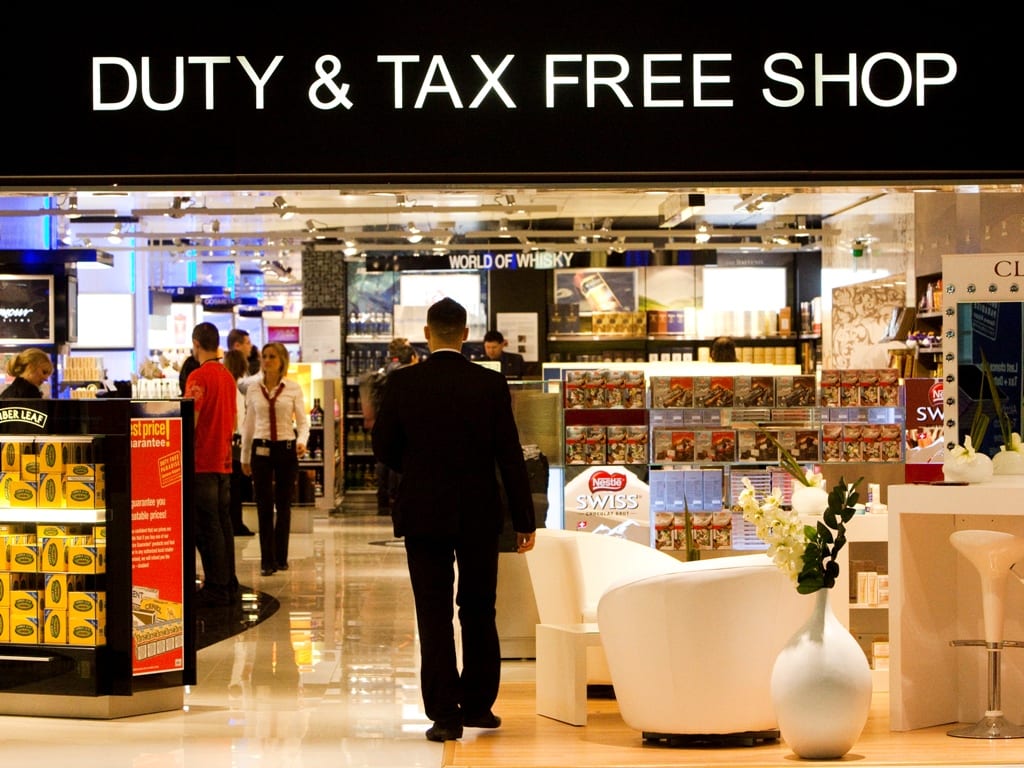
    State-owned Duty Free Philippines is targeting total sales of $235m in 2015 (+2.5%) after hitting $229m in 2014, with Manila Airport accounting for nearly 45% and the downtown Fiesta Mall just under 50% as DFP’s largest single outlet.

    While the expected sales increase is modest, it is regarded as a good performance considering Manila Airport Authority reduced the number of concessions in T1 from around 30 to less than 20 due to congestion and major airlines have also transferred operations to T3.

    “T1 work is not finished. It’s work in progress,” said Duty Free Philippines Merchandising Division Manager Jennifer Start, talking exclusively to TRBusiness recently.

    “There has been a remarkable change. We have renovated our departure stores, but we heard there is more work to be done by the airport authority in T1. It’s upgrading work. They have shown us plans to expand the facility.”

    NAIA T3 departure confectionery ©

    Duty Free Philippines’ biggest-selling product category remains confectionery, accounting for 37% of total sales. It is also the biggest selling category at Manila Airport, accounting for 44%. Above: Manila NAIA Terminal 3. ©.

    Further work is also in the pipeline for T3 (which accounts for 20% of Manila Airport sales) as DFP gets to work on renovating and increasing its shops and boutiques in the departure hall.

    Meanwhile, arrival shops sales account for more than half of DFP’s total sales revenue at Manila Airport, with Filipino passengers representing the majority of customers and the number one purchase being confectionery/chocolate.

    NAIA T3 departure perfumery ©

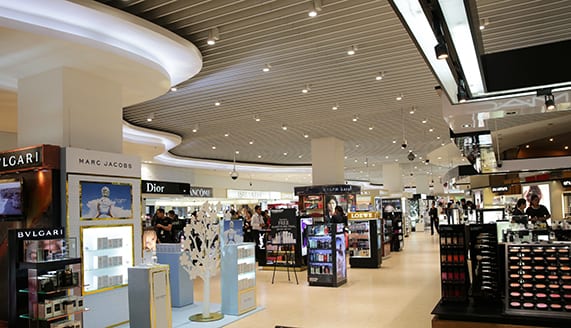
    DFP’s perfume and cosmetics sales accounted for 11% of it total merchandise sales last year. Above: Manila NAIA Terminal 3. ©.

    By contrast, foreign passengers purchase a larger share of goods in DFP’s departure shops, with South Koreans and Mainland Chinese the highest spenders.

    Confectionery is the biggest selling category at Manila Airport, accounting for 44%, followed by liquor (26%), perfume and cosmetics (12%) and tobacco (7%). Fashion, watches and souvenirs take the remaining 11%.

    DFP Fiesta Mall-liquor ©

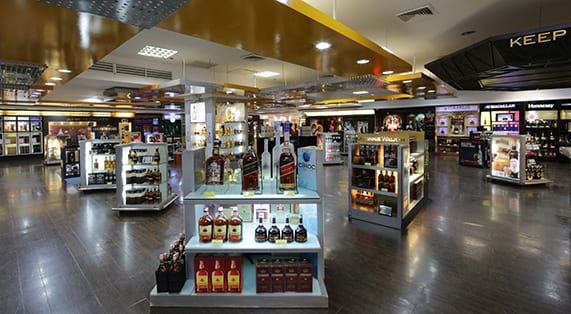
    The liquor section within the Duty Free Philippines Fiesta Mall. ©.

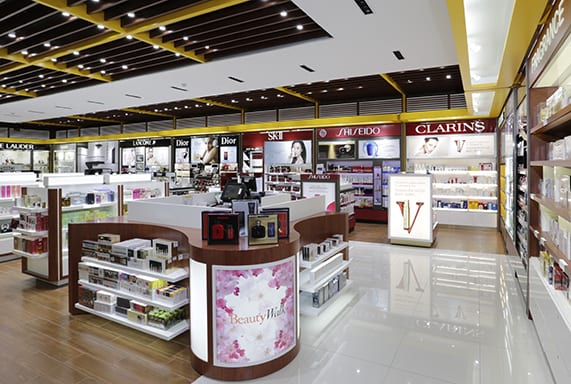
    The retailer’s downtown duty free Fiesta Mall has also undergone a total renovation and upgrade over the last two years, according to Start, and has received favourable comments from customers: “We have had a major transformation in Fiesta Mall, especially for perfume and cosmetics last year. The fashion area also has been renovated, along with liquor, tobacco and confectionery,” she said.

    “We have new Coach and Chloe boutiques, and a complete range of lingerie, bags and perfume and cosmetics in Victoria’s Secret. Another new outlet is our Bath & Bodyworks health and beauty products shop that opened here earlier in 2015.”

    Fiesta Mall Beauty Walk ©

    Wines and spirits is the second-largest product category in terms of sales across DFP’s outlets, accounting for 18% in total. ©.

    Including sales from all ten of its provincial airports, Manila Airport and the Fiesta Mall, DFP’s biggest selling product category remains confectionery, accounting for 37% of total sales, followed by liquor (18%); Perfume and cosmetics (11%); fashion (9%); and tobacco (5%).

  • PTT firms up local expansion program

    PTT firms up local expansion program

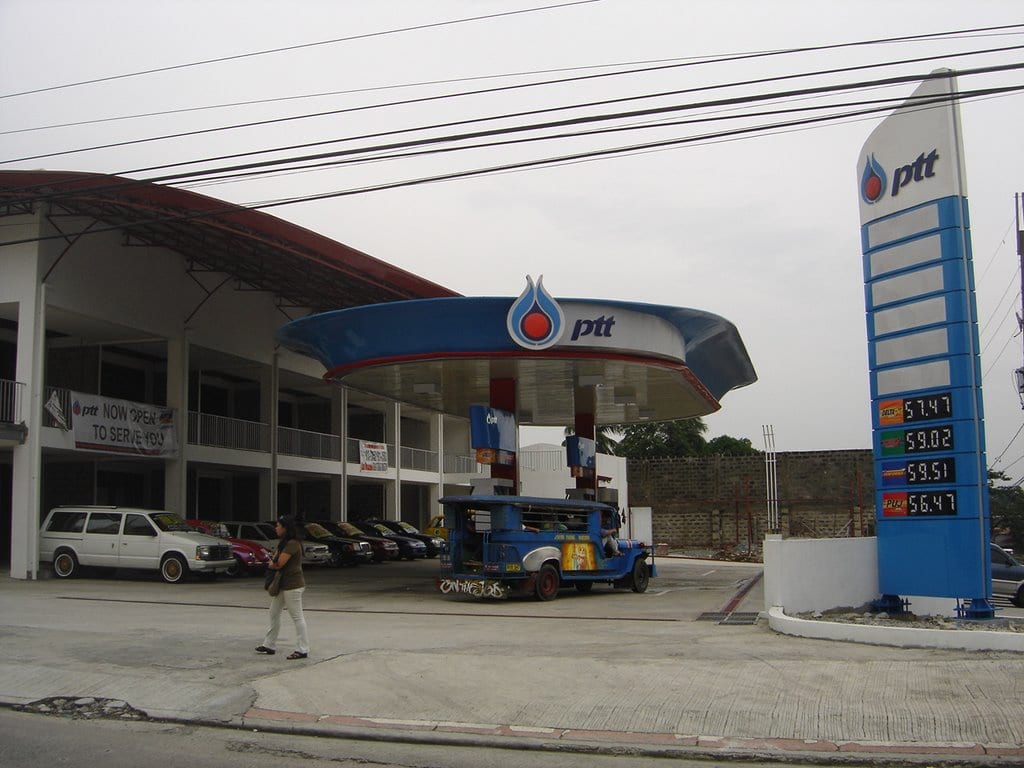
    PTT Philippines, a unit of PTT Public Co. Ltd. of Thailand, plans to invest P3 billion in the next five years to expand the company’s network here.

    The capital expenditure program includes investments in retail stations, oil depots and terminals in Luzon and Visayas.

    “In the next five years, PTT appropriated P3 billion for expansion plan, for laying down on infra,” general manager Danilo Alabado told reporters.

    PTT Philippines currently has 94 stations and plans to put up a total of 300 by 2020.

    “Right now we have the trading areas in Luzon and Cebu. In order for us to achieve our goal to be one of the top five oil companies in the next five years, we will expand into other trading areas, other islands,” Alabado said.

    He said the company needed the support of a stronger infrastructure network  for its expansion program.

    “We need depot, fuel terminal that could come in in Visayas and Mindanao which we have been looking at,” the official said.

    PTT president and chief executive Sukanya Seriyothin cited a strong growth projected growth in Luzon for the company’s planned expansion.

    “Visayas and Mindanao we still have to further expand. We’re still moving forward in Luzon, but aside from that, we move further in Visayas, Mindanao,” Sukanya said.

    Alabado, meanwhile, said the company performed “fairly well” in 2015 with sales volume likely to increase 5 percent to 6 percent.

    “We are confident we are going to meet our target,” Alabado said, adding revenues may reach P1.1 billion this year.

    “We are looking at 5 to 6 percent growth next year until 2017 because we are going to lay down our infra support for expansion for 2018 going into 2020, we are looking at growth of 60 percent compared to what we had in 2015,” he said.

    PTT Thailand is Thailand’s biggest oil player and ranked number 81 under Fortune 500’s List of world’s largest companies.

    The company, controlled by the Thai government, is engaged in downstream and upstream petroleum, natural gas, coal, and other related businesses.

    PTT Public Co. Ltd. of Thailand, the parent of PTT Philippines, earlier said it planned to increase the revenue share of its overseas retail oil business to 20 percent in the next five years.

    PTT Thailand vice president for international marketing Wisarn Chawalitanon noted that the share of the overseas retail oil business to the company’s revenues was still small.

    PTT Thailand, which owns around 1,200 to 1,300 retail stations in Thailand, is banking on its overseas presence in the Philippines and other countries to help propel the company’s growth.

    Wisarn said the Philippines remained PTT Thailand’s priority market.

    “The Philippines is the biggest operation that we have in other Asean countries. Our revenue in the Philippines is more than 20 billion baht [P26 billion] compared with the other countries which have around 5 billion baht [P6.5 billion]. That’s why we pay attention to the Philippines,” the official said.

  • Mango sees potential in Philippines

    Mango sees potential in Philippines

    The recent move of international fashion retailer Mango from a space tucked inside Eastwood Mall to a bigger area in front of the shopping center was a sentimental moment for Kelly Santos, Mango Philippines country supervisor.

    “This was my base store so it’s close to my heart,” says Santos, who started as a manager of the shop in June 2010, then moved up to merchandising, then to her current post for the last two-and-a-half years. “But we’re just relocating so it’s very exciting.”

    Santos’ steady climb in the company mirrors Mango’s own growth in the Philippines’ thriving retail industry.

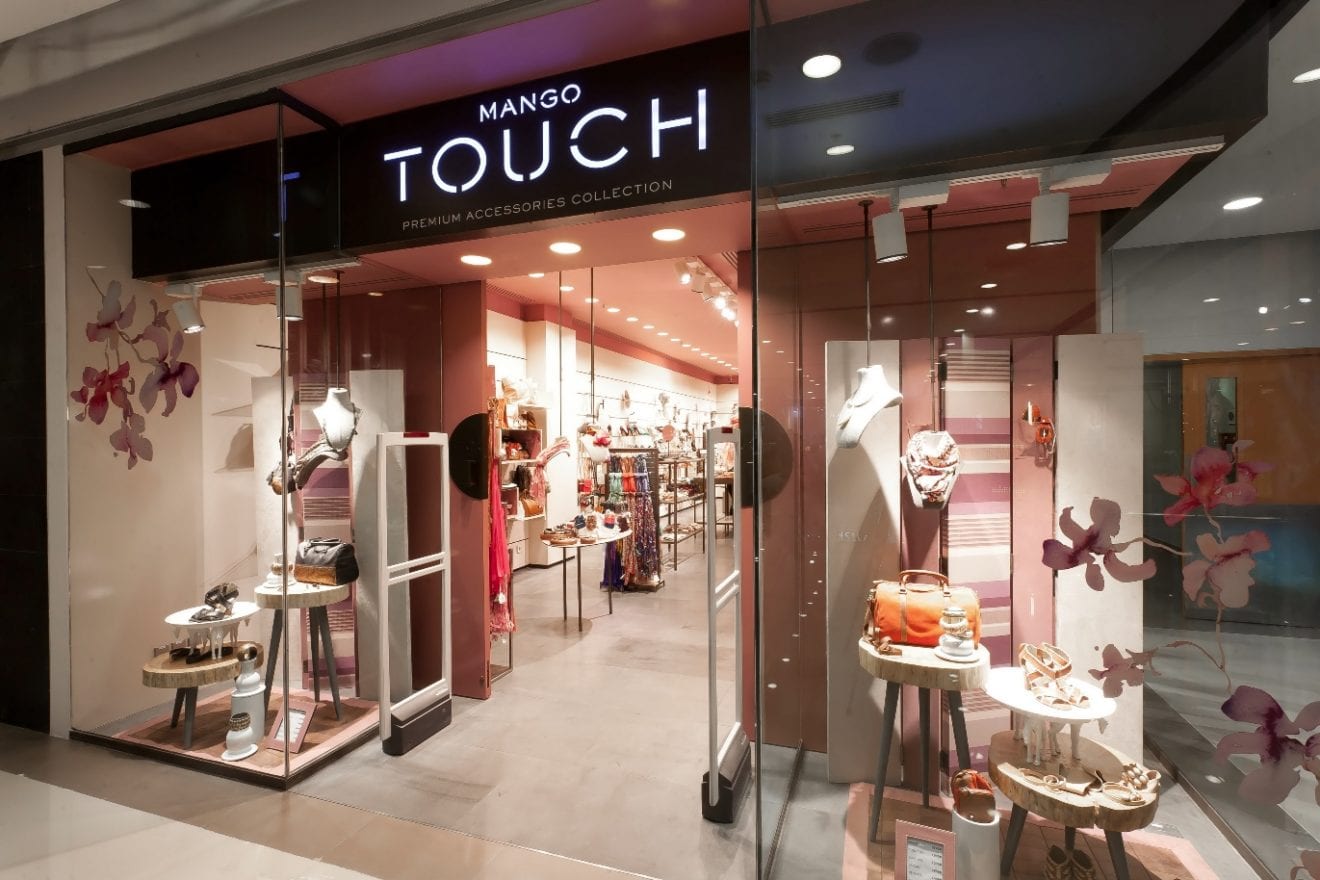
    Since its first store in Robinsons Ermita in 1999, the boutique now boasts of 34 standalone stores spread across the Philippines-that’s more than Hong Kong’s 4, Singapore’s 16, and the US’s 7. The variants are expanding, too: Mango Woman is available in 26 stores, Mango Man in 7, the accessories line Mango Touch and Mango Kids in 5 each, and Mango’s athletic apparel is found in the brand’s boutique in SM Mall of Asia.

    Measuring 650 square meters, the Eastwood Mall boutique is an impressive affair, designed to heighten the shopping experience with its lighting, furniture, mannequins, visuals and displays.

    Still, there’s an even bigger branch in the offing.

    By the end of the year, Mango’s Megamall branch will be a multilevel store with a total floor area of 1,000 sqm. This is the second multilevel store after Mango in Ayala Malls Cebu.

    “The expansions are part of Mango revolutionizing itself and adapting to the needs of the market,” says Santos of Mango’s growth even with the presence of retail rivals. “With the challenge of competition, we remain strong because we go with the flow, bringing Mango to where the people are.”

    Collections that can be worn season after season also explain why this fast fashion brand is a favorite of both style-savvy and smart dressers. Loyal Mango patrons know that a basic top or bottom is a durable investment that works well when combined with other clothing labels. Even this season’s trend-Boho Chic, as modeled by brand ambassadors-of-the-moment Cara Delevingne and Kate Moss-offers pieces that won’t appear dated post Autumn/Winter 2015. “I would put my name on the line to say that you can still wear them after many years,” swears Santos. That even goes for the pant silhouette du jour, flares. “We were just talking about that!” exclaims the petite store supervisor with a laugh. “Actually, flared pants were the trend three years ago and I remember buying a pair from Mango. I thought I’d never use them again, but now I’m thinking of reviving my pair.”

    The brand has had a connection with the Philippines even before its boutiques reached these shores. Founded in 1984 in Spain by Turkish emigrant brothers Isak and Nahman Andic, Mango was named after the Philippine mango, whose taste so captivated Isak when he sampled the fruit during a trip to the country many years ago. The name also stuck because it is pronounced the same way in any language.

    Fifteen years later, that connection remains stronger than ever. Two years ago, the notoriously low-profile and media-shy Isak Andic visited the Philippines for the first time since the country’s stores became operational. While Mango Philippines executives were surprised at news of his arrival, “we also felt important,” says Santos. “In Asia, they know that the Philippines is full of potential. There’s even talk that he may come back soon, which really says a lot.”

    As such, Mango’s principals are keen on getting Filipinos’ opinions on everything, from the choice of brand ambassadors to the type of clothes they see on the shelves. “They always, always ask us, ‘What does your market need?’” says the country store supervisor. The short sleeve shirts that appear on the racks of Mango Man this Autumn/Winter, for instance, are a product of research from last season as well as feedback from Filipino execs.

    Evidently, this explains Mango’s staying power against equally enticing rivals.

    By giving the market exactly what it wants—from specific merchandise to stores that excite the senses—the brand will remain a constant in the malls, and in people’s wardrobes, for years to come.

    “Even with the competition,” says Santos, “we know our customers are there. They will always be back.”

  • Metro Retail to tap P1.05-B loan facility

    Metro Retail to tap P1.05-B loan facility

    GAISANO-LED mall developer Metro Retail Stores Group Inc. (MRSGI) will be tapping a P1.05-billion loan facility for future projects.

    In a disclosure to the Philippine Stock Exchange on Friday, Metro Retail said its board of directors had allowed the company to use the facility, provided by Union Bank of the Philippines (UnionBank).

    “In the same resolution, the board approved the authorized signatories to transact with the UnionBank on behalf of the corporation for the availment of the said credit accommodation and facility,” the disclosure read.

    “It is in addition to our existing untouched loan facilities that we can tap,” Metro Retail Chief Finance Officer Aljim Jamandre told The Manila Times.

    The firm still has P9 billion worth of credit facilities from banks, which Metro Retail can tap in case of funding needs after pricing its initial public offering (IPO) at a steep discount from the original guidance.

    The 35 percent discount still yielded Metro Retail P3.62 billion from its IPO. The plan before the discount was to raise P6.17 billion.

    Joseph Conrad Balatbat, MRSGI vice president for business development, said the company “has more than adequate untapped credit facilities in addition to our IPO proceeds that can fund our current and immediate expansion plan.”

    The company is looking to build 60 to 70 stores mostly in the Visayas over the next five years to bring its store count to more than 100 by 2020 from 46 stores at present. The five year plan entails a budget of P10 billion to P15 billion.

  • Generics revive Philippines pharma

    Generics revive Philippines pharma

    The Philippines is a developing country in which nearly 70 per cent of healthcare spending goes to the private sector. This combination means that for most Filipinos, medicines are expensive. But a regulatory shift has boosted the use of generics — cheaper copies of proprietary medicines with expired patents — and is shaking up the market to the benefit of local manufacturers.

    The shift has followed a law passed in 2008 that imposed price caps and stiffer fines on doctors prescribing brand-name medicines instead of generics.

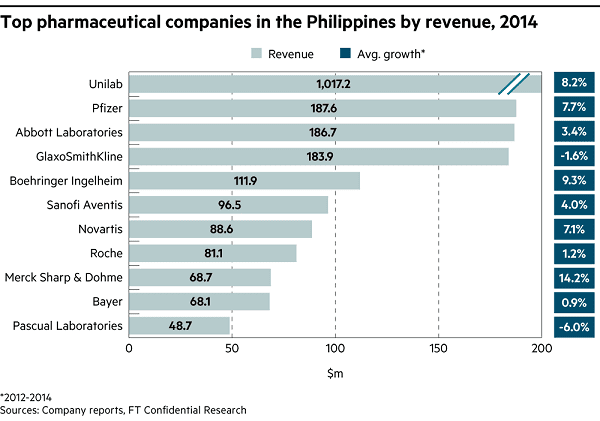
    One result is that Unilab, a local pharmaceuticals group, has captured nearly 48 per cent of the pharmaceuticals market, at the expense of multinational giants such as Pfizer, Abbott Laboratories and GlaxoSmithKline.

    Generic medicines took 65 per cent of the market in 2014, from less than 40 per cent in 2009, according to the Pharmaceutical and Healthcare Association of the Philippines, an industry lobby group.

    Foreign pharmaceuticals makers suffered price caps imposed by a 2008 law on prescription drugs considered to be essential medicines, such as those used to treat hypertension, diabetes and pulmonary diseases.

    In response, companies such as Pfizer have begun to introduce their own branded generic lines or have dismantled production in the Philippines altogether.

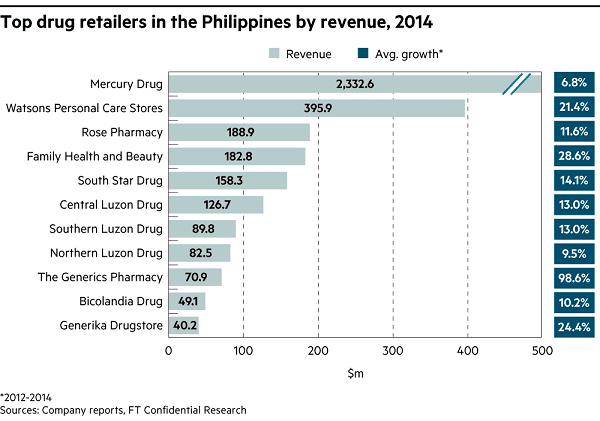
    Increased use of generic drugs has been spurred by the emergence of generics-only pharmacies such as Generika and The Generics Pharmacy, two chains that have more branches between them than the retail leader Mercury Drug’s 1,000 stores.

    FT Confidential Research, a Financial Times research service, expects the market share of generics to expand to 70 per cent by 2020, as the government bolsters spending on healthcare with revenues from rising taxes on tobacco and alcohol.

    This year, the Philippine pharmaceuticals market is expected to grow 4.4 per cent to 152bn pesos ($3.25bn). Growth however is expected to accelerate to 4.7 per cent next year and 5 per cent in 2017–2018, with the administration of President Benigno Aquino raising healthcare expenditures by 38 per cent to 132.7bn pesos under the 2016 budget.

  • SM Malls proves disaster resiliency makes business sense

    SM Malls proves disaster resiliency makes business sense

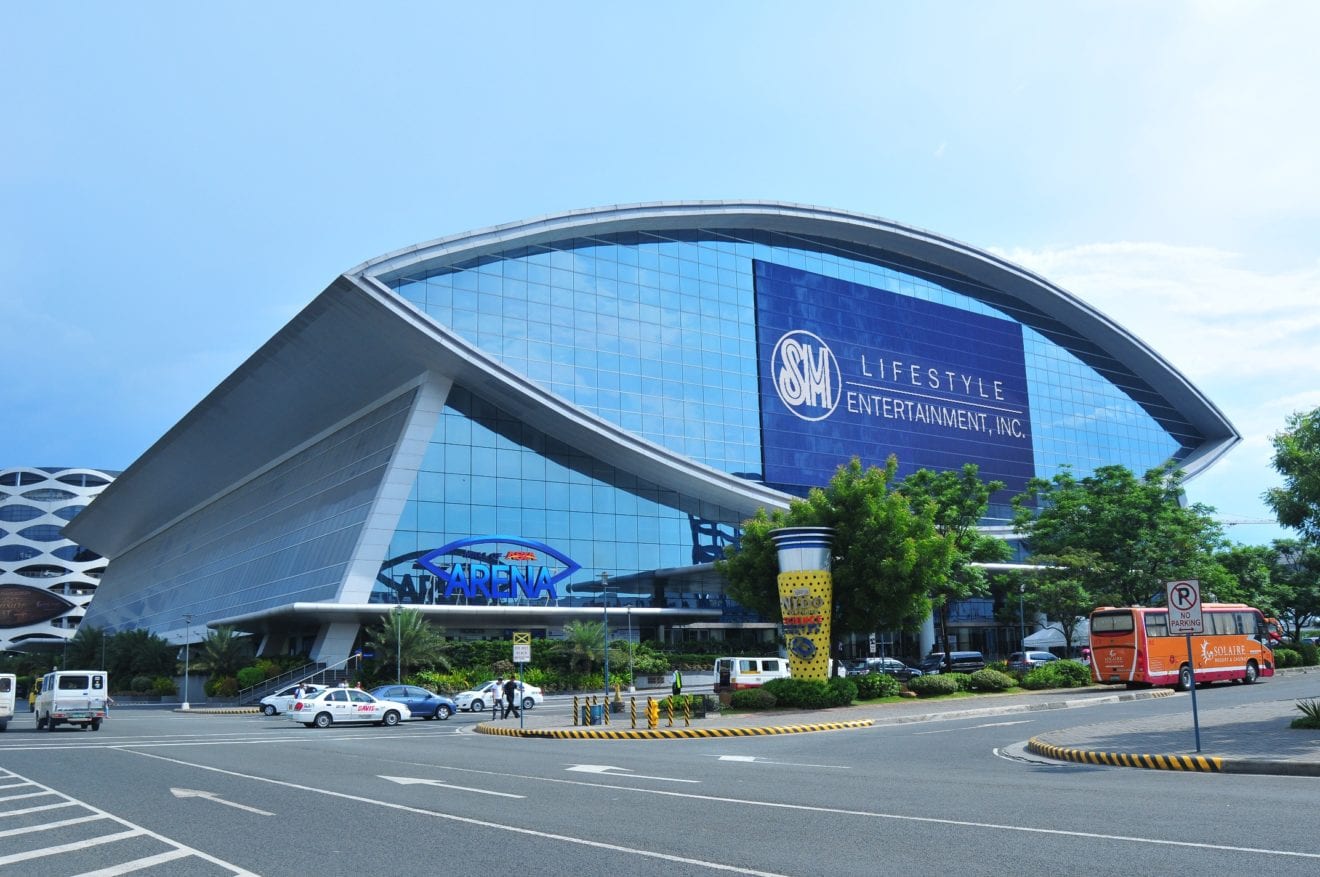
    SM Malls shopping centres – now a 56-strong network across the Philippines – have evolved into sustainable structures that are proving to be valuable investments in the event of the frequent natural disasters which strike the nation.

    In the last few years, SM malls have consciously integrated disaster risk reduction into design and operations in the midst of worsening effects of climate change.

    Speaking before the annual meeting of the United Nations International Strategy for Disaster Risk Reduction (UNISDR) in London, recently, SM Prime president Hans T Sy shared that the company has taken major steps to ensure the longevity of its developments and safeguard its host communities given this context.

    SM’s malls, with a total gross area of over 7 million sqm, have an average daily foot traffic of over 4 million people and some 15,000 tenants.

    “My experience has proven that investing in resilience of our company’s assets makes good business sense. Depending on the location and assessment of the project, around 10 per cent of capital expenditure is allocated to Disaster Resiliency,” said Sy who is the only Filipino to be part of the UNISDR’s Private Sector Advisory Group.

    “We see the entirety of our malls as a city in itself, with locators, employees, customers and the communities we serve,” he added.

    One of the latest SM malls to open, SM City Cabanatuan in Nueva Ecija, is a good example of how SM Prime has adapted to climate change by making its infrastructure more disaster resilient.

    Cabanatuan was affected by Super Typhoon Lando (International name: Koppu) which caused massive flooding, mudslides and power outages that affected 9 million people in the northern region. The mall’s design allowed the free flow of creek floodwater during extreme flooding while the lower ground structure served as a flood catchment, thereby reducing the risk of flooding and ensuring the safety of the surrounding communities. The mall likewise served as a refuge for over 400 customers and families in the area at the height of the typhoon.

    Over the past several decades, SM Prime has made significant inroads in incorporating disaster resiliency in its centres. The best example is SM City Marikina which opened in 2008 and was built on concrete stilts to allow flood water from the nearby Marikina River to flow freely. When Typhoon Ondoy (International name: Ketsana) flooded most of Marikina City, the mall stood high above flood waters and all its tenants were undamaged and safe.

    The roads surrounding the Marikina mall are at ground level. Anticipating floods during heavy rains at that level, SM Prime constructed the first two levels of SM Marikina as parking areas without wall enclosures. The upper parking level was constructed at an elevation of 20.5 meters. During extreme floods, the parking floors are vacated and the supportive stilts allow for the free flow of water through the lower levels, while the business units continue to operate safely as was seen at the onset of Typhoon Ondoy (Ketsana) when a huge part of Marikina was flooded. The mall became a refuge for stranded people and food seekers. It also became a re-packing center for relief goods.

    SM City Masinag in Antipolo, SM BF Paranaque, SM Angono and SM San Mateo both in Rizal province were provided with catch basins underneath the mall to hold water during flooding.

    SM Muntinlupa in Alabang, was also designed to ensure the safety of the customers even if it was found to be located on a “discontinued major fault line”. Its design features a slab system that minimises the effects of earthquakes.

    The Mall of Asia Complex in Pasay City, one of SM Prime’s biggest investments located on 60 hectares of reclaimed property, has also been been designed for resiliency. He said that the main feature of the complex is that all structures were constructed at a height of 4.5 meters above the National Building Code requirements.

    “SM Prime places crucial importance on disaster resilience, not as an additional cost, but as part of our core business strategy. It allows us to serve our communities better, to be competitive, to increase our value and bottomline. But most of all, disaster resilience ensures the safety of our customers and the communities where we operate,” Sy said.

    Aside from introducing sustainable features in its malls, SM Prime also educates and updates its partners and stakeholders on disaster risk reduction (DRR) through internal procedures and various forums, such as the Green Retail Agenda, Business Case for Disaster Resilience, Top Leaders Forum and others. It also values and supports the government’s programs and initiatives in their information and educational campaigns such as the first Metro Manila Shake Drill for Earthquake Preparedness.

    SM Prime also supports DRR projects such as the Weather Philippines Foundation’s Automated Weather Station (AWS) which specialises in local weather forecasting.  All SM malls have also installed the AWS device which provides online five-day local weather forecasts as a form of public service in support of the government’s weather forecasting.

    SM has also donated 1000 units of disaster resilient houses to victims of Typhoon Haiyan, the strongest storm to make landfall in the southern part of the Philippines.

    SM Prime set up its efforts to lead Philippine businesses and communities disaster-resilient through the Private Sector Alliance for Disaster Resilient Societies (Arise), a worldwide initiative spearheaded by the UNISDR to create more resilient societies.

    Arise was introduced for the first time in Southeast Asia during the 2015 Top Leaders Forum at the SMX Mall of Asia in Pasay City.

    Arise, which was launched in London last September, was created in order to implement the Sendai Framework for Disaster Risk Reduction, a 15-year global roadmap adopted in March 2015 which aims to curb disaster mortality and economic losses substantially.

  • Calata corporation innovates for agriculture industry in the Philippines

    Calata corporation innovates for agriculture industry in the Philippines

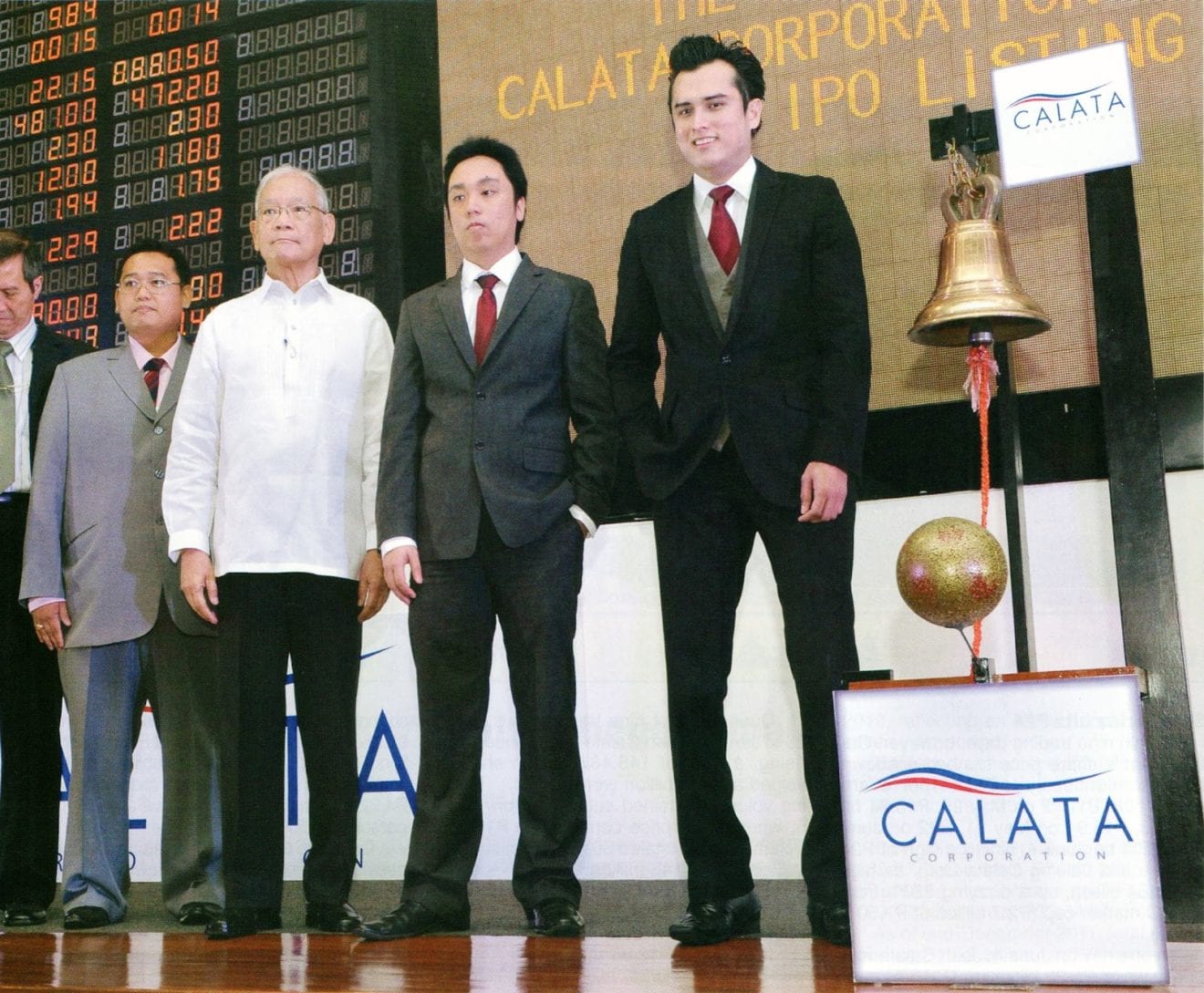
    The Calata Corporation has made significant strides within the agricultural industry in The Philippines. In fact, the country has grown significantly within this sector and it is now one of the most diverse and innovative in the region. Agriculture is the largest industry in the Philippines. It is vitally important to the country’s gross domestic product and the livelihood of thousands of farmers and millions of people. Although agriculture has been a long-standing industry here, the innovations and modifications made by Calata Corporation really have helped to open the door for opportunity and have changed the industry.

    Investing in Agriculture

    When the founder of Calata Corporation set out, he aimed to provide an improved model for doing business within the agricultural sector. He did so because he believed, and still does, that investing in the agricultural industry will boost the economy and bring improvement in the future of The Philippines. Joseph Calata has talked numerous times about the importance of agriculture, not in just the old way of farming, but in innovative, tech-based improvements that can help the industry to soar locally.

    But, how did he and the company itself change the industry?

    A look back at what Calata Corporation started at can provide some insight. The 30-something-year-old business professional is happy to talk about the retail business his family owned. At that time, it was a small retail outlet that met the needs of just those in the local area. It sold fertilizers that were very important to the industry. Yet, this wasn’t enough to spur the development and growth necessary within the company.

    Today, Calata and his team have opened the door for all farmers and agricultural businesses in The Philippines by providing better access to materials and products that improve the industry. This includes a number of significant changes.

    • He introduced technology that improved the inventory tracking and management processes, reducing man hours spent.
    • He introduced innovative methods for using land and for developing a better quality of product every time.
    • He also worked to expand the company to provide better access to materials to more sectors.

    Once a fertilizer based business, Calata Corporation now dominates numerous industries. It’s AGRI component still offers fertilizers, as well as numerous other products that help to protect the investments farmers make. It also offers a seed division, a planting equipment division, retail stores for local access to farmers, and a distribution network that spans from the ground through the distribution of final products. He’s added in soya, cassava, corn, and rice to the industry while also improving animal feeds and processing.
    As a conglomerate of numerous companies and sectors, it is far easier for the companies within this sector to thrive. They now have better access to materials, high-quality seeds and industry knowledge.

    They also have access to better materials, which has become one of the most important components to the industry’s development and growth. In short, Calata Corporation connects farmers and technology, innovation and proven methods, and cost effectiveness and growth. It is in these connections that the company has been able to change the agricultural industry and the lives of many of those who are working in it today. Calata Corporation and Joseph Calata continue to innovate to achieve even more for the future.

  • Charming Charlie opens first Philippines store

    Charming Charlie opens first Philippines store

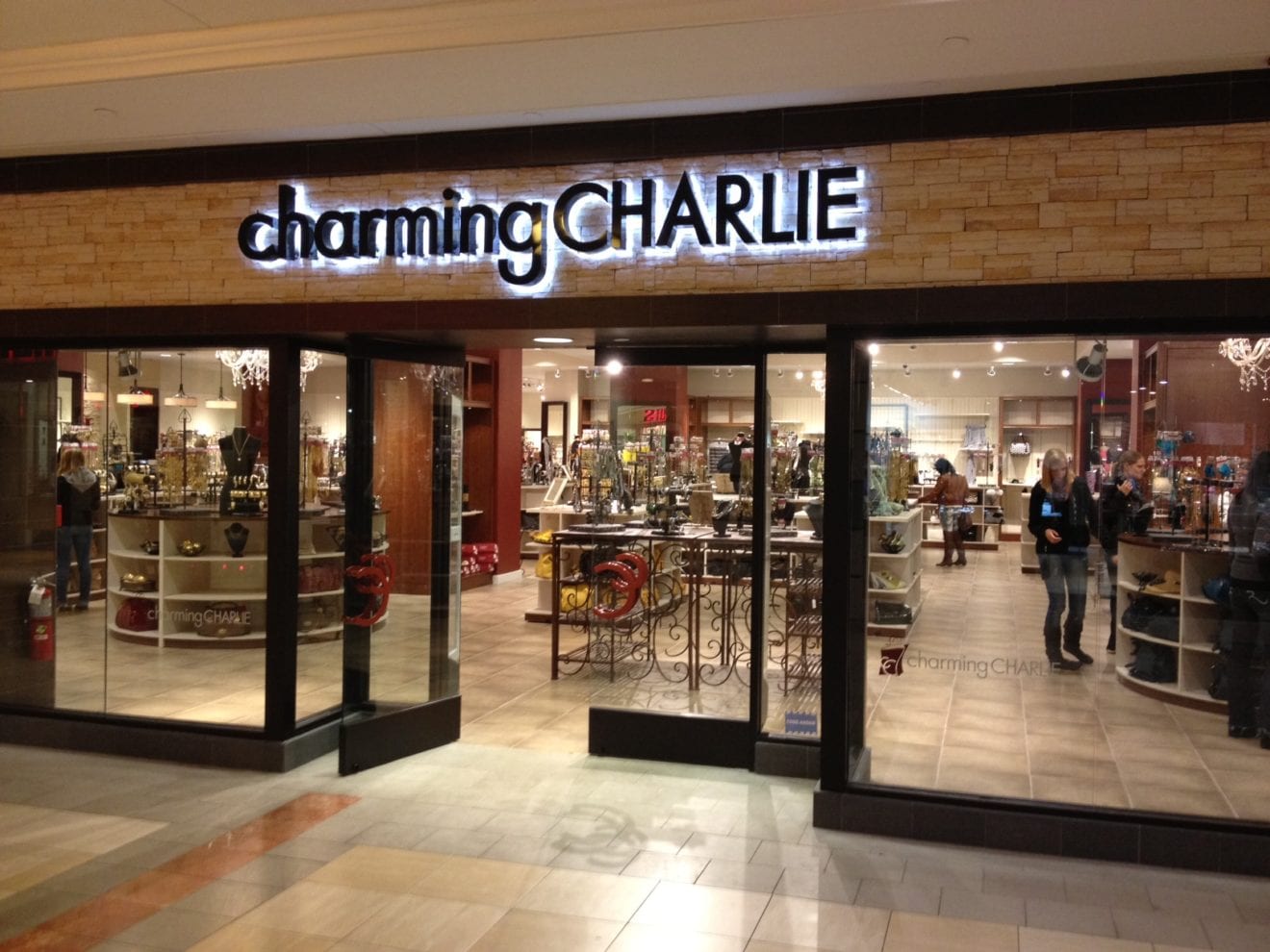
    The first Charming Charlie in the Philippines is scheduled to open Saturday, Dec. 19, 2015. The Houston-based women’s jewelry and accessories retailer has opened as many as 55 U.S. stores each year, and expanded to Dubai in 2015.

    The first Charming Charlie in the Philippines is scheduled to open Saturday, Dec. 19, 2015. The Houston-based women’s jewelry and accessories retailer has opened as many as 55 U.S. stores each year, and … more.

    Houston-based women’s jewelry and accessories retailer Charming Charlie has spread its footprint across the Pacific Ocean.

    This past Saturday, the retailer’s first Philippines location opened at Bonifacio High Street Central Square, a shopping district in the capital city of Manila.

    Charming Charlie worked with distributor Stores Specialists, Inc. a member of SSI Group, to expand to Manila, according to a company statement. Additional growth is planned in Manila and in Cebu in 2016.

    “The Philippines is a fast growing territory with an increasing population of young adults and proven track record for American brands, so entering Southeast Asia following our Middle East expansion made perfect sense for the brand,” Charlie Chanaratsopon, founder and CEO, said in a statement. “SSI Group is the premier partner in the Philippines and we believe their local expertise will allow us to bring our incredible value and fun shopping experience to customers throughout the region.”

    This past summer, the retailer opened two locations in Dubai, United Arab Emirates.

    Charming Charlie has 350 retail stores across the United States, Canada, the United Arab Emirates and the Philippines.

  • Prada Philippines re-opens expanded Makati boutique

    Prada Philippines re-opens expanded Makati boutique

    Prada Philippines has reopened its high profile boutique in the Greenbelt Ayala Center in downtown Makati, Manila.

    The expanded and renovated store inside the prestigious mall was designed by architect Roberto Baciocchi, covers a total area of approximately 200 sqm on a single level. It houses women’s and men’s leather goods, accessories and footwear collections.

    pradaThe high-impact external facade is composed of an interplay of light-boxes, completed by a backlit white canvas curtain enclosed in a crystal box. The internal facade echoes the motif of the exterior and features two large entrances and a series of display windows.


    The first entrance, defined by the signature black-and-white marble chequered flooring – a legacy of Prada’s identity worldwide – opens up on an area dedicated to the women’s leather goods collections.

    A portal leads to a second space, where the women’s footwear collections is displayed. The entire area devoted to women is characterised by green fabric- clad walls with cut-in polished steel and crystal display niches. Steel and crystal tables with coloured display shelves and green velvet sofas complete the furnishing.

    The second entrance and the space dedicated to women both lead to a regularly-shaped area housing the men’s leather goods and footwear collections. Ebony floorboards and walls, crystal and polished steel display cases and chocolate brown carpeting define the space. Display counters with coloured saffiano leather detailing and light coloured leather sofas enhance the atmosphere.

  • Scientific Games renews lottery supply deal in Philippines

    Scientific Games renews lottery supply deal in Philippines

    The three-year extension ends in July 2018, and will see Scientific Games supply POSC with 1,500 new WAVE lottery terminals by the end of the year.

    “Scientific Games has demonstrated a strong commitment to our systems technology over the last decade, and we are pleased to continue working together to grow lottery sales in the Philippines,” POSC president Willy Ocier said.

    “The new terminals installed through this contract extension will allow us to retire some of our older terminals and provide our retailers with advanced technology that drives efficiencies and makes it easy and convenient for retailers to sell lottery games,” Ocier has explained.

    Scientific Games has provided POSC with products and services since 2005, supplying instant games and an instant ticket validation system in addition to the systems and retail technology.

    Founded in 1993, POSC sources and leases gaming technology to the Philippine Charity Sweepstakes Office (PCSO) and supplies the Visayas and Mindanao regions with lottery technology since 1995. It also leases keno terminals and an online operating system to PCSO across the country, having signed an agreement in 2004.

    “We appreciate the professionalism and creativity exhibited by POSC and its leadership team, and we look forward to supporting their numerous growth initiatives over the next several years,” Scientific Games president of corporate development and global strategic accounts Michael Conforti said.

  • Ikea to ramp up SEA expansion

    Ikea to ramp up SEA expansion

    Swedish furniture and homewares retailer Ikea wants to ramp up its Southeast Asian store rollout.

    The next two markets in its sights are the Philippines and Vietnam.

    But in some key markets, finding suitable locations for its large format stores is proving a challenge, especially in Vietnam where it wants to launch in Ho Chi Minh City, the country’s commercial capital with a catchment of 8 million consumers.

    Speaking to The Nation newspaper after opening its first pickup point (PUP) in the Thai resort city of Phuket, Mike King, retail manager of Ikea Singapore, Malaysia and Thailand, said the company wants to have three large format stores in Bangkok and five or six PUPs in Thailand within five years.

    In July, the company announced it had located site for its second Bangkok store – adjacent to the new CentralPlaza Westgate shopping mall under construction in Bangyai, in Nonthaburi province in Bangkok’s west. Another site has been earmarked in the city’s north, near the recently expandedFuture Park Rangsit shopping centre.

    Ikea is already actively seeking local partners in Vietnam and the Philippines. Typically when Ikea enters a new market, it locates its initial stores in the most populated cities – for example in Indonesia where it has a joint venture with Hong Kong’s Dairy Farm International, it has opened its first store in Jakarta, and in Malaysia it has two in greater Kuala Lumpur. In the Philippines it will focus on Manila with a population catchment of about 24 million.

    “The two new branches [in Ho Chi Minh City and Manila] will possibly be erected within five years,” King told The Nation.

    Ikea plans to open at least one store a year in Southeast Asia from now on – typically about 40,00 sqm in size.

    Meanwhile, the 2651 sqm Phuket PUP is expected to increase the Bangkok store’s sales by 10 per cent annually. Customers can order online, or in the store and have the products shipped to the PUP for collection.

    It is the first PUP store in Asia, although others operate in Spain, the UAE, Turkey, Norway, Finland and Greece, among other places.

  • Sonae launches Zippy Philippines

    Sonae launches Zippy Philippines

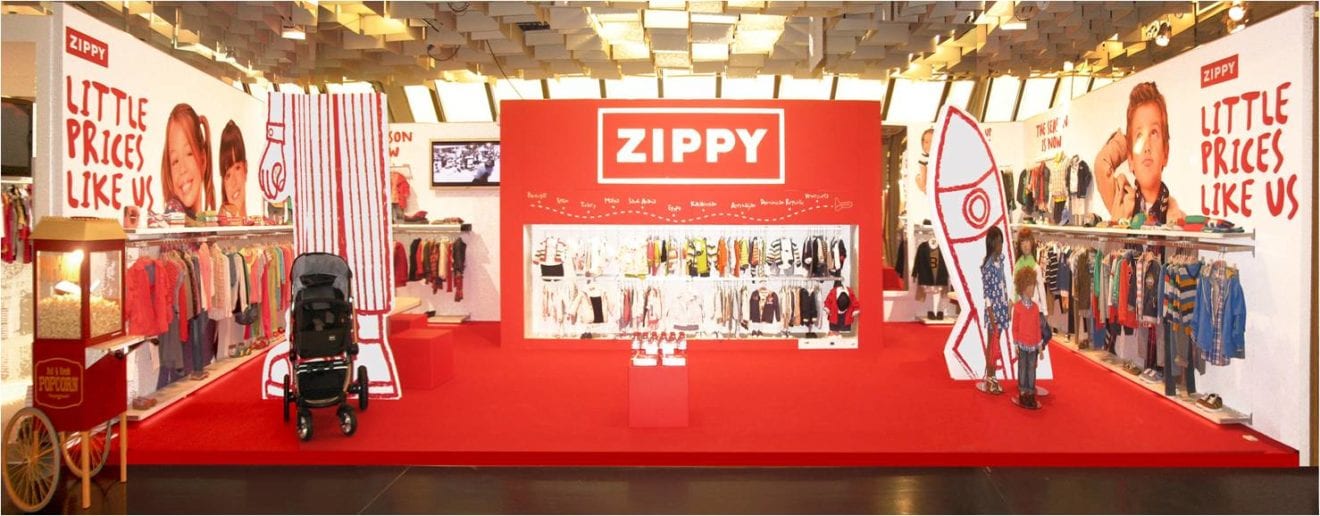
    Portuguese multi-brand retailer Sonae has expanded its international activity to Asia by opening its first two Zippy stores in the Philippines.

    The Sonae brand of children’s clothing and nursery products has signed a franchising agreement that includes opening about 24 stores across the country during the next five years.

    Miguel Mota Freitas, CEO of Sonae SR,  said the partnership is in line with Sonae’s international expansion strategy, which looks to use its brands’ competitive advantages worldwide, diversifying markets and stimulating new development opportunities.

    “Asia is a populous and economically dynamic region, with high birth rates, where consumers are beginning to pay more and more attention to quality products, which opens new perspectives for Zippy, particularly now in the Philippines,” he said.

    Entering the Philippines resulted from the franchising agreement celebrated with Trimark Holdings, which operates more than 600 stores in the country under more than 40 international brands, mostly in fashion.

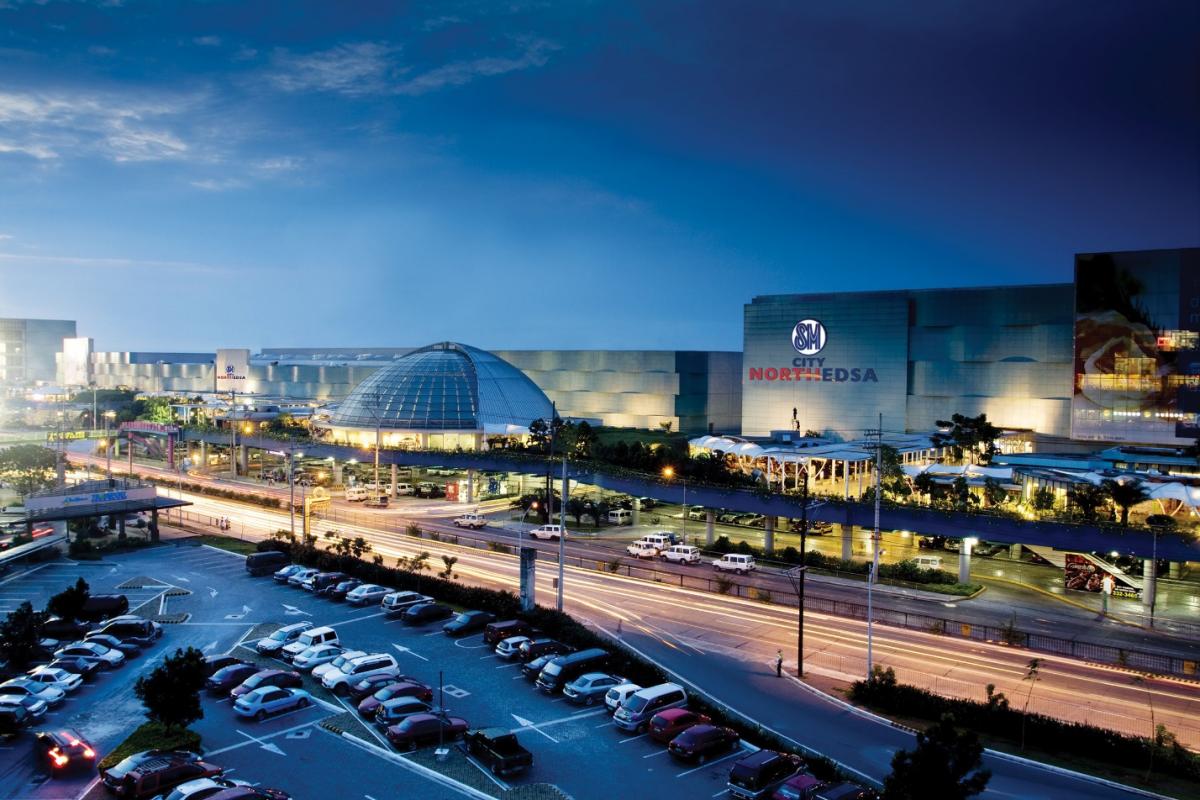
    The Zippy Philippines stores have opened at the Glorietta and North Edsa shopping centres, in the capital city, Manila.  Zippy’s Philippines stores will have an average area of 100 sqm offering products from clothing and footwear to baby and kids accessories.

    With a population of around 100 million inhabitants, the Philippines is the seventh most populated country in Asia and the 12th most populated in the world. With more than one third of the population aged under 14 years, the potential customer base fits right into Zippy’s target market.

    World Bank data predicts the Philippines’ economy will grow at 6.5 per cent annually for the next two years.

  • Penshoppe parent plans 125 new stores

    Penshoppe parent plans 125 new stores

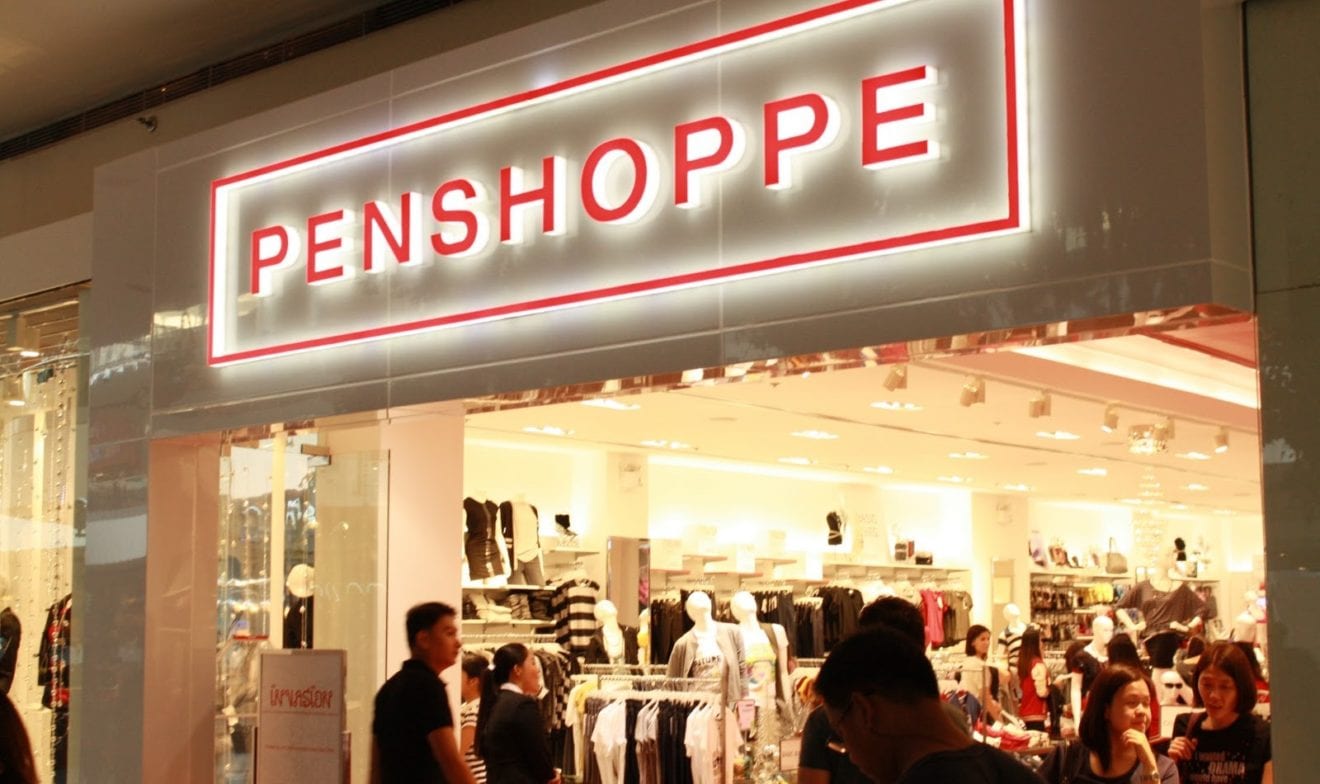
    Philippines fashion retailer Golden ABC says it plans to open 125 new stores in the Philippines and across Asia in 2016.

    According to CEO Bernie Liu, 100 stores will open in the company’s home market and a further 25 will open in other Asian countries, including Indonesia.

    Liu is undeterred by the rapidly rising ranks of foreign fast fashion clothing brands entering and expanding in the Philippines.

    “We have been competing with these international brands for years now in other parts of Asia. Our goal is to bring a Filipino brand into the international arena,” Liu said during the opening of three new stores at the SM Seaside City mall in Cebu.

    Golden ABC’s flagship brand – and the one most likely to be opened in Asian markets – is Penshoppe. The new Penshoppe store at SM Seaside City is the brand’s largest shop yet, with a footprint of 850 sqm, more than twice the size of a normal store.

    Golden ABC also operates the ForMe and Oxygen brands, both of which have also opened stores in SM Seaside City. The retailer has 700 stores across Asia and the Middle East. Its largest Asian markets outside the Philippines are Indonesia and Cambodia – and in Vietnam where the company recently opened a store inside the new VivoCity mall in District 7.

    “We are very encouraged by the response in Vietnam,” Liu said in an interview.

    Penshoppe has 26 stores in Indonesia, with three more under construction.

    Golden ABC also owns the Memo, Regatta and Tyler retail brands, and the direct-selling business Red Logo.