Japansese fashion retailer Uniqlo and Toray Industries have created apparel made from recycled down and fabric from polyester fibres made with recycled PET bottles.
The technology partnership will lead to clothes made from recycled plastic bottles going on sale next year in Singapore and other Asian markets.
Used Ultra Light Down pieces will be collected by Uniqlo stores and go through extraction process run by Toray-developed system. Materials then will be cleansed for use in new down merchandise. The collection program started this month initially only in Japan. Some down products from the 2020 Fall/Winter season will use the recycled material.
“Uniqlo is committed to improving the sustainability of society,” said Tadashi Yanai, Uniqlo’s founder and chairman.
“To this end, we will soon begin our new initiative with Toray that promotes the use of recycled materials. Through such an important partnership, we can continue to offer high-performance, high-quality, and sustainable clothing to all customers around the world.”
President of Toray Industries, Akihiro Nikkaku said that the companies challenged themselves to seek solutions for global social issues as they believe that ‘materials can change our lives’.
Next year, Uniqlo will produce Dry-Ex pieces of clothing that combine high-value-added polyester fibers derived from reclaimed PET bottles – clothes made from recycled plastic.
Adelaide’s first three retail precincts to go plastic-free have been named with the South Australian government declaring now is the time to remove and replace single-use items.
The Adelaide Central Market, The Parade at Norwood and the Jetty Road Brighton Traders are the first areas to trial the government’s initiative and will also be joined by the state’s 21 surf life-saving clubs.
The government intends to legislate to ban single-use plastics in 2020.
“The message from the community is clear, they expect the government to lead on the issue of plastics, and it definitely feels like the time is right to reduce, remove and replace single-use plastics where ever we can,” Environment Minister David Speirs said.
Surf Life Saving South Australia chief executive Damien Marangon said his organisation was thrilled to be one of the first single-use plastic-free precincts.
“As custodians of South Australia’s coastline our organization sees first hand the impact single-use plastics can have on our beaches and waterways,” said Marangon.
The government received 10 applications for the precincts and has also set up a stakeholder taskforce which will provide input and advice to assist in making the precinct trial as successful as possible.
“These first four partners are just the first step, and we expect more plastic-free precincts will follow soon given the high quality of the other applications from across the state,” Speirs said.
“Our government is seeking a wide range of input on what any future phase-out or replacement for single-use plastic might look like and the stakeholder taskforce will play an important role in our decision making.”
Those areas taking part in the trial have agreed to remove a range of single-use items from their stores including straws, cutlery and cups.
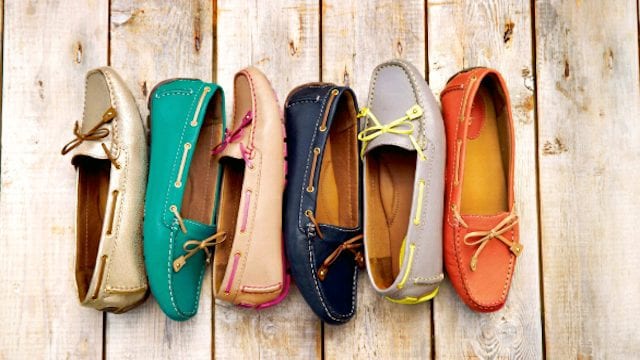
Online shoes-from-plastic brand Rothy’s is opening its first physical stores in four key US locations.
The brand creates women’s shoes from recycled materials, including plastic bottles, and has a burgeoning following in the territory. Its new stores will open in downtown Manhattan, Los Angeles, Boston and Washington DC.
A further five locations are planned to open in the US next year. To date Rothy’s has operated just one store – in its home city of San Francisco. But it has sold online across the US and internationally.
The shoes are all flats with knitted materials, retailing from $125–165. The popularity of the footwear has rested on the Rothy’s marketing savvy and advertising investment on social media. The firm has thus far raised $42 million and earnt $140 million in revenue last year. It has recycled around 32 million plastic bottles.
Victoria is bidding adieu to lightweight, single-use plastic shopping bags with a ban to be introduced state-wide in November.
The state government introduced new legislation to parliament on Wednesday to ban bags at retail outlets including supermarkets, fashion boutiques, fast food outlets, convenience stores and service stations.
The ban will target lightweight plastic bags with a thickness of 35 microns including those made from degradable, biodegradable and compostable plastic.
The legislation will ensure all single-use lightweight plastic shopping bags with a thickness of 35 microns or less will be banned, including bags made from degradable, biodegradable and compostable plastic.
The legislative changes follow community consultation, which revealed “overwhelming” support for the ban.
“Plastic pollution is a significant environmental problem – the actions we take now will help ensure Victoria has a clean and bright future,” Minister for Environment Lily D’Ambrosio said on Wednesday.
“The feedback on this one was clear. Victorians want to do more to protect the environment from the damage litter causes and are overwhelmingly supportive of banning single-use plastic shopping bags.”
The government is working with the National Retailers Association to ensure businesses are prepared for the ban and have access to sustainable packaging alternatives.
Single-use plastic bags have already been banned by governments in Queensland, Western Australia, South Australia, Tasmania, ACT and NT.
Coles revealed on Wednesday that it has saved 1.7 billion lightweight single-use plastic bags from landfill since the ban came into place last July.
Woolworths said it has issued around three billion fewer plastic bags from its stores over the last 12 months, equating to a 4,700 tonne reduction in single-use plastics going into the environment over the course of the year.
Single-use cup consumption at Korean fast-food restaurants has plunged by 72 per cent.
The changes have occurred in the year since establishments began to participate in a move initiated by the government to pull back plastics use.
The Korean Ministry of Environment assessed 1000 outlets under 21 brands over the past year, of which 16 were coffee chains (including Starbucks) and five fast-food restaurants (including Lotteria and McDonald’s) all located in metropolitan Incheon and its environs.
The findings showed that 81 per cent of the outlets served beverages in multi-use cups, reducing the stores’ reliance on disposable cups from 206 tons last July to 58 tons in April. All brands assessed offered discounts to customers bringing their own cups, and many replaced plastic drinking straws with other alternatives.
“We can live without disposable products and they can be replaced,” said a ministry official. “It is inconvenient without them, but we have to make the effort.”
Beauty and body care retailer The Body Shop is stepping up its sustainability efforts with the launch of its new recycling scheme that helps consumers recycle their empty packaging. The new initiative, which will launch in Australia on June 10, allows customers to return their empty bottles, jars, tubs, tubes, and pots in The Body Shop stores for recycling.
The scheme, established in partnership with recycling company TerraCycle, was introduced in the UK, Canada, and France on May 10. It will be introduced in Germany soon.
In a bid to tackle plastic pollution, the global personal care brand has also announced it plans to purchase 250 tonnes of community-trade recycled plastic from Bengaluru, India, and use them in nearly three million 250ml haircare bottles by the end of 2019.
According to The Body Shop, it has already started using community-trade recycled plastic in 250ml haircare bottles in partnership with Plastics for Change and soon, the retailer said it will include its bestselling Ginger Shampoo. The bottles will contain 100 percent recycled plastic, excluding the bottle caps.
Fifteen percent of that will be community-trade recycled plastic; the remainder will be recycled plastic from European sources.
“The Body Shop will increase the amount of community trade Recycled plastic over time,” the retailer said. “Working with a start-up company and small waste picker communities means starting small and scaling up in a responsible and sustainable manner.”
This move marks the start of a wider ambition for The Body Shop, which is to introduce community-trade recycled plastic across all plastic used by The Body Shop within three years.
The company said over the course of three years the program will scale up to purchasing over 900 tonnes of community-trade recycled plastic and help empower up to 2500 waste pickers in Bengaluru.
The retailer’s new campaign uses experiential marketing to tell people about the plight of waste-pickers in India and how it aims to help them by paying a fairer price for their work.
“They will receive a fair price for their work, a predictable income and access to better working conditions,” The Body Shop announced. “They will also get help in accessing services such as education, financial loans and healthcare services, and the respect and recognition they deserve.”
As part of their campaign, The Body Shop has commissioned a portrait of a female waste-picker made from 1500 recycled plastic items hand-collected by waste-pickers in Bengaluru. The installation was on display in London’s Borough Market from May 10 to 11.
“As a company, we’ve always had the conviction to stand up for our principles when it comes to helping empower people, especially women while protecting our planet,” said Lee Mann, Global Community Trade manager for The Body Shop.
“Our new partnership with Plastics for Change and our other partners will not only help support waste pickers but also champion plastic as a valuable, renewable resource when used responsibly.”
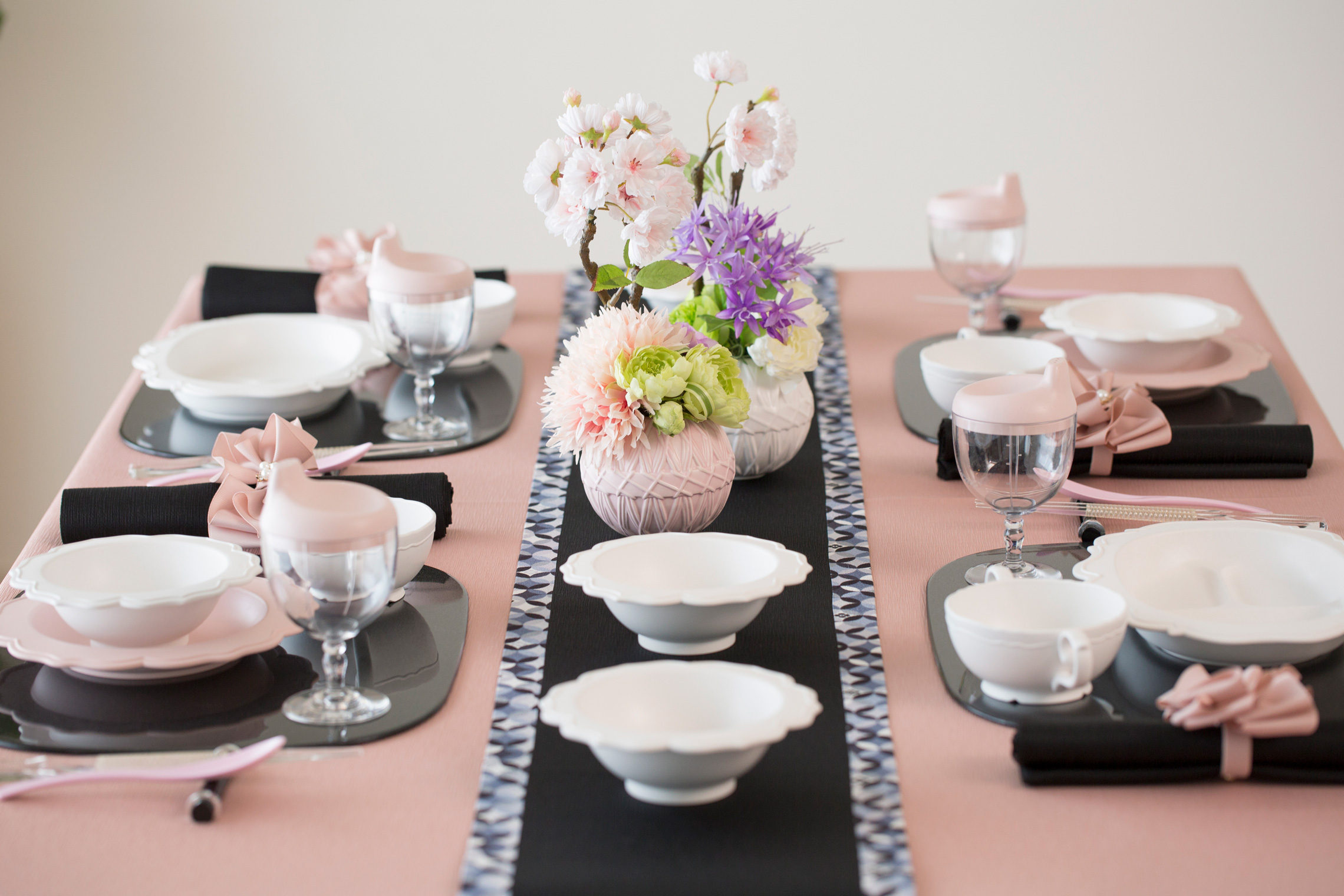
Tableware firm Sagara Inc has opened a global website after setting up a retail store in New York to market its environmentally conscious tableware for children.
The firm’s Reale brand, made from a new bioplastic raw material blended with native Japanese bamboo, is being made available for the first time across North America, including the US and Canada.
The company is scheduled to launch business-to-business and business-to-customer online sales in the territory next month, starting with sales through major department stores as well as retail outlets, online shops and other venues across North America dealing in baby and kid goods, interior products, gifts and other items.
Sagara embarked on developing Reale in 2014 and started selling the tableware in Japan in November 2016. As of March this year, the brand is on sale in Taiwan, Mainland China and Australia.
More than 20,000 Reale sets in total have been shipped up to this month. Its designs are inspired by traditional silverware in Europe and the US.
Vietnam will not import plastic scrap from 2025 and will deal with the scrap consignments stuck at ports, the government has said. It has ordered the Ministry of Natural Resources and Environment to work with other government bodies to eliminate unnecessary procedures which are delaying their delivery.
Customs data shows almost 21,600 containers of scrap remain uncleared at ports as of February 22, 44 percent of them for more than three months.
The government instructed the environment ministry to issue environmental safety certificates to eligible containers so that their importers could use them to manufacture products. All imports of plastic scrap as feedstock would cease on December 31, 2024, it said.
Prime Minister Nguyen Xuan Phuc ordered to scrap imports temporarily last July, saying Vietnam must not become a dumping ground for other countries’ scrap, leaving thousands of containers stuck at ports for months.
His orders followed a surge in imports in the first six months after China banned imports of certain wastes.
But steel, paper and plastic industries have expressed concern since they need to import metal, paper and plastic scrap as feedstock.
Vietnam imported 9.2 million tons of scrap last year, up 14 percent from 2017, according to Vietnam Customs.
Adidas has spent the last four years curbing ocean pollution by recycling plastic beach waste into shoes – and because their customers have been so eager for the product, the company is kicking it up a notch. Adidas produced more than five million pairs of recycled plastic waste shoes in 2018, and they plan to incorporate the waste into at least 11 million this year.
The upcycled plastic waste is made into a yarn which has since become a key component of the upper material of Adidas footwear. In addition to shoes, the company has also used it to make the first ever football jerseys made from recycled materials.
The sporting goods manufacturer first started making the shoes in collaboration with environmental group Parley for the Oceans back in 2015. They developed the slick kicks using plastic waste intercepted on beaches, such as the Maldives, before it can reach the oceans. The Parley shoes are recreated from editions of their UltraBoost shoe, and a new version of their Adidas Originals shoe.
And, in 2016, Adidas stores stopped using plastic bags.
“We also continue to improve our environmental performance during the manufacturing,” said Gil Steyaert, who is responsible for global operations. “This includes the use of sustainable materials, the reduction of CO2 emissions and waste prevention.
“In 2018 alone, we saved more than 40 tons of plastic waste in our offices, retail stores, warehouses and distribution centers worldwide and replaced it with more sustainable solutions.”
Additionally, Adidas is committed to using only recycled polyester in every product and application where a solution exists by 2024. As a founding member of the Better Cotton Initiative, Adidas meanwhile sources only sustainably produced cotton.
Recently, Adidas signed the Climate Protection Charter for the Fashion Industry at the UN Climate Change Conference in Katowice, Poland—and agreed to reduce greenhouse gas emissions by 30% before 2030.
Centara Hotels & Resorts, Thailand’s leading hotel operator, is focusing on three key sustainability initiatives as part of the company’s recently announced 2019 Sustainability Plan: eliminating single-use plastic products; reducing its food waste footprint; and expanding its support of local farming and produce-growing communities.
No Single-Use Plastic Products by end-2019
The elimination of single-use plastic items is part of the “Centara Earth Care” programme aimed at encouraging hotel guests and tourists to be proactive about energy saving, waste reduction and sustainable environmental tourism. The sustainability plan covers five types of single-use plastic items, including drinking straws, laundry bags, take-away food containers, fitness centre and poolside plastic bottles, and plastic guest room amenities. They are being replaced with items made from materials designed to minimise environmental impact.
“Centara strives to operate ethically and sustainably in a balanced manner across the entire portfolio whilst providing an exceptional level of Thai hospitality,” said Thirayuth Chirathivat, Chief Executive Officer. “We are committed to selecting environmentally friendly produce which, in turn, enables us to further incorporate sustainable strategies and development into our products and services, creating shared value at an environmental, social and economic level wherever we operate. We are also committed to ensuring a respectful, safe and healthy environment to the larger society and our future generations.”
Centara began phasing in its elimination of single-use plastic products in 2018 across all 39 of its operating properties. Under the plan, alternative products which are reusable and made from environmentally friendlier materials, including plant-based, compostable and bio-degradable plastics, will be fully phased in by year-end.
Phase I, targeting the elimination of plastic straws, began in August 2018. The single-use plastic straws being eliminated take up to 200 years to decompose; the new bio-straws replacing them decompose within six months. Once the change is fully enacted throughout all Centara properties, the reduction in plastic straw consumption will total nearly 2.2 million straws per year.
Phase II, eliminating the use of plastic laundry bags, began in December 2018. Moving forward, these practices will also become Centara’s standards for all existing and new properties.
Food Waste Reduction
Centara’s new and continuing food-related sustainability initiatives include:
further reducing food waste and minimising each property’s carbon footprint with expanded purchasing of fresh local foods from herb, fruit and vegetable growers
making same-day donations of surplus food to charities located near each property
providing local farms with pre-separated organic waste for composting
transforming waste at select properties into biogas fuel, a blend of mostly methane and carbon dioxide gases which can be used in place of fossil fuels.
In 2018, Centara supported the Bangkok-based foundation Scholars of Sustenance (SOS Thailand) by making same-day donations of more than 28,000 kilogrammes (kg) of quality surplus food. The donations provided over 86,000 servings to those in need, while the reduction in Centara’s food waste saved over 54,000 kg of GHG equivalent emissions.
Both Centra by Centara Maris Resort Jomtien and Centara Grand Beach Resort Phuket have biogas machines on-site capable of converting 30-100 kg of organic waste each day into an equivalent number of litres of organic compost and biogas comparable to nearly five kg/day of LPG fuel. Since July 2018, the Cowtec Composting & Biogas Production Machine installed at Centra by Centara Maris Resort Jomtien has been processing organic waste from the property’s kitchens, staff canteens and landscaping works. By the end of 2018, the machine had composted more than 5,700 kg of organic waste and produced 262 kg of biogas equivalent LPG.
Strengthen Local Communities
Centara’s 2019 Sustainability Plan further expands the company’s support for local communities’ small farms and producers who grow food for Centara hotels and resorts in their area.
The company attributes much of its carbon footprint reduction to making approximately 70% of total produce purchases from local sources. Beyond the economic benefits to the community, expanding farm-to-table dining enables each property to provide the freshest available food items to guests.
The company’s ongoing engagement with EarthCheck, the world’s leading scientific benchmarking, certification and advisory group for travel and tourism, continues to yield consequential improvements in key sustainability metrics. To date, 15 Centara hotels and resorts have achieved EarthCheck certification and another four properties are enrolled in EarthCheck’s Evaluate Plus programme, leading to significant reductions in carbon footprints and greenhouse gas emissions across a number of Centara’s certified properties.
Most recently, the company’s leadership in environmental sustainability was recognised by the Stock Exchange of Thailand, which awarded Centara Hotels & Resorts (CENTEL) its “Thailand Sustainability Investment (THSI)” designation, an annual recognition for listed companies that operate with responsibility for Environmental, Social and Governance (ESG) aspects.
Further recognition for properties includes the “Green Hotel 2018 Award” from the Department of Environmental Quality Promotion at Thailand’s Ministry of Natural Resources and Environment, awarded to Centara Grand Beach Resort & Villas Hua Hin and Centra by Centara Maris Resort Jomtien.
Starbucks Korea and 7-Eleven Thailand have announced positive results for their respective anti-plastic campaigns.
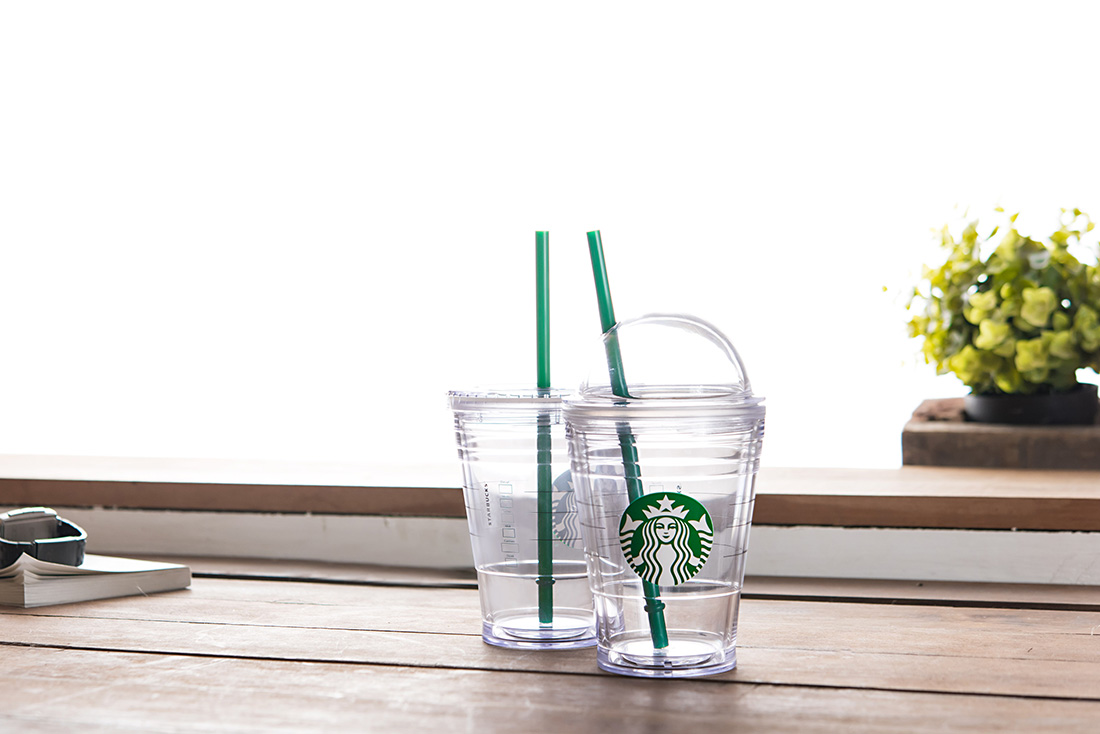
A reportrevealed that the local Starbucks subsidiary has seen consumption of single-use straws cut by half in the months since introducing strawless lids on drinks without whipped cream or that do not need stirring.
The initiative, introduced last November, has resulted in the monthly average of 15 million straws used across its coffee chain stores drop to 7.5 million per month. The company now only provides straws to customers who request them.
Aiming to further reduce straw usage by up to 70 per cent, Starbucks Korea is planning an online event to offer rewards to customers who upload pictures of drinks taken without using straws. It has also introduced paper straws for usage in some beverages.
7-Eleven saves 169 million bags
Meanwhile, in Thailand, more than 169 million plastic bags have remained unused over the past two months at 7-Eleven stores, according to a report, the result of a management initiative to phase out their use. The move, which has been supported by local celebrities, encourages shoppers to refuse plastic bags or bring reusable bags to the store.
The reductions are reported to have saved the chain more than 33 million baht, which operator CP All Public Company will donate to a local hospital.
All about perception?
Despite these reports, there have been growing concerns among critics in the media regarding the perceived environmental benefits of similar plastics initiatives worldwide.
The sippy cup lid adopted in Korea is identical to the design used in North American stores, which was shown in a Reason magazine report last year to use more plastic than the previous lid design and straw put together.
Plastic shopping bag initiatives similar to the one adopted by 7-Eleven have provoked skepticism among observers who point out that of all single-use plastic packaging used throughout supermarkets and convenience stores, the shopping bag is the only item that tends to be reused in the home.
On a trip to Thailand in 2017, serial entrepreneur Brian Bushell went diving for the first time and expected that the water would be pristine. Instead, it was filled with trash. “We were about to dive off the back of the boat, and all of the sudden we’re surrounded by junk plastic containers,” he says. That night, he went back to his hotel room and looked at the products he had sitting on the bathroom counter. “I realized that I was part of the problem.”
Bushell, who had recently left Baked by Melissa, the chain of successful New York City-area cupcake bakeries he co-founded, started researching the challenge of plastic waste.
“We learned that a third of all the single-use plastic products in landfills are personal care products,” he says. “So we decided that personal care was really an important nut to crack.”
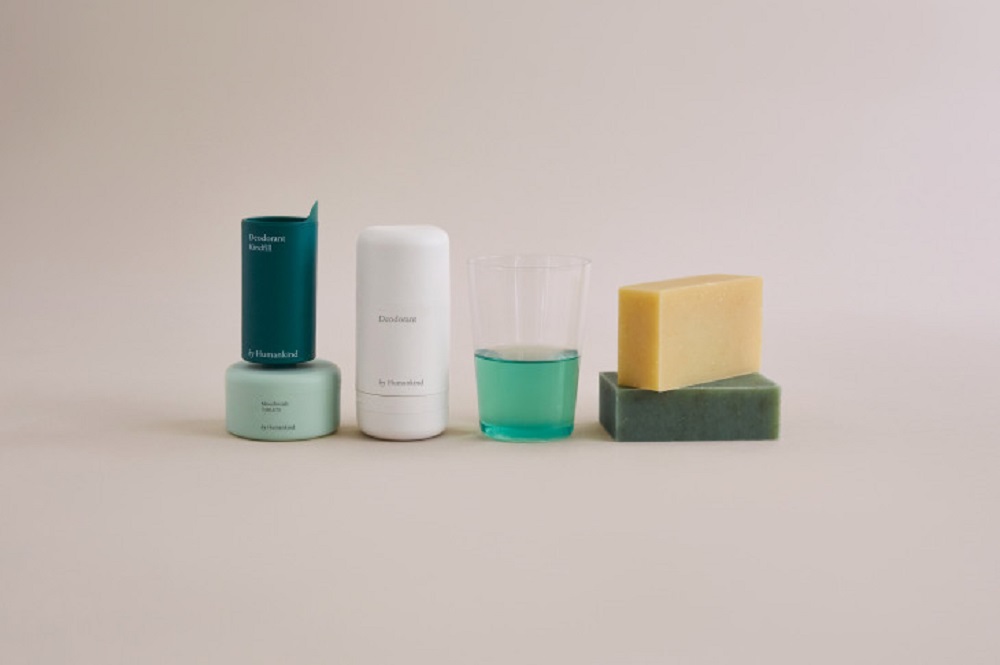
With co-founder Joshua Goodman, he started working on By Humankind, a new line of personal care products that launched today. Each product eliminates single-use packaging.
A new type of deodorant, made from natural ingredients that the company says are formulated to kill bacteria more quickly than other natural products, comes in a reusable container the first time you order. (The reusable container is plastic; the founders say they believe that plastic is not inherently bad, but it needs to be designed in a way that it doesn’t immediately land in the trash.)
In the next order, the product shows up in a paper pod that pops into the original package and then twists out like a typical deodorant. The company’s mouthwash comes in tablets that customers drop in water, eliminating the need for a plastic bottle. Its shampoo comes in a bar form wrapped in paper instead of liquid in a bottle.
Unlike Loop, a new experiment from major brands that will sell products like deodorant in packaging that is sent back to manufacturers for reuse, the startup thought that it made more sense to make packaging that consumers would keep and reuse themselves.
“We didn’t think that customers were going to want to do the work to send it back,” Bushell says. “And there’s also an additional cost in that reverse or return logistics.”
With the first three products, available online, the startup has calculated that in a year, an average American consumer can keep five pounds of plastic out of the environment. The company will also donate $1 for ocean plastic cleanup for each first purchase of a product. It plans to continue adding new personal care products.
“Our whole thesis is, what if you could help save the world from single-use plastic just by getting ready in the morning?” he says. “And so anything that’s within that morning routine is within our target.”
Starbucks Korea and 7-Eleven Thailand have announced positive results for their respective anti-plastic campaigns. A report revealed that the local Starbucks subsidiary has seen consumption of single-use straws cut by half in the months since introducing strawless lids on drinks without whipped cream or that do not need stirring. The initiative, introduced last November, has resulted in the monthly average of 15 million straws used across its coffee chain stores drop to 7.5 million per month. The company now only provides straws to customers who request them.
Aiming to further reduce straw usage by up to 70 per cent, Starbucks Korea is planning an online event to offer rewards to customers who upload pictures of drinks taken without using straws. It has also introduced paper straws for usage in some beverages.
7-Eleven saves 169 million bags
Meanwhile, in Thailand, more than 169 million plastic bags have remained unused over the past two months at 7-Eleven stores, according to a report in local news site The Thaiger, the result of a management initiative to phase out their use. The move, which has been supported by local celebrities, encourages shoppers to refuse plastic bags or bring reusable bags to the store.
The reductions are reported to have saved the chain more than 33 million baht, which operator CP All Public Company will donate to a local hospital.
All about perception?
Despite these reports, there have been growing concerns among critics in the media regarding the perceived environmental benefits of similar plastics initiatives worldwide.
The sippy cup lid adopted in Korea is identical to the design used in North American stores, which was shown in a Reason magazine report last year to use more plastic than the previous lid design and straw put together.
Plastic shopping bag initiatives similar to the one adopted by 7-Eleven have provoked skepticism among observers who point out that of all single-use plastic packaging used throughout supermarkets and convenience stores, the shopping bag is the only item that tends to be reused in the home.
A 2017 report in Australia’s journalism hub The Conversation called getting rid of plastic bags a windfall for supermarkets without much perceptible benefit to the environment. It reasoned that most alternatives that were recyclable ended up in landfills anyway.
For many in Korea, Lunar New Year is a time to meet relatives and exchange elaborately-packaged gift sets that could contain anything from fruits and raw meat to cans of Spam. But one side effect to this approach to gift giving is the excessive waste – especially those originating from gift set packaging – which has been brought up as a major concern by Korea’s environment authorities in recent years.
With growing government pressure and awareness about the environmental issues caused by excessive packaging, department stores and grocery franchises are trying to take the lead in adopting greener alternatives this year.
Colored Styrofoam and gel-based ice packs, which are notoriously difficult to recycle, are the first things to get scrapped.
Hyundai Department Store and Lotte Mart have both announced that they are replacing colored Styrofoam in gift sets with a plain white alternative starting from this holiday season. Previously, the companies added color to the material to add visual appeal. Colored Styrofoam materials are difficult to recycle because more money and manpower is required to create new Styrofoam products from them, making them unattractive to recycling companies.
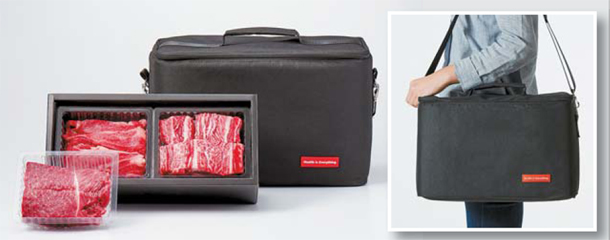
Lotte Mart Thermal Bag
Lotte Department Store is chilling gift sets of meat and fish with ice packs filled with water instead of gel-based ones for the first time this year.
Competitor Shinsegae Department Store is also ditching the hard-to-recycle wooden boxes and cloth wrapping it had previously used to package gift sets. It will use paper boxes instead.
Other retailers are collecting ice packs – both gel- and water-based – and recycling them themselves.
Department store chain AK Plaza said it will collect ice packs from AK Plaza-bought gift sets across all its stores until Feb. 10 for recycling and disposal.
Hyundai Home Shopping is taking it one step further and accepting ice packs regardless of their place of purchase. This year, it teamed up with Gangdong District office in eastern Seoul to install collection bins in 18 locations to allow customers to drop off used ice packs after the holidays.
“We’ve collected ice packs from our online shopping members in the past and decided to install public ice pack collection bins this holiday season,” said a Hyundai spokesperson. “We will send out the ice packs that we collect to our partners in the food industry so they can be reused.”
Lotte Mart is focusing on making gift bags more attractive and practical to encourage customers to use them even after the holidays end.
The thermal bags that come with its beef gift sets now have shoulder straps and a sleek black design, making them practical and user-friendly. While the thermal bags have always been reusable, they were previously covered with large Lotte brand logos and difficult to carry around.
The grocery chain is also going to package more fruit gifts this year in what it calls “recycle boxes.” The boxes, first introduced during last year’s Chuseok (harvest festival) holidays, are made of sturdy paper that can easily be reassembled into mini storage boxes.
“We didn’t register any copyright for our fruit ‘recycle box’ design so that other retailers can also participate in recycling and reducing disposable waste,” a Lotte spokesperson explained.
The businesses’ green initiatives follow the government’s consistent calls to reduce packaging and other waste during the Lunar New Year holidays.
As has become customary every holiday season, the Environment Ministry announced last month that it will work together with local governments to inspect gift sets being sold across retailers in the country and fine violators up to 3 million won ($2,700) if they do not comply with packaging rules.
Current regulations stipulate that gift sets can only be wrapped two times and that the volume of packaging must not exceed 25 percent of the product’s total volume.
Last Lunar New Year, the Environment Ministry fined the manufacturers of 49 products that were in violation of these rules. The total fine combined came to 52 million won ($46,000).
“We have seen a small decline in the number of products that violate excessive packaging regulations over the years,” said an Environment Ministry official in the recycling division. “The participation of companies to reduce packaging and comply with inspection is always a big help.”
South Korea is to ban big-time supermarkets and retailers nationwide from selling single-use plastic bags in an attempt to conserve natural resources and reduce recyclable waste. The ban will come into effect on Tuesday as part of a revised law on conserving resources and encouraging the reuse of recyclable waste. Subject to the ban are 2000 outlets of major discount chains and 11,000 supermarkets with sales floor spaces of 165sqm or more where handing out free plastic bags are currently prohibited.
Stores that violate the ban could face fines of up to 3 million won (around US$2683). Instead, those shops are required to offer customers recyclable containers, cloth shopping bags or paper bags.
Plastic containers for wet goods, such as meat and fish, will still be used.
Under the revised law, 18,000 bakeries nationwide will be barred from handing out free disposable plastic bags.
In cooperation with local governments, the Environment Ministry plans to encourage the affected stores to observe the ban from January through March.
The ministry is also pushing ahead with a plan to reduce the use of plastic garment bags at laundry shops.