Tag: real estate

  • Property Sector Will Continue to Face Headwinds in 2019

    Property Sector Will Continue to Face Headwinds in 2019

    Indonesia’s property sector will continue to face headwinds next year amid the usual uncertainties associated with an election year, a declining rupiah and rising interest rates, global credit rating agency Moody’s Investors Service said.

    In a report titled “Indonesian Property Developer Chartbook,” Moody’s rated eight of the country’s property developers, Bumi Serpong Damai, Lippo Karawaci, Sentul City, Intiland Development, Alam Sutra Realty, Agung Podomoro Land and Modernland Realty.

    “The chartbook [report] provides updated snapshots of the developers’ business positions, marketing sales trends, revenue, profitability, cash flow, liquidity, leverage and interest coverage ratios, debt maturity profiles, foreign exchange exposure and covenant quality scores,” Jacintha Poh, vice president and senior analyst at Moody’s Investors Service, said in a statement on Tuesday (04/09).

    Moody’s said further rupiah depreciation, along with rising interest rates, will hamper growth in the property sector.

    Bank Indonesia has raised interest rates by 125 basis points since May this year and many observers expect further increases towards the end of the year.

    The rupiah has depreciated by 11 percent against United States dollar so far this year and traded at 14,927 against the greenback on Wednesday, near its lowest point in 20 years.

    Moody’s found that five of the eight property companies did not have sufficient cash as of June 30 this year to repay their short-term debt. These are Agung Podomoro, Modernland Realty, Intiland Development, Sentul City and Lippo Karawaci.

    For example, Agung Podomoro Land had Rp 1.3 trillion ($87 million) in internal cash, while its short-term debt stood at Rp 5.9 trillion as of June 30. Intiland Development had Rp 976 billion, while its short-term debt stood at Rp 4.61 trillion.

    But the global firm noted that some of these companies have replaced short-term debt with longer-term debt, which in the end could improve their cash coverage ratios.

    Higher debt-funded capital expenditure and a surge in the cost of funding will further weaken some developers’ leverage and interest coverage ratios over the next 12 to 18 months, Moody’s said.

    The ratings agency also highlighted that most of the developers will generate operating cash flow over the next 12-18 months, but only Pakuwon Jati, Bumi Serpong Damai and Intiland Development will be able to generate free cash flow – allowing them to expand, reduce debt or pay dividends to shareholders.

    However, Moody ‘s still expects demand for property to recover next year. The increase in new property projects, sales promotions and lower property prices will boost demand and support an improvement in marketing sales.

    Moody’s said in the report that the marketing sales of Bumi Serpong Damai, Alam Sutra Realty and Modernland Realty have exceeded 50 percent of their full-year target in the first half.
  • Indonesia Apartment Sales Slump in H1 2018, No Sign of Recovery

    Indonesia Apartment Sales Slump in H1 2018, No Sign of Recovery

    Apartment sales in Jakarta slumped in the first half of this year, due to a lack of confidence among top-tier buyers to commit to big-ticket purchases amid economic and political uncertainty, property consultancy Jones Lang LaSalle said on Wednesday (18/07).

    However, the silver lining is that demand for lower- and middle-class apartments has kept growing, although it was barely enough to curb a further sales decline in the rest of the year.

    Developers sold 2,100 units in the country’s largest property market between January and June, which is 6.2 percent less than in the corresponding period last year, Jones Lang LaSalle said in the report.

    The slump was mainly cause by a decline in sales of the most expensive units, the consultancy said. The government imposed a 20 percent luxury tax on sales of apartments worth Rp 10 billion ($694,000) or more in March last year, further curbing top-tier buyers’ appetite for new apartments.

    “For most people, the condominium is the part of an investment,” Vivin Harsanto, head of advisory at Jones Lang LaSalle, said on Tuesday.

    “In the first half of this year, they were still not confident enough because of volatility of the rupiah, and they also held off purchases of investment products due to the fasting month and the Idul Fitri celebration,” she said.

    Vivin said there is always a slowdown in apartment sales during Ramadan as consumers are usually more focused on other needs, such as going on holiday and the Idul Fitri celebration.

    Still, demand for lower-cost apartments – priced between Rp 300 million and Rp 500 million – remains robust and growing. Cleon Park, a middle-class apartment project in East Jakarta by listed property developer Modernland Realty, was sold out when it launched in May, according to Luke Rowe, head of residential project marketing at Jones Lang LaSalle.

    The consultancy said in the report that there might be an improvement in property demand as some large, reputable developers offer units close to public transportation, such as the mass rapid transit and light rail transit systems, currently under development in Jakarta, while smaller developers are offering more affordable units.

    Bank Indonesia has dropped its requirement for mortgage down payments in April this year. It formed part of the central bank’s effort to ensure domestic economic growth after it had to increase its benchmark interest rate by 100 basis points in the preceding three months to maintain economic stability amid global capital outflows.

    Still, Vivin said she does not expect the central bank policy to significantly impact current sales trends, which have been on a decline since 2014.

    “[Apartment buyers] want to see a stable rupiah and a steady political situation as we enter an election year in 2019,” she said.

    According to research by Jones Lang LaSalle, apartment prices in the greater Jakarta area are expected to remain flat amid weak demand for the remainder of the year.

    Developers only built 1,292 units between January and June this year, bringing the number of total unsold units to 144,000. In the same period last year, developers built 4,843 units, resulting in total stock of 134,536 units.

  • Bid to Revive Property Market Highlights Bank of Indonesia’s Policy Dilemma

    Bid to Revive Property Market Highlights Bank of Indonesia’s Policy Dilemma

    As Indonesia’s central bank drives up interest rates to defend a fragile currency, governor Perry Warjiyo is banking on a revival of the sluggish property sector to help maintain growth momentum in Southeast Asia’s biggest economy.

    Five years ago, luxury Indonesian apartment prices skyrocketed amid a commodities boom that saw some wealthy buyers pay cash upfront. The boom’s end, slower economic growth and rules to curb property speculation slammed on the brakes.

    Now, authorities want to encourage buying. From August, the central bank is scrapping its 15 percent minimum mortgage down payment for first-time home buyers and relaxing rules on loan disbursements, in a bid to support listless credit expansion.

    “We need to support our economic growth,” Perry said in a recent interview, asserting that property can have a multiplier effect on other sectors.

    This comes as Indonesia is caught in the cross hairs of an emerging market sell-off that caused the central bank to raise interest rates by 100 basis points in six weeks, to defend the rupiah.

    Filianingsih Hendarta, a senior Bank Indonesia (BI) official, estimates the eased mortgage rules will add 0.04 percentage points to economic growth this year. That sounds small, but Indonesia’s higher interest rates will reduce its growth pace, making a net gain from the rule changes welcome.

    BI’s growth forecast is 5.1-5.2 percent, compared with 2017’s 5.07 percent.

    But given the absence of a hot commodity market and the rising interest rates, seeking to make property an economic pillar might highlight authorities’ lack of credible policy options in the current environment.

    A Pedestrian Pace 

    Standard & Poor’s expects property sales to be flat this year despite BI’s new measures.

    “We don’t think there will be a major recovery, everything will probably move at pedestrian pace until the second half of 2019, after elections at best,” analyst Kah Ling Chan said, referring to parliamentary and presidential polls next April.

    In recent years, Indonesia’s biggest online housing broker Rumah123.com, part of Australia’s REA Group, has recorded sluggish sales.

    “The number of buyers seems to be stagnant now,” country manager Ignatius Untung of Rumah123.com said.

    Bankers have said they will not completely remove downpayments and instead will adjust the interest rates on home loans based on a customer’s risk profile.

    Roosniati Salihin, deputy president director of Bank Panin , said tepid demand is a major problem for property. “The market needs to be reinvigorated. The banking sector is only waiting for customers to walk in,” she said.

    Soelaeman Soemawinata, chairman of the Real Estate Association of Indonesia, said its “most optimistic scenario” is for the number of units sold to increase by 10 percent in the next year.

    “But the property industry is hard to predict,” he said. “People’s psychology affects this.”

    Preference for Renting

    The younger generation prefer to rent than purchase a home, said Handayani, consumer banking director of Bank Rakyat Indonesia.

    “Kids nowadays prefer to rent and to travel whenever they have spare money,” she said.

    Even if banks start requiring no downpayment at all, that would mean higher installments for customers, which won’t sit well given higher interest rates, said Aldi Garibaldi, senior associate director of Colliers International Indonesia, a property services firm. He said he does not think BI’s measures will be enough to spur demand.

    While BI’s easing is welcome, the central bank should take it up a notch by scrapping rules on the maximum number of credit facilities per person and allow banks to dispense more cash upon signing loan documents, said Adrianto Adhi, president director of developer Summarecon Agung.

    BI’s announcement on mortgages has spurred some young Indonesians to consider home-ownership.

    Newly married Khaerul Estian, a 28-year-old who works in a bank, has started looking. He hopes not to have to make any down payment, given small savings. But Estian intends to buy, even if higher interest rates raise the ultimate cost.

    “It’s a risk, but the most important thing is to own a house,” he said.

  • Cheap real estate in Vietnam draws scores of Chinese buyers

    Cheap real estate in Vietnam draws scores of Chinese buyers

    Vietnam has become an up and coming property investment destination among Chinese and Hong Kong buyers with real estate prices lower than in other Southeast Asian countries.

    Demand for properties in Vietnam among Chinese buyers surged 300 percent year-on-year in the first quarter of 2018, Chief Executive Carrie Law of Juwai, one of the biggest international property portal in China said.

    “Many investors from mainland China are hoping to see these cities [Ho Chi Minh City, Hanoi] replicate the same growth as Beijing and Shanghai,” said Stephen Wyatt, the country head of JLL Vietnam.

    Buyers from mainland China, Taiwan and Hong Kong last year accounted for 25 per cent of the Southeast Asian nation’s total transactions by foreign buyers, up from 21 per cent in 2016, according to data from real estate company CBRE Vietnam.

    Analysts say relatively low prices in Vietnam, one of world’s fastest growing economies, and the desire for Chinese buyers to diversify their portfolios given their limited assets overseas, make markets like Ho Chi Minh City, Hanoi particularly attractive.

    A high end property in central Ho Chi Minh City costs $3,000 to $6,000 per square meter. However, its equivalent in Bangkok costs around $7,000 to $9,000 per square meter, and still less than 10 percent of the value of Hong Kong properties.

    Vietnam’s relaxed restrictions on foreign property ownership are also believed to have facilitated the surge in Chinese and Hong Kong buyers, but to a lesser extent because bureaucracy remains a strong barrier.

    The 2015 Housing Law allows foreign investment funds, foreigners with valid visas, international firms with operations in Vietnam and overseas Vietnamese to buy residential properties with leaseholds of 50 years.

    And developers are allowed to sell only 30 percent of the units in each building to foreigners, meaning eligible apartments need to be advertised.

    However, analysts warned about the possibility of a real estate bubble in Vietnam, which is similar to the historic one in 2008.

    Eight out of 10 signs of a real estate bubble have been identified in the Vietnamese market, said Tran Kim Chung, deputy director of the Central Institute for Economic Management (CIEM) at a conference last week.

    Local residents and real estate agents said the price doubled last year’s, and has climbed a further 30-50 percent so far this year.

  • Overlook to the future Chinese Real Estate market

    Overlook to the future Chinese Real Estate market

    Since the origination of REITs in the United States, in the 50 years of its development, REITs in the United States, Singapore, Japan has been running on a rather perfect system, with legal policies and tax system. REITs was able to help the countries in growth, sustainable decisions, and the industry coordination. China had the first REITs in 2005. Since then, REITs in China have been moving forward, to seek further opportunity.

    The new age of investment has come. PE is the most anticipated type of investment that most of the investors that are eyeing for. According to Asset Management Association of China, by the end of Februrary 2018, PE Fund pool have reached monthly growth of 250 billion Yuan, totaling 12 trillion Yuan. It has its competition to Public Placement.

    With the development of Real Estate Equity Fund and REITs, an increase in the amount of firms are interested to be a part of it. As the fundamental, Finfo Global along with CaishiV is going to host the 2nd Real Estate Equity Investment & REITs in Shanghai on May 17. The event have gathered worldwide trust firms, insurance company, law firms, securities, asset managements and banks. The event is excepting more than 300 managerial positioned attendees.

    At the event, Weida Kuang from China Remin University, National Development and Strategy Institution, City and Real Estate Institution with be introducing his ideas over the macro economy and the effect of the industry of real estates. Also, there are newly added topics such as low-cost rental housing, public rental housing, rental housing REITs, investment opportunities in second and third tier cities, offshore real estate PE Fund and its structuring,

    To learn more, please go to: https://www.peinreits.com/index.php/en/index.html

  • 92% of Malaysians prefer to own than rent

    92% of Malaysians prefer to own than rent

    Despite the rising perception that more Malaysians would choose to rent than to buy a home, statistics from the recent PropertyGuru Consumer Sentiment Survey show that 92% of those polled would rather own the roof over their heads than to lease.

    Among those polled, about 33% were presently renting with 67% residing in their “own homes”. Own homes are regarded as homes that are owned by their dwellers or it could be a family home, staying with a sibling or relative and other non-rental residences.

    A total of 817 respondents participated in the PropertyGuru’s Consumer Sentiment Survey for the second half of 2017.

    The survey shows that the traditional aspiration of owning a home remains largely unchanged despite evolving property market trends and demographics.

    For those who would prefer to rent, the majority cited a location that is close to their office or workplace as the most important criterion (71%), followed by family considerations (55%) and public transportation accessibility (52%) respectively. High-rise homes are the preferred option for renters with condominiums and serviced apartments being the top choice.

    “It appears that despite rising living costs, higher loan rejection rates and price unaffordability, Malaysians including the younger generation still would make home ownership a key lifestyle aspiration. The desire is very strong perhaps due to family or peer pressure or due to the prevalence of traditional perceptions of owning a home as being a sound foundation for one’s future,” said PropertyGuru Malaysia country manager Sheldon Fernandez.

    “Beyond providing a place to stay, a home to Malaysians still represents stability, security and continues to be a key asset class for wealth accumulation via capital appreciation and rental yields.”

    Fernandez added that the PropertyGuru survey also showed that even many of those who are presently renting also aspire to buy a home if they can afford it.

    Renters believe that RM501-RM800 monthly to rent a room was a realistic budget while those looking to rent a home would ideally wish to pay RM801-RM1100 per month, depending on location, property type, unit size and other factors.

  • Vietnam property sales rise in January

    Vietnam property sales rise in January

    The domestic property market reported more sales in January compared to December 2017, according to the Ministry of Construction’s Housing and Property Market Management Department.

    It said that in January, Hà Nội had 1,650 transactions, an increase of 13.8 per cent and HCM City had 1,900, a rise of 8.6 per cent over December’s figures.

    In Hà Nội, many housing projects have been completed and offered with attractive trade promotion programmes. The offerings are in the high- and mid-end segments and are located in convenient places. There are many kinds of area and payment methods can be flexible, the department said.

    Some projects had many sales in January, including Season Avenue, Hà Đông; An Bình City-Bắc Từ Liêm; Sunshine Riverside Tây Hồ and Romance Plaza, Hà Đông.

    Average offered price of an apartment in January rose 0.14 per cent against the December price. Of which, the price surged 0.17 per cent for high-end apartments, 0.05 per cent for mid-end apartments and 0.56 per cent for affordable apartments.

    Price of house on land had an increase of 0.24 per cent compared with December.

    Liquidity on the HCM City property market also increased in January. High- and mid-end apartment segments reported many sales.

    Customers paid attention to apartments having one or two bedrooms and price at about VNĐ1 billion (US$44,000) per unit, but the supply was low.

    Projects reporting many transactions included New City Thủ Thiêm, District 2; Saigon Intela-Bình Chánh District; and Melosa Garden, District 9.

    Average selling price increased 0.24 per cent for apartments and 0.81 per cent for house and land.

    The price declined 0.05 per cent for high-end apartments, but rose 0.33 per cent for mid-end apartments and 0.53 per cent for affordable apartments.

    The department said that by January 20, the value of the property inventory stood at VNĐ25 trillion, a drop of 19 per cent from the previous month.

    The value of property inventory in January was VNĐ5.27 trillion in Hà Nội, VNĐ19 billion lower than the value in December.

    In HCM City, the property inventory was VNĐ4.62 trillion, a fall of VNĐ47 billion.

    According to the State Bank of Việt Nam’s report, total outstanding loans in the property sector reached VNĐ446.36 trillion in the third quarter of 2017, a quarter-on-quarter increase of 2.1 per cent.

    Resort property

    The department also had a report on development of resort property, the hot spot on the property market.

    In the report, the Ministry of Construction appraised 71 “condotel” and “officetel” projects that have been built nationwide since 2015. .

    Meanwhile, provincial and municipal authorities have given licences to develop many more projects.

    However, many difficulties have arisen over investment, construction, trading and management of operation for those projects, the department said.

    Therefore, the ministry has proposed that the Prime Minister direct ministries to solve them.


  • Titijaya Land teams up with Tokyu Land

    Titijaya Land teams up with Tokyu Land

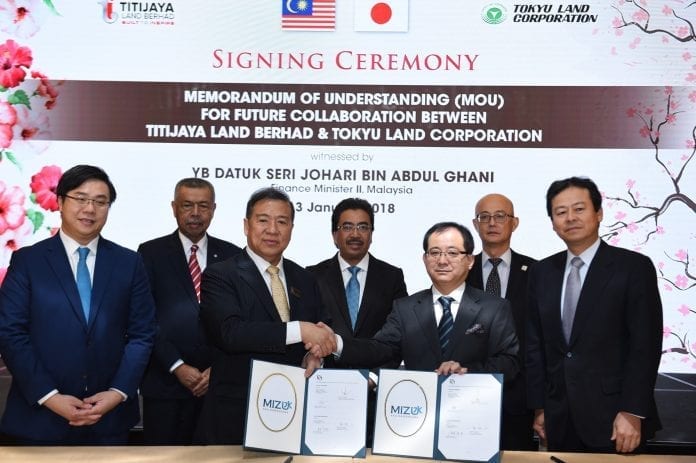
    Bursa Malaysia-listed property developer Titijaya Land Berhad (Titajaya) has signed a memorandum of understanding with Tokyu Land Corporation (TLC) to establish a provisional collaboration in the real estate industry.

    In a statement, Titijaya said it will share and exchange knowledge and expertise with TLC with the intention of further revolutionising their real estate development and to explore potential collaborations for any property development projects that either of them may undertake.

    TLC, founded in 1953, is a real estate firm involved in urban development, wellness and overseas business. It is a core subsidiary of the Tokyu Fudosan Holdings Group, a Japanese company listed in the Tokyo Stock Exchange.

    “By entering into the MOU, we are able to leverage on TLC’s strength to further revolutionise our business,” said Titijaya Land Group Managing Director Tan Sri Dato’ Lim Soon Peng.

    TLC is to establish itself in the Malaysia property development sector by capitalising on Titijaya’s current and upcoming market, he added.

    TLC is known for its technology, expertise, creativity, and innovative knowledge in developing and marketing real estate with an edge, putting it a class ahead in the urban property development realm.

    This includes multiple large-scale projects in Shibuya (birthplace of TLC), Ginza, Takeshiba, and other urban areas.

    Its development in Shibuya is a transit-oriented development (“TOD”) concept with a bus terminal as well as tourist support facility that supports the activities of local and international visitors. TLC also has a good track record in property

    According to the MOU, Titijaya and TLC are desirous of collaborating in real estate development areas such as, but not limited to, residential, office, transit oriented development, senior housing, urban hotels and other forms of hospitality, commercial and retail properties.

    It also includes property management and operations, as well as the establishment of or investments in real estate investment trusts (“REITs”).

  • Asian Pac’s diverse and original real estate projects attract Asia-Pacific investors

    Asian Pac’s diverse and original real estate projects attract Asia-Pacific investors

    Touted as Kota Kinabalu’s one-stop premier shopping destination and one of its largest retail establishments, Imago KK Times Square has set the bar for shopping centres in Sabah’s flourishing capital.

    Encompassing 800,000 sq ft of world-class retail, entertainment and dining outlets, the four-level landmark mall forms part of KK Times Square – a modern, vibrant and strategically located 24-hectare mixed-use development project comprised of office, residential and commercial space.

    It is Kota Kinabalu’s first non-stratified retail establishment with wholly management-owned and operated tenant stores. Since its opening in 2015, it has reached a tenant occupancy rate of 90 per cent with more than 300 retail outlets.

    Imago shopping mall and KK Times Square would have been but invisible twinkles on the Kota Kinabalu horizon without the initiatives of industry-leading Malaysian real estate developer Asian Pac Holdings.

    A company that is forging a reputation as the partner-of-choice among Asian and Chinese developers, consultants and contractors, Asian Pac is reputed for its first-mover advantage, strong local market knowledge and industry expertise honed over more than 100 years.

    With a portfolio of projects ranging from landed real estate, strip malls and high-rise residential towers to township developments and niche projects such as industrial parks, Asian Pac’s generalist approach to property development is a key advantage.

    “Being able to tackle a wide range of property types gives us strength in planning wider scale or stand-alone projects effectively,” says managing director Mustapha Buang. “Our differential edge is that we look into areas others tend to overlook with educated research. We focus ahead and look at what the potentials are. To a certain degree, we have a first-mover approach by looking into locations, themes and ideas that people have never tried before.”

    Led by a strong management team of young multidisciplinary professionals, Asian Pac traces its expertise and origins back to 1913. The company entered Kota Kinabalu in the early 2000s through its construction of KK Times Square.

    Apart from Imago, KK Times Square also houses The Loft Residences – Asian Pac’s premier residential address featuring an exclusive and integrated lifestyle experience.

    Nestled within KK Times Square’s vast leisure and recreational space, The Loft Residences offers 631 highly sought-after units ranging from US$413,898 to US$658,739 – and serviced apartments 1,834 to 4,192 sq ft in size.

    Listed on the main board of the Bursa Malaysia exchange, the company’s business interests include investment holdings, property development and investment, mall and carpark ownership and trading in building materials. By focusing on property investments with recurrent income such as the ownership and management of around 2,500 car parking bays in KK Times Square, Asian Pac keeps itself afloat through economic fluctuations.

    “We are able to renew ourselves frequently because we are quite a small team – compact, agile and capable of quickly adapting to changes,” Buang says. “We do everything in-house from leasing to facility management.”

    Asian Pac’s upcoming projects include investments in off-the-radar land banks. It also envisions to expand beyond Malaysia in the future.

    Driven to beget positive change in Malaysia through sustainable modernisation, Asian Pac has also earned the BCA Green Mark for its environment-friendly projects. Certified by Singapore’s Building and Construction Authority, the BCA Green Mark scheme is an initiative to promote sustainability in the construction and real estate sectors.

    “We always see how to make things work rather than see how things can’t,” Buang says. “We’ll still be looking at creating really sustainable projects that work long-term, and we’ll never say no to potential investors and partners who can bring added value to the table in terms of concepts and ideas – not just in the monetary sense.”

  • Foreign Investment Hotspots In Asia Pacific

    Foreign Investment Hotspots In Asia Pacific

    Cross-border real estate investment in the Asia Pacific region could achieve a record high this year as foreign investors shore up interest and seek assets in greener pastures beyond borders.

    As it stands, year-to-date intra-regional cross-border transaction volumes have already exceeded the previous 10-year record high in 2015 (1Q15-3Q15) by 30 per cent, and is currently a 21.8 per cent step up from its 10-year average (2007-2016).

    Singapore the main source of intra-regional capital

    Chinese would be the largest group of foreign investors if inter-regional flows were part of the picture. But in the context of intra-regional capital flows (which only considers deployment within Asia Pacific), Singapore continues to dominate with year-to-date foreign investments currently standing at US$5.6 billion.

    China (US$2.1 billion) and Hong Kong (US$2.9 billion) were ranked second and third respectively given a significant portion of capital are recycled between the two closely-integrated countries.

    These three countries make up 85 per cent of total source of foreign capital within the region.

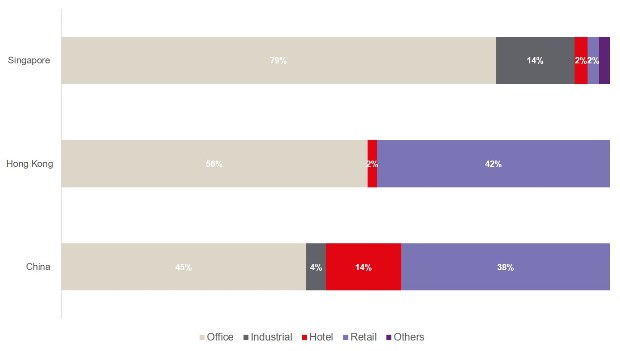
    Much of the capital from these countries is allocated to office assets. From the standpoint of Singapore investors, most are seeking to plough capital in gateway cities such as Melbourne and Sydney, which offer steady and attractive income streams.

    79 per cent of Singapore capital has been allocated into outbound office assets, with 11 out of 18 of the office assets acquired based in Australia.  One such cross-border deal is the acquisition of 206 million Telstra Plaza building by Singapore’s ARA Asset Management and co-investment vehicle Straits Real Estate.

    While 45 per cent of China capital is allocated to office assets, most are flowing into Hong Kong strata-titled opportunistic assets, with a focus on capital growth.

    Figure 1: Allocation of intra-regional cross border capital outflow by asset classSource: JLL

    Australia and China most popular for foreign investors

    Australia and China draw the most foreign investments given assets in those markets generally offer more attractive yields. But relative to domestic purchasers, (Figure 3) India stands out with 65 per cent of its total transactions coming from foreign investors (all of which were Singapore based institutional funds investors).

    One notable example was Singapore sovereign wealth fund GIC’s US$1.4 billion joint venture with DLF Cyber City Developers, which also happened to be the largest cross border deal year-to-date.

    These investors are looking to ride the investment wave via debt deals and joint ventures with local partners, as the market continues to grow in depth and demonstrates their willingness to shift from traditional markets if the opportunity presents itself.


  • Kiwi Property launches virtual reality fashion show

    Kiwi Property launches virtual reality fashion show

    Landlord investment firm, Kiwi Property, has launched  the first 360° virtual reality fashion show in Aotearoa, allowing consumers to see spring fashion collections via headsets.

    Launched as the Non-Stop Fashion Show, shoppers are invited to don a VR head set to be transported to the front-row of a fashion show with 360° views of the catwalk, featuring the latest fashion trends from retailers at Kiwi Property-owned centres..

    “We hope to provide our customers with an exciting experience in a convenient, inclusive and accessible space; we’d like to show them that style can be fun and attainable,” said Karlee Lightbourne, national marketing manager at Kiwi Property.

    “We’re dedicated to create exceptional experiences for our customers, as we continue to evolve in step with demand,” she said.

    A 24-camera unit from Jaunt One was used to film the show, which is a Hollywood-quality 360° camera and shoots in every direction.

    “Shot in 3D, anyone can come in and put on a headset for a front-row seat at a live high-end fashion show,” said Craig Whitehead, chief creative officer from creative agency 99 who has worked with Kiwi Property on the campaign since late last year.

    “It’s all about connecting New Zealand shoppers with fashion inspiration in a whole new way, something we’re really excited about.”

    The show is being screened via Vodafone Smart V8 smartphone devices and will feature at

    Sylvia Park and LynnMall in Auckland, Centre Place in Hamilton, The Plaza in Palmerston North, Northlands in Christchurch and North City in Porirua.

  • Hang Lung profits hit by falling rents

    Hang Lung profits hit by falling rents

    Falling rents have hit profits for Hang Lung Properties, which has posted a 4 per cent decline in underlying net profit to HK$3 billion (US$383.9 million) in its first half.

    Asset-enhancement initiatives in Hong Kong and Shanghai also caused disruption of rental income, but this was for a short term and had been expected.

    However, total operating profit rose 5 per cent to $4.541 billion and $4.743 billion year on year for Hang Lung Properties and Hang Lung Group respectively.

    Chairman Ronnie Chan Chi-chung says the group achieved a solid performance on its core leasing business against a backdrop of challenging business conditions, and a yuan depreciation of 5 per cent.

    Rental income from its eight mainland shopping malls rose 2 per cent to RMB1.338 billion (HK$1.55 billion), with the rental revenue of Shanghai Plaza jumping 23 per cent.

    Total revenues of the six malls outside Shanghai fell 3 per cent, however, with some having to downwardly adjust rents to optimise tenant mix and occupancy, says the group.

    For instance, rental income at its Shenyang mall dropped 28 per cent, as it had to replace non- performing tenants, but the retail sales had mild growth despite lower occupancy.

    In Hong Kong, commercial portfolio revenues slipped 1 per cent to $1.118 billion, but Chan says the group’s main business focus is on the mainland where it has 250 million sqft of land reserves awaiting development.

    However, the group may also consider undertaking more redevelopment projects in the old districts of Hong Kong.

  • PropNex spreads wings to Indonesia; next stop Vietnam

    PropNex spreads wings to Indonesia; next stop Vietnam

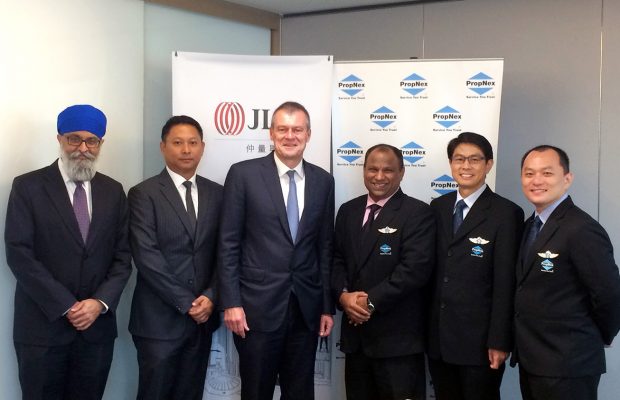
    Amid a lacklustre housing market at home, PropNex Realty, one of Singapore’s largest real estate agencies, embarked on its first regional expansion in the second half of last year with its entry into the massive Indonesian market.

    “The reasons were quite clear. We have been in existence for 17 years. The first 15 years we had no intention to go regional because the market was very much upbeat,” said PropNex CEO Ismail Gafoor in a media briefing ahead of the company’s grand opening in Indonesia next Tuesday.

    “When all the cooling measures started we straightaway had a strategy … It was time for PropNex to go and stretch its wings regionally.

    “Naturally, we selected Indonesia because a lot of Indonesians, wealthy investors, do have a home in Singapore and they always see Singapore as a safe haven, secure and a place for schools and financial businesses … Also, among the Asean countries it has the highest population of 260 million.”

    PT PropNex Realty Indonesia, set up through a master franchise arrangement, has grown to seven offices with a sales force of 600 within a few months, said Mr Ismail, adding he was confident it will cross the target of 1,000 by the end of the year.

    Affluent Indonesians continued to show keen interest in Singapore’s properties, he added.

    There have been “numerous sales” with Indonesian buyers picking up mass-market condominiums, he said, noting that there will be “natural interest” among Indonesians in the higher end of the market if prices drop further.

    PropNex has Vietnam next in its sights as it continues its regional expansion, but it is still in the early stages of finding a partner, said Mr Ismail.

    He said there has been little immediate impact from last Friday’s easing of property cooling measures and loan curbs in Singapore.

    “Over the weekend, we have not seen any push in activities or buying interest patterns. To me, these are all not the key drivers. The key drivers … would be to tweak the Additional Buyer’s Stamp Duty (ABSD) for the second and third properties for locals and foreigners,” he said.

    Nonetheless, Mr Ismail welcomed the easing as a “positive step”.

    Under the latest changes effective from last Saturday, the Seller’s Stamp Duty (SSD) will be payable if a homeowner sells his or her property within three years of purchase, down from four years previously.

    The SSD rates will also be lowered by 4 percentage points for each tier — to 4 per cent for properties sold in the third year; 8 per cent for those sold in the second year; and 12 per cent for those sold within the first year.

    In addition, the Government will no longer apply the Total Debt Servicing Ratio (TDSR) framework to mortgage equity withdrawal loans, with loan-to-value ratios of 50 per cent and below.

    The Government had imposed a series of cooling measures and borrowing curbs since 2009, to rein in a steep jump in home prices as the economy emerged from the global financial crisis.

    These measures included the SSD, ABSD, tighter loan-to-value ratios and mortgage servicing ratios, as well as the TDSR, among others.

    From the recent peak in 2013, private home prices in Singapore have fallen 11.3 per cent, while resale HDB prices declined 9.9 per cent, reflecting the sustained impact of the loan curbs and cooling measures.

  • First Japanese apartments in Phu My Hung launched

    First Japanese apartments in Phu My Hung launched

    Prestigious real estate developer Phu My Hung plans to launch its new apartments, developed in cooperation with three leading Japanese partners, in Ho Chi Minh City in the coming weeks.

    The Grande is built over 5,540 square meters. The 26-floor building, with two basements, has 309 apartments and 13 shops. There are options for apartments ranging from 69 and 249 square meters with one to four bedrooms. Two-bedroom apartments account for 62 percent of all the units.

    Customers will have 28 months to pay for half of the prices, the investors said. They will pay another 45 percent when receiving the apartment and the remaining 5 percent when receiving the ownership certificate.

    The project is guaranteed by Vietcombank’s South Saigon Branch and Vietnam International Bank, which also work with the investors to provide interest rate support for customers seeking bank loans.

    Midtown, a complex of condos, office and retail space and amusement centers, is Phu My Hung’s biggest investment the past three years, with many high-end facilities, some of which have never appeared at any Phu My Hung projects.

    Phu My Hung Midtown hopes to bring a new concept about living space, which should be a perfect combination of facilities instead of an individual house.

    The complex is the first one built with cooperation from three leading Japanese property developers – Daiwa House Group, Nomura Real Estate Group and Sumitomo Forestry Group, which together account for 50 percent of the property market in Japan.

    A Phu My Hung executive said Japan is a country with good infrastructure and great experience in infrastructure development, especially for complex and high-rise buildings.

    “Our meaningful cooperation with strong, experienced partners will help achieve desired goals and quality in our construction projects,” he said.

    The complex is designed as a multi-facility zone at different levels, allowing its residents to access all kinds of services from inside to outside the house without having to go far.

    Golf simulation studio inside The Grande.

    Golf simulation studio inside The Grande.

    The Grande, for example, is designed with many exclusive services for its residents such as swimming pools, BBQ areas, gardens, yoga courts, golf simulation studio and libraries.

    All the facilities are built based on careful research of the habits and interests of residents, making sure all members of a family can find some activities that suit them.

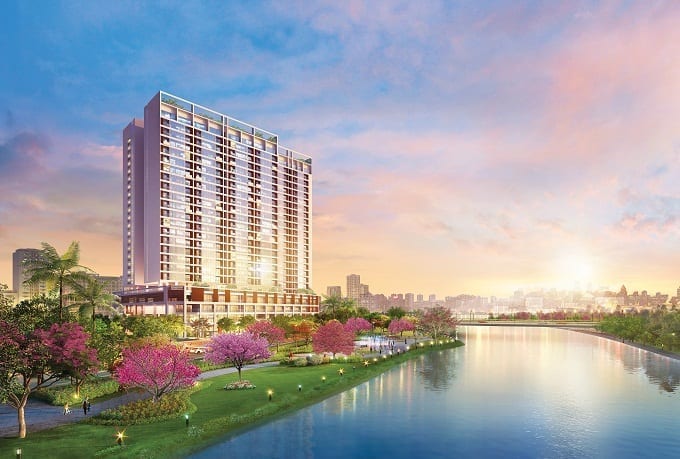
    The residents will also be able to enjoy the value of Sakura Park, which stands across the apartments with riverside views of beautiful trees and flowers.

    There are other facilities such as a sports complex, a recreational area for children with sections for different ages, a flower square, a water fountain and a pavilion. The project is entirely protected with a security system that will guarantee the privacy of all residents.

    Sakura Park runs 602 meters along the Ca Cam River. It covers 11,722 square meters, with construction on 6,414 square meters or 54.7 percent of the area, and natural plants on 5,308 square meters (45.3 percent). The park comprises three parts – the main square, a kids playground and a sports area.

    Facilities around the complex, including a cherry blossom park, represent a new style in Phu My Hungs quality housing development.

    Facilities around the complex, including a cherry blossom park, represent a new style in Phu My Hung’s quality housing development.

    The recreational area for children and two gardens nearby allow residents to relax while watching their children. Sakura Plaza, a square at the center of the park, carries the shape of a cherry blossom. The square features a fountain with beautiful jets at different heights, dotted by colorful flowers.

    Besides the sports complex and the mini football court, the sports area of the park also gives families some space if they want to have a picnic day and enjoy the fresh air.

    The park also has parking space for more than 150 cars, which is conveniently connected to other parts in Midtown.

    “Phu My Hung Midtown complex with the impressive Sakura Park promises to be a must-visit place for Saigon residents in the future. Here we have a lot of green space, natural harmony and many interesting activities for sports, dining and entertainment,” the investor said.

    The first phase of Sakura Park will complete in 2019, around the same time with the first apartment building of the complex, The Grande.

  • The outlook for Singapore’s real estate market in 2017

    The outlook for Singapore’s real estate market in 2017

    Singapore’s soft real estate market in Singapore was given a boost last year. Investment volume rose 34 percent year-on-year to US$9.4 billion, underpinned by major deals such as the sale of Asia Square Tower 1 and a series of transactions, including a top bid for the prime Central Boulevard white site in the Marina Bay area.

    “The Singapore property market is poised for a recovery in 2017. GDP growth and inflation are expected to pick up in 2017, driving stronger demand for real estate,” says Regina Lim, JLL’s National Director, Advisory and Research, Capital Markets. “In most sectors, we also saw an increase in transaction volumes, including residential property sales and office building transactions.”

    The Lion City is traditionally seen as a safe haven for property investment. It is likely that investment volume will hold up 2017 even as new supply continues to enter the market. Among them are Grade A buildings in the Central Business District, Marina One and Tanjong Pagar Centre. These new office buildings have attracted stronger than expected pre-commitments. And about 50 percent of the office space in buildings completed in 2016 to 2017 have already been leased.

    The sale of Central Boulevard at S$2.57 billion, or S$1,689 per square foot per plot ratio, which is the highest bid ever for a Government Land Sale site in Singapore, signals strong investor optimism – with projections that prime rents would rise over the next five years.

    Retail and residences
    “While demand for office, retail and food and beverage real estate slowed between 2012 and 2015, we believe this bottomed out in 2016 and we expect a modest recovery in the next couple of years,” says Chris Fossick, Managing Director, Singapore and Southeast Asia, JLL.

    Gross domestic product is expected to grow 2.3 percent in 2017, an increase from 1.8 percent in 2016.

    The stronger tourist arrival figures and slightly higher economic growth will help bolster retail assets. “We expect more retail malls to transact. Good quality, well-positioned retail assets are likely to be attractive to core investors as yields are still higher than office assets, and occupancies have always been resilient even in recessions,” adds Lim.

    Singapore’s prime residential market remains attractive for investors compared to other global cities. The latest data from JLL shows that prime residential prices are 126 percent higher in Hong Kong, 62 percent higher in New York and 22 percent higher in London.

    And based on JLL estimates in a report, luxury prime properties in Singapore have corrected on average 18 percent, while mass market prices have softened about 10 percent.

    Developers are keen to attract buyers and beat the deadline of selling units within two years of completion as mandated by the Residential Property Act by offering discounts and block deals. Nearly S$2 billion worth of residential units were sold via block deals or structured vehicles in 2016; more of such deals are expected in the next two years.