Tag: telecom

  • Samsung supplying 5G NR solutions for Sprint

    Samsung supplying 5G NR solutions for Sprint

    Samsung has announced at Mobile World Congress this week that it is supplying its 5G new radio solutions for US operator Sprint‘s 5G new radio solutions.

    Sprint is deploying Samsung’s 5G NR solution, which combines Samsung’s existing Massive MIMO technology with new software and a new channel card, in one of its first 5G cities, Chicago.

    The operator plans to launch its 5G network in Chicago, Atlanta, Dallas and Kansas City in May as part of a nationwide launch, and plans to go live in five more cities in the first half of 2019.

    Sprint has been using Samsung’s Massive MIMO technology in its 2.5-GHz TD-LTE network since 2018. The modular nature of the upgrade will allow Sprint to offer both LTE and 5G services on the same radio using the split-mode capabilities of the MIMO solution.

    “Our collaboration on massive MIMO has delivered significant LTE capacity and speed enhancements,” Sprint SVP of network deployment and operations Scott Santi said.

    “With 5G, we look forward to giving Sprint customers even greater experiences from gaming and entertainment services, to IoT and business applications.”

    Samsung is showcasing its 2.5-GHz 64-transmit 64-receive Massive MIMO unit at its Mobile World Congress booth in Barcelona.

  • Telcos fear surging energy costs due to 5G

    Telcos fear surging energy costs due to 5G

    More than 90% of mobile operators fear that the arrival of the 5G era will result in significantly higher energy costs, according to research from data center equipment provider Vertiv and 451 Research.

    A survey of mobile operators, released at Mobile World Congress in Barcelona, found high interest in technologies and services that can improve energy efficiency of 5G networks.

    More than 90% of respondents expressed an interest in the emerging energy savings as a service (ESaaS) model of reducing energy costs.

    This model involves working with energy partners to use technologies including IoT sensors, artificial intelligence and other connected technology to gain real-time insight into energy consumption patterns and where improvements can be made.

    Vertiv has predicted that the move to 5G will increase total network energy consumption by up to 170% by 2026, with the largest increases expected in macro, node and network data center areas.

    Despite this and other challenges ahead, the survey also indicates that operators are optimistic about the potential of 5G, and believe the 5G era will start in earnest in 2021. Nearly nine in 10 (88%) respondents to the survey are planning to deploy 5G in 2021-2022.

    To support the transition to 5G, 37% of operators have deployed multi-access edge computing technology, with a further 47% planning to do so.

    451 Research research vice president Brian Partridge said the survey sought to deliver clarity around operators’ hopes and fears around 5G and edge deployments,

    “The two toughest connectivity challenges for supporting 5G topologies were revealed to be upgrading access and aggregation layer networks and adding new backhaul links,” he said.

    “Survey respondents indicated that the availability of high quality connectivity to distributed POPs and ease of site acquisition were viewed as the most critical enablers to 5G success. We were frankly surprised by some of these results and believe it brings clarity to the level of transformation the industry now faces.”

  • Airtel taps Ciena for high-speed backbone network

    Airtel taps Ciena for high-speed backbone network

    India’s Bharti Airtel has contracted Ciena to deploy a large-scale photonic control plane backbone network that will connect more than 4,000 towns across the nation.

    Under the agreement, announced at Mobile World Congress in Barcelona, the companies will collaborate to deploy a network spanning 130,000km.

    The network deployment, which the companies said will be one of the world’s largest photonic control plane deployments, forms part of Airtel’s Project Leap network transformation program.

    Airtel plans to use the network to serve exploding demand for high-speed data services, and to enable the delivery of high-speed broadband to end users over 4G/5G/FTTH architectures.

    For retail and enterprise customers, the network will also support bandwidth on demand, optical VPNs, latency based routing and dynamic data center interconnection.

    Airtel CTO Randeep Sekhon said the backbone architecture will be capable of working with data rates of 400Gbps and higher, and delivering low-latency software-controlled connectivity for cloud infrastructure.

    “Airtel has always pioneered the introduction of cutting-edge network technologies to serve its customers. We are pleased to work with Ciena to build one of world’s largest optical spine and leaf networks, which is also a big step towards 5G readiness by leveraging our huge fiber assets,” he said.

    “This will not only scale our network for massive capacity but also protect traffic and enhance service delivery to all our customers. It will also help Airtel further strengthen its position as a key enabler of digital experiences in an increasingly connected world.”

  • Juniper Networks to buy Mist Systems for $405m

    Juniper Networks to buy Mist Systems for $405m

    Juniper Networks has arranged to acquire Mist Systems, a provider of cloud-managed wireless network solutions powered by artificial intelligence, for $405 million. Juniper Networks plans to use the acquisition to fill wireless gaps in its enterprise networking portfolio through the addition of Mist’s WLAN platform.

    Mist’s AI-driven wireless platform is designed to enhance the reliability of Wi-Fi networks. The company has also developed an AI-driven virtual assistant to simplify wireless troubleshooting.

    The company also uses virtual Bluetooth low energy technology, combined with Wi-Fi and IoT connectivity, to provide location-based wireless services to customers, including indoor wayfinding, proximity notifications, traffic analytics and asset tracking.

    Juniper Networks CEO Rami Rahim said he expects the acquisition to enhance the company’s presence in the cloud-managed segment of the wireless networking market, and to allow it to expand AI-driven network management capabilities across the end-to-end enterprise network.

    “Mist Systems is a great fit for Juniper and for our enterprise customers,” explained Rami Rahim, CEO of Juniper Networks,” he said.

    “Juniper and Mist share a common strategic goal. We believe in the Software-Defined Enterprise and Mist’s focus on bringing AI to IT is consistent with our core belief that we need to simplify operations and improve customer experience while lowering costs.”

    The acquisition still requires regulatory approvals and is expected to close by the end of the second quarter.

  • M1 to be delisted after crossing buyout threshold

    M1 to be delisted after crossing buyout threshold

    Konnectivity Corp has succeeded in its takeover attempt for Singapore’s third largest operator M1 and will now take the company private. Konnectivity, the joint venture established by major M1 shareholders Keppel Corp and Singapore Press Holdings, has announced in a stock exchange filing that its share in M1 has now crossed the 90% threshold.

    With fewer than 10% of shares now owned by the public, M1 now no longer meets the threshold of listing on the Singapore stock exchange and will be delisted.

    Remaining shareholders will have until March 18 to accept the S$2.06 ($1.52) per share buyout offer if they do not want to own shares in a delisted company.

    Keppel and SPH first mounted their buyout offer for M1 in January, after announcing an intention to do so in December. Their joint venture Konnectivity gained majority control of M1 in mid-February.

  • Operators not ready to exploit 5G opportunities

    Operators not ready to exploit 5G opportunities

    Syniverse’s global survey of service providers reveals that the industry is banking on driving new revenues from enterprise 5G opportunities, and that many have yet to develop the underlying payment, partnership, and interoperability systems that will allow a 5G ecosystem to monetize itself and flourish.

    Enterprise focus

    The survey highlights the degree to which 5G ecosystems are expected and prepared to play a significant part in an operator’s business model. Nearly 60% of respondents say that 5G will swing their organization’s focus to enterprise ecosystems, 77% of respondents expect their organizations to lead 5G ecosystems and offer advanced enterprise services, such as network slicing.

    Confident in recouping their investment in 5G enterprise plays, 90% of service providers surveyed said they have made progress in identifying vertical market opportunities. However, respondents raised significant concerns about the practical challenges of engaging in a new ecosystem that will entail many new partners, payment mechanisms and security challenges.

    Challenges remain

    Seventy-four percent acknowledged that coordinating multiple partners is somewhat or the most difficult challenge, followed by maintaining service quality (70%), and revenue-sharing mechanisms (65%).

    Where multiple partners require billing and charging, as many as 83% of respondents identified security and immutability of ecosystem transactions as a somewhat or most important feature, followed closely by the ability to allocate revenue between all partners (78%).

    Despite the scale of these specific concerns, as many as 51% say they have not yet identified, or are only just beginning to identify, their technical requirements for multi-party billing, reconciliation, and payment solutions.

    “One of 5G’s defining aspirations is that it offers service providers the capability to expand beyond the traditional consumer boundary by supporting enterprise services brought about by the internet of things (IoT), with such innovations as smart cities, self-driving cars, and robotics,” said Bill Hurley, chief marketing officer, Syniverse.

    “The ability to ensure operators can monetize these ecosystems is a particularly important aspect, along with the ability to ensure that every contributor to those ecosystems gets their fair share of revenue. Without monetization and related financial security, ecosystems just won’t grow.”

    Not ready

    The survey highlighted further concerns about the industry’s readiness to effectively monetize 5G, with just 10% of respondents saying their existing systems are suitable for multi-party billing, reconciliation and payment solutions in 5G. Ecosystem complexity also raises specific challenges around invoicing and paying non-operator partners.

    Seventy-seven percent of respondents see fraudulent activity as somewhat or the biggest challenge in this area, closely followed by revenue assurance for billing, and settlement vs. contract data (71%).

    Blockchain future

    Syniverse affirm development effort around the application of emerging technologies like blockchain as a means to transcend industry silos. This technology will ultimately allow universal payment processing and reconciliation among any company or provider across any technology by securely validating and managing transactions.

    It also sees blockchain as allowing companies to efficiently and securely overcome the inherent 5G challenges associated with security, monetization, and connecting partners.

    Anticipating a future dominated by 5G, Syniverse launched a 5G signaling service that supports cross-network connectivity for the IoT, artificial intelligence (AI), and virtual reality (VR), as well as interoperability with 4G and 3G networks.

    It is also partnering on a virtualized network that is already powering 30 million connected cars in Asia that all need globally accessible cellular connectivity. In addition, challenges around security of transactions in 5G ecosystems are being addressed by firewalls and a private global network that protect data from cyberattacks arising from IoT devices being connected to the internet.
  • Thai telcos to establish telecom CERT

    Thai telcos to establish telecom CERT

    Eight Thai telecom operators have reportedly signed an agreement to establish a dedicated telecom computer emergency response team (CERT).

    The operators, which include incumbents AIS, Dtac and True as well as state-owned operators TOT and CAT, will establish the CERT over the next 12 months.

    The collaboration will initially involve sharing information about cyber threats, as well as collaborating on analytics to deal with threats to state agency websites and e-commerce sites.

    Other signatories include Symphony Communication, CS Loxinfo and United Information Highway.

    The move to establish a dedicated industry CERT is in line with the cybersecurity bill recently passed by Thailand’s National Legislative Assembly. The telecom body will be the second industry CERT to collaborate with the national CERT after the finance industry.

    The telecom CERT will be self-regulated and managed by the Telecommunications Association of Thailand, the report states.

    The association is seeking funding of 20 million baht ($630,000) from telecoms regulator NBTC to help pay for the establishment of the CERT. The full budget has not yet been set, but all members are expected to contribute.

  • New Zealand bans Huawei from 5G mobile network

    New Zealand bans Huawei from 5G mobile network

    From offering mobile payment services such as WePay and Alipay to hiring front-desk staff proficient in Mandarin, the New Zealand Chinese Travel and Tourism Association was not short of advice for Kiwi tourism operators on how to benefit from an influx of mainland Chinese visitors to New Zealand this year.

    “Chinese tourists enjoy spontaneous travel so there are a lot of last minute bookings. For businesses who’d like to attract Chinese tourists, this is the major challenge for them,” association chairman Simon Cheung said in a promotional video.

    But preparations for the 2019 China-New Zealand Year of Tourism – a campaign by both governments to strengthen economic and bilateral ties – were cast in doubt when China postponed the launch event, which was expected to take place in Wellington next week. Huawei is banned, but where is the backlash in New Zealand?

    New Zealand Prime Minister Jacinda Ardern on Tuesday acknowledged that the country’s relationship was complex and not without challenges, but dismissed talk there was a rift. But she revealed that dates for her first official trip to China, planned for the end of last year, still had not been finalised.

    “I have been issued with an invitation to visit China, that has not changed. We continue to find dates that would work,” she said.

    Her admission fuelled concerns from opposition parties and the media that ties, already tense after Ardern’s government blocked Chinese telecom giant Huawei from the nationwide roll-out of a 5G data network over “significant national security concerns”, were deteriorating further.

    Last weekend, an Air New Zealand flight en route to Shanghai was turned back to Auckland, with some reports suggesting it was due to how paperwork on board the plane had referred to Taiwan. According to Bloomberg, the airline said the Boeing 787-9 Dreamliner was not yet certified to fly to China, but had been “unfortunately assigned” the flight.

    The Civil Aviation Administration of China last year told foreign firms and airlines not to refer to Taiwan as anything other than a Chinese territory on their websites.

    Former New Zealand government trade consultant Robert Scollay said from the point of view of those in the country, China’s latest actions “raised the question of whether this is a temporary expression of displeasure or if it means something more significant”.

    After Wellington’s decision on Huawei, which it took in support of its fellow members in the Five Eyes intelligence alliance, there was a debate on whether it had finally chosen a side in its long-running balancing act between the United States and China – its two most important economic partners.

    But Chinese foreign ministry spokesman Geng Shuang on Friday dismissed the suggestion, saying both countries had a common interest in ensuring healthy and stable ties. “China is willing to work with New Zealand on the basis of mutual respect, equality and mutual benefit to promote the continued development of China-New Zealand relations,” Geng said.

    Noakes from the University of Auckland said he was not convinced ties had deteriorated, despite recent events. “The really unlucky thing is that the perceived souring of ties dovetails with commonly held misperceptions of what China is and what engagement with China means for New Zealanders.”

    Jason Young, director of New Zealand Contemporary China Research Centre at the Victoria University of Wellington, had a more ominous take.

    “This can become a self-fulfilling prophecy,” he said. “We talk ourselves into having a bad relationship with China, and that’s quite dangerous.”

  • 5G to change life, drive innovation

    5G to change life, drive innovation

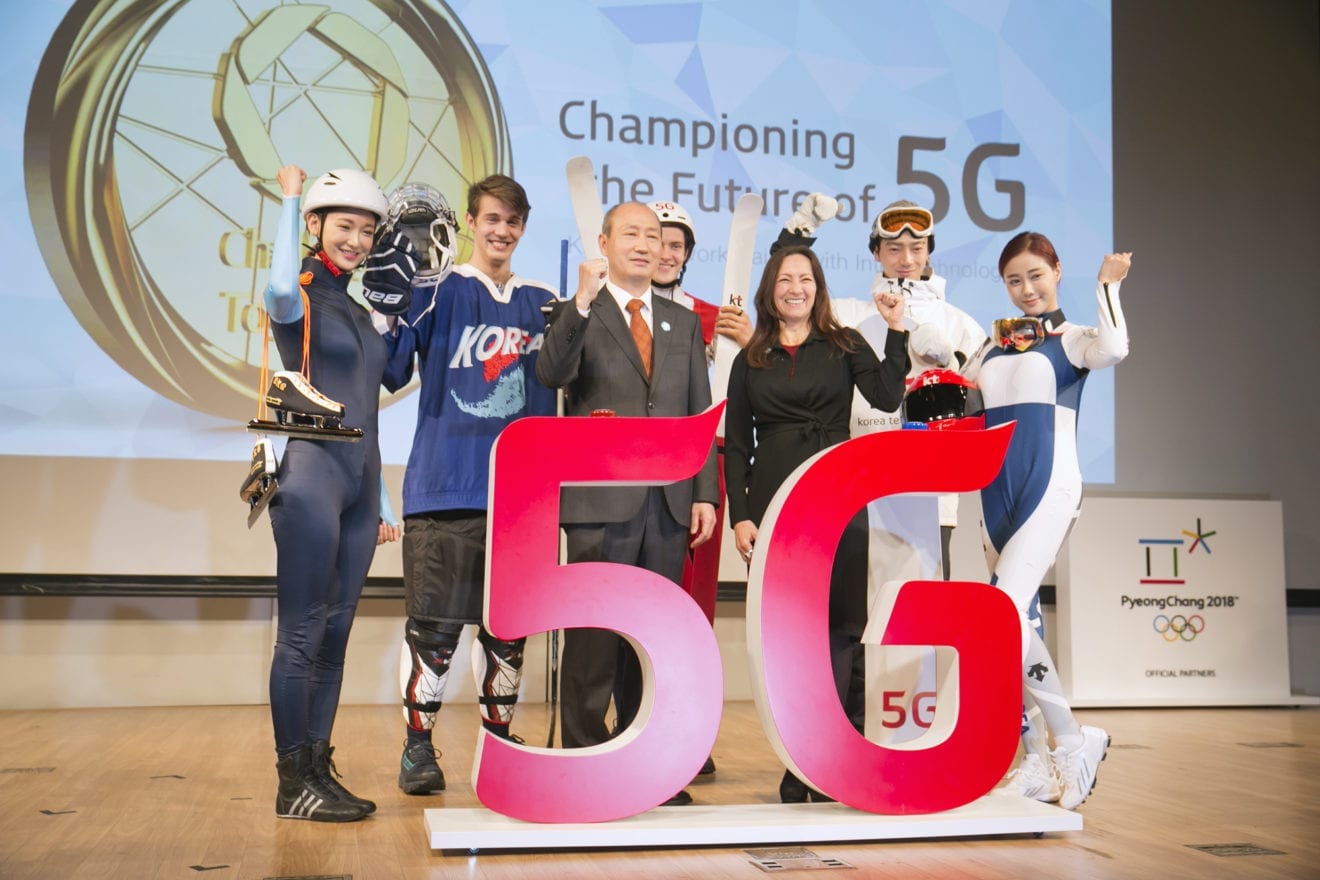
    Korea’s Finance Minister Hong Nam-ki said once the world’s first 5G smartphone is introduced at the end of March and 5G connectivity is in full swing, life will improve significantly.  “Commercialized 5G is a core infrastructure of the fourth industrial revolution as it superconnects everything in real time and transfers massive amounts of data at high speeds,” Finance Minister Hong said during a meeting on innovation-led growth Wednesday. “The 5G smartphone, which is to be launched for the first time in the world in March, and 5G telecommunications services will be used in interactive education and digital health care, which will contribute significantly to the quality of life.”

    He said the government has been working on establishing the foundation for the commercialization of 5G, including distributing the 5G frequency to telecommunication companies in June 2018, expanding R&D investments and even setting a new tax rate – a maximum of 3 percent – for companies building the 5G network.

    “This year, the three telecommunication companies – SK Telecom, KT and LG U+ – are expected to invest more than 3 trillion won [$2.67 billion]” in 5G, Hong said.

    Samsung Electronics is expected to hold an event at the end of March to introduce its first 5G smartphone, dubbed the “Galaxy S10 X.” It will also be celebrating 10 years since the mobile phone manufacturer released its first Galaxy phone.

    In December, the company tested its 5G smartphone as the three Korean mobile telecommunication companies officially switched on 5G-network services for clients in the greater Seoul area and in some of the larger cities in the country.

    Finance Minister Hong said the commercialization of 5G services will spark innovation and convergence in various industries, including manufacturing, logistics, health and medical services, even in disaster prevention and management.

    5G is estimated to have maximum data transmission speeds 20 time faster than 4G.

    According to the government, 5G connectivity will not only increase the access to virtual and augmented reality, including wireless holograms for education or entertainment, but with the help of 5G, autonomous vehicles will roam the streets while traffic control will be managed more efficiently by applying artificial intelligence technologies in real time.

    Smart factories with wireless robots and quality control and delivery by drones will become a reality.

    By 2026, the global 5G equipment and device market is expected to be worth around 344 trillion won, while the telecommunication service market will be worth around 410 trillion won and the 5G-based convergence market about 1,440 trillion won.

    By 2030, the economic effects of 5G will be valued at an estimated 47.8 trillion won in Korea, which is equivalent to 2.5 percent of the country’s economy.

  • SK Telecom to launch data analyzer with Microsoft

    SK Telecom to launch data analyzer with Microsoft

    Korea’s No. 1 mobile carrier SK Telecom said Wednesday it will collaborate with U.S. software giant Microsoft for big data solutions to expand its presence in the global market. SK Telecom said it signed a development and global business cooperation agreement with Microsoft in Silicon Valley to step up development and global marketing in big data analysis.

    Under the partnership, SKT will launch its real-time big data analyzer, Metatron, on Microsoft’s public cloud platform Azure.

    Metatron provides quick and easy data analysis, which also includes data collection, storage and visualization processes. Azure is the world’s second-largest public cloud provider, used in 140 nations across the globe.

    The two companies agreed to launch the big-data-based asset performance-management service for the commercial market in July.

    “The partnership is expected to set the ground for Metatron’s footprint in the global market,” Choi Yong-jin, SKT’s data labs director, said in a release.

    Already well-established in its domestic market, SK Telecom has focused on leveraging its mobile network technology expertise and increasing revenue in content, software and security.

    During MWC Barcelona, set to open next Monday, the company plans to demonstrate its 5G technology, including quantum-safe cryptography solutions and mobile edge computing.

    Quantum-safe technology encrypts transmitted data using special quantum keys, which prevents interception or theft.

    Edge-computing systems process data locally, in nearby data centers or on devices, which eases the strain on networks and improves data reply times.

  • Huawei confident of 5G role in Vietnam

    Huawei confident of 5G role in Vietnam

    Huawei Technologies says it has a good chance to be a supplier of 5G equipment to Vietnamese service providers. Fine Fan, CEO of Huawei Vietnam, said that the Chinese company is in talks with Vietnamese partners on conducting 5G trials later this year. “We are confident of expanding in Vietnam,” Fan said, adding that Vietnamese Minister of Information and Communications Nguyen Manh Hung “is open to every provider.”

    Fan said that Huawei cannot be beaten on quality or cost in Vietnam. “Huawei will provide better technology and solutions, along with financial support to local operators to deploy 5G.”

    Huawei’s expression of confidence comes as major mobile carriers in Vietnam have previously announced plans to develop 5G networks using equipment from other suppliers, including Ericsson, Nokia and Samsung Electronics.

    Viettel, the country’s largest telecommunications company, became the first firm to receive permission to trial 5G services last month.

    The company has earmarked $40 million for the development of its own 5G chipset, but was also considering using technology from Ericsson and Nokia, its president and CEO Le Dang Dung said.

    Last November, Minister Hung said at a conference that Vietnam should test 5G in 2019 and ensure nationwide coverage by 2020.

    “Vietnam should be one of the first to launch the network, at least in Hanoi and HCMC,” Hung said. The country had been one of the last in Southeast Asia to roll out 4G services.

    Huawei has been the largest provider of 2G and 3G network equipment in Vietnam, though the company lost its lead when 4G arrived, CEO Fan said.

    Vietnam’s telecom market was estimated at more than $16 billion in 2016, with the three state-owned providers, Viettel, MobiFone, and VNPT, accounting for 95 percent of the market.

    5G is said to offer speeds 100 times faster than 4G, primarily used for smartphones and other similar devices. 5G is also expected to support new applications like remote medical procedures and autonomous driving.

  • SKT brings 5G workplace to life

    SKT brings 5G workplace to life

    ID cards, laptops and business trips will no longer be necessary, according to SK Telecom, when the 5G network-based smart office environment becomes an industry norm. The mobile carrier showcased its smart office technology test bed in Jongno District, central Seoul, Wednesday. Currently, about 300 SK Telecom employees are working at the space set up roughly a month ago by renting out three floors in the Centropolis building.

    At the entrance to the office, SK Telecom has facial recognition technology manning the security desk. Due to privacy issues, only employees who have agreed to register their biometric information can pass through the gate without an ID card.

    Inside the office, a display panel shows seat reservations. The screen shows all available seats inside the office, similar to the systems seen in university libraries and also shows who is in which seat. When designing the smart office, SK Telecom made it into an open space so employees can freely move around. The display even shows how many toilet cubicles are available for immediate use, although in this case employee names aren’t shown.

    The carrier said it used roughly 2,300 sensors, including on the ceilings, CCTV and even doorknobs in the bathrooms that track relevant data on employees’ work patterns inside the office. The data collected will be used to develop smart office solutions packages for enterprise customers.

    The desks in the office come with desktop computers connected to mobile routers that convert 5G signals into super-fast Wi-Fi. Beside the computer monitor is a docking station for smartphones. The so-called virtual desktop infrastructure enables employees to bring up what they were working on with their personal computers on the desktop computer using the cloud. Unlike simply mirroring a smartphone display, the phones become an authorization medium that allow the computer to verify which work files are downloaded from the cloud.

    At one side of the office is a space for so-called telemeetings that could cut down the need for frequent business trips. SK Telecom said it used its “T real telepresence” technology to invite multiple users into a virtual space where participants can have meetings while watching videos or 3-D designs of game characters and buildings together.

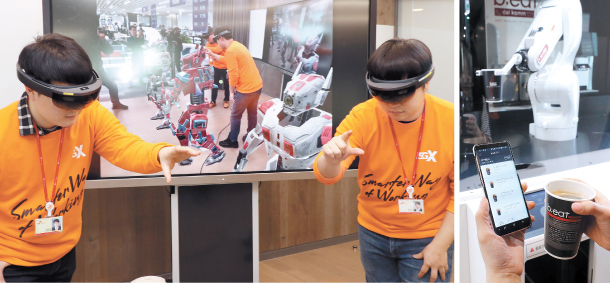
    After donning Microsoft’s HoloLens, this reporter was invited to a telemeeting to discuss the design of a game character.

    Within the virtual meeting, attendees were able to see and walk around a moving 3-D game character while interacting with the avatars of other people in the meeting.

    The experience wasn’t perfect – the field of view was small and constantly looking around was necessary in order to follow everything that was going on, but the potential of the technology to greatly reduce the need for business trips was evident.

    Other technologies already being used in the office included a barista robot and artificial intelligence-based autonomous vending machine, which can track employee purchases with camera sensors.

    Would any of these innovations be possible without 5G network?

    According to SK Telecom, yes. But, while all of these technologies are possible on the existing 4G LTE network, the new high-speed network, touted to be 20 times faster when fully commercialized, offers faster and more stable internet connection even when a million devices are connected at once.

    In essence, 5G ensures that all these systems work seamlessly without their huge data usage interrupting networks or slowing down work.

    “Dependency on landline internet will be reduced and high-capacity data will be delivered fast enough for real-time telemeetings with 5G,” said Shin Seung-ho, a manager from SK Telecom’s media lab under ICT center.

  • Mobile phone ads gain greater purchase during Tet in Vietnam

    Mobile phone ads gain greater purchase during Tet in Vietnam

    Vietnam recorded the fourth highest mobile in-app ad revenues (eCPM) in the Asia-Pacific region during Tet 2018. It ranked behind China, Singapore and the Philippines, according to a report recently released by Vietnamese digital advertising service company Adsota.

    The report also showed that app downloads were the highest 10 days prior to Tet in 2017, while downloads peaked on the first day of the 2018 Tet, showing that the Lunar New Year holiday was a highly effective period to execute user acquisition campaigns for app developers.

    The number of mobile app ad requests (the number of ads displayed in apps) rose by 32 percent in Vietnam during this holiday compared to other days in January and February, said the report.

    Many Vietnamese mobile app developers have gone global and succeeded in the U.S. or Australia by targeting foreign holidays like Black Friday and Christmas. Overall, the highest downloads of Vietnamese-developed apps came from India and the U.S. at 13 and 11 percent respectively, followed by Brazil and Indonesia at 8 percent and 6 percent respectively.

    In terms of revenue, profits from the U.S. market contribute around 20 percent of overseas revenue generated by Vietnamese applications, followed by other developed markets like Australia at five percent; and Germany, Japan and Korea at three percent each.

    Of some 95 million people in Vietnam, 73 percent use mobile phones, 42 percent use smartphones and 50 million people use mobile social media, according to the report.

  • Axiata’s share price falls 4.87% on RM2.16b tax bill

    Axiata’s share price falls 4.87% on RM2.16b tax bill

     Axiata Group Bhd’s share price fell 4.87% at mid-day after the group and its majority owned subsidiary Ncell Pte Ltd were ordered by the Nepal Supreme Court to pay capital gains tax of 61 billion Nepalese rupees (RM2.16 billion) for the Ncell buyout deal. At 12.30pm, Axiata was the eighth loser on Bursa Malaysia, trading at RM3.71 with 7.03 million shares changing hands.

    The Himalayan Times yesterday reported that Axiata had been hit with the tax bill, which excludes late fees and fines, for its US$1.36 billion purchase of Reynolds Holdings Ltd, which has 80% stake in Ncell, in 2015.

    The publication cited the Nepalese Large Taxpayers Office chief as saying it would only initiate the process of collecting the tax amount once it gets a copy of the tax verdict.

  • Axiata slides 5% in early morning trade on tax bill

    Axiata slides 5% in early morning trade on tax bill

    Axiata Group Bhd saw some selling pressure in early morning trade on news that it had been hit with a capital gains tax bill of RM2.16bil by the Nepalese Supreme Court. The stock lost as much as 20 sen or 5.1% in early morning trading on Friday to a low of RM3.70. At 9.30am, the counter was down 14 sen or 3.59% to RM3.76 a share on the back of 1.57 million shares traded.

    Analysts said the news report by the Himalayan Times yesterday came as a negative surprise, which may impact the group’s FY19E earnings forecasts.

    Kenanga research made no changes to its FY18-19E earnings forecast pending its upcoming 4Q18 results but lowered its target price to RM4.50 from RM4.60 previously.

    “All in, we are keeping our Outperform call for now in view of its relatively decent valuation (Forward EV/EBITDA of 7.2x vs. peers of 12-13x) coupled with a stronger Celcom and earnings recovery at XL.

    “Bargain-hunting opportunity could potentially arise on any share price weakness due to the recent hiccup. We advocate investors to start accumulating the share at c.RM3.70 level,” it said.

    PublicInvest research said its core earnings forecasts remain unchanged but headline profit could see a sharp decline if Axiata paid the capital gains tax in FY19F.

    “Although our core earnings forecasts and Neutral call remain unchanged, we believe share price would react negatively to this news due to uncertainties and the potential downside to headline profit,” it said.

    It maintained its target price at RM3.85.

    In its response to news reports, Axiata said in a statement that it is yet to receive the judgment and order of the Supreme Court and is yet to receive any details of the order.

    “Ncell, Reynolds, and Axiata UK were given the full clearance by the Large Tax Payers Office of Nepal [LTPO] of its obligations to withhold any CGT payment on behalf of the Seller in relation to the Transaction via the letter from LTPO dated 4 June 2017, following the full and final payment made by Ncell, albeit under protest on the basis that CGT is not applicable on offshore transactions and even if applicable, any shortfall on payment is the responsibility of the Seller,” it said.

    The group said it would provide further updates upon receiving the order of the Supreme Court.