Tag: wechat

  • What young Chinese luxury shoppers want

    What young Chinese luxury shoppers want

    Young Chinese luxury travellers demand bespoke experiences and go abroad every three to four months, mainly for leisure, according to a Hurun Research Institute report.

    It shows that these travellers spend RMB420,000 (US$65,000) on tourism every year and RMB220,000 on travel shopping. Japan is the top destination for shopping – not Hong Kong.

    They demand personalised luxury experiences, Wi-Fi access, and next-generation guest services on smart devices as standard.

    The inaugural Chinese Luxury Traveler 2016 study was released by the institute in conjunction with Marriott International, and is the first collaboration of its kind between a global hotel company and an authority on Chinese luxury travel.

    Key findings reveal a shift in travel habits among this younger generation of travelers, aged 18 to 36 years. They want added value throughout the entire hospitality ecosystem, from planning a trip, to requesting guest services, to choosing which loyalty program to join.

    When it comes to services and information, young Chinese luxury travellers prefer the digital approach. Interactive guest services on smart devices are far more popular than traditional guest services, and travelers also expect this smart technology to record and manage their personal preferences.

    They also do their research on digital platforms, with WeChat emerging as their primary source of travel information. Third-party apps are also important for information, such as C-Trip, Qunar and Tuniu.

    Novel travel experiences are popular, such as adventure travel, polar exploration and road trips.
    Also, this group feels underwhelmed by loyalty programs, many of which are seen as low value and not unique.

    “This is a key focus area for Marriott,” says Marriott International chief sales and marketing officer for Asia Pacific, Peggy Fang Roe. In the first quarter of this year, the hotel group had a 7 per cent increase in domestic travellers in China and a 25 per cent increase in Chinese outbound travellers.

    Hurun Report chairman and chief researcher Rupert Hoogewerf says despite the economy slowing, the impact on outbound travel from high-net-worth individuals seems to have steadily grown.

    “The young luxury travellers have developed significant spending firepower, minted on the back of the recent boom in Chinese entrepreneurship, together with a growing class of second-generation ‘rich kids’.”

    The report says the young, Chinese luxury travellers have an average hotel budget of RMB3100 a night.

    Established as a research unit in 1999, Hurun Report has grown into a media group targeted at high-net-worth individuals in China and India. Headquartered in Shanghai, Hurun Report has offices in Beijing, Guangzhou, Chengdu, Sanya, London, Los Angeles, Chicago and Cochin (Kerala) in India.

  • Baidu Wallet launches Southeast Asia foray

    Baidu Wallet launches Southeast Asia foray

    China’s Baidu Wallet has launched its mobile payment service in Thailand, on the eve of the traditional Thai new-year celebration Songkran.

    Part of the Baidu search-engine group, the digital payment service is now connected to more than 400 merchants in four Thai cities – Bangkok, Chiang Mai, Pattaya and Phuket. It covers restaurants, shopping malls and spas.

    Baidu Wallet is also set to launch in South Korea and Japan, with plans to also expand into Hong Kong, Macau and Taiwan.

    Baidu Wallet’s smartphone app means Chinese travellers can avoid the bother of exchanging currency. They need only scan the QR codes of partnered merchants and enter the amount of Thai baht they need. The app converts the figure to yuan based on real-time exchange rates.

    China has the highest adoption rate in the world for technology-enabled payment systems, according to a new survey by market data company Nielsen. With information from 13,000 respondents across 26 countries, the survey shows that 86 per cent of Chinese respondents paid for online purchases over a six-month period, while the global average rate was half that at 43 per cent.

    A report by consultancy iResearch shows that China’s mobile payment transactions reached $373.2 billion in the third quarter of last year, a 64 per cent increase year-on-year.

    China has been the biggest source of international tourists since 2012, says the Tourism Authority of Thailand. There were 7.9 million Chinese tourists last year – 27 per cent of total international arrivals.

    Chinese travellers spent 6400 baht (US$180) a day each on average, with most tourists spending 5690 baht.

    A report from Forrester Research says the rapid growth of smartphones is driving an eCommerce boom across Southeast Asia, the world’s third-largest digital marketplace after China and India. This boom is being paralleled by strong payment growth via mobile. Companies are boosting their investments in online and mobile platforms such as Carousell in Singapore and Tarad in Thailand, where 35 per cent of purchases are made via a mobile device.

    Alipay, from Alibaba, has introduced an online shopping service Thailand duty-free shop King Power, and the WeChat app payment option launched in Thailand at the beginning of this year.

  • Tencent Holdings rakes in $15 billion

    Tencent Holdings rakes in $15 billion

    Chinese eCommerce giant Tencent Holdings increased its revenues last year by 30 per to RMB101.9 billion ($US15.7 billion).

    Excluding its eCommerce business, the revenue increase was 38 per cent, to RMB102.2 billion.

    Tencent’s subsidiaries provide media, entertainment, internet and mobile-phone value-added services, and provide online advertising services in China.

    Chairman and founder Ma Huateng says its online game business had healthy revenue growth, mainly driven by smartphones, key PC titles and new client games launched during the year. The company’s social network revenues also grew, from increased digital content subscription services, QQ membership subscription services and virtual item sales.

    Revenues from online advertising shot up 110 per cent to RMB17.5 billion.

    Hong Kong- and Singapore-listed Tencent continued its traffic leadership in multiple online media categories such as video, sports, music, news and literature through partnering with premium content providers including the NBA, HBO, Paramount, Sony Music and Warner Music, and investing in original content.

    “During the year, we further executed our ‘connection’ strategy, bringing our own and our partners’ products and services to our consumers through cultivating an ecosystem around our core communication and social platforms,” says Ma in his chairman’s statement.

    Key initiatives for the group’s “internet-plus” ecosystem included:

    * Enriching products and services available within its platforms, such as introducing personal micro-loan products and municipal services like visa applications

    * Promoting online payment services

    * Growing mobile utility services, including security, a browser, an application store and strengthened infrastructural supports

    * Investing in equity stakes in leading companies in related internet verticals, such as Internet Plus Holdings.

    Industry trends

    Ma also noted a range of industry trends…

    “Messaging and social networking continued to rank as the highest time spent and widest penetration activities on smartphones, and evolved into increasingly relevant content-discovery media. Search queries moved primarily to mobile, and search remained an important content-discovery tool, along with application stores.

    “Online shopping became increasingly widespread, especially in lower-tier cities, and eCommerce transaction volumes sustained healthy growth rates.

    “Online advertising activity shifted decisively from PC to mobile, with particular growth in areas such as performance advertising on social networks, pre-roll advertising in video services, and in-feed advertising in news services.

    “Users proved increasingly willing to pay for digital content such as movies, TV series and music.

    “Mid/hard-core smartphone games, including PC game franchises moving to smartphones, boosted game-industry revenue.”

    Ma says China’s internet companies in sectors such as ride-hailing, classified listings, group buying, and online travel services competed with heightened intensity last year, leading to rapid user growth but reduced or negative profitability. “Consequently, several leading companies in these sectors consolidated with competitors, creating a wave of merger and acquisition activities.”

    There were more offline-to-online transactions last year which, together with the emergence of person-to-person payment transactions, contributed to substantial growth in online payments.

    Key platforms

    On Tencent’s key platforms, the QQ Wallet payment service gained popularity, with about 6 billion red envelopes exchanged within six days during the Lunar New Year holidays early this year.

    Qzone user activity benefited from enhanced features in areas such as sticker sharing and photo-album editing.

    There was year-on-year growth of 39 per cent for Weixin and WeChat together, with official accounts becoming a leading platform to connect users to content creators, merchants and advertisers.

    Weixin Pay also increased in popularity, with more than 32 billion red envelopes being exchanged within the six-day Lunar New Year holidays – growing by nine times year-on-year.

    Ma says the group’s social networks experienced 30 per cent revenue growth last year as digital content subscription services, QQ membership subscription services and virtual item sales were improved.

    “Our cloud service achieved more than 100 per cent year-on-year revenue growth as we promoted our services to key enterprise customers from a range of verticals such as eCommerce, O2O services, online games, online video and internet finance.”

  • WeChat launches mobile wallet service in Hong Kong

    WeChat launches mobile wallet service in Hong Kong

    WeChat has launched its payment service WeChat Pay in Hong Kong, including the new Wallet in-app payment feature.

    Wallet allows WeChat users to connect their MasterCard or Visa credit cards with their accounts to allow them to pay for products and services without having to exit the WeChat app.

    Users will be prompted to create a six digit PIN that must be input before any payment is authorized.

    Wallet currently supports payment for tickets, transportation services and travel products, and more product and service categories will be added soon.

    WeChat has partnered with local merchants to offer Hong Kong users exclusive promotions and campaigns over the messaging service.

    “We are so excited to bring WeChat Pay, a new mobile experience that allows users to pay on the go in the simplest way, to Hong Kong,” commented Norman Tam, head of the Hong Kong and Taiwan office of WeChat owner Tencent‘s international business group.

    “Customized for Hong Kong users, WeChat Pay provides a seamless and secure payment experience to users while providing our partners with the benefit of a direct connection to WeChat’s massive community that other payment platforms cannot provide. This is truly a triple-win for us all.”

  • M&M’s take over DFS’ HKIA shop-in-shop area

    M&M’s take over DFS’ HKIA shop-in-shop area

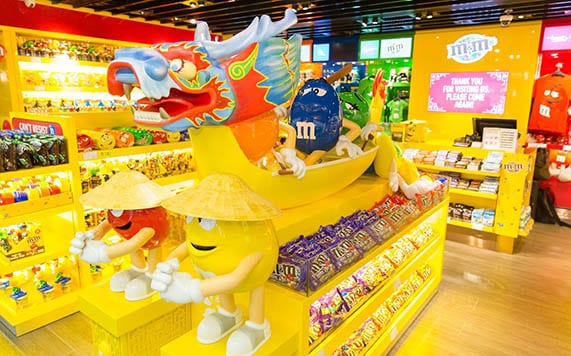
    M&M’S have taken over a new dedicated 35sq m shop-in-shop concept at Hong Kong International Airport, which Mars International Travel Retail have launched jointly with DFS Group in Terminal 1 – close to Gate N28 on the central concourse.

    “Asia is one of the fastest-growing regions for MITR, so we are extremely pleased to be opening this new M&M’S Travel Retail shop-in-shop at DFS, Hong Kong International Airport,” said MITR Regional Sales Director, Christophe Bouye.

    “By offering passengers outstanding retail experiences that first and foremost will make them smile, we are confident it will increase shopper engagement and encourage conversion. Through placing consumers in a smiling frame of mind, we believe that this will not only benefit the confectionery category, but all sectors of the travel retail offer here in Hong Kong.”

    The interior of the store features an ‘interactive’ retail theatre, with the ‘focus on fun’, says MITR, in line with its ’Smiles’ campaign which is a breath of fresh air in many DF&TR locations today.

    MM's ride the Dragon Boat

    Personalised and tailored specifically to reflect a taste of Hong Kong, the shop combines a sample of local tradition with a replica of a dragon boat, which is both guarded and manned by smiling red, yellow, blue and green M&M characters. This is centrally located in the store, against a sea of wall and floor mounted brightly-lit yellow display fixtures – featuring a full range of M&M’s products.

    The store also carries destination merchandise, such as Hong Kong Travel Collection packs of Snickers, Mars and Twix, plus a Hong Kong-themed M&M’S dragon boat box. Core brands of Snickers, Mars, Celebrations and Twix are also offered in individual packs.

    The partners are also promising a strong social media campaign from DFS. This will utilise the WeChat, Facebook and Instagram platforms to alert interest customers to the existence and location of this new outlet before they arrive at HKIA. They also add that as an incentive, a free gift awaits the first 500 visitors, while all customers will be encouraged to take photos in the store and post them to friends on their mobile phones.

    Thierry Canivet, DFS Group’s Senior Vice President, Food and Gifts said the retailer is ‘thrilled’ with the new shop-in-shop concept: “With the shop-in-shop’s localised format, exclusive product offering and innovative approach to engaging customers, we’re confident travellers will love this addition to DFS, Hong Kong International Airport.”

    MITR’s Christophe Bouye added that the company is very grateful to DFS for the opportunity to create such strong branding for M&M’S. He said it is a good opportunity for both existing and new shoppers to discover a new experience, to interact with the M&M’S characters and exercise impulse purchasing.

  • Alipay, WeChat drive China Jo-Jo sales

    Alipay, WeChat drive China Jo-Jo sales

    China Jo-Jo Drugstores, the US listed, China-based multichannel pharmaceutical and healthcare retailer, says customers are embracing Tencent’s WeChat and Alibaba’s Alipay to buy its goods from mobile phones.

    In the third quarter, Alipay mobile transactions with China Jo-Jo grew 84 per cent quarter on quarter, while sequential traditional payment transactions such as City Health Insurance payment transactions grew 27 per cent.

    According to research firm Analysys, Alipay and WeChat currently dominate mobile payment in China with 45 per cent and 19 per cent of the market respectively.

    “Integrating these mobile payment platforms is an important growth initiative for China Jo-Jo as consumers in China, especially the young and growing middle-class, have been keen to actively adopt mobile payment as the method of choice for their integrated mobile and physical retail store shopping experience,” the pharmacist said in a statement.

    “Providing customers this convenient and familiar mobile payment platform is helping to drive overall transaction growth in both our retail and online pharmacies.”

    Since launching Alipay’s mobile payment service in November 2014, China Jo-Jo has been initiating novel marketing campaigns including in-store sales and bonus promotions in order to attract and customers while promoting premium branded products. Payment transactions and marketing initiatives under WeChat Payment which launched in July 2015 have also been successful in growing China Jo-Jo’s customer base and overall transactions.

    Chairman and CEO Lei Liu says mobile payment platforms have had immense success in China providing consumers with a fast, secure and novel means of paying for both online and offline pharmacy goods and services that is becoming the standard method for paying for goods and services in China.

    “Mobile payment platforms now account for more and more of China Jo-Jo’s online payment transactions and is playing an integral role in the push to drive adoption of China Jo-Jo’s business model.”

    As of December 31, China Jo-Jo had 59 retail pharmacies in Zhejiang Province, China.

  • China’s move to curb grey market for luxury goods may have opposite effect

    China’s move to curb grey market for luxury goods may have opposite effect

    Given the still significant price gap between high-end goods inside and outside of China, parallel imports are big business. The key players in this grey market are cross-border traders known in Chinese as daigou, and they sometimes double-deal in genuine goods and fakes. While the country’s customs service has taken steps to curb the re-selling of luxury goods sourced from overseas, some evidence suggests that those measures have driven business toward daigou by making legitimate online purchases more difficult. Both trends should be considered by brands tailoring their retail and enforcement strategies to the Chinese market.

    Driven by high taxes, tariffs and the impact of different retail strategies, price differentials for luxury goods between China and developed markets like Europe and North America make buying through daigou a compelling option for many consumers. According to Fortune Character’s 2015 China Luxury Report, the average price difference last year was between 25% and 33% depending on the category of goods. For watches, certain models were nearly 90% more expensive in China.

    These disparities make it a no-brainer for Chinese consumers to look for alternatives to their local retail outlets. One result is the huge amount spent by Chinese tourists on trips abroad. But for those who are not travelling overseas in the near future, and cannot ask a friend or relative to pick up goods for them, daigou have emerged as an alternative. Often coordinating through messaging app WeChat, Chinese buyers pick up specific items for Chinese customers and ship them to China in what Bain & Company says is a 43 billion Rmb per year business in the luxury segment alone. But the introduction of this unknown third party also creates an opportunity for dishonest traders to introduce fake goods into the mix, meaning daigou customers may be getting less than they bargained for.

    Chinese shoppers do have another option – buying online direct from the brand. While only 4% of consumers told Fortune Character that e-commerce was their preferred channel for buying luxury items, more opportunities are opening up. Among these is Alipay’s ePass, introduced about a year-and-a-half ago. The service allows brands to sell directly into China through their existing online outlets by providing both Rmb payment settlement and a delivery network in China. Cutting out the middleman gives customers more confidence that the products they order are the real deal, and Bain says this option is already hurting parallel traders’ bottom line: cross-border e-commerce accounted for 48 billion Rmb in luxury sales in 2015 – a shade higher than the figure for daigou business.

    China has also introduced measures specifically aimed at curbing grey market imports and thus allowing the government to recover more tax and tariff revenue. Last summer, the Ministry of Finance cut tariffs on cosmetics, fur products and suits. It followed up in December by announcing reduced duties on sunglasses, handbags and clothing.

    So far, this sounds like good news for brand owners. But a recent report in Business of Fashion suggests that tougher customs controls – intended to check parallel traders – are instead hampering legitimate e-commerce, and may even be driving customers back to daigou sellers.

    China’s General Administration of Customs (GAC) has stepped up scrutiny of small shipments with high declared values as part of the country’s wide-ranging anti-graft campaign. That’s problematic for some consumers who prefer to buy big-ticket luxury goods directly from overseas brands. A woman named Gao described to Business of Fashion her experience of having two DHL parcels from a UK luxury retailer turned around at customs, saying: “If they’re more than 1,000 Rmb, your parcels will be returned. So I have to either order them separately and pay double DHL overseas shipping fees, or use a daigou.” Unlike legitimate sellers, daigou can attempt to get around this by not declaring an accurate value. An e-tailer who provides a legitimate platform for Chinese consumers to buy directly from brands including Chloé and Lanvin said the complaint was a common one among his customers, with many saying their parcels had been rejected “for no reason”.

    Asked why they think luxury goods cost so much more in China, 24% of people told Fortune Character it’s because “Chinese commerce channels are unduly complex”. For brands looking to sell directly into China via e-commerce, GAC may be complicating their efforts to give customers there a simple and reliable way to buy authentic products. According to Bain, the market share of luxury parallel importers contracted last year, but if cross-border e-commerce gains a reputation as unreliable and the price gap persists, the daigou could prove more resilient than brand owners would like.

  • WeChat replaces waiters at Chinese restaurant

    WeChat replaces waiters at Chinese restaurant

    A Chinese restaurant in Beijing has replaced its front-of-house staff and diners use messaging app WeChat to order and pay.

    Diners at Renrenxiang Restaurant launch the app on their smartphone to browse the menu and place their order. They then pay for their meal using the messenger service, and are given an order number, reports Springwise.

    Their meal is prepared in the kitchen and their number called out over a loudspeaker when it is ready. The customer can then collect their food. After eating, they leave their crockery on a cleaning table.

    Customers do not even need to be in the restaurant to order. One frequent diner who works nearby says she orders while still in the office, then strolls to the restaurant. By the time she arrives, her meal is ready.

    Meanwhile, the noodle restaurant’s owner is looking at cutting his overheads even further, reports CNN.

    “There will be four ‘no’s in the restaurant – that is, no waitress, no cashier, no merchandiser and no chef,” says Renrenxiang founder Liu Zheng. “I did this because I’m following the technology development trend in China.

    “Thanks to the app, we can cut out unnecessary expenditure, simplify management and focus more on taste and quality.”

    The app also collects customer-related data – such as what dish is most popular, and what age groups visit more frequently. Renrenxiang uses the data to improve its marketing strategy. But despite its high-tech approach, the restaurant does not have its own website.

    Also, it is not the first restaurant to offer waiterless service. In 2007, a restaurant in Nuremberg, Germany, began to offer fully automated order and table services. There are also similar eateries in Japan and the US.

    Using robots to cook, serve and clean is also becoming more common in China.

  • McDonald’s China plans 250 new stores in 2016

    McDonald’s China plans 250 new stores in 2016

    McDonald’s China is shifting its focus from tier 1 and 2 markets to smaller cities as it expands its footprint in the mainland.

    The US fast food operator plans to open 250 new stores in the lower-tier cities in 2016 which represents its biggest expansion plan in any international market.

    Phyllis Cheung, CEO of McDonald’s China, says the company will target third and fourth tier cities, along with developing digital ordering and offering customised burgers.

    Cheung says 150 stores in Beijing, Shanghai, Shenzhen and Guangzhou will have self-service kiosks introduced this year allowing customised ingredients. The build-your-own concept is called My Burger and has already been introduced in some Asian markets, including Thailand.

    “Within two to three years, we hope mobile ordering and other digital capabilities would cover all of our restaurants in China, and we will also launch our proprietary smartphone application for ordering by the end of this year,” Cheung said in an interview.

    The Us chain opened its ‘Experience of the future’ flagship restaurant in Beijing’s Wangfujing St this week which features table service for customers who order using the WeChat app.

    McDonald’s China boasts more than 2200 stores already.

  • WeChat use by retail investors poses headache for regulators

    WeChat use by retail investors poses headache for regulators

    The growing popularity of messaging and social media app WeChat among China’s stock market investors is posing a problem to regulators, who now find it harder to monitor trades and spot illegal activity, Reuters reports, citing traders and investors.

    While using apps for trading is not unlawful in China, regulations require reliable monitoring and recording of trades to prevent activities such as insider trading or market manipulation, and to keep regulators on top of threats to market stability such as excessive margin trading.

    The China Securities Regulatory Commission has been clamping down on breaches, including fining four brokerages in September for failing to collect information about the identities of clients who traded stocks through external systems. 

    It also shut down third-party trading software used by brokers that helped traders skirt regulations by dividing one account into many sub-accounts without the need to register a name, the news agency said, citing local media reports.

    Even so, using apps to buy and sell stocks over mobile phones is common in a country where retail investors account for 80 percent of share market volume.

    Despite closer scrutiny from China’s regulators, brokerages including large firms like China Galaxy Securities (06881.HK) and smaller entities such as Great Wall Securities, started offering WeChat share trading account services last year in a bid to access the growing pool of retail traders.

    Overall account openings swelled to around 46 million in the first half of 2015, from around two million over the same period in 2014, according to official data.

    For brokers, the advantages of using WeChat are obvious, since it is the preferred means of communication for many of its 600 million users.

    But a case in Hong Kong last month highlights regulators’ concerns with the trend.

    The regulator there suspended a trader for receiving a buy order on WhatsApp, a messaging app owned by Facebook Inc., in breach of the internal communication policies of the firm he then worked for, BTIG, noting that the company had no control over the recording and retention of such messages.

    While the Hong Kong Securities and Futures Commission code of conduct does not prohibit the use of social messaging apps, it encourages the strict recording and time stamping of all communications and says the use of mobile phones for orders is “strongly discouraged”.

    Some of China’s institutional investors are also using WeChat to instruct their brokers.

    “In practice lots of people don’t care about compliance and take orders on WeChat,” said a Hong Kong-based institutional sales trader specializing in China.

    Such concerns are not limited to China.

    Clara Shih, chief executive and founder of Hearsay Social, a San Francisco-based social media compliance company, said messaging apps are also a potential gap in the compliance systems that US financial services firms have spent years building.

    US brokerages must monitor and store copies of employees’ electronic communications for three years and have a duty to protect clients’ personal information and confidentiality, tasks made more complicated by the proliferation of social media platforms.

    Technology has evolved in recent years to make it easier for companies to monitor employees’ activity on traditional social media platforms such as Facebook and Twitter. But WhatsApp and WeChat are not compatible with that technology, Shih said.

    Using social media for business is a growing trend but also a growing risk for compliance, said Craig Brauff, chief executive of Erado, a social media compliance company in Renton, Washington.

    “Regulations are designed to keep honest people honest. If someone really wants to be dishonest, there are lots of ways around it,” he said.


  • Paipai.com axed to fight counterfeiting

    Paipai.com axed to fight counterfeiting

    China’s number 2 eCommerce player JD.com has axed its consumer to consumer online storePaipai.com in a bid, it says, to cut sales of counterfeit goods.

    The store will be closed by December 31 and after a transitional period of three months, the company will completely close down the website of Paipai.com.

    “The shutdown of the C2C platform is in line with the company’s policy to combat the marketing and sale of counterfeit products and the company will make persistent efforts to protect the interests of consumers and brands,” JD.com said in a statement.

    Paipai.com, along with another site Wanggou, were acquired from WeChat parent Tencent in March 2014. The combined businesses have a goodwill and intangible asset value of US$400 million, making it a very expensive gesture in the war against counterfeit goods in Mainland China.

    The company says it has yet to calculate the book value of the loss given the two websites are accounted for in the books as a combined entity and Wanggou will continue to operate.

    While JD.com is amputating a limb, Alibaba is undergoing a high profile battle in the US courts with French luxury brand owner Kering which alleges Alibaba has failed to take sufficient steps to counter the trading of counterfeit goods on its various websites, as reported by Inside Retail Asia last week.

  • Asia Pacific Travel Retail Association launches member survey

    Asia Pacific Travel Retail Association launches member survey

    The Asia Pacific Travel Retail Association (APTRA) has launched a survey among its members to ascertain priorities for the 2016/2017 APTRA research programme.

    According to APTRA, it is a fundamental mission to further the knowledge of members through studies conducted in partnership with accredited research agencies into past performance of the duty-free and travel-retail industry in the Asia/Pacific and current trends in consumer behaviour to facilitate future development.

    APTRA president Jaya Singh commented: “The business environment of today and indeed the future, is getting increasingly sophisticated and demanding. We live in dynamic times and the greater the level of insights we can achieve through our research platform the greater the relevance that all our stakeholders and members can deliver.”

    Recent reports have covered a range of topics including Chinese, Indian and Korean consumer behaviour, Cambodian travelling consumer trends, impact of security regulations and product category reports into fashion and accessories, confectionery, gifting and eyewear. Although the full research reports are available exclusively to APTRA members through www.aptra.asia, key findings are shared with members and other interested parties at APTRA Insights Seminars staged around the Asia/Pacific.

    In September, a total of over 250 participants attended the latest APTRA Insights Seminars which took place in Hong Kong, New Delhi and Seoul.

    Topics included key results of the APTRA m1nd-set study into Chinese, Korean and Indian travellers, analysis of e-commerce behaviour from KPMG, Chinese social-media landscape and potential of WeChat marketing from China International Duty Free and potential of technology to reach travellers on the move from geo-location marketing company NEAR.

    Singh added: “Through its research programme, APTRA provides actionable insights which enable members to understand their customers better and identify future opportunities. We want to target our research where it is most needed so we have asked members to nominate future subjects for research.”

    Commenting on the seminars, he said the “the response from delegates to the recent APTRA Insights Seminars was extremely favourable and we intend to schedule similar seminars into the programme next year.


  • Apple to launch online payment in China

    Apple to launch online payment in China

    Apple will launch an online payment service in China, as the tech giant seeks to expand in its largest market outside of the US despite fierce competition from local rivals.

    An Apple Company offering online payment has launched in the Shanghai Free Trade Zone (FTZ), an area set up as a testbed for financial reforms, China News Service reported late Thursday.

    Apple didn’t give a date for the launch, but the company told AFP that CEO Tim Cook hopes to set-up Apple Pay in China “as quickly as possible”.

    Cook previously said that he expects China one day to surpass the United States to become Apple’s largest market.

    But China’s e-commerce giant Alibaba dominates the country’s online payment sector, with the Paypal-like Alipay taking around 80 percent of the market.

    Internet firm Tencent is also catching up with a similar service provided via its popular messaging application WeChat.

  • Using WeChat to Grow Your Business in China

    Using WeChat to Grow Your Business in China

    In the world of mobile commerce, all eyes are on China.

    Even as China’s economy and overall retail sales growth drops, business-to-consumer (B2C) online sales are growing by 25 per cent each year. Data gathered from iResearch in a March 2015 report states that China’s gross merchandise volume (GMV) of the mobile shopping market reached 929.71 billion RMB in 2014, increasing by 239.3 per cent from the previous year.

    The growth was significantly larger than that of the overall GMV of the online shopping market. China has the world’s largest digital marketplace, and is predicted to grow three times faster than overall retail. The industry is primed for growth not only in the first-tier cities, but also in the third-tier and lower cities with an estimated half of total online sales coming from the lower tier cities by 2018.

    When considering the mobile commerce industry in China, one name stands out: Tencent’s WeChat has long been impacting the lives of Chinese consumers, and with its move to digital payment systems it now has the ability to revolutionise the mobile commerce industry in China.

    WeChat has a massive scale, with over 468 million monthly active global users and 25 per cent of users checking WeChat over 30 times a day. Last year, users spent US$15.3 billion on mobile data using WeChat.  As the fastest growing social media platform in the world, and the primary source of interaction between brands and Chinese consumers, foreign investors looking to be successful in China should take note. Chinese consumers actively embrace mobile commerce due to its easy to use, cost-effective payment and delivery system.

    There is huge potential for foreign investors to take advantage of WeChat payment systems for their Chinese consumers and to maximise their profits. WeChat allows foreign investors to interact with their consumers in a way that has not reached the same scale in the Western world.

    Fewer than 20 per cent of internet users in the US have used their mobile phones to pay for services and goods while more than half of users in China have done so. Multiple incentives exist for Chinese consumers to make their purchases through WeChat; enabling businesses to use these schemes to generate profit. Loyalty cards, membership schemes and discounts for paying online all compel cost-effective shoppers to make a purchase.

    In addition to this, due to the convenience of paying through WeChat, there is a higher chance of impulse purchases. However, this ease does not simply apply to the consumer. Brands are able to bridge the gap between attracting new consumers and engaging with paying consumers, which has already begun to change the face of shopping and retailing worldwide. Businesses utilising WeChat payment systems are already experiencing huge profits, and Tencent has stated that several official accounts are now making over US$1 million.

    Not only can consumers purchase items, but can also purchase services inside WeChat. Businesses with service accounts can take advantage of WeChat’s online-to-offline (O2O) business model. Both online and offline purchases are available to consumers. Customers can either pay for services or items by scanning the QR codes of products provided by offline retailers, or pay on web pages inside the app.

    All vendors, from big name brands to small and medium-sized enterprises are able to create service accounts in WeChat. Big name companies like McDonalds, Starbucks, Xiaomi, Watsons, and Pacific Coffee have all created service accounts. WeChat allows all vendors the potential for success and the ability for SMEs to create accounts is an important aspect for foreign investors to capitalise on.

    Certain industries, such as food, beverage and retail, tend to generate more profit as they are more primed for mobile commerce. That being said, taxi companies, airlines, newspapers, government organisations, and pharmaceutical companies are all using WeChat payments to their advantage.

    Tencent has now enabled users to pay their utility bills through WeChat, and more and more businesses are finding a way to use WeChat mobile payments to grow their business and attain a competitive advantage.

    It is crucial for foreign businesses entering a new market to take advantage of domestic trends in order to be competitive in that marketplace. Mobile commerce in China is constantly evolving and businesses like WeChat are revolutionising how business is conducted. WeChat allows both big name brands and SMEs to compete in the same market space which has the ability to change the entire industry. Entering the Chinese market has its difficulties, but applications like WeChat make it easier for foreign investors to communicate effectively with their Chinese consumers.

  • China Jo-Jo WeChat retailer opens

    China Jo-Jo WeChat retailer opens

    China Jo-Jo Drugstores has opened a retailer on Tencent’s WeChat social media platform. The China Jo-Jo WeChat foray might be carried out by way of its subsidiary Hangzhou Jiuzhou Grand Pharmacy Chain. It’s the first Hangzhou based mostly pharmacy to launch shops on WeChat, which has greater than 500 million lively customers.

    China Jo-Jo says the transfer, following partnerships with Alipay and Ali-Well being, is a part of a broader technique to construct its personal On-line-to-Offline (O2O) ecosystem for its pharmaceutical and healthcare merchandise.

    In late 2014, Tencent unveiled its on-line service provider shops for small to medium measurement companies based mostly on its common WeChat platform, and it has shortly developed into an all-in-one cellular advertising service. WMS permits retailers the alternatives to interact with their clients in real-time and collect knowledge based mostly on shopper profiles and spending behaviors. Retailers may also use WMS to replace product info and handle stock and merchandising course of. WMS permits clients to pay by WeChat Pay, a handy cost technique just like Alipay. “As a well known cost technique that clients already belief, WeChat Pay can drastically improve on-line transaction movement for WeChat Retailers. By opening our pharmacy on WMS platform, China Jo-Jo hopes to draw a a lot bigger and constant shopper base by implementing higher knowledge mining, goal advertising and gross sales promotions corresponding to group-buy, present certificates, flash sale, coupons and loyalty program,” the corporate stated in a statemet.

    By integrating our in-store IT system with WMS’s highly effective cost, O2O and repair spine platform, we intend to rework our brick and mortar shops into “Clever Pharmacies”.

    China Jo-Jo President, Li Qi, added: “In a standard drugstore, there’s solely one-way interplay between the shop and its clients. Now in our O2O drugstores, we and our clients can simply talk with one another via WeChat platform anytime and anyplace. Shoppers can now take pleasure in customised service and acquired extra focused advantages reminiscent of coupons and member reductions. For us, we will now construct, monitor and analyse quite a few knowledge on buyer spending sample, which can be used to enhance the on-line buying expertise as an entire. O2O enterprise options will stay an integral a part of China Jo-Jo’s technique sooner or later.”